Rainwater Harvesting Project: Design for Water Supply in Cambodia
VerifiedAdded on 2023/04/21
|12
|1939
|133
Project
AI Summary
This project proposal investigates design solutions for water supply issues in the Sambo district of Cambodia, focusing on rainwater harvesting. It provides background justification, and preliminary research, including articles on rainwater harvesting sustainability, cost reduction, and water quality. The project proposes two design options: a rooftop rainwater harvesting system using first flush diverters and plastic sheets to optimize supply, and a charcoal filter to improve water quality. The designs aim for cost-effectiveness and the use of locally sourced materials. The project also identifies areas for further investigation, such as improving the design's stability in windy conditions and optimizing hygiene in the rainwater harvesting process. The document concludes with a clear description of the improved rainwater harvesting system. The project emphasizes the importance of water quality and hygiene and proposes charcoal filters to remove pollutants from harvested water.
Running head: RAINWATER HARVESTING PROJECT
RAINWATER HARVESTING PROJECT
Name of the Student
Name of the University
Author Note
RAINWATER HARVESTING PROJECT
Name of the Student
Name of the University
Author Note

Paraphrase This Document
Need a fresh take? Get an instant paraphrase of this document with our AI Paraphraser
1
RAINWATER HARVESTING PROJECT
Table of Contents
1.0 Introduction:.........................................................................................................................2
2.0 Project background and justification:...................................................................................2
3.0 Preliminary research:...........................................................................................................2
4.0 Design options:.....................................................................................................................5
4.1. Design Project 1.1 – Optimising rainwater collection systems: supply:.........................5
4.2. Design Project 1.2 – Optimising rainwater collection systems: water quality:..............6
4.3. Issues for further Investigation:....................................................................................6
5.0. Conclusion:.........................................................................................................................7
References:.................................................................................................................................8
RAINWATER HARVESTING PROJECT
Table of Contents
1.0 Introduction:.........................................................................................................................2
2.0 Project background and justification:...................................................................................2
3.0 Preliminary research:...........................................................................................................2
4.0 Design options:.....................................................................................................................5
4.1. Design Project 1.1 – Optimising rainwater collection systems: supply:.........................5
4.2. Design Project 1.2 – Optimising rainwater collection systems: water quality:..............6
4.3. Issues for further Investigation:....................................................................................6
5.0. Conclusion:.........................................................................................................................7
References:.................................................................................................................................8
2
RAINWATER HARVESTING PROJECT
1.0 Introduction:
This assignment will investigate a design response to water supply issues in
communities of the Sambo district of Cambodia. It will provide justification of and research
informing the project and two possible design ideas.
2.0 Project background and justification:
In this assignment two design ideas has been formulated for improving the rainwater
harvesting process with increased availability which is another major resource for the water
supply considered by the community ("Design Area 1 - water supply | EWB Challenge",
2019). Although is serves as a comprehensive source for the water, the community has to
look for other resources during the dry season such as Pagoda Committee requires to pay
middleman to fill the empty jars that collect water in the rainwater harvesting process. The
proposed design will improve rainwater harvesting process and will improve the quality of
the water as well.
3.0 Preliminary research:
Article 1:
Foster, T., Shantz, A., Lala, S., & Willetts, J. (2018). Factors associated with operational
sustainability of rural water supplies in Cambodia. Environmental Science:
Water Research & Technology, 4(10), 1577-1588.
Summary of the article:
The article talks about the sustainability aspect of the rain water harvesting. The
articles particularly focus on the fact that although water is assumed to be an abundant
resource, it is actually not, especially in some parts of the world, where water sacristy is an
important issue to be consider. Hence it is important to develop a sustainable resource for
RAINWATER HARVESTING PROJECT
1.0 Introduction:
This assignment will investigate a design response to water supply issues in
communities of the Sambo district of Cambodia. It will provide justification of and research
informing the project and two possible design ideas.
2.0 Project background and justification:
In this assignment two design ideas has been formulated for improving the rainwater
harvesting process with increased availability which is another major resource for the water
supply considered by the community ("Design Area 1 - water supply | EWB Challenge",
2019). Although is serves as a comprehensive source for the water, the community has to
look for other resources during the dry season such as Pagoda Committee requires to pay
middleman to fill the empty jars that collect water in the rainwater harvesting process. The
proposed design will improve rainwater harvesting process and will improve the quality of
the water as well.
3.0 Preliminary research:
Article 1:
Foster, T., Shantz, A., Lala, S., & Willetts, J. (2018). Factors associated with operational
sustainability of rural water supplies in Cambodia. Environmental Science:
Water Research & Technology, 4(10), 1577-1588.
Summary of the article:
The article talks about the sustainability aspect of the rain water harvesting. The
articles particularly focus on the fact that although water is assumed to be an abundant
resource, it is actually not, especially in some parts of the world, where water sacristy is an
important issue to be consider. Hence it is important to develop a sustainable resource for
⊘ This is a preview!⊘
Do you want full access?
Subscribe today to unlock all pages.

Trusted by 1+ million students worldwide
3
RAINWATER HARVESTING PROJECT
water production and consumption. Hence the author suggest rainwater harvesting for
sustainable water production in Cambodia. The article also provides a detailed guideline for
selecting resources for designing effective rainwater harvesting system.
Reason for selecting the article:
The article has been selected as it provides brief overview of the rainwater harvesting
in Cambodia and also provides a comprehensive analysis for selecting rainwater harvesting
an important technique for sustainable water production which helps to gain a detailed
theoretical knowledge which serves a basis for the practical application and incorporating it
into actual design which aims to apply rainwater harvesting in the Sambo district of
Cambodia.
The guideline provided by the article for designing a quality rainwater harvesting
system is helpful as it provides an organized view for designing the project in such a way
that proper standard is maintained in the project while considering the local resources in
Cambodia. Hence this article has been considered in this context.
Article 2:
Jeuland, M., Orgill, J., Shaheed, A., Revell, G., & Brown, J. (2016). A matter of good
taste: investigating preferences for in-house water treatment in peri-urban
communities in Cambodia. Environment and development economics, 21(3), 291-
317.
Summary of the article:
The article has discussed about the cost factor in the rainwater harvesting project. The
author have suggested that although quality is important in such projects it is important to
consider that this kind of project should not cost too much as it need trio be integrated in the
RAINWATER HARVESTING PROJECT
water production and consumption. Hence the author suggest rainwater harvesting for
sustainable water production in Cambodia. The article also provides a detailed guideline for
selecting resources for designing effective rainwater harvesting system.
Reason for selecting the article:
The article has been selected as it provides brief overview of the rainwater harvesting
in Cambodia and also provides a comprehensive analysis for selecting rainwater harvesting
an important technique for sustainable water production which helps to gain a detailed
theoretical knowledge which serves a basis for the practical application and incorporating it
into actual design which aims to apply rainwater harvesting in the Sambo district of
Cambodia.
The guideline provided by the article for designing a quality rainwater harvesting
system is helpful as it provides an organized view for designing the project in such a way
that proper standard is maintained in the project while considering the local resources in
Cambodia. Hence this article has been considered in this context.
Article 2:
Jeuland, M., Orgill, J., Shaheed, A., Revell, G., & Brown, J. (2016). A matter of good
taste: investigating preferences for in-house water treatment in peri-urban
communities in Cambodia. Environment and development economics, 21(3), 291-
317.
Summary of the article:
The article has discussed about the cost factor in the rainwater harvesting project. The
author have suggested that although quality is important in such projects it is important to
consider that this kind of project should not cost too much as it need trio be integrated in the
Paraphrase This Document
Need a fresh take? Get an instant paraphrase of this document with our AI Paraphraser
4
RAINWATER HARVESTING PROJECT
community service and maintain the price such that it is possible for community members to
adopt the solution. The author makes this clear the idea here is not to make the design
complicated and costly, but the focus should be on the widespread adoption and associated
benefits it provides. It has provided some important alternatives for reducing the production
cost. Some of the alternatives that the article has provided are clay pots instead of water tanks
for collecting water, plastic sheets instead of cement rooftops. The details for integrating all
of these components into the project has been discussed as well with adequate details.
Reason for selecting the article:
The article has been selected as it provides ways to minimize cost of the rainwater
harvesting projects in Cambodia. It provides alternatives that is worth considering to reduce
the cost for designing the project. Alternatives such as clay pots instead of water tanks for
collecting water, plastic sheets instead of cement rooftops are some of the important and vital
suggestion that the article has provided.
Article 3:
Stubbé, S. M., Pelgrim-Adams, A., Szántó, G. L., & Halem, D. V. (2016). Household
water treatment and safe storage–effectiveness and economics. Drinking Water
Engineering and Science, 9(1), 9-18.
Summary of the article:
According to the article it is always important to assess the quality of the water before
it is made available for drinking and other essential purposes. In the rain water, especially
when it is collected through rooftop or by other means, there is chances of pollutants in the
rainwater. If these pollutants are not removed they will not be valuable resources for healthy
water consumption. The article has suggested that before the water is collected in specific
RAINWATER HARVESTING PROJECT
community service and maintain the price such that it is possible for community members to
adopt the solution. The author makes this clear the idea here is not to make the design
complicated and costly, but the focus should be on the widespread adoption and associated
benefits it provides. It has provided some important alternatives for reducing the production
cost. Some of the alternatives that the article has provided are clay pots instead of water tanks
for collecting water, plastic sheets instead of cement rooftops. The details for integrating all
of these components into the project has been discussed as well with adequate details.
Reason for selecting the article:
The article has been selected as it provides ways to minimize cost of the rainwater
harvesting projects in Cambodia. It provides alternatives that is worth considering to reduce
the cost for designing the project. Alternatives such as clay pots instead of water tanks for
collecting water, plastic sheets instead of cement rooftops are some of the important and vital
suggestion that the article has provided.
Article 3:
Stubbé, S. M., Pelgrim-Adams, A., Szántó, G. L., & Halem, D. V. (2016). Household
water treatment and safe storage–effectiveness and economics. Drinking Water
Engineering and Science, 9(1), 9-18.
Summary of the article:
According to the article it is always important to assess the quality of the water before
it is made available for drinking and other essential purposes. In the rain water, especially
when it is collected through rooftop or by other means, there is chances of pollutants in the
rainwater. If these pollutants are not removed they will not be valuable resources for healthy
water consumption. The article has suggested that before the water is collected in specific
5
RAINWATER HARVESTING PROJECT
storage options such as jar, pot, tanks, it is important to filter the water to remove various
pollutants from the water.
Reason for selecting the article:
The article has discussed about the importance of maintaining the quality and hygiene
in the water collection process in the rainwater harvesting projects. Along with that the
articles has also discussed about various techniques that are effective in this purpose. The
authors have presented various filter options that are easy to design, cost effective and the
materials required for such designs are also available. Hence this is an important feature of
the article which makes it appropriate for this projects as the aim is to design cost effective
projects without compromising the quality of the water produce. Due to this features this
article has been selected in this context.
4.0 Design options:
4.1. Design Project 1.1 – Optimising rainwater collection systems: supply:
4.1.1. Rooftop rainwater harvesting through First flush diverter and plastic sheets:
Required components:
First flush diverter
8m2 plastic sheet
Clay pots for collecting water
Design description:
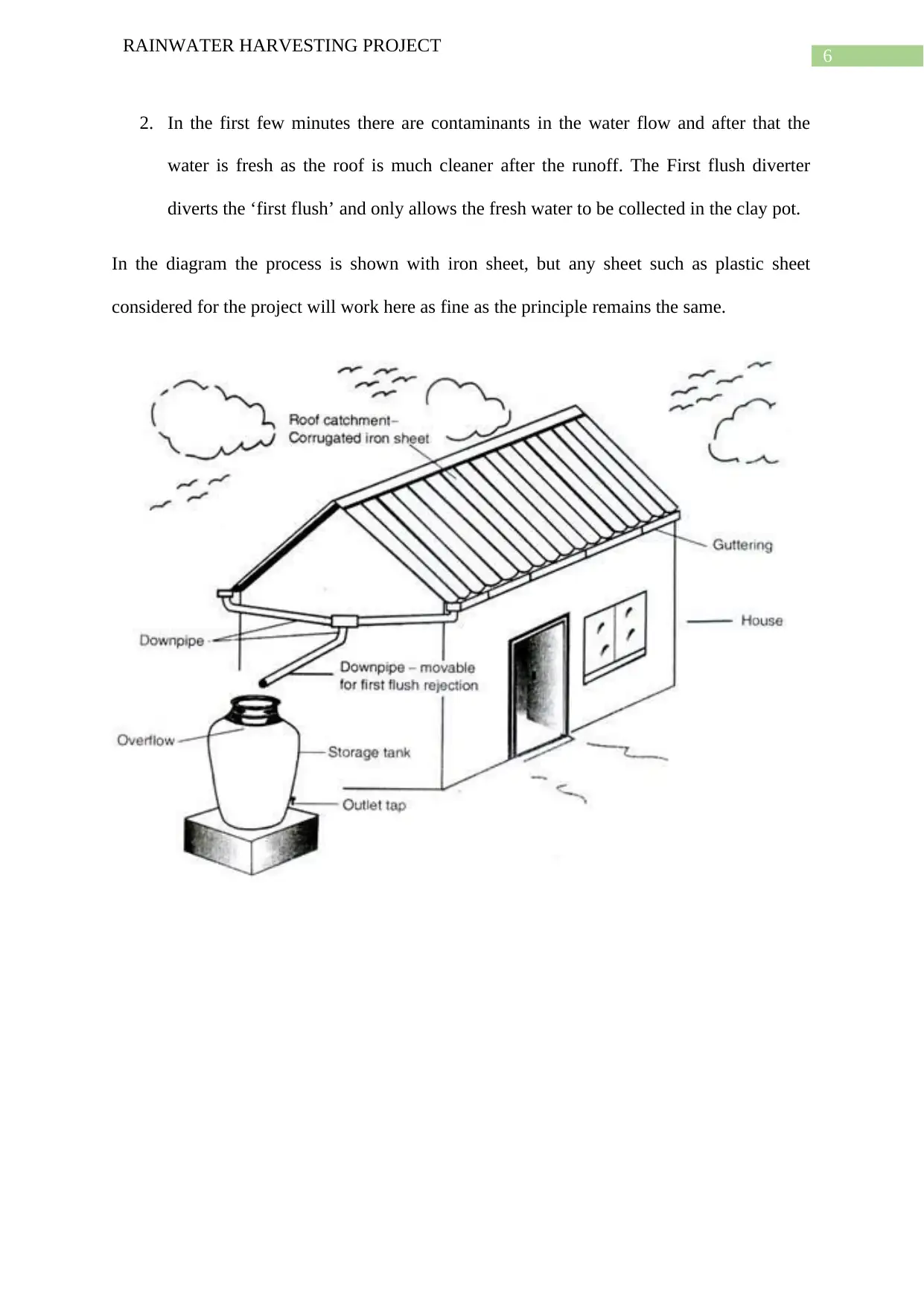
1. First the iron sheets collect the rain water. The plastic sheet needs to be tied with four
poles. Clay pot is placed under the plastic sheet.
RAINWATER HARVESTING PROJECT
storage options such as jar, pot, tanks, it is important to filter the water to remove various
pollutants from the water.
Reason for selecting the article:
The article has discussed about the importance of maintaining the quality and hygiene
in the water collection process in the rainwater harvesting projects. Along with that the
articles has also discussed about various techniques that are effective in this purpose. The
authors have presented various filter options that are easy to design, cost effective and the
materials required for such designs are also available. Hence this is an important feature of
the article which makes it appropriate for this projects as the aim is to design cost effective
projects without compromising the quality of the water produce. Due to this features this
article has been selected in this context.
4.0 Design options:
4.1. Design Project 1.1 – Optimising rainwater collection systems: supply:
4.1.1. Rooftop rainwater harvesting through First flush diverter and plastic sheets:
Required components:
First flush diverter
8m2 plastic sheet
Clay pots for collecting water
Design description:
1. First the iron sheets collect the rain water. The plastic sheet needs to be tied with four
poles. Clay pot is placed under the plastic sheet.
⊘ This is a preview!⊘
Do you want full access?
Subscribe today to unlock all pages.
Trusted by 1+ million students worldwide
6
RAINWATER HARVESTING PROJECT
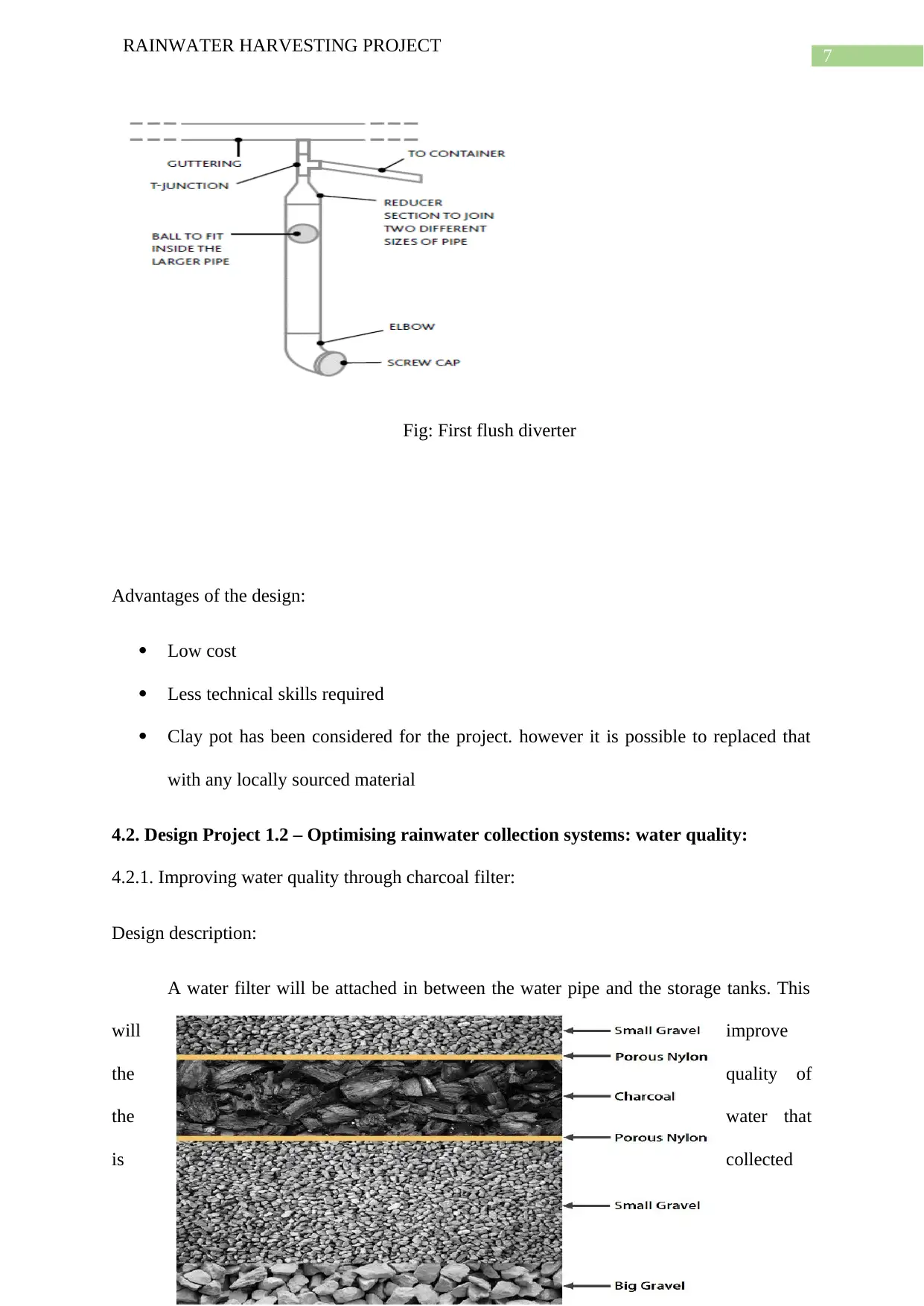
2. In the first few minutes there are contaminants in the water flow and after that the
water is fresh as the roof is much cleaner after the runoff. The First flush diverter
diverts the ‘first flush’ and only allows the fresh water to be collected in the clay pot.
In the diagram the process is shown with iron sheet, but any sheet such as plastic sheet
considered for the project will work here as fine as the principle remains the same.
RAINWATER HARVESTING PROJECT
2. In the first few minutes there are contaminants in the water flow and after that the
water is fresh as the roof is much cleaner after the runoff. The First flush diverter
diverts the ‘first flush’ and only allows the fresh water to be collected in the clay pot.
In the diagram the process is shown with iron sheet, but any sheet such as plastic sheet
considered for the project will work here as fine as the principle remains the same.
Paraphrase This Document
Need a fresh take? Get an instant paraphrase of this document with our AI Paraphraser
7
RAINWATER HARVESTING PROJECT
Fig: First flush diverter
Advantages of the design:
Low cost
Less technical skills required
Clay pot has been considered for the project. however it is possible to replaced that
with any locally sourced material
4.2. Design Project 1.2 – Optimising rainwater collection systems: water quality:
4.2.1. Improving water quality through charcoal filter:
Design description:
A water filter will be attached in between the water pipe and the storage tanks. This
will improve
the quality of
the water that
is collected
RAINWATER HARVESTING PROJECT
Fig: First flush diverter
Advantages of the design:
Low cost
Less technical skills required
Clay pot has been considered for the project. however it is possible to replaced that
with any locally sourced material
4.2. Design Project 1.2 – Optimising rainwater collection systems: water quality:
4.2.1. Improving water quality through charcoal filter:
Design description:
A water filter will be attached in between the water pipe and the storage tanks. This
will improve
the quality of
the water that
is collected
8
RAINWATER HARVESTING PROJECT
through rainwater harvesting. Before the rainwater enters the pots, it is filtered through the
charcoal filter.
Fig: Charcoal Filter
RAINWATER HARVESTING PROJECT
through rainwater harvesting. Before the rainwater enters the pots, it is filtered through the
charcoal filter.
Fig: Charcoal Filter
⊘ This is a preview!⊘
Do you want full access?
Subscribe today to unlock all pages.
Trusted by 1+ million students worldwide
9
RAINWATER HARVESTING PROJECT
Advantages:
In order to improve the efficiency while keeping the cost as low as possible charcoal
water filter has been considered. It consists of very basic elements which is easily available
and low cost as well. The main components required to design the filter are gravel, sand and
charcoal. It will remove most of the pollutants from the water to increase the hygiene of the
water.
4.3. Issues for further Investigation:
The plastic sheets that was used in the design were lightweight and there might be
stability issues when there is strong wind flowing before the rainfall. In order to
improve the design it is important to further research on this aspect to increase the
credibility of the design so that it is compatible with large scale projects.
In the rainwater harvesting process, each and every component of the design need to
be clean, otherwise it is not easy to maintain hygiene in the process. Hence the
process to provide optimized solution for increasing the hygiene while keeping the
cost low is a design challenge as well which needs further investigation for improving
design efficiency.
5.0. Conclusion:
The document has provide a clear description of the requirement for designing an
improved rainwater harvesting system. Along with that the detailed design specification of
the proposed design has been analysed as well. In order to water supply through rainwater
harvesting, Rooftop rainwater harvesting through First flush diverter and plastic sheets has
been suggested. Although the aim is to design a cost effective solution it is important not to
compromise with the quality of the water produced. Hence a charcoal filter has been
RAINWATER HARVESTING PROJECT
Advantages:
In order to improve the efficiency while keeping the cost as low as possible charcoal
water filter has been considered. It consists of very basic elements which is easily available
and low cost as well. The main components required to design the filter are gravel, sand and
charcoal. It will remove most of the pollutants from the water to increase the hygiene of the
water.
4.3. Issues for further Investigation:
The plastic sheets that was used in the design were lightweight and there might be
stability issues when there is strong wind flowing before the rainfall. In order to
improve the design it is important to further research on this aspect to increase the
credibility of the design so that it is compatible with large scale projects.
In the rainwater harvesting process, each and every component of the design need to
be clean, otherwise it is not easy to maintain hygiene in the process. Hence the
process to provide optimized solution for increasing the hygiene while keeping the
cost low is a design challenge as well which needs further investigation for improving
design efficiency.
5.0. Conclusion:
The document has provide a clear description of the requirement for designing an
improved rainwater harvesting system. Along with that the detailed design specification of
the proposed design has been analysed as well. In order to water supply through rainwater
harvesting, Rooftop rainwater harvesting through First flush diverter and plastic sheets has
been suggested. Although the aim is to design a cost effective solution it is important not to
compromise with the quality of the water produced. Hence a charcoal filter has been
Paraphrase This Document
Need a fresh take? Get an instant paraphrase of this document with our AI Paraphraser

10
RAINWATER HARVESTING PROJECT
proposed to remove pollutants from the collected water that is through rainwater harvesting.
It will help to maintain hygiene in the water collection process.
RAINWATER HARVESTING PROJECT
proposed to remove pollutants from the collected water that is through rainwater harvesting.
It will help to maintain hygiene in the water collection process.
11
RAINWATER HARVESTING PROJECT
References:
Design Area 1 - water supply | EWB Challenge. (2019). Retrieved from
https://ewbchallenge.org/design-area-1-water-supply-0
Foster, T., Shantz, A., Lala, S., & Willetts, J. (2018). Factors associated with operational
sustainability of rural water supplies in Cambodia. Environmental Science: Water
Research & Technology, 4(10), 1577-1588.
Jeuland, M., Orgill, J., Shaheed, A., Revell, G., & Brown, J. (2016). A matter of good taste:
investigating preferences for in-house water treatment in peri-urban communities in
Cambodia. Environment and development economics, 21(3), 291-317.
Stubbé, S. M., Pelgrim-Adams, A., Szántó, G. L., & Halem, D. V. (2016). Household water
treatment and safe storage–effectiveness and economics. Drinking Water Engineering
and Science, 9(1), 9-18.
RAINWATER HARVESTING PROJECT
References:
Design Area 1 - water supply | EWB Challenge. (2019). Retrieved from
https://ewbchallenge.org/design-area-1-water-supply-0
Foster, T., Shantz, A., Lala, S., & Willetts, J. (2018). Factors associated with operational
sustainability of rural water supplies in Cambodia. Environmental Science: Water
Research & Technology, 4(10), 1577-1588.
Jeuland, M., Orgill, J., Shaheed, A., Revell, G., & Brown, J. (2016). A matter of good taste:
investigating preferences for in-house water treatment in peri-urban communities in
Cambodia. Environment and development economics, 21(3), 291-317.
Stubbé, S. M., Pelgrim-Adams, A., Szántó, G. L., & Halem, D. V. (2016). Household water
treatment and safe storage–effectiveness and economics. Drinking Water Engineering
and Science, 9(1), 9-18.
⊘ This is a preview!⊘
Do you want full access?
Subscribe today to unlock all pages.
Trusted by 1+ million students worldwide

1 out of 12


Your All-in-One AI-Powered Toolkit for Academic Success.
+13062052269
info@desklib.com
Available 24*7 on WhatsApp / Email
![[object Object]](/_next/static/media/star-bottom.7253800d.svg)
Unlock your academic potential
Copyright © 2020–2025 A2Z Services. All Rights Reserved. Developed and managed by ZUCOL.