Analyzing Cultural Differences: The Wei Case Study in Organizations

Verified

Added on  2023/06/05

|7
|1479
|255
Case Study
AI Summary
This case study delves into the challenges faced by Wei, a Chinese employee, in a negotiation with his US counterparts, highlighting the significant impact of cultural differences on organizational interactions. The analysis reveals a lack of understanding and communication between the two teams, ultimately leading to the failure of a potentially beneficial deal. Recommendations emphasize the importance of cultural awareness training, open communication, and leadership in fostering inclusive workplaces. The study underscores that acknowledging and addressing cultural nuances is crucial for successful cross-cultural collaborations and the long-term growth of organizations. Desklib offers a range of resources, including past papers and solved assignments, to aid students in understanding such complex business scenarios.
Document Page
he case study of wei and how cultural differences can impact organizationsT
Case study analysis
tabler-icon-diamond-filled.svg

Paraphrase This Document

Need a fresh take? Get an instant paraphrase of this document with our AI Paraphraser
Document Page
Case Study analysis 1
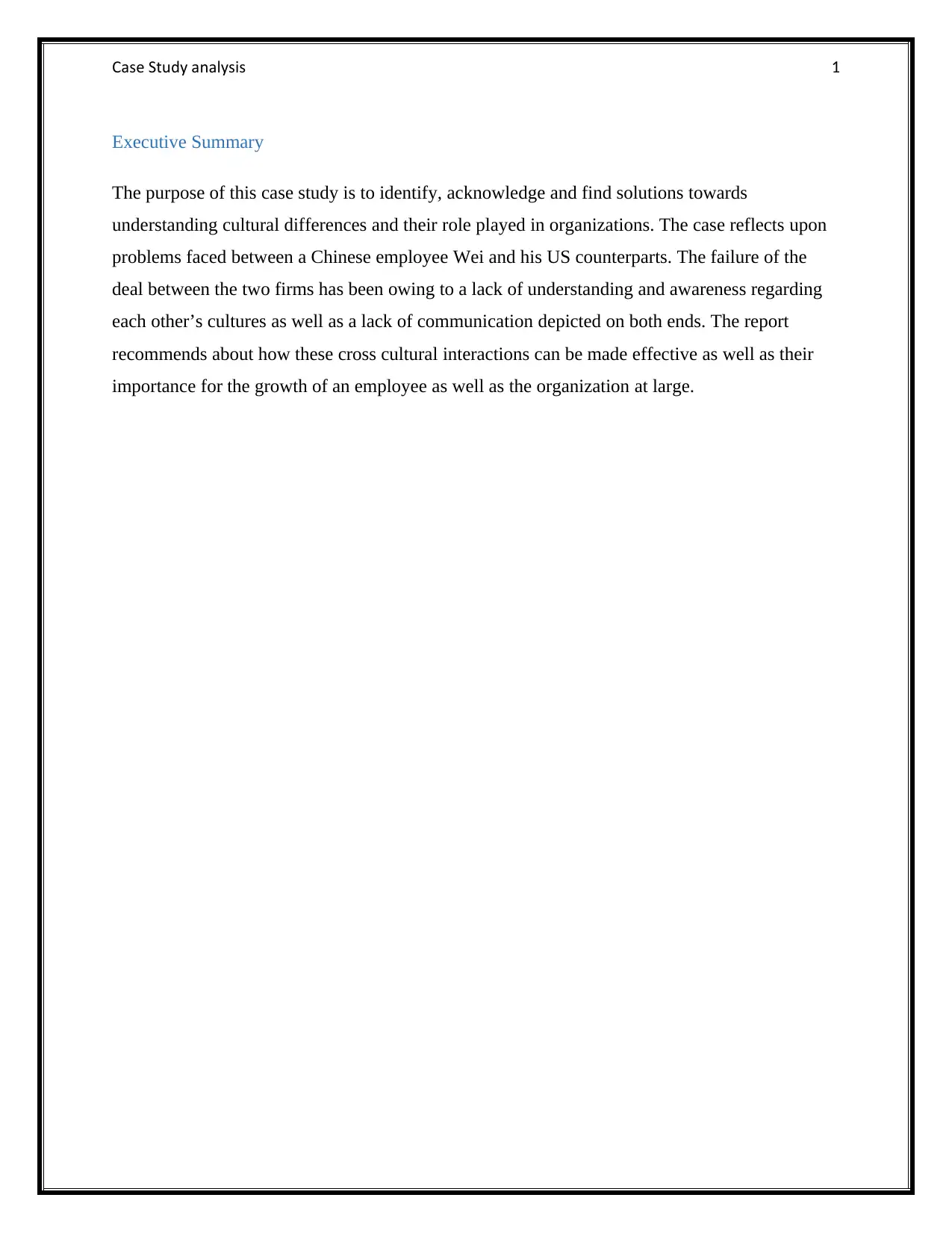
Executive Summary
The purpose of this case study is to identify, acknowledge and find solutions towards
understanding cultural differences and their role played in organizations. The case reflects upon
problems faced between a Chinese employee Wei and his US counterparts. The failure of the
deal between the two firms has been owing to a lack of understanding and awareness regarding
each other’s cultures as well as a lack of communication depicted on both ends. The report
recommends about how these cross cultural interactions can be made effective as well as their
importance for the growth of an employee as well as the organization at large.
Document Page
Case Study analysis 2
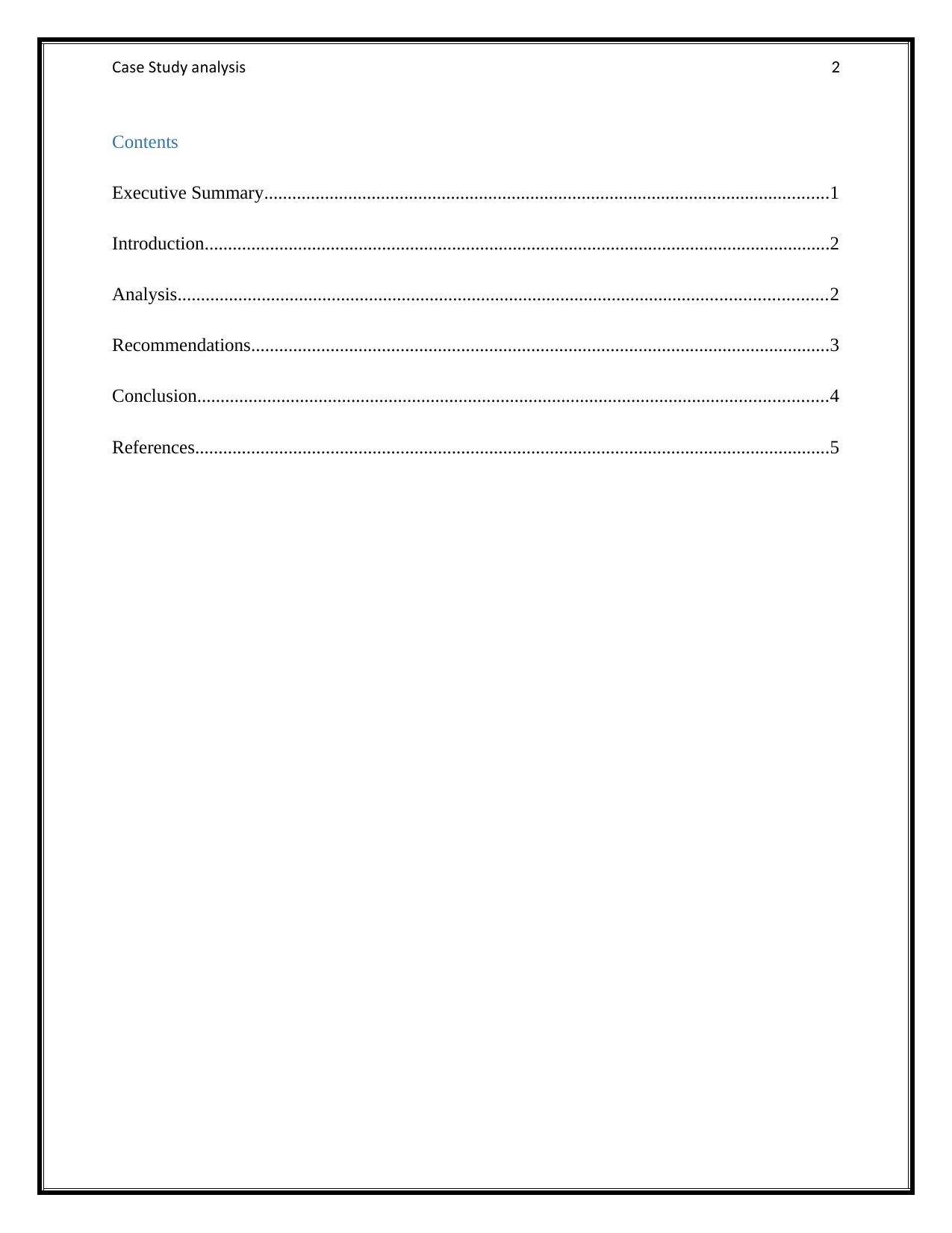
Contents
Executive Summary.........................................................................................................................1
Introduction......................................................................................................................................2
Analysis...........................................................................................................................................2
Recommendations............................................................................................................................3
Conclusion.......................................................................................................................................4
References........................................................................................................................................5
Document Page
Case Study analysis 3
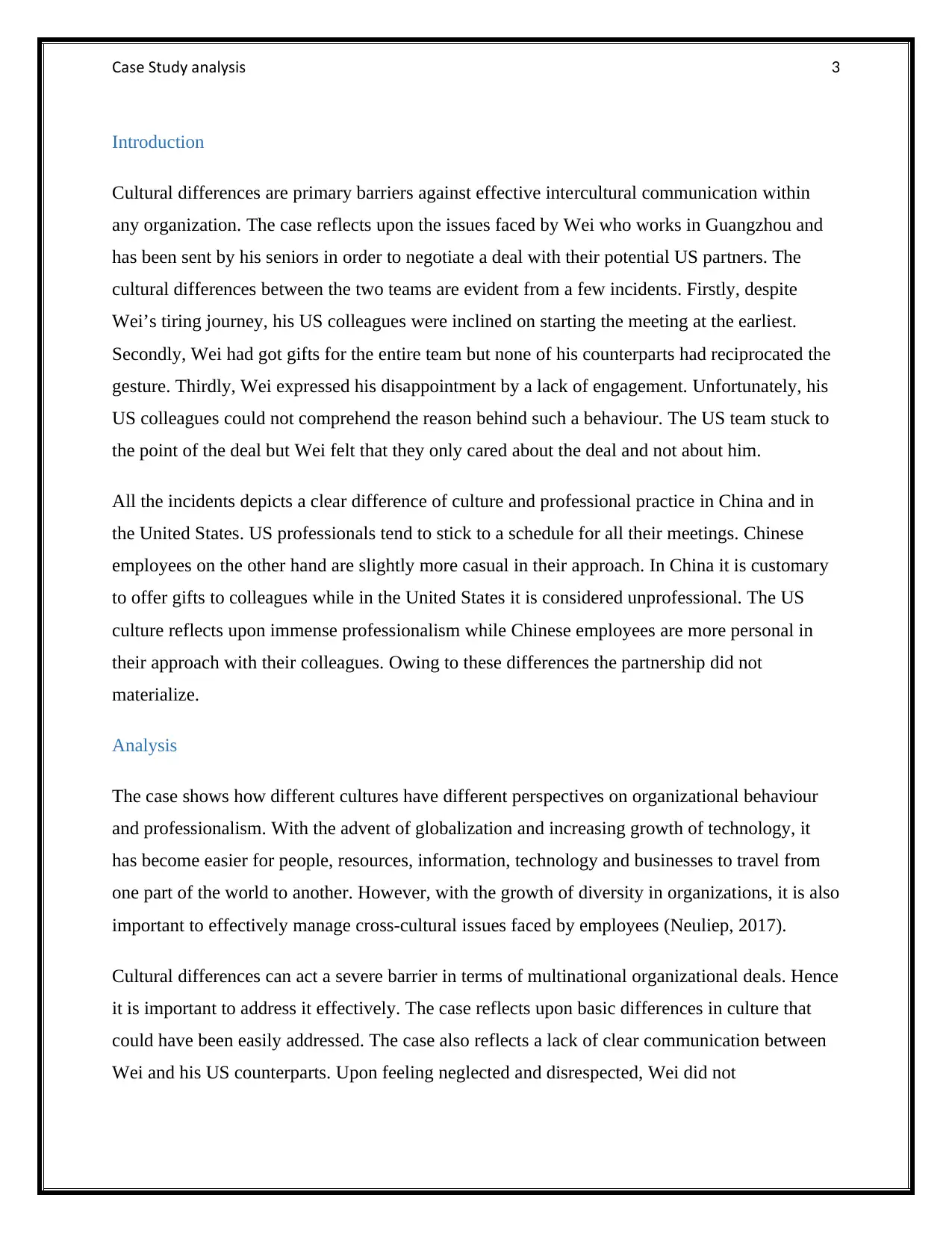
Introduction
Cultural differences are primary barriers against effective intercultural communication within
any organization. The case reflects upon the issues faced by Wei who works in Guangzhou and
has been sent by his seniors in order to negotiate a deal with their potential US partners. The
cultural differences between the two teams are evident from a few incidents. Firstly, despite
Wei’s tiring journey, his US colleagues were inclined on starting the meeting at the earliest.
Secondly, Wei had got gifts for the entire team but none of his counterparts had reciprocated the
gesture. Thirdly, Wei expressed his disappointment by a lack of engagement. Unfortunately, his
US colleagues could not comprehend the reason behind such a behaviour. The US team stuck to
the point of the deal but Wei felt that they only cared about the deal and not about him.
All the incidents depicts a clear difference of culture and professional practice in China and in
the United States. US professionals tend to stick to a schedule for all their meetings. Chinese
employees on the other hand are slightly more casual in their approach. In China it is customary
to offer gifts to colleagues while in the United States it is considered unprofessional. The US
culture reflects upon immense professionalism while Chinese employees are more personal in
their approach with their colleagues. Owing to these differences the partnership did not
materialize.
Analysis
The case shows how different cultures have different perspectives on organizational behaviour
and professionalism. With the advent of globalization and increasing growth of technology, it
has become easier for people, resources, information, technology and businesses to travel from
one part of the world to another. However, with the growth of diversity in organizations, it is also
important to effectively manage cross-cultural issues faced by employees (Neuliep, 2017).
Cultural differences can act a severe barrier in terms of multinational organizational deals. Hence
it is important to address it effectively. The case reflects upon basic differences in culture that
could have been easily addressed. The case also reflects a lack of clear communication between
Wei and his US counterparts. Upon feeling neglected and disrespected, Wei did not
tabler-icon-diamond-filled.svg

Paraphrase This Document

Need a fresh take? Get an instant paraphrase of this document with our AI Paraphraser
Document Page
Case Study analysis 4
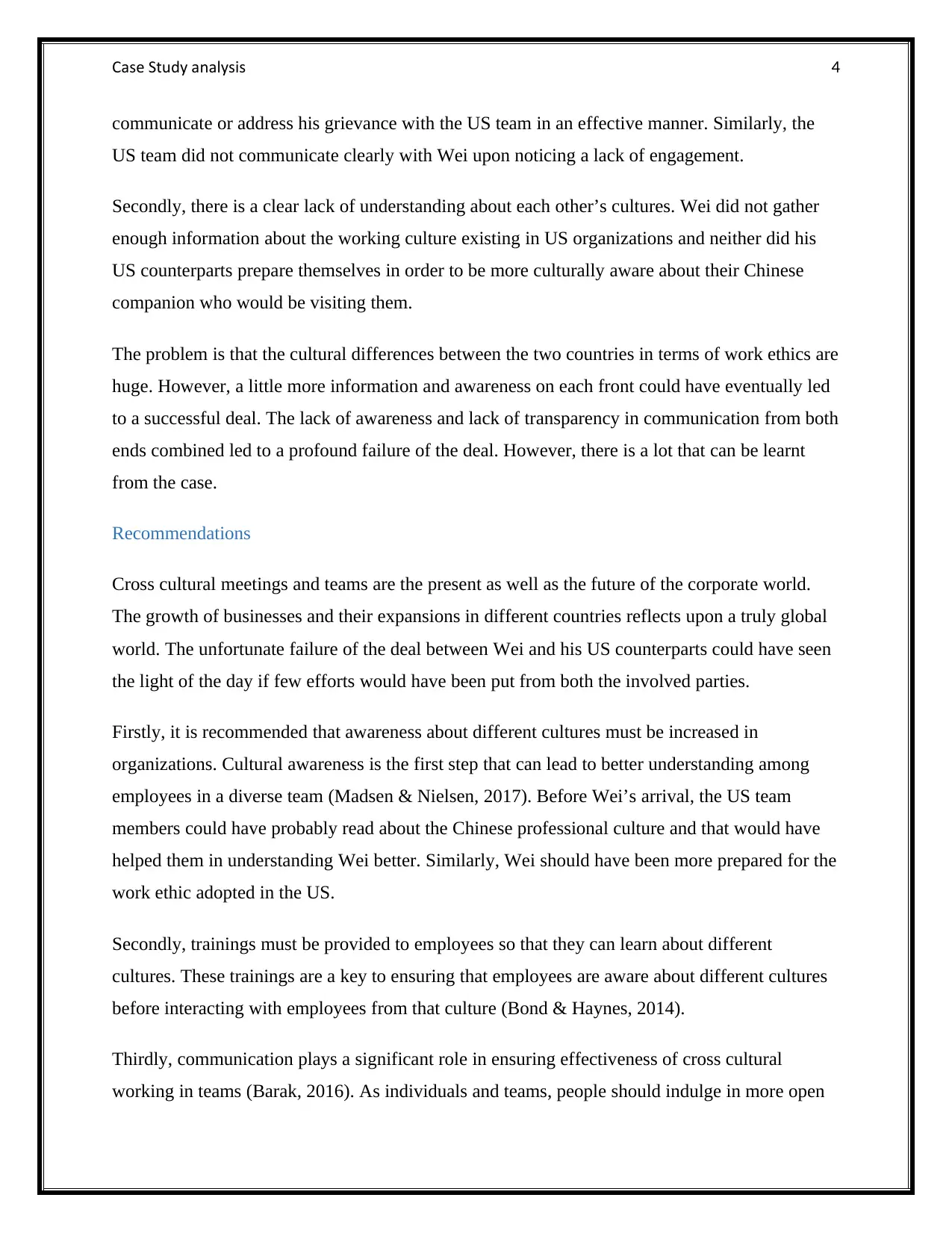
communicate or address his grievance with the US team in an effective manner. Similarly, the
US team did not communicate clearly with Wei upon noticing a lack of engagement.
Secondly, there is a clear lack of understanding about each other’s cultures. Wei did not gather
enough information about the working culture existing in US organizations and neither did his
US counterparts prepare themselves in order to be more culturally aware about their Chinese
companion who would be visiting them.
The problem is that the cultural differences between the two countries in terms of work ethics are
huge. However, a little more information and awareness on each front could have eventually led
to a successful deal. The lack of awareness and lack of transparency in communication from both
ends combined led to a profound failure of the deal. However, there is a lot that can be learnt
from the case.
Recommendations
Cross cultural meetings and teams are the present as well as the future of the corporate world.
The growth of businesses and their expansions in different countries reflects upon a truly global
world. The unfortunate failure of the deal between Wei and his US counterparts could have seen
the light of the day if few efforts would have been put from both the involved parties.
Firstly, it is recommended that awareness about different cultures must be increased in
organizations. Cultural awareness is the first step that can lead to better understanding among
employees in a diverse team (Madsen & Nielsen, 2017). Before Wei’s arrival, the US team
members could have probably read about the Chinese professional culture and that would have
helped them in understanding Wei better. Similarly, Wei should have been more prepared for the
work ethic adopted in the US.
Secondly, trainings must be provided to employees so that they can learn about different
cultures. These trainings are a key to ensuring that employees are aware about different cultures
before interacting with employees from that culture (Bond & Haynes, 2014).
Thirdly, communication plays a significant role in ensuring effectiveness of cross cultural
working in teams (Barak, 2016). As individuals and teams, people should indulge in more open
Document Page
Case Study analysis 5
and transparent communication. This is especially important while interacting with people from
a different culture. It is fair to assume that people from different cultures may not know about
each other’s cultures in detail. However, the problems arising from cross cultural interactions can
only be solved through effective communication (Werth & Brownlow, 2018).
Lastly, it is essential to highlight the role played by leaders in effectively managing cross cultural
interactions in the organization. Leaders of the business must take responsibility to ensure that
the organization is more open, accepting and understanding to different cultures (Hays-Thomas,
2016). It is the leaders of the business who can create a culture wherein employees are efficiently
trained and made aware about working ethics of different cultures. The leaders must also work
towards breaking stereotypes associated with different cultures (Acosta, 2017).
Conclusion
Cross cultural dealings are often difficult but with the growth in organizations it is important that
employees are more open and trained towards cross cultural interactions. Wei and his US
counterparts could not finalize the deal owing to minute cultural differences that would adversely
impact both the organizations in play. Openness in communication and increased awareness of
different cultural work ethics in important to ensure the effectiveness of cross cultural
communications existing between employees from different cultures (Berrey, 2014). Besides
this, the leaders must work towards enhancing inclusion in the workplace and training employees
to be more accepting, aware and understanding towards different cultures. This would help in
widening employee horizons as well as ensuring long term growth of the organization.
Document Page
Case Study analysis 6
References
Acosta, D, 2017. Breaking the silence: time to talk about race and racism. Academic
medicine, 92(3), pp.285-288.
Barak, M.E.M., 2016. Managing diversity: Toward a globally inclusive workplace. Sage
Publications. United States.
Berrey, E., 2014. Breaking glass ceilings, ignoring dirty floors: The culture and class bias of
diversity management. American Behavioral Scientist, 58(2), pp.347-370.
Bond, M.A. and Haynes, M.C., 2014. Workplace diversity: A social–ecological framework and
policy implications. Social Issues and Policy Review, 8(1), pp.167-201.
Hays-Thomas, R., 2016. Managing Workplace Diversity and Inclusion: A Psychological
Perspective. Taylor & Francis. United Kingdom.
Madsen, M.B. and Nielsen, V.L., 2017. Does Gender Diversity in the Workplace Affect Job
Satisfaction and Turnover Intentions?. International Public Management Review, 1(18), pp.77-
115.
Neuliep, J.W., 2017. Intercultural communication: A contextual approach. Sage Publications.
United States.
Werth, S. and Brownlow, C. eds., 2018. Work and identity: contemporary perspectives on
workplace diversity. Springer. United States.
chevron_up_icon
1 out of 7
circle_padding
hide_on_mobile
zoom_out_icon
[object Object]