Project Management Report: In-depth Analysis of WMUP Project
VerifiedAdded on 2020/01/15
|12
|4409
|360
Report
AI Summary
This report provides a comprehensive analysis of the Wellington Metro Upgrade Project (WMUP), focusing on key aspects of project management. The introduction outlines the project's context, highlighting the government's investment in upgrading Wellington's rail services. The project description details the WMUP, including its objectives, goals, and sub-phases, such as preparing lines for new trains and improving infrastructure. The report examines the project's rationale, emphasizing the need for upgrades due to infrastructure limitations and service delays. It also covers project scope, including objectives, goals, resources, and scheduling. Furthermore, the report addresses market analysis and project scheduling, using tools like Work Breakdown Structure (WBS) and Product Development Activity List. Overall, the report offers a detailed overview of the WMUP, providing valuable insights into its management and execution.
Project Management
1
1

Paraphrase This Document
Need a fresh take? Get an instant paraphrase of this document with our AI Paraphraser
Table of Contents
INTRODUCTION................................................................................................................................3
Project description...........................................................................................................................3
Project rational.................................................................................................................................4
Project scope....................................................................................................................................4
Market (or need to be meet).............................................................................................................6
Project scheduling............................................................................................................................7
Project risks and risks management.................................................................................................8
CONCLUSION....................................................................................................................................9
REFERENCES...................................................................................................................................11
2
INTRODUCTION................................................................................................................................3
Project description...........................................................................................................................3
Project rational.................................................................................................................................4
Project scope....................................................................................................................................4
Market (or need to be meet).............................................................................................................6
Project scheduling............................................................................................................................7
Project risks and risks management.................................................................................................8
CONCLUSION....................................................................................................................................9
REFERENCES...................................................................................................................................11
2
INTRODUCTION
Project Management is the application of skills, knowledge, techniques and tools to task
activities in order to complete the entire plan. It is the most effective method of delivering the
expected outcomes within the estimated costs, schedule and limited resource constraints (Bentham,
2012). The following approach assists an organization to ensure that projects are completed on time
and budget while giving the final outcome to the end users as per their expectations. The present
study is based on project management and to understand this, Wellington Metro Upgrading Project
(WMUP) of New Zealand has been taken into the consideration. In 2008, government of the nation
announced in May 2011 to allocate funds which is around $88.4 million over eight years to continue
to transform Wellington rail services (Kerzner, 2013). This project will deliver some significant
improvements to ageing overhead traction systems and signalling across the network.
Project description
A well-written description of any project makes it possible for the indented audience to
understand the concept and context of the proposed plan. On the basis of this, it becomes easy to
realize whether the cited project can be accepted or rejected (Burke, 2013). The following
document defines the project as a worthwhile, economically effective and reasonable endeavour to
induce the investors to make investment in the project plan. In the other words, project description
is a formal document or written declaration of the plan which includes project idea, goals and
objectives. Along with this it also considers problem statements, estimation of resources,
involvement of organization and people, other relevant information (Schwalbe, 2015). It explains
the need for selection of task and aims to illustrate the amount of work planned for implementation
of plan.
In the context of WMUP project, a well design and effective project description is as
follows:
About Wellington Metro Rail: Wellington was first electrified suburban rail service
introduced on the Johnsonville Line in July 1938 in New Zealand. Till the year 1980, the
electrification of lines was continued. In the present time, it is part of Metlink which is the
association of bus, train and harbour ferry services (Verburg, Bosch-Sijtsema and Vartiainen, 2013).
This has been planned and controlled by the Greater Wellington Regional Council. The metro lines
are operating under contract by TranzMetro which is a subsidiary of KiwiRail and using a five-line
154-kilometre network. In 2001 year, the rail patronage has increased from 10 million and in the
year 2013, it has become 11.8 million. In 2011-12, the project of Wellington Regional Rail
Programme was completed and it had included various activities. First one was upgrade of the rail
3
Project Management is the application of skills, knowledge, techniques and tools to task
activities in order to complete the entire plan. It is the most effective method of delivering the
expected outcomes within the estimated costs, schedule and limited resource constraints (Bentham,
2012). The following approach assists an organization to ensure that projects are completed on time
and budget while giving the final outcome to the end users as per their expectations. The present
study is based on project management and to understand this, Wellington Metro Upgrading Project
(WMUP) of New Zealand has been taken into the consideration. In 2008, government of the nation
announced in May 2011 to allocate funds which is around $88.4 million over eight years to continue
to transform Wellington rail services (Kerzner, 2013). This project will deliver some significant
improvements to ageing overhead traction systems and signalling across the network.
Project description
A well-written description of any project makes it possible for the indented audience to
understand the concept and context of the proposed plan. On the basis of this, it becomes easy to
realize whether the cited project can be accepted or rejected (Burke, 2013). The following
document defines the project as a worthwhile, economically effective and reasonable endeavour to
induce the investors to make investment in the project plan. In the other words, project description
is a formal document or written declaration of the plan which includes project idea, goals and
objectives. Along with this it also considers problem statements, estimation of resources,
involvement of organization and people, other relevant information (Schwalbe, 2015). It explains
the need for selection of task and aims to illustrate the amount of work planned for implementation
of plan.
In the context of WMUP project, a well design and effective project description is as
follows:
About Wellington Metro Rail: Wellington was first electrified suburban rail service
introduced on the Johnsonville Line in July 1938 in New Zealand. Till the year 1980, the
electrification of lines was continued. In the present time, it is part of Metlink which is the
association of bus, train and harbour ferry services (Verburg, Bosch-Sijtsema and Vartiainen, 2013).
This has been planned and controlled by the Greater Wellington Regional Council. The metro lines
are operating under contract by TranzMetro which is a subsidiary of KiwiRail and using a five-line
154-kilometre network. In 2001 year, the rail patronage has increased from 10 million and in the
year 2013, it has become 11.8 million. In 2011-12, the project of Wellington Regional Rail
Programme was completed and it had included various activities. First one was upgrade of the rail
3
⊘ This is a preview!⊘
Do you want full access?
Subscribe today to unlock all pages.

Trusted by 1+ million students worldwide
network to power the new Matangi fleet (Lind and Culler, 2013). Second one was improving the
Kaiwharawhara throat which had been a major cause of service delays. Next one was extension of
the electrified network at new Waikanae station and last one was closing of the new Electric
Multiple Unit (EMU) maintenance depot. After announcing the funding by the NZ government for
eight years about to $485 million for the upgrade of the metro rail service, in November 2012,
Wellington’s new 48 2-car Matangi trains completed testing. Along with this, all new metro trains
became available for passenger services (Sandbhor and et.al., 2014).
Project description: Wellington Region Rail Programme (WRRP) project although is about
near to complete. This project is related to prepare the lines for the introduction of the new Matangi
trains with the aim of improving the rail services and delivering more convenience to the travellers.
It has included to made double tracking to Waikanae, improved the traction overhead to carry more
power and building a third track into Wellington Station (Joslin and Müller, 2015).
Current status: WMUP project is about to complete and after the completion of this work; it
will deliver several benefits to the passengers and NZ government in various aspects. The timeline
of the following project is about 8 years and for this, government has announced to contribute
funds of about $485 million in order to upgrade the metro rail services (Sanjuan and Froese, 2013).
Project rational
Project rational is an argument in favour of executing the proposed project plan. It gives
complete detailed explanation of why the plan is required to carry out in the particular area. In
simple words, it describes the problems and issues that are faced by a community or an organization
and the proposed project plan will address those difficulties in effective manner (Bryde, Broquetas
and Volm, 2013). Project rational is very important aspect of every plan because it possess
capability to convince the investors to grant the funds.
Up gradation the WMUP project has proposed because of several reasons. In the previous
time, the metro trains were most of the time not on right timing. Due to this, many of the passengers
have deal with different difficulties. Along with this, the old infrastructure and rail network was not
developed and improved. In addition to this, the number of faults and errors in metro trains were
also increasing with the time. So, these were the major reasons to carry out WMUP project by the
NZ government (Doloi, 2015).
Project scope
Project scope is a part of project planning which includes identifying and documenting a list
of particular goals, deliverables, tasks, costs and deadlines. It also explains the limitations of a plan,
setting of responsibilities for each team member and developing procedures for completing the
4
Kaiwharawhara throat which had been a major cause of service delays. Next one was extension of
the electrified network at new Waikanae station and last one was closing of the new Electric
Multiple Unit (EMU) maintenance depot. After announcing the funding by the NZ government for
eight years about to $485 million for the upgrade of the metro rail service, in November 2012,
Wellington’s new 48 2-car Matangi trains completed testing. Along with this, all new metro trains
became available for passenger services (Sandbhor and et.al., 2014).
Project description: Wellington Region Rail Programme (WRRP) project although is about
near to complete. This project is related to prepare the lines for the introduction of the new Matangi
trains with the aim of improving the rail services and delivering more convenience to the travellers.
It has included to made double tracking to Waikanae, improved the traction overhead to carry more
power and building a third track into Wellington Station (Joslin and Müller, 2015).
Current status: WMUP project is about to complete and after the completion of this work; it
will deliver several benefits to the passengers and NZ government in various aspects. The timeline
of the following project is about 8 years and for this, government has announced to contribute
funds of about $485 million in order to upgrade the metro rail services (Sanjuan and Froese, 2013).
Project rational
Project rational is an argument in favour of executing the proposed project plan. It gives
complete detailed explanation of why the plan is required to carry out in the particular area. In
simple words, it describes the problems and issues that are faced by a community or an organization
and the proposed project plan will address those difficulties in effective manner (Bryde, Broquetas
and Volm, 2013). Project rational is very important aspect of every plan because it possess
capability to convince the investors to grant the funds.
Up gradation the WMUP project has proposed because of several reasons. In the previous
time, the metro trains were most of the time not on right timing. Due to this, many of the passengers
have deal with different difficulties. Along with this, the old infrastructure and rail network was not
developed and improved. In addition to this, the number of faults and errors in metro trains were
also increasing with the time. So, these were the major reasons to carry out WMUP project by the
NZ government (Doloi, 2015).
Project scope
Project scope is a part of project planning which includes identifying and documenting a list
of particular goals, deliverables, tasks, costs and deadlines. It also explains the limitations of a plan,
setting of responsibilities for each team member and developing procedures for completing the
4
Paraphrase This Document
Need a fresh take? Get an instant paraphrase of this document with our AI Paraphraser
work. On the basis of this, a project manager or other responsible person can verify and approve the
project plan (Badewi, 2016). Further, project scope provides the facilities of establishing guidelines
for making decisions about change request during the project. By doing this, it becomes easy to
state project scope in more effective manner and ensure that new alterations can be easily managed.
It avoids the situation of scope creep and minimizes the situations of poor planning as well as
miscommunication. From the research, it has found that an effective project scope helps the team
members of project to understand the scope of the plan and agrees upon exactly how the project
goals will be attained (Chih and Zwikael, 2015). There are three facts of project scope management
which are planning, controlling and closing. These three elements helps in defining the scope of
action plan and manage it in right manner so that expected outcomes can be achieved.
In the context of WMUP project, the project scope refers to the detailed set of deliverable or
features of plan. The project scope for the following plan is as follows:
Project objectives: There have been few objective of the following project which are following:
To bring the significant improvements to ageing overhead traction systems and signalling
across the network (Irvine and Hall, 2015).
To improve and maintain the reliability of commuter services.
To enhance the existing rail network and infrastructure in order to deliver improved quality
rail services to the passengers of New Zealand.
Goals: At the time of preparing the project plan of upgrade WMUP, some goals have been set which
are as follows:
To increase the speed of metro trains and improve their timekeeping (Unger and et.al.,
2012).
To minimize the number of faults in the existing metro railway systems by making required
changes.
To build a better rail networks in the New Zealand.
Sub-phases: These are the some parts of a project which contain various activities that help in
completing the plan in more appropriate manner. In this context, the three sub-phase of WMUP
project is as follows:
To prepare the lines for the introduction of the new Matangi trains.
To construct a third track into Wellington Station (Morris, 2013).
To improve the traction overhead to carry more power so that more metro trains of high
power and speed can be run over the tracks in New Zealand.
Resources: These are the essential part of a project because without it, it is difficult to carry out the
plan in right manner and achieve the estimated outcomes. It includes different kinds of resources
5
project plan (Badewi, 2016). Further, project scope provides the facilities of establishing guidelines
for making decisions about change request during the project. By doing this, it becomes easy to
state project scope in more effective manner and ensure that new alterations can be easily managed.
It avoids the situation of scope creep and minimizes the situations of poor planning as well as
miscommunication. From the research, it has found that an effective project scope helps the team
members of project to understand the scope of the plan and agrees upon exactly how the project
goals will be attained (Chih and Zwikael, 2015). There are three facts of project scope management
which are planning, controlling and closing. These three elements helps in defining the scope of
action plan and manage it in right manner so that expected outcomes can be achieved.
In the context of WMUP project, the project scope refers to the detailed set of deliverable or
features of plan. The project scope for the following plan is as follows:
Project objectives: There have been few objective of the following project which are following:
To bring the significant improvements to ageing overhead traction systems and signalling
across the network (Irvine and Hall, 2015).
To improve and maintain the reliability of commuter services.
To enhance the existing rail network and infrastructure in order to deliver improved quality
rail services to the passengers of New Zealand.
Goals: At the time of preparing the project plan of upgrade WMUP, some goals have been set which
are as follows:
To increase the speed of metro trains and improve their timekeeping (Unger and et.al.,
2012).
To minimize the number of faults in the existing metro railway systems by making required
changes.
To build a better rail networks in the New Zealand.
Sub-phases: These are the some parts of a project which contain various activities that help in
completing the plan in more appropriate manner. In this context, the three sub-phase of WMUP
project is as follows:
To prepare the lines for the introduction of the new Matangi trains.
To construct a third track into Wellington Station (Morris, 2013).
To improve the traction overhead to carry more power so that more metro trains of high
power and speed can be run over the tracks in New Zealand.
Resources: These are the essential part of a project because without it, it is difficult to carry out the
plan in right manner and achieve the estimated outcomes. It includes different kinds of resources
5
such as financial, human resource, technology, time, work, material etc (Badewi and Shehab, 2016).
In this regard, it becomes significance for the project manager to optimally utilize the available
resources and complete the whole action plan within the existing resources constraints. WMUP
project needs all these sources to finish the project within the given limitations. Further, the major
resources are men, machine and materials.
Budget: It works as a resource for a project in which a project manager and other team members
estimates funds required for a plan. It includes different kinds of expenses and overhead costs that
will be occurred at the time of implementing a project plan. Budget of WMUP project is $485
million and it has prepared by considering several kinds of expenses and costing (Söderlund and
Geraldi, 2012).
Schedule: It refers to a time frame in which a project is needed to be completed. It can be
considered as constraint for an action plan. In the context of WMUP project, the scheduling of the
following project plan is 8 years.
Market (or need to be meet)
In the project management, market assessment plays an important role. With the help of this,
it becomes easy to know about the aggregate demand for the service or product and the market
share that the proposed project will enjoy in the near future (Brandon and Guimaraes, 2016).
WMUP project has conducted a market analysis in order to determine the need of improvement in
existing rail network and infrastructures. For this, the first step is situational analysis and
specification of objectives. In this context, demand of travelling in metro trains in New Zealand
have been considered. On the basis of this, some objectives have been set by the higher authority of
WMUP project. In the second stage of collection of secondary information, the information
regarding the issues and faults in existing rail system has determined (Han and et.al., 2012). Along
with this, rail industry potential surveys have also included in this phase. After this, a market survey
has conducted because secondary data does not provide comprehensive information for the
proposed plan. To overcome this gap, a supplement process i.e. primary data collection has been
carried out. It has delivered the information related to need of improvement in New Zealand rail
network along with the growth of the entire industry in the nation. In addition to this, it has also
shown the travelling motive of passengers. After gathering this information, the project manager of
WMUP project has characterized the market on the basis of various factors such as types of
travellers, listing of supply and competition, prices, effective demand of metro rails in New Zealand
etc (Niazi and et.al., 2016). Beside this, demand forecasting phase has taken place where future
demand of Wellington Metro has been determined. By considering this, project plan of WMUP
6
In this regard, it becomes significance for the project manager to optimally utilize the available
resources and complete the whole action plan within the existing resources constraints. WMUP
project needs all these sources to finish the project within the given limitations. Further, the major
resources are men, machine and materials.
Budget: It works as a resource for a project in which a project manager and other team members
estimates funds required for a plan. It includes different kinds of expenses and overhead costs that
will be occurred at the time of implementing a project plan. Budget of WMUP project is $485
million and it has prepared by considering several kinds of expenses and costing (Söderlund and
Geraldi, 2012).
Schedule: It refers to a time frame in which a project is needed to be completed. It can be
considered as constraint for an action plan. In the context of WMUP project, the scheduling of the
following project plan is 8 years.
Market (or need to be meet)
In the project management, market assessment plays an important role. With the help of this,
it becomes easy to know about the aggregate demand for the service or product and the market
share that the proposed project will enjoy in the near future (Brandon and Guimaraes, 2016).
WMUP project has conducted a market analysis in order to determine the need of improvement in
existing rail network and infrastructures. For this, the first step is situational analysis and
specification of objectives. In this context, demand of travelling in metro trains in New Zealand
have been considered. On the basis of this, some objectives have been set by the higher authority of
WMUP project. In the second stage of collection of secondary information, the information
regarding the issues and faults in existing rail system has determined (Han and et.al., 2012). Along
with this, rail industry potential surveys have also included in this phase. After this, a market survey
has conducted because secondary data does not provide comprehensive information for the
proposed plan. To overcome this gap, a supplement process i.e. primary data collection has been
carried out. It has delivered the information related to need of improvement in New Zealand rail
network along with the growth of the entire industry in the nation. In addition to this, it has also
shown the travelling motive of passengers. After gathering this information, the project manager of
WMUP project has characterized the market on the basis of various factors such as types of
travellers, listing of supply and competition, prices, effective demand of metro rails in New Zealand
etc (Niazi and et.al., 2016). Beside this, demand forecasting phase has taken place where future
demand of Wellington Metro has been determined. By considering this, project plan of WMUP
6
⊘ This is a preview!⊘
Do you want full access?
Subscribe today to unlock all pages.
Trusted by 1+ million students worldwide
project has prepared which was funded by the New Zealand government.
Project scheduling
Project scheduling is a kind of a tool that define which task is needed to be performed,
which kinds of resources will be required to perform the action plan within the constraints etc
(Kerzner, 2013). It reflects the activities associated with delivering the plan on time. It enables the
project manager to complete the action plan within the given cost and resources. WMUP project
contains two kinds of project scheduling which are work Breakdown Structure (WBS) and Product
Development Activity List. In WBS, the project plan has been shown in hierarchical form in the
terms of deliverables (Burke, 2013). On the other hand, Product Development Activity List has
included the activities that have been carried out to manage the work along with assigning the
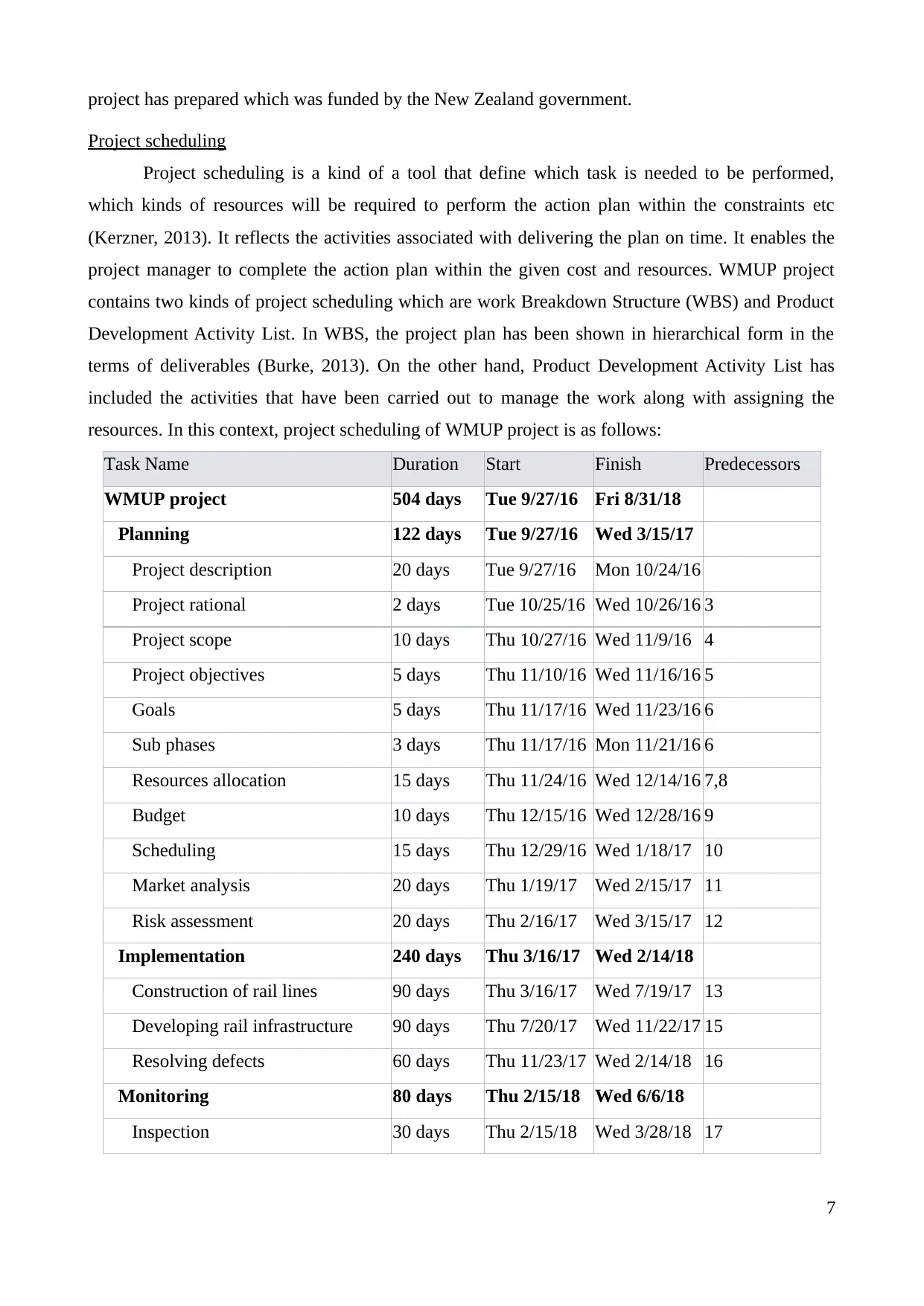
resources. In this context, project scheduling of WMUP project is as follows:
Task Name Duration Start Finish Predecessors
WMUP project 504 days Tue 9/27/16 Fri 8/31/18
Planning 122 days Tue 9/27/16 Wed 3/15/17
Project description 20 days Tue 9/27/16 Mon 10/24/16
Project rational 2 days Tue 10/25/16 Wed 10/26/16 3
Project scope 10 days Thu 10/27/16 Wed 11/9/16 4
Project objectives 5 days Thu 11/10/16 Wed 11/16/16 5
Goals 5 days Thu 11/17/16 Wed 11/23/16 6
Sub phases 3 days Thu 11/17/16 Mon 11/21/16 6
Resources allocation 15 days Thu 11/24/16 Wed 12/14/16 7,8
Budget 10 days Thu 12/15/16 Wed 12/28/16 9
Scheduling 15 days Thu 12/29/16 Wed 1/18/17 10
Market analysis 20 days Thu 1/19/17 Wed 2/15/17 11
Risk assessment 20 days Thu 2/16/17 Wed 3/15/17 12
Implementation 240 days Thu 3/16/17 Wed 2/14/18
Construction of rail lines 90 days Thu 3/16/17 Wed 7/19/17 13
Developing rail infrastructure 90 days Thu 7/20/17 Wed 11/22/17 15
Resolving defects 60 days Thu 11/23/17 Wed 2/14/18 16
Monitoring 80 days Thu 2/15/18 Wed 6/6/18
Inspection 30 days Thu 2/15/18 Wed 3/28/18 17
7
Project scheduling
Project scheduling is a kind of a tool that define which task is needed to be performed,
which kinds of resources will be required to perform the action plan within the constraints etc
(Kerzner, 2013). It reflects the activities associated with delivering the plan on time. It enables the
project manager to complete the action plan within the given cost and resources. WMUP project
contains two kinds of project scheduling which are work Breakdown Structure (WBS) and Product
Development Activity List. In WBS, the project plan has been shown in hierarchical form in the
terms of deliverables (Burke, 2013). On the other hand, Product Development Activity List has
included the activities that have been carried out to manage the work along with assigning the
resources. In this context, project scheduling of WMUP project is as follows:
Task Name Duration Start Finish Predecessors
WMUP project 504 days Tue 9/27/16 Fri 8/31/18
Planning 122 days Tue 9/27/16 Wed 3/15/17
Project description 20 days Tue 9/27/16 Mon 10/24/16
Project rational 2 days Tue 10/25/16 Wed 10/26/16 3
Project scope 10 days Thu 10/27/16 Wed 11/9/16 4
Project objectives 5 days Thu 11/10/16 Wed 11/16/16 5
Goals 5 days Thu 11/17/16 Wed 11/23/16 6
Sub phases 3 days Thu 11/17/16 Mon 11/21/16 6
Resources allocation 15 days Thu 11/24/16 Wed 12/14/16 7,8
Budget 10 days Thu 12/15/16 Wed 12/28/16 9
Scheduling 15 days Thu 12/29/16 Wed 1/18/17 10
Market analysis 20 days Thu 1/19/17 Wed 2/15/17 11
Risk assessment 20 days Thu 2/16/17 Wed 3/15/17 12
Implementation 240 days Thu 3/16/17 Wed 2/14/18
Construction of rail lines 90 days Thu 3/16/17 Wed 7/19/17 13
Developing rail infrastructure 90 days Thu 7/20/17 Wed 11/22/17 15
Resolving defects 60 days Thu 11/23/17 Wed 2/14/18 16
Monitoring 80 days Thu 2/15/18 Wed 6/6/18
Inspection 30 days Thu 2/15/18 Wed 3/28/18 17
7
Paraphrase This Document
Need a fresh take? Get an instant paraphrase of this document with our AI Paraphraser
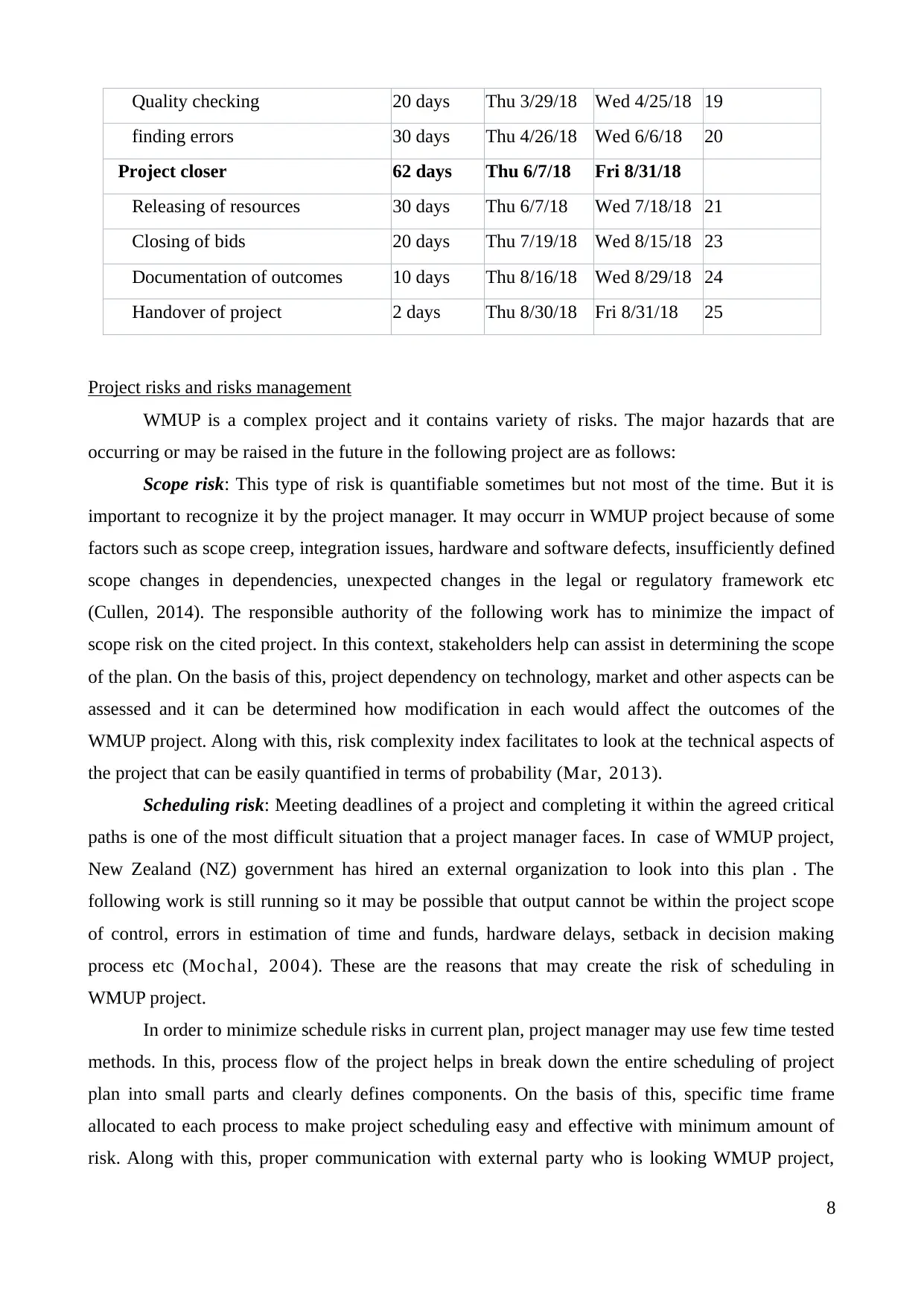
Quality checking 20 days Thu 3/29/18 Wed 4/25/18 19
finding errors 30 days Thu 4/26/18 Wed 6/6/18 20
Project closer 62 days Thu 6/7/18 Fri 8/31/18
Releasing of resources 30 days Thu 6/7/18 Wed 7/18/18 21
Closing of bids 20 days Thu 7/19/18 Wed 8/15/18 23
Documentation of outcomes 10 days Thu 8/16/18 Wed 8/29/18 24
Handover of project 2 days Thu 8/30/18 Fri 8/31/18 25
Project risks and risks management
WMUP is a complex project and it contains variety of risks. The major hazards that are
occurring or may be raised in the future in the following project are as follows:
Scope risk: This type of risk is quantifiable sometimes but not most of the time. But it is
important to recognize it by the project manager. It may occurr in WMUP project because of some
factors such as scope creep, integration issues, hardware and software defects, insufficiently defined
scope changes in dependencies, unexpected changes in the legal or regulatory framework etc
(Cullen, 2014). The responsible authority of the following work has to minimize the impact of
scope risk on the cited project. In this context, stakeholders help can assist in determining the scope
of the plan. On the basis of this, project dependency on technology, market and other aspects can be
assessed and it can be determined how modification in each would affect the outcomes of the
WMUP project. Along with this, risk complexity index facilitates to look at the technical aspects of
the project that can be easily quantified in terms of probability (Mar, 2013).
Scheduling risk: Meeting deadlines of a project and completing it within the agreed critical
paths is one of the most difficult situation that a project manager faces. In case of WMUP project,
New Zealand (NZ) government has hired an external organization to look into this plan . The
following work is still running so it may be possible that output cannot be within the project scope
of control, errors in estimation of time and funds, hardware delays, setback in decision making
process etc (Mochal, 2004). These are the reasons that may create the risk of scheduling in
WMUP project.
In order to minimize schedule risks in current plan, project manager may use few time tested
methods. In this, process flow of the project helps in break down the entire scheduling of project
plan into small parts and clearly defines components. On the basis of this, specific time frame
allocated to each process to make project scheduling easy and effective with minimum amount of
risk. Along with this, proper communication with external party who is looking WMUP project,
8
finding errors 30 days Thu 4/26/18 Wed 6/6/18 20
Project closer 62 days Thu 6/7/18 Fri 8/31/18
Releasing of resources 30 days Thu 6/7/18 Wed 7/18/18 21
Closing of bids 20 days Thu 7/19/18 Wed 8/15/18 23
Documentation of outcomes 10 days Thu 8/16/18 Wed 8/29/18 24
Handover of project 2 days Thu 8/30/18 Fri 8/31/18 25
Project risks and risks management
WMUP is a complex project and it contains variety of risks. The major hazards that are
occurring or may be raised in the future in the following project are as follows:
Scope risk: This type of risk is quantifiable sometimes but not most of the time. But it is
important to recognize it by the project manager. It may occurr in WMUP project because of some
factors such as scope creep, integration issues, hardware and software defects, insufficiently defined
scope changes in dependencies, unexpected changes in the legal or regulatory framework etc
(Cullen, 2014). The responsible authority of the following work has to minimize the impact of
scope risk on the cited project. In this context, stakeholders help can assist in determining the scope
of the plan. On the basis of this, project dependency on technology, market and other aspects can be
assessed and it can be determined how modification in each would affect the outcomes of the
WMUP project. Along with this, risk complexity index facilitates to look at the technical aspects of
the project that can be easily quantified in terms of probability (Mar, 2013).
Scheduling risk: Meeting deadlines of a project and completing it within the agreed critical
paths is one of the most difficult situation that a project manager faces. In case of WMUP project,
New Zealand (NZ) government has hired an external organization to look into this plan . The
following work is still running so it may be possible that output cannot be within the project scope
of control, errors in estimation of time and funds, hardware delays, setback in decision making
process etc (Mochal, 2004). These are the reasons that may create the risk of scheduling in
WMUP project.
In order to minimize schedule risks in current plan, project manager may use few time tested
methods. In this, process flow of the project helps in break down the entire scheduling of project
plan into small parts and clearly defines components. On the basis of this, specific time frame
allocated to each process to make project scheduling easy and effective with minimum amount of
risk. Along with this, proper communication with external party who is looking WMUP project,
8
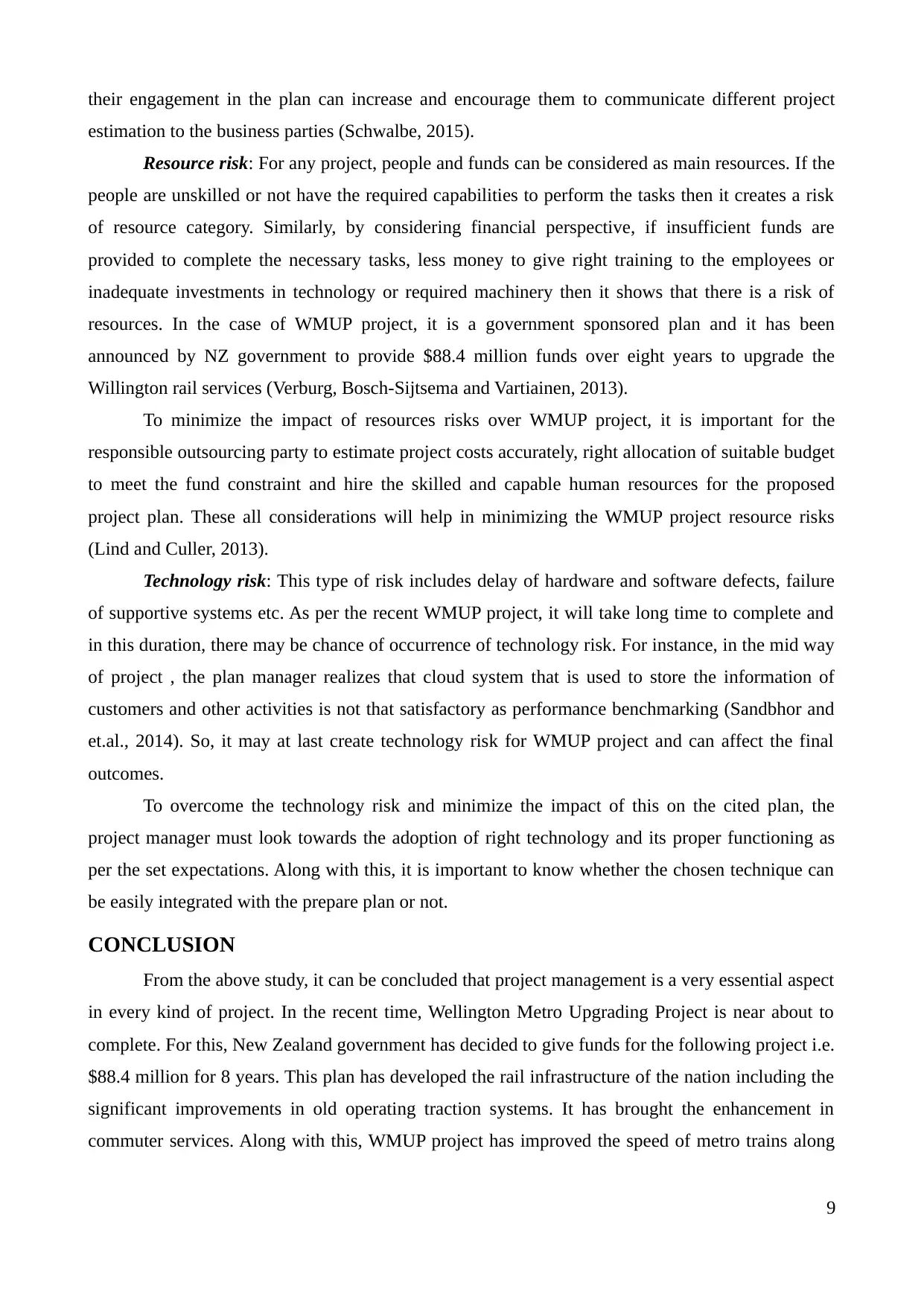
their engagement in the plan can increase and encourage them to communicate different project
estimation to the business parties (Schwalbe, 2015).
Resource risk: For any project, people and funds can be considered as main resources. If the
people are unskilled or not have the required capabilities to perform the tasks then it creates a risk
of resource category. Similarly, by considering financial perspective, if insufficient funds are
provided to complete the necessary tasks, less money to give right training to the employees or
inadequate investments in technology or required machinery then it shows that there is a risk of
resources. In the case of WMUP project, it is a government sponsored plan and it has been
announced by NZ government to provide $88.4 million funds over eight years to upgrade the
Willington rail services (Verburg, Bosch-Sijtsema and Vartiainen, 2013).
To minimize the impact of resources risks over WMUP project, it is important for the
responsible outsourcing party to estimate project costs accurately, right allocation of suitable budget
to meet the fund constraint and hire the skilled and capable human resources for the proposed
project plan. These all considerations will help in minimizing the WMUP project resource risks
(Lind and Culler, 2013).
Technology risk: This type of risk includes delay of hardware and software defects, failure
of supportive systems etc. As per the recent WMUP project, it will take long time to complete and
in this duration, there may be chance of occurrence of technology risk. For instance, in the mid way
of project , the plan manager realizes that cloud system that is used to store the information of
customers and other activities is not that satisfactory as performance benchmarking (Sandbhor and
et.al., 2014). So, it may at last create technology risk for WMUP project and can affect the final
outcomes.
To overcome the technology risk and minimize the impact of this on the cited plan, the
project manager must look towards the adoption of right technology and its proper functioning as
per the set expectations. Along with this, it is important to know whether the chosen technique can
be easily integrated with the prepare plan or not.
CONCLUSION
From the above study, it can be concluded that project management is a very essential aspect
in every kind of project. In the recent time, Wellington Metro Upgrading Project is near about to
complete. For this, New Zealand government has decided to give funds for the following project i.e.
$88.4 million for 8 years. This plan has developed the rail infrastructure of the nation including the
significant improvements in old operating traction systems. It has brought the enhancement in
commuter services. Along with this, WMUP project has improved the speed of metro trains along
9
estimation to the business parties (Schwalbe, 2015).
Resource risk: For any project, people and funds can be considered as main resources. If the
people are unskilled or not have the required capabilities to perform the tasks then it creates a risk
of resource category. Similarly, by considering financial perspective, if insufficient funds are
provided to complete the necessary tasks, less money to give right training to the employees or
inadequate investments in technology or required machinery then it shows that there is a risk of
resources. In the case of WMUP project, it is a government sponsored plan and it has been
announced by NZ government to provide $88.4 million funds over eight years to upgrade the
Willington rail services (Verburg, Bosch-Sijtsema and Vartiainen, 2013).
To minimize the impact of resources risks over WMUP project, it is important for the
responsible outsourcing party to estimate project costs accurately, right allocation of suitable budget
to meet the fund constraint and hire the skilled and capable human resources for the proposed
project plan. These all considerations will help in minimizing the WMUP project resource risks
(Lind and Culler, 2013).
Technology risk: This type of risk includes delay of hardware and software defects, failure
of supportive systems etc. As per the recent WMUP project, it will take long time to complete and
in this duration, there may be chance of occurrence of technology risk. For instance, in the mid way
of project , the plan manager realizes that cloud system that is used to store the information of
customers and other activities is not that satisfactory as performance benchmarking (Sandbhor and
et.al., 2014). So, it may at last create technology risk for WMUP project and can affect the final
outcomes.
To overcome the technology risk and minimize the impact of this on the cited plan, the
project manager must look towards the adoption of right technology and its proper functioning as
per the set expectations. Along with this, it is important to know whether the chosen technique can
be easily integrated with the prepare plan or not.
CONCLUSION
From the above study, it can be concluded that project management is a very essential aspect
in every kind of project. In the recent time, Wellington Metro Upgrading Project is near about to
complete. For this, New Zealand government has decided to give funds for the following project i.e.
$88.4 million for 8 years. This plan has developed the rail infrastructure of the nation including the
significant improvements in old operating traction systems. It has brought the enhancement in
commuter services. Along with this, WMUP project has improved the speed of metro trains along
9
⊘ This is a preview!⊘
Do you want full access?
Subscribe today to unlock all pages.
Trusted by 1+ million students worldwide

with this it has reduced the number of faults in rail services..
10
10
Paraphrase This Document
Need a fresh take? Get an instant paraphrase of this document with our AI Paraphraser
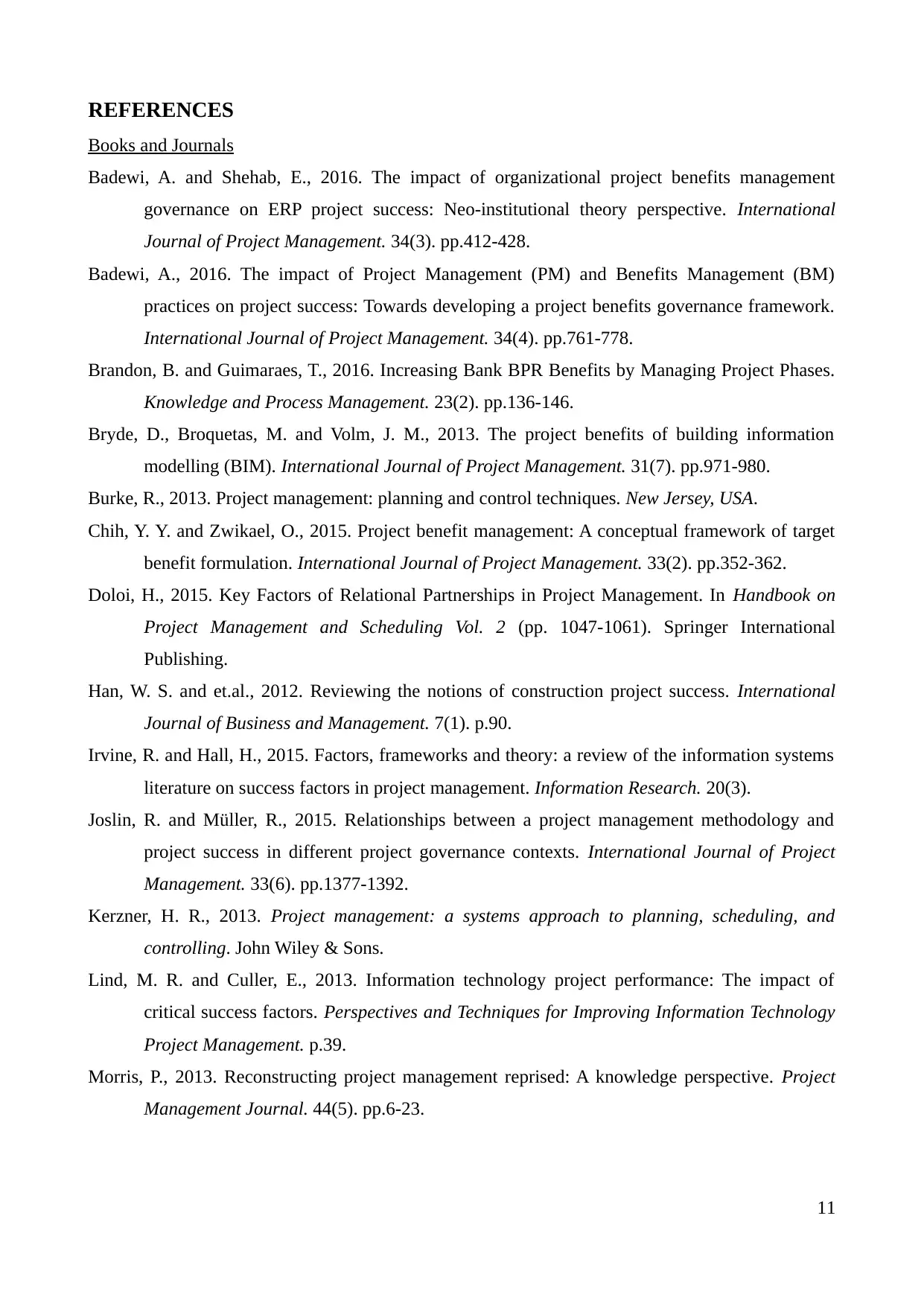
REFERENCES
Books and Journals
Badewi, A. and Shehab, E., 2016. The impact of organizational project benefits management
governance on ERP project success: Neo-institutional theory perspective. International
Journal of Project Management. 34(3). pp.412-428.
Badewi, A., 2016. The impact of Project Management (PM) and Benefits Management (BM)
practices on project success: Towards developing a project benefits governance framework.
International Journal of Project Management. 34(4). pp.761-778.
Brandon, B. and Guimaraes, T., 2016. Increasing Bank BPR Benefits by Managing Project Phases.
Knowledge and Process Management. 23(2). pp.136-146.
Bryde, D., Broquetas, M. and Volm, J. M., 2013. The project benefits of building information
modelling (BIM). International Journal of Project Management. 31(7). pp.971-980.
Burke, R., 2013. Project management: planning and control techniques. New Jersey, USA.
Chih, Y. Y. and Zwikael, O., 2015. Project benefit management: A conceptual framework of target
benefit formulation. International Journal of Project Management. 33(2). pp.352-362.
Doloi, H., 2015. Key Factors of Relational Partnerships in Project Management. In Handbook on
Project Management and Scheduling Vol. 2 (pp. 1047-1061). Springer International
Publishing.
Han, W. S. and et.al., 2012. Reviewing the notions of construction project success. International
Journal of Business and Management. 7(1). p.90.
Irvine, R. and Hall, H., 2015. Factors, frameworks and theory: a review of the information systems
literature on success factors in project management. Information Research. 20(3).
Joslin, R. and Müller, R., 2015. Relationships between a project management methodology and
project success in different project governance contexts. International Journal of Project
Management. 33(6). pp.1377-1392.
Kerzner, H. R., 2013. Project management: a systems approach to planning, scheduling, and
controlling. John Wiley & Sons.
Lind, M. R. and Culler, E., 2013. Information technology project performance: The impact of
critical success factors. Perspectives and Techniques for Improving Information Technology
Project Management. p.39.
Morris, P., 2013. Reconstructing project management reprised: A knowledge perspective. Project
Management Journal. 44(5). pp.6-23.
11
Books and Journals
Badewi, A. and Shehab, E., 2016. The impact of organizational project benefits management
governance on ERP project success: Neo-institutional theory perspective. International
Journal of Project Management. 34(3). pp.412-428.
Badewi, A., 2016. The impact of Project Management (PM) and Benefits Management (BM)
practices on project success: Towards developing a project benefits governance framework.
International Journal of Project Management. 34(4). pp.761-778.
Brandon, B. and Guimaraes, T., 2016. Increasing Bank BPR Benefits by Managing Project Phases.
Knowledge and Process Management. 23(2). pp.136-146.
Bryde, D., Broquetas, M. and Volm, J. M., 2013. The project benefits of building information
modelling (BIM). International Journal of Project Management. 31(7). pp.971-980.
Burke, R., 2013. Project management: planning and control techniques. New Jersey, USA.
Chih, Y. Y. and Zwikael, O., 2015. Project benefit management: A conceptual framework of target
benefit formulation. International Journal of Project Management. 33(2). pp.352-362.
Doloi, H., 2015. Key Factors of Relational Partnerships in Project Management. In Handbook on
Project Management and Scheduling Vol. 2 (pp. 1047-1061). Springer International
Publishing.
Han, W. S. and et.al., 2012. Reviewing the notions of construction project success. International
Journal of Business and Management. 7(1). p.90.
Irvine, R. and Hall, H., 2015. Factors, frameworks and theory: a review of the information systems
literature on success factors in project management. Information Research. 20(3).
Joslin, R. and Müller, R., 2015. Relationships between a project management methodology and
project success in different project governance contexts. International Journal of Project
Management. 33(6). pp.1377-1392.
Kerzner, H. R., 2013. Project management: a systems approach to planning, scheduling, and
controlling. John Wiley & Sons.
Lind, M. R. and Culler, E., 2013. Information technology project performance: The impact of
critical success factors. Perspectives and Techniques for Improving Information Technology
Project Management. p.39.
Morris, P., 2013. Reconstructing project management reprised: A knowledge perspective. Project
Management Journal. 44(5). pp.6-23.
11
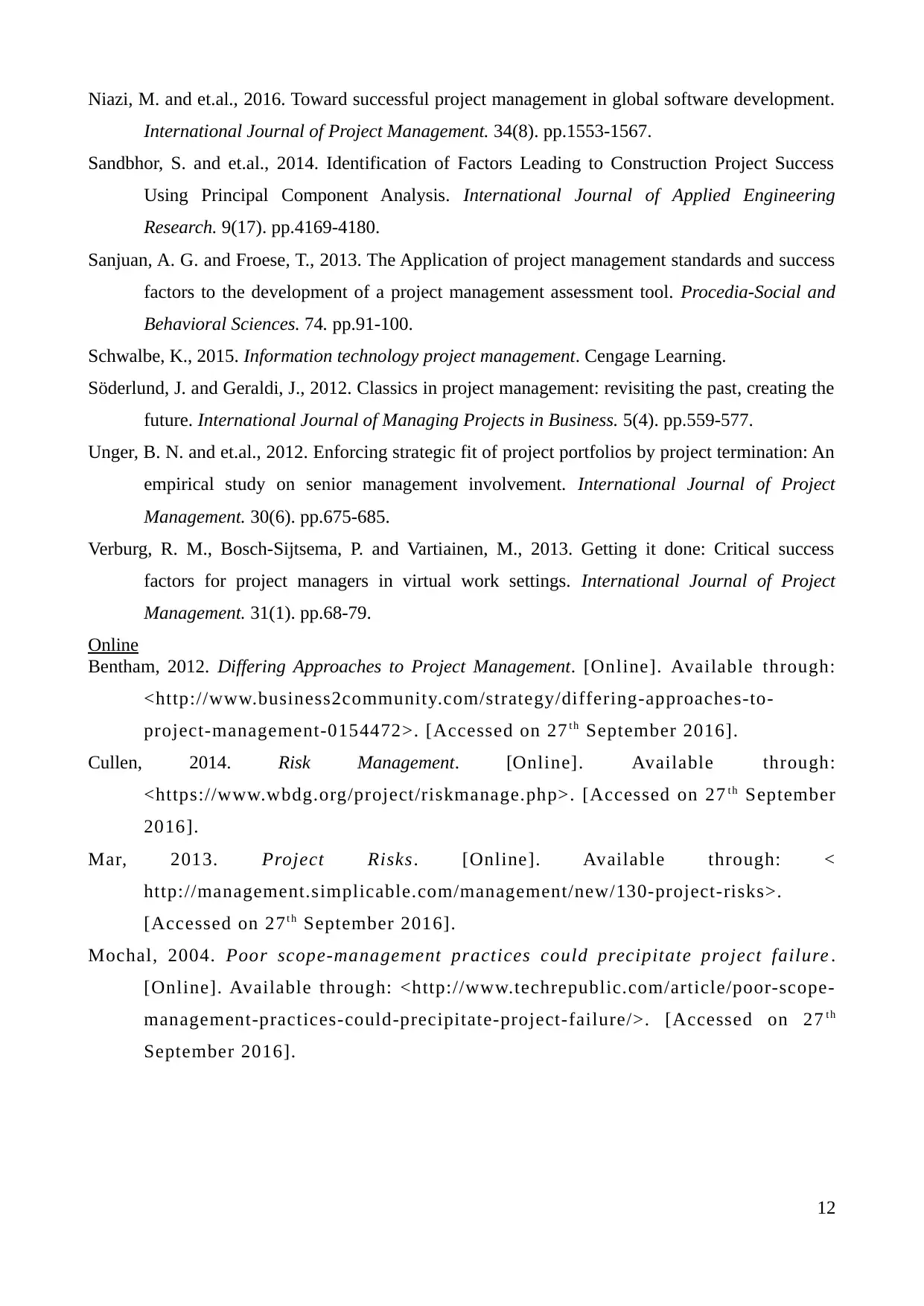
Niazi, M. and et.al., 2016. Toward successful project management in global software development.
International Journal of Project Management. 34(8). pp.1553-1567.
Sandbhor, S. and et.al., 2014. Identification of Factors Leading to Construction Project Success
Using Principal Component Analysis. International Journal of Applied Engineering
Research. 9(17). pp.4169-4180.
Sanjuan, A. G. and Froese, T., 2013. The Application of project management standards and success
factors to the development of a project management assessment tool. Procedia-Social and
Behavioral Sciences. 74. pp.91-100.
Schwalbe, K., 2015. Information technology project management. Cengage Learning.
Söderlund, J. and Geraldi, J., 2012. Classics in project management: revisiting the past, creating the
future. International Journal of Managing Projects in Business. 5(4). pp.559-577.
Unger, B. N. and et.al., 2012. Enforcing strategic fit of project portfolios by project termination: An
empirical study on senior management involvement. International Journal of Project
Management. 30(6). pp.675-685.
Verburg, R. M., Bosch-Sijtsema, P. and Vartiainen, M., 2013. Getting it done: Critical success
factors for project managers in virtual work settings. International Journal of Project
Management. 31(1). pp.68-79.
Online
Bentham, 2012. Differing Approaches to Project Management. [Online]. Available through:
<http://www.business2community.com/strategy/differing-approaches-to-
project-management-0154472>. [Accessed on 27 t h September 2016].
Cullen, 2014. Risk Management. [Online]. Available through:
<https://www.wbdg.org/project/riskmanage.php>. [Accessed on 27 t h September
2016].
Mar, 2013. Project Risks. [Online]. Available through: <
http://management.simplicable.com/management/new/130-project-risks>.
[Accessed on 27t h September 2016].
Mochal, 2004. Poor scope-management practices could precipitate project failure .
[Online]. Available through: <http://www.techrepublic.com/article/poor-scope-
management-practices-could-precipitate-project-failure/>. [Accessed on 27 t h
September 2016].
12
International Journal of Project Management. 34(8). pp.1553-1567.
Sandbhor, S. and et.al., 2014. Identification of Factors Leading to Construction Project Success
Using Principal Component Analysis. International Journal of Applied Engineering
Research. 9(17). pp.4169-4180.
Sanjuan, A. G. and Froese, T., 2013. The Application of project management standards and success
factors to the development of a project management assessment tool. Procedia-Social and
Behavioral Sciences. 74. pp.91-100.
Schwalbe, K., 2015. Information technology project management. Cengage Learning.
Söderlund, J. and Geraldi, J., 2012. Classics in project management: revisiting the past, creating the
future. International Journal of Managing Projects in Business. 5(4). pp.559-577.
Unger, B. N. and et.al., 2012. Enforcing strategic fit of project portfolios by project termination: An
empirical study on senior management involvement. International Journal of Project
Management. 30(6). pp.675-685.
Verburg, R. M., Bosch-Sijtsema, P. and Vartiainen, M., 2013. Getting it done: Critical success
factors for project managers in virtual work settings. International Journal of Project
Management. 31(1). pp.68-79.
Online
Bentham, 2012. Differing Approaches to Project Management. [Online]. Available through:
<http://www.business2community.com/strategy/differing-approaches-to-
project-management-0154472>. [Accessed on 27 t h September 2016].
Cullen, 2014. Risk Management. [Online]. Available through:
<https://www.wbdg.org/project/riskmanage.php>. [Accessed on 27 t h September
2016].
Mar, 2013. Project Risks. [Online]. Available through: <
http://management.simplicable.com/management/new/130-project-risks>.
[Accessed on 27t h September 2016].
Mochal, 2004. Poor scope-management practices could precipitate project failure .
[Online]. Available through: <http://www.techrepublic.com/article/poor-scope-
management-practices-could-precipitate-project-failure/>. [Accessed on 27 t h
September 2016].
12
⊘ This is a preview!⊘
Do you want full access?
Subscribe today to unlock all pages.
Trusted by 1+ million students worldwide

1 out of 12


Related Documents


Your All-in-One AI-Powered Toolkit for Academic Success.
+13062052269
info@desklib.com
Available 24*7 on WhatsApp / Email
![[object Object]](/_next/static/media/star-bottom.7253800d.svg)
Unlock your academic potential
Copyright © 2020–2026 A2Z Services. All Rights Reserved. Developed and managed by ZUCOL.