Exploring the Relationship Between Wellness, Economics, and Business

Verified

Added on  2020/03/13

|4
|516
|47
Report
AI Summary
This report explores the intricate relationship between wellness, economics, and business practices, with a specific focus on the impact of fast food marketing. It examines how the business concept of targeted marketing, particularly within the fast-food industry, influences consumer behavior and health outcomes. The report highlights the role of fast-food restaurants in contributing to obesity, especially among children, and discusses how these practices affect both physical and social well-being. The author argues that the strategies employed by fast-food companies, such as low pricing and appealing advertisements, disproportionately target individuals with lower socioeconomic status, leading to poor health and potentially limiting opportunities for upward mobility. The report concludes by emphasizing the interconnectedness of economic factors, business strategies, social standing, and overall wellness, advocating for a better understanding of these connections to promote healthier lifestyles and outcomes.

Document Page
Running Head: WELLNESS
Wellness
Name of the Student
Name of the University
Author Note
tabler-icon-diamond-filled.svg

Paraphrase This Document

Need a fresh take? Get an instant paraphrase of this document with our AI Paraphraser
Document Page
1WELLNESS
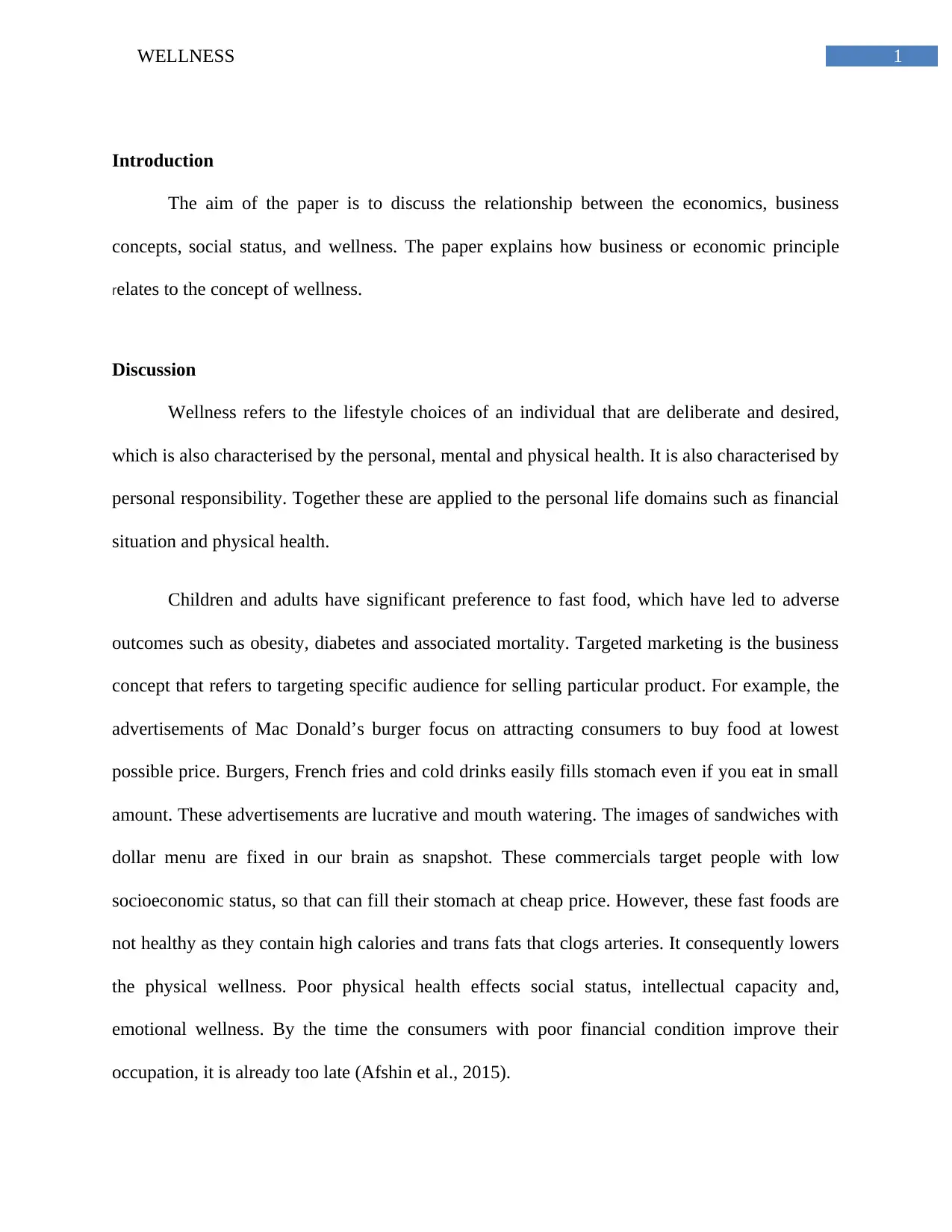
Introduction
The aim of the paper is to discuss the relationship between the economics, business
concepts, social status, and wellness. The paper explains how business or economic principle
relates to the concept of wellness.
Discussion
Wellness refers to the lifestyle choices of an individual that are deliberate and desired,
which is also characterised by the personal, mental and physical health. It is also characterised by
personal responsibility. Together these are applied to the personal life domains such as financial
situation and physical health.
Children and adults have significant preference to fast food, which have led to adverse
outcomes such as obesity, diabetes and associated mortality. Targeted marketing is the business
concept that refers to targeting specific audience for selling particular product. For example, the
advertisements of Mac Donald’s burger focus on attracting consumers to buy food at lowest
possible price. Burgers, French fries and cold drinks easily fills stomach even if you eat in small
amount. These advertisements are lucrative and mouth watering. The images of sandwiches with
dollar menu are fixed in our brain as snapshot. These commercials target people with low
socioeconomic status, so that can fill their stomach at cheap price. However, these fast foods are
not healthy as they contain high calories and trans fats that clogs arteries. It consequently lowers
the physical wellness. Poor physical health effects social status, intellectual capacity and,
emotional wellness. By the time the consumers with poor financial condition improve their
occupation, it is already too late (Afshin et al., 2015).
Document Page
2WELLNESS
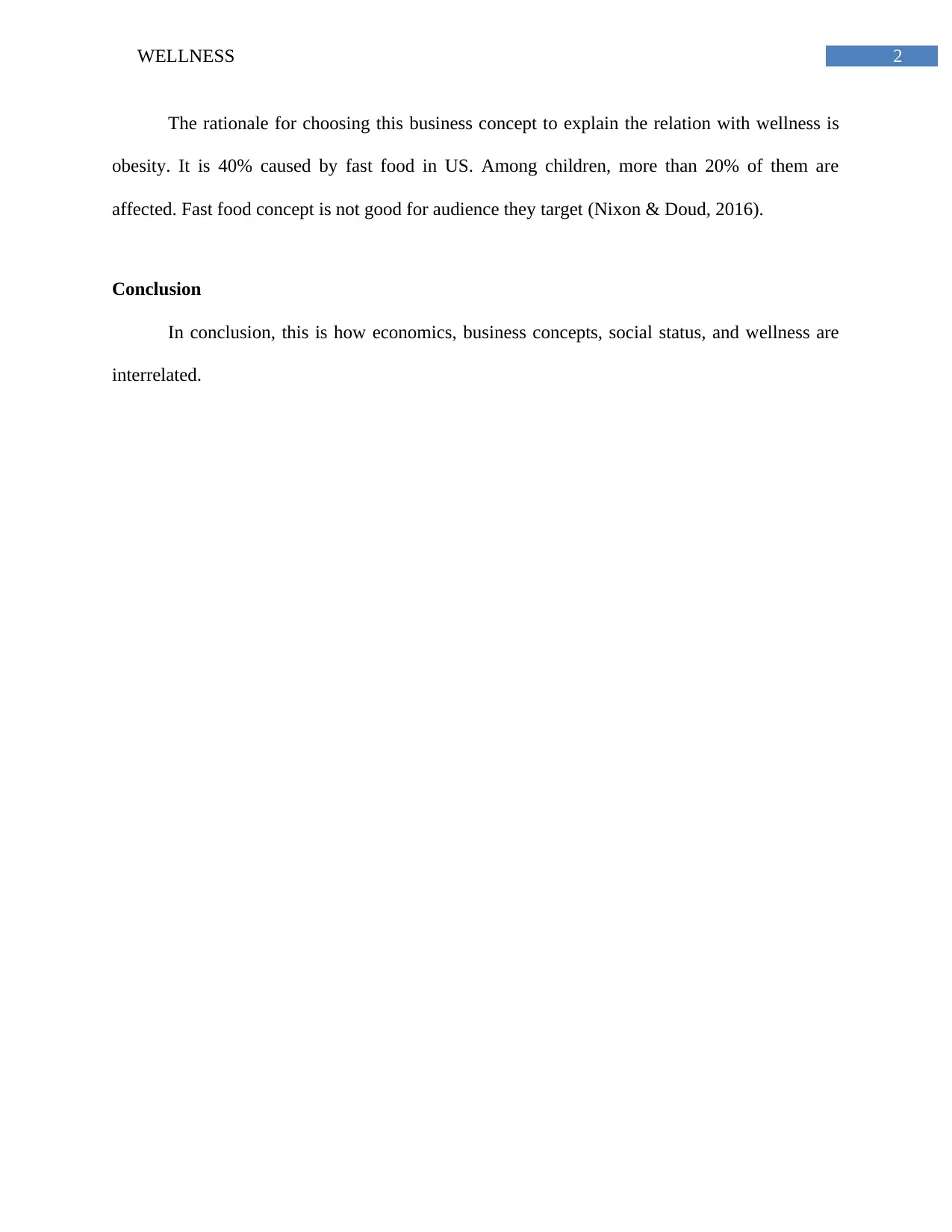
The rationale for choosing this business concept to explain the relation with wellness is
obesity. It is 40% caused by fast food in US. Among children, more than 20% of them are
affected. Fast food concept is not good for audience they target (Nixon & Doud, 2016).
Conclusion
In conclusion, this is how economics, business concepts, social status, and wellness are
interrelated.
Document Page
3WELLNESS
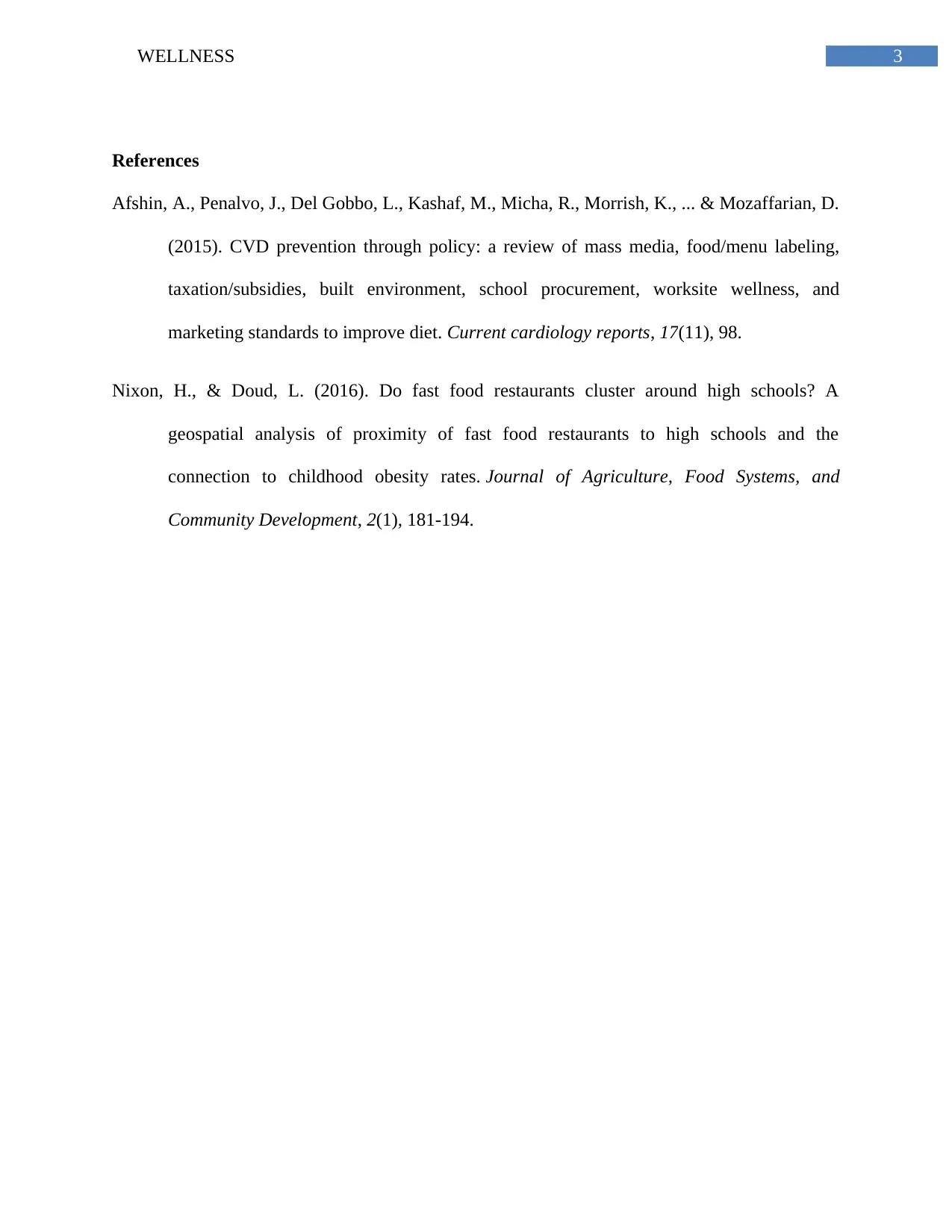
References
Afshin, A., Penalvo, J., Del Gobbo, L., Kashaf, M., Micha, R., Morrish, K., ... & Mozaffarian, D.
(2015). CVD prevention through policy: a review of mass media, food/menu labeling,
taxation/subsidies, built environment, school procurement, worksite wellness, and
marketing standards to improve diet. Current cardiology reports, 17(11), 98.
Nixon, H., & Doud, L. (2016). Do fast food restaurants cluster around high schools? A
geospatial analysis of proximity of fast food restaurants to high schools and the
connection to childhood obesity rates. Journal of Agriculture, Food Systems, and
Community Development, 2(1), 181-194.
chevron_up_icon
1 out of 4
circle_padding
hide_on_mobile
zoom_out_icon
[object Object]