Corporate Governance and Risk Management Audit: Wells Fargo Case Study
VerifiedAdded on 2021/06/17
|20
|5562
|64
Report
AI Summary
This report conducts a governance and risk management audit of Wells Fargo, examining the company's values, financial management, and accountability. It provides an overview of Wells Fargo's operations, its advertised values, and historical context, including the account fraud scandal. The report delves into financial management practices, including the application of Basel III capital rules and liquidity coverage ratios. It identifies risks to Wells Fargo's well-being, such as reputational damage and regulatory scrutiny, and analyzes the company's management structure. The audit highlights the importance of ethical conduct, transparency, and effective risk management in the financial industry, and concludes with recommendations for improved corporate governance and risk mitigation strategies. The report emphasizes the need for robust internal controls and a strong ethical culture to prevent future scandals and protect stakeholder interests.
1
Corporate Governance and Risk Management Audit Exercise
Case of Wells Fargo Company and the Case of “Wells Fargo account Fraud Scandal”
Student Name:
Student Number:
Module Code:
Submission Date:
Corporate Governance and Risk Management Audit Exercise
Case of Wells Fargo Company and the Case of “Wells Fargo account Fraud Scandal”
Student Name:
Student Number:
Module Code:
Submission Date:

Paraphrase This Document
Need a fresh take? Get an instant paraphrase of this document with our AI Paraphraser
2
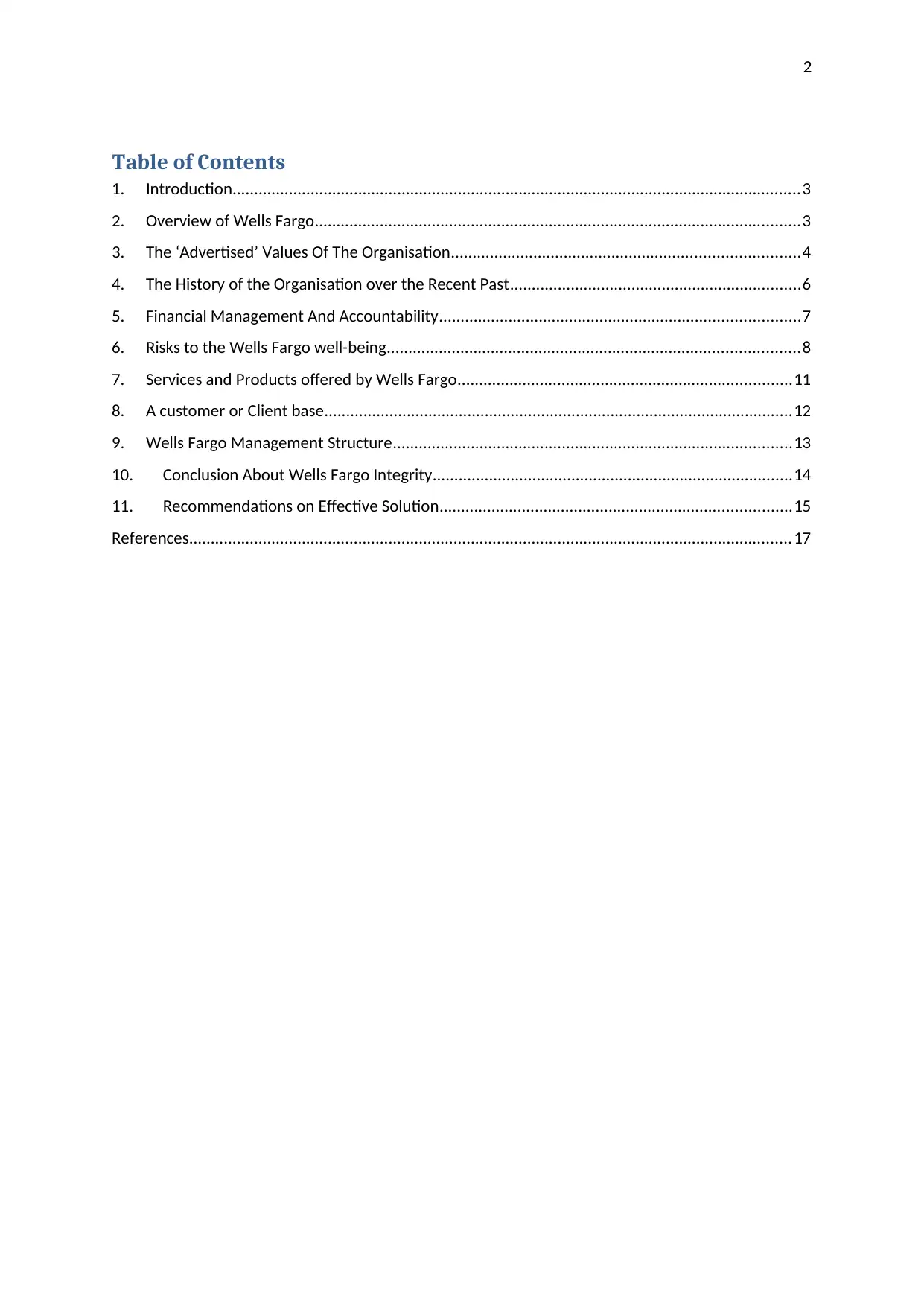
Table of Contents
1. Introduction...................................................................................................................................3
2. Overview of Wells Fargo................................................................................................................3
3. The ‘Advertised’ Values Of The Organisation................................................................................4
4. The History of the Organisation over the Recent Past...................................................................6
5. Financial Management And Accountability...................................................................................7
6. Risks to the Wells Fargo well-being...............................................................................................8
7. Services and Products offered by Wells Fargo.............................................................................11
8. A customer or Client base............................................................................................................12
9. Wells Fargo Management Structure............................................................................................13
10. Conclusion About Wells Fargo Integrity...................................................................................14
11. Recommendations on Effective Solution.................................................................................15
References...........................................................................................................................................17
Table of Contents
1. Introduction...................................................................................................................................3
2. Overview of Wells Fargo................................................................................................................3
3. The ‘Advertised’ Values Of The Organisation................................................................................4
4. The History of the Organisation over the Recent Past...................................................................6
5. Financial Management And Accountability...................................................................................7
6. Risks to the Wells Fargo well-being...............................................................................................8
7. Services and Products offered by Wells Fargo.............................................................................11
8. A customer or Client base............................................................................................................12
9. Wells Fargo Management Structure............................................................................................13
10. Conclusion About Wells Fargo Integrity...................................................................................14
11. Recommendations on Effective Solution.................................................................................15
References...........................................................................................................................................17
3
1. Introduction
Values in organizations play a key role in determining the nature of actions to
implement. It is through identification of organizational values such as actual and proclaimed
that all actions relate to values (Ruiz Jiménez, Vallejo Martos and Martínez Jiménez 2015).
Furthermore, values allow companies establish robust structures that enhance
“operationalisation” of all values. Avota, McFadzean and Peiseniece (2015) illustrate that
such problems could include differences in value systems. External auditors that conduct
governance and risk management seek to identify clear guidelines concerning the constraints
of acceptable behaviour consistent across the world. They try to identify available differences
in the market where they operate. In overall, managers conduct governance and risk
management audit in order to identify core values as well as evaluate internal and external
implementation. This paper conducts a governance and risk management audit of Wells
Fargo Company.
2. Overview of Wells Fargo
Wells Fargo operates in American market within its headquarters at San Francisco,
California. Currently, the company operates in almost every part of American market. The
recent market ratings conducted by Waistell (2017) revealed that Wells Fargo ranks second in
terms of market capitalization. Furthermore, the company ranks third in US in terms of total
assets. For example, the 2015 report by Nightingale (2018) reveals that the company ranked
highest in market capitalization. Wells Fargo also operates through the national bank Wells
Fargo Bank, N.A as its primary subsidiary. The primary main offices are located at Sioux
Falls, South Dakota.
1. Introduction
Values in organizations play a key role in determining the nature of actions to
implement. It is through identification of organizational values such as actual and proclaimed
that all actions relate to values (Ruiz Jiménez, Vallejo Martos and Martínez Jiménez 2015).
Furthermore, values allow companies establish robust structures that enhance
“operationalisation” of all values. Avota, McFadzean and Peiseniece (2015) illustrate that
such problems could include differences in value systems. External auditors that conduct
governance and risk management seek to identify clear guidelines concerning the constraints
of acceptable behaviour consistent across the world. They try to identify available differences
in the market where they operate. In overall, managers conduct governance and risk
management audit in order to identify core values as well as evaluate internal and external
implementation. This paper conducts a governance and risk management audit of Wells
Fargo Company.
2. Overview of Wells Fargo
Wells Fargo operates in American market within its headquarters at San Francisco,
California. Currently, the company operates in almost every part of American market. The
recent market ratings conducted by Waistell (2017) revealed that Wells Fargo ranks second in
terms of market capitalization. Furthermore, the company ranks third in US in terms of total
assets. For example, the 2015 report by Nightingale (2018) reveals that the company ranked
highest in market capitalization. Wells Fargo also operates through the national bank Wells
Fargo Bank, N.A as its primary subsidiary. The primary main offices are located at Sioux
Falls, South Dakota.
⊘ This is a preview!⊘
Do you want full access?
Subscribe today to unlock all pages.

Trusted by 1+ million students worldwide
4
As one of the leading player in the financial sector, the company management
believes that it has an important role to play in offering thought leadership as well as ensuring
that it delivers practical solutions for some of the challenges arising from economic, social,
and environment. For example, the company uses its products and services, cultures,
philanthropy, and operations to fulfil its commitments (Porter 2015). The company illustrates
its commitments through its vision, values, and goals. For example, the company vision
shows that it is committed in ensuring that it satisfies the financial needs of its customers by
helping them to succeed financially. The major premise around this commitment is to serve
customers better when there is a strong relationship between customers and the provider who
understands them well as well as offering of reliable guidelines.
In every action that the company takes, it applies five major values. The company
understands what is right for its customers. It relies on people/employees as its key
competitive advantage to compete against other financial service providers. The value of
ethics makes it gain a higher commitment towards using highest standards of integrity,
principled performance, as well as transparency in all its actions. The value of diversity and
inclusion helps the company value and promote diversity and inclusion across all areas of
operation. The value of leadership reminds the company about its call to be leaders. This
makes it easier for the company to provide an environment where everyone can attain own
leadership, lead the team, and in overall, lead the company as a whole.
3. The ‘Advertised’ Values Of The Organisation
The company has five primary values that they emphasis out in public. They mainly
are the rights of clients, diversity, and participation, individuals and leadership as a rivalry
advantage. Wells Fargo aims at employing the most skilled people in the market. The
As one of the leading player in the financial sector, the company management
believes that it has an important role to play in offering thought leadership as well as ensuring
that it delivers practical solutions for some of the challenges arising from economic, social,
and environment. For example, the company uses its products and services, cultures,
philanthropy, and operations to fulfil its commitments (Porter 2015). The company illustrates
its commitments through its vision, values, and goals. For example, the company vision
shows that it is committed in ensuring that it satisfies the financial needs of its customers by
helping them to succeed financially. The major premise around this commitment is to serve
customers better when there is a strong relationship between customers and the provider who
understands them well as well as offering of reliable guidelines.
In every action that the company takes, it applies five major values. The company
understands what is right for its customers. It relies on people/employees as its key
competitive advantage to compete against other financial service providers. The value of
ethics makes it gain a higher commitment towards using highest standards of integrity,
principled performance, as well as transparency in all its actions. The value of diversity and
inclusion helps the company value and promote diversity and inclusion across all areas of
operation. The value of leadership reminds the company about its call to be leaders. This
makes it easier for the company to provide an environment where everyone can attain own
leadership, lead the team, and in overall, lead the company as a whole.
3. The ‘Advertised’ Values Of The Organisation
The company has five primary values that they emphasis out in public. They mainly
are the rights of clients, diversity, and participation, individuals and leadership as a rivalry
advantage. Wells Fargo aims at employing the most skilled people in the market. The
Paraphrase This Document
Need a fresh take? Get an instant paraphrase of this document with our AI Paraphraser
5
firm searches for individuals who care and work together as partners across business
sections and duties.
Wells Fargo strives for each member of the staff to say they chose the right
organization; they are valued, rewarded and recognized. The team work hard but have fun
at the same time. The company seeks to ensure the staff has the satisfaction that they can
enhance themselves professionally in the company. Since people trust Wells Fargo to
protect their money, staff in the firm are held to the highest standards of ethics. Each
person is accountable for the decision they make and relaying it is vital.
At the company, client’s best interest is always taken into consideration. The client is
considered to be still right hence the firm`s members of staff ensure to do what is right for
the consumer. Wells Fargo values and advocates diversity and inclusion in all aspects of
its operations and all levels of the company (Maylett & Wride, 2017). These two values
are in complete contrast to the actions taken by the firm. The company did not involve the
customer when creating fake accounts and charging them for the unrecognized accounts.
Why is it that the customer raising issues on the high cost of debit cards arising from
clone accounts not treated truthfully?
An environment that is fruitful and diverse on the workstation is one of Wells Fargo’s
most recognized values. The company encourages leadership at all levels of the company.
Each person has the power to lead and have the self-esteem to do so. Wells Fargo looks
for the most qualified candidates to work for them (Maylett & Wride, 2017). Individuals
hired by Wells Fargo offer upscale training and are rewarded for their exceptional results.
Wells Fargo wishes all members of the team to be in a constant state of development and
growth. The chances of professional increase in the company include tuition
firm searches for individuals who care and work together as partners across business
sections and duties.
Wells Fargo strives for each member of the staff to say they chose the right
organization; they are valued, rewarded and recognized. The team work hard but have fun
at the same time. The company seeks to ensure the staff has the satisfaction that they can
enhance themselves professionally in the company. Since people trust Wells Fargo to
protect their money, staff in the firm are held to the highest standards of ethics. Each
person is accountable for the decision they make and relaying it is vital.
At the company, client’s best interest is always taken into consideration. The client is
considered to be still right hence the firm`s members of staff ensure to do what is right for
the consumer. Wells Fargo values and advocates diversity and inclusion in all aspects of
its operations and all levels of the company (Maylett & Wride, 2017). These two values
are in complete contrast to the actions taken by the firm. The company did not involve the
customer when creating fake accounts and charging them for the unrecognized accounts.
Why is it that the customer raising issues on the high cost of debit cards arising from
clone accounts not treated truthfully?
An environment that is fruitful and diverse on the workstation is one of Wells Fargo’s
most recognized values. The company encourages leadership at all levels of the company.
Each person has the power to lead and have the self-esteem to do so. Wells Fargo looks
for the most qualified candidates to work for them (Maylett & Wride, 2017). Individuals
hired by Wells Fargo offer upscale training and are rewarded for their exceptional results.
Wells Fargo wishes all members of the team to be in a constant state of development and
growth. The chances of professional increase in the company include tuition
6
reimbursement for career-related programs, setting objectives and performance education
and finally online career growth tools and resources.
4. The History of the Organisation over the Recent Past
Currently, Wells Fargo is involved in a scandal where it is accused that members of
staff opened millions of fake accounts under the names of unwitting clients. The company
has faced many suits and fines imposed on them. However, for the past years before the
scandal, the company has been on a successful path all along. This has just been revealed
to be a lie due to it unscrupulous undertakings behind the scenes.
The company has been involved in cross-selling which is a practice supporting the
fraud. The concept was used to sell many products to clients. For example, a client with a
checking account may be encouraged to take a mortgage or create an online bank
account. The profitability of retail banks was determined partially by the number of
products held by clients, and the firm was at the top of all banks. The company was
allegedly introduced to the technique by the once C.E.O Richard Kovacevich. The actions
of Richard defies the social expectations of the clients since the bank is merely using its
clients for selfish gains.
The firm’s sales and cross-selling technique were brought to light by the Wall Street
Journal in 2011. In 2013, an investigation done by L.A Times showed intense pressure on
bank managers and bankers to produce sales against difficult and impossible quotas
(Schwartz, 2017). It became apparent that members of staff in Wells Fargo had been
encouraged to order debit cards for pre-approved clients without their permission. The
reimbursement for career-related programs, setting objectives and performance education
and finally online career growth tools and resources.
4. The History of the Organisation over the Recent Past
Currently, Wells Fargo is involved in a scandal where it is accused that members of
staff opened millions of fake accounts under the names of unwitting clients. The company
has faced many suits and fines imposed on them. However, for the past years before the
scandal, the company has been on a successful path all along. This has just been revealed
to be a lie due to it unscrupulous undertakings behind the scenes.
The company has been involved in cross-selling which is a practice supporting the
fraud. The concept was used to sell many products to clients. For example, a client with a
checking account may be encouraged to take a mortgage or create an online bank
account. The profitability of retail banks was determined partially by the number of
products held by clients, and the firm was at the top of all banks. The company was
allegedly introduced to the technique by the once C.E.O Richard Kovacevich. The actions
of Richard defies the social expectations of the clients since the bank is merely using its
clients for selfish gains.
The firm’s sales and cross-selling technique were brought to light by the Wall Street
Journal in 2011. In 2013, an investigation done by L.A Times showed intense pressure on
bank managers and bankers to produce sales against difficult and impossible quotas
(Schwartz, 2017). It became apparent that members of staff in Wells Fargo had been
encouraged to order debit cards for pre-approved clients without their permission. The
⊘ This is a preview!⊘
Do you want full access?
Subscribe today to unlock all pages.
Trusted by 1+ million students worldwide
7
owner’s information was then used in filling requests to ensure they weren’t aware of it.
The employees also made false checking and savings accounts which means transactions
would be made from legitimate accounts. This creation of products was made possible in
part through a course known as pinning.
owner’s information was then used in filling requests to ensure they weren’t aware of it.
The employees also made false checking and savings accounts which means transactions
would be made from legitimate accounts. This creation of products was made possible in
part through a course known as pinning.
Paraphrase This Document
Need a fresh take? Get an instant paraphrase of this document with our AI Paraphraser
8
5. Financial Management And Accountability
Management of the company has put in place measures and policies that guide how it
manages finances. The company applies the Basel III capital rules while reporting its
financial position. The basic objectives to follow such code of conduct in reporting, is
because of the regulatory framework that helps to strengthen the company by following
guidelines concerning leverage ratios, capital requirements, and liquidity coverage ratio
(Wells Fargo 2018). The company management understands that in normal economic
operations, it can depend on high leverage ratio to enhance its returns. However, such ratio
can as well become disastrous when the market prices fall below the expected level and
liquidity level recedes (Grima & Bezzina 2016). The company has managed to institute Basel
III rules in the first quarter of 2018 financial reporting to achieve high-quality assets that are
above 3% of all its assets. The application of LCR is a clear indication that the bank has
succeeded in promoting its short-term resilience risk profile. For instance, the company now
has enough stock of its unencumbered high-liquid assets (HQLA) easy to convert into cash to
meet all types of financial needs likely to occur in a period of 30 days. Mathur and
Rangarajan (2015) explain that proper financial management requires that companies now
have the ability to absorb any kind of crisis or risks likely to arise from either economic of
financial stress. Hence, the company has succeeded to reduce the risk of spill over likely to
arise from the financial market during its normal operations.
The company financial management and accountability is guided by the principle to
achieve high capital requirements. Miu and Ozdemir (2012) reiterate that according to Basel
III, all banks must have a minimum capital adequacy ratio of 8%. The company applies this
measure to weight the risks likely to come from its assets. The company now uses the capital-
to-risk-weighted-assets ratio as the best way for managing its finances. It creates stability and
efficiency in all its operations. For example, the company now adds tier 1 capital to tier 2
5. Financial Management And Accountability
Management of the company has put in place measures and policies that guide how it
manages finances. The company applies the Basel III capital rules while reporting its
financial position. The basic objectives to follow such code of conduct in reporting, is
because of the regulatory framework that helps to strengthen the company by following
guidelines concerning leverage ratios, capital requirements, and liquidity coverage ratio
(Wells Fargo 2018). The company management understands that in normal economic
operations, it can depend on high leverage ratio to enhance its returns. However, such ratio
can as well become disastrous when the market prices fall below the expected level and
liquidity level recedes (Grima & Bezzina 2016). The company has managed to institute Basel
III rules in the first quarter of 2018 financial reporting to achieve high-quality assets that are
above 3% of all its assets. The application of LCR is a clear indication that the bank has
succeeded in promoting its short-term resilience risk profile. For instance, the company now
has enough stock of its unencumbered high-liquid assets (HQLA) easy to convert into cash to
meet all types of financial needs likely to occur in a period of 30 days. Mathur and
Rangarajan (2015) explain that proper financial management requires that companies now
have the ability to absorb any kind of crisis or risks likely to arise from either economic of
financial stress. Hence, the company has succeeded to reduce the risk of spill over likely to
arise from the financial market during its normal operations.
The company financial management and accountability is guided by the principle to
achieve high capital requirements. Miu and Ozdemir (2012) reiterate that according to Basel
III, all banks must have a minimum capital adequacy ratio of 8%. The company applies this
measure to weight the risks likely to come from its assets. The company now uses the capital-
to-risk-weighted-assets ratio as the best way for managing its finances. It creates stability and
efficiency in all its operations. For example, the company now adds tier 1 capital to tier 2
9
capitals then divides by the risk-weighted assets to meet financial accountability. The
company relies on tier 1 as its core capital that covers equity capital and disclosed reserves.
The company is able to absorb any nature of losses without necessarily requiring
management to stop some operations. While on the other hand, the company depends on tier
2 capital to assist it absorb possible losses in the event of liquidation (Rasheed, Siong-Hook
and Habibullah 2016). The current tier 1 and tier 2 capitals for the company is more than 8%
minimum requirement of its risk-weighted assets. For instance, the 2017 common equity tier
1 to its total risk-weighted assets (RWAs) amounts to 11.9%.
The current strong financial management has helped the company in achieving
liquidity coverage ratio. The conduct is also another indicator that shows accountability and
strong financial management of its assets. Kleinknecht and Ng (2015) explain that liquidity
coverage ratio mandates financial institutions to have high quality, liquid assets that
management can use to cover their cash outflows for at least a period of 30 days in case the
company experiences unexpected event. For instance, the net stable funding that the company
needs is to have stable funding that it could make the company to operate effectively in an
entire year. For stakeholders such as individuals, businesses, and commercials, they have
been able to have higher confidence in the strength as well as the stability of the company’s
balance sheet. Even though the company has been able to reduce leverage and impose capital
requirements of Basel III to reduce its earnings power during good economic period, it is
imperative to note that management have succeed to make to make the company safer.
Consequently, the company is now in a better position to survive and grow under any risk or
crisis.
6. Risks to the Wells Fargo well-being
Risks in organizations refers to perceptions developed by stakeholders towards
unpredictable events that have potentials of causing negative impacts to stakeholders as well
capitals then divides by the risk-weighted assets to meet financial accountability. The
company relies on tier 1 as its core capital that covers equity capital and disclosed reserves.
The company is able to absorb any nature of losses without necessarily requiring
management to stop some operations. While on the other hand, the company depends on tier
2 capital to assist it absorb possible losses in the event of liquidation (Rasheed, Siong-Hook
and Habibullah 2016). The current tier 1 and tier 2 capitals for the company is more than 8%
minimum requirement of its risk-weighted assets. For instance, the 2017 common equity tier
1 to its total risk-weighted assets (RWAs) amounts to 11.9%.
The current strong financial management has helped the company in achieving
liquidity coverage ratio. The conduct is also another indicator that shows accountability and
strong financial management of its assets. Kleinknecht and Ng (2015) explain that liquidity
coverage ratio mandates financial institutions to have high quality, liquid assets that
management can use to cover their cash outflows for at least a period of 30 days in case the
company experiences unexpected event. For instance, the net stable funding that the company
needs is to have stable funding that it could make the company to operate effectively in an
entire year. For stakeholders such as individuals, businesses, and commercials, they have
been able to have higher confidence in the strength as well as the stability of the company’s
balance sheet. Even though the company has been able to reduce leverage and impose capital
requirements of Basel III to reduce its earnings power during good economic period, it is
imperative to note that management have succeed to make to make the company safer.
Consequently, the company is now in a better position to survive and grow under any risk or
crisis.
6. Risks to the Wells Fargo well-being
Risks in organizations refers to perceptions developed by stakeholders towards
unpredictable events that have potentials of causing negative impacts to stakeholders as well
⊘ This is a preview!⊘
Do you want full access?
Subscribe today to unlock all pages.
Trusted by 1+ million students worldwide
10
as the organization itself (Hyman 2013). The risk lifecycle framework developed by
Mahoney (2016), indicates that any organization that fails to keep pace with the needed
changes, could experience risks from pre-conditions, trigger, crisis, and post-crisis period.
When this happens, it affects the well-being of stakeholders and the organization itself.
Radosevich (2018) posit that management of change make managers develop insight
concerning the best way to manage impacts of disruptive events that could cause losses to
internal and external stakeholders. Crandall, Parnell and Spillan (2014) explain that risks are
companies do not just occur from nowhere. Even though the company reported the recent
2015 accounts scandal, there were some eminent sights that the risk was bound to take place.
Gobry (2016) focuses on explaining the real reasons that made employees of Wells Fargo to
commit fraud. The findings from the enquiry of the parliamentary commission revealed that
the company employees went ahead to use unauthorized customer details to create two
million bank and credit card accounts.
According to the New York Times, is that the executives held two-day retreat with the
employees to warn them against opening fake accounts. The 2014 workshop was a two-day
ethics meeting between executive and account opening department held to give instructions
to everyone involved in opening and maintaining accounts. Initially, the company was well
known within the financial market as a company that could design cross-selling strategy. For
instance, the strategy involved having customers that owned products that were then allowed
to purchase other products. The company found such a strategy to be much lucrative as part
of its retail banking. The company found getting a client as the most expensive thing to create
customer relationship. Therefore, the company found it imperative and profitable to sell as
many products as possible to its existing clients. The company chief executive officer-John
Stumpf encouraged this idea by giving employees the target to open accounts and sell eight
products to every customer. However, he asked why the companies had just targeted eight
as the organization itself (Hyman 2013). The risk lifecycle framework developed by
Mahoney (2016), indicates that any organization that fails to keep pace with the needed
changes, could experience risks from pre-conditions, trigger, crisis, and post-crisis period.
When this happens, it affects the well-being of stakeholders and the organization itself.
Radosevich (2018) posit that management of change make managers develop insight
concerning the best way to manage impacts of disruptive events that could cause losses to
internal and external stakeholders. Crandall, Parnell and Spillan (2014) explain that risks are
companies do not just occur from nowhere. Even though the company reported the recent
2015 accounts scandal, there were some eminent sights that the risk was bound to take place.
Gobry (2016) focuses on explaining the real reasons that made employees of Wells Fargo to
commit fraud. The findings from the enquiry of the parliamentary commission revealed that
the company employees went ahead to use unauthorized customer details to create two
million bank and credit card accounts.
According to the New York Times, is that the executives held two-day retreat with the
employees to warn them against opening fake accounts. The 2014 workshop was a two-day
ethics meeting between executive and account opening department held to give instructions
to everyone involved in opening and maintaining accounts. Initially, the company was well
known within the financial market as a company that could design cross-selling strategy. For
instance, the strategy involved having customers that owned products that were then allowed
to purchase other products. The company found such a strategy to be much lucrative as part
of its retail banking. The company found getting a client as the most expensive thing to create
customer relationship. Therefore, the company found it imperative and profitable to sell as
many products as possible to its existing clients. The company chief executive officer-John
Stumpf encouraged this idea by giving employees the target to open accounts and sell eight
products to every customer. However, he asked why the companies had just targeted eight
Paraphrase This Document
Need a fresh take? Get an instant paraphrase of this document with our AI Paraphraser
11
and not ten. Such unrealistic idea is what led a majority of greedy employees to expose the
company to the risk by using same customer details to create fake accounts (Cagnoni 2017).
Cybercrime also forms a set of risk likely to affect the company well-being. Jones
(2016) explains that banks have continued to fall victim of cyber-heists. Criminals use their
skills to hack into security systems of banks. The masquerade as official personnel of such
institutions then they end up transferring unauthorized millions of dollars to their fake
accounts. The attacks on banks and other financial institutions fall under one of the
cybercrime risks that affect global banking systems (Herley 2014). For example, the risk
relates to a wider range of the offences that cover compromising of information technology
and consequently, affecting the well-being of the company in terms of reputation, customer
base, and financial position. In todays’ technology advanced markets, the amount of money
that hackers steal during cyber-heists has reached staggering levels. Stanciu and Tinca (2017)
estimate the theft reached $3 trillion in 2016.
The risk at the company could involve the use of the customized “malware” such as
malicious software in order to cause infection to the company computer systems.
Consequently, the risk could see hackers affecting the financial position by withdrawing large
sums of money as well as accessing customer sensitive information such as the places where
they live, credit information, as well as security information like passwords (Kesari,
Hoofnagle & McCoy 2017). In a recent case of Carbanak, hackers conducted spear phishing
by sending malware-ridden emails to several employees of the bank. The act made them to
control computers and entire system at the company. The hackers managed to trace the
company network to identify how they could trace the financial data before using payment
transfer to withdraw money to their created fake accounts. Besides, they also used remote
commands to operate different ATMs.
and not ten. Such unrealistic idea is what led a majority of greedy employees to expose the
company to the risk by using same customer details to create fake accounts (Cagnoni 2017).
Cybercrime also forms a set of risk likely to affect the company well-being. Jones
(2016) explains that banks have continued to fall victim of cyber-heists. Criminals use their
skills to hack into security systems of banks. The masquerade as official personnel of such
institutions then they end up transferring unauthorized millions of dollars to their fake
accounts. The attacks on banks and other financial institutions fall under one of the
cybercrime risks that affect global banking systems (Herley 2014). For example, the risk
relates to a wider range of the offences that cover compromising of information technology
and consequently, affecting the well-being of the company in terms of reputation, customer
base, and financial position. In todays’ technology advanced markets, the amount of money
that hackers steal during cyber-heists has reached staggering levels. Stanciu and Tinca (2017)
estimate the theft reached $3 trillion in 2016.
The risk at the company could involve the use of the customized “malware” such as
malicious software in order to cause infection to the company computer systems.
Consequently, the risk could see hackers affecting the financial position by withdrawing large
sums of money as well as accessing customer sensitive information such as the places where
they live, credit information, as well as security information like passwords (Kesari,
Hoofnagle & McCoy 2017). In a recent case of Carbanak, hackers conducted spear phishing
by sending malware-ridden emails to several employees of the bank. The act made them to
control computers and entire system at the company. The hackers managed to trace the
company network to identify how they could trace the financial data before using payment
transfer to withdraw money to their created fake accounts. Besides, they also used remote
commands to operate different ATMs.
12
7. Services and Products offered by Wells Fargo
Wells Fargo offers differentiated services and products to three segments of customers –
personal, small business, and commercial (https://www.wellsfargo.com/). The services
offered to personal categories of customers cover banking, loans and credits, investing and
retirement, and wealth management. For example, the banking services focuses on opening of
accounts such as checking accounts, savings accounts and CDs, debit and prepaid cards,
foreign exchanges, and global remittance services, online banking, transfer and pay, and
mobile features. The loans and credit services to personal households makes the company to
offer services such as mortgage loans, home equity lines, personal lines and loans, student
loans, auto loans, and credit cards. Consultancy financial services in investing and retirement
train individuals on ways to invest, solutions to investing, and ways to achieve financial
goals. The wealth management consultancy services cover a wider range of wealth services,
wealth solutions (wealth planning, private banking, investment management, specialized
wealth services, and trust services), and wealth advice and guidance.
The second category of services and products targets small businesses. Currently, the
company offer services that seek to make entrepreneurs start, run, grow, and exploit the
resources of their businesses. The company outlines on its website that it offers four
categories to small businesses (banking, loans and credits, merchant services, and payroll &
other services) (https://www.wellsfargo.com/biz/). For example, the company offer eight
different banking services to small businesses (some of them include business checking,
business savings and CDs, business debit cards, business online baking, etc.). The loans and
credit products and services are categorized into seven areas (SBA loans, health practice
financing, business real estate financing, e.t.c). The merchant services supports business in
payment solutions (the solutions allows businesses to benefit from clover POS systems, EMV
chip card technology, mobile payments, credit card processing options, and payment
services). While at the same time, the company ensures that it offers solutions that make
7. Services and Products offered by Wells Fargo
Wells Fargo offers differentiated services and products to three segments of customers –
personal, small business, and commercial (https://www.wellsfargo.com/). The services
offered to personal categories of customers cover banking, loans and credits, investing and
retirement, and wealth management. For example, the banking services focuses on opening of
accounts such as checking accounts, savings accounts and CDs, debit and prepaid cards,
foreign exchanges, and global remittance services, online banking, transfer and pay, and
mobile features. The loans and credit services to personal households makes the company to
offer services such as mortgage loans, home equity lines, personal lines and loans, student
loans, auto loans, and credit cards. Consultancy financial services in investing and retirement
train individuals on ways to invest, solutions to investing, and ways to achieve financial
goals. The wealth management consultancy services cover a wider range of wealth services,
wealth solutions (wealth planning, private banking, investment management, specialized
wealth services, and trust services), and wealth advice and guidance.
The second category of services and products targets small businesses. Currently, the
company offer services that seek to make entrepreneurs start, run, grow, and exploit the
resources of their businesses. The company outlines on its website that it offers four
categories to small businesses (banking, loans and credits, merchant services, and payroll &
other services) (https://www.wellsfargo.com/biz/). For example, the company offer eight
different banking services to small businesses (some of them include business checking,
business savings and CDs, business debit cards, business online baking, etc.). The loans and
credit products and services are categorized into seven areas (SBA loans, health practice
financing, business real estate financing, e.t.c). The merchant services supports business in
payment solutions (the solutions allows businesses to benefit from clover POS systems, EMV
chip card technology, mobile payments, credit card processing options, and payment
services). While at the same time, the company ensures that it offers solutions that make
⊘ This is a preview!⊘
Do you want full access?
Subscribe today to unlock all pages.
Trusted by 1+ million students worldwide

1 out of 20


Related Documents


Your All-in-One AI-Powered Toolkit for Academic Success.
+13062052269
info@desklib.com
Available 24*7 on WhatsApp / Email
![[object Object]](/_next/static/media/star-bottom.7253800d.svg)
Unlock your academic potential
Copyright © 2020–2026 A2Z Services. All Rights Reserved. Developed and managed by ZUCOL.