Social Change: Western Aid & Political Development in Third World
VerifiedAdded on 2023/06/10
|17
|4998
|238
Essay
AI Summary
This essay explores the contentious role of Western aid in the political development of Third World countries, examining both the positive and negative impacts. It delves into the debates surrounding Western aid, highlighting how it can expose recipient nations to political manipulation by donor countries. Through case studies, the research illustrates instances where Western aid has both benefited and manipulated Third World politics. The essay analyzes the motivations behind aid provision, referencing theories such as the political stability hypothesis and the power political hypothesis. It also addresses criticisms of Western aid, including its potential use as a tool for advancing capitalist exploitation and exacerbating political disparities. The conclusion summarizes the complex relationship between Western aid and political change, emphasizing the need for transparency and accountability in aid distribution to ensure genuine development rather than political manipulation. Desklib provides a platform to access this and similar assignments for academic assistance.
Running head: SOCIAL CHANGE AND DEVELOPMENT 1
Social change and development
Name:
Institution Affiliation:
Social change and development
Name:
Institution Affiliation:

Paraphrase This Document
Need a fresh take? Get an instant paraphrase of this document with our AI Paraphraser
SOCIAL CHANGE AND DEVELOPMENT 2
Executive Summary
in this research it would analyze on the role of the western aid to the political development of
the Third World countries. This research would unravel on the western aid debates, which
highlights on the positives as well as the negatives which have surrounded on this contentious
concept. Within the paper it would explain on the provisions of the Western aid on how it
exposes Third World countries to the first World political manipulation. The research would
provide examples which are case study examples of countries which have positively benefited
from the Western aid and how it has enhanced political manipulation.
Executive Summary
in this research it would analyze on the role of the western aid to the political development of
the Third World countries. This research would unravel on the western aid debates, which
highlights on the positives as well as the negatives which have surrounded on this contentious
concept. Within the paper it would explain on the provisions of the Western aid on how it
exposes Third World countries to the first World political manipulation. The research would
provide examples which are case study examples of countries which have positively benefited
from the Western aid and how it has enhanced political manipulation.
SOCIAL CHANGE AND DEVELOPMENT 3
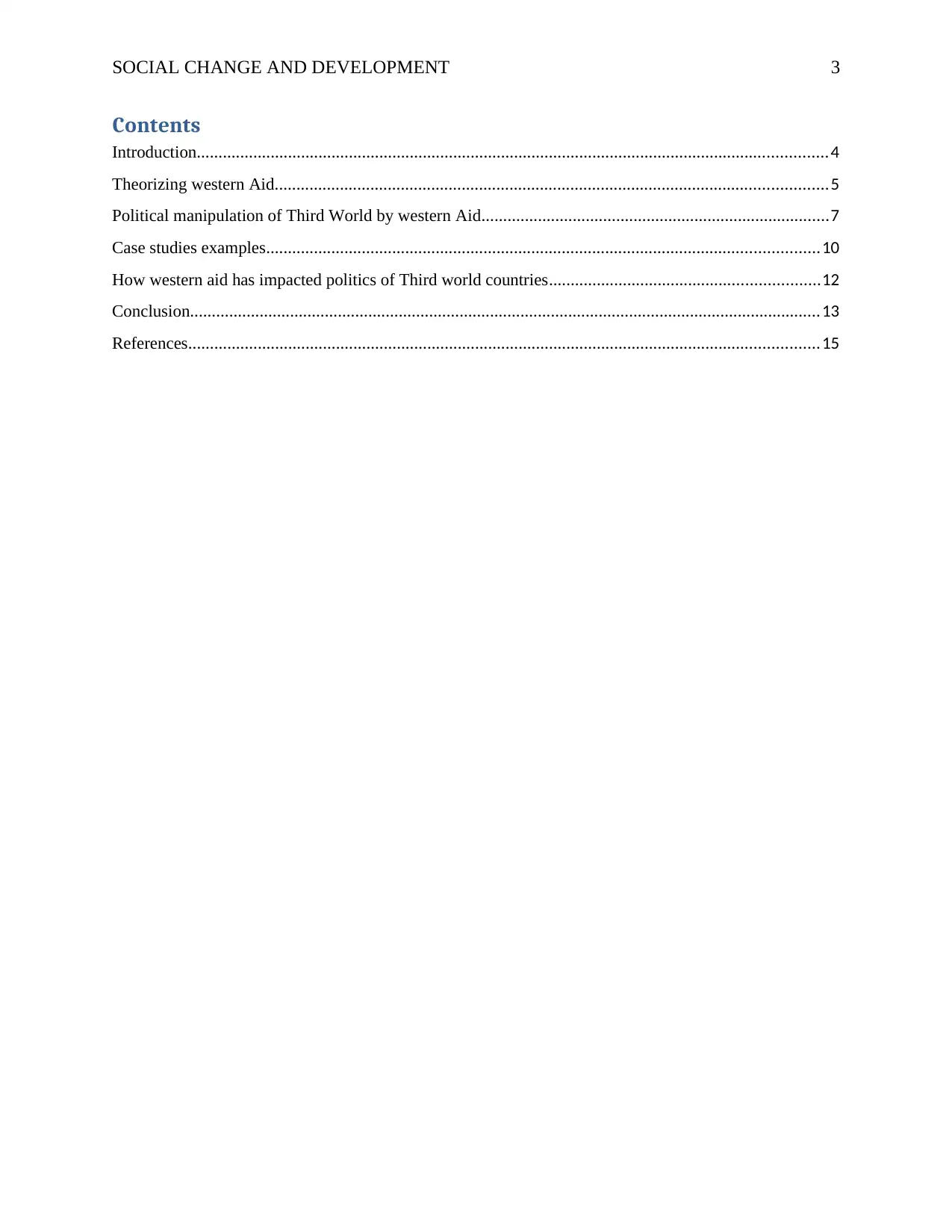
Contents
Introduction.................................................................................................................................................4
Theorizing western Aid...............................................................................................................................5
Political manipulation of Third World by western Aid................................................................................7
Case studies examples...............................................................................................................................10
How western aid has impacted politics of Third world countries..............................................................12
Conclusion.................................................................................................................................................13
References.................................................................................................................................................15
Contents
Introduction.................................................................................................................................................4
Theorizing western Aid...............................................................................................................................5
Political manipulation of Third World by western Aid................................................................................7
Case studies examples...............................................................................................................................10
How western aid has impacted politics of Third world countries..............................................................12
Conclusion.................................................................................................................................................13
References.................................................................................................................................................15
⊘ This is a preview!⊘
Do you want full access?
Subscribe today to unlock all pages.

Trusted by 1+ million students worldwide
SOCIAL CHANGE AND DEVELOPMENT 4
Introduction
According to Easterly (2006) defines the modern western aid as the voluntary transfer of the
resources from one country to another , provided at least partially with the goals of benefiting the
recipient country. Aid continues to be thought to be the type of the assistance by government or
the financial institutions to other desperate countries particularly the third world countries
(Gukurume, 2012). It should be noted that the aid are inclined to have numerous capabilities
such as being a signal to the political manipulation, manipulation, diplomatic authorization, tool
to improve the military ally or perhaps to reward a government for the behavior preferred by the
donor . It would be for the provision of the infrastructures which are required for the donor for
the resources extraction from recipient country or maybe in an effort to gain some kind of the
commercial access (Easterly, 2002). The most typical type of the western aid is the official
development support that is presented in order to promote on the development as well as
combating poverty (Gukurume, 2012). Nonetheless, in this research it would explain on how the
western aid it has been used to manipulate politics especially in the Third World countries for the
first time.
There have been issues concerning the current practices of the western aid that has received
much attention from the scholars in numerous disciplines (Easterly, 2002). The scholars have
examined on the geopolitical interests of the donor countries and the impacts these interests have
on the provision of the aid (Cohn, 2016). Thus in this research it would generate new
observations into the complex relations between the modern western aid on the third world
countries in the political manipulation. In this research it might argue also that the western aid is
politically motivated and often utilized as an instrument to advertise the western countries
interests, thus contradicts on the western aid elements itself (Cohn, 2016). When it came to the
post cold war era, problems of poverty as well as the social exclusion has dominated the
Introduction
According to Easterly (2006) defines the modern western aid as the voluntary transfer of the
resources from one country to another , provided at least partially with the goals of benefiting the
recipient country. Aid continues to be thought to be the type of the assistance by government or
the financial institutions to other desperate countries particularly the third world countries
(Gukurume, 2012). It should be noted that the aid are inclined to have numerous capabilities
such as being a signal to the political manipulation, manipulation, diplomatic authorization, tool
to improve the military ally or perhaps to reward a government for the behavior preferred by the
donor . It would be for the provision of the infrastructures which are required for the donor for
the resources extraction from recipient country or maybe in an effort to gain some kind of the
commercial access (Easterly, 2002). The most typical type of the western aid is the official
development support that is presented in order to promote on the development as well as
combating poverty (Gukurume, 2012). Nonetheless, in this research it would explain on how the
western aid it has been used to manipulate politics especially in the Third World countries for the
first time.
There have been issues concerning the current practices of the western aid that has received
much attention from the scholars in numerous disciplines (Easterly, 2002). The scholars have
examined on the geopolitical interests of the donor countries and the impacts these interests have
on the provision of the aid (Cohn, 2016). Thus in this research it would generate new
observations into the complex relations between the modern western aid on the third world
countries in the political manipulation. In this research it might argue also that the western aid is
politically motivated and often utilized as an instrument to advertise the western countries
interests, thus contradicts on the western aid elements itself (Cohn, 2016). When it came to the
post cold war era, problems of poverty as well as the social exclusion has dominated the
Paraphrase This Document
Need a fresh take? Get an instant paraphrase of this document with our AI Paraphraser
SOCIAL CHANGE AND DEVELOPMENT 5
discussion in regards to the geopolitics relations and western aid (Banfield, 2017). As the
competition between West and the East has subsided in the late 80s, the western aid was
generally regarded as the geopolitical and more humanitarian when it came to motive
(Gukurume , 2012 ) . Nonetheless, there has been a shift in the patent of the aid provision and the
distribution to the recent years especially to the third world countries and this has reflected the
geopolitics relations between the donor and the recipient nations (Gukurume , 2012 ) . Within
this research it would describe how the provision of the western aid reveals Third World
countries to first world political manipulation. In this study it might use case studies for
example Nepal to display how political changes have occurred due to the western aid provision
and precisely how the priorities of the donor countries and international development agencies
have played a major part in expanding on the sociopolitical disparities among the Third
World nations.
Theorizing western Aid
According to Mathew Fieden used the term aid to refer to the diverse form of the humanitarian
as well as the development assistance which is offered in the short term emergency context along
with the longer term capacity when it comes to building context (Banfield, 2017). It could
consist of the food rations, water, healthcare along with the general infrastructure. The provision
of the aid within a system mainly includes organizations, their political owners and their sources
as well as usage of the funds (Banfield, 2017). Rogerson with his colleagues had developed 4
frameworks which had proved to be much useful when it came to analyzing changes in aid
system over some time (Busse, Erdogan & Mühlen, 2016). According to these scholars they
highlighted that multiple foreign as well as security policy objectives, had loosely been bundled
with the anti-poverty goals, with no common weighing system, along with the continued
discussion in regards to the geopolitics relations and western aid (Banfield, 2017). As the
competition between West and the East has subsided in the late 80s, the western aid was
generally regarded as the geopolitical and more humanitarian when it came to motive
(Gukurume , 2012 ) . Nonetheless, there has been a shift in the patent of the aid provision and the
distribution to the recent years especially to the third world countries and this has reflected the
geopolitics relations between the donor and the recipient nations (Gukurume , 2012 ) . Within
this research it would describe how the provision of the western aid reveals Third World
countries to first world political manipulation. In this study it might use case studies for
example Nepal to display how political changes have occurred due to the western aid provision
and precisely how the priorities of the donor countries and international development agencies
have played a major part in expanding on the sociopolitical disparities among the Third
World nations.
Theorizing western Aid
According to Mathew Fieden used the term aid to refer to the diverse form of the humanitarian
as well as the development assistance which is offered in the short term emergency context along
with the longer term capacity when it comes to building context (Banfield, 2017). It could
consist of the food rations, water, healthcare along with the general infrastructure. The provision
of the aid within a system mainly includes organizations, their political owners and their sources
as well as usage of the funds (Banfield, 2017). Rogerson with his colleagues had developed 4
frameworks which had proved to be much useful when it came to analyzing changes in aid
system over some time (Busse, Erdogan & Mühlen, 2016). According to these scholars they
highlighted that multiple foreign as well as security policy objectives, had loosely been bundled
with the anti-poverty goals, with no common weighing system, along with the continued
SOCIAL CHANGE AND DEVELOPMENT 6
existence of the institutional obstacles which insulated the aid programmes to a great extent from
the hard budget constraints (Busse, Erdogan & Mühlen, 2016). These changes further
highlighted that the politics which is involved with the provision as well as the distribution of the
aid did demonstrate on the competing interests among the western donors which contributed to
the widespread to the inequalities among the Third World countries (Cooley, 2015). Despite the
emphasis to broader objectives of the western aid economic and the political growth has been
utilized to determine on the aid effectiveness (Cooley, 2015). To be able to understand on the
complexities whenever it came to the shift priorities of the western aid within the political
context, it is essential to understand on the motives and the motives of the western donor
(Gukurume, 2012). On the analysis of the provision of the Nepal case study reveals that there is a
diverse interests and motives of the western donors and agencies especially to the Third World
countries in their political aspects. In analyzing the motivations to the provision of the aid, there
are numerous theoretical approaches which have proven to be useful, such as political stability
hypothesis, and the power political hypothesis (Gukurume, 2012). These approaches have
offered some insights to examine on how the western donors’ motivations in providing aid and
how aid has been politized (Holsti, 2015). On the power political theory describes concerning
how aid continues to be provided to gaining support from the recipient (Holsti, 2015).
Alternatively, on the political stability and democracy has suggested on how aid should be
viewed within the context of the human rights (Pearce, 2000). These theories have been used to
examine on the shifting on the patterns of aid provision as well distribution amongst the western
countries over the years (Holsti, 2015). Different theories have been used to explain various aid
practitioners in order to explain issues that are within the domain of the development assistance
(Gukurume, 2012). Presently, there has been higher tendency among the scholars in constructing
existence of the institutional obstacles which insulated the aid programmes to a great extent from
the hard budget constraints (Busse, Erdogan & Mühlen, 2016). These changes further
highlighted that the politics which is involved with the provision as well as the distribution of the
aid did demonstrate on the competing interests among the western donors which contributed to
the widespread to the inequalities among the Third World countries (Cooley, 2015). Despite the
emphasis to broader objectives of the western aid economic and the political growth has been
utilized to determine on the aid effectiveness (Cooley, 2015). To be able to understand on the
complexities whenever it came to the shift priorities of the western aid within the political
context, it is essential to understand on the motives and the motives of the western donor
(Gukurume, 2012). On the analysis of the provision of the Nepal case study reveals that there is a
diverse interests and motives of the western donors and agencies especially to the Third World
countries in their political aspects. In analyzing the motivations to the provision of the aid, there
are numerous theoretical approaches which have proven to be useful, such as political stability
hypothesis, and the power political hypothesis (Gukurume, 2012). These approaches have
offered some insights to examine on how the western donors’ motivations in providing aid and
how aid has been politized (Holsti, 2015). On the power political theory describes concerning
how aid continues to be provided to gaining support from the recipient (Holsti, 2015).
Alternatively, on the political stability and democracy has suggested on how aid should be
viewed within the context of the human rights (Pearce, 2000). These theories have been used to
examine on the shifting on the patterns of aid provision as well distribution amongst the western
countries over the years (Holsti, 2015). Different theories have been used to explain various aid
practitioners in order to explain issues that are within the domain of the development assistance
(Gukurume, 2012). Presently, there has been higher tendency among the scholars in constructing
⊘ This is a preview!⊘
Do you want full access?
Subscribe today to unlock all pages.
Trusted by 1+ million students worldwide
SOCIAL CHANGE AND DEVELOPMENT 7
theories of the western aid in regards to some basic paradigms which are in relation to the
political issues amongst the states (Holsti, 2015).. According to Marxist paradigm western aid is
regarded as a mean to advance capitalists exploitation as well as widening on the political
disparities between the wealthy western nations and Third-World countries (Dreher & Fuchs,
2015).
Political manipulation of Third World by western Aid
Western aid is a transnational influence to many Third World countries. The western aid has
helped many developing countries to develop on their politics by manipulating them to the first
world politics (Dreher & Fuchs, 2015). The relationship between most of the western aid
agencies as well as the government in the Third World countries continues to be volatile, in the
sense that many of the these western aid agencies have been criticized in meddling in the local
politics and has been drivers when it came to the regime change agenda to reflect that of the
western nations (Dreher & Fuchs, 2015). Within this view the western aid agencies have
been considered the state as mostly affiliated with on the interests of the donor nations rather
than being genuinely philanthropic from their resources. Certainly a case study was the one
which was made by Bird and Busee (2007) who had observed that in Zimbabwe country western
aid from the international community was interpreted as politically motivated facilitates to the
opposition. It is in view to such background that in 2002, Zimbabwe government had suspended
operations to numerous aid agencies (Gift & Krcmaric, 2017). The government had after
that bluntly highlighted that their intention would be to regularize on the activities of the aid
community and eventually, the western aid needed to register in case they wanted to resume on
their interventions (Gift & Krcmaric, 2017). Hence, ever since then dealings between the western
aid population which of the Zimbabwe government had already been characterized by the
theories of the western aid in regards to some basic paradigms which are in relation to the
political issues amongst the states (Holsti, 2015).. According to Marxist paradigm western aid is
regarded as a mean to advance capitalists exploitation as well as widening on the political
disparities between the wealthy western nations and Third-World countries (Dreher & Fuchs,
2015).
Political manipulation of Third World by western Aid
Western aid is a transnational influence to many Third World countries. The western aid has
helped many developing countries to develop on their politics by manipulating them to the first
world politics (Dreher & Fuchs, 2015). The relationship between most of the western aid
agencies as well as the government in the Third World countries continues to be volatile, in the
sense that many of the these western aid agencies have been criticized in meddling in the local
politics and has been drivers when it came to the regime change agenda to reflect that of the
western nations (Dreher & Fuchs, 2015). Within this view the western aid agencies have
been considered the state as mostly affiliated with on the interests of the donor nations rather
than being genuinely philanthropic from their resources. Certainly a case study was the one
which was made by Bird and Busee (2007) who had observed that in Zimbabwe country western
aid from the international community was interpreted as politically motivated facilitates to the
opposition. It is in view to such background that in 2002, Zimbabwe government had suspended
operations to numerous aid agencies (Gift & Krcmaric, 2017). The government had after
that bluntly highlighted that their intention would be to regularize on the activities of the aid
community and eventually, the western aid needed to register in case they wanted to resume on
their interventions (Gift & Krcmaric, 2017). Hence, ever since then dealings between the western
aid population which of the Zimbabwe government had already been characterized by the
Paraphrase This Document
Need a fresh take? Get an instant paraphrase of this document with our AI Paraphraser
SOCIAL CHANGE AND DEVELOPMENT 8
mistrust (Holsti, 2015). It has also been observed that there was general wrong beliefs in regards
to the western aid in Zimbabwe in which many of the politicians have see the aid as an end by
itself instead of the way to an end, with the end getting alleviation of the poverty as well as the
socio-political development (Holsti, 2015). To such end, the official development Guidance in
the Zimbabwe needed fraught with insufficient transparency making it more fungible by the
corrupt politicians who makes use of it for their personal primordial needs for example gain of
the political economy at expense of the national interests to development ( Cooley ,
2015 ) . Efficiency of the western aid ought to be measured first of all by its involvement in order
to impact the politics of the Third World countries to the world politics and the support to the
human rights, and democracy (Cooley, 2015).
In sharp contrast when it comes to Zimbabwe aid it is often utilized to further totally
contradicting aspects ( Holsti, 2015). This continues to be true particularly with the aid that
has been originating from China and other Asian countries which has been used on the
projects that has been used on the projects which violate on the human rights and democracy
(Wood & Sullivan, 2015). One thing to note is the assistance of the assistance of China in type
of the military arms that has exacerbated on the facets of the human rights violations in the
nations especially prior to and after the elections (Gift & Krcmaric, 2017). In many of the
elections it is observed that individuals are usually brutalized, intimidated or even killed with
donated military weapons which act as the symbolic to violence in order to intimidate on the
electorate particularly during violating on the process (Wood & Sullivan, 2015). In the case
study about Zimbabwe western aid has been used to bring about the political manipulation as a
means to attaining contradictory ends from its meant objectives. This concurs to
the justifications highlighted by Wood & Sullivan ( 2015 ), who discussed that western
mistrust (Holsti, 2015). It has also been observed that there was general wrong beliefs in regards
to the western aid in Zimbabwe in which many of the politicians have see the aid as an end by
itself instead of the way to an end, with the end getting alleviation of the poverty as well as the
socio-political development (Holsti, 2015). To such end, the official development Guidance in
the Zimbabwe needed fraught with insufficient transparency making it more fungible by the
corrupt politicians who makes use of it for their personal primordial needs for example gain of
the political economy at expense of the national interests to development ( Cooley ,
2015 ) . Efficiency of the western aid ought to be measured first of all by its involvement in order
to impact the politics of the Third World countries to the world politics and the support to the
human rights, and democracy (Cooley, 2015).
In sharp contrast when it comes to Zimbabwe aid it is often utilized to further totally
contradicting aspects ( Holsti, 2015). This continues to be true particularly with the aid that
has been originating from China and other Asian countries which has been used on the
projects that has been used on the projects which violate on the human rights and democracy
(Wood & Sullivan, 2015). One thing to note is the assistance of the assistance of China in type
of the military arms that has exacerbated on the facets of the human rights violations in the
nations especially prior to and after the elections (Gift & Krcmaric, 2017). In many of the
elections it is observed that individuals are usually brutalized, intimidated or even killed with
donated military weapons which act as the symbolic to violence in order to intimidate on the
electorate particularly during violating on the process (Wood & Sullivan, 2015). In the case
study about Zimbabwe western aid has been used to bring about the political manipulation as a
means to attaining contradictory ends from its meant objectives. This concurs to
the justifications highlighted by Wood & Sullivan ( 2015 ), who discussed that western
SOCIAL CHANGE AND DEVELOPMENT 9
aid advance , is generally acquired to further on the personal and political interests along with
other parochial uses ( Holsti, 2015). It is usually tied to the party politics, elevation and
patronage of the primordial interest instead of promotion to the national needs together with the
socio related to politics growth (Holsti, 2015).
The western aid has been able to enable embattlement of the political leaders a tenaciously hold
onto the power has been seen in Zimbabwe (Kahl, 2018). This has been the case across the
developing countries which have been inundated with the civil strife (Wedel, 2015). In country
such as Zimbabwe which is a Third World country much of the western aid has been taken by
the government each in funding on the regime and political weapon ( Kahl , 2018). It ought to
be pointed out that western aid can foster or support the political institutional buildings as well as
processes which may strengthen on the leads for the peaceful existence and decrease on the
likelihood of any outbreak of violence between the Third World countries (Easterly, 2002). It
could be recognize from the peace making, which is more involved on the political diplomatic
which could be directed to bring warring parties to agreements (Cohn, 2016). The
conceptualization to the peace building has been based on the assumption that the human
security entails more than the military as well as policing aspects (Cohn, 2016). Western aid can
be reconceptualized as a tool to which promote political manipulation to the developing
countries (Packenham, 2015). Moreover, it has been observed that it promotes global security. It
can be a strategic framework process, which can be an instrument to build peace (Carothers,
2015). In 2001, there was a growing realization that the reconstruction as well as institution
building need to precede as well as act as a catalyst to the political agreement to ensure that the
developing countries exhibit the world politics (Carothers, 2015). According to the maximalists
theorists they have argued that aid need to be consciously be utilized as a political building.
aid advance , is generally acquired to further on the personal and political interests along with
other parochial uses ( Holsti, 2015). It is usually tied to the party politics, elevation and
patronage of the primordial interest instead of promotion to the national needs together with the
socio related to politics growth (Holsti, 2015).
The western aid has been able to enable embattlement of the political leaders a tenaciously hold
onto the power has been seen in Zimbabwe (Kahl, 2018). This has been the case across the
developing countries which have been inundated with the civil strife (Wedel, 2015). In country
such as Zimbabwe which is a Third World country much of the western aid has been taken by
the government each in funding on the regime and political weapon ( Kahl , 2018). It ought to
be pointed out that western aid can foster or support the political institutional buildings as well as
processes which may strengthen on the leads for the peaceful existence and decrease on the
likelihood of any outbreak of violence between the Third World countries (Easterly, 2002). It
could be recognize from the peace making, which is more involved on the political diplomatic
which could be directed to bring warring parties to agreements (Cohn, 2016). The
conceptualization to the peace building has been based on the assumption that the human
security entails more than the military as well as policing aspects (Cohn, 2016). Western aid can
be reconceptualized as a tool to which promote political manipulation to the developing
countries (Packenham, 2015). Moreover, it has been observed that it promotes global security. It
can be a strategic framework process, which can be an instrument to build peace (Carothers,
2015). In 2001, there was a growing realization that the reconstruction as well as institution
building need to precede as well as act as a catalyst to the political agreement to ensure that the
developing countries exhibit the world politics (Carothers, 2015). According to the maximalists
theorists they have argued that aid need to be consciously be utilized as a political building.
⊘ This is a preview!⊘
Do you want full access?
Subscribe today to unlock all pages.
Trusted by 1+ million students worldwide
SOCIAL CHANGE AND DEVELOPMENT 10
There are many political theorists who believe that the traditional societies especially the ones in
the Third World countries are being transformed into modern societies, with the traditional
features which have been destined for the oblivion and these countries have been regarded as the
transient (Carothers, 2015). The political aspects which have been encountered by these
countries are in large measures, and they are consequences to shift to modernity (Carothers,
2015). The government in the Third World countries need to implement measures which
transform them into industrialized communities and this transformation begin with enhanced
political stability.
Case studies examples
Western aid has enhanced on the politics of those countries in the sense that the funding has been
used to develop on the political systems within a given Third World country to ensure they are
functioning effectively and that they are running in line with the other countries across the globe
(Jacobson, 2015). In the Third World countries more often they are associated with violence
cases which have been associated to leaders who intend to stay in power at all costs even though
lives are lost in the process (Mawdsley, Savage & Kim, 2014). Another country which has
exhibited such changes is Nepal (Jacobson, 2015). This country is in the South Asia which has
not observed any significant improvement in the residing standards of individuals (Jacobson,
2015). The country is widely seen as the poorest of the poor. Their insurgence has resulted in the
destruction of the nation infrastructure. There is significant role which the western aid
has presented in Nepal political development. The increase poverty robbed the country their self
confidence which help to create generalized sense of the helplessness. Since the 50s,
Nepal continues to be ruled by the series of the political successions (Mawdsley, Savage & Kim,
2014 ). Previously in 60s, there was clearly a military coup which was led by King Mahadra that
There are many political theorists who believe that the traditional societies especially the ones in
the Third World countries are being transformed into modern societies, with the traditional
features which have been destined for the oblivion and these countries have been regarded as the
transient (Carothers, 2015). The political aspects which have been encountered by these
countries are in large measures, and they are consequences to shift to modernity (Carothers,
2015). The government in the Third World countries need to implement measures which
transform them into industrialized communities and this transformation begin with enhanced
political stability.
Case studies examples
Western aid has enhanced on the politics of those countries in the sense that the funding has been
used to develop on the political systems within a given Third World country to ensure they are
functioning effectively and that they are running in line with the other countries across the globe
(Jacobson, 2015). In the Third World countries more often they are associated with violence
cases which have been associated to leaders who intend to stay in power at all costs even though
lives are lost in the process (Mawdsley, Savage & Kim, 2014). Another country which has
exhibited such changes is Nepal (Jacobson, 2015). This country is in the South Asia which has
not observed any significant improvement in the residing standards of individuals (Jacobson,
2015). The country is widely seen as the poorest of the poor. Their insurgence has resulted in the
destruction of the nation infrastructure. There is significant role which the western aid
has presented in Nepal political development. The increase poverty robbed the country their self
confidence which help to create generalized sense of the helplessness. Since the 50s,
Nepal continues to be ruled by the series of the political successions (Mawdsley, Savage & Kim,
2014 ). Previously in 60s, there was clearly a military coup which was led by King Mahadra that
Paraphrase This Document
Need a fresh take? Get an instant paraphrase of this document with our AI Paraphraser
SOCIAL CHANGE AND DEVELOPMENT 11
have led to the partyless panchyat program which had only lasted till the 90s (Mawdsley, Savage
& Kim , 2014). Despite the political changes the Nepali government had failed to implement
progressive reforms and get rid of the class and caste dependent discrimination. Since the
90s, there was a rise in the internal political conflict that have resulted in lose of Nepalese lives
as well as destruction of the country infrastructure (Grindle, 2017). Due to the recent reports of
the corruption as well as human rights violations committed many western aid agencies to
become the major source of concern (Grindle, M. S. (2017). These agencies through their aid
they have been able to bring about the political manipulation in which the funds have been used
to make effective reforms in the political arena of the country (Grindle, M. S. (2017). This has
forced the government to introduce Disruptive Activities Act, which has given the security forces
powers to arrest without the warrant (Grindle, M. S. (2017). This has been possible through the
funding which the western have brought to this country.
The perceptions of the western aid in developing country like Zimbabwe as well as other Third
World country has been shrouded into the deep rooted ambivalence to political manipulation.
This aid has been able to create and at the same time entrench patronage which is the client
relationship between the western and the recipients. The western aid has been used as an
economic muscle to champion on the regime change in Zimbabwe. Most of the scholars’
highlights that western aid tends to foster on the dependency syndrome and influence on the
political aspects of the country that is receiving (Mawdsley, Savage & Kim, 2014). Thus, the
critics behind the motives behind this western aid have been on political manipulation of this
country (Mawdsley, Savage & Kim, 2014). It is thus against this background scholar such as
neo-Marxists have asserted that the aspects which propel on the development of the first world
economies such as the western aid which have extended to the Third World countries are the
have led to the partyless panchyat program which had only lasted till the 90s (Mawdsley, Savage
& Kim , 2014). Despite the political changes the Nepali government had failed to implement
progressive reforms and get rid of the class and caste dependent discrimination. Since the
90s, there was a rise in the internal political conflict that have resulted in lose of Nepalese lives
as well as destruction of the country infrastructure (Grindle, 2017). Due to the recent reports of
the corruption as well as human rights violations committed many western aid agencies to
become the major source of concern (Grindle, M. S. (2017). These agencies through their aid
they have been able to bring about the political manipulation in which the funds have been used
to make effective reforms in the political arena of the country (Grindle, M. S. (2017). This has
forced the government to introduce Disruptive Activities Act, which has given the security forces
powers to arrest without the warrant (Grindle, M. S. (2017). This has been possible through the
funding which the western have brought to this country.
The perceptions of the western aid in developing country like Zimbabwe as well as other Third
World country has been shrouded into the deep rooted ambivalence to political manipulation.
This aid has been able to create and at the same time entrench patronage which is the client
relationship between the western and the recipients. The western aid has been used as an
economic muscle to champion on the regime change in Zimbabwe. Most of the scholars’
highlights that western aid tends to foster on the dependency syndrome and influence on the
political aspects of the country that is receiving (Mawdsley, Savage & Kim, 2014). Thus, the
critics behind the motives behind this western aid have been on political manipulation of this
country (Mawdsley, Savage & Kim, 2014). It is thus against this background scholar such as
neo-Marxists have asserted that the aspects which propel on the development of the first world
economies such as the western aid which have extended to the Third World countries are the
SOCIAL CHANGE AND DEVELOPMENT 12
same aspects perpetually suppressing on the growth as well as the development of the developing
countries such as Zimbabwe or Nepal (Mawdsley, Savage & Kim, 2014).
Third World countries are a products of the western aid imposed models and ideologies
(Mawdsley, Savage & Kim, 2014). These countries are still dependent on the willingness of the
world powers to be able to give space to the nascent economies of their very own, or maybe rely
on the commitment of the development nations to permit them to set priorities as well as agenda
to help them stand on their own in order to design their own fate (Qian, 2015). In most of the
time the western aid has been contracted for various specific reasons such as enhancing on the
political institutions which are in place along with promoting the short term political interests
(Mawdsley, Savage & Kim, 2014). Sometimes the funds are directed by the government to
implement on the foreign policies or political agenda (Dreher & Fuchs, 2015). The good signals
to good governance, liberty as well as freedom of the citizen, is laid down through effective
governing system in place which ensures that there is participation and there is operation of the
democratic institutions which are operating (Mawdsley, Savage & Kim, 2014).
How western aid has impacted politics of Third world countries
Western aid has manipulated the politics of the Third World countries to a great extent (Cohn,
2016). It has led to the formation of the political parties and it has enhanced competition on the
political scenes in order to gain power (Cohn, 2016). This was meant to deny tenure on the
power and any possible dictatorships that might have hindered any development and do away
with the interest of the western (Nwaogu & Ryan, 2015). This also brought the end of the end
period where there was a nascent issue such as security like the terrorism which had drawn
attention of the western aid agencies on the matters which concerns the migration (Hook &
Spanier, 2018). Western aid has always being given on the condition whose acclaimed aim is
same aspects perpetually suppressing on the growth as well as the development of the developing
countries such as Zimbabwe or Nepal (Mawdsley, Savage & Kim, 2014).
Third World countries are a products of the western aid imposed models and ideologies
(Mawdsley, Savage & Kim, 2014). These countries are still dependent on the willingness of the
world powers to be able to give space to the nascent economies of their very own, or maybe rely
on the commitment of the development nations to permit them to set priorities as well as agenda
to help them stand on their own in order to design their own fate (Qian, 2015). In most of the
time the western aid has been contracted for various specific reasons such as enhancing on the
political institutions which are in place along with promoting the short term political interests
(Mawdsley, Savage & Kim, 2014). Sometimes the funds are directed by the government to
implement on the foreign policies or political agenda (Dreher & Fuchs, 2015). The good signals
to good governance, liberty as well as freedom of the citizen, is laid down through effective
governing system in place which ensures that there is participation and there is operation of the
democratic institutions which are operating (Mawdsley, Savage & Kim, 2014).
How western aid has impacted politics of Third world countries
Western aid has manipulated the politics of the Third World countries to a great extent (Cohn,
2016). It has led to the formation of the political parties and it has enhanced competition on the
political scenes in order to gain power (Cohn, 2016). This was meant to deny tenure on the
power and any possible dictatorships that might have hindered any development and do away
with the interest of the western (Nwaogu & Ryan, 2015). This also brought the end of the end
period where there was a nascent issue such as security like the terrorism which had drawn
attention of the western aid agencies on the matters which concerns the migration (Hook &
Spanier, 2018). Western aid has always being given on the condition whose acclaimed aim is
⊘ This is a preview!⊘
Do you want full access?
Subscribe today to unlock all pages.
Trusted by 1+ million students worldwide

1 out of 17


Related Documents


Your All-in-One AI-Powered Toolkit for Academic Success.
+13062052269
info@desklib.com
Available 24*7 on WhatsApp / Email
![[object Object]](/_next/static/media/star-bottom.7253800d.svg)
Unlock your academic potential
Copyright © 2020–2026 A2Z Services. All Rights Reserved. Developed and managed by ZUCOL.