Water Treatment and SDG-6: WEWPCC Field Trip Report, Winnipeg
VerifiedAdded on 2022/09/13
|8
|1981
|10
Report
AI Summary
This report analyzes a field trip to the West End Water Pollution Control Center (WEWPCC) in Winnipeg, focusing on the treatment of wastewater and its significance in achieving Sustainable Development Goal 6 (SDG-6) for clean water and sanitation. The report details the processes involved in wastewater treatment at WEWPCC, including pre-treatment, primary treatment, secondary treatment, final clarification, and digestion, dewatering, and solids disposal. It also explains the importance of water treatment facilities for water management in Winnipeg and Manitoba, highlighting the sources of drinking water and the role of water treatment in minimizing waterborne diseases and meeting water quality standards. Furthermore, the report discusses individual and household-level measures to reduce water consumption, such as rainwater harvesting, efficient dishwashing, and modifying water tap usage. The report references several sources and provides a comprehensive overview of the WEWPCC field trip's observations and the broader context of water management and sustainability.
Assignment based on the field trip to West End Water Pollution Control
Center ( WEWPCC) , Winnipeg .
Paraphrase This Document
Need a fresh take? Get an instant paraphrase of this document with our AI Paraphraser

SDG-6 on clean water and Sanitation:
Corporate water methodologies must ensure the agreement, which is related with the risks
management, water efficiency improvement, and waste management for the company’s
operation and value chain. This water management strategy has two major goals as mitigating
and identifying the negative impacts and improvement in excellence and operational
performance.
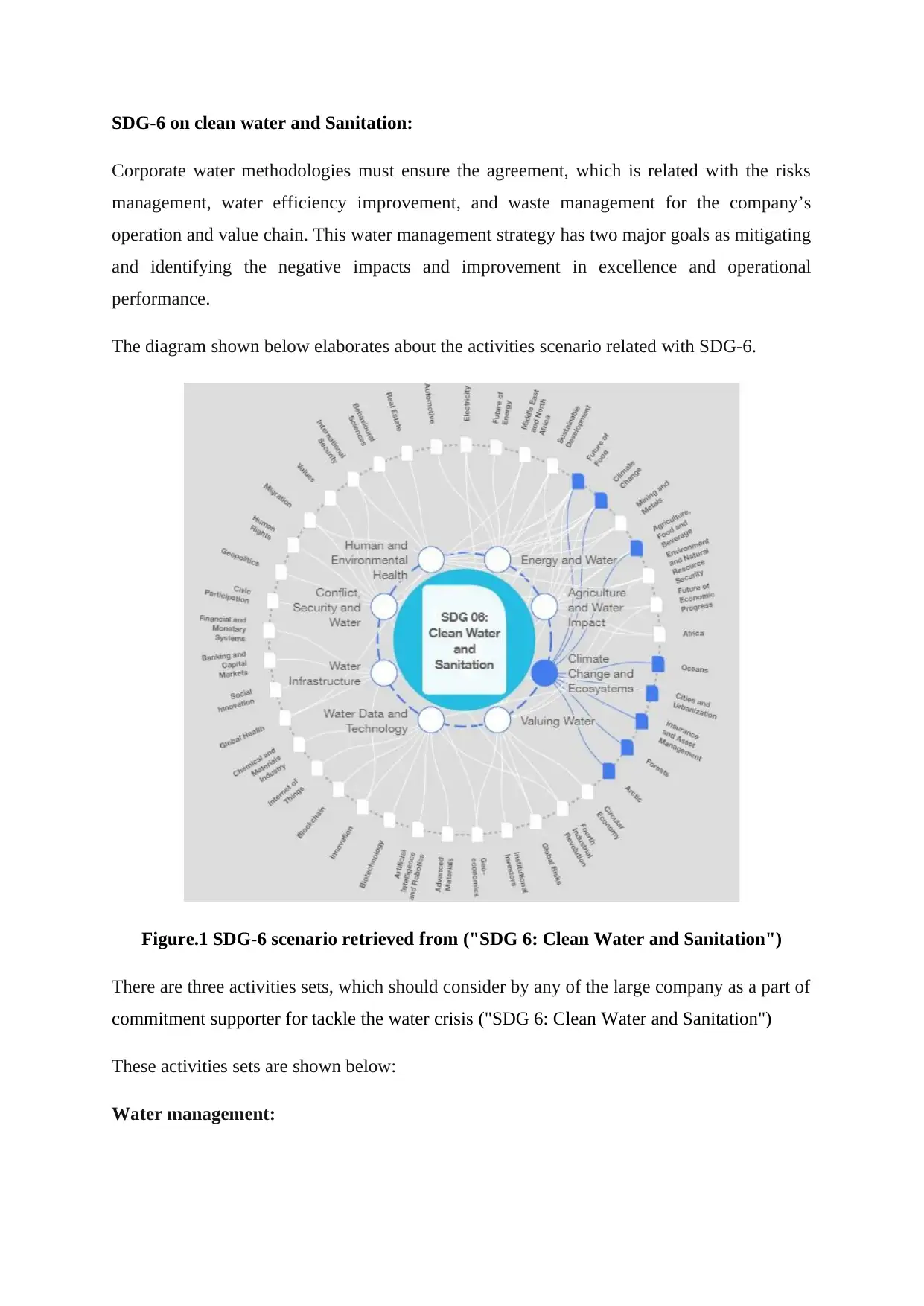
The diagram shown below elaborates about the activities scenario related with SDG-6.
Figure.1 SDG-6 scenario retrieved from ("SDG 6: Clean Water and Sanitation")
There are three activities sets, which should consider by any of the large company as a part of
commitment supporter for tackle the water crisis ("SDG 6: Clean Water and Sanitation")
These activities sets are shown below:
Water management:
Corporate water methodologies must ensure the agreement, which is related with the risks
management, water efficiency improvement, and waste management for the company’s
operation and value chain. This water management strategy has two major goals as mitigating
and identifying the negative impacts and improvement in excellence and operational
performance.
The diagram shown below elaborates about the activities scenario related with SDG-6.
Figure.1 SDG-6 scenario retrieved from ("SDG 6: Clean Water and Sanitation")
There are three activities sets, which should consider by any of the large company as a part of
commitment supporter for tackle the water crisis ("SDG 6: Clean Water and Sanitation")
These activities sets are shown below:
Water management:

In numerous companies and industries, there is untapped capability for harnessing the new
technologies and financial innovations to move from harmless to proactively profitable
delivery and scalable water solution (Feinmann, 2020).
Water stewardship:
Leading corporates are going a step further by committing with more integrated
methodologies that go beyond their own applications to work with others on watershed
administration and the valuing water. These methodologies call for the ability to map and
engage effectively with the diverse shareholders. It needs the complex analysis and data
collection of water by including water usage trade-offs, and understanding the water food
energy nexus in economic, demographic and political manner. For being effective, it calls the
joint investments and collective water administration and accountability scenario.
Water advocacy:
Some of the business leaders are also becoming outspoken champions for the subject of water
sustainability at global, national and local levels. They do the investment in technology,
innovation and research, which are beyond their regular operational requirements. They
support the enhancing efforts in education and public awareness on the water crisis urgency
(Storbi et al., 2019).
Different processes involved in treating waste water at WEWPCC:
In WEWPCC, the waste water is treated for removing the main contaminants such as
phosphorous, nitrogen and carbon. In this process, the raw sewage is sent by various
processes in the plants. The activated sludge, which is known as Bacteria, plays a main role
in the treatment method. The stimulated sludge or the bacteria use the pollutants of the
sewage in the form of food for reproduction process. Once the treatment cycle is finished, the
Bacteria are removed, that treated water is sanitary and it is transferred to the river ("Sewage
treatment plants").
This method is used globally from 1914. In Winnipeg, this process is used since 1964 at the
time of first stimulated sludge plant at the NEWPCC for carbon removing process. In 2008,
the stimulated sludge method in West End Sewage Treatment Plant was updated. This plant
was updated for removing not only the carbon but also for phosphorous and nitrogen.
technologies and financial innovations to move from harmless to proactively profitable
delivery and scalable water solution (Feinmann, 2020).
Water stewardship:
Leading corporates are going a step further by committing with more integrated
methodologies that go beyond their own applications to work with others on watershed
administration and the valuing water. These methodologies call for the ability to map and
engage effectively with the diverse shareholders. It needs the complex analysis and data
collection of water by including water usage trade-offs, and understanding the water food
energy nexus in economic, demographic and political manner. For being effective, it calls the
joint investments and collective water administration and accountability scenario.
Water advocacy:
Some of the business leaders are also becoming outspoken champions for the subject of water
sustainability at global, national and local levels. They do the investment in technology,
innovation and research, which are beyond their regular operational requirements. They
support the enhancing efforts in education and public awareness on the water crisis urgency
(Storbi et al., 2019).
Different processes involved in treating waste water at WEWPCC:
In WEWPCC, the waste water is treated for removing the main contaminants such as
phosphorous, nitrogen and carbon. In this process, the raw sewage is sent by various
processes in the plants. The activated sludge, which is known as Bacteria, plays a main role
in the treatment method. The stimulated sludge or the bacteria use the pollutants of the
sewage in the form of food for reproduction process. Once the treatment cycle is finished, the
Bacteria are removed, that treated water is sanitary and it is transferred to the river ("Sewage
treatment plants").
This method is used globally from 1914. In Winnipeg, this process is used since 1964 at the
time of first stimulated sludge plant at the NEWPCC for carbon removing process. In 2008,
the stimulated sludge method in West End Sewage Treatment Plant was updated. This plant
was updated for removing not only the carbon but also for phosphorous and nitrogen.
⊘ This is a preview!⊘
Do you want full access?
Subscribe today to unlock all pages.

Trusted by 1+ million students worldwide

Recently, the North End Sewage Treatment Plant (NEWPCC) and South End Sewage
Treatment Plant (SEWPCC) are also updated for removing all these three pollutants.
Pre-treatment
In this process, screens are used for removing the rags, plastic and other debris from the
entering underdone waste material. After this screening process, the git and sand settles in the
bottom side. This grit and sand are detached and trucked away to the Brady Road Asset
management facility for removal purpose.
Primary treatment:
In next process, this waste water moves into the sedimentation tanks. In this sedimentation
tanks, around 65% of the deferred material resolves to the bottom side of the tank.
Additionally, the oil and grease that glides at the surface is detached by skimmers or paddlers
from the material which settles at the bottom side of the tanks. The primary treatment process
takes many hours before the wastewater transfers to the treatment next phase.
Secondary treatment:
After the primary treatment process, the wastewater runs into the bioreactors. It contains the
mixture of micro-organism which feed on the carbon in the waste water. In bioreactor,
oxygen is fed by which the micro-organisms can metabolize the feeding carbon. This method
also proceeds with many hours. The biomass should be detached from the waste water. This
split-up process takes place in an alternative group of the sedimentation tanks; this group is
named as secondary clarifiers.
Final Clarification:
Treatment Plant (SEWPCC) are also updated for removing all these three pollutants.
Pre-treatment
In this process, screens are used for removing the rags, plastic and other debris from the
entering underdone waste material. After this screening process, the git and sand settles in the
bottom side. This grit and sand are detached and trucked away to the Brady Road Asset
management facility for removal purpose.
Primary treatment:
In next process, this waste water moves into the sedimentation tanks. In this sedimentation
tanks, around 65% of the deferred material resolves to the bottom side of the tank.
Additionally, the oil and grease that glides at the surface is detached by skimmers or paddlers
from the material which settles at the bottom side of the tanks. The primary treatment process
takes many hours before the wastewater transfers to the treatment next phase.
Secondary treatment:
After the primary treatment process, the wastewater runs into the bioreactors. It contains the
mixture of micro-organism which feed on the carbon in the waste water. In bioreactor,
oxygen is fed by which the micro-organisms can metabolize the feeding carbon. This method
also proceeds with many hours. The biomass should be detached from the waste water. This
split-up process takes place in an alternative group of the sedimentation tanks; this group is
named as secondary clarifiers.
Final Clarification:
Paraphrase This Document
Need a fresh take? Get an instant paraphrase of this document with our AI Paraphraser

In the last clarifiers’ tanks, the biomass from the bioreactors resolves out by the gravity.
Approximate 25-50% of the developed biomass is reimbursed to the head of every bioreactor
to the method beginning again.
The biomass, which is recycled, delivers a constant asset of micro-organisms to the arriving
waste water for the treatment method, because in bioreactors, the biological development
creates more waste water than the requirement. Some of it must be detached.
This leftover biomass is also known as waste activated sludge and it is driven to the Digesters
for the decomposition purpose. All the settler material in the Primary clarifiers is also driven
to the Digesters.
Digestion, Dewatering and Solids Disposal:
Throughout this digestion process, the anaerobic bacteria interrupted in the solids within 15
days. Approximate 50% of the solid are demolished in this method.
In the Digesters, anaerobes which are a diverse kind of bacteria feed on the carbon in the
solids for biogases production such as, methane and carbon dioxide. Methane is improved at
NEWPCC or North End Sewage Treatment Plant and it is utilized in digesters heating and
other building’s processes.
Once the digestion process is completed, the additional water must be detached from the
digested sludge. Dewatering is consummated by utilizing the high speed mechanical
centrifuges. The liquid which is formed during the dewatering process is reimbursed to
additional activated sludge method. This process is planned especially for removing the
nitrogen and ammonia formed during the digestion.
Digested material comprises approximate 2% solids but it is condensed to approximate 25%
before being transmitted. This condensing method especially minimizes the material volume
that must be transferred for the final disposition process.
Approximate 25-50% of the developed biomass is reimbursed to the head of every bioreactor
to the method beginning again.
The biomass, which is recycled, delivers a constant asset of micro-organisms to the arriving
waste water for the treatment method, because in bioreactors, the biological development
creates more waste water than the requirement. Some of it must be detached.
This leftover biomass is also known as waste activated sludge and it is driven to the Digesters
for the decomposition purpose. All the settler material in the Primary clarifiers is also driven
to the Digesters.
Digestion, Dewatering and Solids Disposal:
Throughout this digestion process, the anaerobic bacteria interrupted in the solids within 15
days. Approximate 50% of the solid are demolished in this method.
In the Digesters, anaerobes which are a diverse kind of bacteria feed on the carbon in the
solids for biogases production such as, methane and carbon dioxide. Methane is improved at
NEWPCC or North End Sewage Treatment Plant and it is utilized in digesters heating and
other building’s processes.
Once the digestion process is completed, the additional water must be detached from the
digested sludge. Dewatering is consummated by utilizing the high speed mechanical
centrifuges. The liquid which is formed during the dewatering process is reimbursed to
additional activated sludge method. This process is planned especially for removing the
nitrogen and ammonia formed during the digestion.
Digested material comprises approximate 2% solids but it is condensed to approximate 25%
before being transmitted. This condensing method especially minimizes the material volume
that must be transferred for the final disposition process.

The condensed solids, which are also known as bio-solids, are trucked to the Brady Road
Asset management facility. On average, Brady road get 36,000 kg bio-solids on daily basis
for final disposal process.
Significance of water treatment facilities for water management in Winnipeg and
Manitoba:
Winnipeg acquires the drinking water from the Shoal Lake which is situated at the boundary
between Ontario and Manitoba. Water flow from the Sola Lake to Winnipeg is due to the
gravity over a 160km aqueduct. This water is deposited in Deacon Reservoir, which is a large
open reservoir with 8,800 million litres capacity. This reservoir support an acceptable supply
of water during the peak water practice and it also permits the channel to be shut down for
maintenance purpose ("Should Winnipeg Build a Water Treatment Plant? ").
Two smaller channels downstream of the Deacon Reservoir transport the water into three
pumping stations and small reservoirs of various regions of the city. Three regions reservoirs
and the pumping stations perform together to deliver the water at adequate pressure to water
users all over the region. Fluoride is mixed with the water for protecting against the tooth
decay and chlorine is mixed as an antiseptic for killing the microorganisms.
Importance of water treatment plant:
There are three major reasons which elaborate the importance of water treatment plant in
Winnipeg and Manitoba:
For minimizing the risk of waterborne disease outbreak caused by chlorine-resistant
microorganisms. Crypto which is also named as microscopic parasite can cause the
gastrointestinal illness. For the good health people as well, this disease may come and go
for up to a month. Indications of this disease can contain abdominal cramps,
diarrhoea, headaches and mild fever etc. for the person with low immune system, the
illness can be an origin of prolonged distress and it can be life intimidating. Presently,
there is no cure for this disease.
For reducing the levels of DBPs or Disinfections by product, when the chlorine is
mixed with the water, a reaction occurs with the organic matter which is naturally
found in this lake and this compound relation is known as DBPs.
Asset management facility. On average, Brady road get 36,000 kg bio-solids on daily basis
for final disposal process.
Significance of water treatment facilities for water management in Winnipeg and
Manitoba:
Winnipeg acquires the drinking water from the Shoal Lake which is situated at the boundary
between Ontario and Manitoba. Water flow from the Sola Lake to Winnipeg is due to the
gravity over a 160km aqueduct. This water is deposited in Deacon Reservoir, which is a large
open reservoir with 8,800 million litres capacity. This reservoir support an acceptable supply
of water during the peak water practice and it also permits the channel to be shut down for
maintenance purpose ("Should Winnipeg Build a Water Treatment Plant? ").
Two smaller channels downstream of the Deacon Reservoir transport the water into three
pumping stations and small reservoirs of various regions of the city. Three regions reservoirs
and the pumping stations perform together to deliver the water at adequate pressure to water
users all over the region. Fluoride is mixed with the water for protecting against the tooth
decay and chlorine is mixed as an antiseptic for killing the microorganisms.
Importance of water treatment plant:
There are three major reasons which elaborate the importance of water treatment plant in
Winnipeg and Manitoba:
For minimizing the risk of waterborne disease outbreak caused by chlorine-resistant
microorganisms. Crypto which is also named as microscopic parasite can cause the
gastrointestinal illness. For the good health people as well, this disease may come and go
for up to a month. Indications of this disease can contain abdominal cramps,
diarrhoea, headaches and mild fever etc. for the person with low immune system, the
illness can be an origin of prolonged distress and it can be life intimidating. Presently,
there is no cure for this disease.
For reducing the levels of DBPs or Disinfections by product, when the chlorine is
mixed with the water, a reaction occurs with the organic matter which is naturally
found in this lake and this compound relation is known as DBPs.
⊘ This is a preview!⊘
Do you want full access?
Subscribe today to unlock all pages.

Trusted by 1+ million students worldwide

For meeting evolve Canadian water quality strategies, which are fetching more
rigorous for public health protection.
Three measures that can be done at an individual/household level to reduce water
consumption: (Danielsson, 2019)
1. Installation of Rain Barrels for rainwater collection reuse:
The water bills can have reduction in a great extent by using the collected
rainwater (Strobl et al., 2019).
It permits to be prepared for low rainfall timing by maintaining the garden.
Minimizes the load on storm water systems
Rainwater usage minimizes the requirements of more water dams’
construction (Jain, 2018).
2. Low water Dishwashing methods:
Usage of dishwasher in case of full load
Usage of rinse hold setting of dishwasher
During the dishes wash by hand, don’t rinse the water under the running tap.
Usage of the washing liquid sparingly for minimizing the amount of required
rinsing.
Capturing the excess water into the container during the running tap
3. Water Tap user Modification:
Running tap utilizes approximate 16 litres water/ minute.
Turn the tap off when brushing the teeth
Do not rinse the razor under the flowing tap (Otaki, Otaki & Aramaki, 2017)
Usage of bucket for water collection, while waiting for the hot water
While taking the bath, fill the tub as much as needed. Use lesser quantity of
water for pets and kids.
rigorous for public health protection.
Three measures that can be done at an individual/household level to reduce water
consumption: (Danielsson, 2019)
1. Installation of Rain Barrels for rainwater collection reuse:
The water bills can have reduction in a great extent by using the collected
rainwater (Strobl et al., 2019).
It permits to be prepared for low rainfall timing by maintaining the garden.
Minimizes the load on storm water systems
Rainwater usage minimizes the requirements of more water dams’
construction (Jain, 2018).
2. Low water Dishwashing methods:
Usage of dishwasher in case of full load
Usage of rinse hold setting of dishwasher
During the dishes wash by hand, don’t rinse the water under the running tap.
Usage of the washing liquid sparingly for minimizing the amount of required
rinsing.
Capturing the excess water into the container during the running tap
3. Water Tap user Modification:
Running tap utilizes approximate 16 litres water/ minute.
Turn the tap off when brushing the teeth
Do not rinse the razor under the flowing tap (Otaki, Otaki & Aramaki, 2017)
Usage of bucket for water collection, while waiting for the hot water
While taking the bath, fill the tub as much as needed. Use lesser quantity of
water for pets and kids.
Paraphrase This Document
Need a fresh take? Get an instant paraphrase of this document with our AI Paraphraser

References
Danielsson, M. (2019, May 6). Reduce Water Consumption at Home: SSWM - Find tools for
sustainable sanitation and water management! Retrieved April 5, 2020, from
https://sswm.info/taxonomy/term/2658/reduce-water-consumption-at-home
Feinmann, J. (2020). The BMJ Appeal Christmas 2019: How WaterAid is bringing a
sanitation revolution to all. BMJ, 368.
Jain, S. C. (2018). Unit-7 Water Quality Basic Treatment Measures. IGNOU.
Otaki, Y., Otaki, M., & Aramaki, T. (2017). Combined methods for quantifying end-uses of
residential indoor water consumption. Environmental Processes, 4(1), 33-47.
SDG 6: Clean Water and Sanitation. (n.d.). Retrieved April 5, 2020, from
https://in.one.un.org/page/sustainable-development-goals/sdg-6/
Sewage treatment plants. (n.d.). Retrieved April 5, 2020, from
https://www.winnipeg.ca/waterandwaste/sewage/treatmentPlant/default.stm#tab-west-
end-sewage-treatment-plant
Should Winnipeg Build a Water Treatment Plant? . (n.d.). Retrieved April 5, 2020, from
https://www.winnipeg.ca/waterandwaste/pdfs/water/water_treatment.pdf
Strobl, B., Etter, S., van Meerveld, I. H., & Seibert, J. (2019). The CrowdWater Game: A
Playful Method for Data Quality Control and Training. AGUFM, 2019, IN23B-05.
Danielsson, M. (2019, May 6). Reduce Water Consumption at Home: SSWM - Find tools for
sustainable sanitation and water management! Retrieved April 5, 2020, from
https://sswm.info/taxonomy/term/2658/reduce-water-consumption-at-home
Feinmann, J. (2020). The BMJ Appeal Christmas 2019: How WaterAid is bringing a
sanitation revolution to all. BMJ, 368.
Jain, S. C. (2018). Unit-7 Water Quality Basic Treatment Measures. IGNOU.
Otaki, Y., Otaki, M., & Aramaki, T. (2017). Combined methods for quantifying end-uses of
residential indoor water consumption. Environmental Processes, 4(1), 33-47.
SDG 6: Clean Water and Sanitation. (n.d.). Retrieved April 5, 2020, from
https://in.one.un.org/page/sustainable-development-goals/sdg-6/
Sewage treatment plants. (n.d.). Retrieved April 5, 2020, from
https://www.winnipeg.ca/waterandwaste/sewage/treatmentPlant/default.stm#tab-west-
end-sewage-treatment-plant
Should Winnipeg Build a Water Treatment Plant? . (n.d.). Retrieved April 5, 2020, from
https://www.winnipeg.ca/waterandwaste/pdfs/water/water_treatment.pdf
Strobl, B., Etter, S., van Meerveld, I. H., & Seibert, J. (2019). The CrowdWater Game: A
Playful Method for Data Quality Control and Training. AGUFM, 2019, IN23B-05.
1 out of 8
Related Documents
Your All-in-One AI-Powered Toolkit for Academic Success.
+13062052269
info@desklib.com
Available 24*7 on WhatsApp / Email
Unlock your academic potential
Copyright © 2020–2025 A2Z Services. All Rights Reserved. Developed and managed by ZUCOL.