Reflective Journal: Whole Life Cost Analysis of Building Projects

Verified

Added on  2022/09/11

|6
|837
|16
Journal and Reflective Writing
AI Summary
This reflective journal reviews the concept of whole life costs (WLC) and life cycle costing (LCC) in building projects. The author evaluates theoretical perspectives, distinguishing between ontological and epistemological underpinnings, where WLC aligns with ontological methodology and LCC with epistemological. The journal emphasizes ethical considerations, particularly the importance of the Green Mark Program for sustainable development, advocating for the WLC method. It analyzes the historical, social, and political contexts influencing research choices, highlighting the impact of the Green Mark Program on building design. The conclusion reinforces the preference for WLC to promote sustainable development and environmental responsibility within the construction industry. The journal references relevant literature on green building construction, carbon emissions, and cost optimization.
Document Page
REFLECTIVE JOURNAL REVIEW
STUDENT NAME:
STUDENT ID
1
tabler-icon-diamond-filled.svg

Paraphrase This Document

Need a fresh take? Get an instant paraphrase of this document with our AI Paraphraser
Document Page
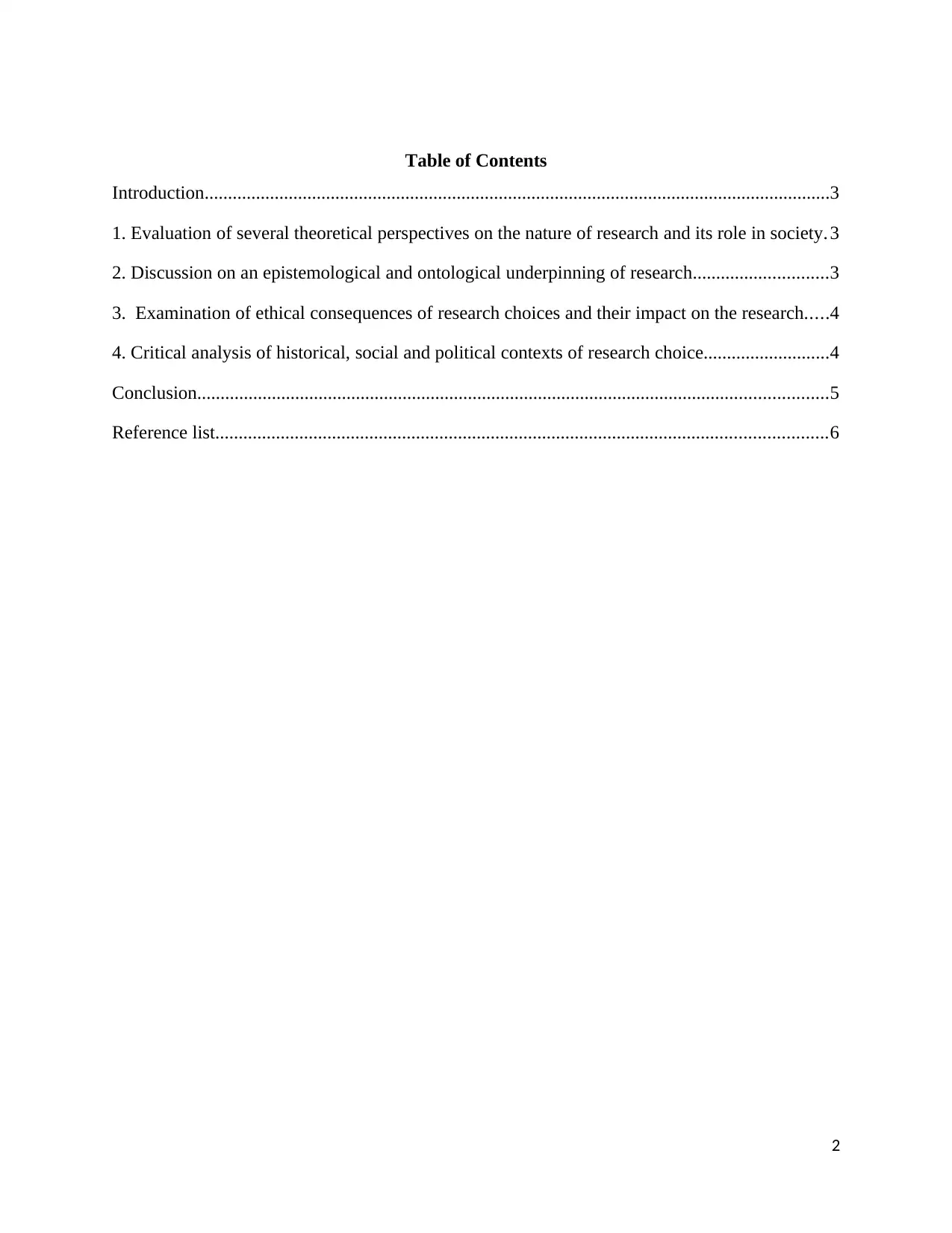
Table of Contents
Introduction......................................................................................................................................3
1. Evaluation of several theoretical perspectives on the nature of research and its role in society. 3
2. Discussion on an epistemological and ontological underpinning of research.............................3
3. Examination of ethical consequences of research choices and their impact on the research.....4
4. Critical analysis of historical, social and political contexts of research choice...........................4
Conclusion.......................................................................................................................................5
Reference list...................................................................................................................................6
2
Document Page
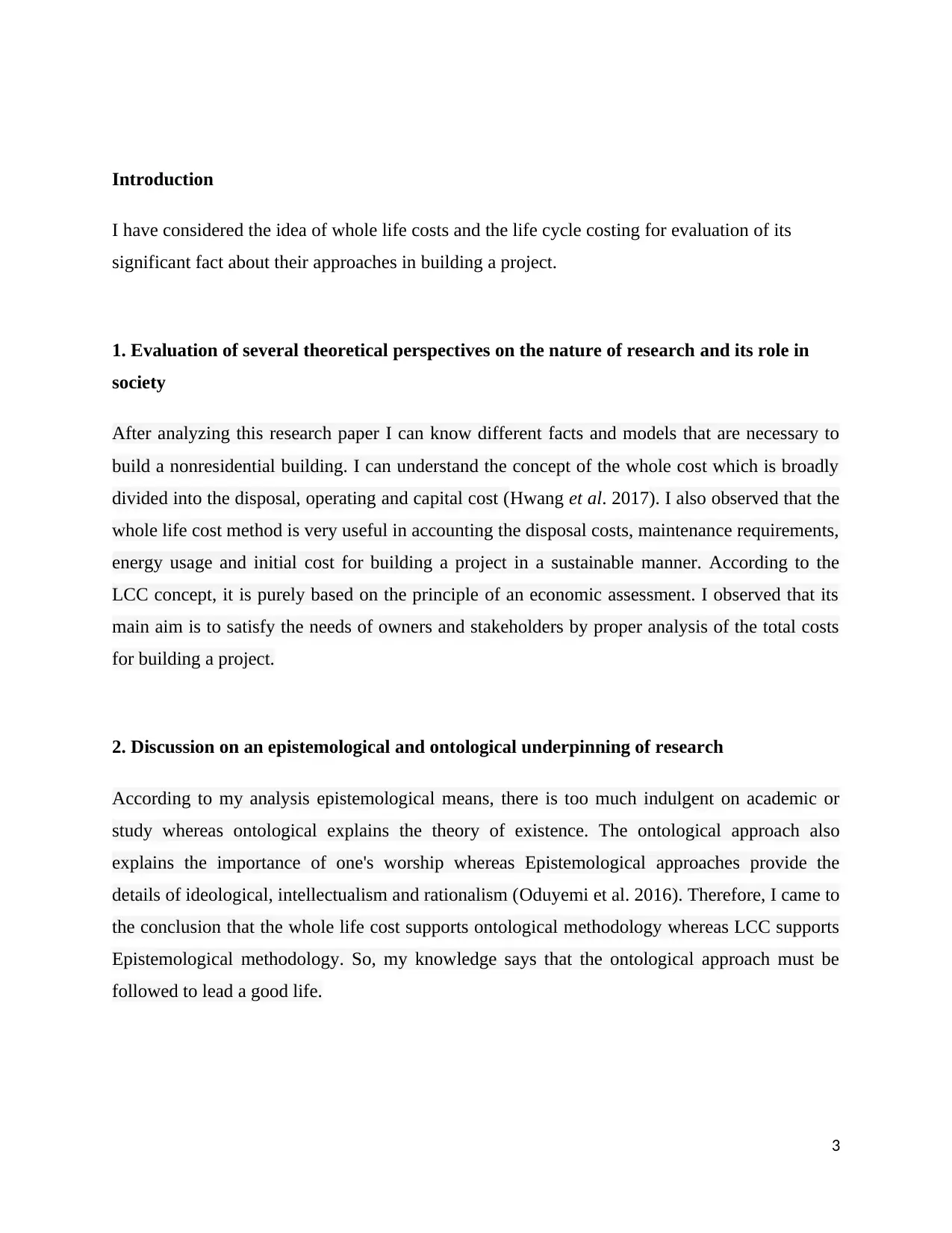
Introduction
I have considered the idea of whole life costs and the life cycle costing for evaluation of its
significant fact about their approaches in building a project.
1. Evaluation of several theoretical perspectives on the nature of research and its role in
society
After analyzing this research paper I can know different facts and models that are necessary to
build a nonresidential building. I can understand the concept of the whole cost which is broadly
divided into the disposal, operating and capital cost (Hwang et al. 2017). I also observed that the
whole life cost method is very useful in accounting the disposal costs, maintenance requirements,
energy usage and initial cost for building a project in a sustainable manner. According to the
LCC concept, it is purely based on the principle of an economic assessment. I observed that its
main aim is to satisfy the needs of owners and stakeholders by proper analysis of the total costs
for building a project.
2. Discussion on an epistemological and ontological underpinning of research
According to my analysis epistemological means, there is too much indulgent on academic or
study whereas ontological explains the theory of existence. The ontological approach also
explains the importance of one's worship whereas Epistemological approaches provide the
details of ideological, intellectualism and rationalism (Oduyemi et al. 2016). Therefore, I came to
the conclusion that the whole life cost supports ontological methodology whereas LCC supports
Epistemological methodology. So, my knowledge says that the ontological approach must be
followed to lead a good life.
3
Document Page
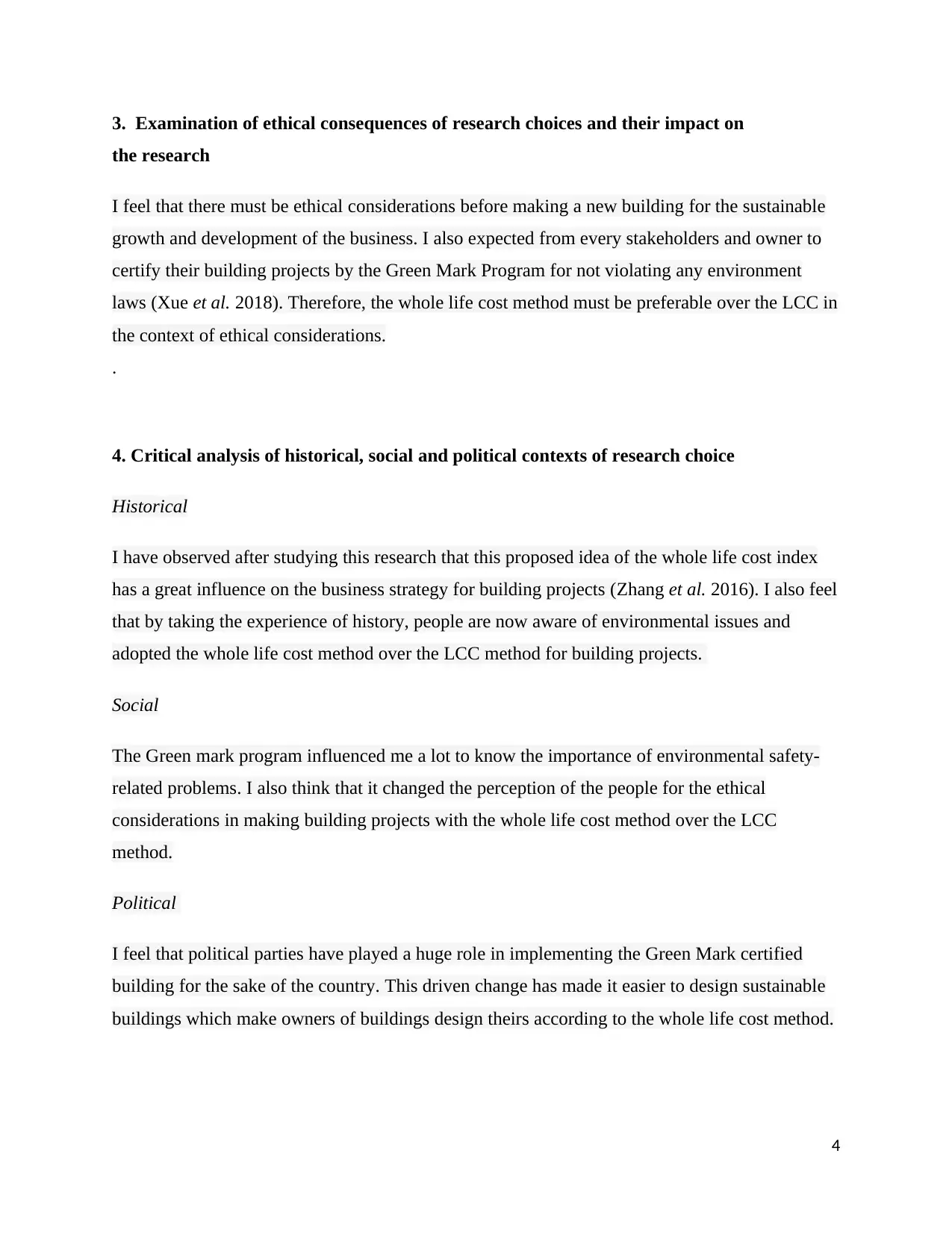
3. Examination of ethical consequences of research choices and their impact on
the research
I feel that there must be ethical considerations before making a new building for the sustainable
growth and development of the business. I also expected from every stakeholders and owner to
certify their building projects by the Green Mark Program for not violating any environment
laws (Xue et al. 2018). Therefore, the whole life cost method must be preferable over the LCC in
the context of ethical considerations.
.
4. Critical analysis of historical, social and political contexts of research choice
Historical
I have observed after studying this research that this proposed idea of the whole life cost index
has a great influence on the business strategy for building projects (Zhang et al. 2016). I also feel
that by taking the experience of history, people are now aware of environmental issues and
adopted the whole life cost method over the LCC method for building projects.
Social
The Green mark program influenced me a lot to know the importance of environmental safety-
related problems. I also think that it changed the perception of the people for the ethical
considerations in making building projects with the whole life cost method over the LCC
method.
Political
I feel that political parties have played a huge role in implementing the Green Mark certified
building for the sake of the country. This driven change has made it easier to design sustainable
buildings which make owners of buildings design theirs according to the whole life cost method.
4
tabler-icon-diamond-filled.svg

Paraphrase This Document

Need a fresh take? Get an instant paraphrase of this document with our AI Paraphraser
Document Page
Conclusion
As per my knowledge and analysis, the whole life costs method must be applied over the LCC
method to a building project that supports green mark program in regards to sustainable
development for a nation.
5
Document Page
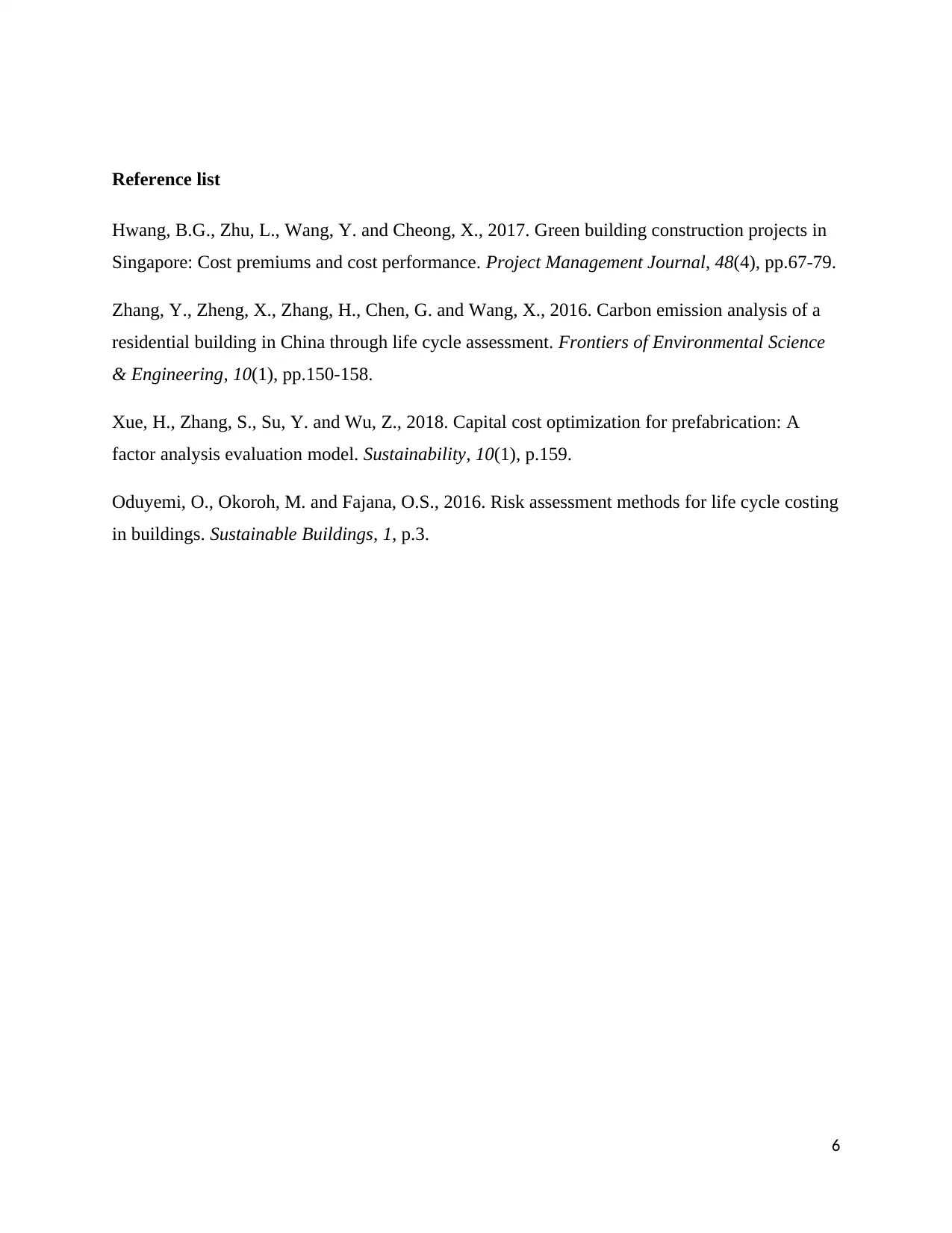
Reference list
Hwang, B.G., Zhu, L., Wang, Y. and Cheong, X., 2017. Green building construction projects in
Singapore: Cost premiums and cost performance. Project Management Journal, 48(4), pp.67-79.
Zhang, Y., Zheng, X., Zhang, H., Chen, G. and Wang, X., 2016. Carbon emission analysis of a
residential building in China through life cycle assessment. Frontiers of Environmental Science
& Engineering, 10(1), pp.150-158.
Xue, H., Zhang, S., Su, Y. and Wu, Z., 2018. Capital cost optimization for prefabrication: A
factor analysis evaluation model. Sustainability, 10(1), p.159.
Oduyemi, O., Okoroh, M. and Fajana, O.S., 2016. Risk assessment methods for life cycle costing
in buildings. Sustainable Buildings, 1, p.3.
6
chevron_up_icon
1 out of 6
circle_padding
hide_on_mobile
zoom_out_icon
[object Object]