WHS Policies: Hazard Identification and Risk Assessment Report

Verified

Added on  2021/04/17

|7
|1228
|368
Report
AI Summary
This report provides a comprehensive analysis of Workplace Health and Safety (WHS) policies, focusing on hazard identification, risk assessment, and the development of effective training programs. The report begins by identifying various workplace hazards, such as those related to cleaning agents, wet floors, and electrical hazards, and assesses their potential harmful effects and associated risk factors. It then delves into the inadequacies of the current hazard identification process, highlighting the importance of clearly assigning responsibilities and incorporating employee awareness to mitigate risks. The report emphasizes the need for professional risk assessment consultants and healthcare experts to identify and eliminate hazards. It outlines essential intervention measures, including informing employees about risks, providing appropriate safety equipment, and ensuring regular health check-ups. Furthermore, the report suggests additional risk assessment plans, such as providing healthcare insurance and soliciting employee feedback. Part B details the essential components of a WHS induction and training program, covering hazard awareness, emergency procedures, and record-keeping systems. It also provides a solution for specific hazards like leaving boxes on stairs and includes a detailed list of required documents and their retention periods for WHS recordkeeping. The report concludes with a list of references to support its findings.
Document Page
Running head: WHS POLICIES
WHS Policies
Name of the Student:
Name of the University:
Author Note:
tabler-icon-diamond-filled.svg

Paraphrase This Document

Need a fresh take? Get an instant paraphrase of this document with our AI Paraphraser
Document Page
1
WHS POLICIES
Part A
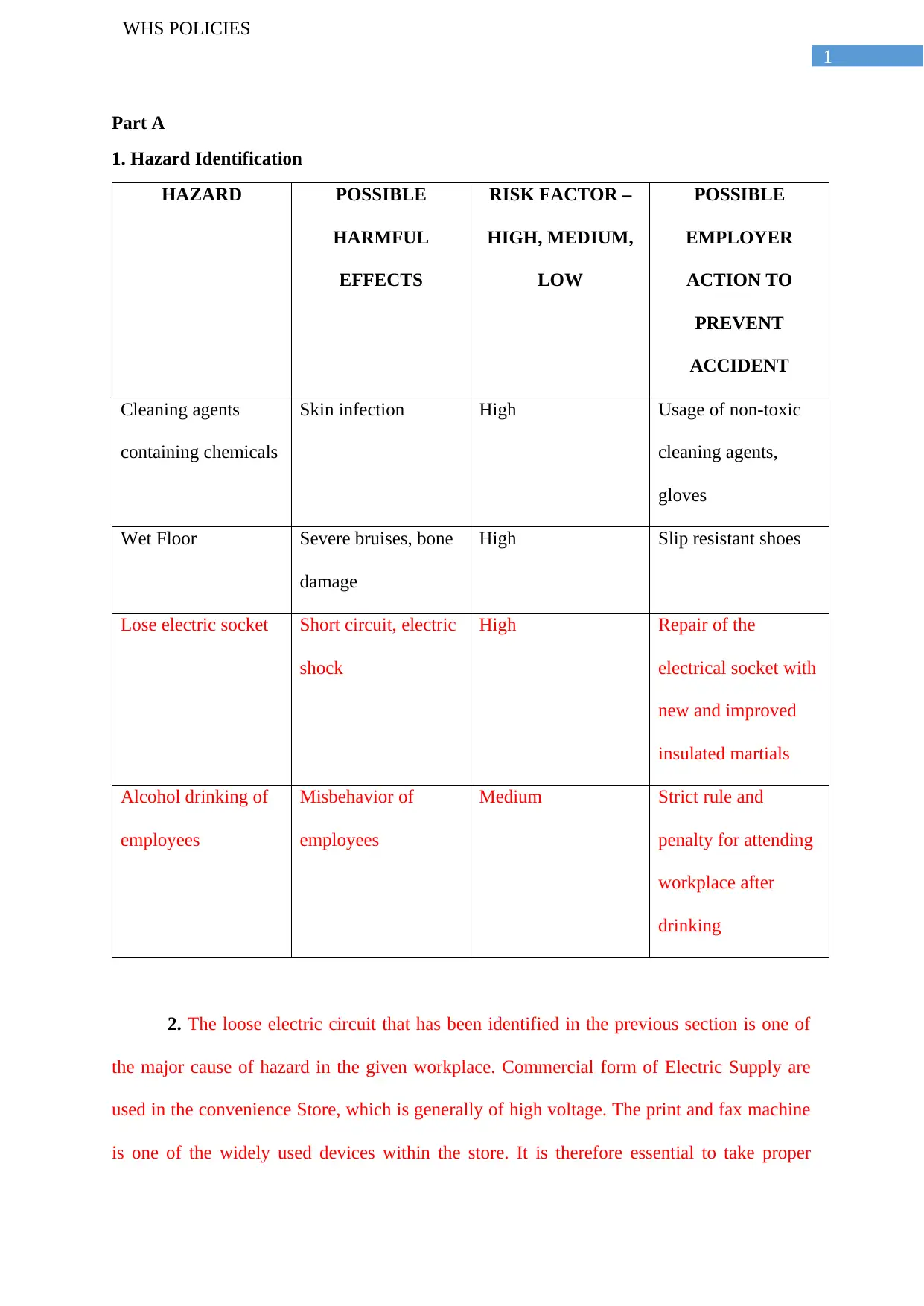
1. Hazard Identification
HAZARD POSSIBLE
HARMFUL
EFFECTS
RISK FACTOR –
HIGH, MEDIUM,
LOW
POSSIBLE
EMPLOYER
ACTION TO
PREVENT
ACCIDENT
Cleaning agents
containing chemicals
Skin infection High Usage of non-toxic
cleaning agents,
gloves
Wet Floor Severe bruises, bone
damage
High Slip resistant shoes
Lose electric socket Short circuit, electric
shock
High Repair of the
electrical socket with
new and improved
insulated martials
Alcohol drinking of
employees
Misbehavior of
employees
Medium Strict rule and
penalty for attending
workplace after
drinking
2. The loose electric circuit that has been identified in the previous section is one of
the major cause of hazard in the given workplace. Commercial form of Electric Supply are
used in the convenience Store, which is generally of high voltage. The print and fax machine
is one of the widely used devices within the store. It is therefore essential to take proper
Document Page
2
WHS POLICIES
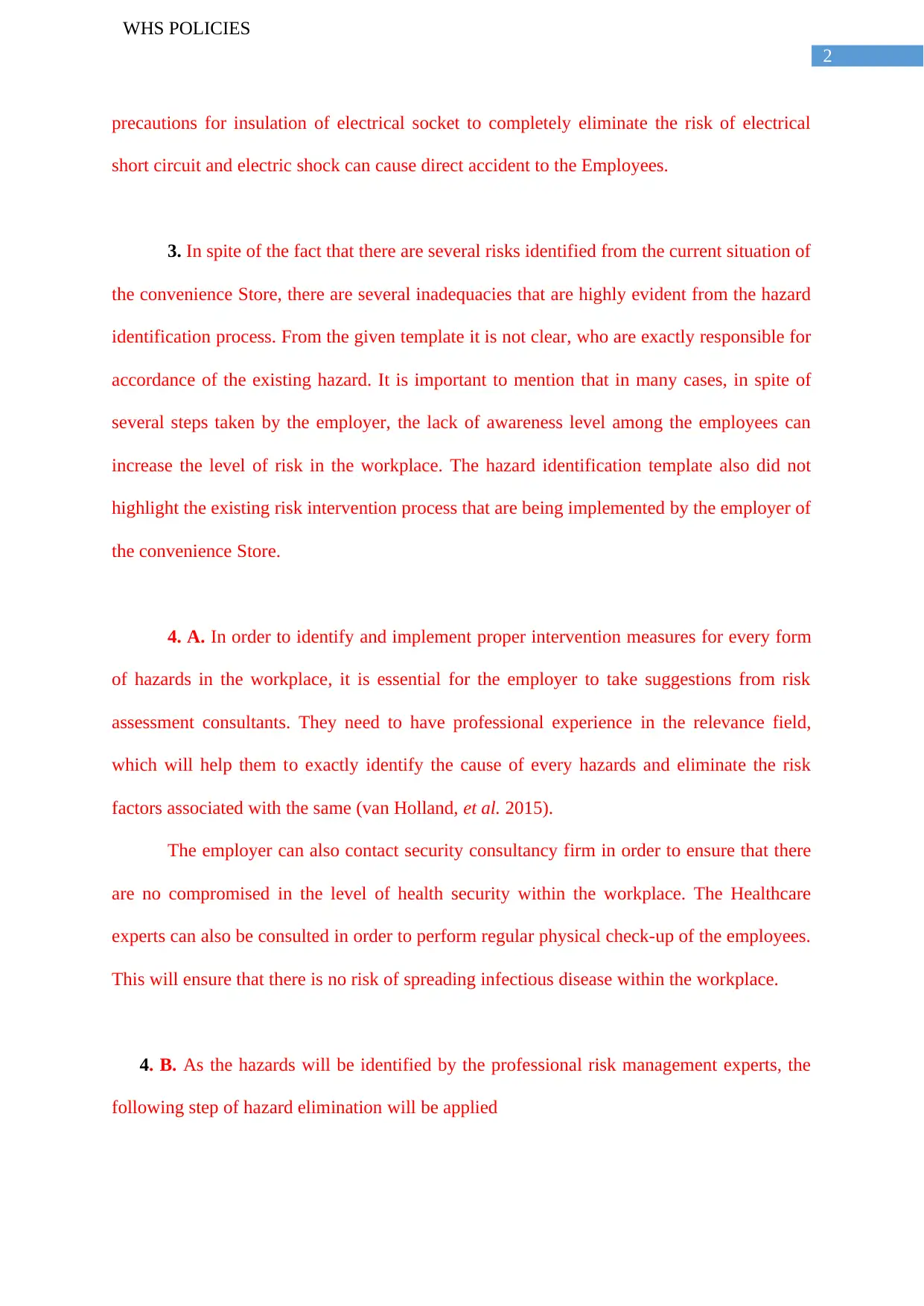
precautions for insulation of electrical socket to completely eliminate the risk of electrical
short circuit and electric shock can cause direct accident to the Employees.
3. In spite of the fact that there are several risks identified from the current situation of
the convenience Store, there are several inadequacies that are highly evident from the hazard
identification process. From the given template it is not clear, who are exactly responsible for
accordance of the existing hazard. It is important to mention that in many cases, in spite of
several steps taken by the employer, the lack of awareness level among the employees can
increase the level of risk in the workplace. The hazard identification template also did not
highlight the existing risk intervention process that are being implemented by the employer of
the convenience Store.
4. A. In order to identify and implement proper intervention measures for every form
of hazards in the workplace, it is essential for the employer to take suggestions from risk
assessment consultants. They need to have professional experience in the relevance field,
which will help them to exactly identify the cause of every hazards and eliminate the risk
factors associated with the same (van Holland, et al. 2015).
The employer can also contact security consultancy firm in order to ensure that there
are no compromised in the level of health security within the workplace. The Healthcare
experts can also be consulted in order to perform regular physical check-up of the employees.
This will ensure that there is no risk of spreading infectious disease within the workplace.
4. B. As the hazards will be identified by the professional risk management experts, the
following step of hazard elimination will be applied
Document Page
3
WHS POLICIES
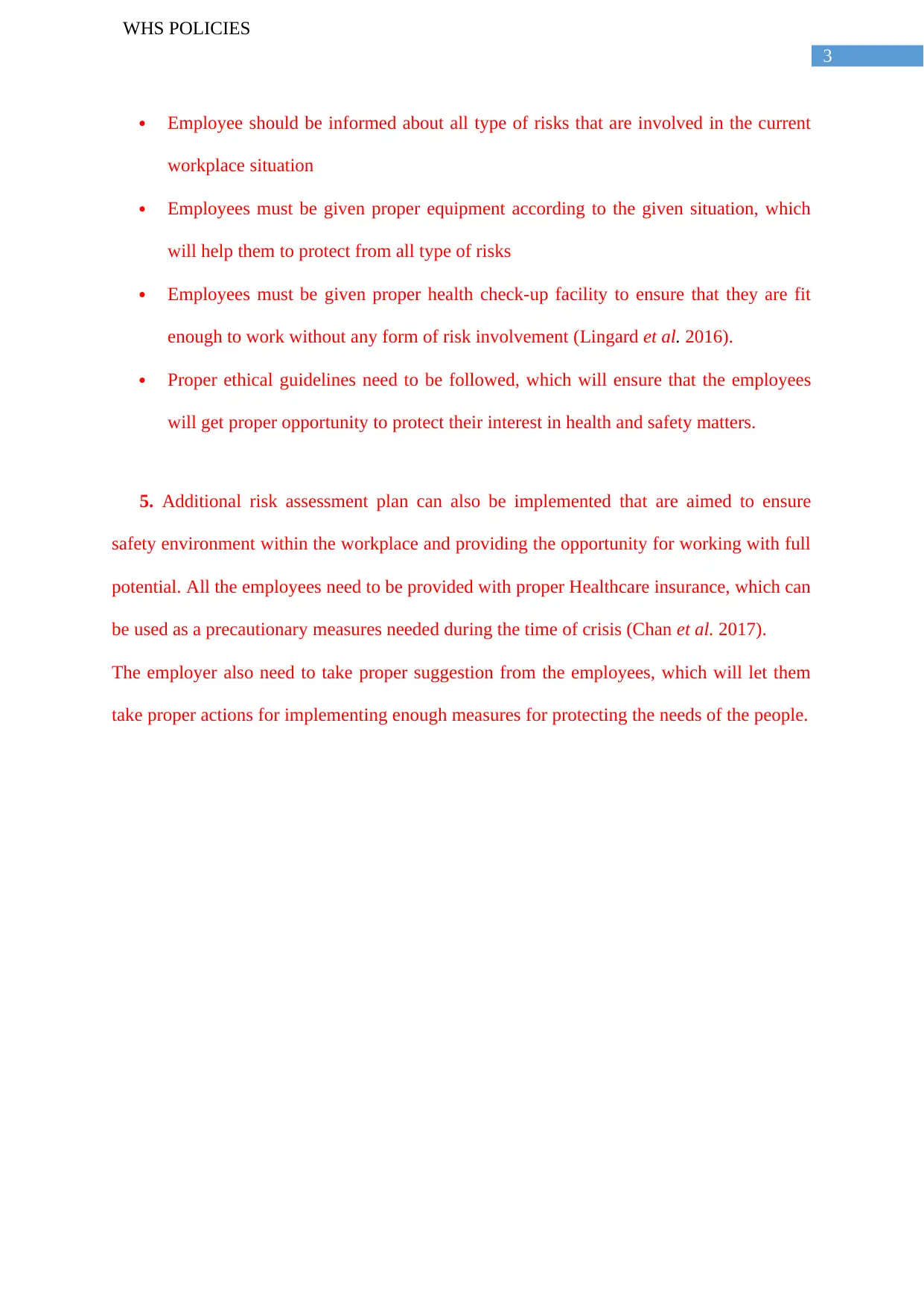
Employee should be informed about all type of risks that are involved in the current
workplace situation
Employees must be given proper equipment according to the given situation, which
will help them to protect from all type of risks
Employees must be given proper health check-up facility to ensure that they are fit
enough to work without any form of risk involvement (Lingard et al. 2016).
Proper ethical guidelines need to be followed, which will ensure that the employees
will get proper opportunity to protect their interest in health and safety matters.
5. Additional risk assessment plan can also be implemented that are aimed to ensure
safety environment within the workplace and providing the opportunity for working with full
potential. All the employees need to be provided with proper Healthcare insurance, which can
be used as a precautionary measures needed during the time of crisis (Chan et al. 2017).
The employer also need to take proper suggestion from the employees, which will let them
take proper actions for implementing enough measures for protecting the needs of the people.
tabler-icon-diamond-filled.svg

Paraphrase This Document

Need a fresh take? Get an instant paraphrase of this document with our AI Paraphraser
Document Page
4
WHS POLICIES
Part B
1. What would you include in a WHS induction and training program?
Induction:
1. Introduction to a safe and secure process related to workplace health and safety in the
workplace, so that the previous issues present in the WHS policy can be minimized
and the new and improved process can be implemented (Campbell 2016).
2. Overview of WHS management system and policies so that faults and mistakes
related to employee safety can be minimized and safety can be reinforced.
3. Different types of hazards within the organization and steps to eradicate them.
Training:
1. Emergency evacuation procedures
2. First aid arrangements and providing them to co-workers
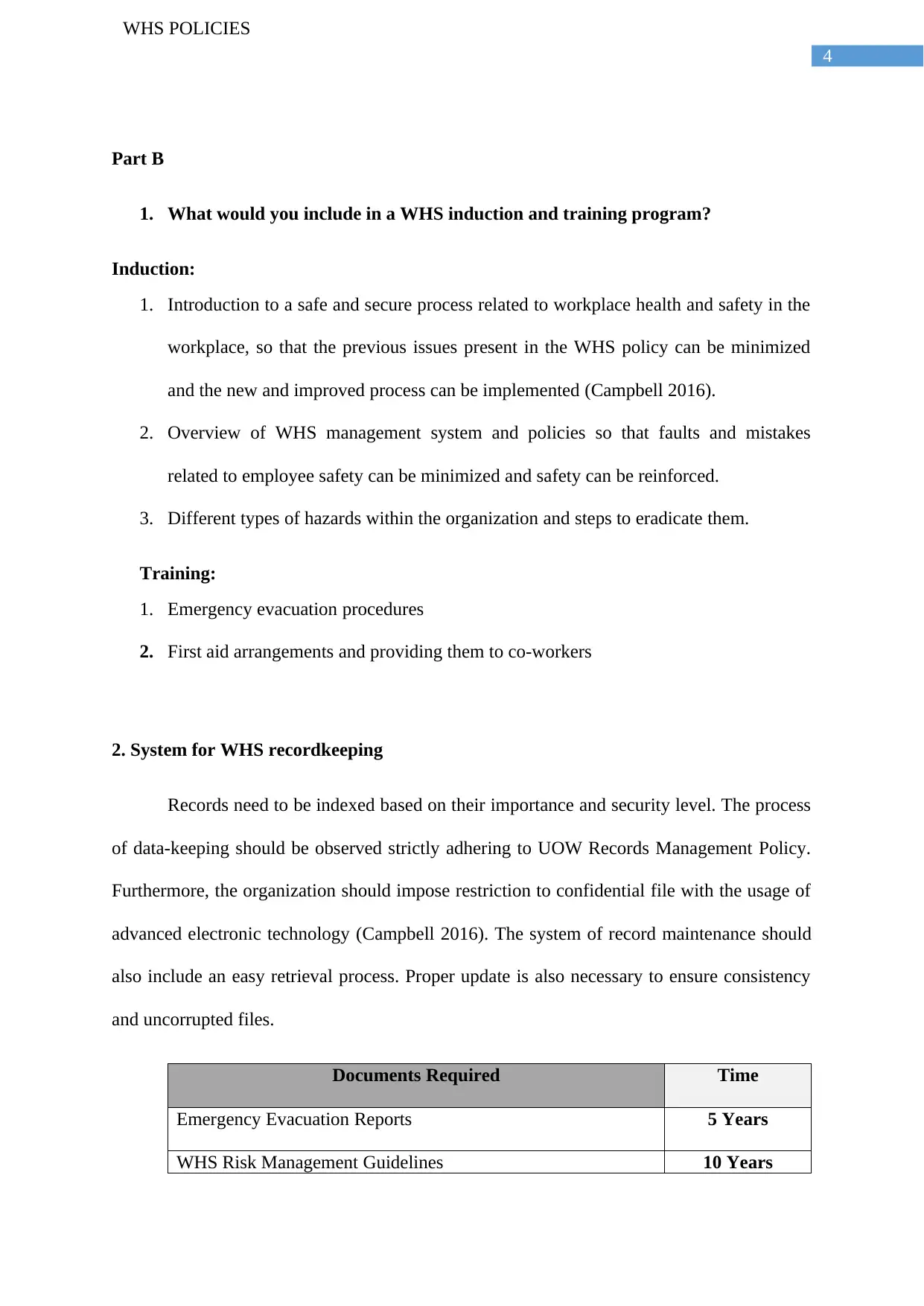
2. System for WHS recordkeeping
Records need to be indexed based on their importance and security level. The process
of data-keeping should be observed strictly adhering to UOW Records Management Policy.
Furthermore, the organization should impose restriction to confidential file with the usage of
advanced electronic technology (Campbell 2016). The system of record maintenance should
also include an easy retrieval process. Proper update is also necessary to ensure consistency
and uncorrupted files.
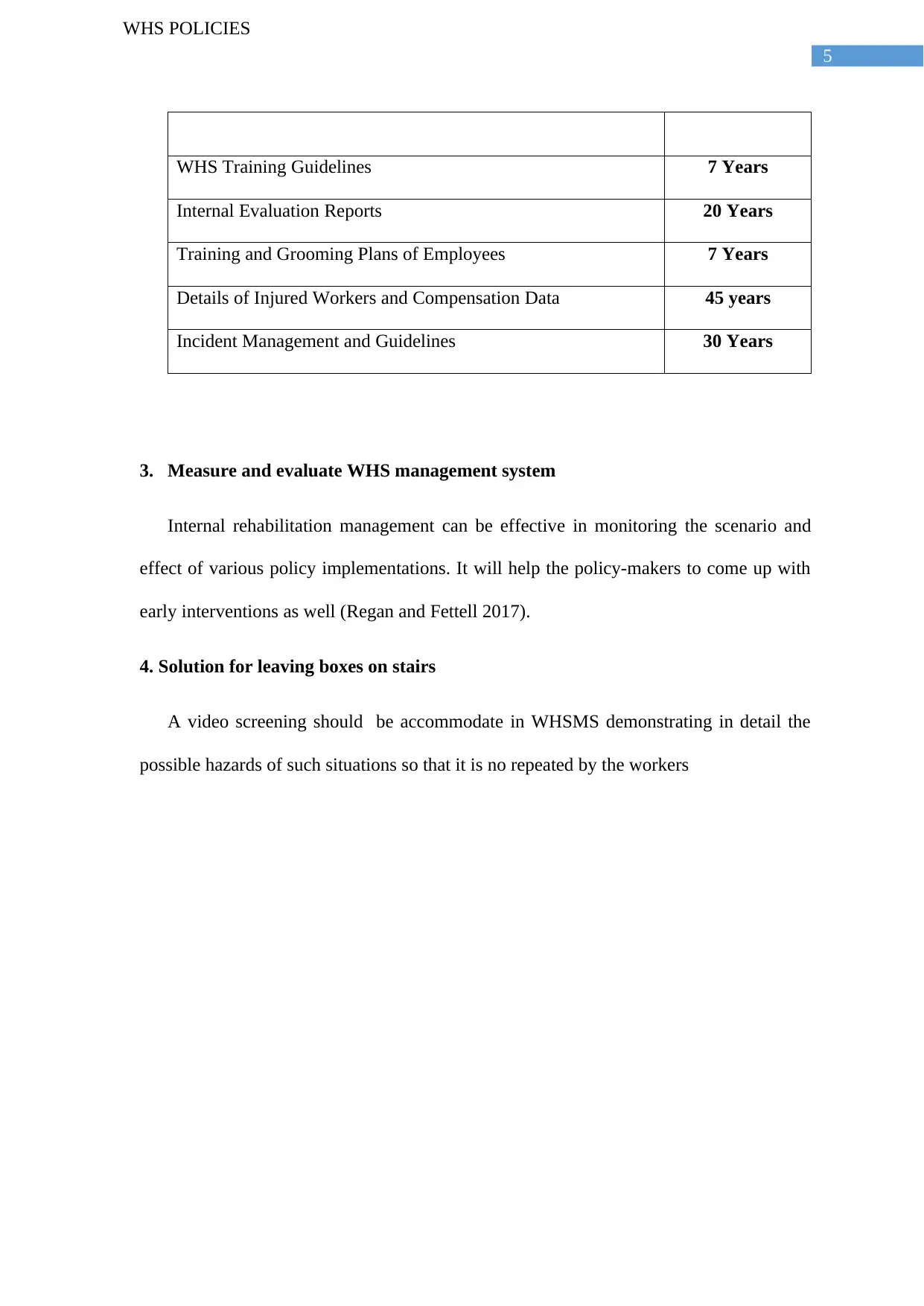
Documents Required Time
Emergency Evacuation Reports 5 Years
WHS Risk Management Guidelines 10 Years
Document Page
5
WHS POLICIES
WHS Training Guidelines 7 Years
Internal Evaluation Reports 20 Years
Training and Grooming Plans of Employees 7 Years
Details of Injured Workers and Compensation Data 45 years
Incident Management and Guidelines 30 Years
3. Measure and evaluate WHS management system
Internal rehabilitation management can be effective in monitoring the scenario and
effect of various policy implementations. It will help the policy-makers to come up with
early interventions as well (Regan and Fettell 2017).
4. Solution for leaving boxes on stairs
A video screening should be accommodate in WHSMS demonstrating in detail the
possible hazards of such situations so that it is no repeated by the workers
Document Page
6
WHS POLICIES
Reference List:
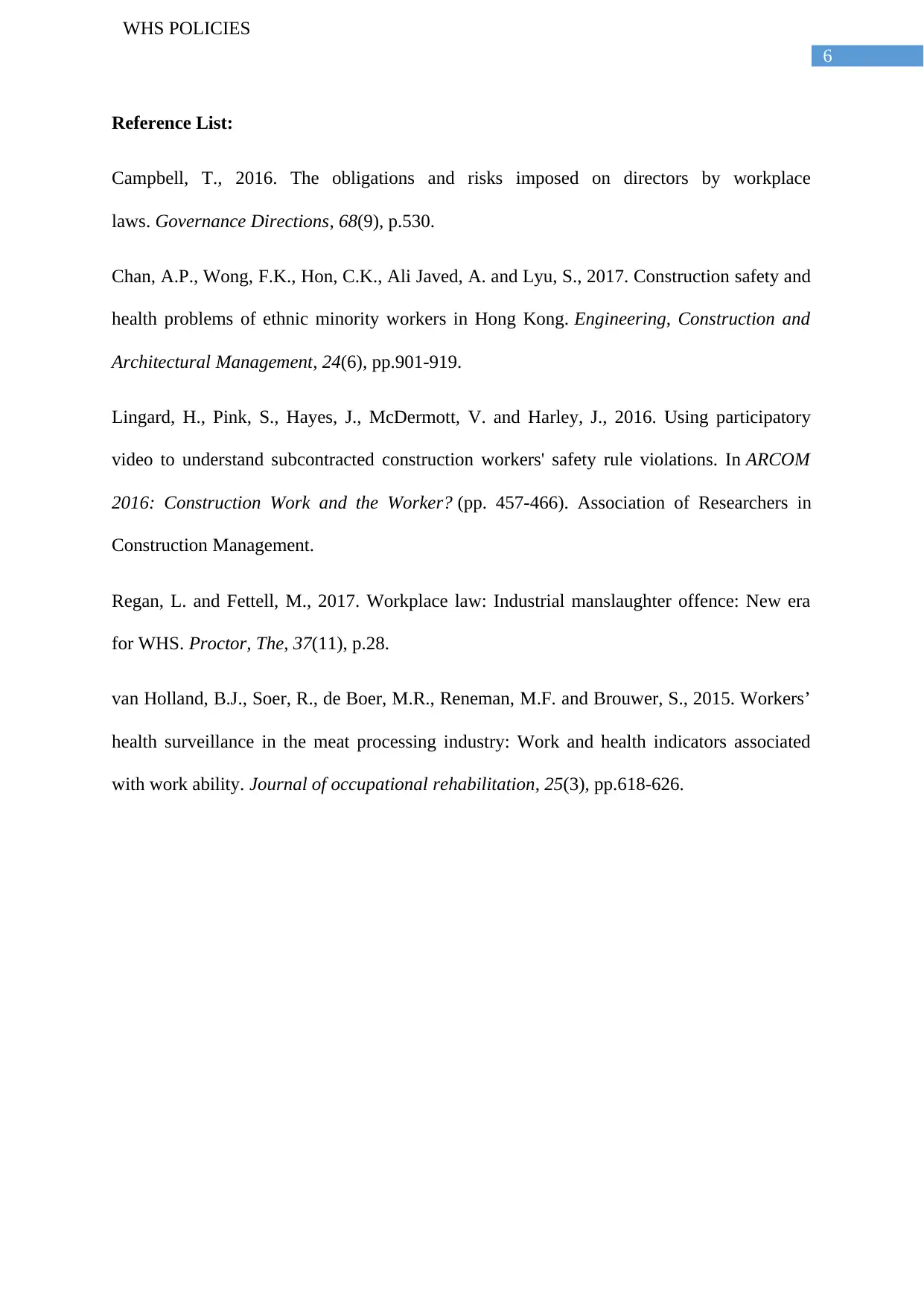
Campbell, T., 2016. The obligations and risks imposed on directors by workplace
laws. Governance Directions, 68(9), p.530.
Chan, A.P., Wong, F.K., Hon, C.K., Ali Javed, A. and Lyu, S., 2017. Construction safety and
health problems of ethnic minority workers in Hong Kong. Engineering, Construction and
Architectural Management, 24(6), pp.901-919.
Lingard, H., Pink, S., Hayes, J., McDermott, V. and Harley, J., 2016. Using participatory
video to understand subcontracted construction workers' safety rule violations. In ARCOM
2016: Construction Work and the Worker? (pp. 457-466). Association of Researchers in
Construction Management.
Regan, L. and Fettell, M., 2017. Workplace law: Industrial manslaughter offence: New era
for WHS. Proctor, The, 37(11), p.28.
van Holland, B.J., Soer, R., de Boer, M.R., Reneman, M.F. and Brouwer, S., 2015. Workers’
health surveillance in the meat processing industry: Work and health indicators associated
with work ability. Journal of occupational rehabilitation, 25(3), pp.618-626.
chevron_up_icon
1 out of 7
circle_padding
hide_on_mobile
zoom_out_icon
[object Object]