WHS Management System: Australian Hardware Report and Analysis
VerifiedAdded on 2020/03/23
|6
|1184
|145
Report
AI Summary
This report examines the components of a Work Health and Safety Management System (WHSMS). It outlines the key elements, including a safety plan, policies, procedures, training and induction, monitoring, supervision, and reporting. The report emphasizes the importance of implementing the system effectively to ensure worker compliance, proper training, and ongoing supervision. It also highlights the specifics of a WHSMS for Australian Hardware, covering its commitment to establishing a safe workplace, complying with legislation, providing training, consulting employees, and monitoring performance goals. The report discusses the roles and responsibilities of various personnel within the WHSMS framework, including senior managers, store managers, team leaders, and workers, as well as the importance of safety engineers and training budgets.
Work Health and Safety Management System
A Work Health and Safety Management System can be described as the systematic methodology
used to address occupational health and safety in an organisation. With the system components
in place, the various specific work health and safety issues can be addressed within this
framework (Glendon, Clarke & McKenna, 2016). Goals and objectives will be needed to achieve
the implementation of a WHS management system within realistic timeframes.
There are so many aspects to creating and maintaining a safe working environment that
sometimes it’s easy to get lost in it all. To truly succeed in creating a safe place of work, the key
is to develop and implement an effective safety management system. A safety management
system combines all the different elements in your workplace that need attention to ensure you
provide a safe working environment for everyone who enters it.
Safety management systems make health and safety an integral part of your business’s core
operations. By designing, developing and implementing an effective safety management system,
you will have methods for managing reporting, responsibilities, planning and resourcing to create
a safer workplace.
Safety management systems have six elements: a safety plan; policies, procedures and processes;
training and induction; monitoring; supervision; and reporting.
Remember, it is not enough to simply adopt a satisfactory safety management system. You must
also actively implement that system in your workplace. To do this, you must ensure that: workers
comply with procedures and instructions; workers are appropriately trained; and workers are
subject to ongoing supervision.
A Work Health and Safety Management System can be described as the systematic methodology
used to address occupational health and safety in an organisation. With the system components
in place, the various specific work health and safety issues can be addressed within this
framework (Glendon, Clarke & McKenna, 2016). Goals and objectives will be needed to achieve
the implementation of a WHS management system within realistic timeframes.
There are so many aspects to creating and maintaining a safe working environment that
sometimes it’s easy to get lost in it all. To truly succeed in creating a safe place of work, the key
is to develop and implement an effective safety management system. A safety management
system combines all the different elements in your workplace that need attention to ensure you
provide a safe working environment for everyone who enters it.
Safety management systems make health and safety an integral part of your business’s core
operations. By designing, developing and implementing an effective safety management system,
you will have methods for managing reporting, responsibilities, planning and resourcing to create
a safer workplace.
Safety management systems have six elements: a safety plan; policies, procedures and processes;
training and induction; monitoring; supervision; and reporting.
Remember, it is not enough to simply adopt a satisfactory safety management system. You must
also actively implement that system in your workplace. To do this, you must ensure that: workers
comply with procedures and instructions; workers are appropriately trained; and workers are
subject to ongoing supervision.
Paraphrase This Document
Need a fresh take? Get an instant paraphrase of this document with our AI Paraphraser

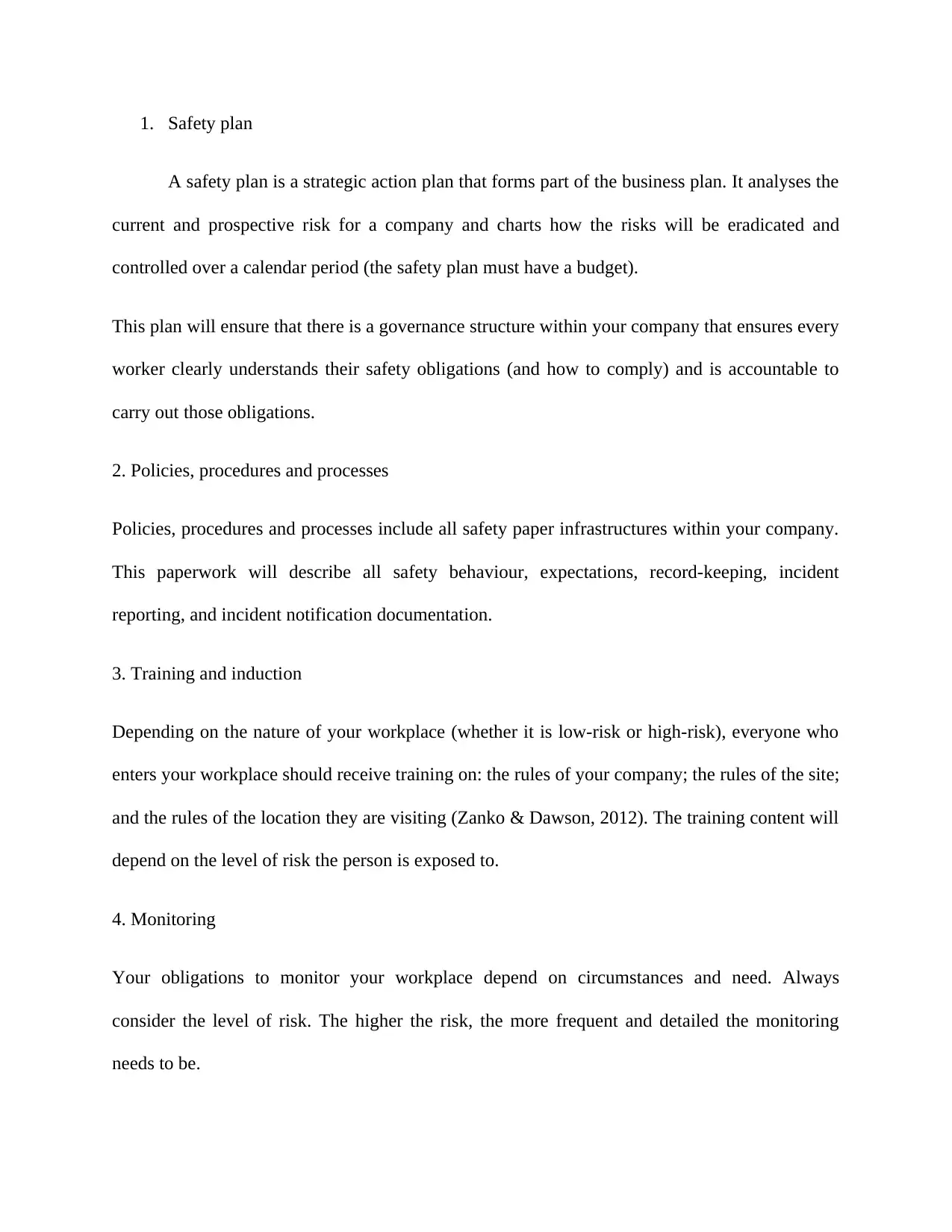
1. Safety plan
A safety plan is a strategic action plan that forms part of the business plan. It analyses the
current and prospective risk for a company and charts how the risks will be eradicated and
controlled over a calendar period (the safety plan must have a budget).
This plan will ensure that there is a governance structure within your company that ensures every
worker clearly understands their safety obligations (and how to comply) and is accountable to
carry out those obligations.
2. Policies, procedures and processes
Policies, procedures and processes include all safety paper infrastructures within your company.
This paperwork will describe all safety behaviour, expectations, record-keeping, incident
reporting, and incident notification documentation.
3. Training and induction
Depending on the nature of your workplace (whether it is low-risk or high-risk), everyone who
enters your workplace should receive training on: the rules of your company; the rules of the site;
and the rules of the location they are visiting (Zanko & Dawson, 2012). The training content will
depend on the level of risk the person is exposed to.
4. Monitoring
Your obligations to monitor your workplace depend on circumstances and need. Always
consider the level of risk. The higher the risk, the more frequent and detailed the monitoring
needs to be.
A safety plan is a strategic action plan that forms part of the business plan. It analyses the
current and prospective risk for a company and charts how the risks will be eradicated and
controlled over a calendar period (the safety plan must have a budget).
This plan will ensure that there is a governance structure within your company that ensures every
worker clearly understands their safety obligations (and how to comply) and is accountable to
carry out those obligations.
2. Policies, procedures and processes
Policies, procedures and processes include all safety paper infrastructures within your company.
This paperwork will describe all safety behaviour, expectations, record-keeping, incident
reporting, and incident notification documentation.
3. Training and induction
Depending on the nature of your workplace (whether it is low-risk or high-risk), everyone who
enters your workplace should receive training on: the rules of your company; the rules of the site;
and the rules of the location they are visiting (Zanko & Dawson, 2012). The training content will
depend on the level of risk the person is exposed to.
4. Monitoring
Your obligations to monitor your workplace depend on circumstances and need. Always
consider the level of risk. The higher the risk, the more frequent and detailed the monitoring
needs to be.

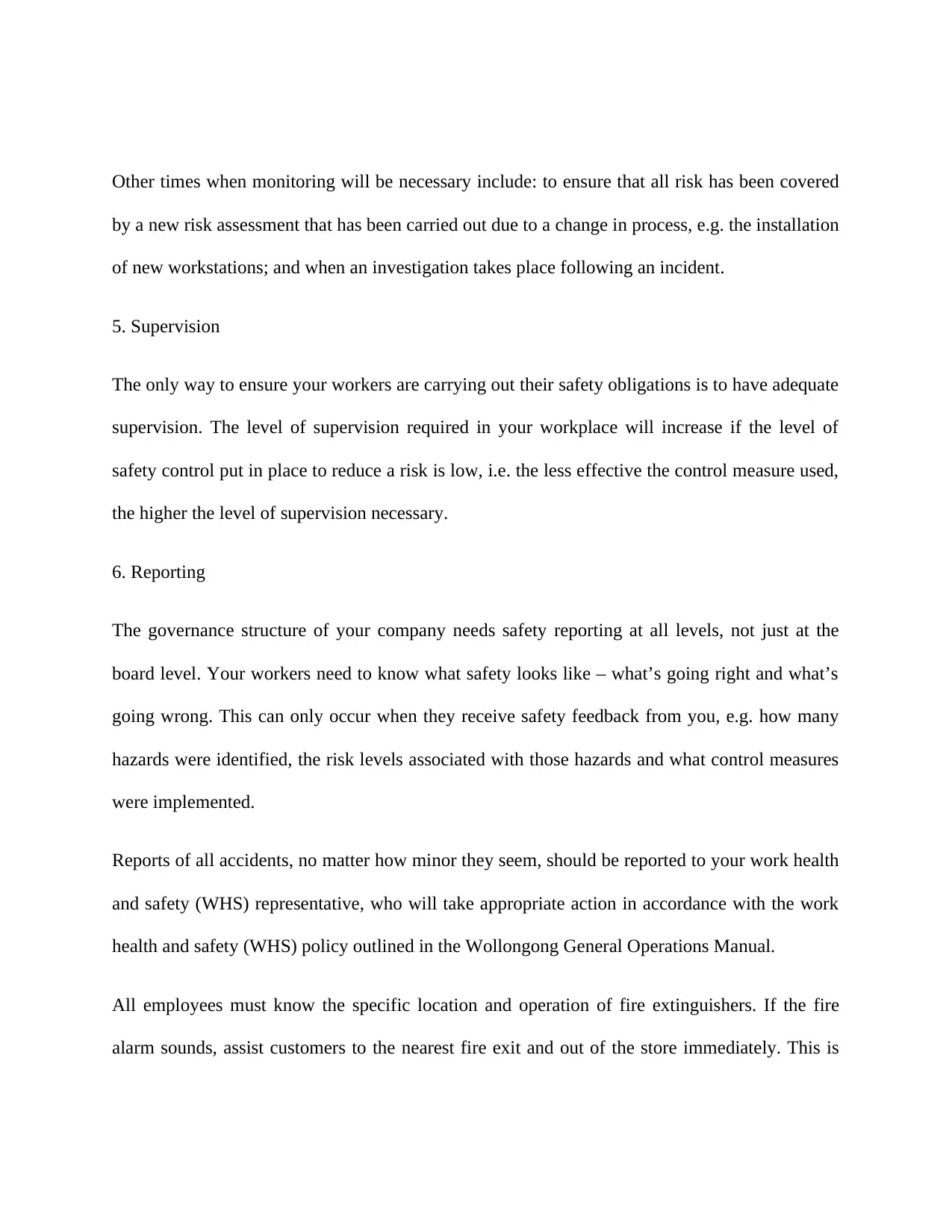
Other times when monitoring will be necessary include: to ensure that all risk has been covered
by a new risk assessment that has been carried out due to a change in process, e.g. the installation
of new workstations; and when an investigation takes place following an incident.
5. Supervision
The only way to ensure your workers are carrying out their safety obligations is to have adequate
supervision. The level of supervision required in your workplace will increase if the level of
safety control put in place to reduce a risk is low, i.e. the less effective the control measure used,
the higher the level of supervision necessary.
6. Reporting
The governance structure of your company needs safety reporting at all levels, not just at the
board level. Your workers need to know what safety looks like – what’s going right and what’s
going wrong. This can only occur when they receive safety feedback from you, e.g. how many
hazards were identified, the risk levels associated with those hazards and what control measures
were implemented.
Reports of all accidents, no matter how minor they seem, should be reported to your work health
and safety (WHS) representative, who will take appropriate action in accordance with the work
health and safety (WHS) policy outlined in the Wollongong General Operations Manual.
All employees must know the specific location and operation of fire extinguishers. If the fire
alarm sounds, assist customers to the nearest fire exit and out of the store immediately. This is
by a new risk assessment that has been carried out due to a change in process, e.g. the installation
of new workstations; and when an investigation takes place following an incident.
5. Supervision
The only way to ensure your workers are carrying out their safety obligations is to have adequate
supervision. The level of supervision required in your workplace will increase if the level of
safety control put in place to reduce a risk is low, i.e. the less effective the control measure used,
the higher the level of supervision necessary.
6. Reporting
The governance structure of your company needs safety reporting at all levels, not just at the
board level. Your workers need to know what safety looks like – what’s going right and what’s
going wrong. This can only occur when they receive safety feedback from you, e.g. how many
hazards were identified, the risk levels associated with those hazards and what control measures
were implemented.
Reports of all accidents, no matter how minor they seem, should be reported to your work health
and safety (WHS) representative, who will take appropriate action in accordance with the work
health and safety (WHS) policy outlined in the Wollongong General Operations Manual.
All employees must know the specific location and operation of fire extinguishers. If the fire
alarm sounds, assist customers to the nearest fire exit and out of the store immediately. This is
⊘ This is a preview!⊘
Do you want full access?
Subscribe today to unlock all pages.

Trusted by 1+ million students worldwide

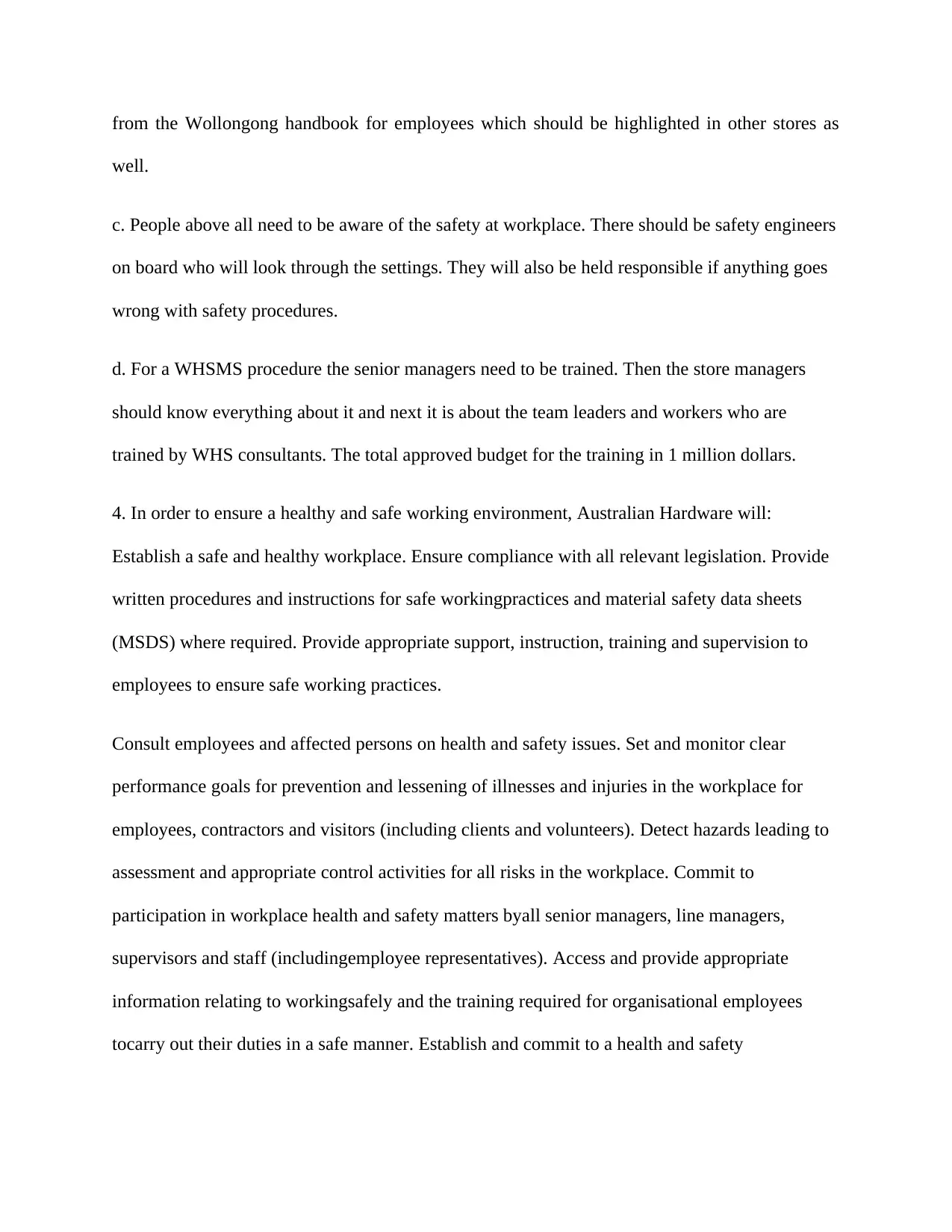
from the Wollongong handbook for employees which should be highlighted in other stores as
well.
c. People above all need to be aware of the safety at workplace. There should be safety engineers
on board who will look through the settings. They will also be held responsible if anything goes
wrong with safety procedures.
d. For a WHSMS procedure the senior managers need to be trained. Then the store managers
should know everything about it and next it is about the team leaders and workers who are
trained by WHS consultants. The total approved budget for the training in 1 million dollars.
4. In order to ensure a healthy and safe working environment, Australian Hardware will:
Establish a safe and healthy workplace. Ensure compliance with all relevant legislation. Provide
written procedures and instructions for safe workingpractices and material safety data sheets
(MSDS) where required. Provide appropriate support, instruction, training and supervision to
employees to ensure safe working practices.
Consult employees and affected persons on health and safety issues. Set and monitor clear
performance goals for prevention and lessening of illnesses and injuries in the workplace for
employees, contractors and visitors (including clients and volunteers). Detect hazards leading to
assessment and appropriate control activities for all risks in the workplace. Commit to
participation in workplace health and safety matters byall senior managers, line managers,
supervisors and staff (includingemployee representatives). Access and provide appropriate
information relating to workingsafely and the training required for organisational employees
tocarry out their duties in a safe manner. Establish and commit to a health and safety
well.
c. People above all need to be aware of the safety at workplace. There should be safety engineers
on board who will look through the settings. They will also be held responsible if anything goes
wrong with safety procedures.
d. For a WHSMS procedure the senior managers need to be trained. Then the store managers
should know everything about it and next it is about the team leaders and workers who are
trained by WHS consultants. The total approved budget for the training in 1 million dollars.
4. In order to ensure a healthy and safe working environment, Australian Hardware will:
Establish a safe and healthy workplace. Ensure compliance with all relevant legislation. Provide
written procedures and instructions for safe workingpractices and material safety data sheets
(MSDS) where required. Provide appropriate support, instruction, training and supervision to
employees to ensure safe working practices.
Consult employees and affected persons on health and safety issues. Set and monitor clear
performance goals for prevention and lessening of illnesses and injuries in the workplace for
employees, contractors and visitors (including clients and volunteers). Detect hazards leading to
assessment and appropriate control activities for all risks in the workplace. Commit to
participation in workplace health and safety matters byall senior managers, line managers,
supervisors and staff (includingemployee representatives). Access and provide appropriate
information relating to workingsafely and the training required for organisational employees
tocarry out their duties in a safe manner. Establish and commit to a health and safety
Paraphrase This Document
Need a fresh take? Get an instant paraphrase of this document with our AI Paraphraser

management system and continual improvement including internal/external audits and
systematic management review.

References
Glendon, A. I., Clarke, S., & McKenna, E. (2016). Human safety and risk management. Crc
Press.
Zanko, M., & Dawson, P. (2012). Occupational health and safety management in organizations:
A review. International Journal of Management Reviews, 14(3), 328-344.
Glendon, A. I., Clarke, S., & McKenna, E. (2016). Human safety and risk management. Crc
Press.
Zanko, M., & Dawson, P. (2012). Occupational health and safety management in organizations:
A review. International Journal of Management Reviews, 14(3), 328-344.
⊘ This is a preview!⊘
Do you want full access?
Subscribe today to unlock all pages.

Trusted by 1+ million students worldwide
1 out of 6
Related Documents
Your All-in-One AI-Powered Toolkit for Academic Success.
+13062052269
info@desklib.com
Available 24*7 on WhatsApp / Email
Unlock your academic potential
Copyright © 2020–2025 A2Z Services. All Rights Reserved. Developed and managed by ZUCOL.