Presentation: Why the US Lost the Vietnam War - Key Reasons

Verified

Added on  2023/06/15

|8
|492
|189
Presentation
AI Summary
This presentation analyzes the reasons behind the United States' defeat in the Vietnam War, highlighting several key factors. It discusses the characteristics of the American forces, including their strategies that often resulted in civilian casualties and decreased troop morale, as well as the logistical challenges of fighting a war far from home. The presentation also points to the weakness and corruption of the South Vietnamese regime and the inexperience of some American troops. In contrast, the Vietcong's effective guerrilla tactics, support from China and Russia, and the high morale of North Vietnamese soldiers are emphasized. The presentation further explores the lack of clear purpose and weak allied support on the American side, contrasting it with the strong peasant support for the Vietcong, fueled by historical grievances. Ultimately, the presentation concludes that the US failure was due to confining ground operations, a lack of a clear mission to win, and a failure to adapt to the unique challenges of the conflict. The references cited support these points, drawing from various analyses of the war's political, military, and social dimensions.
Document Page
WHY THE US COULD
NOT WIN THE
VIETNAM WAR
Reasons which lead to the defeat of the United States
tabler-icon-diamond-filled.svg

Paraphrase This Document

Need a fresh take? Get an instant paraphrase of this document with our AI Paraphraser
Document Page
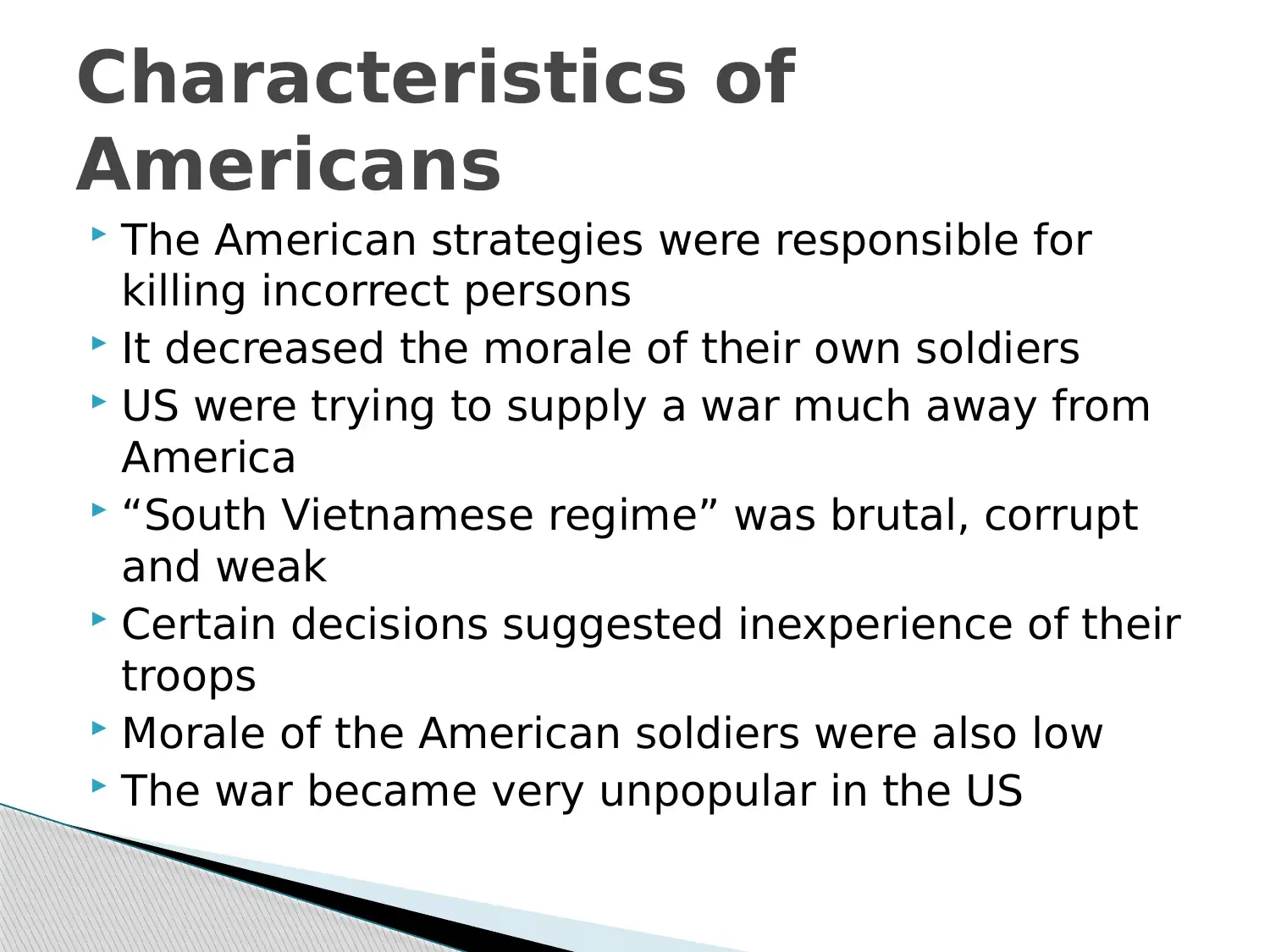
The American strategies were responsible for
killing incorrect persons
It decreased the morale of their own soldiers
US were trying to supply a war much away from
America
South Vietnamese regime” was brutal, corrupt
and weak
Certain decisions suggested inexperience of their
troops
Morale of the American soldiers were also low
The war became very unpopular in the US
Characteristics of
Americans
Document Page
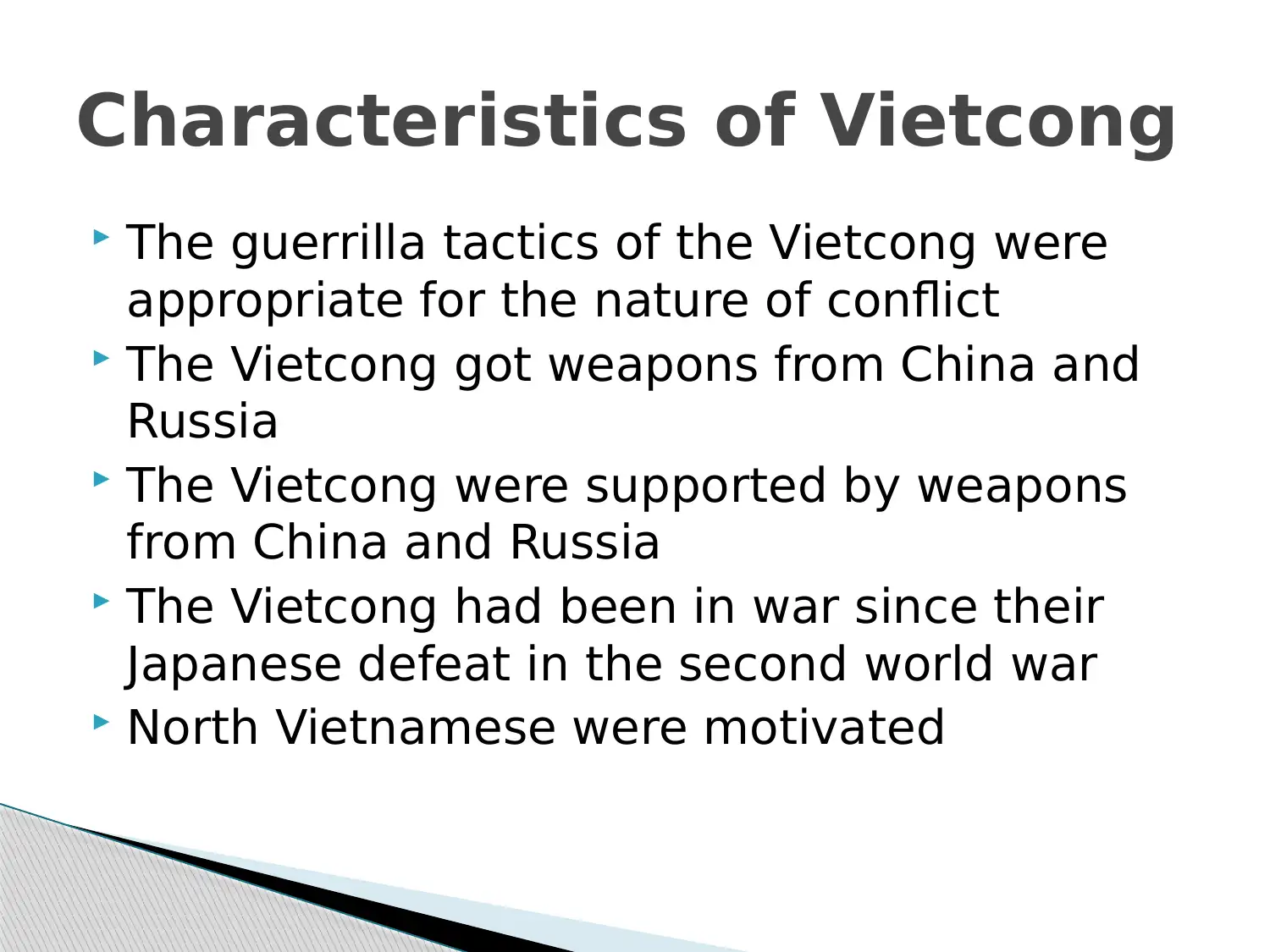
The guerrilla tactics of the Vietcong were
appropriate for the nature of conflict
The Vietcong got weapons from China and
Russia
The Vietcong were supported by weapons
from China and Russia
The Vietcong had been in war since their
Japanese defeat in the second world war
North Vietnamese were motivated
Characteristics of Vietcong
Document Page
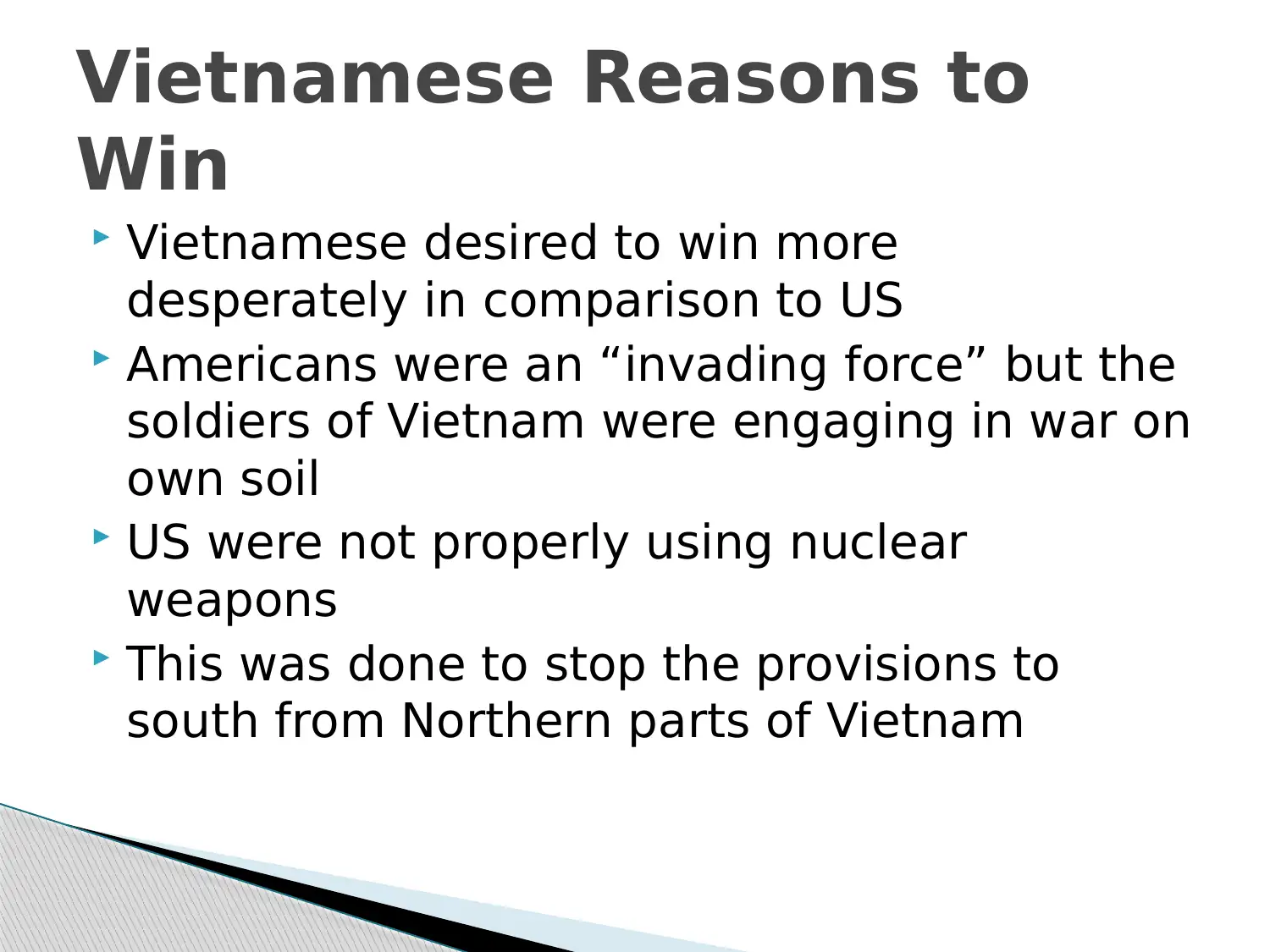
Vietnamese desired to win more
desperately in comparison to US
Americans were an “invading force” but the
soldiers of Vietnam were engaging in war on
own soil
US were not properly using nuclear
weapons
This was done to stop the provisions to
south from Northern parts of Vietnam
Vietnamese Reasons to
Win
tabler-icon-diamond-filled.svg

Paraphrase This Document

Need a fresh take? Get an instant paraphrase of this document with our AI Paraphraser
Document Page
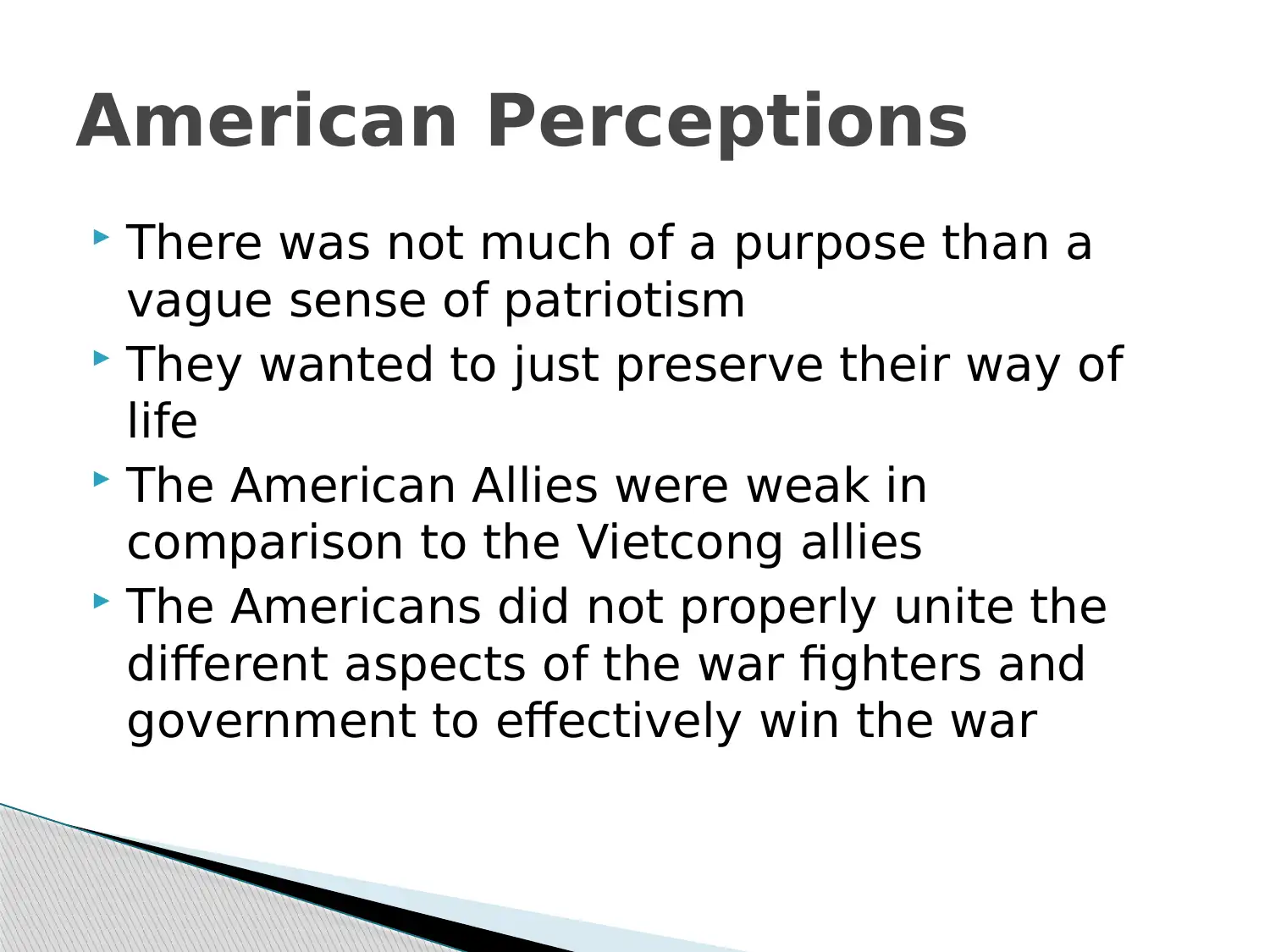
There was not much of a purpose than a
vague sense of patriotism
They wanted to just preserve their way of
life
The American Allies were weak in
comparison to the Vietcong allies
The Americans did not properly unite the
different aspects of the war fighters and
government to effectively win the war
American Perceptions
Document Page
The peasant backing was huge in case of
the Vietcong
The peasants has to deal with several
problems during the French rule and
Japanese occupation
US allowed a bloody coup to ensue which
killed crucial leaders
The Peasant Support to the
Vietnamese
Document Page
The confining ground operations within the
borders of South Vietnam proved to be fatal
US military commanders did not have a
mission to win the Vietnamese war rather
preventing them from winning it
Americans also lost the Vietnam war when
leaders chose to refight the last war
Conclusion
tabler-icon-diamond-filled.svg

Paraphrase This Document

Need a fresh take? Get an instant paraphrase of this document with our AI Paraphraser
Document Page
Gibbons, W. C. (2014). The US Government and the Vietnam
War: Executive and Legislative Roles and Relationships, Part
IV: July 1965-January 1968 (Vol. 4). Princeton University Press.
Lind, M. (2013). Vietnam: The necessary war. Simon and
Schuster.
Page, C. (2016). US official propaganda during the Vietnam
War, 1965-1973: the limits of persuasion. Bloomsbury
Publishing.
Thayer, T. (2016). War without fronts: The American
experience in Vietnam. Naval Institute Press.
Turse, N. (2013). Kill anything that moves: The real American
war in Vietnam. Macmillan.

References
chevron_up_icon
1 out of 8
circle_padding
hide_on_mobile
zoom_out_icon
[object Object]