WIAT-III Assessment Report: Analysis of Student Performance

Verified

Added on  2023/05/31

|8
|1601
|67
Report
AI Summary
This report provides an analysis of a WIAT-III (Wechsler Individual Achievement Test-3rd Edition) assessment, a standardized measure used to evaluate a student's academic performance in areas such as oral language, reading, mathematics, and written language. The report details the interpretation of subtest scores, including listening comprehension, reading comprehension, math problem-solving, sentence composition, word reading, essay composition, pseudoword decoding, numerical operations, oral expression, oral reading fluency, spelling, and math fluency. Each subtest's standard score, percentile, and corresponding skill range are presented, highlighting the student's strengths and weaknesses. Based on the assessment results, the report offers specific recommendations to improve the student's learning, including suggestions for listening and speaking skills, writing skills, and mathematics. The recommendations include strategies such as repeating instructions, utilizing visual aids, providing group work opportunities, allotting more time for writing, and incorporating remedial classes and games. The report concludes that the assessment covered all the questions and there were no limitations to the process.
Document Page
Running head: ASSESSMENT OF EXCEPTIONALITIES 1
Assessment of Exceptionalities Paper
Student's Name
Professor's Name
Affiliation
Date
tabler-icon-diamond-filled.svg

Paraphrase This Document

Need a fresh take? Get an instant paraphrase of this document with our AI Paraphraser
Document Page
ASSESSMENT OF EXCEPTIONALITIES
2
Assessment of Exceptionalities
Introduction
The WIAT-III (Wechsler Individual Achievement Test- 3rd Edition) is considered to be
standardized measure of functionality and achievement in the academic areas of oral language,
reading, mathematics, and written language that is administered to students individually. The
WIAT-III is offered to students between the ages of 4years and 19 11
12 years; as such, it caters to
all children and teenagers from pre-kindergarten to the twelfth grade (McCrimmon & Climie,
2011). The WIAT-II was developed by Pearson and is constituted of 16 subtests that are
designed to score the student with regard to the four domains presented above. An overall score
is then drawn from this subtests that is supposed to clearly highlight the student's strengths and
weaknesses. This information is then used to diagnose any learning disadvantages in the
students, and lay down precedent for the formulation of incentives & programs that address that
student's unique academic needs (McCrimmon & Climie, 2011).
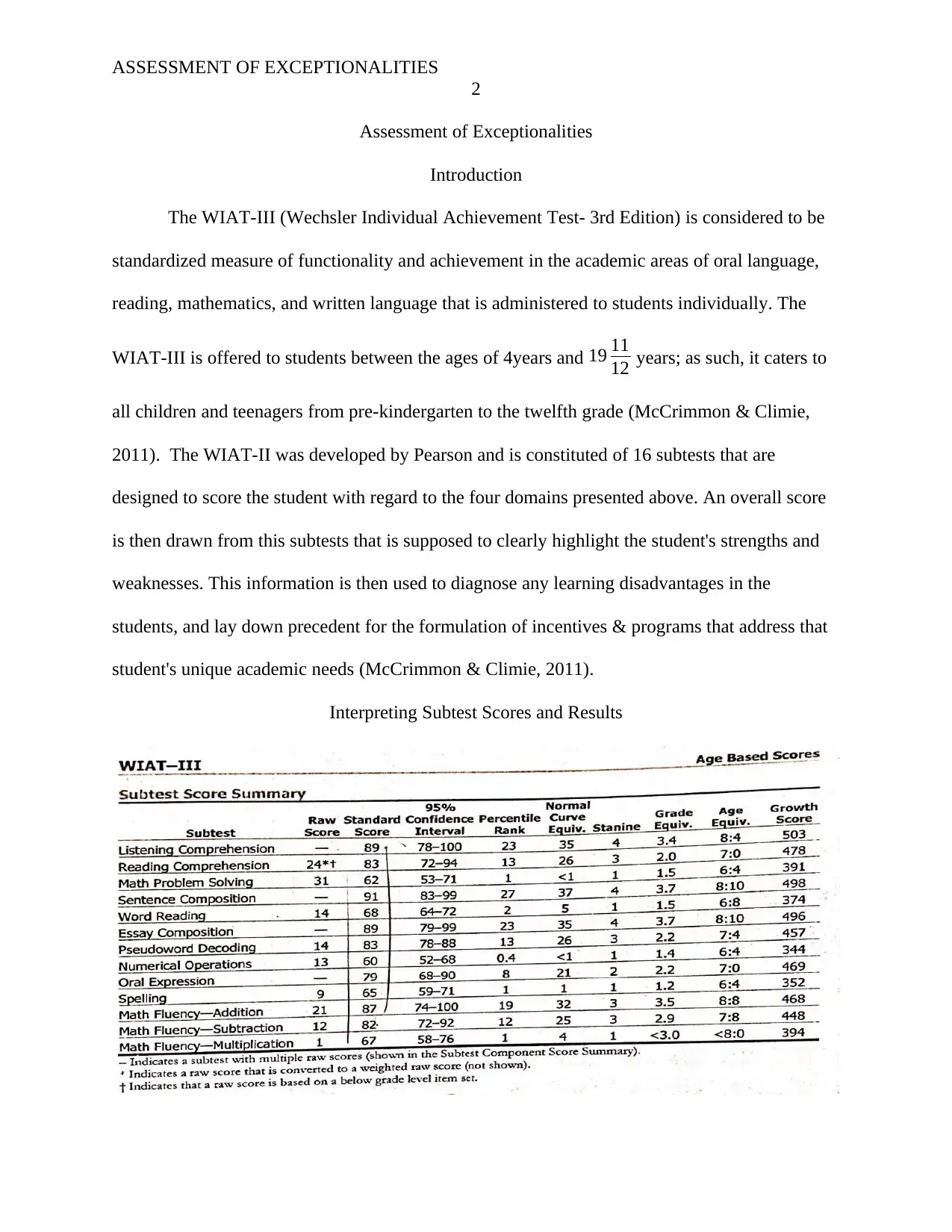
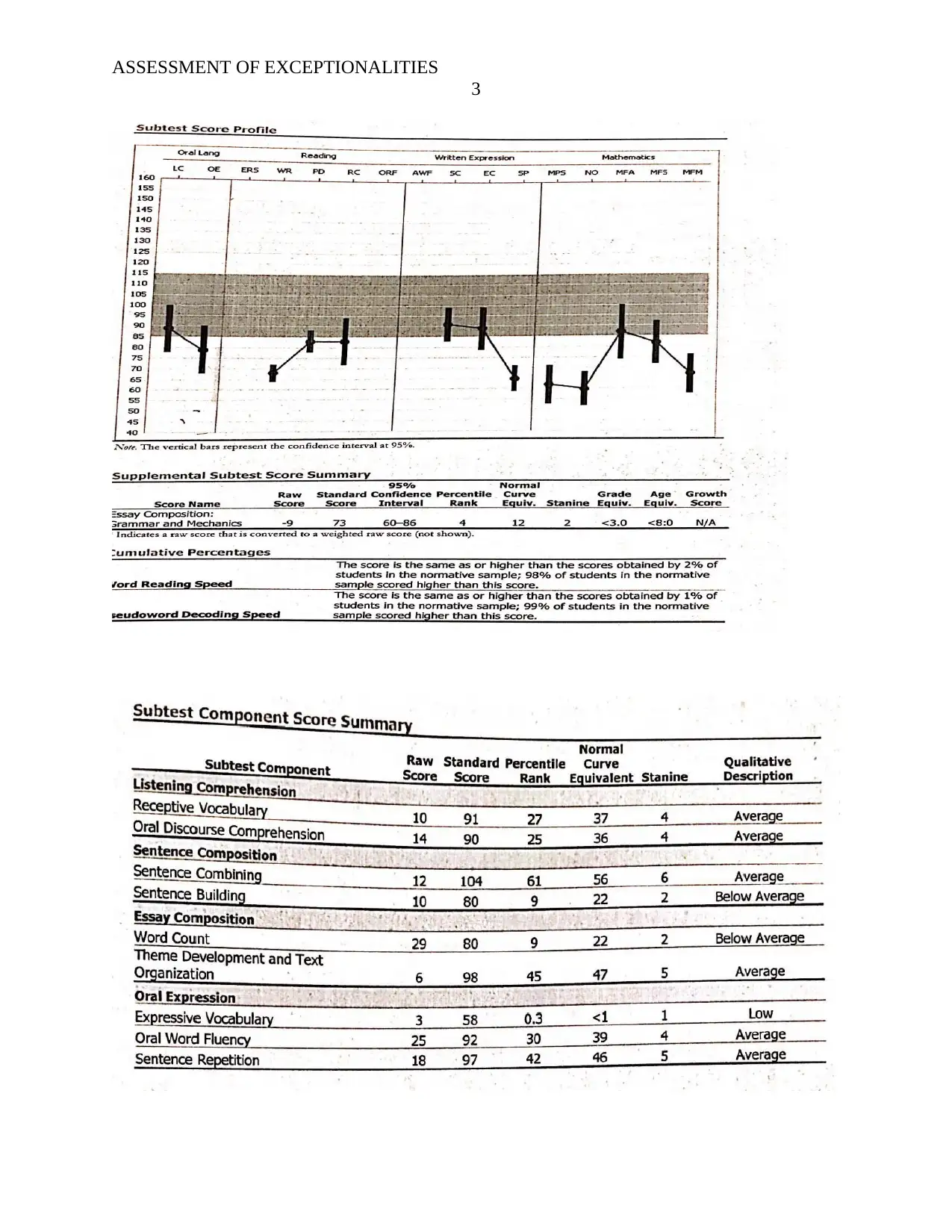
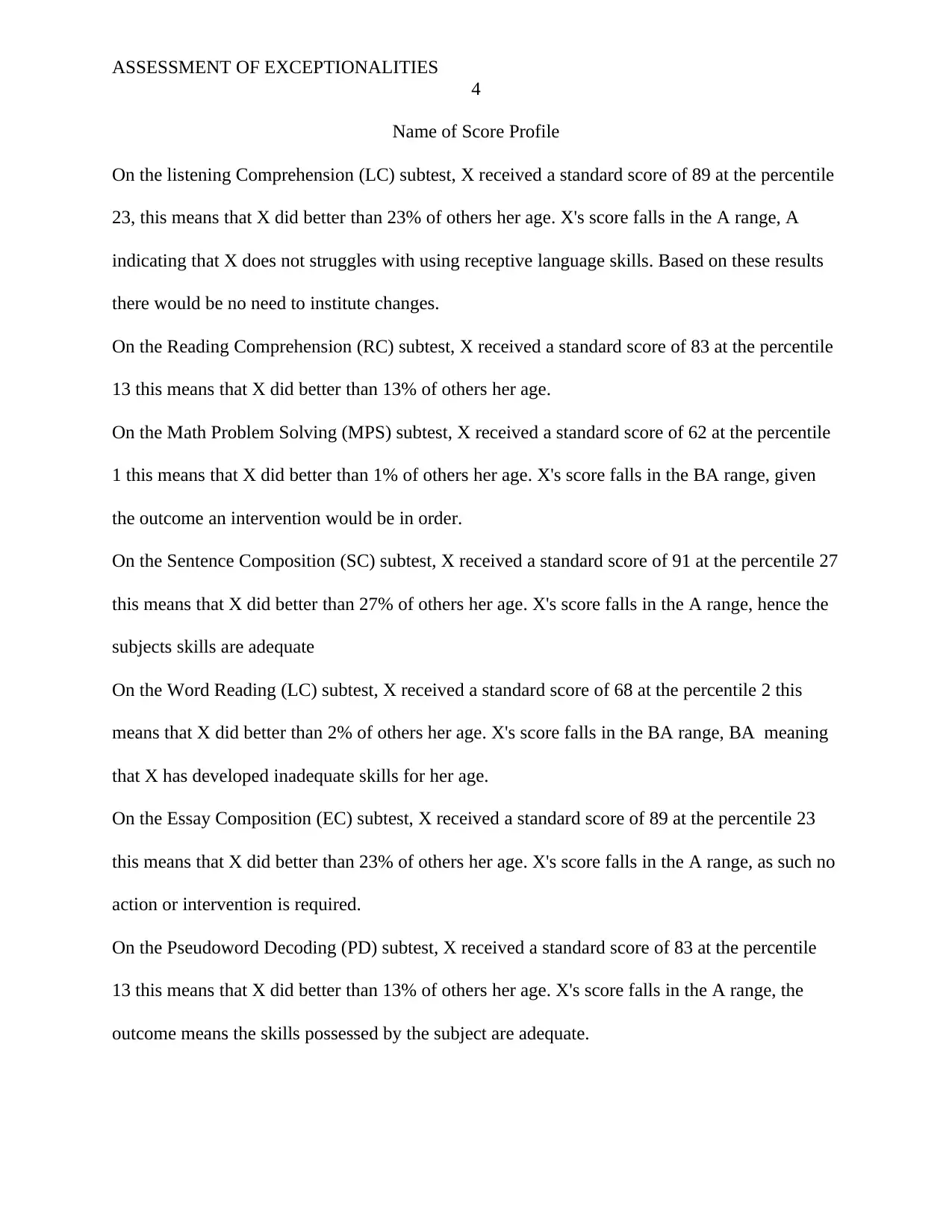
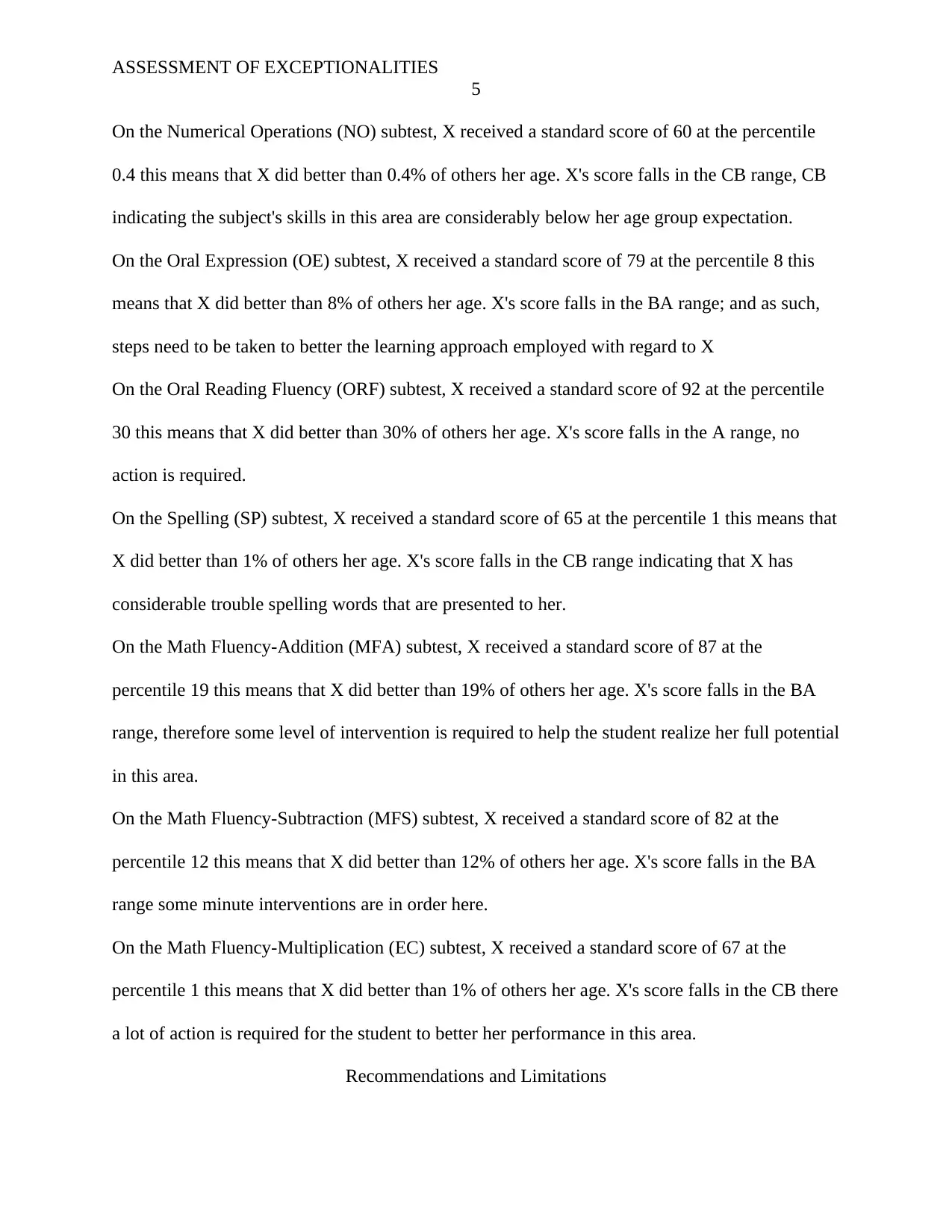
Interpreting Subtest Scores and Results
Document Page
ASSESSMENT OF EXCEPTIONALITIES
3
Document Page
ASSESSMENT OF EXCEPTIONALITIES
4
Name of Score Profile
On the listening Comprehension (LC) subtest, X received a standard score of 89 at the percentile
23, this means that X did better than 23% of others her age. X's score falls in the A range, A
indicating that X does not struggles with using receptive language skills. Based on these results
there would be no need to institute changes.
On the Reading Comprehension (RC) subtest, X received a standard score of 83 at the percentile
13 this means that X did better than 13% of others her age.
On the Math Problem Solving (MPS) subtest, X received a standard score of 62 at the percentile
1 this means that X did better than 1% of others her age. X's score falls in the BA range, given
the outcome an intervention would be in order.
On the Sentence Composition (SC) subtest, X received a standard score of 91 at the percentile 27
this means that X did better than 27% of others her age. X's score falls in the A range, hence the
subjects skills are adequate
On the Word Reading (LC) subtest, X received a standard score of 68 at the percentile 2 this
means that X did better than 2% of others her age. X's score falls in the BA range, BA meaning
that X has developed inadequate skills for her age.
On the Essay Composition (EC) subtest, X received a standard score of 89 at the percentile 23
this means that X did better than 23% of others her age. X's score falls in the A range, as such no
action or intervention is required.
On the Pseudoword Decoding (PD) subtest, X received a standard score of 83 at the percentile
13 this means that X did better than 13% of others her age. X's score falls in the A range, the
outcome means the skills possessed by the subject are adequate.
tabler-icon-diamond-filled.svg

Paraphrase This Document

Need a fresh take? Get an instant paraphrase of this document with our AI Paraphraser
Document Page
ASSESSMENT OF EXCEPTIONALITIES
5
On the Numerical Operations (NO) subtest, X received a standard score of 60 at the percentile
0.4 this means that X did better than 0.4% of others her age. X's score falls in the CB range, CB
indicating the subject's skills in this area are considerably below her age group expectation.
On the Oral Expression (OE) subtest, X received a standard score of 79 at the percentile 8 this
means that X did better than 8% of others her age. X's score falls in the BA range; and as such,
steps need to be taken to better the learning approach employed with regard to X
On the Oral Reading Fluency (ORF) subtest, X received a standard score of 92 at the percentile
30 this means that X did better than 30% of others her age. X's score falls in the A range, no
action is required.
On the Spelling (SP) subtest, X received a standard score of 65 at the percentile 1 this means that
X did better than 1% of others her age. X's score falls in the CB range indicating that X has
considerable trouble spelling words that are presented to her.
On the Math Fluency-Addition (MFA) subtest, X received a standard score of 87 at the
percentile 19 this means that X did better than 19% of others her age. X's score falls in the BA
range, therefore some level of intervention is required to help the student realize her full potential
in this area.
On the Math Fluency-Subtraction (MFS) subtest, X received a standard score of 82 at the
percentile 12 this means that X did better than 12% of others her age. X's score falls in the BA
range some minute interventions are in order here.
On the Math Fluency-Multiplication (EC) subtest, X received a standard score of 67 at the
percentile 1 this means that X did better than 1% of others her age. X's score falls in the CB there
a lot of action is required for the student to better her performance in this area.
Recommendations and Limitations
Document Page
ASSESSMENT OF EXCEPTIONALITIES
6
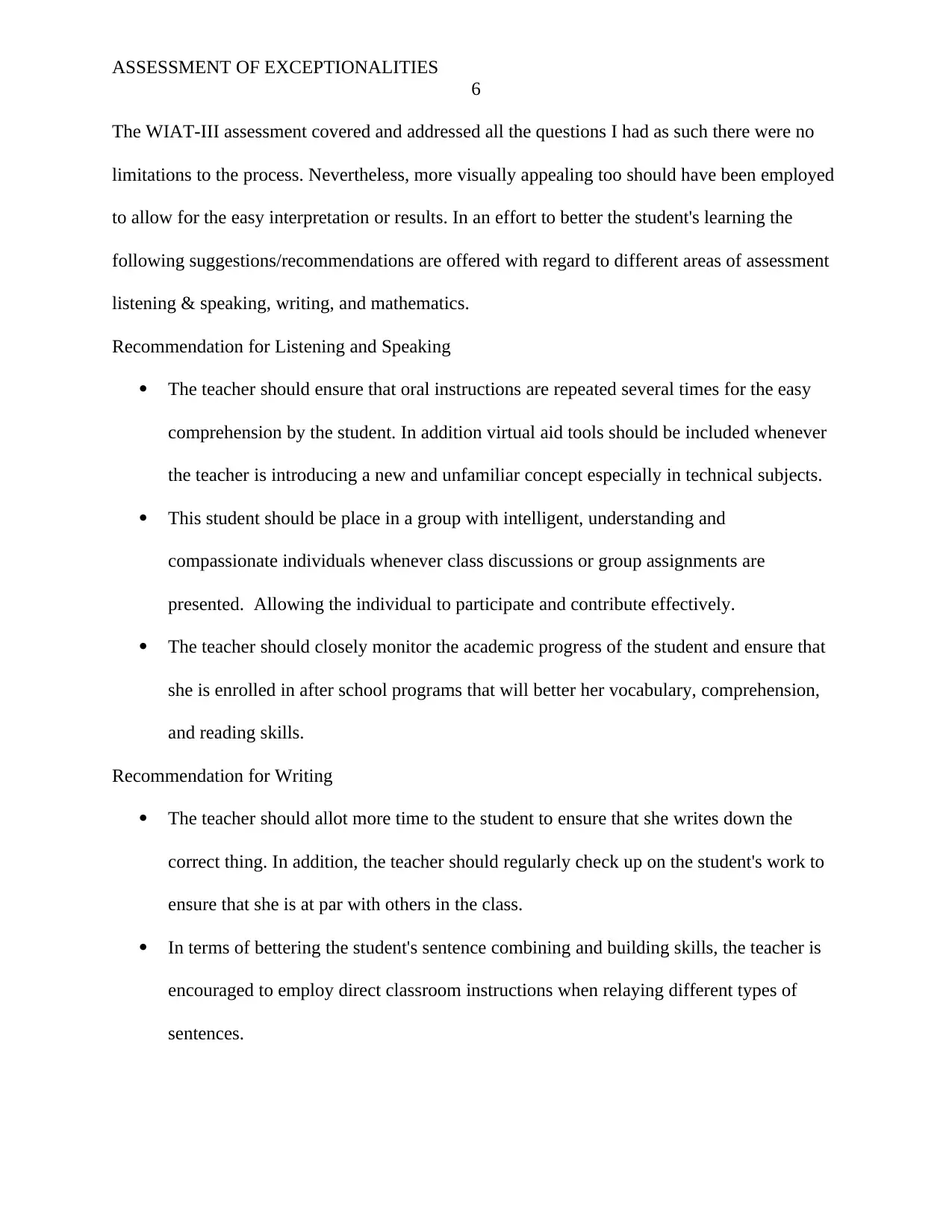
The WIAT-III assessment covered and addressed all the questions I had as such there were no
limitations to the process. Nevertheless, more visually appealing too should have been employed
to allow for the easy interpretation or results. In an effort to better the student's learning the
following suggestions/recommendations are offered with regard to different areas of assessment
listening & speaking, writing, and mathematics.
Recommendation for Listening and Speaking
The teacher should ensure that oral instructions are repeated several times for the easy
comprehension by the student. In addition virtual aid tools should be included whenever
the teacher is introducing a new and unfamiliar concept especially in technical subjects.
This student should be place in a group with intelligent, understanding and
compassionate individuals whenever class discussions or group assignments are
presented. Allowing the individual to participate and contribute effectively.
The teacher should closely monitor the academic progress of the student and ensure that
she is enrolled in after school programs that will better her vocabulary, comprehension,
and reading skills.
Recommendation for Writing
The teacher should allot more time to the student to ensure that she writes down the
correct thing. In addition, the teacher should regularly check up on the student's work to
ensure that she is at par with others in the class.
In terms of bettering the student's sentence combining and building skills, the teacher is
encouraged to employ direct classroom instructions when relaying different types of
sentences.
Document Page
ASSESSMENT OF EXCEPTIONALITIES
7
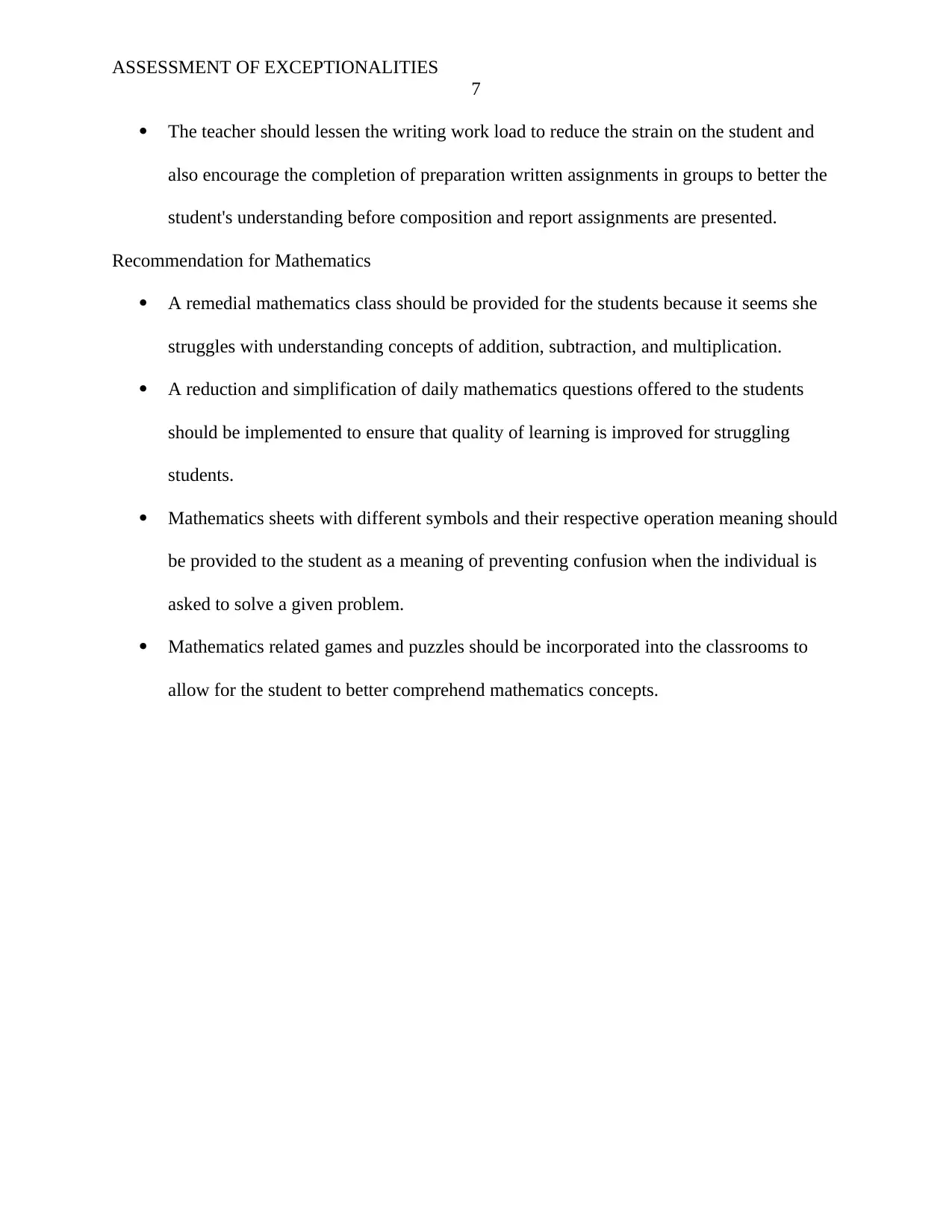
The teacher should lessen the writing work load to reduce the strain on the student and
also encourage the completion of preparation written assignments in groups to better the
student's understanding before composition and report assignments are presented.
Recommendation for Mathematics
A remedial mathematics class should be provided for the students because it seems she
struggles with understanding concepts of addition, subtraction, and multiplication.
A reduction and simplification of daily mathematics questions offered to the students
should be implemented to ensure that quality of learning is improved for struggling
students.
Mathematics sheets with different symbols and their respective operation meaning should
be provided to the student as a meaning of preventing confusion when the individual is
asked to solve a given problem.
Mathematics related games and puzzles should be incorporated into the classrooms to
allow for the student to better comprehend mathematics concepts.
tabler-icon-diamond-filled.svg

Paraphrase This Document

Need a fresh take? Get an instant paraphrase of this document with our AI Paraphraser
Document Page
ASSESSMENT OF EXCEPTIONALITIES
8
References
Burns, T. G. (2010). Wechsler Individual Achievement Test-III: What is the ‘Gold Standard’ for
Measuring Academic Achievement? Applied Neuropsychology , XVII (3), 234-236.
Maccow, G. (2011). Administration, Scoring, and Interpretation of Wechsler Individual Achievement
Test-III. New York: Pearson Inc.
McCrimmon, A. W., & Climie, E. A. (2011). Test Review: D. Wechsler Wechsler Individual
Achievement Test-Third Edition. Aan antonio, TX: NCS Pearson, 2009. Canadian Journal of
School Psychology , XXVI (2), 148-156.
Parkin, J. R. (2018). Wechsler Individual Achievement Test–Third Edition Oral Language and Reading
Measures Effects on Reading Comprehension in a Referred Sample. Journal of
Psychoeducational Assessment , XXXVI (3), 203–218.
Stephens, M., & Armstrong, M. (2017). Using the WISC-V and WIAT-III to Diagnose Learning
Disorders. New York: Pearson Inc.
chevron_up_icon
1 out of 8
circle_padding
hide_on_mobile
zoom_out_icon
[object Object]