DET4AB51: Unit 4 Report on Professional Practice and Development
VerifiedAdded on 2022/08/01
|31
|8471
|134
Report
AI Summary
This report, submitted by a student, addresses key aspects of professional practice and development within the education and training sector, specifically focusing on the DET4AB51 unit. The report begins by defining and explaining professionalism and dual professionalism, emphasizing the importance of subject matter expertise alongside teaching skills. It then analyzes how professional values influence practice, including the impact of social, political, and economic factors on current education policies in the UK. The report further examines the role of stakeholders, external bodies, and their influence on curriculum design, delivery, and assessment. It concludes with an exploration of quality assurance cycles, self-assessment, and evaluation within an educational institution, identifying areas for improvement within a learning program. The report covers various topics, including the importance of working in partnership with employers and stakeholders, the impact of organizational requirements, and the application of professional standards. The student uses their own experiences to provide context and examples throughout the report.
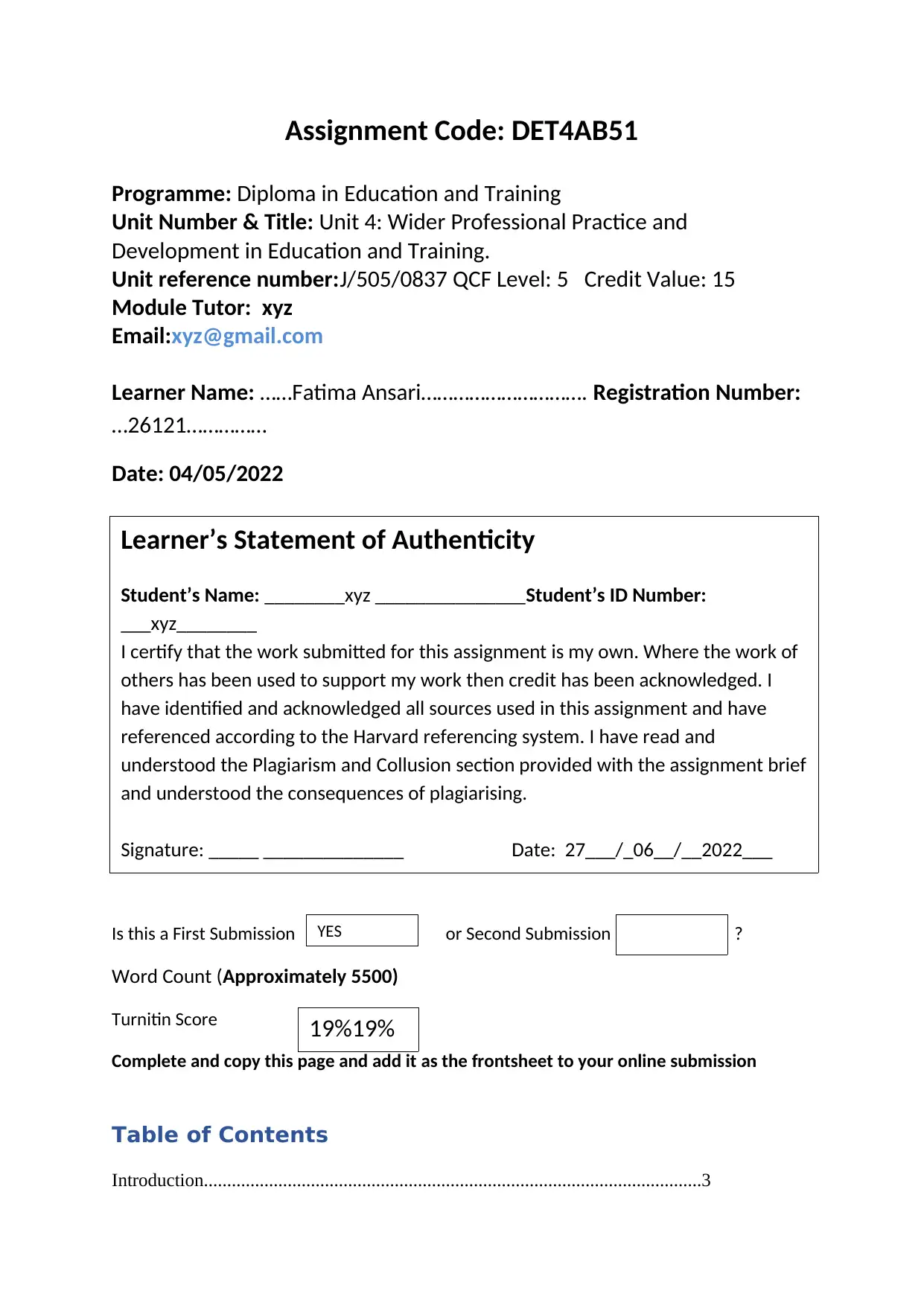
Assignment Code: DET4AB51
Programme: Diploma in Education and Training
Unit Number & Title: Unit 4: Wider Professional Practice and
Development in Education and Training.
Unit reference number:J/505/0837 QCF Level: 5 Credit Value: 15
Module Tutor: xyz
Email:xyz@gmail.com
Learner Name: ……Fatima Ansari…………………………. Registration Number:
…26121……………
Date: 04/05/2022
……………………………………………
Is this a First Submission or Second Submission ?
Word Count (Approximately 5500)
Turnitin Score
Complete and copy this page and add it as the frontsheet to your online submission
Table of Contents
Introduction...........................................................................................................3
Learner’s Statement of Authenticity
Student’s Name: ________xyz _______________Student’s ID Number:
___xyz________
I certify that the work submitted for this assignment is my own. Where the work of
others has been used to support my work then credit has been acknowledged. I
have identified and acknowledged all sources used in this assignment and have
referenced according to the Harvard referencing system. I have read and
understood the Plagiarism and Collusion section provided with the assignment brief
and understood the consequences of plagiarising.
Signature: _____ ______________ Date: 27___/_06__/__2022___
YES
19%19%
Programme: Diploma in Education and Training
Unit Number & Title: Unit 4: Wider Professional Practice and
Development in Education and Training.
Unit reference number:J/505/0837 QCF Level: 5 Credit Value: 15
Module Tutor: xyz
Email:xyz@gmail.com
Learner Name: ……Fatima Ansari…………………………. Registration Number:
…26121……………
Date: 04/05/2022
……………………………………………
Is this a First Submission or Second Submission ?
Word Count (Approximately 5500)
Turnitin Score
Complete and copy this page and add it as the frontsheet to your online submission
Table of Contents
Introduction...........................................................................................................3
Learner’s Statement of Authenticity
Student’s Name: ________xyz _______________Student’s ID Number:
___xyz________
I certify that the work submitted for this assignment is my own. Where the work of
others has been used to support my work then credit has been acknowledged. I
have identified and acknowledged all sources used in this assignment and have
referenced according to the Harvard referencing system. I have read and
understood the Plagiarism and Collusion section provided with the assignment brief
and understood the consequences of plagiarising.
Signature: _____ ______________ Date: 27___/_06__/__2022___
YES
19%19%

Paraphrase This Document
Need a fresh take? Get an instant paraphrase of this document with our AI Paraphraser
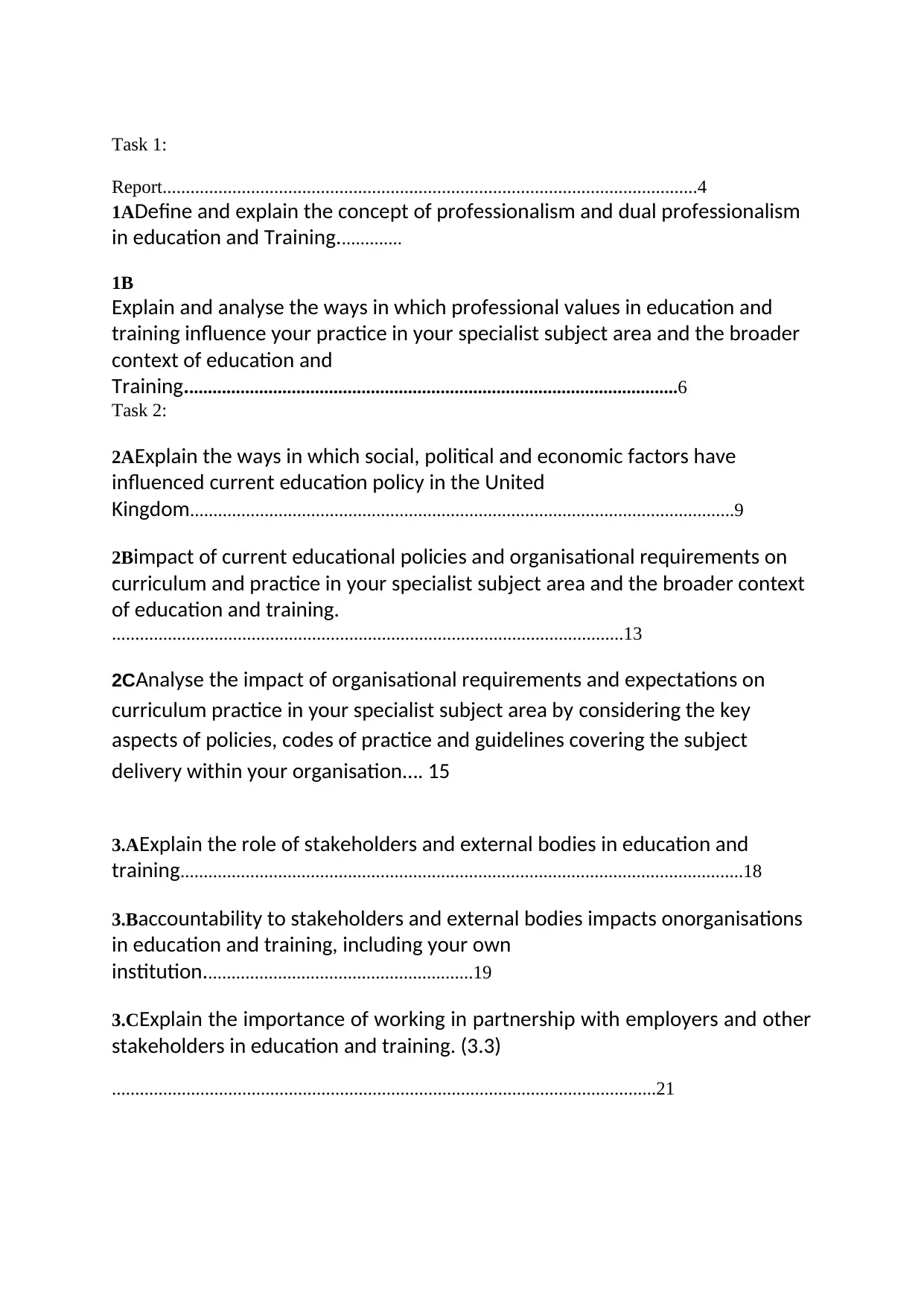
Task 1:
Report...................................................................................................................4
1ADefine and explain the concept of professionalism and dual professionalism
in education and Training..............
1B
Explain and analyse the ways in which professional values in education and
training influence your practice in your specialist subject area and the broader
context of education and
Training..........................................................................................................6
Task 2:
2AExplain the ways in which social, political and economic factors have
influenced current education policy in the United
Kingdom.....................................................................................................................9
2Bimpact of current educational policies and organisational requirements on
curriculum and practice in your specialist subject area and the broader context
of education and training.
..............................................................................................................13
2CAnalyse the impact of organisational requirements and expectations on
curriculum practice in your specialist subject area by considering the key
aspects of policies, codes of practice and guidelines covering the subject
delivery within your organisation…. 15
3.AExplain the role of stakeholders and external bodies in education and
training.........................................................................................................................18
3.Baccountability to stakeholders and external bodies impacts onorganisations
in education and training, including your own
institution..........................................................19
3.CExplain the importance of working in partnership with employers and other
stakeholders in education and training. (3.3)
.....................................................................................................................21
Report...................................................................................................................4
1ADefine and explain the concept of professionalism and dual professionalism
in education and Training..............
1B
Explain and analyse the ways in which professional values in education and
training influence your practice in your specialist subject area and the broader
context of education and
Training..........................................................................................................6
Task 2:
2AExplain the ways in which social, political and economic factors have
influenced current education policy in the United
Kingdom.....................................................................................................................9
2Bimpact of current educational policies and organisational requirements on
curriculum and practice in your specialist subject area and the broader context
of education and training.
..............................................................................................................13
2CAnalyse the impact of organisational requirements and expectations on
curriculum practice in your specialist subject area by considering the key
aspects of policies, codes of practice and guidelines covering the subject
delivery within your organisation…. 15
3.AExplain the role of stakeholders and external bodies in education and
training.........................................................................................................................18
3.Baccountability to stakeholders and external bodies impacts onorganisations
in education and training, including your own
institution..........................................................19
3.CExplain the importance of working in partnership with employers and other
stakeholders in education and training. (3.3)
.....................................................................................................................21
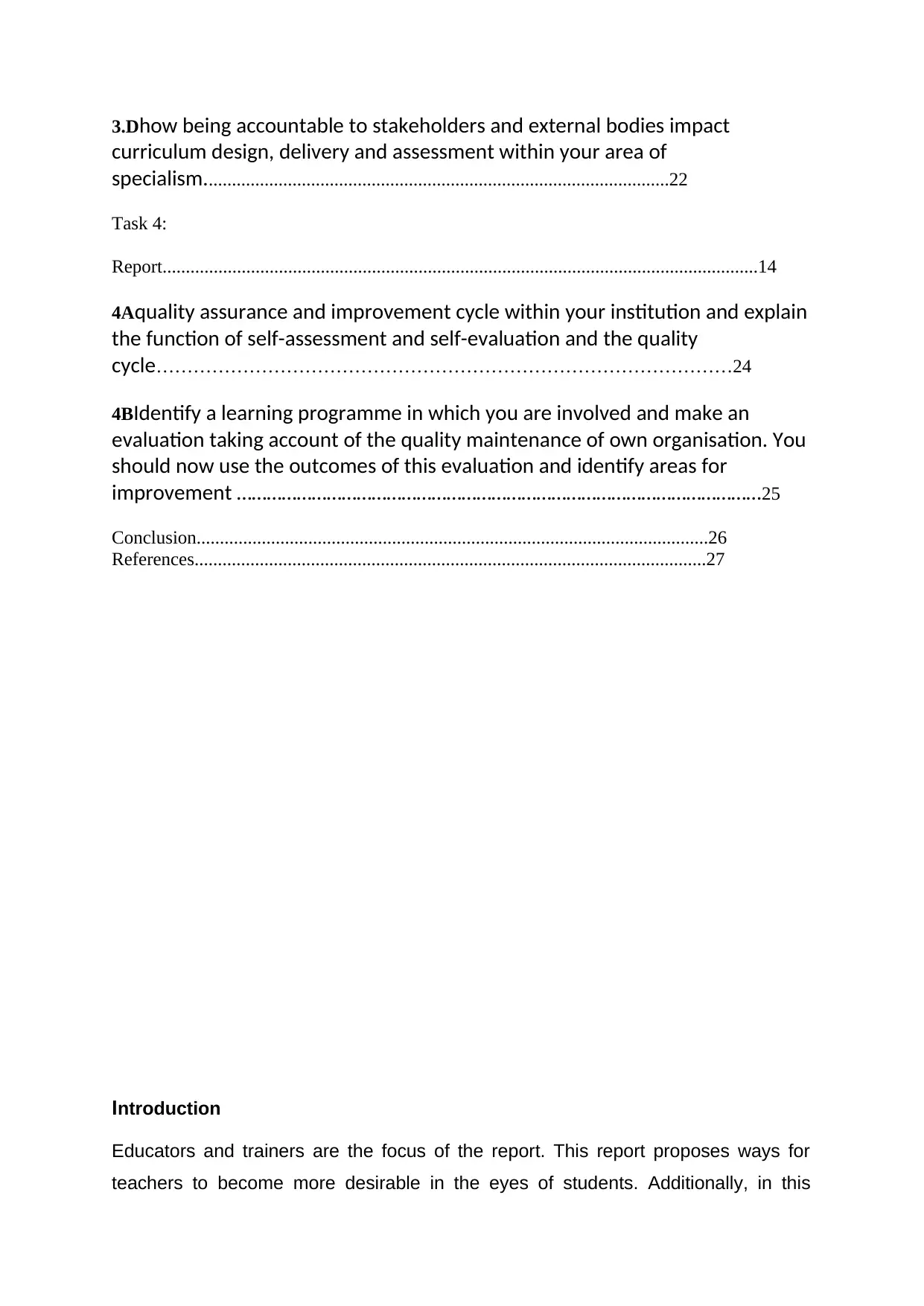
3.Dhow being accountable to stakeholders and external bodies impact
curriculum design, delivery and assessment within your area of
specialism....................................................................................................22
Task 4:
Report................................................................................................................................14
4Aquality assurance and improvement cycle within your institution and explain
the function of self-assessment and self-evaluation and the quality
cycle…………………………………………………………………………………24
4BIdentify a learning programme in which you are involved and make an
evaluation taking account of the quality maintenance of own organisation. You
should now use the outcomes of this evaluation and identify areas for
improvement ……………………………………………………………………………………………25
Conclusion..............................................................................................................26
References..............................................................................................................27
Introduction
Educators and trainers are the focus of the report. This report proposes ways for
teachers to become more desirable in the eyes of students. Additionally, in this
curriculum design, delivery and assessment within your area of
specialism....................................................................................................22
Task 4:
Report................................................................................................................................14
4Aquality assurance and improvement cycle within your institution and explain
the function of self-assessment and self-evaluation and the quality
cycle…………………………………………………………………………………24
4BIdentify a learning programme in which you are involved and make an
evaluation taking account of the quality maintenance of own organisation. You
should now use the outcomes of this evaluation and identify areas for
improvement ……………………………………………………………………………………………25
Conclusion..............................................................................................................26
References..............................................................................................................27
Introduction
Educators and trainers are the focus of the report. This report proposes ways for
teachers to become more desirable in the eyes of students. Additionally, in this
⊘ This is a preview!⊘
Do you want full access?
Subscribe today to unlock all pages.

Trusted by 1+ million students worldwide
report, those approaches are going to be developed for achieving a quality
assurance framework for assessing students. In the educational institute and training
sector, all conditions will be met. There will be a number of approaches and
requirements for education and training described. Students and teachers are
introduced to all the procedures, strategies, and advantages for the improvement of
their teaching. Throughout this report as an educator, I will investigate the
professional practices in the education and training fields.
TASK – 1
A. Define and explain the concept of professionalism and dual
professionalism in education and Training. (1.1)
assurance framework for assessing students. In the educational institute and training
sector, all conditions will be met. There will be a number of approaches and
requirements for education and training described. Students and teachers are
introduced to all the procedures, strategies, and advantages for the improvement of
their teaching. Throughout this report as an educator, I will investigate the
professional practices in the education and training fields.
TASK – 1
A. Define and explain the concept of professionalism and dual
professionalism in education and Training. (1.1)
Paraphrase This Document
Need a fresh take? Get an instant paraphrase of this document with our AI Paraphraser
I am expected to show professionalism and develop my dual professional skills after
completing my DET teacher training. In dual professionalism, my main aim is to
demonstrate professionalism at work. By becoming a subject specialist and teacher,
I will emphasize essential knowledge, values, and skills. I will follow the educational
standards set by the sector.
The author (Hoyle, 1975, p. 315) states that extended professionalism is a means by
which members of an occupation aim to improve their status, salary, and working
conditions. According to Scales (2008), professionalism is a characteristic of an
effective teacher. His definition of a professional includes how educators behave, look,
interact with students, speak, and prepare and plan their work.
A professional is someone who has skills and capabilities. A professional is
someone with the following skills, great communication skills, disciplined and
organized, reliable, respectful, responsible, and supportive, positive, fair, punctuality,
appearance and outfit, appropriate language, integrity and dignity (Pratte&Rury,
1992, p.60). Examples of professionals include, teacher, lawyer, judge, doctor,
nurse, optician, engineer, accountant etc. Professionalism is also defined by the
(LLUK 2006) as an ability to teach well. A professional approach to teaching involves
not only a code of conduct, a code of behaviour, and knowledge, but also the ability
to do an effective job. They have to value all students individually and equally.
Someone who is a dual professional is someone who is primarily knowledgeable
about their subject as well as their teaching practice (Sims, 2011). Dual professions
are those in the learning and skills sector who have training in one field and are
teachers who are committed to developing their skills and knowledge in teaching
(Plowright and Barr, 2012: 8). Those who are dual-trained as teachers and subject
specialists are committed to developing expertise and knowledge in both fields of
study to ensure that students succeed (Green, 2015; Education and Training
Foundation, 2014). Training as a teacher requires me to meet the standards set by
professional bodies. As an example, treating all students equally, being prepared,
and maintaining good attendance, once I complete my Diploma in education and
training, I will become a dual professional since I will have subject knowledge and a
completing my DET teacher training. In dual professionalism, my main aim is to
demonstrate professionalism at work. By becoming a subject specialist and teacher,
I will emphasize essential knowledge, values, and skills. I will follow the educational
standards set by the sector.
The author (Hoyle, 1975, p. 315) states that extended professionalism is a means by
which members of an occupation aim to improve their status, salary, and working
conditions. According to Scales (2008), professionalism is a characteristic of an
effective teacher. His definition of a professional includes how educators behave, look,
interact with students, speak, and prepare and plan their work.
A professional is someone who has skills and capabilities. A professional is
someone with the following skills, great communication skills, disciplined and
organized, reliable, respectful, responsible, and supportive, positive, fair, punctuality,
appearance and outfit, appropriate language, integrity and dignity (Pratte&Rury,
1992, p.60). Examples of professionals include, teacher, lawyer, judge, doctor,
nurse, optician, engineer, accountant etc. Professionalism is also defined by the
(LLUK 2006) as an ability to teach well. A professional approach to teaching involves
not only a code of conduct, a code of behaviour, and knowledge, but also the ability
to do an effective job. They have to value all students individually and equally.
Someone who is a dual professional is someone who is primarily knowledgeable
about their subject as well as their teaching practice (Sims, 2011). Dual professions
are those in the learning and skills sector who have training in one field and are
teachers who are committed to developing their skills and knowledge in teaching
(Plowright and Barr, 2012: 8). Those who are dual-trained as teachers and subject
specialists are committed to developing expertise and knowledge in both fields of
study to ensure that students succeed (Green, 2015; Education and Training
Foundation, 2014). Training as a teacher requires me to meet the standards set by
professional bodies. As an example, treating all students equally, being prepared,
and maintaining good attendance, once I complete my Diploma in education and
training, I will become a dual professional since I will have subject knowledge and a
professional teaching qualification. With my degree in education and the DET, I'll
have a dual career
B. Explain and analyse the ways in which professional values in education
and training influence your practice in your specialist subject area and
the broader context of education and Training. (1.2)
have a dual career
B. Explain and analyse the ways in which professional values in education
and training influence your practice in your specialist subject area and
the broader context of education and Training. (1.2)
⊘ This is a preview!⊘
Do you want full access?
Subscribe today to unlock all pages.
Trusted by 1+ million students worldwide
I must achieve and work within certain values as a member of the teaching and
training profession. The values I hold influence how I practice my profession and
how I relate to others. I always considered organisational values as an important
aspect of being a critical reflective teacher. Teachers' professional qualities are
measured by their professional values, including responsibilities, attitudes, fairness,
integrity, commitment, loyalty, cooperation, justice, faithfulness, respect for others,
and self-discipline (Strain, 1995:47-48). In addition to meeting the organization's
policies, promoting equality in teaching and learning, setting high standards, referring
to the current awarding organization requirements, and engaging in professional
development, all of those qualities assist me in meeting the organization's
objectives.
Halsted and Taylor (2000:177) acknowledge there are two assumptions behind
professional values for teachers. As a teacher, you have a responsibility to influence
the development of your pupils' values. It is also clear that a pupil's values are
consciously shaped by the example set by his or her teachers in the way they
interact, behave, or teach. For a teacher to portray a professional image, they must
demonstrate reliability, consistency, and honesty.
Professional values
The way we view ourselves as professionals can be defined through the values we
hold. These values are determined by our beliefs, attitudes, motives, and
experiences. They shape our teaching decisions. Professional values that we
already possess and then develop as we teach, are influenced by society's attitude
to education, learners, morals, and ethics. Culture and society have a large impact
on our value systems because the people and institutions we interact with shape our
values. My performance is influenced by how I follow organizational policies
and procedures, promote equality in learning, establish high standards, share
best practice, work towards the current awarding organization's requirements,
participate in continuing professional development, and meet my own
standards.
Dress and behave appropriately. Deliver work within agreed timelines and quality
standards. Someone who displays professional values will follow all of the above
training profession. The values I hold influence how I practice my profession and
how I relate to others. I always considered organisational values as an important
aspect of being a critical reflective teacher. Teachers' professional qualities are
measured by their professional values, including responsibilities, attitudes, fairness,
integrity, commitment, loyalty, cooperation, justice, faithfulness, respect for others,
and self-discipline (Strain, 1995:47-48). In addition to meeting the organization's
policies, promoting equality in teaching and learning, setting high standards, referring
to the current awarding organization requirements, and engaging in professional
development, all of those qualities assist me in meeting the organization's
objectives.
Halsted and Taylor (2000:177) acknowledge there are two assumptions behind
professional values for teachers. As a teacher, you have a responsibility to influence
the development of your pupils' values. It is also clear that a pupil's values are
consciously shaped by the example set by his or her teachers in the way they
interact, behave, or teach. For a teacher to portray a professional image, they must
demonstrate reliability, consistency, and honesty.
Professional values
The way we view ourselves as professionals can be defined through the values we
hold. These values are determined by our beliefs, attitudes, motives, and
experiences. They shape our teaching decisions. Professional values that we
already possess and then develop as we teach, are influenced by society's attitude
to education, learners, morals, and ethics. Culture and society have a large impact
on our value systems because the people and institutions we interact with shape our
values. My performance is influenced by how I follow organizational policies
and procedures, promote equality in learning, establish high standards, share
best practice, work towards the current awarding organization's requirements,
participate in continuing professional development, and meet my own
standards.
Dress and behave appropriately. Deliver work within agreed timelines and quality
standards. Someone who displays professional values will follow all of the above
Paraphrase This Document
Need a fresh take? Get an instant paraphrase of this document with our AI Paraphraser
values. These are the qualities a teacher must possess. It is important to incorporate
these values into the practices of work, such as adhering to organisational policies,
complying with legal requirements for an inclusive learning environment and
promoting equality. Through their teaching profession values, educational institutions
are able to demonstrate their policies and procedures for good practices.
A value like "honesty" will enable me to follow your organization's policies and
procedures as a teacher. Teachers will use these guidelines. Integrity will help to
create a good relationship with the students. People can trust easily through these
people, and a sharing environment will be embedded. Teachers who are adaptable
will be able to cope with the requirements of the current awarding organisations. A
teacher's communication skills and attitude will influence the quality of both teaching
and learning. As part of ongoing professional development, teachers need to update
their specialized knowledge and expertise. We as teachers are role models of values
and honesty, and that impacts the way I teach. Having a commitment to my learners
is one of my guiding values. That involves emotional investment and a morality of
excellence. I will have to adapt resources to support the earner, good relationship
and positive encouragement will help with building relationship with the learner.
Valuing, indorsing and respecting inclusion and equal opportunity.
Professional standards
In 2014, the education and training departments developed professional standards.
The professional standards underlines the list of responsibilities that I have to intake
as a teacher concerning my learner, the community, stakeholders and other
organisations. 2014 professional standards for education and training outline clear
expectations for effective practice. Provide teachers and trainers with guidance on
their own professional development (Halstead and Taylor, 2000:17). These
standards describe a teacher's professional attributes, professional knowledge, and
professional skills. In each career stage, they clarify what is expected.
A teacher or trainer is a "dual professional". This means they are subject specialists
as well as training specialists. They strive to give their students the best possible
results. The standards are divided into three parts. Teachers and trainers are able to
define the areas in which they want to grow professionally by using the 2014
these values into the practices of work, such as adhering to organisational policies,
complying with legal requirements for an inclusive learning environment and
promoting equality. Through their teaching profession values, educational institutions
are able to demonstrate their policies and procedures for good practices.
A value like "honesty" will enable me to follow your organization's policies and
procedures as a teacher. Teachers will use these guidelines. Integrity will help to
create a good relationship with the students. People can trust easily through these
people, and a sharing environment will be embedded. Teachers who are adaptable
will be able to cope with the requirements of the current awarding organisations. A
teacher's communication skills and attitude will influence the quality of both teaching
and learning. As part of ongoing professional development, teachers need to update
their specialized knowledge and expertise. We as teachers are role models of values
and honesty, and that impacts the way I teach. Having a commitment to my learners
is one of my guiding values. That involves emotional investment and a morality of
excellence. I will have to adapt resources to support the earner, good relationship
and positive encouragement will help with building relationship with the learner.
Valuing, indorsing and respecting inclusion and equal opportunity.
Professional standards
In 2014, the education and training departments developed professional standards.
The professional standards underlines the list of responsibilities that I have to intake
as a teacher concerning my learner, the community, stakeholders and other
organisations. 2014 professional standards for education and training outline clear
expectations for effective practice. Provide teachers and trainers with guidance on
their own professional development (Halstead and Taylor, 2000:17). These
standards describe a teacher's professional attributes, professional knowledge, and
professional skills. In each career stage, they clarify what is expected.
A teacher or trainer is a "dual professional". This means they are subject specialists
as well as training specialists. They strive to give their students the best possible
results. The standards are divided into three parts. Teachers and trainers are able to
define the areas in which they want to grow professionally by using the 2014
professional standards. In addition to promoting teacher education, the program
provides organizations with a national reference when promoting employee
development. To achieve my goal of becoming a professional teacher, I must be
able to demonstrate the following in my teaching practice:
Professional values and attributes
As a professional teacher I must consider how I can help and meet the needs of the
learner, the strategies that are in place and the resources if they meet and works in
teaching. As a teacher I must be passionate and pass the knowledge I have and
expect high from my learner. Valuing socio and cultural and diversity and equal
opportunity and inclusion is a professional value and attribute that a teacher must
show when teaching or practicing.
I show the professional attributes and values by acting on it, for example having or
showing respect towards other colleagues, parents and external stakeholders.
Structuring a safe and engaging atmosphere for all the students regardless of their
belief, abilities, gender, and age.
Professional knowledge and understanding
As a trainee teacher I must have an well-versed knowledge o the subject I teach and
keeping up to date with the educational knowledge, educational studies to help me
improve my teaching. My teaching practice is continuously improved through CPD,
staff meetings, courses, and school networks.
Depth knowledge of the subjects will boost up the confidence of the teachers. By
this, they can do prior planning on the teaching subjects towards the students, by
doing that learning will take place, and students will achieved and succeed, if the
teacher did not plan her lesson and doesn’t know what to teach student will fail and
school will have a bad image. The teacher should take steps to motivate students
with a dual professional approach, including experience in practice.
TASK – 2
provides organizations with a national reference when promoting employee
development. To achieve my goal of becoming a professional teacher, I must be
able to demonstrate the following in my teaching practice:
Professional values and attributes
As a professional teacher I must consider how I can help and meet the needs of the
learner, the strategies that are in place and the resources if they meet and works in
teaching. As a teacher I must be passionate and pass the knowledge I have and
expect high from my learner. Valuing socio and cultural and diversity and equal
opportunity and inclusion is a professional value and attribute that a teacher must
show when teaching or practicing.
I show the professional attributes and values by acting on it, for example having or
showing respect towards other colleagues, parents and external stakeholders.
Structuring a safe and engaging atmosphere for all the students regardless of their
belief, abilities, gender, and age.
Professional knowledge and understanding
As a trainee teacher I must have an well-versed knowledge o the subject I teach and
keeping up to date with the educational knowledge, educational studies to help me
improve my teaching. My teaching practice is continuously improved through CPD,
staff meetings, courses, and school networks.
Depth knowledge of the subjects will boost up the confidence of the teachers. By
this, they can do prior planning on the teaching subjects towards the students, by
doing that learning will take place, and students will achieved and succeed, if the
teacher did not plan her lesson and doesn’t know what to teach student will fail and
school will have a bad image. The teacher should take steps to motivate students
with a dual professional approach, including experience in practice.
TASK – 2
⊘ This is a preview!⊘
Do you want full access?
Subscribe today to unlock all pages.
Trusted by 1+ million students worldwide
A. Explain the ways in which social, political and economic factors have
influenced current education policy in the United Kingdom. (2.1)
Educational policies are influencedby many factors, comprises Social, political and
economic factors are all influential. After an educational system,, some factors are
decided, affected to help and develop policies.
Social factors:
Social factors are things that influence someone’s lifestyle. Social factors are family,
environment, language, peer pressure, education level, and population. The
perception of education is that it must reflect the ideal of the people it represents. Not
only has education played a significant role in social policy, but also in the
development of policies aimed at transforming the structure of society.
Raising standards
By raising educational standards and expanding opportunities for young people,
United Kingdom will be able to achieve a higher standard of living. England's new
Education Secretary proposes expanding opportunities for training in underserved
areas and aiding underperforming schools.
Schools have used this social factor to influence inclusion policies by increasing the
standard of living for all students. By adopting this policy, schools affirm its
commitment to diversity and inclusion in the workplace and classroom. They
promote equal treatment for all characters, irrespective of their age, disability,
maternity status, sexual orientation, race (nationality, ethnicity, or national origin),
marriage status, or religious beliefs. The Equality Act of 2010 influences inclusion
policy. Every school has an inclusion policy, and students are challenged according
to their abilities and needs. The immigration rate increased and ethnic minorities
underperformed and or were excluded; therefore the government's 2010 equality act
influenced inclusion policy. School officials set their own goals and set challenges for
students (Vachon and Menz, 2018).
Combatting extremism through education
influenced current education policy in the United Kingdom. (2.1)
Educational policies are influencedby many factors, comprises Social, political and
economic factors are all influential. After an educational system,, some factors are
decided, affected to help and develop policies.
Social factors:
Social factors are things that influence someone’s lifestyle. Social factors are family,
environment, language, peer pressure, education level, and population. The
perception of education is that it must reflect the ideal of the people it represents. Not
only has education played a significant role in social policy, but also in the
development of policies aimed at transforming the structure of society.
Raising standards
By raising educational standards and expanding opportunities for young people,
United Kingdom will be able to achieve a higher standard of living. England's new
Education Secretary proposes expanding opportunities for training in underserved
areas and aiding underperforming schools.
Schools have used this social factor to influence inclusion policies by increasing the
standard of living for all students. By adopting this policy, schools affirm its
commitment to diversity and inclusion in the workplace and classroom. They
promote equal treatment for all characters, irrespective of their age, disability,
maternity status, sexual orientation, race (nationality, ethnicity, or national origin),
marriage status, or religious beliefs. The Equality Act of 2010 influences inclusion
policy. Every school has an inclusion policy, and students are challenged according
to their abilities and needs. The immigration rate increased and ethnic minorities
underperformed and or were excluded; therefore the government's 2010 equality act
influenced inclusion policy. School officials set their own goals and set challenges for
students (Vachon and Menz, 2018).
Combatting extremism through education
Paraphrase This Document
Need a fresh take? Get an instant paraphrase of this document with our AI Paraphraser
Due to recent acts of terrorism both at home and abroad, a new policy as changed
the way teachers monitor and use safeguarding techniques. Schools and childcare
providers were published a 10-page guide in 2015 titled "The Prevent Duty.".
Schools and colleges must monitor learners for signs of extremist grooming and
influence by extremists both locally and online. Defining extremism as opposition to
British values, the guidance states. A largely complex problem would require in-
house training, workshops, and sessions experts (BaileyShea, 2019).
Widening participation
Students from low-income families and other underrepresented groups may have
difficulty accessing higher education. By widening participation, the aim is to remove
these barriers and increase participation in higher education as well as graduate
outcomes and employability ( Sahlberg 2017 ).
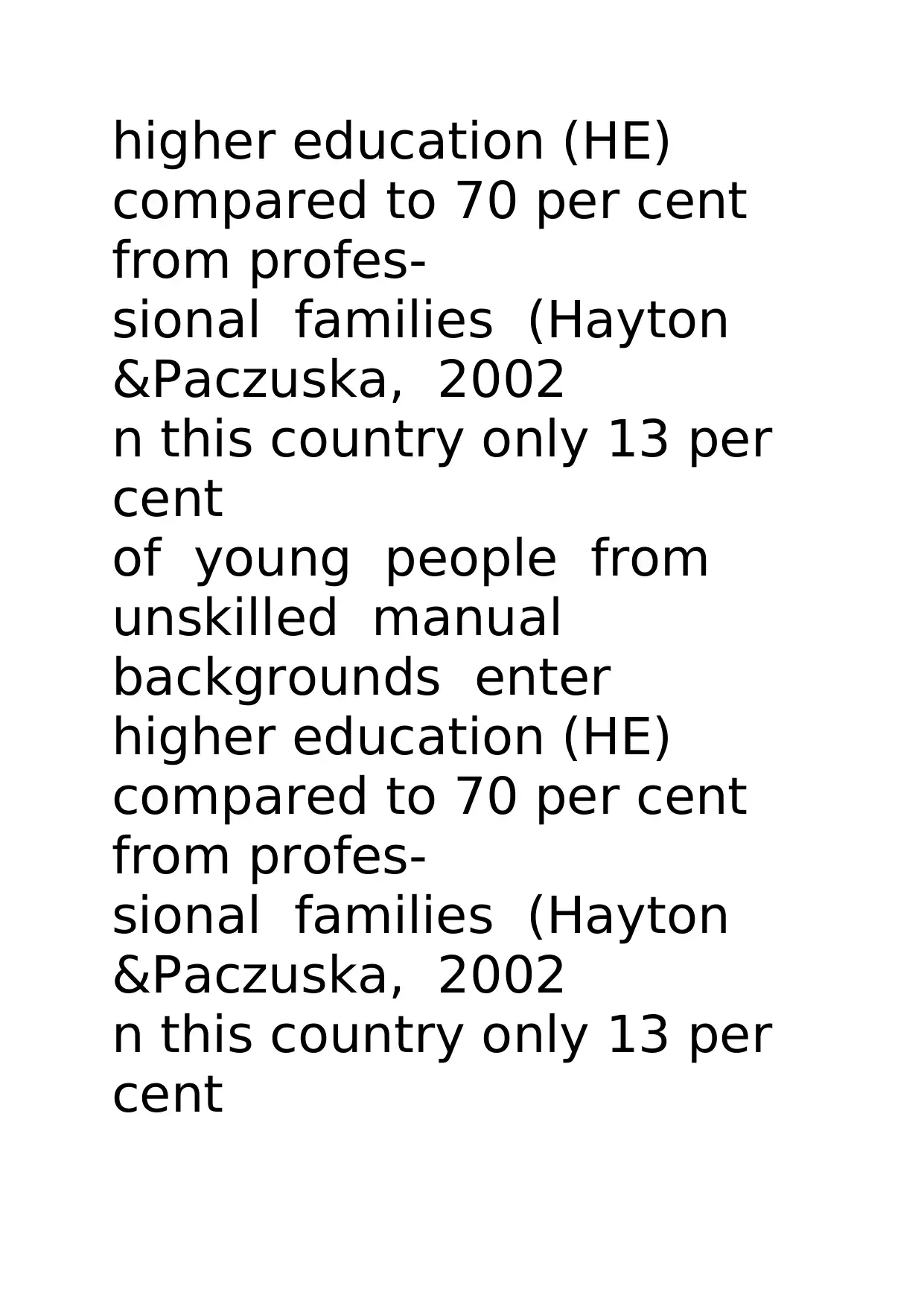
The number of young people from unskilled manual backgrounds who attend college
in this country is 13%, compared to 70% from professional families (Hayton,
Paczuska, 200). In 2017, new laws were introduced to broaden participation in
higher education. By creating a new regulatory framework, enhancing competition,
and increasing student choice, it aims to improve higher education. Organizations
and schools were made aware of the inclusion of learners and access to higher
education for people from different backgrounds
n this country only 13 per
cent
of young people from
unskilled manual
backgrounds enter
the way teachers monitor and use safeguarding techniques. Schools and childcare
providers were published a 10-page guide in 2015 titled "The Prevent Duty.".
Schools and colleges must monitor learners for signs of extremist grooming and
influence by extremists both locally and online. Defining extremism as opposition to
British values, the guidance states. A largely complex problem would require in-
house training, workshops, and sessions experts (BaileyShea, 2019).
Widening participation
Students from low-income families and other underrepresented groups may have
difficulty accessing higher education. By widening participation, the aim is to remove
these barriers and increase participation in higher education as well as graduate
outcomes and employability ( Sahlberg 2017 ).
The number of young people from unskilled manual backgrounds who attend college
in this country is 13%, compared to 70% from professional families (Hayton,
Paczuska, 200). In 2017, new laws were introduced to broaden participation in
higher education. By creating a new regulatory framework, enhancing competition,
and increasing student choice, it aims to improve higher education. Organizations
and schools were made aware of the inclusion of learners and access to higher
education for people from different backgrounds
n this country only 13 per
cent
of young people from
unskilled manual
backgrounds enter
higher education (HE)
compared to 70 per cent
from profes‐
sional families (Hayton
&Paczuska, 2002
n this country only 13 per
cent
of young people from
unskilled manual
backgrounds enter
higher education (HE)
compared to 70 per cent
from profes‐
sional families (Hayton
&Paczuska, 2002
n this country only 13 per
cent
compared to 70 per cent
from profes‐
sional families (Hayton
&Paczuska, 2002
n this country only 13 per
cent
of young people from
unskilled manual
backgrounds enter
higher education (HE)
compared to 70 per cent
from profes‐
sional families (Hayton
&Paczuska, 2002
n this country only 13 per
cent
⊘ This is a preview!⊘
Do you want full access?
Subscribe today to unlock all pages.
Trusted by 1+ million students worldwide

1 out of 31


Related Documents


Your All-in-One AI-Powered Toolkit for Academic Success.
+13062052269
info@desklib.com
Available 24*7 on WhatsApp / Email
![[object Object]](/_next/static/media/star-bottom.7253800d.svg)
Unlock your academic potential
Copyright © 2020–2026 A2Z Services. All Rights Reserved. Developed and managed by ZUCOL.