Spring 2020: Grid Connection and Wind Power Integration Project

Verified

Added on  2022/08/15

|4
|771
|21
Project
AI Summary
This project focuses on the grid connection and integration of wind power, analyzing losses, reactive power consumption, and voltage drops within a wind farm. The assignment involves selecting cables for a given wind farm setup, calculating approximate values for losses and reactive power consumption in collection system cables, and determining voltage drops across wind turbine transformers. Furthermore, the project requires performing a power flow analysis to compare the results of the approximate calculations with the power flow results, providing a detailed understanding of the wind farm's electrical behavior. The analysis includes calculations in per-unit systems, determination of cable resistance and reactance, and the impact of shunt susceptance on reactive power injection. The project also covers the calculation of transformer impedance, voltage drops, and system admittance to provide a comprehensive overview of the wind farm's electrical characteristics and performance.
Document Page
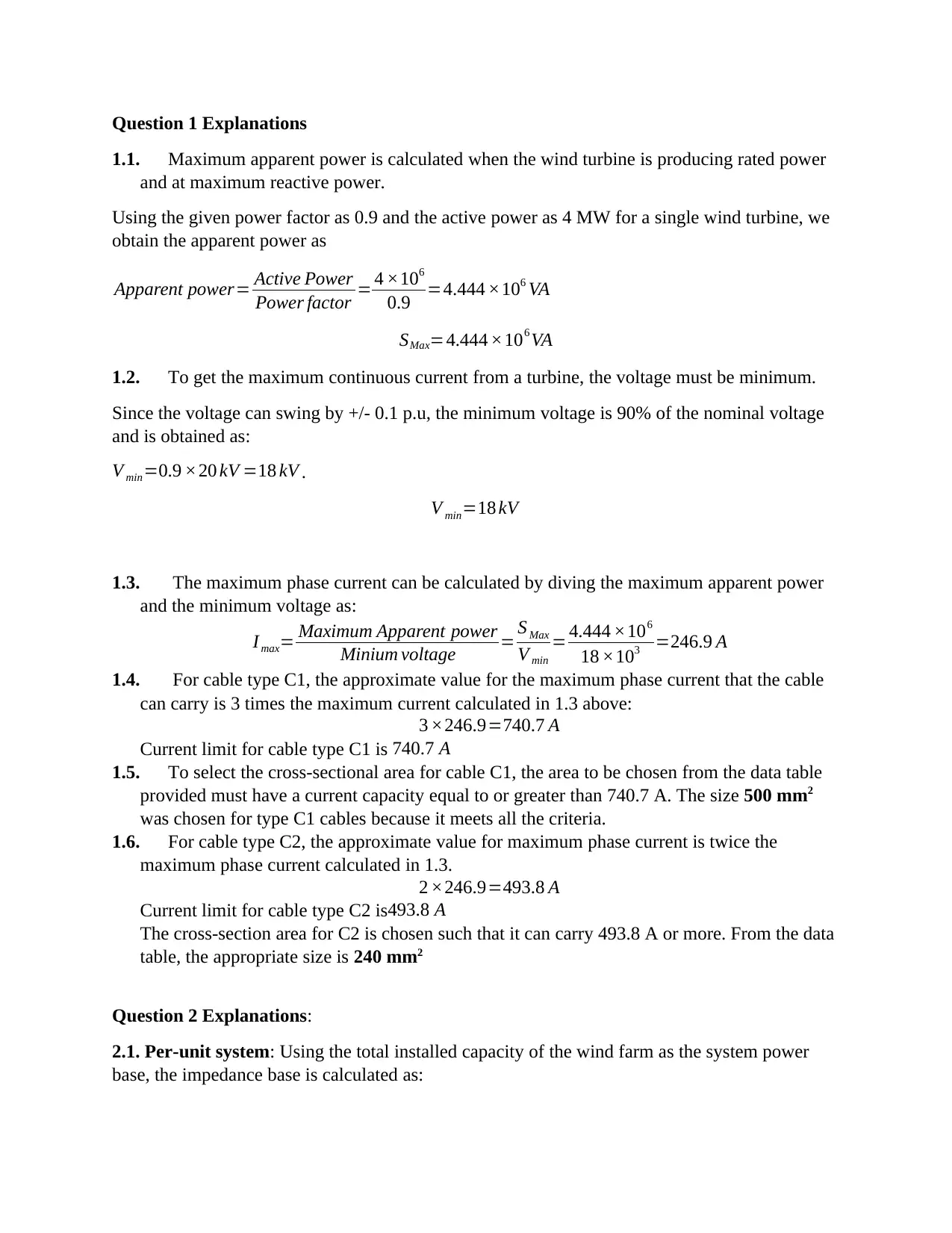
Question 1 Explanations
1.1. Maximum apparent power is calculated when the wind turbine is producing rated power
and at maximum reactive power.
Using the given power factor as 0.9 and the active power as 4 MW for a single wind turbine, we
obtain the apparent power as
Apparent power= Active Power
Power factor = 4 ×10⁶
0.9 =4.444 ×10⁶ VA
SMax=4.444 ×10⁶ VA
1.2. To get the maximum continuous current from a turbine, the voltage must be minimum.
Since the voltage can swing by +/- 0.1 p.u, the minimum voltage is 90% of the nominal voltage
and is obtained as:
V min=0.9 ×20 kV =18 kV .
V min=18 kV
1.3. The maximum phase current can be calculated by diving the maximum apparent power
and the minimum voltage as:
I max= Maximum Apparent power
Minium voltage = S Max
V min
= 4.444 ×10⁶
18 ×103 =246.9 A
1.4. For cable type C1, the approximate value for the maximum phase current that the cable
can carry is 3 times the maximum current calculated in 1.3 above:
3 ×246.9=740.7 A
Current limit for cable type C1 is 740.7 A
1.5. To select the cross-sectional area for cable C1, the area to be chosen from the data table
provided must have a current capacity equal to or greater than 740.7 A. The size 500 mm2
was chosen for type C1 cables because it meets all the criteria.
1.6. For cable type C2, the approximate value for maximum phase current is twice the
maximum phase current calculated in 1.3.
2 ×246.9=493.8 A
Current limit for cable type C2 is493.8 A
The cross-section area for C2 is chosen such that it can carry 493.8 A or more. From the data
table, the appropriate size is 240 mm2
Question 2 Explanations:
2.1. Per-unit system: Using the total installed capacity of the wind farm as the system power
base, the impedance base is calculated as:
tabler-icon-diamond-filled.svg

Paraphrase This Document

Need a fresh take? Get an instant paraphrase of this document with our AI Paraphraser
Document Page
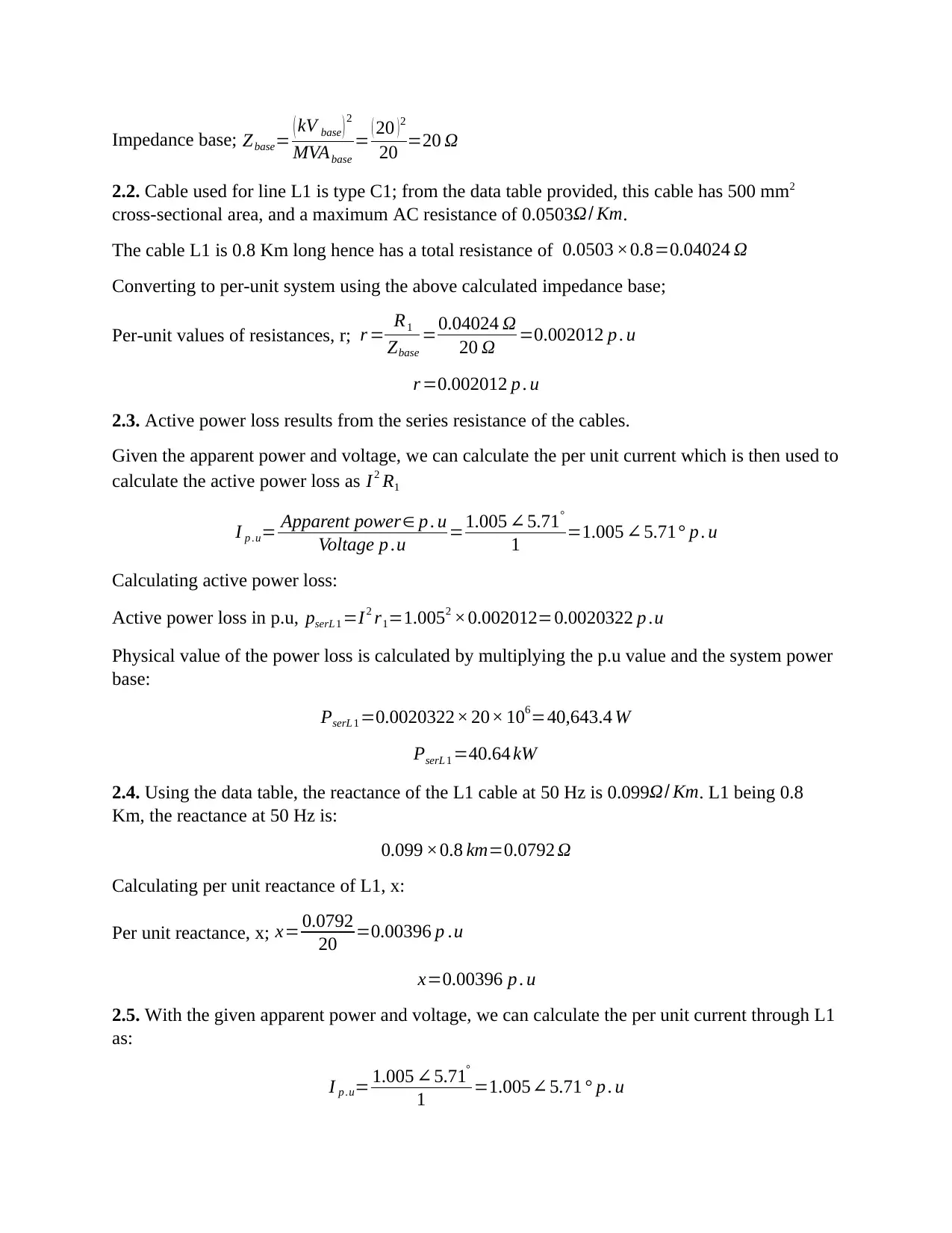
Impedance base; Zbase= ( kV base ) 2
MVAbase
= ( 20 )2
20 =20 Ω
2.2. Cable used for line L1 is type C1; from the data table provided, this cable has 500 mm2
cross-sectional area, and a maximum AC resistance of 0.0503Ω/ Km.
The cable L1 is 0.8 Km long hence has a total resistance of 0.0503 ×0.8=0.04024 Ω
Converting to per-unit system using the above calculated impedance base;
Per-unit values of resistances, r; r = R1
Zbase
=0.04024 Ω
20 Ω =0.002012 p . u
r =0.002012 p . u
2.3. Active power loss results from the series resistance of the cables.
Given the apparent power and voltage, we can calculate the per unit current which is then used to
calculate the active power loss as I2 R1
I p .u= Apparent power p . u
Voltage p .u =1.005 5.71°
1 =1.005 5.71° p . u
Calculating active power loss:
Active power loss in p.u, pserL1 =I 2 r1=1.0052 ×0.002012=0.0020322 p .u
Physical value of the power loss is calculated by multiplying the p.u value and the system power
base:
PserL1 =0.0020322× 20× 106=40,643.4 W
PserL 1 =40.64 kW
2.4. Using the data table, the reactance of the L1 cable at 50 Hz is 0.099Ω/ Km. L1 being 0.8
Km, the reactance at 50 Hz is:
0.099 ×0.8 km=0.0792 Ω
Calculating per unit reactance of L1, x:
Per unit reactance, x; x= 0.0792
20 =0.00396 p .u
x=0.00396 p . u
2.5. With the given apparent power and voltage, we can calculate the per unit current through L1
as:
I p .u= 1.005 5.71°
1 =1.0055.71 ° p . u
Document Page
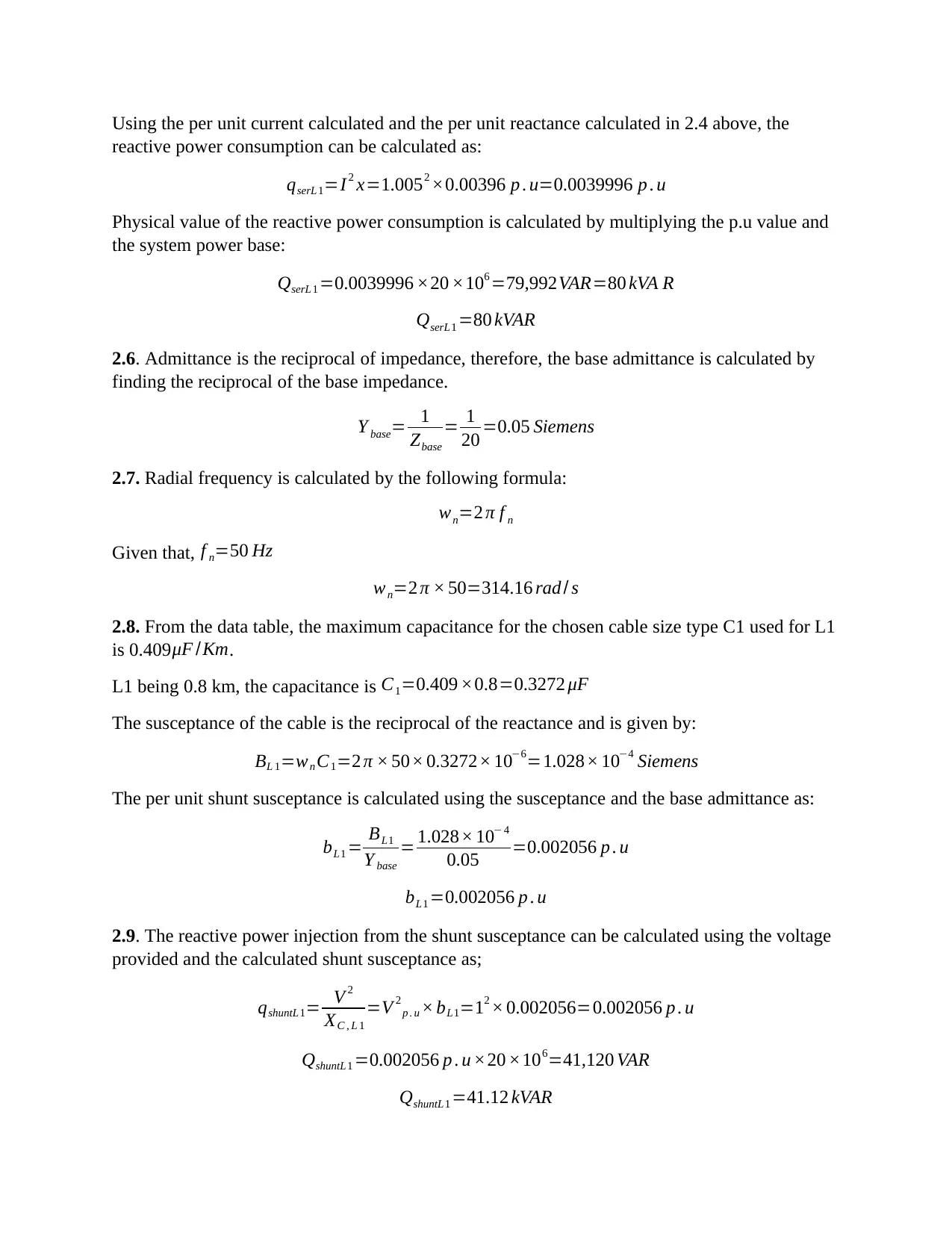
Using the per unit current calculated and the per unit reactance calculated in 2.4 above, the
reactive power consumption can be calculated as:
qserL1=I 2 x=1.0052 ×0.00396 p . u=0.0039996 p . u
Physical value of the reactive power consumption is calculated by multiplying the p.u value and
the system power base:
QserL1 =0.0039996 ×20 ×106 =79,992VAR=80 kVA R
QserL1 =80 kVAR
2.6. Admittance is the reciprocal of impedance, therefore, the base admittance is calculated by
finding the reciprocal of the base impedance.
Y base= 1
Zbase
= 1
20 =0.05 Siemens
2.7. Radial frequency is calculated by the following formula:
wn=2 π f n
Given that, f n=50 Hz
wn=2 π × 50=314.16 rad / s
2.8. From the data table, the maximum capacitance for the chosen cable size type C1 used for L1
is 0.409μF /Km.
L1 being 0.8 km, the capacitance is C1=0.409 ×0.8=0.3272 μF
The susceptance of the cable is the reciprocal of the reactance and is given by:
BL 1=wn C1=2 π × 50× 0.3272× 106=1.028× 10⁴ Siemens
The per unit shunt susceptance is calculated using the susceptance and the base admittance as:
bL1 = BL1
Y base
= 1.028× 10 4
0.05 =0.002056 p . u
bL1 =0.002056 p . u
2.9. The reactive power injection from the shunt susceptance can be calculated using the voltage
provided and the calculated shunt susceptance as;
qshuntL1= V 2
XC , L 1
=V 2
p . u × bL1=12 × 0.002056=0.002056 p . u
QshuntL1 =0.002056 p . u ×20 ×106=41,120 VAR
QshuntL1 =41.12 kVAR
Document Page
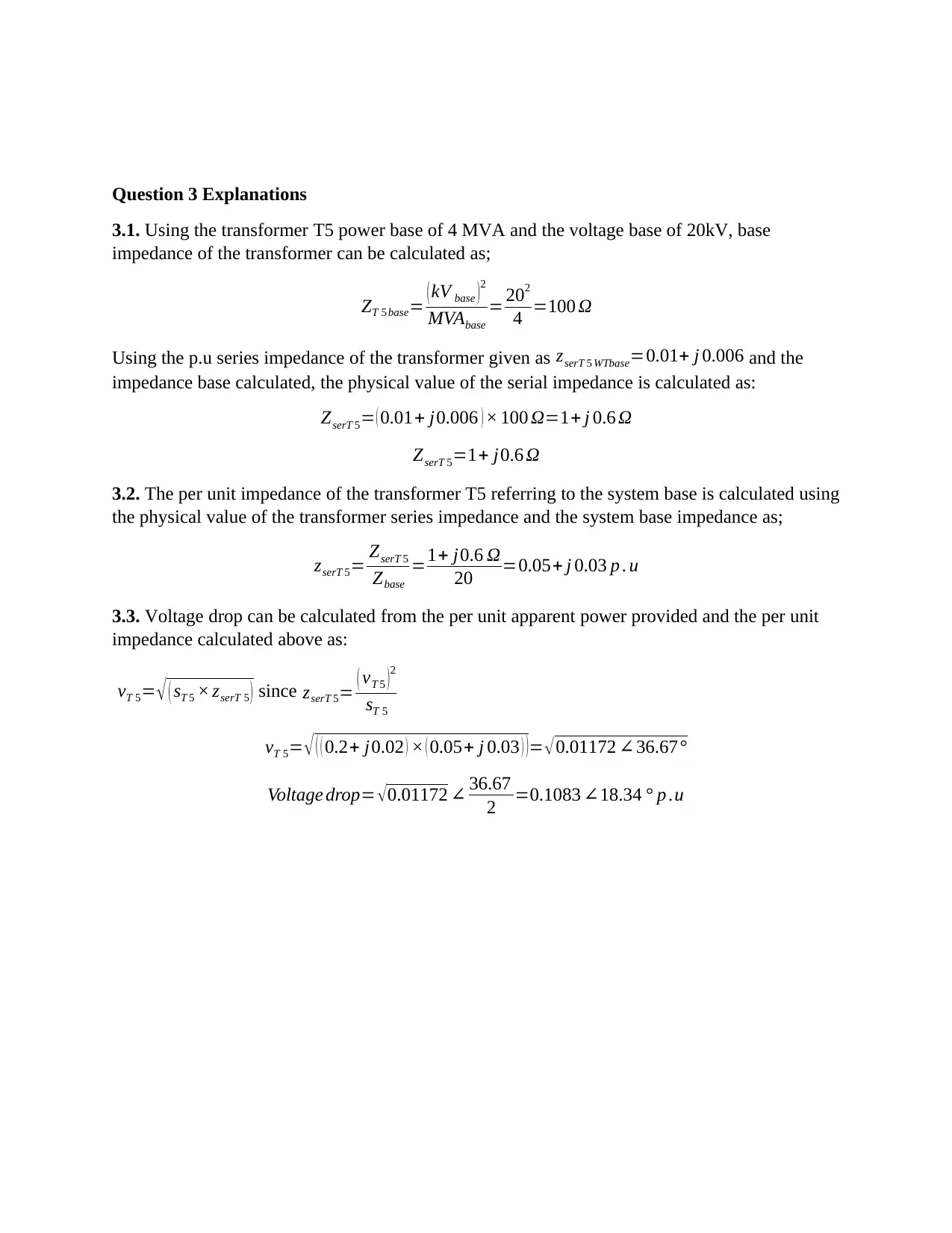
Question 3 Explanations
3.1. Using the transformer T5 power base of 4 MVA and the voltage base of 20kV, base
impedance of the transformer can be calculated as;
ZT 5 base= ( kV base )2
MVAbase
= 202
4 =100 Ω
Using the p.u series impedance of the transformer given as zserT 5 WTbase=0.01+ j 0.006 and the
impedance base calculated, the physical value of the serial impedance is calculated as:
ZserT 5= ( 0.01+ j0.006 ) × 100 Ω=1+ j 0.6 Ω
ZserT 5=1+ j0.6 Ω
3.2. The per unit impedance of the transformer T5 referring to the system base is calculated using
the physical value of the transformer series impedance and the system base impedance as;
zserT 5= ZserT 5
Zbase
=1+ j0.6 Ω
20 =0.05+ j 0.03 p . u
3.3. Voltage drop can be calculated from the per unit apparent power provided and the per unit
impedance calculated above as:
vT 5= ( sT 5 × zserT 5 ) since zserT 5= ( vT 5 )2
sT 5
vT 5= ( ( 0.2+ j0.02 ) × ( 0.05+ j 0.03 ) )= 0.01172 36.67°
Voltage drop= 0.01172 36.67
2 =0.1083 18.34 ° p .u
chevron_up_icon
1 out of 4
circle_padding
hide_on_mobile
zoom_out_icon
[object Object]