Comprehensive Analysis: The Wine Tourism Industry in China
VerifiedAdded on 2021/12/06
|8
|2098
|63
Report
AI Summary
This report provides a comprehensive analysis of the wine tourism industry in China. It begins with an introduction highlighting the importance of wine in the hospitality sector and its connection to tourism, particularly in China. The literature review explores the history of the Chinese wine industry, its modern development, industry structure, and new business models. It examines the Chinese wine market, including competition with imported wines, consumer preferences, and the impact of economic growth. The report delves into the dynamics of wine tourism in China, emphasizing its emergence as a response to consumer demand for leisure and travel, and discusses various research approaches to wine tourism, including product provision, marketing strategies, and tourist experiences. The conclusion summarizes the key findings, emphasizing the growth in alcohol consumption, the popularity of red wine, and the need for wineries to balance the development of wine tourism with its potential negative effects. The report includes references to key academic sources that support the analysis.
1The wine tourism in China
Running head: THE WINE TOURISM IN CHINA
The wine tourism in China
Name:
Course:
Running head: THE WINE TOURISM IN CHINA
The wine tourism in China
Name:
Course:

Paraphrase This Document
Need a fresh take? Get an instant paraphrase of this document with our AI Paraphraser
2The wine tourism in China
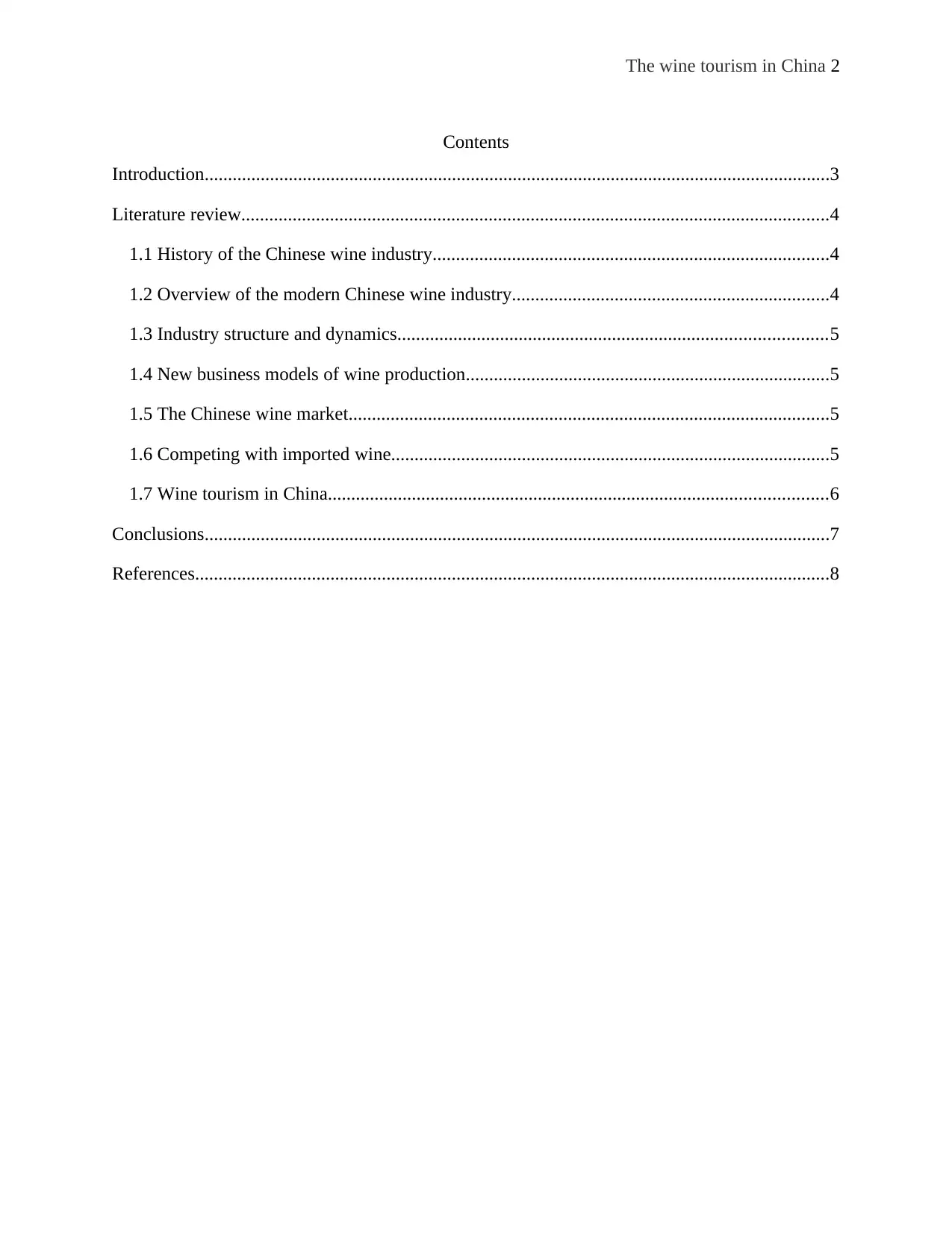
Contents
Introduction......................................................................................................................................3
Literature review..............................................................................................................................4
1.1 History of the Chinese wine industry.....................................................................................4
1.2 Overview of the modern Chinese wine industry....................................................................4
1.3 Industry structure and dynamics............................................................................................5
1.4 New business models of wine production..............................................................................5
1.5 The Chinese wine market.......................................................................................................5
1.6 Competing with imported wine..............................................................................................5
1.7 Wine tourism in China...........................................................................................................6
Conclusions......................................................................................................................................7
References........................................................................................................................................8
Contents
Introduction......................................................................................................................................3
Literature review..............................................................................................................................4
1.1 History of the Chinese wine industry.....................................................................................4
1.2 Overview of the modern Chinese wine industry....................................................................4
1.3 Industry structure and dynamics............................................................................................5
1.4 New business models of wine production..............................................................................5
1.5 The Chinese wine market.......................................................................................................5
1.6 Competing with imported wine..............................................................................................5
1.7 Wine tourism in China...........................................................................................................6
Conclusions......................................................................................................................................7
References........................................................................................................................................8
3The wine tourism in China
Introduction
Wine has been considered an integral part of the hospitality industry a long time ago. It
contributes to socialization and relaxation because the moderate consumption of wine is
considered a pleasurable experience and healthy. The wineries benefit from selling the products
and being a consumption place as well that attracts consumers to socialize, taste and purchase.
Contemporary wineries introduce facilities that link between wine and tourism. Tourists are
invited to visit the wine region and taste it. Meeting the wine makers is an exciting experience
for the visitors. The growth of the tourism industry allows communities to benefit from the
various activities that could be introduced to tourists, especially in China. The rural areas within
countries are also attracted to benefit from the tourism opportunities through their developmental
agencies (Alonso & Liu, 2010).
The following section critically analyzes the wine tourism business models and discusses
the Chinese wine industry historical development and current dynamics that influence the wine
tourism.
Introduction
Wine has been considered an integral part of the hospitality industry a long time ago. It
contributes to socialization and relaxation because the moderate consumption of wine is
considered a pleasurable experience and healthy. The wineries benefit from selling the products
and being a consumption place as well that attracts consumers to socialize, taste and purchase.
Contemporary wineries introduce facilities that link between wine and tourism. Tourists are
invited to visit the wine region and taste it. Meeting the wine makers is an exciting experience
for the visitors. The growth of the tourism industry allows communities to benefit from the
various activities that could be introduced to tourists, especially in China. The rural areas within
countries are also attracted to benefit from the tourism opportunities through their developmental
agencies (Alonso & Liu, 2010).
The following section critically analyzes the wine tourism business models and discusses
the Chinese wine industry historical development and current dynamics that influence the wine
tourism.
⊘ This is a preview!⊘
Do you want full access?
Subscribe today to unlock all pages.

Trusted by 1+ million students worldwide
4The wine tourism in China
Literature review
Bruwer & Alant (2009) argue that wine consumption is a hedonic experience for some
consumers and a pleasurable experience for others. In addition, they assume that the wine
tourism activity represents a complex relationship between the wineries, the tourist and the
region where wine is consumed. It does not represent a simple activity of wine consumption
done by any local consumer, it rather involves experience and good memories accumulated over
time. This argument reveals that the wine tourism phenomenon differs from the rational
problem-solving or information processing model. The tourist experience is known as
"winescape", where the setting of the experience is of high importance to the visitors. The setting
usually takes place in the rural areas, especially the vineyard landscape.
1.1 History of the Chinese wine industry
Historically, wine did not represent a significant alcoholic drink in China, except for
three decades that witnessed wine trade. Although, a major shift took place when the Chinese
government encouraged citizens to drink grape wine in 1987. The government at that time aimed
to change the public food consumption habits from grain-based to become fruit-based alcohols
and to reduce their alcohol consumption as well by imposing higher taxes. These policies
boosted the wine industry, but it did not significantly affect the people's alcoholic consumption
rate. The new wine production method that took place during 1978 and 1983 succeeded in
standardizing the wine production. Furthermore, the new policy attracted foreign investments to
the wine industry (Liu & Murphy, 2007).
1.2 Overview of the modern Chinese wine industry
China's great economic prosperity yielded international business that imported goods to
the local market. According to Chen (2003), as cited in Jenster & Cheng (2008), 95 % of the
adults know that the best wine is sourced from France. Since 2000, the red wine consumption has
grown by 104.32% that represented the main driver of growth for the wine industry. It represents
the table wine that accompanies food in China. It is not only associated with health care, but it is
also associated with happiness, pleasure and celebration of its red color. Although, the females
prefer white wine and usually mixes it with soft drinks.
Literature review
Bruwer & Alant (2009) argue that wine consumption is a hedonic experience for some
consumers and a pleasurable experience for others. In addition, they assume that the wine
tourism activity represents a complex relationship between the wineries, the tourist and the
region where wine is consumed. It does not represent a simple activity of wine consumption
done by any local consumer, it rather involves experience and good memories accumulated over
time. This argument reveals that the wine tourism phenomenon differs from the rational
problem-solving or information processing model. The tourist experience is known as
"winescape", where the setting of the experience is of high importance to the visitors. The setting
usually takes place in the rural areas, especially the vineyard landscape.
1.1 History of the Chinese wine industry
Historically, wine did not represent a significant alcoholic drink in China, except for
three decades that witnessed wine trade. Although, a major shift took place when the Chinese
government encouraged citizens to drink grape wine in 1987. The government at that time aimed
to change the public food consumption habits from grain-based to become fruit-based alcohols
and to reduce their alcohol consumption as well by imposing higher taxes. These policies
boosted the wine industry, but it did not significantly affect the people's alcoholic consumption
rate. The new wine production method that took place during 1978 and 1983 succeeded in
standardizing the wine production. Furthermore, the new policy attracted foreign investments to
the wine industry (Liu & Murphy, 2007).
1.2 Overview of the modern Chinese wine industry
China's great economic prosperity yielded international business that imported goods to
the local market. According to Chen (2003), as cited in Jenster & Cheng (2008), 95 % of the
adults know that the best wine is sourced from France. Since 2000, the red wine consumption has
grown by 104.32% that represented the main driver of growth for the wine industry. It represents
the table wine that accompanies food in China. It is not only associated with health care, but it is
also associated with happiness, pleasure and celebration of its red color. Although, the females
prefer white wine and usually mixes it with soft drinks.
Paraphrase This Document
Need a fresh take? Get an instant paraphrase of this document with our AI Paraphraser
5The wine tourism in China
1.3 Industry structure and dynamics
China Alcoholic Drinks Industry Association, as cited in Jenster & Cheng (2008), declared that
93.76 % of the wine production is sourced from 10 provinces, mainly Ningxia, Hebei, Shandong,
Hebei, Xinjiang, Beijing, Tianjin, Yunnan Gansu and Jilin. In addition, it declared that more than
500 wineries were operating by 2007. The top 10 of them accounted for 60.7% of the total
production. Currently, the Chinese wineries do not own vineyards due to the high cost of land.
Alternatively, they buy grapes from farmers and brokers.
1.4 New business models of wine production
Vines production is spreading out of its traditional base in Europe to take place in
Australia, New Zealand, Chile, South Africa, USA and Argentina. This shift has resulted in new
business models due to the huge spread of vine production across the various world countries.
The large business of wine resulted in economies of scale and scope that matches the demand.
Also, new markets were penetrated, including China, India and the former Soviet countries. The
Chinese wineries succeeded in establishing an international vision that resulted in a changed
segment (Liu & Murphy, 2007).
1.5 The Chinese wine market
The general conditions of the wine market in China reveal that high population growth
led to a remarkable increase in alcohol consumption. The most popular kind of consumed wine
in the Chinese market is the red wine because of its health benefits. The development of
infrastructure and commercial facilities, including trading malls, bars, nightclubs and restaurants
facilitated wine consumption and led to decreasing its prices. Wine consumption is concentrated
in the large cities of Beijing, Shanghai and Guangzhou due to the high standard of living
compared to the Western cities. The primary sellers are the supermarkets, wine shops, restaurants
and online selling. The Chinese consumers usually consume the wine on social occasions, it does
not represent a popular drink like the case in the European countries (Yu et al., 2009).
1.6 Competing with imported wine
The Chinese wine market used to be dominated by the local wineries producers that
created a barrier to entry for foreign companies. But due to China decision to join the WTO
agreement, tariff rates were significantly lowered including the bottled wine that decreased from
43% to 14%. Although, the imported wine faced difficulties in distribution that prevented them
from taking a significant market share. The major influential factors of the Chinese consumers
1.3 Industry structure and dynamics
China Alcoholic Drinks Industry Association, as cited in Jenster & Cheng (2008), declared that
93.76 % of the wine production is sourced from 10 provinces, mainly Ningxia, Hebei, Shandong,
Hebei, Xinjiang, Beijing, Tianjin, Yunnan Gansu and Jilin. In addition, it declared that more than
500 wineries were operating by 2007. The top 10 of them accounted for 60.7% of the total
production. Currently, the Chinese wineries do not own vineyards due to the high cost of land.
Alternatively, they buy grapes from farmers and brokers.
1.4 New business models of wine production
Vines production is spreading out of its traditional base in Europe to take place in
Australia, New Zealand, Chile, South Africa, USA and Argentina. This shift has resulted in new
business models due to the huge spread of vine production across the various world countries.
The large business of wine resulted in economies of scale and scope that matches the demand.
Also, new markets were penetrated, including China, India and the former Soviet countries. The
Chinese wineries succeeded in establishing an international vision that resulted in a changed
segment (Liu & Murphy, 2007).
1.5 The Chinese wine market
The general conditions of the wine market in China reveal that high population growth
led to a remarkable increase in alcohol consumption. The most popular kind of consumed wine
in the Chinese market is the red wine because of its health benefits. The development of
infrastructure and commercial facilities, including trading malls, bars, nightclubs and restaurants
facilitated wine consumption and led to decreasing its prices. Wine consumption is concentrated
in the large cities of Beijing, Shanghai and Guangzhou due to the high standard of living
compared to the Western cities. The primary sellers are the supermarkets, wine shops, restaurants
and online selling. The Chinese consumers usually consume the wine on social occasions, it does
not represent a popular drink like the case in the European countries (Yu et al., 2009).
1.6 Competing with imported wine
The Chinese wine market used to be dominated by the local wineries producers that
created a barrier to entry for foreign companies. But due to China decision to join the WTO
agreement, tariff rates were significantly lowered including the bottled wine that decreased from
43% to 14%. Although, the imported wine faced difficulties in distribution that prevented them
from taking a significant market share. The major influential factors of the Chinese consumers
6The wine tourism in China
are the price and brand name, the matter that led foreign brands to franchise their brand names
within the local market to lower the cost and price. The Australian wines accounted for 59% of
the international market share in China compared to the French wine that represented 33% in
2005 (Jenster & Cheng, 2008).
1.7 Wine tourism in China
China was ranked the world seventh in wine production because it produced over 490
thousand tons of wine. The contemporary Chinese society witnesses an increasing rate of tourism
and travel due to the high income level of the urban residents. They allocate a proportion of their
income to spend on leisure, the matter that resulted in making China the largest domestic tourism
market. Fortunately, the financial crisis slightly affected the Chinese tourism industry, the matter
that contributes to the high growth rates of the tourism industry. Accordingly, the wine tourism
in China originally emerged as a response to the consumer needs and their desire for
entertainment and travel (Qiu et al., 2013).
Carlsen and Charters (2006), as cited in Qiu et al. (2013), argue that the research in wine
tourism has evolved from conceptual approach and case-study to more comprehensive
investigations of the phenomenon. They continued to declare the existence of 5 groups of wine-
tourism that could be classified according to the objective of the major activity. They are
represented in tourism, culture and heritage, business, marketing and wine-tourism systems. The
research body of knowledge about wine tourism has evolved around 3 major themes, the product
provision, marketing strategies and tourist experience at the destination district. Also, the wine
tourism consumers were investigated according to various approaches, including their
demographics and psychographic aspects, like their attitudes and lifestyle.
Charters and Ali-Knight (2002), as cited in Qiu et al. (2013), introduced the analytical
approach that explains the complex dimensions three-dimensional model of the tourist interest in
wine, desire to travel and get involved in the wine experience. Despite this, Qiu et al. (2013),
argues that there are still missing factors to determine the development of wine tourism in China.
Also, he argues a research gap in investigating the effectiveness of the current market activities
to meet the real needs of the consumers and tourists.
Although farmers can benefit from wine tourism, they cannot totally depend on it because
its implementation may be difficult for the costs and health requirements. Also, its growth could
harm the environment because of the increasing land and water usage, high traffic during the
are the price and brand name, the matter that led foreign brands to franchise their brand names
within the local market to lower the cost and price. The Australian wines accounted for 59% of
the international market share in China compared to the French wine that represented 33% in
2005 (Jenster & Cheng, 2008).
1.7 Wine tourism in China
China was ranked the world seventh in wine production because it produced over 490
thousand tons of wine. The contemporary Chinese society witnesses an increasing rate of tourism
and travel due to the high income level of the urban residents. They allocate a proportion of their
income to spend on leisure, the matter that resulted in making China the largest domestic tourism
market. Fortunately, the financial crisis slightly affected the Chinese tourism industry, the matter
that contributes to the high growth rates of the tourism industry. Accordingly, the wine tourism
in China originally emerged as a response to the consumer needs and their desire for
entertainment and travel (Qiu et al., 2013).
Carlsen and Charters (2006), as cited in Qiu et al. (2013), argue that the research in wine
tourism has evolved from conceptual approach and case-study to more comprehensive
investigations of the phenomenon. They continued to declare the existence of 5 groups of wine-
tourism that could be classified according to the objective of the major activity. They are
represented in tourism, culture and heritage, business, marketing and wine-tourism systems. The
research body of knowledge about wine tourism has evolved around 3 major themes, the product
provision, marketing strategies and tourist experience at the destination district. Also, the wine
tourism consumers were investigated according to various approaches, including their
demographics and psychographic aspects, like their attitudes and lifestyle.
Charters and Ali-Knight (2002), as cited in Qiu et al. (2013), introduced the analytical
approach that explains the complex dimensions three-dimensional model of the tourist interest in
wine, desire to travel and get involved in the wine experience. Despite this, Qiu et al. (2013),
argues that there are still missing factors to determine the development of wine tourism in China.
Also, he argues a research gap in investigating the effectiveness of the current market activities
to meet the real needs of the consumers and tourists.
Although farmers can benefit from wine tourism, they cannot totally depend on it because
its implementation may be difficult for the costs and health requirements. Also, its growth could
harm the environment because of the increasing land and water usage, high traffic during the
⊘ This is a preview!⊘
Do you want full access?
Subscribe today to unlock all pages.
Trusted by 1+ million students worldwide
7The wine tourism in China
harvesting season and importation of additional labor. From the economic perspective, wine
tourism is profitable, concerning that the initial cost of implementation is high and it is likely to
result in higher land price. That is why wineries have to balance between the development of
wine tourism and its negative effects (Alonso & Liu, 2010).
Conclusions
The general conditions of the wine market in China reveal that high population growth
led to a remarkable increase in alcohol consumption. The most popular kind of consumed wine
in the Chinese market is the red wine because of its health benefits. The Chinese consumers
usually consume the wine on social occasions, it does not represent a popular drink like the case
in the European countries.
The wine tourism activity represents a complex relationship between the wineries, the
tourist and the region where wine is consumed. This argument reveals that the wine tourism
phenomenon differs from the rational problem-solving or information processing model.
Wineries have to balance between the development of wine tourism and its negative effects.
The large business of wine resulted in economies of scale and scope that matches the
demand. Also, new markets were penetrated, including China, India and the former Soviet
countries. China was ranked the world seventh in wine production because it produced over 490
thousand tons of wine.
harvesting season and importation of additional labor. From the economic perspective, wine
tourism is profitable, concerning that the initial cost of implementation is high and it is likely to
result in higher land price. That is why wineries have to balance between the development of
wine tourism and its negative effects (Alonso & Liu, 2010).
Conclusions
The general conditions of the wine market in China reveal that high population growth
led to a remarkable increase in alcohol consumption. The most popular kind of consumed wine
in the Chinese market is the red wine because of its health benefits. The Chinese consumers
usually consume the wine on social occasions, it does not represent a popular drink like the case
in the European countries.
The wine tourism activity represents a complex relationship between the wineries, the
tourist and the region where wine is consumed. This argument reveals that the wine tourism
phenomenon differs from the rational problem-solving or information processing model.
Wineries have to balance between the development of wine tourism and its negative effects.
The large business of wine resulted in economies of scale and scope that matches the
demand. Also, new markets were penetrated, including China, India and the former Soviet
countries. China was ranked the world seventh in wine production because it produced over 490
thousand tons of wine.
Paraphrase This Document
Need a fresh take? Get an instant paraphrase of this document with our AI Paraphraser
8The wine tourism in China
References
Alonso, A., & Liu, Y. (2010). Wine tourism development in emerging Western Australian
regions. International Journal of Contemporary Hospitality Management, 22(2), 245-
262.
Bruwer, J., & Alant, K. (2009). The hedonic nature of wine tourism consumption: an experiential
view. International Journal of Wine Business Research, 21(3), 235-257.
Jenster, P., & Cheng, Y. (2008). Dragon wine: developments in the Chinese wine industry.
International Journal of Wine Business Research, 20(3), 244-259.
Liu, F., & Murphy, J. (2007). A qualitative study of Chinese wine consumption and purchasing
Implications for Australian wines. International Journal of Wine Business Research,
19(2), 98-113.
Qiu, H., Yuan, J., Ye, B., & Hung, K. (2013). Wine tourism phenomena in China: an emerging
market. International Journal of Contemporary Hospitality Management, 25(7), 1115-
1134.
Yu, Y., Sun, H., Goodman, S., Chen, S., & Ma, H. (2009). Chinese choices: a survey of wine
consumers in Beijing. International Journal of Wine Business Research, 21(2), 155-168.
References
Alonso, A., & Liu, Y. (2010). Wine tourism development in emerging Western Australian
regions. International Journal of Contemporary Hospitality Management, 22(2), 245-
262.
Bruwer, J., & Alant, K. (2009). The hedonic nature of wine tourism consumption: an experiential
view. International Journal of Wine Business Research, 21(3), 235-257.
Jenster, P., & Cheng, Y. (2008). Dragon wine: developments in the Chinese wine industry.
International Journal of Wine Business Research, 20(3), 244-259.
Liu, F., & Murphy, J. (2007). A qualitative study of Chinese wine consumption and purchasing
Implications for Australian wines. International Journal of Wine Business Research,
19(2), 98-113.
Qiu, H., Yuan, J., Ye, B., & Hung, K. (2013). Wine tourism phenomena in China: an emerging
market. International Journal of Contemporary Hospitality Management, 25(7), 1115-
1134.
Yu, Y., Sun, H., Goodman, S., Chen, S., & Ma, H. (2009). Chinese choices: a survey of wine
consumers in Beijing. International Journal of Wine Business Research, 21(2), 155-168.

1 out of 8


Your All-in-One AI-Powered Toolkit for Academic Success.
+13062052269
info@desklib.com
Available 24*7 on WhatsApp / Email
![[object Object]](/_next/static/media/star-bottom.7253800d.svg)
Unlock your academic potential
Copyright © 2020–2026 A2Z Services. All Rights Reserved. Developed and managed by ZUCOL.