Designing Wireless Links: A Line of Sight Link Budget Analysis

Verified

Added on  2023/03/30

|4
|337
|144
Practical Assignment
AI Summary
This assignment focuses on the analysis of a wireless communication link budget for a Line of Sight (LOS) link. It involves calculating free space path loss at different distances and frequencies, determining received power based on transmitter power, antenna gains, and losses, and calculating the link margin. The solution also considers receiver sensitivity and its impact on the overall system reliability. The assignment applies formulas to determine the total path loss, received power, and link margin. Furthermore, the assignment analyzes the relationship between the link margin and time availability to assess the wireless system's effectiveness and reliability, and suggests improvements by monitoring path loss and receiver sensitivity.

Document Page
WIRELESS COMMUNICATION
tabler-icon-diamond-filled.svg

Paraphrase This Document

Need a fresh take? Get an instant paraphrase of this document with our AI Paraphraser
Document Page
LINK BUDGET 1
Answer-1
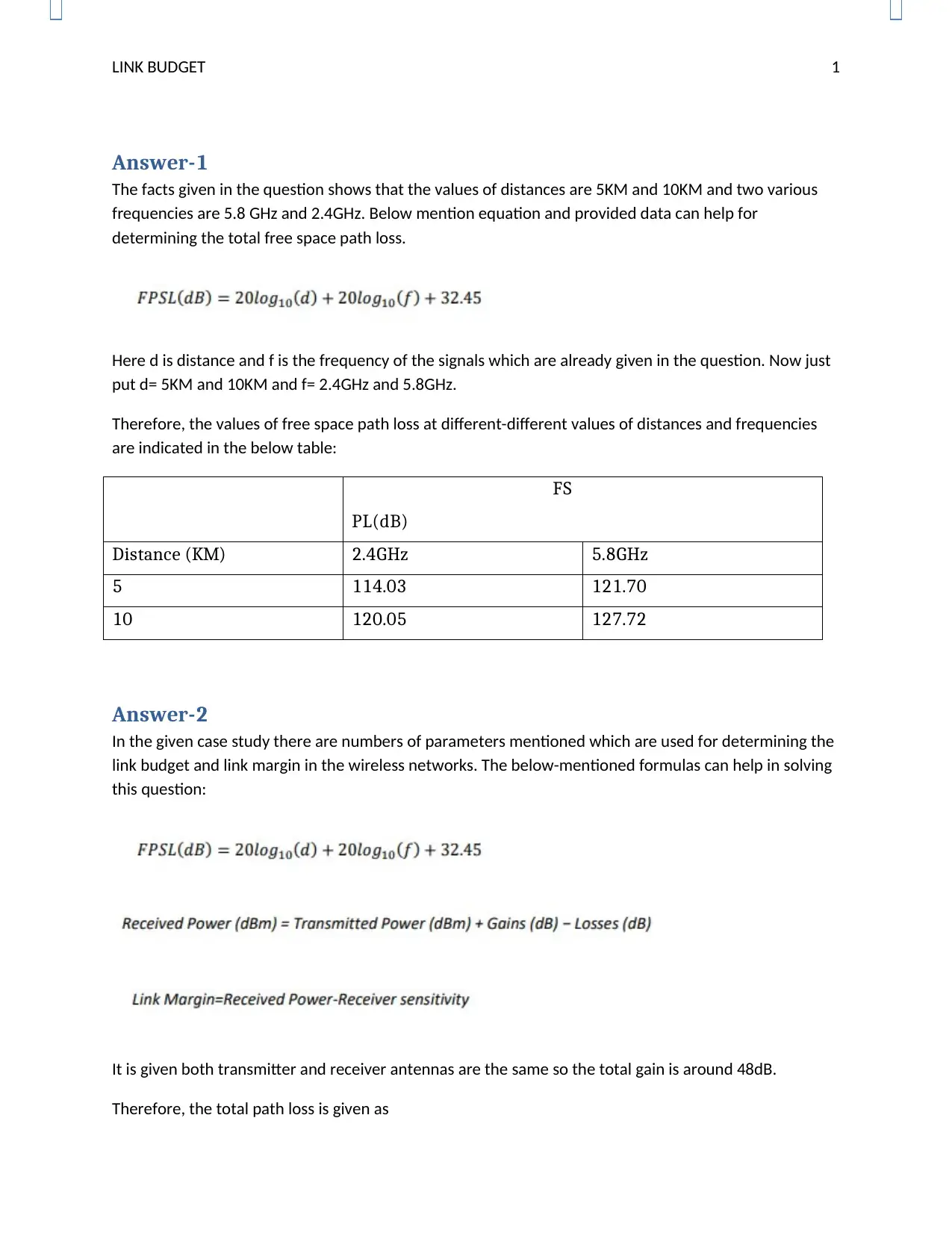
The facts given in the question shows that the values of distances are 5KM and 10KM and two various
frequencies are 5.8 GHz and 2.4GHz. Below mention equation and provided data can help for
determining the total free space path loss.
Here d is distance and f is the frequency of the signals which are already given in the question. Now just
put d= 5KM and 10KM and f= 2.4GHz and 5.8GHz.
Therefore, the values of free space path loss at different-different values of distances and frequencies
are indicated in the below table:
FS
PL(dB)
Distance (KM) 2.4GHz 5.8GHz
5 114.03 121.70
10 120.05 127.72
Answer-2
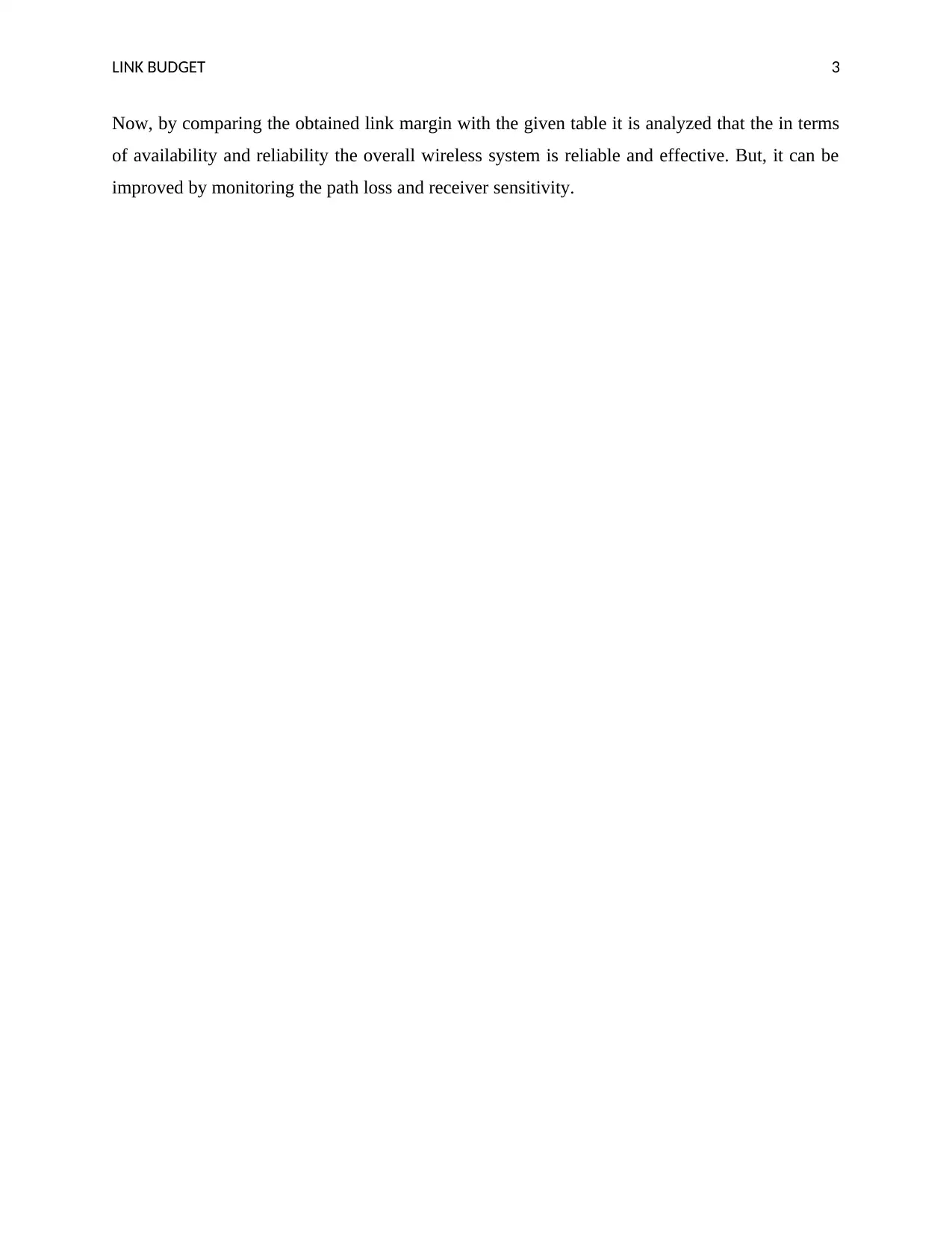
In the given case study there are numbers of parameters mentioned which are used for determining the
link budget and link margin in the wireless networks. The below-mentioned formulas can help in solving
this question:
It is given both transmitter and receiver antennas are the same so the total gain is around 48dB.
Therefore, the total path loss is given as
Document Page
LINK BUDGET 2
FSPL= 20*log10 (5) + 20*log10 (5.8 GHz) + 32.45
Or, path loss= 121.7 dB.
Now, for finding received power put values of gains, losses and transmitter power in the above
equation:
Received power (dBm) = 23+48-121.70
Or, Received power (dBm)= -50.70 dBm.
Now, the link margin at 5KM can be found with the below-mentioned formula:
Link margin= -50.7 + 72
Link margin= 21.3 dBm
Answer- 3
From the given data and information it is evaluated that the link margin at a 5KM distance is
21.30dBm and it can vary by changing the receiver sensitivity. In this question a table is
provided that provides the relation between fade margin and time availability which is mentioned
below:
Document Page
LINK BUDGET 3
Now, by comparing the obtained link margin with the given table it is analyzed that the in terms
of availability and reliability the overall wireless system is reliable and effective. But, it can be
improved by monitoring the path loss and receiver sensitivity.
chevron_up_icon
1 out of 4
circle_padding
hide_on_mobile
zoom_out_icon
[object Object]