Wireless Communication: Link Budget Analysis for LOS Wireless Link

Verified

Added on  2023/03/30

|6
|562
|255
Case Study
AI Summary
This case study provides a comprehensive link budget analysis for a Line-of-Sight (LOS) wireless link, considering factors such as available output power, bandwidth, receiver sensitivity, antenna gains, and environmental conditions. It calculates the Free Space Path Loss (FSPL) at different distances (5km and 10km) and frequencies (2.4GHz and 5.8GHz). The analysis further determines the received power and link margin, evaluating the time availability based on the link margin. The results indicate a reliable link with approximately 99% time availability at a 5km distance, ensuring effective communication between the transmitter and receiver. Desklib offers this solved assignment to help students understand link budget concepts, also providing access to numerous other assignments and study resources.

Document Page
Wireless network and communication
Link Budget Analysis
tabler-icon-diamond-filled.svg

Paraphrase This Document

Need a fresh take? Get an instant paraphrase of this document with our AI Paraphraser
Document Page
LINK BUDGET ANALYSIS 1
Link budget for a LOS Wireless link
From the case study, it is examined that there are various formulas and key parameters
required for performing a link budget for a wireless network (Promax, 2011). These
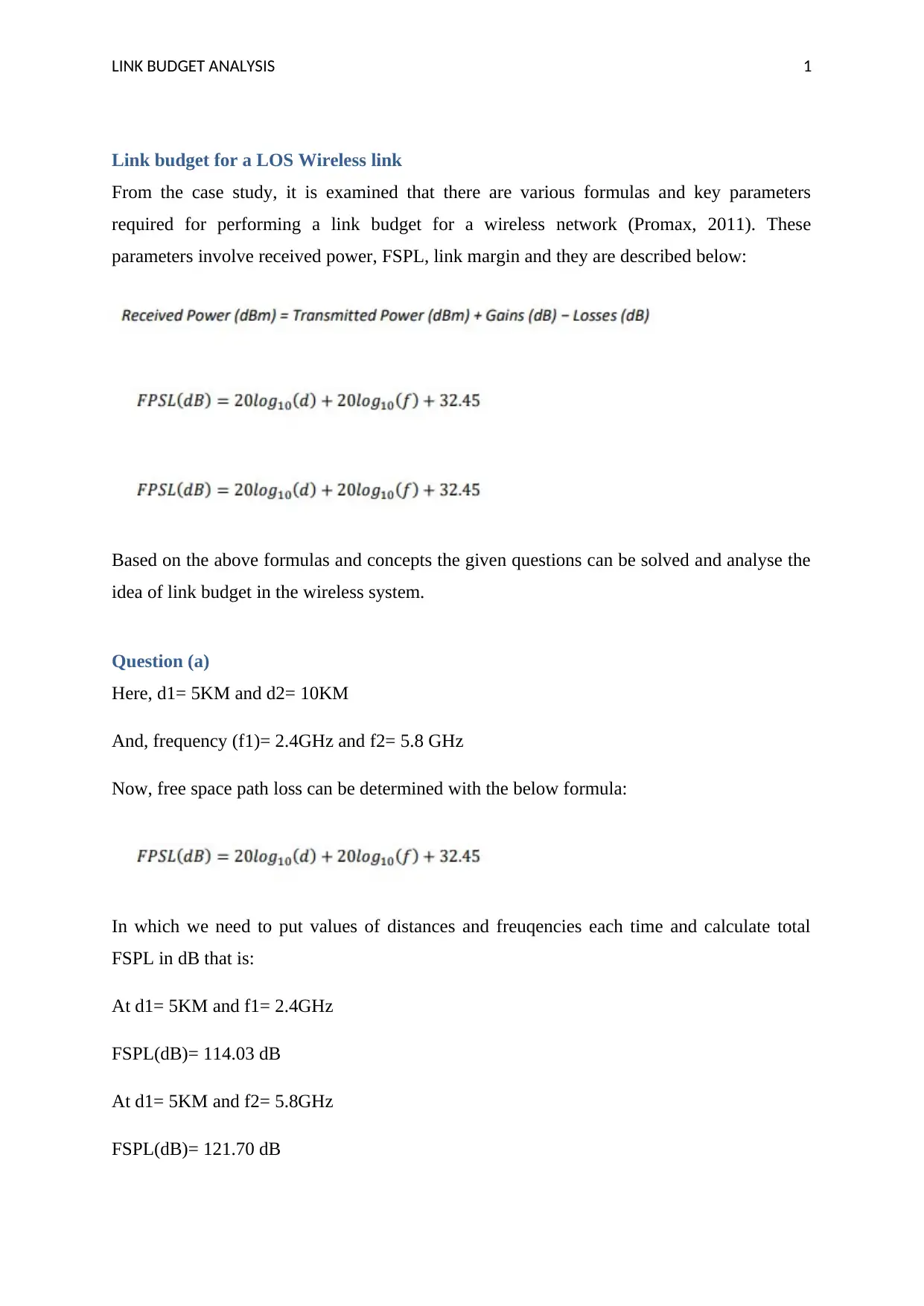
parameters involve received power, FSPL, link margin and they are described below:
Based on the above formulas and concepts the given questions can be solved and analyse the
idea of link budget in the wireless system.
Question (a)
Here, d1= 5KM and d2= 10KM
And, frequency (f1)= 2.4GHz and f2= 5.8 GHz
Now, free space path loss can be determined with the below formula:
In which we need to put values of distances and freuqencies each time and calculate total
FSPL in dB that is:
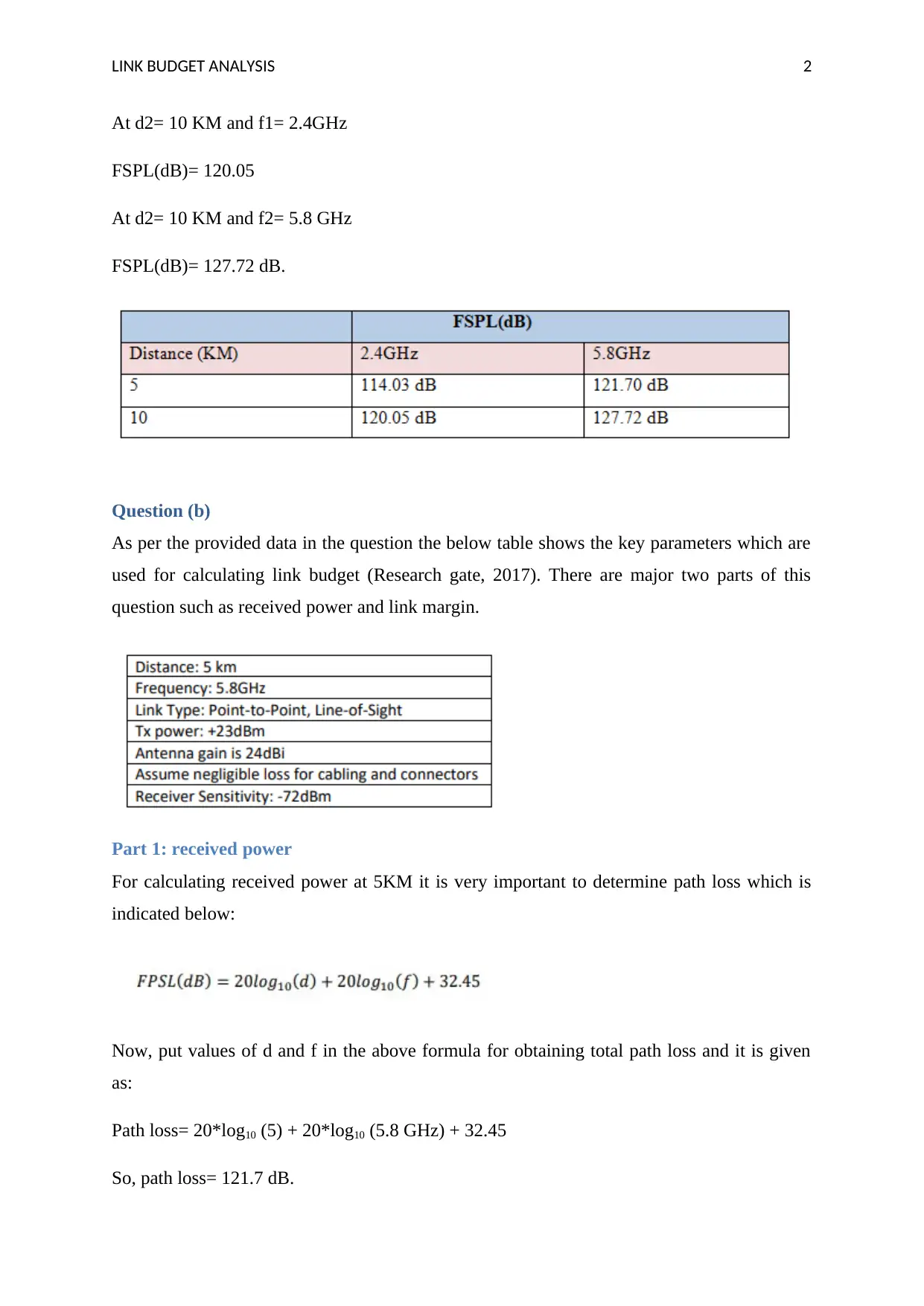
At d1= 5KM and f1= 2.4GHz
FSPL(dB)= 114.03 dB
At d1= 5KM and f2= 5.8GHz
FSPL(dB)= 121.70 dB
Document Page
LINK BUDGET ANALYSIS 2
At d2= 10 KM and f1= 2.4GHz
FSPL(dB)= 120.05
At d2= 10 KM and f2= 5.8 GHz
FSPL(dB)= 127.72 dB.
Question (b)
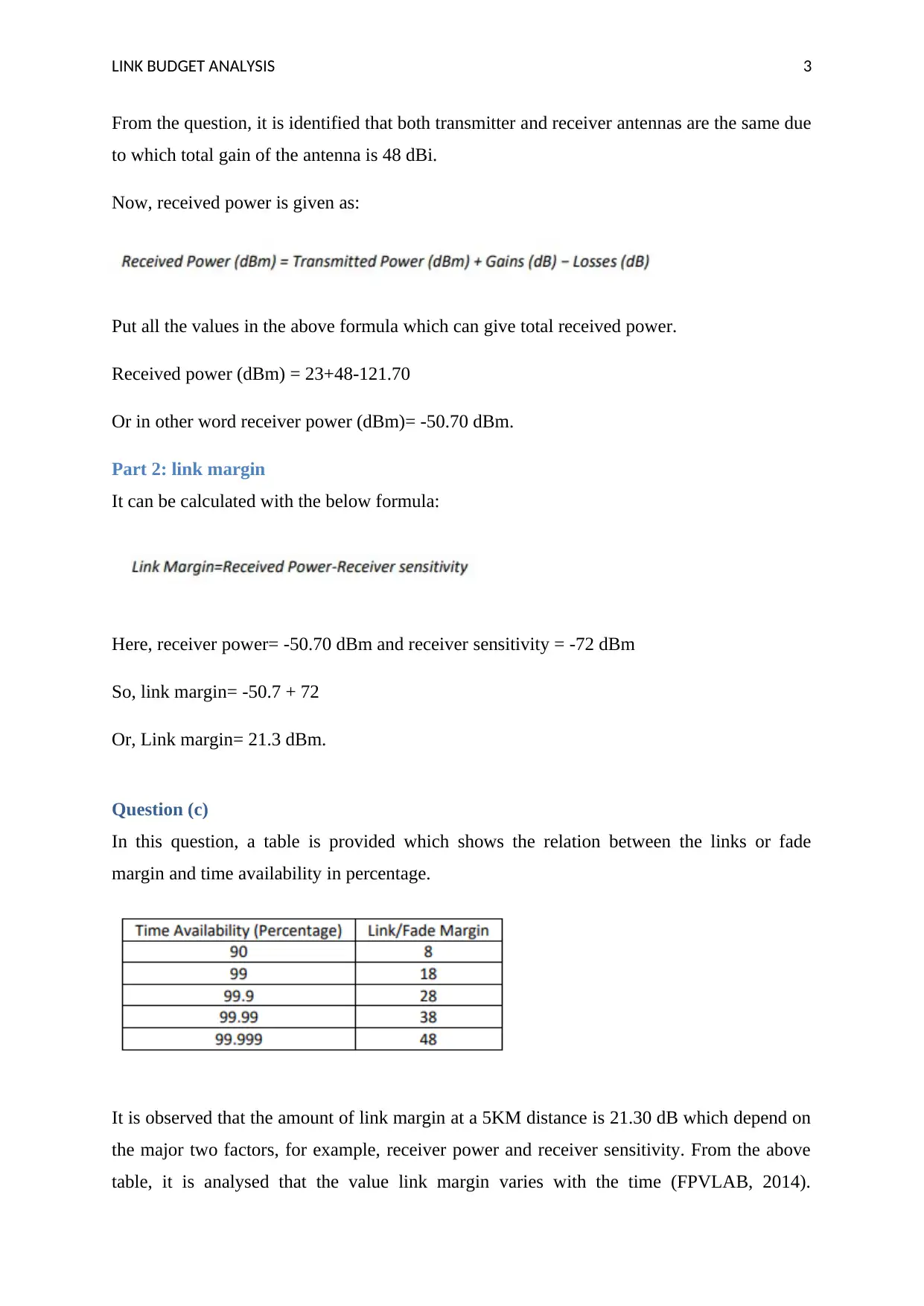
As per the provided data in the question the below table shows the key parameters which are
used for calculating link budget (Research gate, 2017). There are major two parts of this
question such as received power and link margin.
Part 1: received power
For calculating received power at 5KM it is very important to determine path loss which is
indicated below:
Now, put values of d and f in the above formula for obtaining total path loss and it is given
as:
Path loss= 20*log10 (5) + 20*log10 (5.8 GHz) + 32.45
So, path loss= 121.7 dB.
Document Page
LINK BUDGET ANALYSIS 3
From the question, it is identified that both transmitter and receiver antennas are the same due
to which total gain of the antenna is 48 dBi.
Now, received power is given as:
Put all the values in the above formula which can give total received power.
Received power (dBm) = 23+48-121.70
Or in other word receiver power (dBm)= -50.70 dBm.
Part 2: link margin
It can be calculated with the below formula:
Here, receiver power= -50.70 dBm and receiver sensitivity = -72 dBm
So, link margin= -50.7 + 72
Or, Link margin= 21.3 dBm.
Question (c)
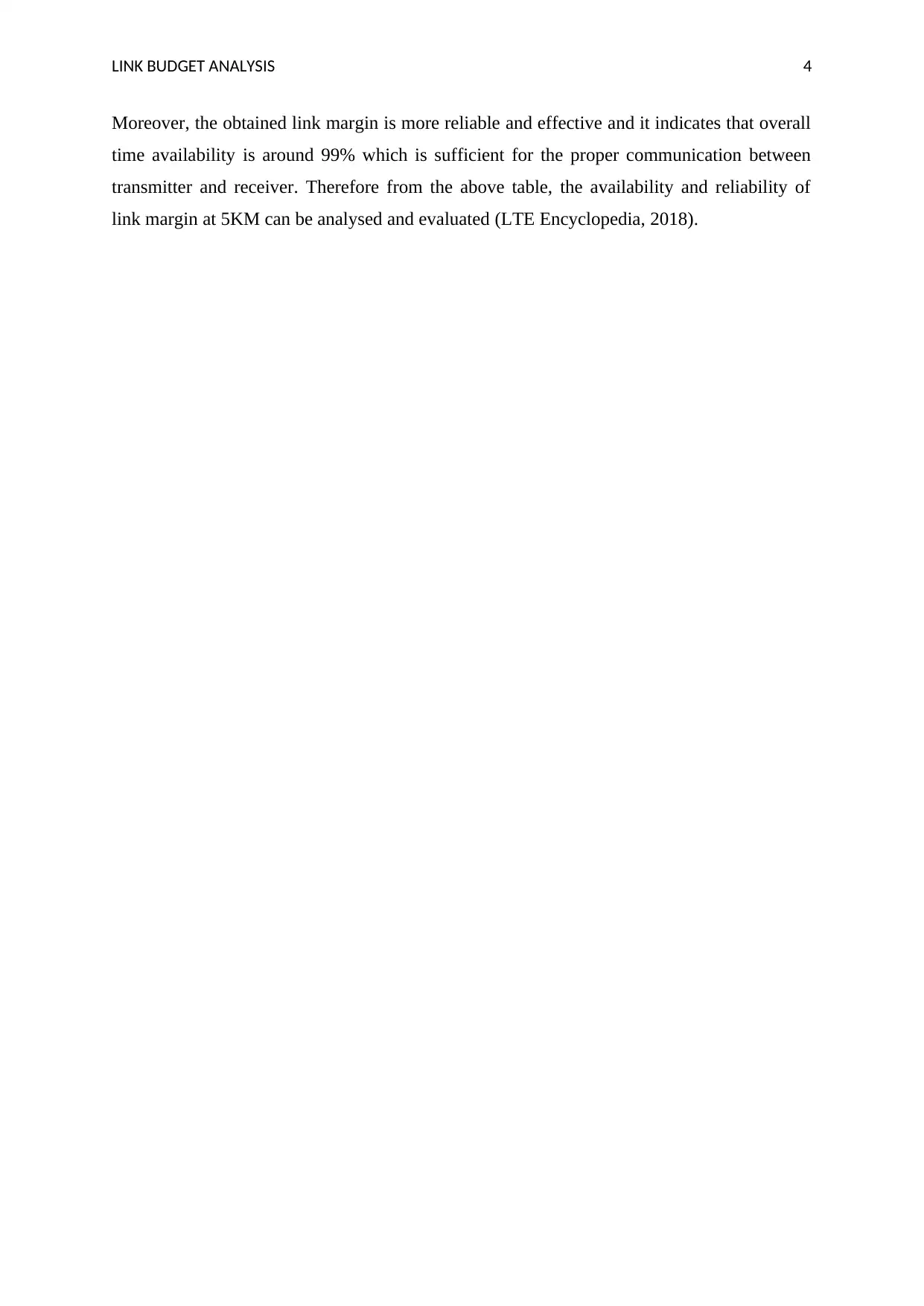
In this question, a table is provided which shows the relation between the links or fade
margin and time availability in percentage.
It is observed that the amount of link margin at a 5KM distance is 21.30 dB which depend on
the major two factors, for example, receiver power and receiver sensitivity. From the above
table, it is analysed that the value link margin varies with the time (FPVLAB, 2014).
tabler-icon-diamond-filled.svg

Paraphrase This Document

Need a fresh take? Get an instant paraphrase of this document with our AI Paraphraser
Document Page
LINK BUDGET ANALYSIS 4
Moreover, the obtained link margin is more reliable and effective and it indicates that overall
time availability is around 99% which is sufficient for the proper communication between
transmitter and receiver. Therefore from the above table, the availability and reliability of
link margin at 5KM can be analysed and evaluated (LTE Encyclopedia, 2018).
Document Page
LINK BUDGET ANALYSIS 5
References
FPVLAB (2014) Link Margin, Transmitter Power, Theoretical Range, and Antenna Gain.
[online] Available from: https://fpvlab.com/forums/showthread.php?25174-Link-Margin-
Transmitter-Power-Theoretical-Range-and-Antenna-Gain
LTE Encyclopedia (2018) LTE Radio Link Budgeting and RF Planning. [online] Available
from: https://sites.google.com/site/lteencyclopedia/lte-radio-link-budgeting-and-rf-planning
Promax (2011) Link Margin Measurement. [online] Available from:
http://www.promax.es/ita/news/327/Link-Margin-Measurement [Accessed 30/05/2019].
Research gate (2017) LINK MARGIN FOR WIRELESS RADIO COMMUNICATION LINK.
[online] Available from:
https://www.researchgate.net/publication/320465087_LINK_MARGIN_FOR_WIRELESS_
RADIO_COMMUNICATION_LINK [Accessed 30/05/2019].
chevron_up_icon
1 out of 6
circle_padding
hide_on_mobile
zoom_out_icon
[object Object]