LAS 432 Impact of Wireless Power
VerifiedAdded on 2019/09/22
|10
|2217
|375
Report
AI Summary
This report, submitted for LAS 432: Analysis of Impact, examines the multifaceted impact of wireless power transfer (WPT) technology. It explores the social implications of improved communication and accessibility, the cultural shift towards wireless convenience, the political landscape of regulations and government funding, and the economic aspects of market competition and cost savings. The environmental benefits of reduced fossil fuel dependence and decreased battery waste are also highlighted. The report concludes that WPT offers significant advantages across various sectors, leading to improved lives, environmental sustainability, and economic growth. The author cites various sources, including research papers, industry reports, and government documents, to support their analysis. The report also includes a table comparing energy consumption between wired and wireless charging systems.

DAN OPOKU MENSAH
PROF. KUPCZYNSKI
3/25/2017
2017
LAS 432 ANALYSIS OF IMPACT DRAFT
PROF. KUPCZYNSKI
3/25/2017
2017
LAS 432 ANALYSIS OF IMPACT DRAFT

Paraphrase This Document
Need a fresh take? Get an instant paraphrase of this document with our AI Paraphraser
Introduction
Wireless technology has become an increasingly crucial part of today's world. It is a
booming business that is finding far reaching benefits on a global level. From health care and
retail to academia across the world, wireless systems are improving the rate and ease with which
data is sent and received. Corporations, schools, homes, and cafes are implementing wireless
solutions as individual organizations and users seek more freedom and constant access. Wireless
Fidelity (Wi-Fi) is the latest buzzword to capture the market in our individual quest for access
anywhere at any time. Wi-Fi was first released for consumers in 1997, when a committee called
802.11 was created. Wi-Fi is easy to install, simple to use and economical too. In the last ten
years Wi-Fi Access Points are now set up at homes, offices, colleges, schools, coffee-shops,
airports, hotels, and in public hotspots, giving convenient internet access to everything from
laptops to smartphones.
The use of Wi-Fi today is summed up nicely by Rethink Wireless that is, Wi-Fi
performance continues to improve and it’s one of the most wireless communications
technologies in use today. It’s clear that Wi-Fi is no longer a one-way street technology, it has
become an essential part of our personal and professional day-to-day, and is constantly
improving our efficiency, our communication, and is persistently encourages the technology
industry to push boundaries. According to VoiceandData.com (2005), wireless "refers to
communications, monitoring or control systems in which electromagnetic or acoustic waves
carry a signal through atmospheric space rather than along a wire". In short, wireless access is a
means in which one can connect to a Wireless Access Point or Wi-Fi spot without needing
physical access.
Wireless technology has become an increasingly crucial part of today's world. It is a
booming business that is finding far reaching benefits on a global level. From health care and
retail to academia across the world, wireless systems are improving the rate and ease with which
data is sent and received. Corporations, schools, homes, and cafes are implementing wireless
solutions as individual organizations and users seek more freedom and constant access. Wireless
Fidelity (Wi-Fi) is the latest buzzword to capture the market in our individual quest for access
anywhere at any time. Wi-Fi was first released for consumers in 1997, when a committee called
802.11 was created. Wi-Fi is easy to install, simple to use and economical too. In the last ten
years Wi-Fi Access Points are now set up at homes, offices, colleges, schools, coffee-shops,
airports, hotels, and in public hotspots, giving convenient internet access to everything from
laptops to smartphones.
The use of Wi-Fi today is summed up nicely by Rethink Wireless that is, Wi-Fi
performance continues to improve and it’s one of the most wireless communications
technologies in use today. It’s clear that Wi-Fi is no longer a one-way street technology, it has
become an essential part of our personal and professional day-to-day, and is constantly
improving our efficiency, our communication, and is persistently encourages the technology
industry to push boundaries. According to VoiceandData.com (2005), wireless "refers to
communications, monitoring or control systems in which electromagnetic or acoustic waves
carry a signal through atmospheric space rather than along a wire". In short, wireless access is a
means in which one can connect to a Wireless Access Point or Wi-Fi spot without needing
physical access.
SOCIAL
Wireless technology has serve an impacts of our social media lives by improving our
communication between family, work, and friends. In this 21 century the world is filled up with
more portable electric devices in our homes, vehicles, jobs, school and many more. More
organizations are now in a race to develop a way to supply wireless power to portable device.
The purpose is to not only make wireless power transmission more convenient by eliminating the
need for cords and wires, but also more reliable for the consumer. With the help of wireless
technology individuals, and companies can assess their internet anywhere even when there is no
electricity. With help of wireless power technology all of the wires will be eliminated that we
used and safer to use power in our homes. Wireless power will also be increasing the safety of
powering devices by “eliminating the sparking hazard associated with conductive
interconnections, and by making them watertight and explosion proof by eliminating connector
headers and wires that run through roofs, walls or other barriers when using medical devices,
such as skin tissue.” (Kesler, 2013) .
The CEO of Viacom/Blockbuster was once quoted for saying, “The information
superhighway is a dirt road that won’t be paved over until 2025” (The Freeman Institute).
Obviously, this was an erroneous quote. The information age is currently at its peak. The use of
technology and the Internet are an essential part of higher education. In the past few years,
colleges have begun providing laptops to all students. A few colleges have even developed
programs that use wireless network technology to access the Internet from anywhere on their
campuses. Giving students a laptop and a wireless network card has increased the learning
possibilities at schools nationwide. This is a very recent idea being practiced by hundreds of
colleges around the United States.
Wireless technology has serve an impacts of our social media lives by improving our
communication between family, work, and friends. In this 21 century the world is filled up with
more portable electric devices in our homes, vehicles, jobs, school and many more. More
organizations are now in a race to develop a way to supply wireless power to portable device.
The purpose is to not only make wireless power transmission more convenient by eliminating the
need for cords and wires, but also more reliable for the consumer. With the help of wireless
technology individuals, and companies can assess their internet anywhere even when there is no
electricity. With help of wireless power technology all of the wires will be eliminated that we
used and safer to use power in our homes. Wireless power will also be increasing the safety of
powering devices by “eliminating the sparking hazard associated with conductive
interconnections, and by making them watertight and explosion proof by eliminating connector
headers and wires that run through roofs, walls or other barriers when using medical devices,
such as skin tissue.” (Kesler, 2013) .
The CEO of Viacom/Blockbuster was once quoted for saying, “The information
superhighway is a dirt road that won’t be paved over until 2025” (The Freeman Institute).
Obviously, this was an erroneous quote. The information age is currently at its peak. The use of
technology and the Internet are an essential part of higher education. In the past few years,
colleges have begun providing laptops to all students. A few colleges have even developed
programs that use wireless network technology to access the Internet from anywhere on their
campuses. Giving students a laptop and a wireless network card has increased the learning
possibilities at schools nationwide. This is a very recent idea being practiced by hundreds of
colleges around the United States.
⊘ This is a preview!⊘
Do you want full access?
Subscribe today to unlock all pages.

Trusted by 1+ million students worldwide
CULTURAL
The world has changed over the last 50 years, going from rotary telephone, typewriters,
paper maps, and local television to cellphone, tablets, internet, satellite GPS, and internet with
digital media. If you don’t know it, we are in the age of technology and are being driven away.
Some of us still prefer actually handheld paper books compared to a digital copy. Technology
has been integrated into our lives through necessity or convenience. We live in a fast paced
world and are always on the go from work, school, social events that we have acquired the need
to use portable devices to stay connected with people.
Developers of wireless power transmission are not just selling the safety and efficiency of
this technology but the convenience of it. The FTA, Federal Transit Administration, has begun
implementing wireless power transfer systems into the transit buses. (Brecher & Dr. Arthur,
2014) Although, this is not new in other countries. The personal charging pads for portable
devices have become so common that the average advertising price ranges from $10 to $1000.
Although the charging speed is much slower than a cord at this time. Other products include the
hybrid cars that are available with energy savings and discounts. The next big thing developers
hope to produce with a 90% efficiency rate is an all-electric vehicle with wireless power
The world has changed over the last 50 years, going from rotary telephone, typewriters,
paper maps, and local television to cellphone, tablets, internet, satellite GPS, and internet with
digital media. If you don’t know it, we are in the age of technology and are being driven away.
Some of us still prefer actually handheld paper books compared to a digital copy. Technology
has been integrated into our lives through necessity or convenience. We live in a fast paced
world and are always on the go from work, school, social events that we have acquired the need
to use portable devices to stay connected with people.
Developers of wireless power transmission are not just selling the safety and efficiency of
this technology but the convenience of it. The FTA, Federal Transit Administration, has begun
implementing wireless power transfer systems into the transit buses. (Brecher & Dr. Arthur,
2014) Although, this is not new in other countries. The personal charging pads for portable
devices have become so common that the average advertising price ranges from $10 to $1000.
Although the charging speed is much slower than a cord at this time. Other products include the
hybrid cars that are available with energy savings and discounts. The next big thing developers
hope to produce with a 90% efficiency rate is an all-electric vehicle with wireless power
Paraphrase This Document
Need a fresh take? Get an instant paraphrase of this document with our AI Paraphraser
transmission. However, there are plans to incorporate wireless power transmission into our
kitchen, living rooms, and the entire house.
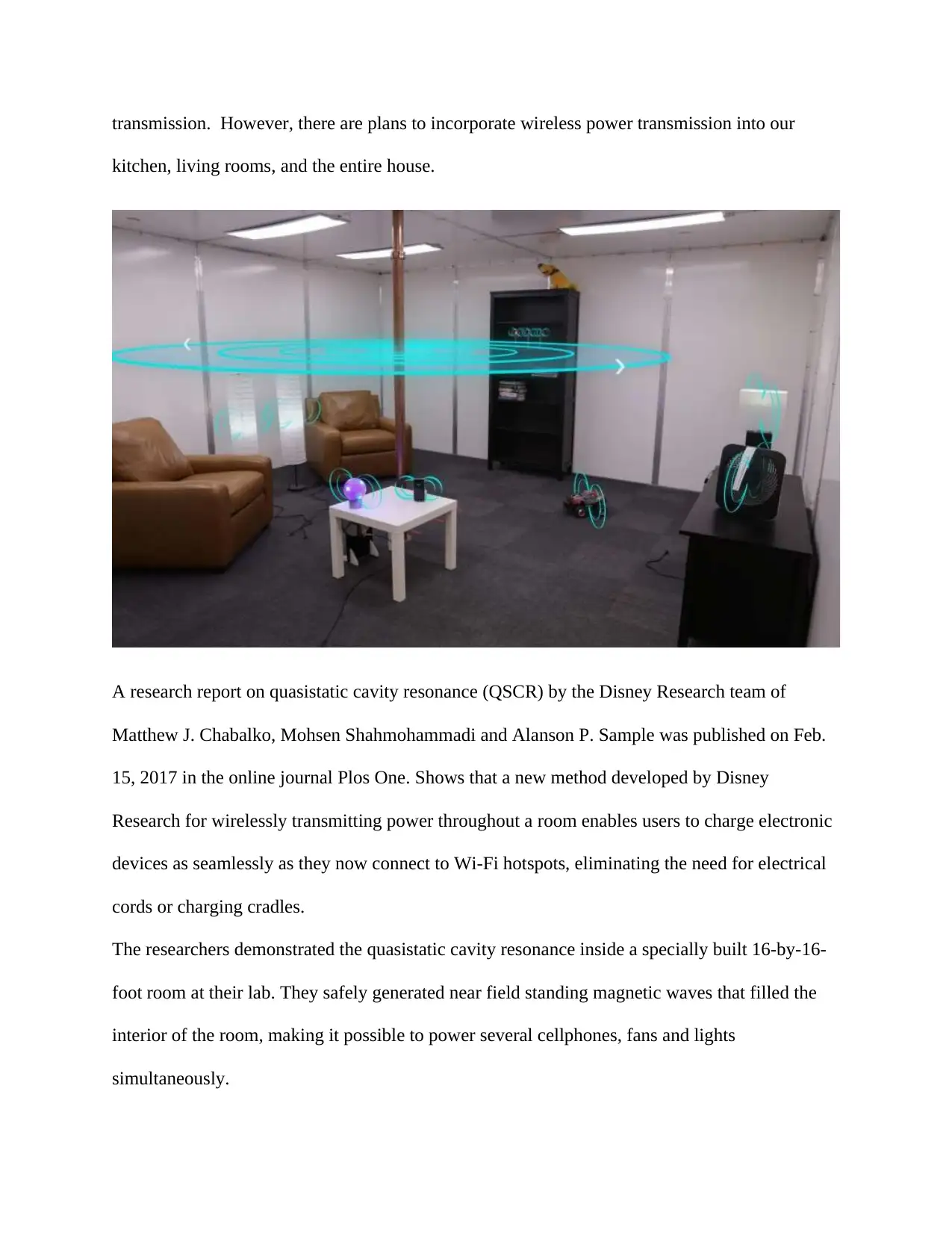
A research report on quasistatic cavity resonance (QSCR) by the Disney Research team of
Matthew J. Chabalko, Mohsen Shahmohammadi and Alanson P. Sample was published on Feb.
15, 2017 in the online journal Plos One. Shows that a new method developed by Disney
Research for wirelessly transmitting power throughout a room enables users to charge electronic
devices as seamlessly as they now connect to Wi-Fi hotspots, eliminating the need for electrical
cords or charging cradles.
The researchers demonstrated the quasistatic cavity resonance inside a specially built 16-by-16-
foot room at their lab. They safely generated near field standing magnetic waves that filled the
interior of the room, making it possible to power several cellphones, fans and lights
simultaneously.
kitchen, living rooms, and the entire house.
A research report on quasistatic cavity resonance (QSCR) by the Disney Research team of
Matthew J. Chabalko, Mohsen Shahmohammadi and Alanson P. Sample was published on Feb.
15, 2017 in the online journal Plos One. Shows that a new method developed by Disney
Research for wirelessly transmitting power throughout a room enables users to charge electronic
devices as seamlessly as they now connect to Wi-Fi hotspots, eliminating the need for electrical
cords or charging cradles.
The researchers demonstrated the quasistatic cavity resonance inside a specially built 16-by-16-
foot room at their lab. They safely generated near field standing magnetic waves that filled the
interior of the room, making it possible to power several cellphones, fans and lights
simultaneously.
"This new innovative method will make it possible for electrical power to become as ubiquitous
as Wi-Fi," said Alanson Sample, associate lab director and principal research scientist at Disney
research. "This in turn could enable new applications for robots and other small mobile devices
by eliminating the need to replace batteries and wires for charging." Even with all of this, the
house and vehicles, developers are not stopping there. Wireless power transfer is in the process
of being integrated into the military with headgear and into the medical field to save lives and
assist us in living longer healthier lives with implantable devices.
Political
Both the US government and International regulations are in place to regulate safety and
efficiency concerns of wireless power transmission, this includes the Consumer Electronics
Association, Federal Communications Commission, and National Institute of Health to name a
few. In order for any wireless power product to be manufactured it must meet the International
Exposure limits for inductive wireless power. The Department of Energy, has supplied over $8
million to companies that are developing an all-electric vehicle that will charge using wireless
power transmission. This is not to mention the amount of funding received from the private
sector. As of the July/august 2015, the WPT vehicle has demonstrated 6.6kW and 85% system
efficiency. (Wireless Charging of Electric Vehicles, 2015) Companies and government agencies
are striving to achieve 90% system efficiency, before approval for the consumer.
However, Companies like Mercedes-Benz, and Nissans are currently developing some electrical
car whiles companies like, 54-year-old Italian car firm Lamborghini will be launching their SUV
at the company's headquarters in Sant'Agata Bolognese, Italy, towards the end of this year, with
as Wi-Fi," said Alanson Sample, associate lab director and principal research scientist at Disney
research. "This in turn could enable new applications for robots and other small mobile devices
by eliminating the need to replace batteries and wires for charging." Even with all of this, the
house and vehicles, developers are not stopping there. Wireless power transfer is in the process
of being integrated into the military with headgear and into the medical field to save lives and
assist us in living longer healthier lives with implantable devices.
Political
Both the US government and International regulations are in place to regulate safety and
efficiency concerns of wireless power transmission, this includes the Consumer Electronics
Association, Federal Communications Commission, and National Institute of Health to name a
few. In order for any wireless power product to be manufactured it must meet the International
Exposure limits for inductive wireless power. The Department of Energy, has supplied over $8
million to companies that are developing an all-electric vehicle that will charge using wireless
power transmission. This is not to mention the amount of funding received from the private
sector. As of the July/august 2015, the WPT vehicle has demonstrated 6.6kW and 85% system
efficiency. (Wireless Charging of Electric Vehicles, 2015) Companies and government agencies
are striving to achieve 90% system efficiency, before approval for the consumer.
However, Companies like Mercedes-Benz, and Nissans are currently developing some electrical
car whiles companies like, 54-year-old Italian car firm Lamborghini will be launching their SUV
at the company's headquarters in Sant'Agata Bolognese, Italy, towards the end of this year, with
⊘ This is a preview!⊘
Do you want full access?
Subscribe today to unlock all pages.
Trusted by 1+ million students worldwide
deliveries starting in the second half of 2018, and German parent Volkswagen is also I interest in
producing zero-emission vehicles could extend to the very top end of its brands.
With Green Energy being a big deal in the government, lobbyists, activists, and
consumers we can expect to reap the rewards in our pocket books. The government has already
been offering tax breaks for energy efficient home improvement and hybrid vehicles.
ECONOMIC
Currently the industry is highly competitive between the companies using the technology
of wireless power. “The market is thought to reach $8.5 million in 2018” (Bender, 2014).
Companies have been purchasing the design to in cooperate it into their products and consumer
are looking for ways to save money with the most convenience, leaving the market for wireless
power technology and product in high demand. In the chart below it is obvious that by switching
to wireless power the consumer will save on their electric bills. The question is what will happen
producing zero-emission vehicles could extend to the very top end of its brands.
With Green Energy being a big deal in the government, lobbyists, activists, and
consumers we can expect to reap the rewards in our pocket books. The government has already
been offering tax breaks for energy efficient home improvement and hybrid vehicles.
ECONOMIC
Currently the industry is highly competitive between the companies using the technology
of wireless power. “The market is thought to reach $8.5 million in 2018” (Bender, 2014).
Companies have been purchasing the design to in cooperate it into their products and consumer
are looking for ways to save money with the most convenience, leaving the market for wireless
power technology and product in high demand. In the chart below it is obvious that by switching
to wireless power the consumer will save on their electric bills. The question is what will happen
Paraphrase This Document
Need a fresh take? Get an instant paraphrase of this document with our AI Paraphraser
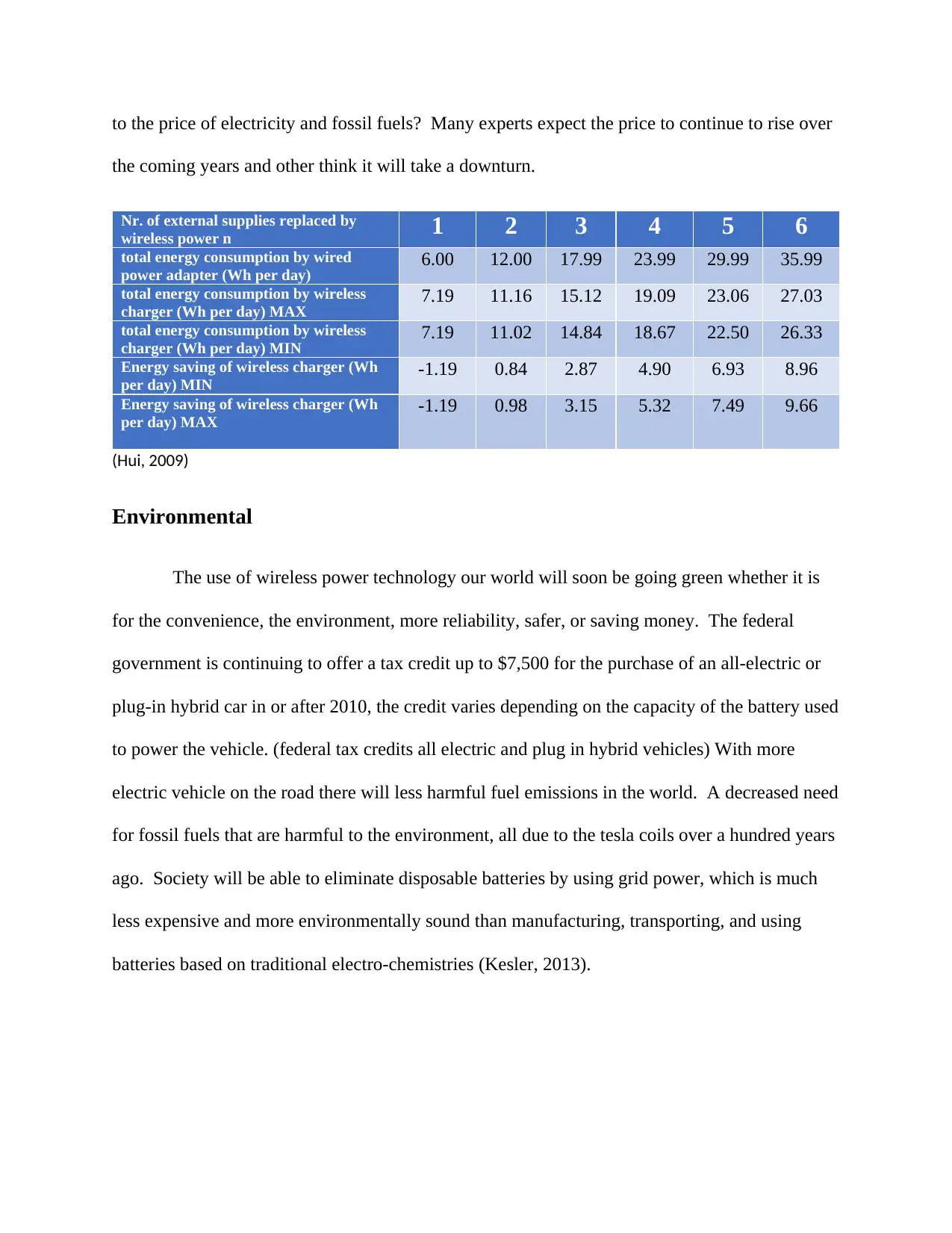
to the price of electricity and fossil fuels? Many experts expect the price to continue to rise over
the coming years and other think it will take a downturn.
Nr. of external supplies replaced by
wireless power n 1 2 3 4 5 6
total energy consumption by wired
power adapter (Wh per day) 6.00 12.00 17.99 23.99 29.99 35.99
total energy consumption by wireless
charger (Wh per day) MAX 7.19 11.16 15.12 19.09 23.06 27.03
total energy consumption by wireless
charger (Wh per day) MIN 7.19 11.02 14.84 18.67 22.50 26.33
Energy saving of wireless charger (Wh
per day) MIN -1.19 0.84 2.87 4.90 6.93 8.96
Energy saving of wireless charger (Wh
per day) MAX -1.19 0.98 3.15 5.32 7.49 9.66
(Hui, 2009)
Environmental
The use of wireless power technology our world will soon be going green whether it is
for the convenience, the environment, more reliability, safer, or saving money. The federal
government is continuing to offer a tax credit up to $7,500 for the purchase of an all-electric or
plug-in hybrid car in or after 2010, the credit varies depending on the capacity of the battery used
to power the vehicle. (federal tax credits all electric and plug in hybrid vehicles) With more
electric vehicle on the road there will less harmful fuel emissions in the world. A decreased need
for fossil fuels that are harmful to the environment, all due to the tesla coils over a hundred years
ago. Society will be able to eliminate disposable batteries by using grid power, which is much
less expensive and more environmentally sound than manufacturing, transporting, and using
batteries based on traditional electro-chemistries (Kesler, 2013).
the coming years and other think it will take a downturn.
Nr. of external supplies replaced by
wireless power n 1 2 3 4 5 6
total energy consumption by wired
power adapter (Wh per day) 6.00 12.00 17.99 23.99 29.99 35.99
total energy consumption by wireless
charger (Wh per day) MAX 7.19 11.16 15.12 19.09 23.06 27.03
total energy consumption by wireless
charger (Wh per day) MIN 7.19 11.02 14.84 18.67 22.50 26.33
Energy saving of wireless charger (Wh
per day) MIN -1.19 0.84 2.87 4.90 6.93 8.96
Energy saving of wireless charger (Wh
per day) MAX -1.19 0.98 3.15 5.32 7.49 9.66
(Hui, 2009)
Environmental
The use of wireless power technology our world will soon be going green whether it is
for the convenience, the environment, more reliability, safer, or saving money. The federal
government is continuing to offer a tax credit up to $7,500 for the purchase of an all-electric or
plug-in hybrid car in or after 2010, the credit varies depending on the capacity of the battery used
to power the vehicle. (federal tax credits all electric and plug in hybrid vehicles) With more
electric vehicle on the road there will less harmful fuel emissions in the world. A decreased need
for fossil fuels that are harmful to the environment, all due to the tesla coils over a hundred years
ago. Society will be able to eliminate disposable batteries by using grid power, which is much
less expensive and more environmentally sound than manufacturing, transporting, and using
batteries based on traditional electro-chemistries (Kesler, 2013).
CONCLUSION
Wireless power transfer will improve or lives, the world around us, and our environment
for the better. Our government is rewarding its citizens for purchasing items that use this
wireless technology, because it is ultimately better for us and our environment. Our homes and
our productivity personally and work related will improve and save us money over all. the
normal option for suitable, short-range communication, wire-free, between the accessories. It is a
worldwide accessible average that wirelessly facilities cellular phones, cars, portable computers,
MP3 players, stereo headsets, and more.
Works Cited
Bender, E. (2014). The future of wireless charging. World Economic Forum.
Wireless power transfer will improve or lives, the world around us, and our environment
for the better. Our government is rewarding its citizens for purchasing items that use this
wireless technology, because it is ultimately better for us and our environment. Our homes and
our productivity personally and work related will improve and save us money over all. the
normal option for suitable, short-range communication, wire-free, between the accessories. It is a
worldwide accessible average that wirelessly facilities cellular phones, cars, portable computers,
MP3 players, stereo headsets, and more.
Works Cited
Bender, E. (2014). The future of wireless charging. World Economic Forum.
⊘ This is a preview!⊘
Do you want full access?
Subscribe today to unlock all pages.
Trusted by 1+ million students worldwide
Brecher, D. A., & Dr. Arthur, D. P. (2014). Review and Evaluation of Wireless Power Transfer
(WPT) for Electric Transit Applications. FTA Report No. 0060.
Hui, P. R. (2009). Comparison of Power Savings based on the Use of Wireless Charging
Systems & Conventional Wired Power Adapters. wireless Power Consortium.
Kesler, D. M. (2013). Highly Resonant Wireless Power Transfer, WiTricity Corporation.
Reddy, G. N., & Reddy, G. (2013). Effects of Wireless Electricity on Human Bodies.
International Journal of Engineering Trends and Technology, 2567-2569.
RF Emission Regulations and Applicability to Inductive Wireless Power Systems. (2016, 09 20).
Retrieved from CEA: CEA.org
Santo, B. (2016, 09 20). The Swiss Army Knife of Wireless. Retrieved from Celeno:
www.cedmagazine.com
Wireless Charging of Electric Vehicles. (2015, 06 10). Retrieved from Energy.gov:
http://energy.gov/sites/prod/files/2015/07/f24/vss103_onar_2015_o.pdf
(WPT) for Electric Transit Applications. FTA Report No. 0060.
Hui, P. R. (2009). Comparison of Power Savings based on the Use of Wireless Charging
Systems & Conventional Wired Power Adapters. wireless Power Consortium.
Kesler, D. M. (2013). Highly Resonant Wireless Power Transfer, WiTricity Corporation.
Reddy, G. N., & Reddy, G. (2013). Effects of Wireless Electricity on Human Bodies.
International Journal of Engineering Trends and Technology, 2567-2569.
RF Emission Regulations and Applicability to Inductive Wireless Power Systems. (2016, 09 20).
Retrieved from CEA: CEA.org
Santo, B. (2016, 09 20). The Swiss Army Knife of Wireless. Retrieved from Celeno:
www.cedmagazine.com
Wireless Charging of Electric Vehicles. (2015, 06 10). Retrieved from Energy.gov:
http://energy.gov/sites/prod/files/2015/07/f24/vss103_onar_2015_o.pdf

1 out of 10


Your All-in-One AI-Powered Toolkit for Academic Success.
+13062052269
info@desklib.com
Available 24*7 on WhatsApp / Email
![[object Object]](/_next/static/media/star-bottom.7253800d.svg)
Unlock your academic potential
Copyright © 2020–2025 A2Z Services. All Rights Reserved. Developed and managed by ZUCOL.