Wireless Sensor Network Simulation Project: Performance Evaluation
VerifiedAdded on 2023/01/23
|30
|5012
|62
Project
AI Summary
This project focuses on the simulation of wireless sensor networks, exploring network design and the performance of two routing protocols: DSDV and AODV. The simulation utilizes tools like NS-2 and NAM to model a network with 20 nodes, evaluating energy consumption and packet transfer rates over a five-minute period. The project analyzes the behavior of each protocol, observing data packet transmission, reception, and loss, along with node movement and energy depletion. The DSDV protocol demonstrates uniform data transfer and higher energy consumption, while AODV exhibits faster initial data transfer but increased packet dropping. Through trace file analysis, the study compares the performance of DSDV and AODV, concluding that DSDV offers more reliable results due to lower packet loss, whereas AODV is faster but less accurate. The project provides screenshots and data analysis to support the findings, offering insights into the trade-offs between speed, energy efficiency, and reliability in wireless network design.

Wireless Sensor Network
Student Name
College
Student Name
College
Paraphrase This Document
Need a fresh take? Get an instant paraphrase of this document with our AI Paraphraser

Introduction
In computer networks, wireless networks can be defined as a field that is concerned with the
interconnection of medium less nodes. Globaly, various organisations and companies have made use of
this technology in laying out their network.The invention of wireless networks has tremendously
reduced the cost of setting up and managing networks. Furtermore the networks are effective and
reliable. Wireless computer networks simulation can be achieved by the use of the NS-3 or NS-2
simulation tools that work well in in a Linux environment [1]. However, they can be used in the
windows environment with the aid of the NSG2-1 and NAM tool. The tools offer a great virtual
environment to create networks before physical implementation.
Network Design
A simple design of a network is achieved with the aid of a design tool; NAM tool. The tool is useful in
both the tracing and simulation of packets across a network. The simulation offers a wide range of
protocols for routing packets but in this case only two are covered. These protocols are the DVSDV and
AODV protocols. Simulation is only done after the network design which is achieved with the aid of a
special software (NetSim software) and saving the tlc. Another tool; Cygwin, is used to come up with the
necessary commands required in generating the nam and tr file[2]. A NAM tool can be used to open and
alter the nam file . The content of the nam file is the simulations and the procedure used in designing
the software.
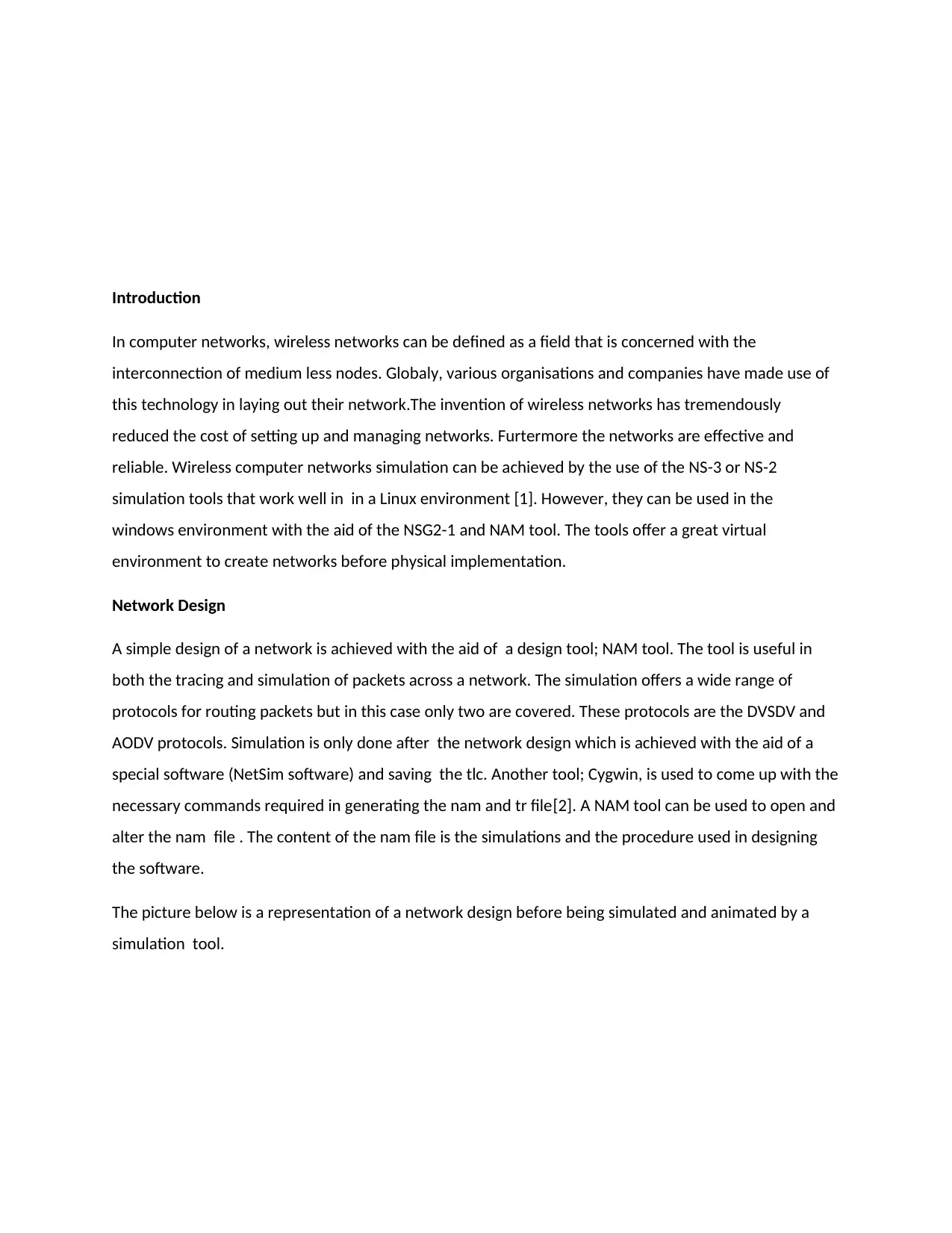
The picture below is a representation of a network design before being simulated and animated by a
simulation tool.
In computer networks, wireless networks can be defined as a field that is concerned with the
interconnection of medium less nodes. Globaly, various organisations and companies have made use of
this technology in laying out their network.The invention of wireless networks has tremendously
reduced the cost of setting up and managing networks. Furtermore the networks are effective and
reliable. Wireless computer networks simulation can be achieved by the use of the NS-3 or NS-2
simulation tools that work well in in a Linux environment [1]. However, they can be used in the
windows environment with the aid of the NSG2-1 and NAM tool. The tools offer a great virtual
environment to create networks before physical implementation.
Network Design
A simple design of a network is achieved with the aid of a design tool; NAM tool. The tool is useful in
both the tracing and simulation of packets across a network. The simulation offers a wide range of
protocols for routing packets but in this case only two are covered. These protocols are the DVSDV and
AODV protocols. Simulation is only done after the network design which is achieved with the aid of a
special software (NetSim software) and saving the tlc. Another tool; Cygwin, is used to come up with the
necessary commands required in generating the nam and tr file[2]. A NAM tool can be used to open and
alter the nam file . The content of the nam file is the simulations and the procedure used in designing
the software.
The picture below is a representation of a network design before being simulated and animated by a
simulation tool.

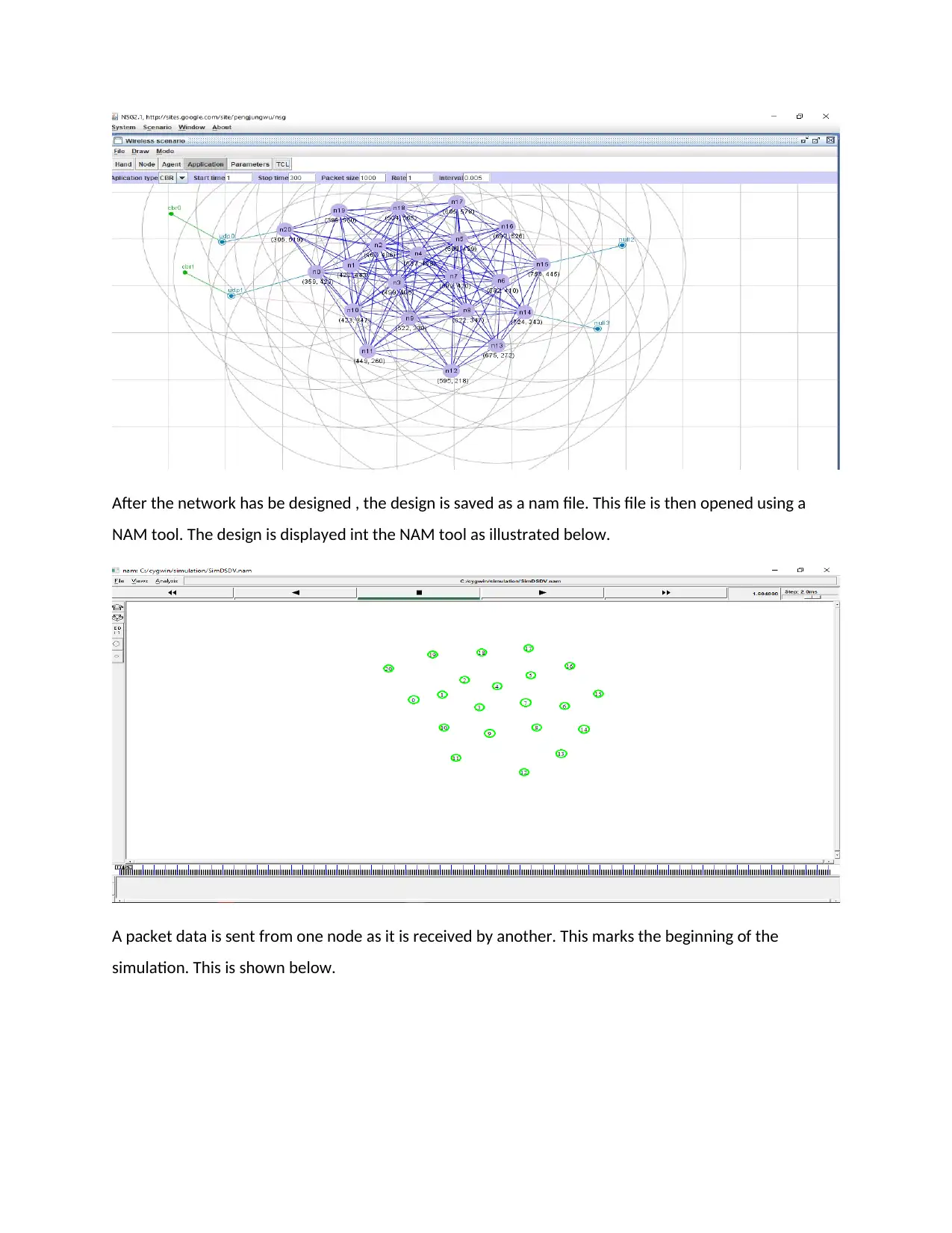
After the network has be designed , the design is saved as a nam file. This file is then opened using a
NAM tool. The design is displayed int the NAM tool as illustrated below.
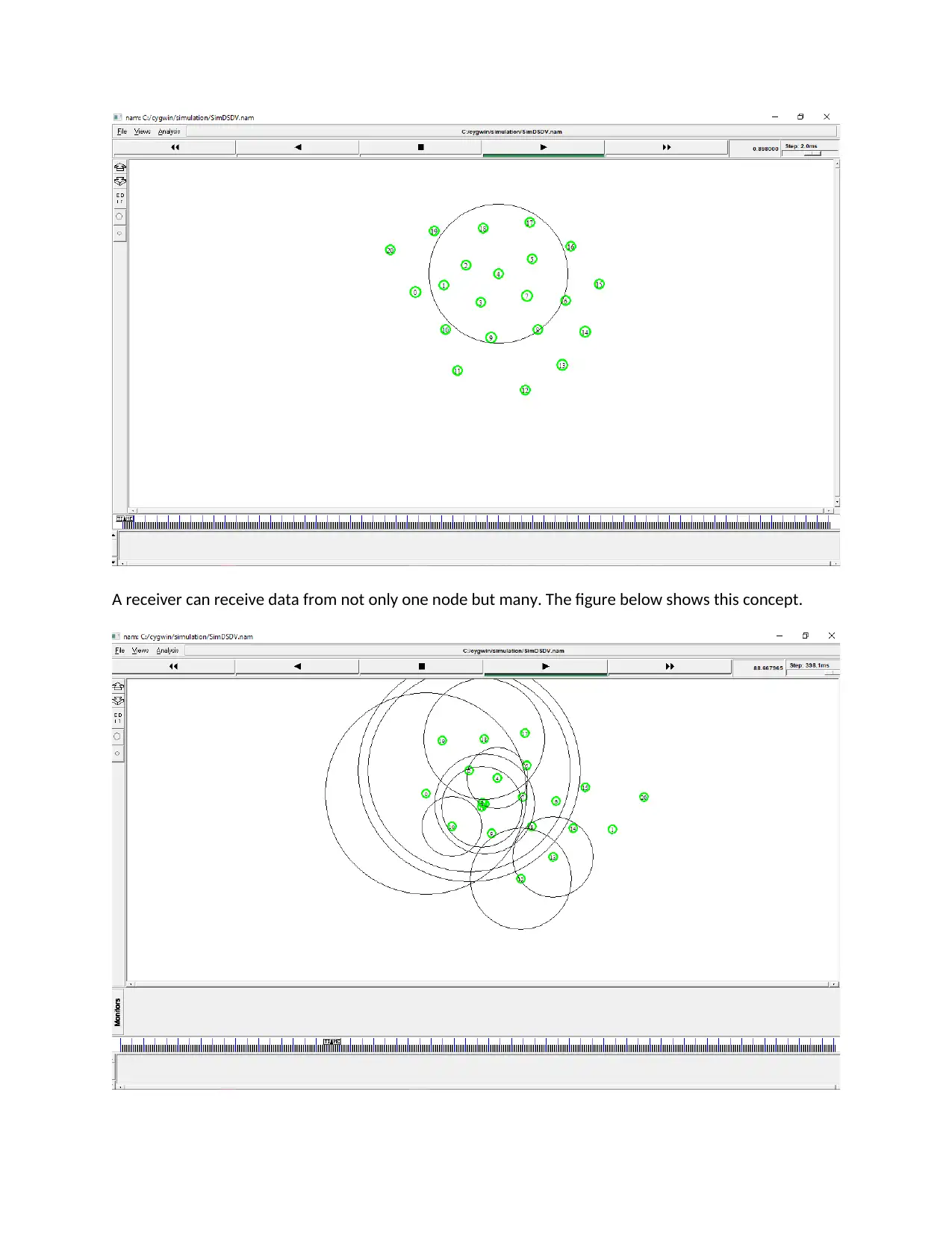
A packet data is sent from one node as it is received by another. This marks the beginning of the
simulation. This is shown below.
NAM tool. The design is displayed int the NAM tool as illustrated below.
A packet data is sent from one node as it is received by another. This marks the beginning of the
simulation. This is shown below.
⊘ This is a preview!⊘
Do you want full access?
Subscribe today to unlock all pages.

Trusted by 1+ million students worldwide

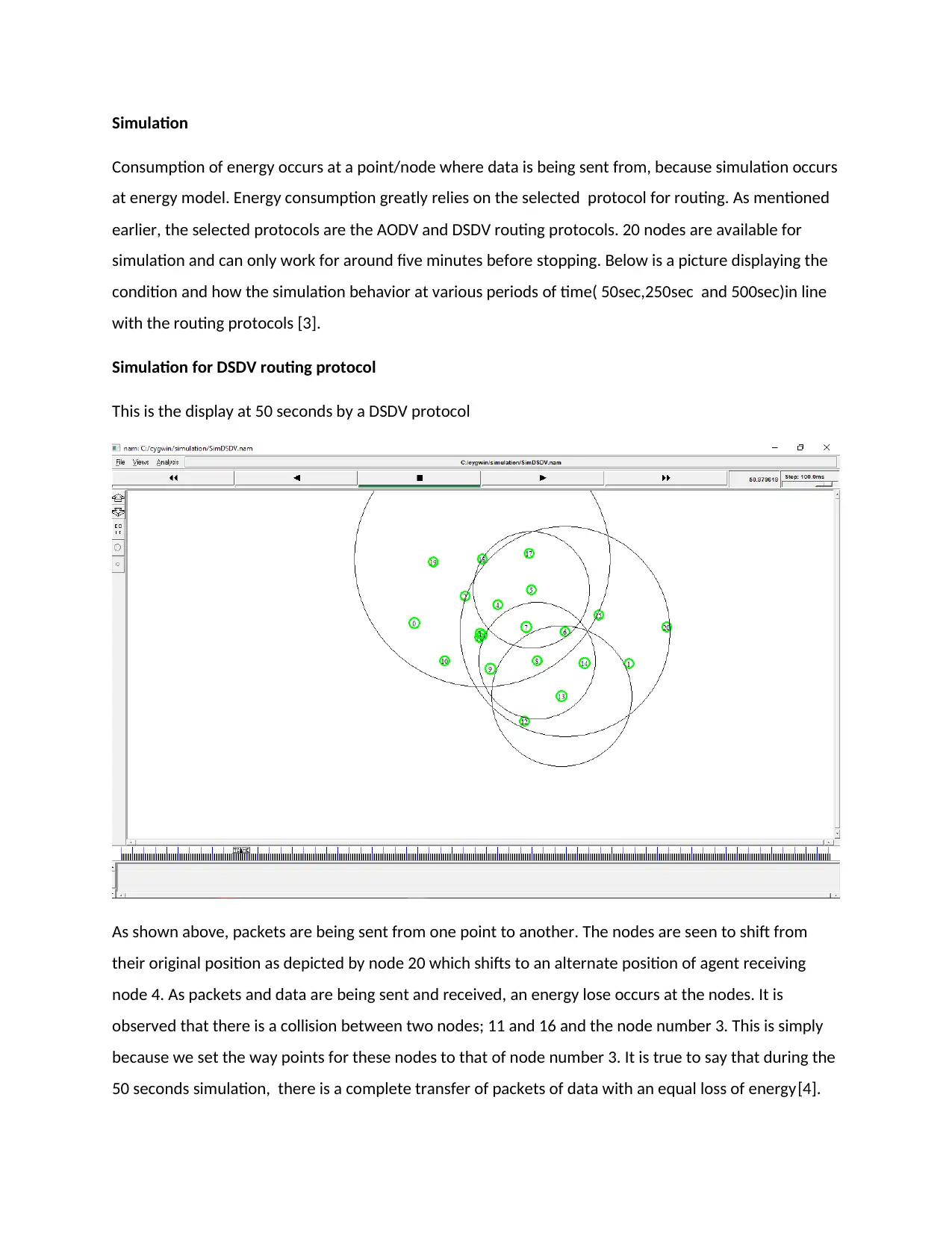
A receiver can receive data from not only one node but many. The figure below shows this concept.
Paraphrase This Document
Need a fresh take? Get an instant paraphrase of this document with our AI Paraphraser

Simulation
Consumption of energy occurs at a point/node where data is being sent from, because simulation occurs
at energy model. Energy consumption greatly relies on the selected protocol for routing. As mentioned
earlier, the selected protocols are the AODV and DSDV routing protocols. 20 nodes are available for
simulation and can only work for around five minutes before stopping. Below is a picture displaying the
condition and how the simulation behavior at various periods of time( 50sec,250sec and 500sec)in line
with the routing protocols [3].
Simulation for DSDV routing protocol
This is the display at 50 seconds by a DSDV protocol
As shown above, packets are being sent from one point to another. The nodes are seen to shift from
their original position as depicted by node 20 which shifts to an alternate position of agent receiving
node 4. As packets and data are being sent and received, an energy lose occurs at the nodes. It is
observed that there is a collision between two nodes; 11 and 16 and the node number 3. This is simply
because we set the way points for these nodes to that of node number 3. It is true to say that during the
50 seconds simulation, there is a complete transfer of packets of data with an equal loss of energy[4].
Consumption of energy occurs at a point/node where data is being sent from, because simulation occurs
at energy model. Energy consumption greatly relies on the selected protocol for routing. As mentioned
earlier, the selected protocols are the AODV and DSDV routing protocols. 20 nodes are available for
simulation and can only work for around five minutes before stopping. Below is a picture displaying the
condition and how the simulation behavior at various periods of time( 50sec,250sec and 500sec)in line
with the routing protocols [3].
Simulation for DSDV routing protocol
This is the display at 50 seconds by a DSDV protocol
As shown above, packets are being sent from one point to another. The nodes are seen to shift from
their original position as depicted by node 20 which shifts to an alternate position of agent receiving
node 4. As packets and data are being sent and received, an energy lose occurs at the nodes. It is
observed that there is a collision between two nodes; 11 and 16 and the node number 3. This is simply
because we set the way points for these nodes to that of node number 3. It is true to say that during the
50 seconds simulation, there is a complete transfer of packets of data with an equal loss of energy[4].

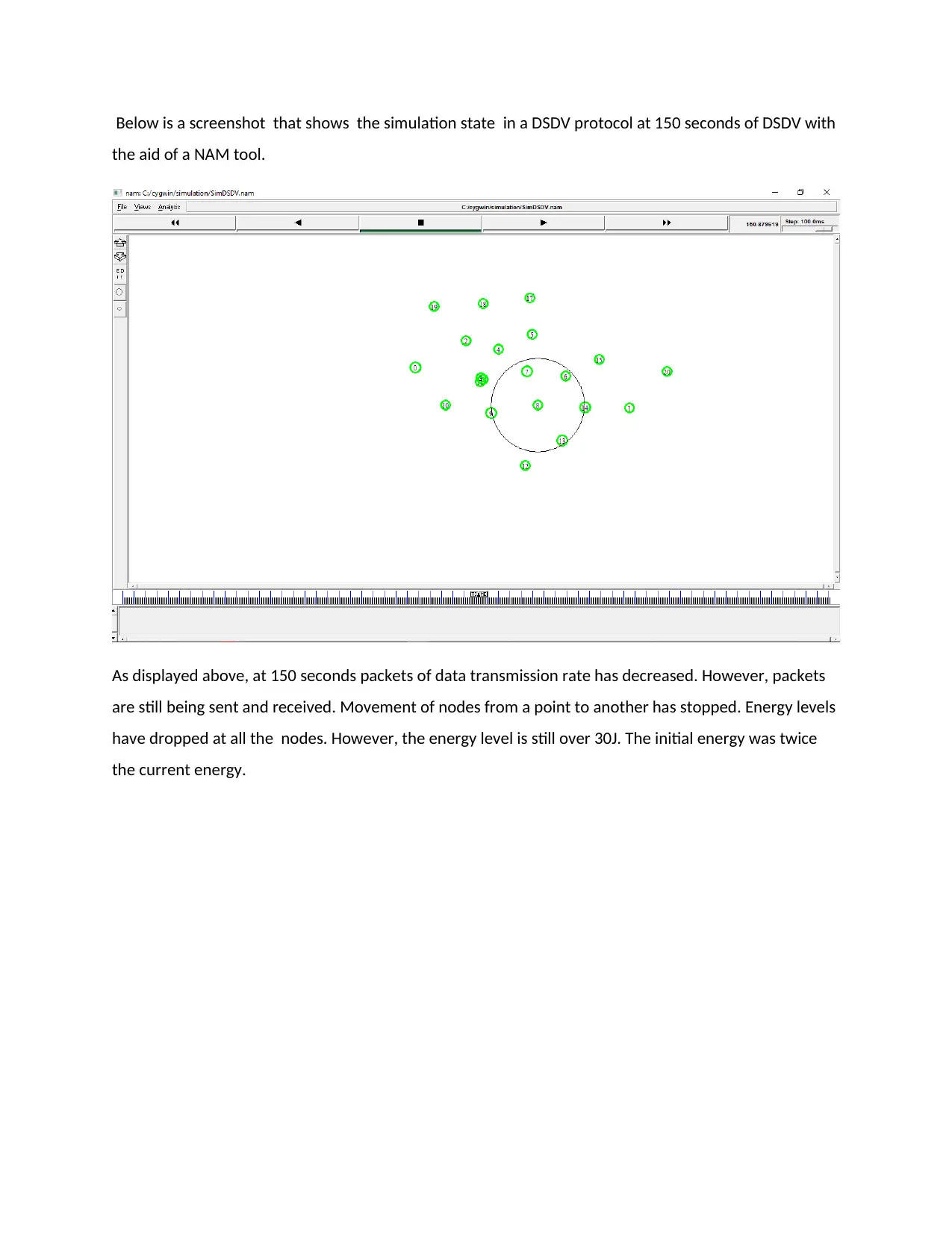
Below is a screenshot that shows the simulation state in a DSDV protocol at 150 seconds of DSDV with
the aid of a NAM tool.
As displayed above, at 150 seconds packets of data transmission rate has decreased. However, packets
are still being sent and received. Movement of nodes from a point to another has stopped. Energy levels
have dropped at all the nodes. However, the energy level is still over 30J. The initial energy was twice
the current energy.
the aid of a NAM tool.
As displayed above, at 150 seconds packets of data transmission rate has decreased. However, packets
are still being sent and received. Movement of nodes from a point to another has stopped. Energy levels
have dropped at all the nodes. However, the energy level is still over 30J. The initial energy was twice
the current energy.
⊘ This is a preview!⊘
Do you want full access?
Subscribe today to unlock all pages.

Trusted by 1+ million students worldwide

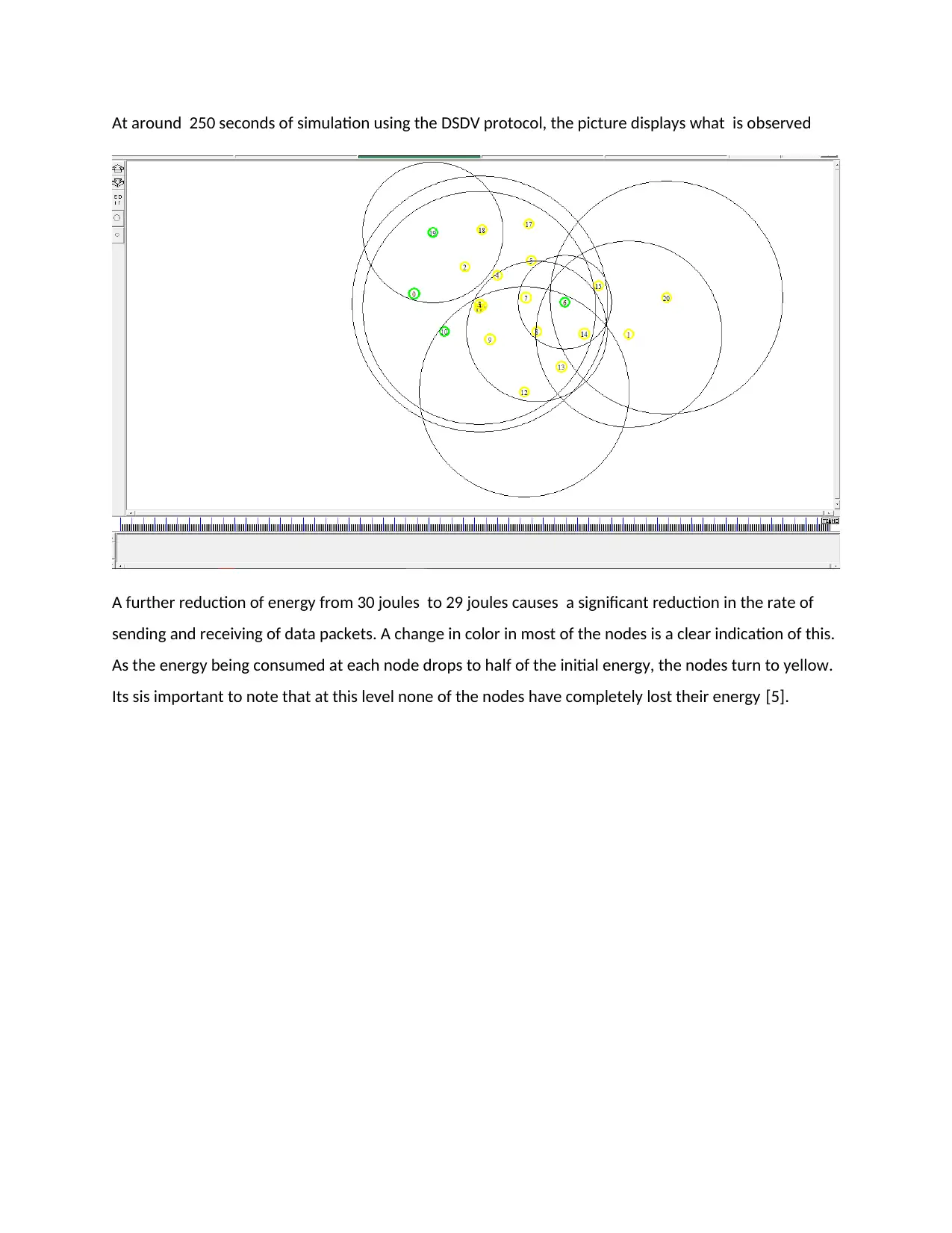
At around 250 seconds of simulation using the DSDV protocol, the picture displays what is observed
A further reduction of energy from 30 joules to 29 joules causes a significant reduction in the rate of
sending and receiving of data packets. A change in color in most of the nodes is a clear indication of this.
As the energy being consumed at each node drops to half of the initial energy, the nodes turn to yellow.
Its sis important to note that at this level none of the nodes have completely lost their energy [5].
A further reduction of energy from 30 joules to 29 joules causes a significant reduction in the rate of
sending and receiving of data packets. A change in color in most of the nodes is a clear indication of this.
As the energy being consumed at each node drops to half of the initial energy, the nodes turn to yellow.
Its sis important to note that at this level none of the nodes have completely lost their energy [5].
Paraphrase This Document
Need a fresh take? Get an instant paraphrase of this document with our AI Paraphraser

Simulation of AODV routing protocol
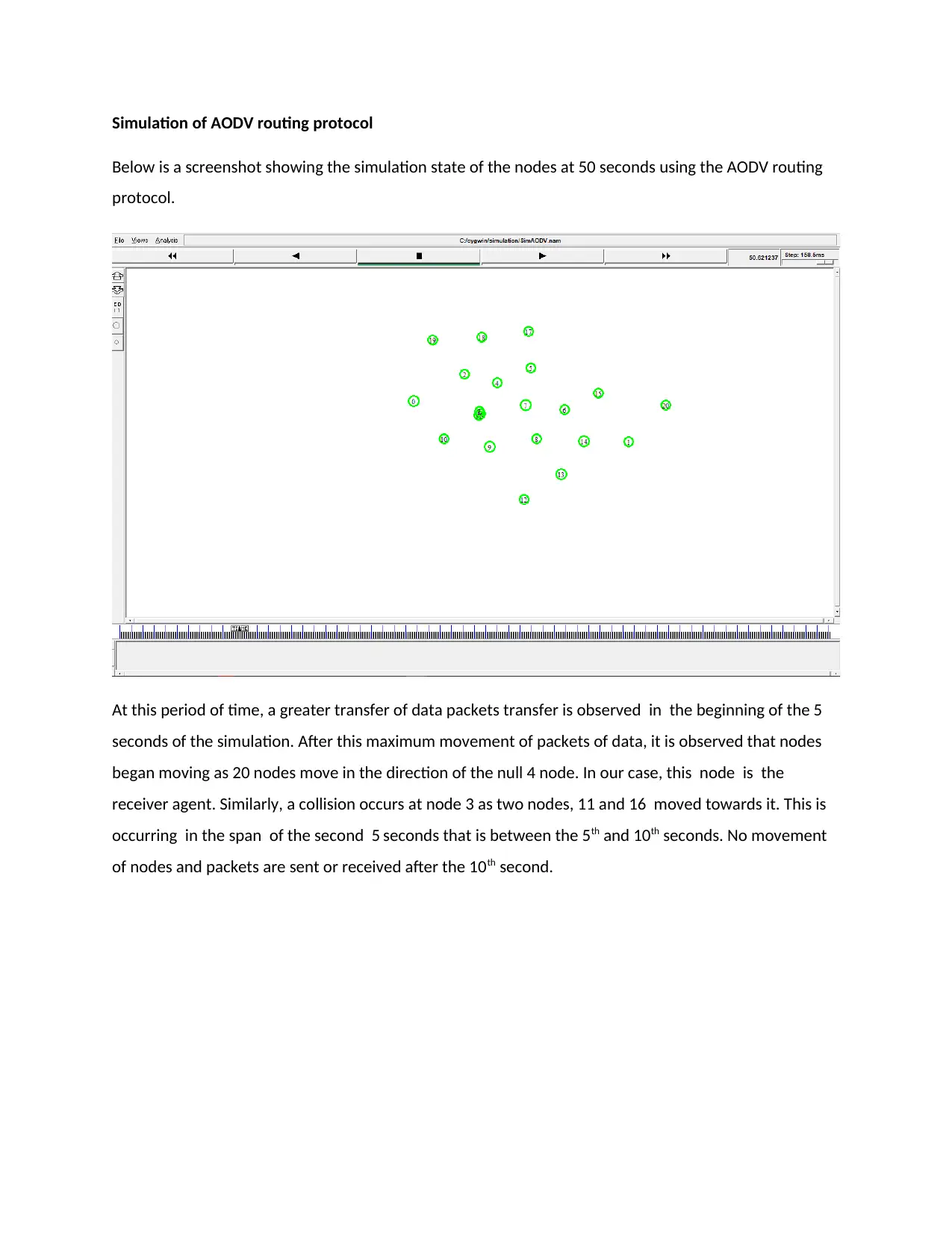
Below is a screenshot showing the simulation state of the nodes at 50 seconds using the AODV routing
protocol.
At this period of time, a greater transfer of data packets transfer is observed in the beginning of the 5
seconds of the simulation. After this maximum movement of packets of data, it is observed that nodes
began moving as 20 nodes move in the direction of the null 4 node. In our case, this node is the
receiver agent. Similarly, a collision occurs at node 3 as two nodes, 11 and 16 moved towards it. This is
occurring in the span of the second 5 seconds that is between the 5th and 10th seconds. No movement
of nodes and packets are sent or received after the 10th second.
Below is a screenshot showing the simulation state of the nodes at 50 seconds using the AODV routing
protocol.
At this period of time, a greater transfer of data packets transfer is observed in the beginning of the 5
seconds of the simulation. After this maximum movement of packets of data, it is observed that nodes
began moving as 20 nodes move in the direction of the null 4 node. In our case, this node is the
receiver agent. Similarly, a collision occurs at node 3 as two nodes, 11 and 16 moved towards it. This is
occurring in the span of the second 5 seconds that is between the 5th and 10th seconds. No movement
of nodes and packets are sent or received after the 10th second.

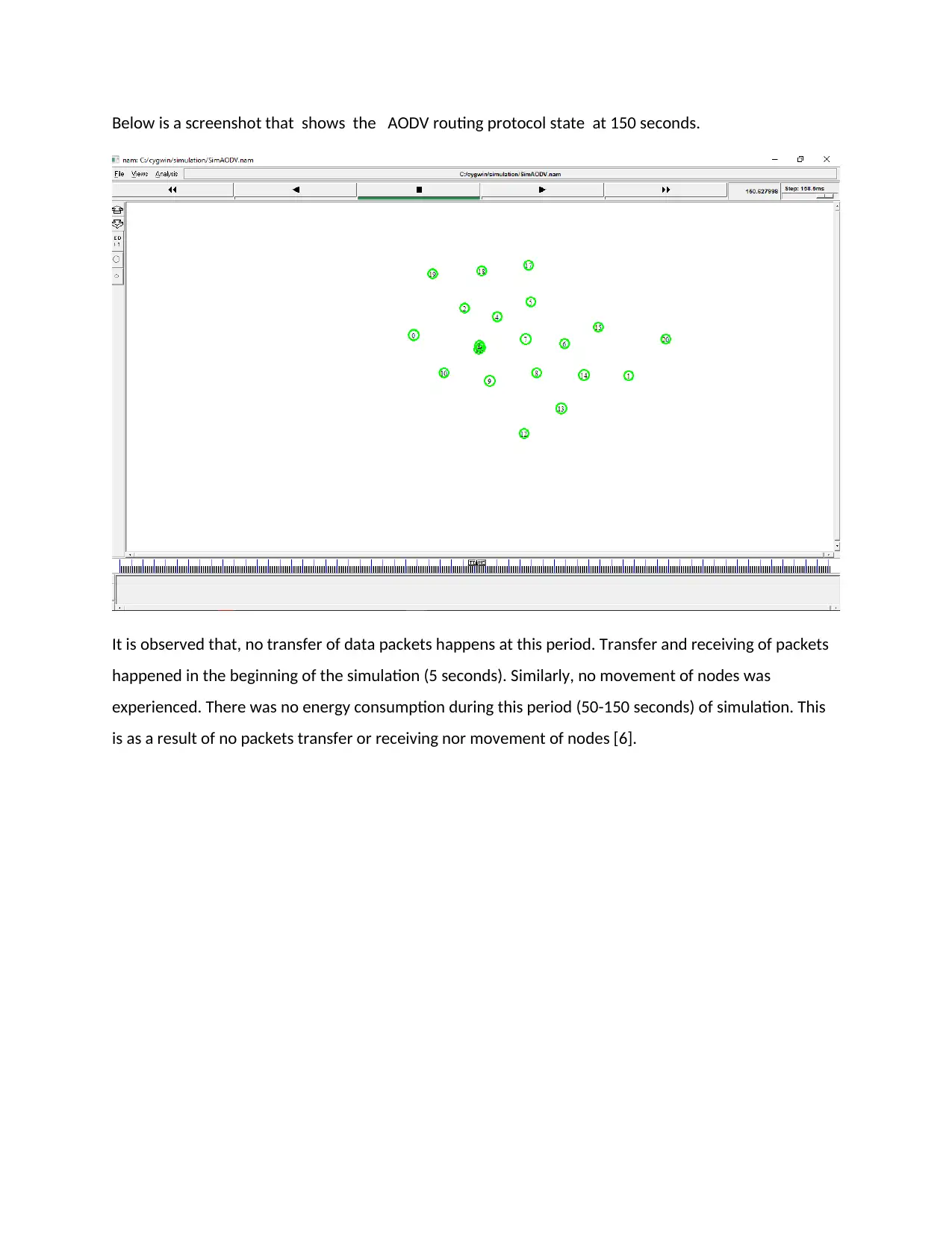
Below is a screenshot that shows the AODV routing protocol state at 150 seconds.
It is observed that, no transfer of data packets happens at this period. Transfer and receiving of packets
happened in the beginning of the simulation (5 seconds). Similarly, no movement of nodes was
experienced. There was no energy consumption during this period (50-150 seconds) of simulation. This
is as a result of no packets transfer or receiving nor movement of nodes [6].
It is observed that, no transfer of data packets happens at this period. Transfer and receiving of packets
happened in the beginning of the simulation (5 seconds). Similarly, no movement of nodes was
experienced. There was no energy consumption during this period (50-150 seconds) of simulation. This
is as a result of no packets transfer or receiving nor movement of nodes [6].
⊘ This is a preview!⊘
Do you want full access?
Subscribe today to unlock all pages.

Trusted by 1+ million students worldwide

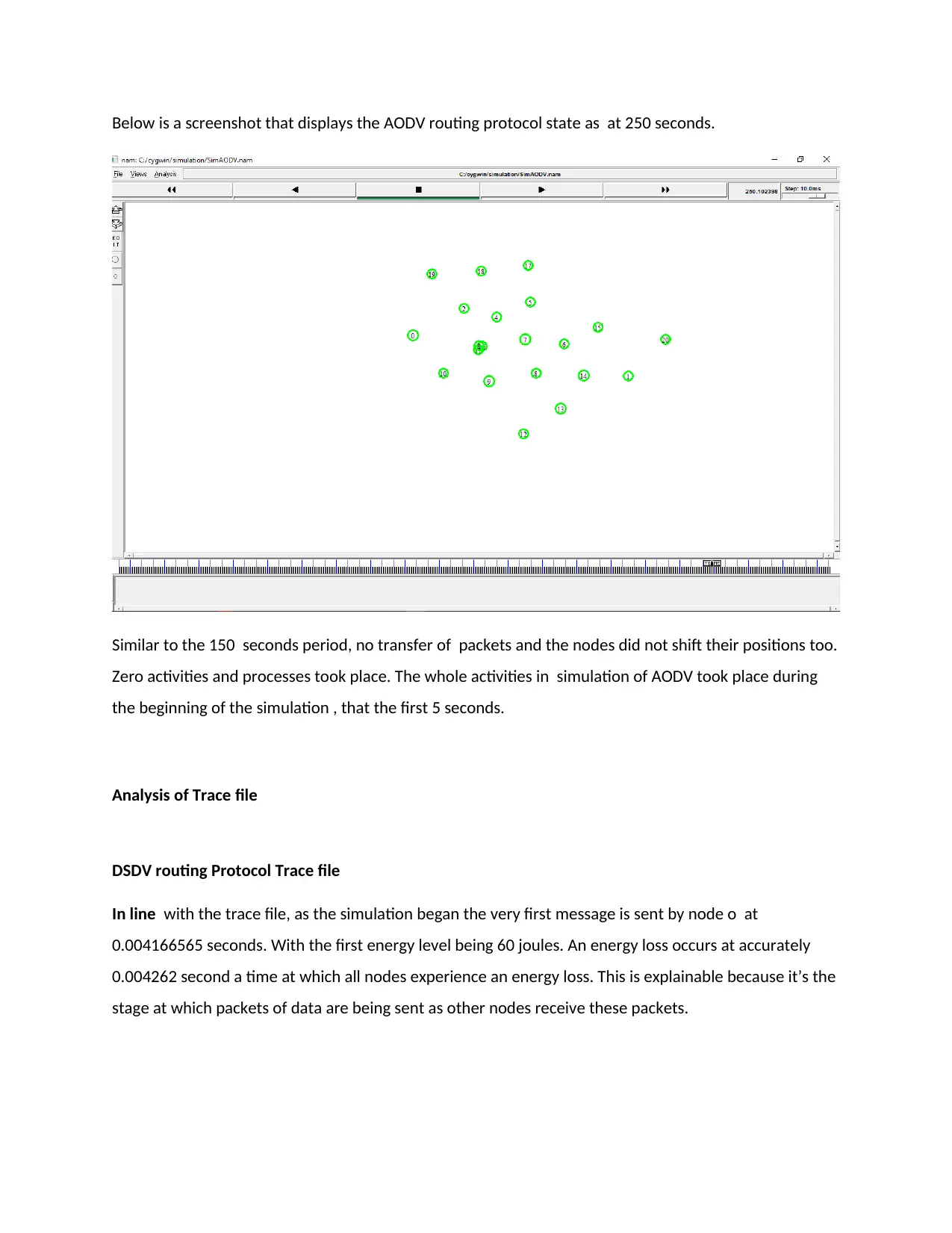
Below is a screenshot that displays the AODV routing protocol state as at 250 seconds.
Similar to the 150 seconds period, no transfer of packets and the nodes did not shift their positions too.
Zero activities and processes took place. The whole activities in simulation of AODV took place during
the beginning of the simulation , that the first 5 seconds.
Analysis of Trace file
DSDV routing Protocol Trace file
In line with the trace file, as the simulation began the very first message is sent by node o at
0.004166565 seconds. With the first energy level being 60 joules. An energy loss occurs at accurately
0.004262 second a time at which all nodes experience an energy loss. This is explainable because it’s the
stage at which packets of data are being sent as other nodes receive these packets.
Similar to the 150 seconds period, no transfer of packets and the nodes did not shift their positions too.
Zero activities and processes took place. The whole activities in simulation of AODV took place during
the beginning of the simulation , that the first 5 seconds.
Analysis of Trace file
DSDV routing Protocol Trace file
In line with the trace file, as the simulation began the very first message is sent by node o at
0.004166565 seconds. With the first energy level being 60 joules. An energy loss occurs at accurately
0.004262 second a time at which all nodes experience an energy loss. This is explainable because it’s the
stage at which packets of data are being sent as other nodes receive these packets.
Paraphrase This Document
Need a fresh take? Get an instant paraphrase of this document with our AI Paraphraser

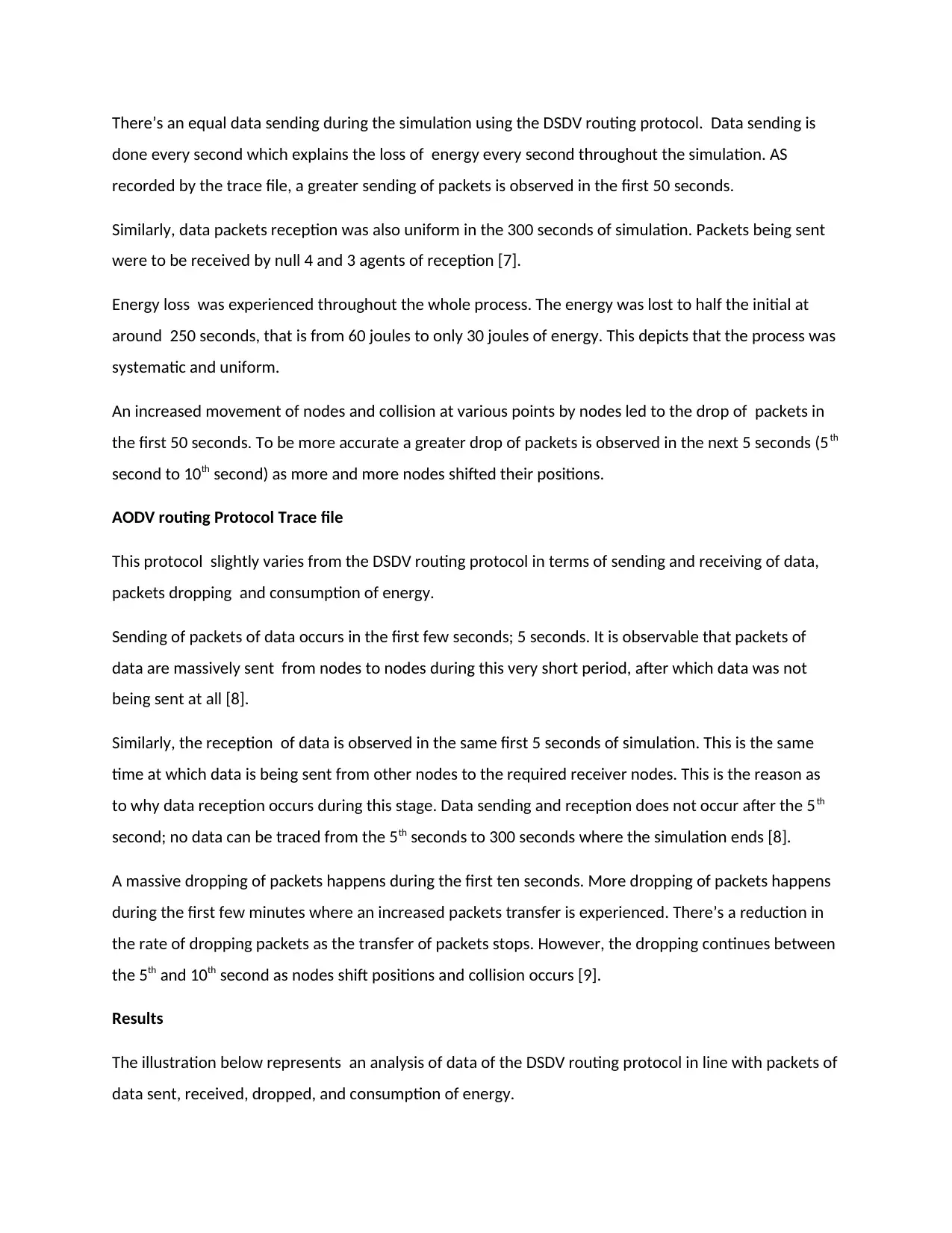
There’s an equal data sending during the simulation using the DSDV routing protocol. Data sending is
done every second which explains the loss of energy every second throughout the simulation. AS
recorded by the trace file, a greater sending of packets is observed in the first 50 seconds.
Similarly, data packets reception was also uniform in the 300 seconds of simulation. Packets being sent
were to be received by null 4 and 3 agents of reception [7].
Energy loss was experienced throughout the whole process. The energy was lost to half the initial at
around 250 seconds, that is from 60 joules to only 30 joules of energy. This depicts that the process was
systematic and uniform.
An increased movement of nodes and collision at various points by nodes led to the drop of packets in
the first 50 seconds. To be more accurate a greater drop of packets is observed in the next 5 seconds (5th
second to 10th second) as more and more nodes shifted their positions.
AODV routing Protocol Trace file
This protocol slightly varies from the DSDV routing protocol in terms of sending and receiving of data,
packets dropping and consumption of energy.
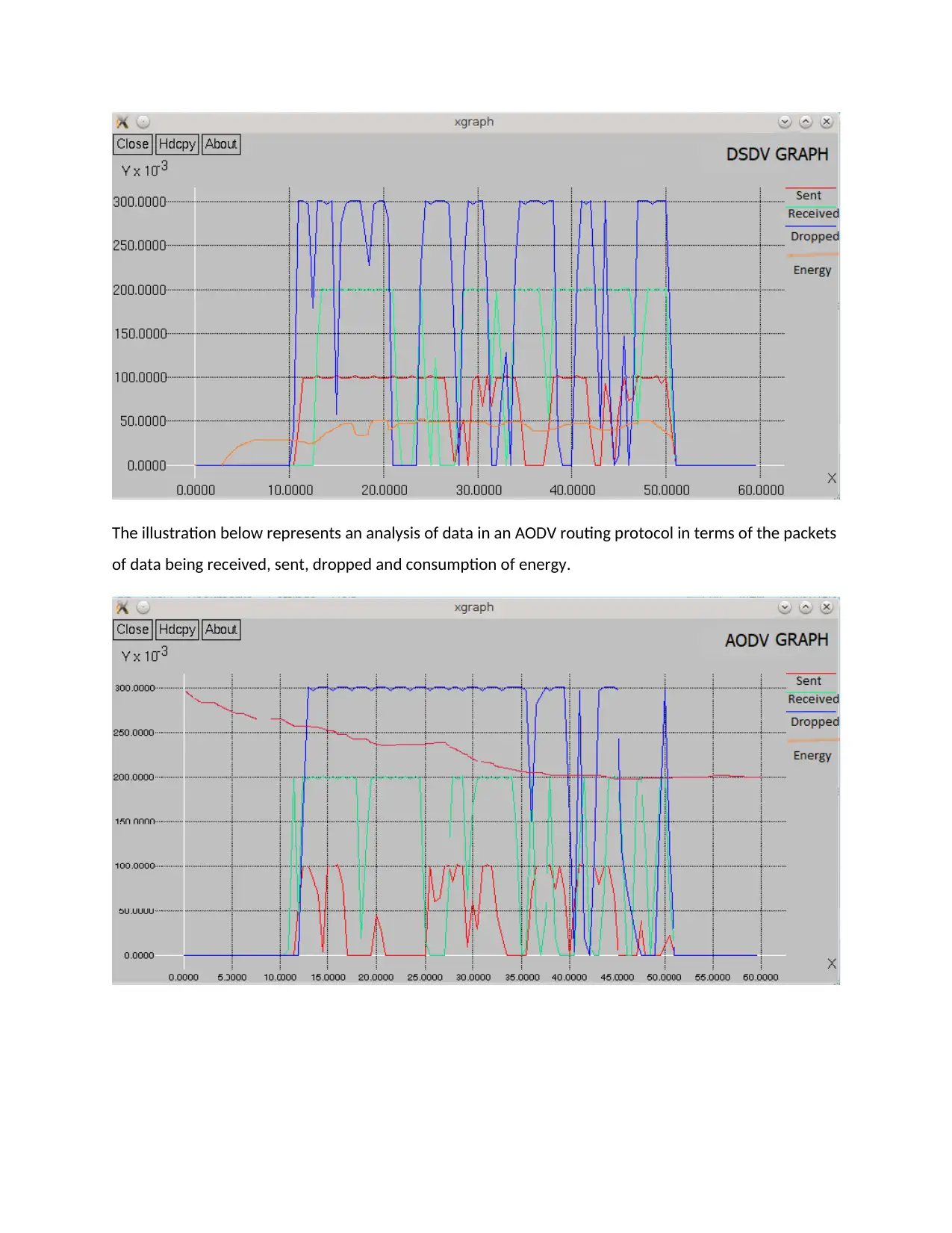
Sending of packets of data occurs in the first few seconds; 5 seconds. It is observable that packets of
data are massively sent from nodes to nodes during this very short period, after which data was not
being sent at all [8].
Similarly, the reception of data is observed in the same first 5 seconds of simulation. This is the same
time at which data is being sent from other nodes to the required receiver nodes. This is the reason as
to why data reception occurs during this stage. Data sending and reception does not occur after the 5th
second; no data can be traced from the 5th seconds to 300 seconds where the simulation ends [8].
A massive dropping of packets happens during the first ten seconds. More dropping of packets happens
during the first few minutes where an increased packets transfer is experienced. There’s a reduction in
the rate of dropping packets as the transfer of packets stops. However, the dropping continues between
the 5th and 10th second as nodes shift positions and collision occurs [9].
Results
The illustration below represents an analysis of data of the DSDV routing protocol in line with packets of
data sent, received, dropped, and consumption of energy.
done every second which explains the loss of energy every second throughout the simulation. AS
recorded by the trace file, a greater sending of packets is observed in the first 50 seconds.
Similarly, data packets reception was also uniform in the 300 seconds of simulation. Packets being sent
were to be received by null 4 and 3 agents of reception [7].
Energy loss was experienced throughout the whole process. The energy was lost to half the initial at
around 250 seconds, that is from 60 joules to only 30 joules of energy. This depicts that the process was
systematic and uniform.
An increased movement of nodes and collision at various points by nodes led to the drop of packets in
the first 50 seconds. To be more accurate a greater drop of packets is observed in the next 5 seconds (5th
second to 10th second) as more and more nodes shifted their positions.
AODV routing Protocol Trace file
This protocol slightly varies from the DSDV routing protocol in terms of sending and receiving of data,
packets dropping and consumption of energy.
Sending of packets of data occurs in the first few seconds; 5 seconds. It is observable that packets of
data are massively sent from nodes to nodes during this very short period, after which data was not
being sent at all [8].
Similarly, the reception of data is observed in the same first 5 seconds of simulation. This is the same
time at which data is being sent from other nodes to the required receiver nodes. This is the reason as
to why data reception occurs during this stage. Data sending and reception does not occur after the 5th
second; no data can be traced from the 5th seconds to 300 seconds where the simulation ends [8].
A massive dropping of packets happens during the first ten seconds. More dropping of packets happens
during the first few minutes where an increased packets transfer is experienced. There’s a reduction in
the rate of dropping packets as the transfer of packets stops. However, the dropping continues between
the 5th and 10th second as nodes shift positions and collision occurs [9].
Results
The illustration below represents an analysis of data of the DSDV routing protocol in line with packets of
data sent, received, dropped, and consumption of energy.

The illustration below represents an analysis of data in an AODV routing protocol in terms of the packets
of data being received, sent, dropped and consumption of energy.
⊘ This is a preview!⊘
Do you want full access?
Subscribe today to unlock all pages.

Trusted by 1+ million students worldwide
1 out of 30
Related Documents
Your All-in-One AI-Powered Toolkit for Academic Success.
+13062052269
info@desklib.com
Available 24*7 on WhatsApp / Email
Unlock your academic potential
Copyright © 2020–2026 A2Z Services. All Rights Reserved. Developed and managed by ZUCOL.