Wireless Communication Technologies: Radio Systems and Future Trends
VerifiedAdded on 2023/06/14
|15
|1969
|322
Report
AI Summary
This report provides a detailed overview of wireless communication technologies, radio systems, and future trends. It begins by explaining the reasons for using spread spectrum transmission and contrasting Frequency Hopped Spread Spectrum with Direct Sequence Spread Spectrum. The report then lists and describes the components of a radio system, including radio transmitters and receivers, and elaborates on different types of mixers, such as active and passive mixers, with diagrams. Finally, it discusses recent advanced wireless technologies like RFID, NFC, Bluetooth, and Wi-Fi Direct, analyzing their strengths and weaknesses and offering an opinion on which technologies may dominate in the future, emphasizing the importance of aligning technology implementation with organizational requirements. This document is available on Desklib, a platform offering a wide range of study resources for students.
Running head: WIRELESS COMMUNICATION
WIRELESS COMMUNICATION
Name of the Student:
Name of the University:
Author Note:
WIRELESS COMMUNICATION
Name of the Student:
Name of the University:
Author Note:
Paraphrase This Document
Need a fresh take? Get an instant paraphrase of this document with our AI Paraphraser

1WIRELESS COMMUNICATION
Answer to the Question no 1.
1.1The reason of using Spread Spectrum Transmission:
There are several attributes of the spread spectrum that makes desirable transmission
technique. Spread spectrum has a wide bandwidth range which enables the user to choose among
the bandwidth. The main advantage of the spread spectrum is that is can resists interface so that
use of spread spectrum can eliminate cross talk (Bi, Zen & Zhang, 2016). Moreover this
technique is cost effective way of transmission. In case of spread spectrum the power of the
signal is very high. In case of spread spectrum, the bandwidth of signal spectrum can be used by
the various users. Moreover it provides better security and reduces the multipath fading.
1.2 Contrast and comparison between the two methods of the transmission of the
spectrum:
The two major types of spread spectrum transmission are- Frequency Hopped Spread
Spectrum Transmission and Direct Sequence Spread Spectrum `Transmission.
Differences between these two transmission techniques:
Frequency Hopped Spread Spectrum
Transmission
Direct Sequence Spread Spectrum
Transmission
Frequency the user is using is hard to find out at
one instance of time
The frequency, the user is using remains the same
after the allocation.
Frequency can be reused in this method. Frequency cannot be reused in this method.
Answer to the Question no 1.
1.1The reason of using Spread Spectrum Transmission:
There are several attributes of the spread spectrum that makes desirable transmission
technique. Spread spectrum has a wide bandwidth range which enables the user to choose among
the bandwidth. The main advantage of the spread spectrum is that is can resists interface so that
use of spread spectrum can eliminate cross talk (Bi, Zen & Zhang, 2016). Moreover this
technique is cost effective way of transmission. In case of spread spectrum the power of the
signal is very high. In case of spread spectrum, the bandwidth of signal spectrum can be used by
the various users. Moreover it provides better security and reduces the multipath fading.
1.2 Contrast and comparison between the two methods of the transmission of the
spectrum:
The two major types of spread spectrum transmission are- Frequency Hopped Spread
Spectrum Transmission and Direct Sequence Spread Spectrum `Transmission.
Differences between these two transmission techniques:
Frequency Hopped Spread Spectrum
Transmission
Direct Sequence Spread Spectrum
Transmission
Frequency the user is using is hard to find out at
one instance of time
The frequency, the user is using remains the same
after the allocation.
Frequency can be reused in this method. Frequency cannot be reused in this method.

2WIRELESS COMMUNICATION
The strength of signal used in this method is high. The strength of signal used in this method is low.
In this method, the signal is not affected by the
interface.
In this method the signal is sensitive to the
interface.
Use of this kind of transmission technique is cheap. Use of this kind of transmission technique is
expensive.
Frequency Hopped Spread Spectrum Transmission
is a commonly used technique for the transmission.
It is not a commonly used technique.
In this technique multiple frequencies can be used. Use of single frequency is permitted.
Comparison between these two frequency techniques:
In case of both frequencies the security concerns are same.
Both Frequency Hopped Spread Spectrum and Direct Sequence Spread Spectrum belong
to the same spread spectrum group.
Answer to the Question no 2.
2.1 Components of the radio system:
The components of the radio system can be categorized into two different categories:
Radio transmitter and Radio Receiver.
Under these two categories there are components of the radio system.
Amplifier, Antenna, Power supply and the modulator come under the radio transmitter
section. These components help to transmit the radio signal.
The strength of signal used in this method is high. The strength of signal used in this method is low.
In this method, the signal is not affected by the
interface.
In this method the signal is sensitive to the
interface.
Use of this kind of transmission technique is cheap. Use of this kind of transmission technique is
expensive.
Frequency Hopped Spread Spectrum Transmission
is a commonly used technique for the transmission.
It is not a commonly used technique.
In this technique multiple frequencies can be used. Use of single frequency is permitted.
Comparison between these two frequency techniques:
In case of both frequencies the security concerns are same.
Both Frequency Hopped Spread Spectrum and Direct Sequence Spread Spectrum belong
to the same spread spectrum group.
Answer to the Question no 2.
2.1 Components of the radio system:
The components of the radio system can be categorized into two different categories:
Radio transmitter and Radio Receiver.
Under these two categories there are components of the radio system.
Amplifier, Antenna, Power supply and the modulator come under the radio transmitter
section. These components help to transmit the radio signal.
⊘ This is a preview!⊘
Do you want full access?
Subscribe today to unlock all pages.

Trusted by 1+ million students worldwide

3WIRELESS COMMUNICATION
Under the category of radio receiver there are radio frequency amplifier, audio amplifier,
tuner and antenna. These components help to receive the radio signal.
2.2 Mixers of different kind:
Active mixer and passive mixer are the two types of mixer in radio frequency (Kaplun et
al.,2017). According to the configuration, mixer can be classified into three categories-
Single Balanced
Double Balanced
Unbalanced
2.3 Active Radio Frequency Mixer:
Amplifiers are used in active mixer in order to increase the strength of the signal. The
isolation between two ports is improved using this signal, although power consumption is high in
active radio frequency mixer. This type frequency mixer is used in implementation of RFIC as it
maintains low power for driving the LO port along with good conversion gain and good isolation
between ports.
Under the category of radio receiver there are radio frequency amplifier, audio amplifier,
tuner and antenna. These components help to receive the radio signal.
2.2 Mixers of different kind:
Active mixer and passive mixer are the two types of mixer in radio frequency (Kaplun et
al.,2017). According to the configuration, mixer can be classified into three categories-
Single Balanced
Double Balanced
Unbalanced
2.3 Active Radio Frequency Mixer:
Amplifiers are used in active mixer in order to increase the strength of the signal. The
isolation between two ports is improved using this signal, although power consumption is high in
active radio frequency mixer. This type frequency mixer is used in implementation of RFIC as it
maintains low power for driving the LO port along with good conversion gain and good isolation
between ports.
Paraphrase This Document
Need a fresh take? Get an instant paraphrase of this document with our AI Paraphraser

4WIRELESS COMMUNICATION
Figure 1: Active Mixer
(Source: Seo, Lee & Yun,2015).
Passive Radio Frequency Mixer:
Diode is used in passive radio frequency mixer. Between the current procedure and the
voltage there exists a non-linear relation which produces signal of lower power.
Passive radio frequency mixer is widely used due to its simplicity, better performance of
inter-module distortion and wide range of bandwidth.
Figure 1: Active Mixer
(Source: Seo, Lee & Yun,2015).
Passive Radio Frequency Mixer:
Diode is used in passive radio frequency mixer. Between the current procedure and the
voltage there exists a non-linear relation which produces signal of lower power.
Passive radio frequency mixer is widely used due to its simplicity, better performance of
inter-module distortion and wide range of bandwidth.

5WIRELESS COMMUNICATION
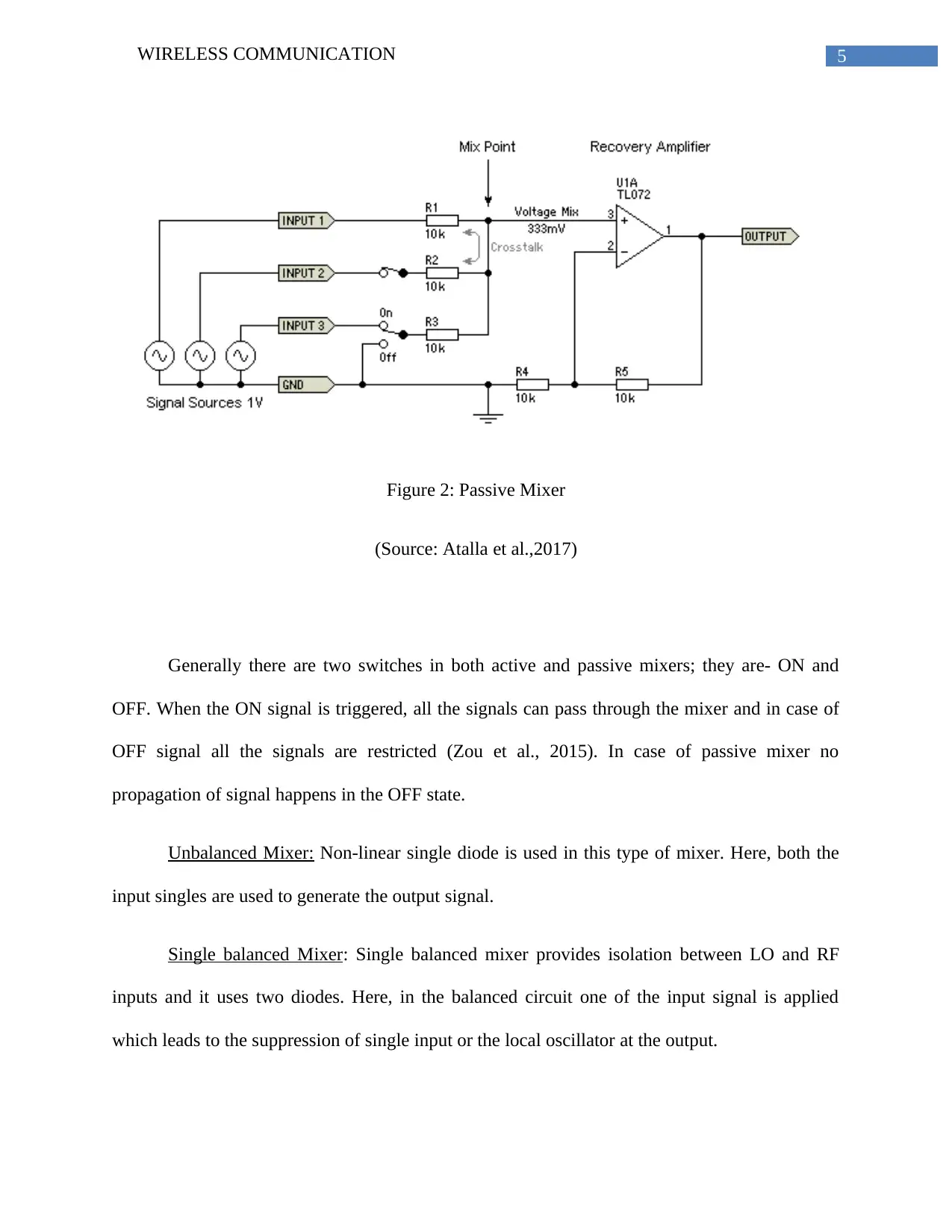
Figure 2: Passive Mixer
(Source: Atalla et al.,2017)
Generally there are two switches in both active and passive mixers; they are- ON and
OFF. When the ON signal is triggered, all the signals can pass through the mixer and in case of
OFF signal all the signals are restricted (Zou et al., 2015). In case of passive mixer no
propagation of signal happens in the OFF state.
Unbalanced Mixer: Non-linear single diode is used in this type of mixer. Here, both the
input singles are used to generate the output signal.
Single balanced Mixer: Single balanced mixer provides isolation between LO and RF
inputs and it uses two diodes. Here, in the balanced circuit one of the input signal is applied
which leads to the suppression of single input or the local oscillator at the output.
Figure 2: Passive Mixer
(Source: Atalla et al.,2017)
Generally there are two switches in both active and passive mixers; they are- ON and
OFF. When the ON signal is triggered, all the signals can pass through the mixer and in case of
OFF signal all the signals are restricted (Zou et al., 2015). In case of passive mixer no
propagation of signal happens in the OFF state.
Unbalanced Mixer: Non-linear single diode is used in this type of mixer. Here, both the
input singles are used to generate the output signal.
Single balanced Mixer: Single balanced mixer provides isolation between LO and RF
inputs and it uses two diodes. Here, in the balanced circuit one of the input signal is applied
which leads to the suppression of single input or the local oscillator at the output.
⊘ This is a preview!⊘
Do you want full access?
Subscribe today to unlock all pages.

Trusted by 1+ million students worldwide

6WIRELESS COMMUNICATION
Double Balanced Mixer: Star mixer and ring mixer are two types of double balanced
mixer. In this case, both input signals are applied to the differential circuit. It requires more
complex circuit and higher level logic for double balanced mixer.
Double balanced mixer has both advantages and disadvantages. It provides strong
isolation between all the ports. All also increased linearity and provides better suppression.
The main disadvantage of the double balanced mixer is that it is not cost effective.
Single balanced, double balanced and unbalanced are the types of passive mixers.
Double Balanced Mixer: Star mixer and ring mixer are two types of double balanced
mixer. In this case, both input signals are applied to the differential circuit. It requires more
complex circuit and higher level logic for double balanced mixer.
Double balanced mixer has both advantages and disadvantages. It provides strong
isolation between all the ports. All also increased linearity and provides better suppression.
The main disadvantage of the double balanced mixer is that it is not cost effective.
Single balanced, double balanced and unbalanced are the types of passive mixers.
Paraphrase This Document
Need a fresh take? Get an instant paraphrase of this document with our AI Paraphraser

7WIRELESS COMMUNICATION
Answer to the Question no 3.
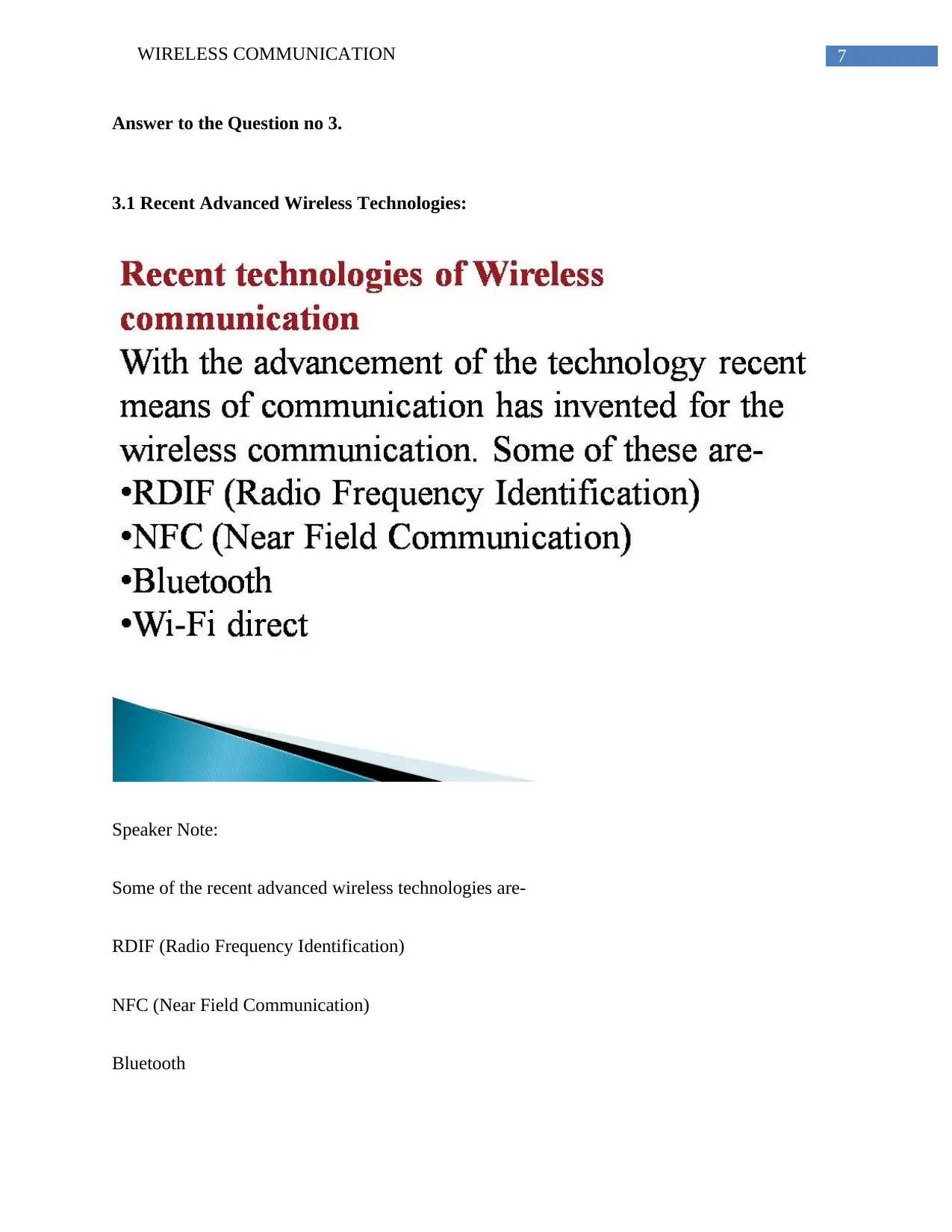
3.1 Recent Advanced Wireless Technologies:
Speaker Note:
Some of the recent advanced wireless technologies are-
RDIF (Radio Frequency Identification)
NFC (Near Field Communication)
Bluetooth
Answer to the Question no 3.
3.1 Recent Advanced Wireless Technologies:
Speaker Note:
Some of the recent advanced wireless technologies are-
RDIF (Radio Frequency Identification)
NFC (Near Field Communication)
Bluetooth

8WIRELESS COMMUNICATION
Wi-Fi direct
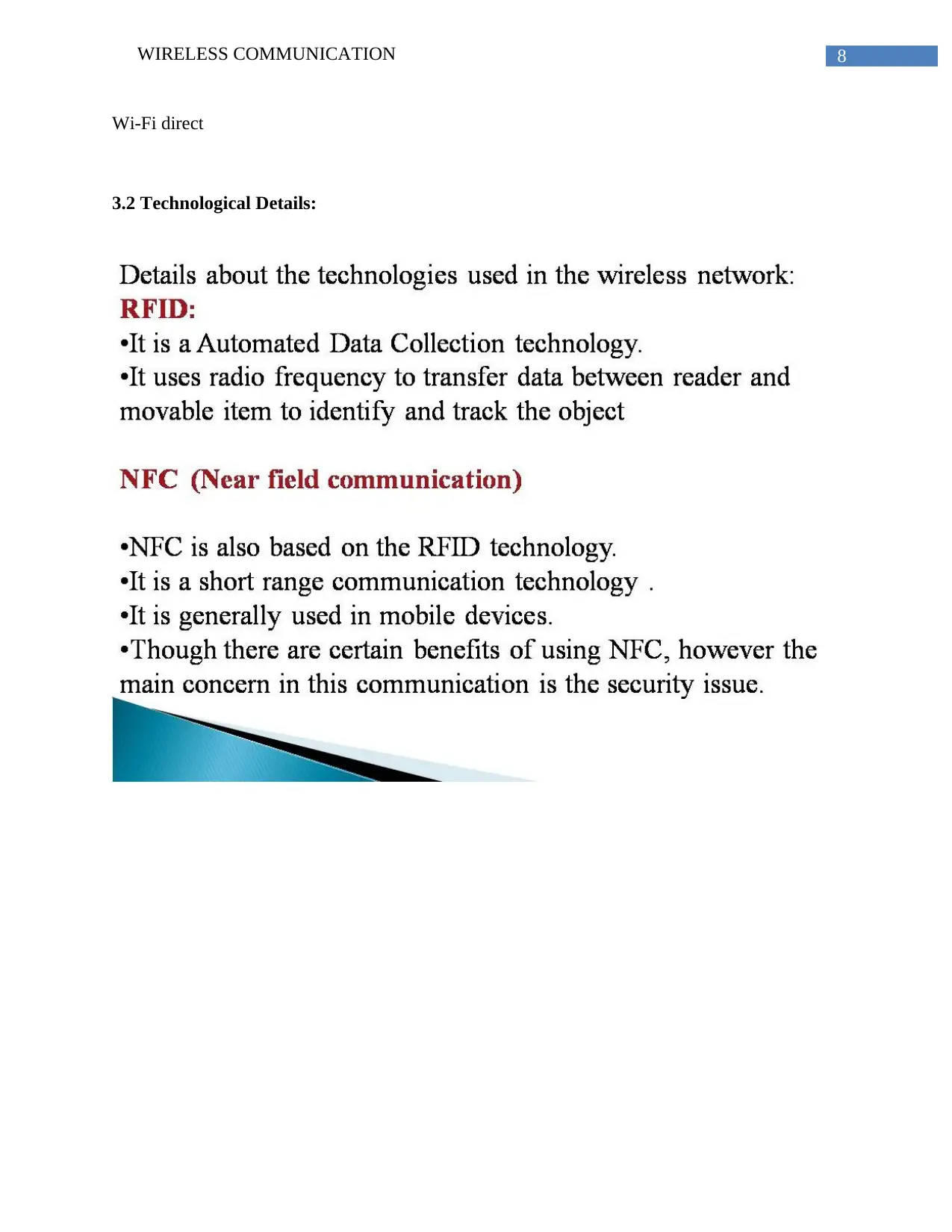
3.2 Technological Details:
Wi-Fi direct
3.2 Technological Details:
⊘ This is a preview!⊘
Do you want full access?
Subscribe today to unlock all pages.

Trusted by 1+ million students worldwide

9WIRELESS COMMUNICATION
Speaker’s Note :
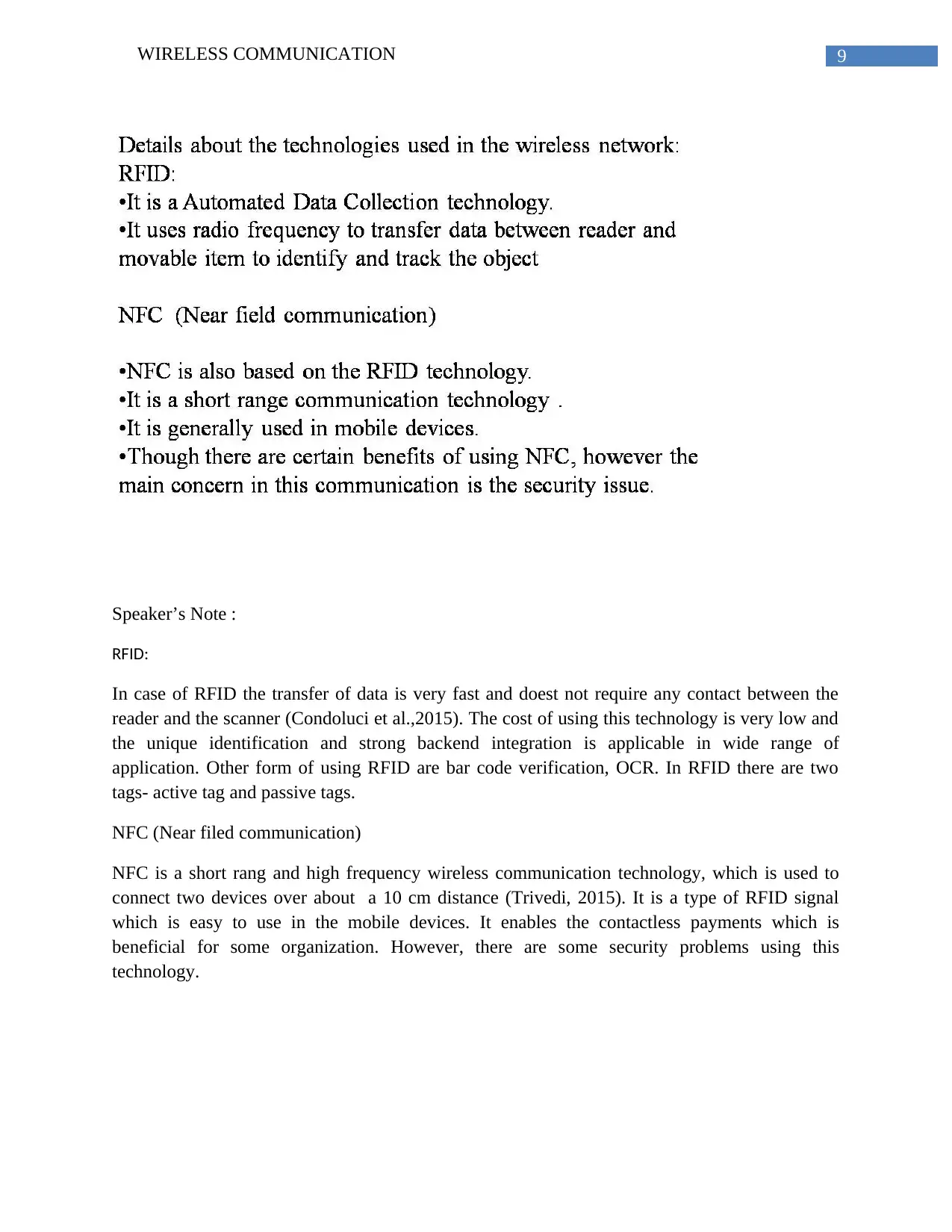
RFID:
In case of RFID the transfer of data is very fast and doest not require any contact between the
reader and the scanner (Condoluci et al.,2015). The cost of using this technology is very low and
the unique identification and strong backend integration is applicable in wide range of
application. Other form of using RFID are bar code verification, OCR. In RFID there are two
tags- active tag and passive tags.
NFC (Near filed communication)
NFC is a short rang and high frequency wireless communication technology, which is used to
connect two devices over about a 10 cm distance (Trivedi, 2015). It is a type of RFID signal
which is easy to use in the mobile devices. It enables the contactless payments which is
beneficial for some organization. However, there are some security problems using this
technology.
Speaker’s Note :
RFID:
In case of RFID the transfer of data is very fast and doest not require any contact between the
reader and the scanner (Condoluci et al.,2015). The cost of using this technology is very low and
the unique identification and strong backend integration is applicable in wide range of
application. Other form of using RFID are bar code verification, OCR. In RFID there are two
tags- active tag and passive tags.
NFC (Near filed communication)
NFC is a short rang and high frequency wireless communication technology, which is used to
connect two devices over about a 10 cm distance (Trivedi, 2015). It is a type of RFID signal
which is easy to use in the mobile devices. It enables the contactless payments which is
beneficial for some organization. However, there are some security problems using this
technology.
Paraphrase This Document
Need a fresh take? Get an instant paraphrase of this document with our AI Paraphraser

10WIRELESS COMMUNICATION
Speaker Note:
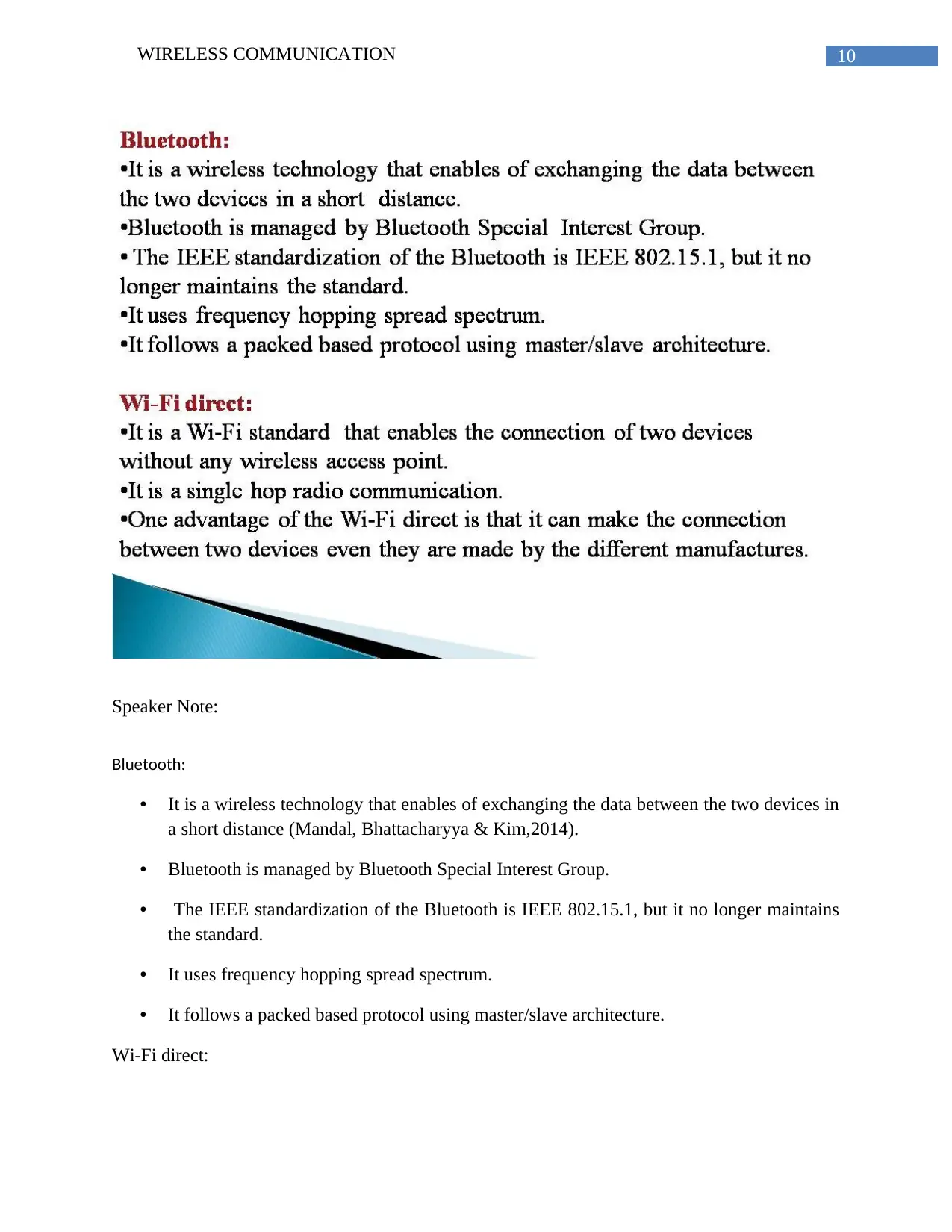
Bluetooth:
• It is a wireless technology that enables of exchanging the data between the two devices in
a short distance (Mandal, Bhattacharyya & Kim,2014).
• Bluetooth is managed by Bluetooth Special Interest Group.
• The IEEE standardization of the Bluetooth is IEEE 802.15.1, but it no longer maintains
the standard.
• It uses frequency hopping spread spectrum.
• It follows a packed based protocol using master/slave architecture.
Wi-Fi direct:
Speaker Note:
Bluetooth:
• It is a wireless technology that enables of exchanging the data between the two devices in
a short distance (Mandal, Bhattacharyya & Kim,2014).
• Bluetooth is managed by Bluetooth Special Interest Group.
• The IEEE standardization of the Bluetooth is IEEE 802.15.1, but it no longer maintains
the standard.
• It uses frequency hopping spread spectrum.
• It follows a packed based protocol using master/slave architecture.
Wi-Fi direct:

11WIRELESS COMMUNICATION
• It is a Wi-Fi standard that enables the connection of two devices without any wireless
access point.
• It is a single hop radio communication.
• One advantage of the Wi-Fi direct is that it can make the connection between two devices
even they are made by the different manufactures.
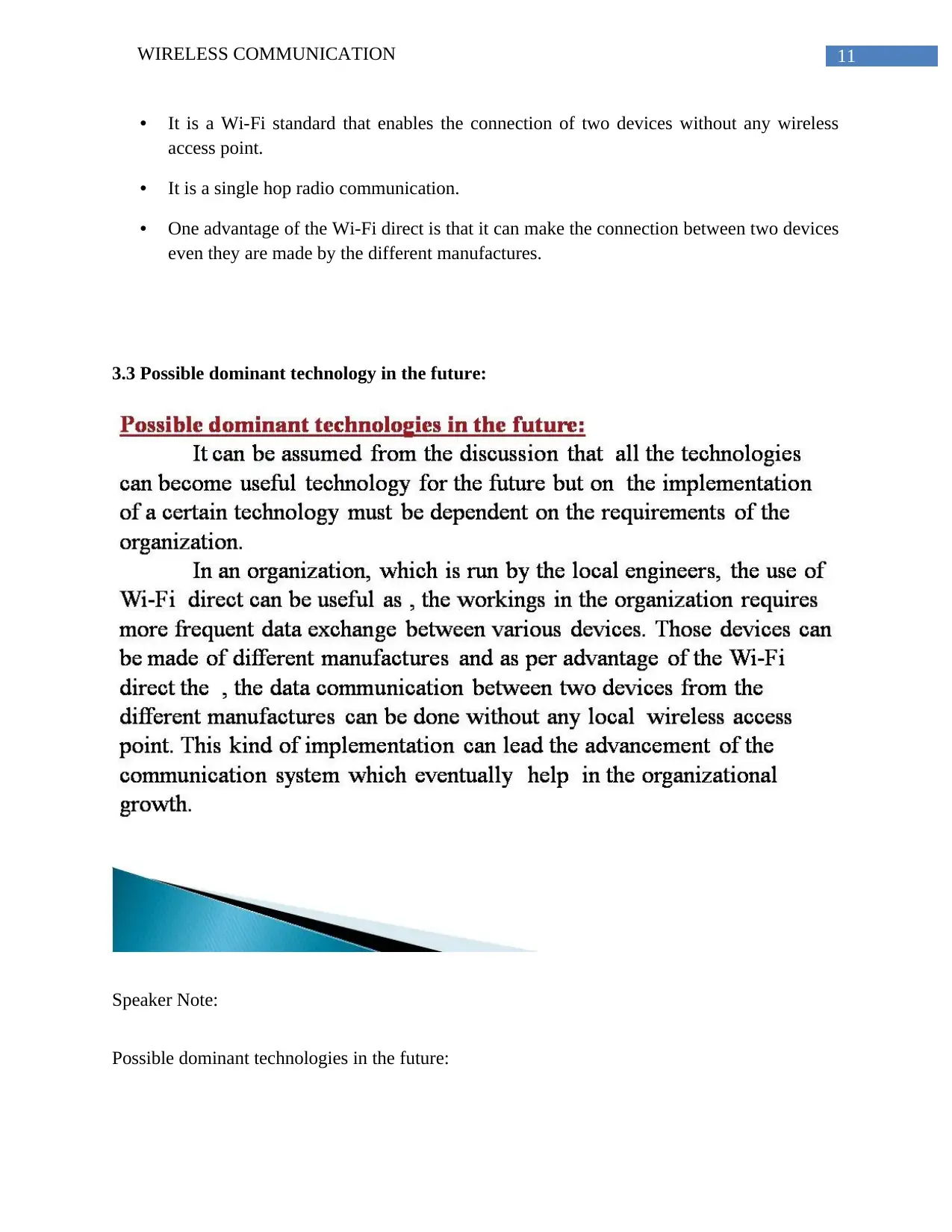
3.3 Possible dominant technology in the future:
Speaker Note:
Possible dominant technologies in the future:
• It is a Wi-Fi standard that enables the connection of two devices without any wireless
access point.
• It is a single hop radio communication.
• One advantage of the Wi-Fi direct is that it can make the connection between two devices
even they are made by the different manufactures.
3.3 Possible dominant technology in the future:
Speaker Note:
Possible dominant technologies in the future:
⊘ This is a preview!⊘
Do you want full access?
Subscribe today to unlock all pages.

Trusted by 1+ million students worldwide
1 out of 15
Related Documents
Your All-in-One AI-Powered Toolkit for Academic Success.
+13062052269
info@desklib.com
Available 24*7 on WhatsApp / Email
Unlock your academic potential
Copyright © 2020–2026 A2Z Services. All Rights Reserved. Developed and managed by ZUCOL.