WMEC110 Introduction to Digital Media: Annotated Bibliography

Verified

Added on  2023/04/20

|6
|1532
|397
Annotated Bibliography
AI Summary
This annotated bibliography provides a critical overview of various academic sources related to digital media, focusing on its impact on society, youth, and ethical considerations. It includes annotations of four key sources, two from the WMEC110 course and two independently researched, evaluating their authority, relevance to the chosen topic, and connections to other texts. The bibliography covers themes such as the stabilization of technology, theories of the information society, digital media citizenship among urban youth, and ethical issues in the information age (Privacy, Accuracy, Property, and Accessibility). The concluding section assesses the strengths, weaknesses, and gaps in the existing literature, offering a comprehensive understanding of the complexities within the field of digital media research. Desklib provides access to similar annotated bibliographies and other study resources for students.
Document Page
Running head: ANNOTATED BIBLIOGRAPHY
Annotated Bibliography
Name of the Student
Name of the University
Author Note
tabler-icon-diamond-filled.svg

Paraphrase This Document

Need a fresh take? Get an instant paraphrase of this document with our AI Paraphraser
Document Page
1ANNOTATED BIBLIOGRAPHY
Introduction
The latest push in the academic world has mostly been towards the disciplinary
specialization rather than the interdisciplinary part of it. Therefore, it has become difficult to find
a common vocabulary for the framework within which the discussion of the various form of the
political and social agency that happens to work within the internet. Following would be an
annotated bibliography based on the different frameworks utilized for analyzing the contexts for
the web and its various agencies.
Feenberg, A., & Friesen, N. (Eds.). (2012). (Re) Inventing the Internet. Springer Science &
Business Media.
The author represents the idea in this book about the stabilization of technology and the
outcomes of the technology when it does not attain stabilization. It describes the concept behind
the stabilization of technology and how the internet is not at all a stabilized technology like a
ballpoint pen or a refrigerator. The author also explains how the technology and its social, as
well as political implications, have still not been recognized as it is yet not a technology that has
acquired stabilization. The authors point out that the reason that internet has even not been
stabilized is that of the constant and random innovations that are implemented influx related to
networks and the innovative usages keep appearing regularly. There have been other authors
talking about the same topic, but claiming to the idea that internet had just been a virtual mall
which forms a capital rationalization and this threatens the individual autonomy and discourse in
the democracy.
Thus, the authors present their original approach to this contentious controversy through
this book and all the five chapters acknowledge the intensity between the process for
Document Page
2ANNOTATED BIBLIOGRAPHY
rationalization that the internet brings about and also succeeds in highlighting the innovative
community forms that are emerged through the ensemble technologies that are available to
people. These topics that include the argument are the critical theory of internet, the critical
theory behind digital gaming, online education and the way which internet is being utilized by
the civilization right now. The argument also includes the possibilities of hacking for social
justice; that is termed as ethical hacking.
Webster, F. (2014). Theories of the information society. Routledge.
The following literature discusses how information has been developing as the primary
defining feature of recent times. The author enunciates how this perception has been reflecting
the actual norms of the new age society and based on this scenario the author has developed
several wings of theories to shed light on the societal views. The author states that these theories
that had been formed on the effect of information designed to reflect the society can be further
divided into two wings. The first set would include the information system that proclaims the
new kind of community, where the theories of post-industrialism, postmodernism, the flexible
specialization, and the informational mode of development can be applied. On the other set of a
wing, the methods that can be implied on include the emphasis on neo-Marxism, regulation
theory, flexible accumulation, nation-state and violence, and the public sphere. The author states
that the society in the world right now is being run by information; human beings are right now
dwelling in the information society. The author also says that the states of the community that
has formed the base of this identification are the technological society, the economic community,
the industrial culture, the spatial and the learned society.
The author happens to arguably emphasize the best arguments in presenting the theories
in favor of the description of the new society based on information, but at some point of time,
Document Page
3ANNOTATED BIBLIOGRAPHY
these arguments fall short of useful pieces of evidence. Otherwise, this is an effective piece of
literature that might instigate the fact of researching more on the stated subject.
Barron, B., Gomez, K., Martin, C. K., & Pinkard, N. (2014). The digital youth network:
Cultivating digital media citizenship in urban communities. MIT Press.
This particular book has been found out to be the fruit of a three-year-long study of the
Digital Youth Network, which happens to be the study about the digitization and its effect on the
youth. The result of the research was based on the findings of the survey that was conducted to
find out if there has been any influence of the economic conditions on the use of digitized
facilities for the youth. As per the conducted study, it was seen that the lack an affinity for the
youth with the digitization factor had been not on account of lack of interest, but the lack of
knowledge and access. The study found that the student engaged with the digitization had regular
interaction with computers and other forms of agents of digitization, but no sustained
engagement would develop these identities as media producers. There were several other
constraints as well; like the limited opportunity for the students that would create the
development of the media entities within the constricted classrooms.
It can be said that the authors succeed in their aim to put their appeal forward to the
broader audience. However, the suggested work makes the educators complicate their form of
digital teaching further in the discourses about the digital divide that focuses on the need for the
development of technical skills for the under-resourced young students.
Mason, R. O. (2017). Four ethical issues of the information age. In Computer Ethics (pp. 41-
48). Routledge.
The literature in review for this part of the annotated bibliography focuses on the four
ethical considerations in the information age, which is symbolized as PAPA; or elaborately can
tabler-icon-diamond-filled.svg

Paraphrase This Document

Need a fresh take? Get an instant paraphrase of this document with our AI Paraphraser
Document Page
4ANNOTATED BIBLIOGRAPHY
be stated as Privacy, Accuracy, Property, and Accessibility. The article focuses the reason of
choosing these ethical considerations in the information age, and each of the ethical
considerations is described thoroughly with their applications and the description of the
complication for not following the implications on a day to day operational basis.
The author has clearly stated the reasons for considering Privacy, Accuracy, Property,
and Accessibility as the primary factors in a digitized way in the best possible way and the article
seems to be fulfilling in its self, making way for further researches based on these ethical factors.
Conclusion
Thus, in conclusion, it can be said that there have been various aspects of applying
digitization in the latest world and various researches have been conducted them as well. The
Authors have put forward the best possible investigations in describing their aspects to view the
digitization implementation, even applying societal theories to analyze the same. All the analysis
of the literature has been conducted through an annotated bibliography based on the different
authors and their works for the internet and its various agencies.
Document Page
5ANNOTATED BIBLIOGRAPHY
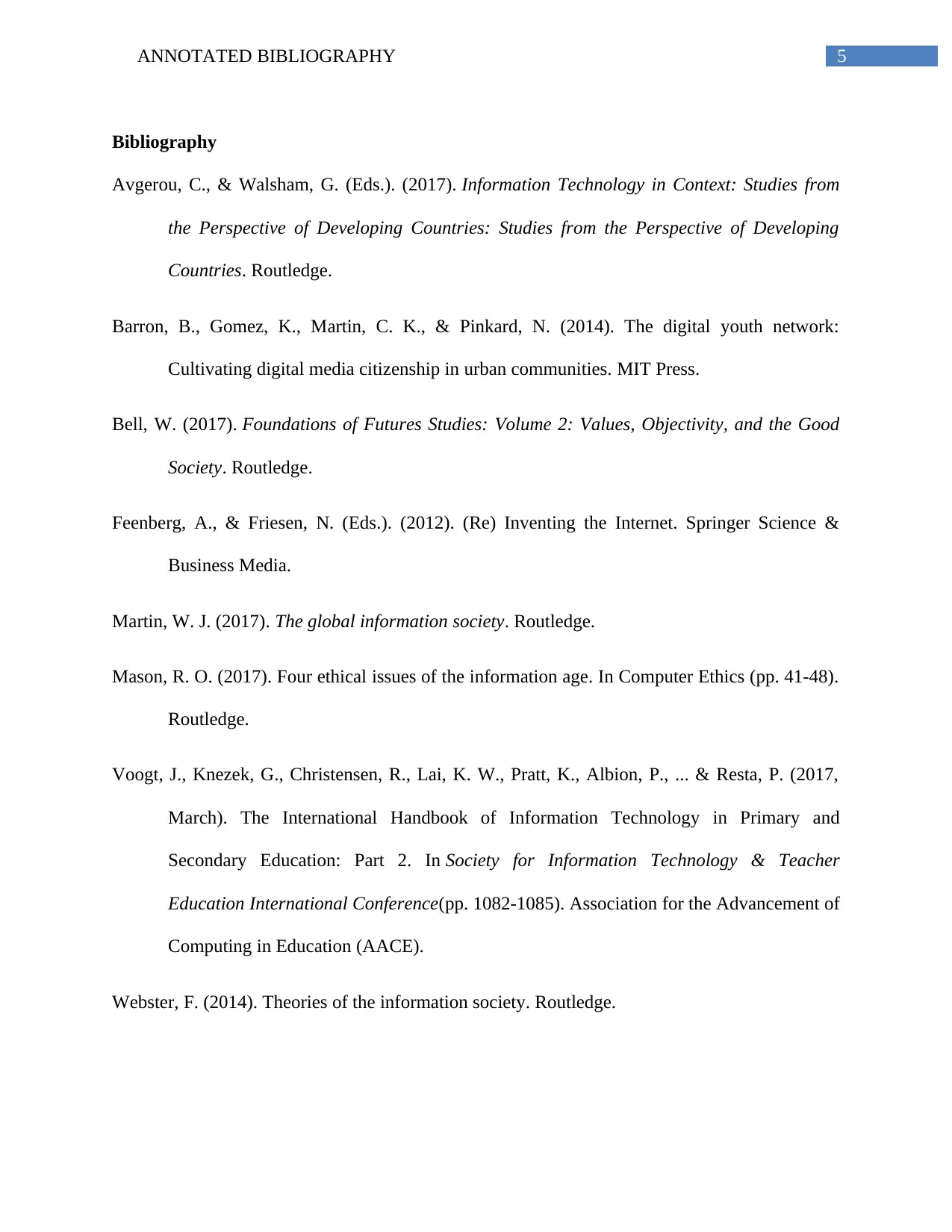
Bibliography
Avgerou, C., & Walsham, G. (Eds.). (2017). Information Technology in Context: Studies from
the Perspective of Developing Countries: Studies from the Perspective of Developing
Countries. Routledge.
Barron, B., Gomez, K., Martin, C. K., & Pinkard, N. (2014). The digital youth network:
Cultivating digital media citizenship in urban communities. MIT Press.
Bell, W. (2017). Foundations of Futures Studies: Volume 2: Values, Objectivity, and the Good
Society. Routledge.
Feenberg, A., & Friesen, N. (Eds.). (2012). (Re) Inventing the Internet. Springer Science &
Business Media.
Martin, W. J. (2017). The global information society. Routledge.
Mason, R. O. (2017). Four ethical issues of the information age. In Computer Ethics (pp. 41-48).
Routledge.
Voogt, J., Knezek, G., Christensen, R., Lai, K. W., Pratt, K., Albion, P., ... & Resta, P. (2017,
March). The International Handbook of Information Technology in Primary and
Secondary Education: Part 2. In Society for Information Technology & Teacher
Education International Conference(pp. 1082-1085). Association for the Advancement of
Computing in Education (AACE).
Webster, F. (2014). Theories of the information society. Routledge.
chevron_up_icon
1 out of 6
circle_padding
hide_on_mobile
zoom_out_icon
[object Object]