BUS020X602A Dissertation: Women, Glass Ceiling, and Leadership
VerifiedAdded on 2023/01/12
|12
|3603
|22
Project
AI Summary
This dissertation delves into the concept of the glass ceiling, a pervasive issue hindering women's advancement in the workplace, particularly in developed and developing countries. It begins with an introduction to the topic, followed by a comprehensive literature review examining the historical context and current understanding of the glass ceiling, exploring the barriers faced by women, including tokenism, stereotyping, and societal expectations. The study investigates the managerial qualities essential for women in the 21st century to overcome these challenges, such as determination, interpersonal and communication skills, and effective decision-making. The research employs a qualitative approach, focusing on the need for women to develop these skills to navigate workplace obstacles. The project aims to understand the concept of glass ceiling, managerial qualities for women, and the issues associated with it. The dissertation also justifies the topic's relevance and outlines the research methodology, including data collection, analysis, and ethical considerations, highlighting the importance of these qualities for career progression and economic contribution. The study emphasizes the need for women to address equality issues and for organizations to implement fair practices to support their workforce.
Dissertation

Paraphrase This Document
Need a fresh take? Get an instant paraphrase of this document with our AI Paraphraser
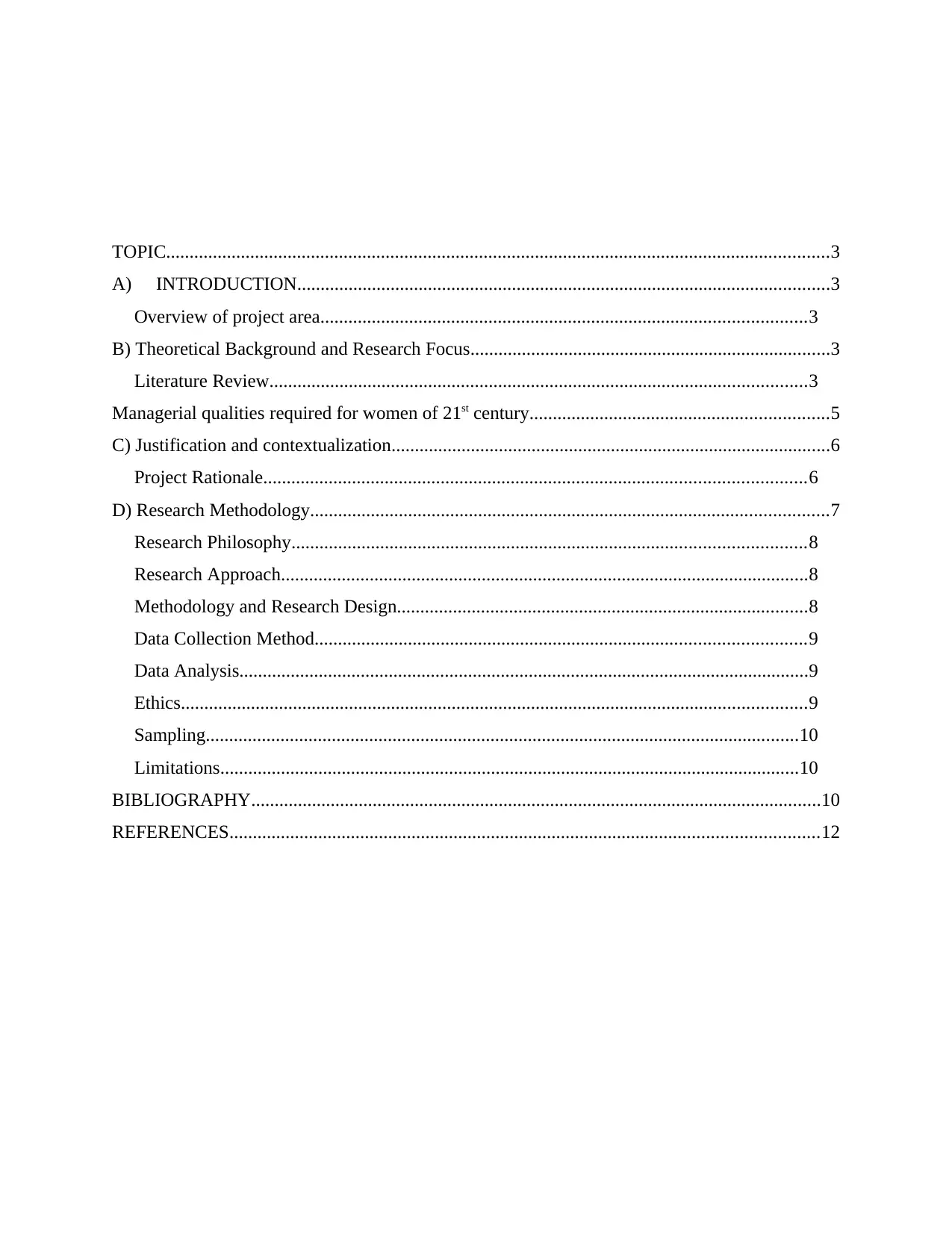
TOPIC..............................................................................................................................................3
A) INTRODUCTION..................................................................................................................3
Overview of project area........................................................................................................3
B) Theoretical Background and Research Focus.............................................................................3
Literature Review...................................................................................................................3
Managerial qualities required for women of 21st century................................................................5
C) Justification and contextualization..............................................................................................6
Project Rationale....................................................................................................................6
D) Research Methodology...............................................................................................................7
Research Philosophy..............................................................................................................8
Research Approach.................................................................................................................8
Methodology and Research Design........................................................................................8
Data Collection Method.........................................................................................................9
Data Analysis..........................................................................................................................9
Ethics......................................................................................................................................9
Sampling...............................................................................................................................10
Limitations............................................................................................................................10
BIBLIOGRAPHY..........................................................................................................................10
REFERENCES..............................................................................................................................12
A) INTRODUCTION..................................................................................................................3
Overview of project area........................................................................................................3
B) Theoretical Background and Research Focus.............................................................................3
Literature Review...................................................................................................................3
Managerial qualities required for women of 21st century................................................................5
C) Justification and contextualization..............................................................................................6
Project Rationale....................................................................................................................6
D) Research Methodology...............................................................................................................7
Research Philosophy..............................................................................................................8
Research Approach.................................................................................................................8
Methodology and Research Design........................................................................................8
Data Collection Method.........................................................................................................9
Data Analysis..........................................................................................................................9
Ethics......................................................................................................................................9
Sampling...............................................................................................................................10
Limitations............................................................................................................................10
BIBLIOGRAPHY..........................................................................................................................10
REFERENCES..............................................................................................................................12
TOPIC
“ Managerial qualities must women of 21st century process to overcome the glass ceiling in
developed and developing countries ”
A) INTRODUCTION
Overview of project area
Glass ceiling is a concept that has actually gained lot of importance in the 21st century. It
is regarded as the volume that is analysing the psychological phenomenon that is actually
blocking the cases of women to get higher positions in the society. The tem glass ceiling was
started in the year 1984 since then women have made great progress in relation with men in the
workplaces. Despite such achievements all this women are underrepresented in some
organisations. The present report deals with the basic criteria to develop the understanding of the
term Glass ceiling in context with women of today. On other hand, there is discussion of the
different managerial qualities that have to be present in women so that they can deal with such
type of obstacles that are part of glass ceiling and is preventing women from their growth &
development. There is also some point related with what are some of the basic issues that there is
discussion of the required skills to deal with such challenges by the women. Main obstacles are
in form of tokenism, stereotyping and sexual harassment some of the basic issues that lead to
increase in barriers for women. The present report discusses about various views of different
writers on authors on such aspects of glass ceiling that is related with women dealing with such
challenges that are occurring for their development.
B) Theoretical Background and Research Focus
Literature Review
Review of key publications & themes
According to the view points of Johnson Lewis, 2019 it can be understood as a invisible
limit in some of the corporations and organisations that is very difficult to be achieved by
women. It consists of both type of barriers that is formal and informal that is used for describing
the barriers that are experienced by women. It is deported by the tem “glass ceiling” because it is
not usually visible but has its presence and is impacting women overall growth in a negative
“ Managerial qualities must women of 21st century process to overcome the glass ceiling in
developed and developing countries ”
A) INTRODUCTION
Overview of project area
Glass ceiling is a concept that has actually gained lot of importance in the 21st century. It
is regarded as the volume that is analysing the psychological phenomenon that is actually
blocking the cases of women to get higher positions in the society. The tem glass ceiling was
started in the year 1984 since then women have made great progress in relation with men in the
workplaces. Despite such achievements all this women are underrepresented in some
organisations. The present report deals with the basic criteria to develop the understanding of the
term Glass ceiling in context with women of today. On other hand, there is discussion of the
different managerial qualities that have to be present in women so that they can deal with such
type of obstacles that are part of glass ceiling and is preventing women from their growth &
development. There is also some point related with what are some of the basic issues that there is
discussion of the required skills to deal with such challenges by the women. Main obstacles are
in form of tokenism, stereotyping and sexual harassment some of the basic issues that lead to
increase in barriers for women. The present report discusses about various views of different
writers on authors on such aspects of glass ceiling that is related with women dealing with such
challenges that are occurring for their development.
B) Theoretical Background and Research Focus
Literature Review
Review of key publications & themes
According to the view points of Johnson Lewis, 2019 it can be understood as a invisible
limit in some of the corporations and organisations that is very difficult to be achieved by
women. It consists of both type of barriers that is formal and informal that is used for describing
the barriers that are experienced by women. It is deported by the tem “glass ceiling” because it is
not usually visible but has its presence and is impacting women overall growth in a negative
⊘ This is a preview!⊘
Do you want full access?
Subscribe today to unlock all pages.

Trusted by 1+ million students worldwide
manner. This is a term that was invented with the various developments that si taking place
across different parts of the world and is related to some of the attitudinal barriers that lead to
competent and qualified women in reaching heights of success in the organisation. It is a term
and a concept that is present in relation with some of the explicit policies and is having a
association with the equality policies in the organisation. In case of many developed countries
such as UK there are many global organisations that are having presence in different parts of the
world and are preparing and functioning but them also this is a concept that is present in these
organisations.
Such as one such major challenge is “Glass ceiling” in which there is disparities that take
place between men & women that occurs in the workplace. It is related with the under
representation of women in various administrative positions at the workplace. It is always
different from the formal barriers that represent in an organisation. It is type of barrier that is
completely invisible and is present mostly in case of developing countries than the developed
countries. Women have played a very major part in the development of a country since ages.
There is a lack of active participation of women on some of the activities and work they perform
in the organization. The glass ceiling is related to this particular concept only where a women is
not willing to work according to their competence and potential they posses.
Various issues that are part of glass ceiling
According to the views of (Wesarat and Mathew, 2017) , the concept of “glass ceiling” is
related with the overall concept of some invisible forces that are present in a organisation. Such
barriers can be in form of invisible challenges that occur in the way of their career pathway. It
leads to stopping of a woman to move to higher positions of the organisation. The most
commonly barriers that can be faced by women can be divided in some broad categories such as
work environment factors, individual factors, and work life conflicts that consist of the issues
that arise in course of functioning of responsibilities and functions in terms of conflicting
situations with their other co workers in the organisation. Societal factors consist of the ways in
which societies and people living in poverty are actually pointing out the way women are not
able to utilise their assigned responsibilities in a more optimum manner. As, they have to face
high level of criticism from many people in this society that leads to a negative mind set that has
been formed for women and it results onto not among able to focus towards achievement of their
across different parts of the world and is related to some of the attitudinal barriers that lead to
competent and qualified women in reaching heights of success in the organisation. It is a term
and a concept that is present in relation with some of the explicit policies and is having a
association with the equality policies in the organisation. In case of many developed countries
such as UK there are many global organisations that are having presence in different parts of the
world and are preparing and functioning but them also this is a concept that is present in these
organisations.
Such as one such major challenge is “Glass ceiling” in which there is disparities that take
place between men & women that occurs in the workplace. It is related with the under
representation of women in various administrative positions at the workplace. It is always
different from the formal barriers that represent in an organisation. It is type of barrier that is
completely invisible and is present mostly in case of developing countries than the developed
countries. Women have played a very major part in the development of a country since ages.
There is a lack of active participation of women on some of the activities and work they perform
in the organization. The glass ceiling is related to this particular concept only where a women is
not willing to work according to their competence and potential they posses.
Various issues that are part of glass ceiling
According to the views of (Wesarat and Mathew, 2017) , the concept of “glass ceiling” is
related with the overall concept of some invisible forces that are present in a organisation. Such
barriers can be in form of invisible challenges that occur in the way of their career pathway. It
leads to stopping of a woman to move to higher positions of the organisation. The most
commonly barriers that can be faced by women can be divided in some broad categories such as
work environment factors, individual factors, and work life conflicts that consist of the issues
that arise in course of functioning of responsibilities and functions in terms of conflicting
situations with their other co workers in the organisation. Societal factors consist of the ways in
which societies and people living in poverty are actually pointing out the way women are not
able to utilise their assigned responsibilities in a more optimum manner. As, they have to face
high level of criticism from many people in this society that leads to a negative mind set that has
been formed for women and it results onto not among able to focus towards achievement of their
Paraphrase This Document
Need a fresh take? Get an instant paraphrase of this document with our AI Paraphraser
objectives in the best possible manner. Another such barriers is the equality factor that is done by
the organisation for which women is working for, in this there is no equal treatment that is
provided to women in comparison with men and it leads to situations of preference given to men
while taking decision of promotion, better opportunities of growth, better environment to work in
etc. All this leads to women getting a setback in comparison with the male workforce working n
the organisation. In UK, being a developed nation, such instances are very common
(Lathabhavan and Balasubramanian, 2017). Family factor is also one of the very commonly
found factors on case of women that prevent them for their development to work towards
achievement of overall objectives in a more effective manner. As there is a responsibility of
family that is also for women and to maintain a balance between such responsibilities and the
pressure of work life it becomes very difficult to effectively perform and achieve more success
by women.
Managerial qualities required for women of 21st century
According to the views of (Adler and Osland, ., 2016), there are many different types of
qualities that has to be present in the women of 21st century so that they are able to deal with
various issues and challenges that are part of the workplace for which they are working. It is very
essential to deal with such issues in most appropriate manner so that they do not posses any
negative impact on the overall challenges that can impact their way of growth and development
and to reach to higher positions in the organisations. For every women their career development
is one of the major challenge that they face while working in the organisation and “Glass ceiling”
is one of the major challenge with these organisations are facing in the course of business
dealings.
There is requirement of certain managerial and leadership qualities by women of 21st
century in order to deal with such big issue of glass ceiling. Such as there is a requirement to be
more determined towards their professional goals. There is also a requirement of understating
such subtle barriers in more detailed manner so that they can make strategies in how to overcome
them in the due course of time (Sandeen, Cavanaugh and Ford, 2017). They must also develop
some interpersonal skills and effective communication skills so that they are able to deal with the
overall negative impact of issues of Glass ceiling. Timely decision making is also a key
requirement by women employees’ while they are hired in the organisation. Such as if there
comes any opportunity it must be utilised in the best possible manner so that based on their
the organisation for which women is working for, in this there is no equal treatment that is
provided to women in comparison with men and it leads to situations of preference given to men
while taking decision of promotion, better opportunities of growth, better environment to work in
etc. All this leads to women getting a setback in comparison with the male workforce working n
the organisation. In UK, being a developed nation, such instances are very common
(Lathabhavan and Balasubramanian, 2017). Family factor is also one of the very commonly
found factors on case of women that prevent them for their development to work towards
achievement of overall objectives in a more effective manner. As there is a responsibility of
family that is also for women and to maintain a balance between such responsibilities and the
pressure of work life it becomes very difficult to effectively perform and achieve more success
by women.
Managerial qualities required for women of 21st century
According to the views of (Adler and Osland, ., 2016), there are many different types of
qualities that has to be present in the women of 21st century so that they are able to deal with
various issues and challenges that are part of the workplace for which they are working. It is very
essential to deal with such issues in most appropriate manner so that they do not posses any
negative impact on the overall challenges that can impact their way of growth and development
and to reach to higher positions in the organisations. For every women their career development
is one of the major challenge that they face while working in the organisation and “Glass ceiling”
is one of the major challenge with these organisations are facing in the course of business
dealings.
There is requirement of certain managerial and leadership qualities by women of 21st
century in order to deal with such big issue of glass ceiling. Such as there is a requirement to be
more determined towards their professional goals. There is also a requirement of understating
such subtle barriers in more detailed manner so that they can make strategies in how to overcome
them in the due course of time (Sandeen, Cavanaugh and Ford, 2017). They must also develop
some interpersonal skills and effective communication skills so that they are able to deal with the
overall negative impact of issues of Glass ceiling. Timely decision making is also a key
requirement by women employees’ while they are hired in the organisation. Such as if there
comes any opportunity it must be utilised in the best possible manner so that based on their
overall competence and capabilities women can make higher contribution towards the
organisational objectives. They must also focus on performing their work with higher level of
dedication so that the level of performance and contribution which they are actually making
towards the organisation can help them in reaching to the higher position of the organisation. In
those cases where there are some equality issues occurring because of management that must
also be addressed to the higher authorities or top management so that management can get
knowledge of any such issue that is taking place in their organisation. Further there is also a
requirement of every organisation to follow equality practises for their overall workforce as in
every country there are many equality rights that have been passed by government and have to be
compulsorily followed in every organisation while planning their policies.
Aims, objectives and research questions
Aims:
The main aim of this report is to” Understand the managerial qualities must women of
21st century process to overcome the glass ceiling in developed and developing
countries"
Objectives:
To develop a understanding of the concept of glass ceiling
Managerial qualities required for women of 21st century
Various issues that are part of glass ceiling
Research questions:
What is the basic concept of Glass ceiling?
What are some of the managerial qualities required for women of 21st century?
What are some of the issues that are part of glass ceiling?
C) Justification and contextualization
Project Rationale
The reason of choosing the topic is to gain knowledge regarding managerial qualities that is
required by women of 21st century in order to overcome glass ceiling in developed and
developing countries. In today’s world, each and every person from different country and region
put their efforts and hard work to gain higher and better position. There is equality take place in
developed and developing as women are also gaining sae right as of men but sometimes to due
organisational objectives. They must also focus on performing their work with higher level of
dedication so that the level of performance and contribution which they are actually making
towards the organisation can help them in reaching to the higher position of the organisation. In
those cases where there are some equality issues occurring because of management that must
also be addressed to the higher authorities or top management so that management can get
knowledge of any such issue that is taking place in their organisation. Further there is also a
requirement of every organisation to follow equality practises for their overall workforce as in
every country there are many equality rights that have been passed by government and have to be
compulsorily followed in every organisation while planning their policies.
Aims, objectives and research questions
Aims:
The main aim of this report is to” Understand the managerial qualities must women of
21st century process to overcome the glass ceiling in developed and developing
countries"
Objectives:
To develop a understanding of the concept of glass ceiling
Managerial qualities required for women of 21st century
Various issues that are part of glass ceiling
Research questions:
What is the basic concept of Glass ceiling?
What are some of the managerial qualities required for women of 21st century?
What are some of the issues that are part of glass ceiling?
C) Justification and contextualization
Project Rationale
The reason of choosing the topic is to gain knowledge regarding managerial qualities that is
required by women of 21st century in order to overcome glass ceiling in developed and
developing countries. In today’s world, each and every person from different country and region
put their efforts and hard work to gain higher and better position. There is equality take place in
developed and developing as women are also gaining sae right as of men but sometimes to due
⊘ This is a preview!⊘
Do you want full access?
Subscribe today to unlock all pages.
Trusted by 1+ million students worldwide
invisible barriers they are not gain success and for this it essential for them to have managerial
qualities. By the assistance of this present study, researcher is enable to gain knowledge about
qualities that assist women to gain higher position in developed as well as developing countries.
In addition to this, investigator gain an insight regarding the concept of glass ceiling in an
effective manner. Moreover, importance of managerial qualities for women is discussed in the
study that assist women to gain higher position or attain success as well as growth. In addition to
this, it has also been identified from conducting research adoption of managerial qualities not
only develop a women but also impact positively on economy of a nation. Furthermore, it is
determined that there are various factors that possess a women to gain success or higher position
such as social factor, economic factor, life conflicts, family, experience and many more. In order
to overcome with this, women require motivation which assist them to explore and gain
knowledge without any barriers (Schmid and Urban, 2018). It also assist them to become
efficient and deal with the issues in a proper and effective manner. Along with this, they can also
improve the potentiality of engaging higher position and surviving on it for longer time frame by
undertaking and deal with obstacles and invisible barriers. The issue of grass ceiling in
developing countries in increasing day to day so it is essential for women to take session and
training as it assist in developing managerial qualities that leads to attainment of higher position
within an organisation or industry. By the assistance of this study, researcher is able to gain
insight regarding various methods of data collection that help in future also in conducting other
research in a proper manner. Moreover, using of suitable methods an techniques assist researcher
to draw a valid as well as reliable conclusion that help in completing report in time frame
without any difficulty. From all this discussion, it is analysed that research is important in order
to gain an in-depth knowledge regarding particular topic. Along with this, it also help researcher
to gain knowledge about various factors that affect negatively on the overall conclusion so that it
can improve on future and draws out valid conclusion within the stipulated time frame.
D) Research Methodology
It is a systematic procedure that is mainly used to collect appropriate data in order to make
proper as well as accurate decision. In this, different approaches and methods will be
adopted by investigator like primary and secondary, quantitative and qualitative, research
approaches, research philosophies and many more. All these methods are given below:
qualities. By the assistance of this present study, researcher is enable to gain knowledge about
qualities that assist women to gain higher position in developed as well as developing countries.
In addition to this, investigator gain an insight regarding the concept of glass ceiling in an
effective manner. Moreover, importance of managerial qualities for women is discussed in the
study that assist women to gain higher position or attain success as well as growth. In addition to
this, it has also been identified from conducting research adoption of managerial qualities not
only develop a women but also impact positively on economy of a nation. Furthermore, it is
determined that there are various factors that possess a women to gain success or higher position
such as social factor, economic factor, life conflicts, family, experience and many more. In order
to overcome with this, women require motivation which assist them to explore and gain
knowledge without any barriers (Schmid and Urban, 2018). It also assist them to become
efficient and deal with the issues in a proper and effective manner. Along with this, they can also
improve the potentiality of engaging higher position and surviving on it for longer time frame by
undertaking and deal with obstacles and invisible barriers. The issue of grass ceiling in
developing countries in increasing day to day so it is essential for women to take session and
training as it assist in developing managerial qualities that leads to attainment of higher position
within an organisation or industry. By the assistance of this study, researcher is able to gain
insight regarding various methods of data collection that help in future also in conducting other
research in a proper manner. Moreover, using of suitable methods an techniques assist researcher
to draw a valid as well as reliable conclusion that help in completing report in time frame
without any difficulty. From all this discussion, it is analysed that research is important in order
to gain an in-depth knowledge regarding particular topic. Along with this, it also help researcher
to gain knowledge about various factors that affect negatively on the overall conclusion so that it
can improve on future and draws out valid conclusion within the stipulated time frame.
D) Research Methodology
It is a systematic procedure that is mainly used to collect appropriate data in order to make
proper as well as accurate decision. In this, different approaches and methods will be
adopted by investigator like primary and secondary, quantitative and qualitative, research
approaches, research philosophies and many more. All these methods are given below:
Paraphrase This Document
Need a fresh take? Get an instant paraphrase of this document with our AI Paraphraser
Research Philosophy
It is one of the most important part of research methodology that is divided into two parts
which are positivism and interprevitism. In the present research, the research uses positivism
research philosophy. The main reason of choosing this philosophy is it help in collecting valid
and reliable data through primary source of collection that is questionnaire. On contrary,
interpretivism is not consider as an appropriate philosophy for the present investigation. As it is
analysed that interpretivism philosophy require more number of sources & also consume high
time of researcher that is totally not beneficial for the present study.
Research Approach
There are mainly two approaches used in an investigation that is deductive as well as
inductive. It is determined that deductive approach is more feasible & suitable and it is adopt by
researcher for investigation on topic “managerial qualities required in women of 21st century to
overcome with glass ceiling”. Deductive approach assist investigator to collect valid data in an
easy and proper manner (Remington and Kitterlin-Lynch, 2018). In addition to this, inductive
approach is not used for investigation as it is totally based on observations.|
Methodology and Research Design
Methodology: There are mainly two types of methodology that is quantitative as well as
qualitative. It is determined that both types of methodology is important but in the present
investigation, quantitative method is selected and applied by researcher. By the assistance of this
method, researcher collect data or information in a proper as well as accurate manner. For
quantitative information, questionnaire is prepared by the investigator in a detailed manner in
order to collect information for the particular topic. On the other side, Qualitative method of
research is not useful for collecting data on particular topic as it is a time consuming process and
occurs high cost to researcher.
Research design: It is essential and significant part of research as it assist investigator in
determining of research aspects and impact as well (Chodorow, 2018). There are three types of
research design such as descriptive, experimental and exploratory as well. From all this type of
research design, descriptive design is used by researcher. The reason of selecting descriptive
design for the investigation is it assist in gaining positive outcome and draws a valid conclusion.
On contrary, exploratory and experimental research is not uses for investigation as sometimes it
does not driving out valid as well as appropriate conclusion.
It is one of the most important part of research methodology that is divided into two parts
which are positivism and interprevitism. In the present research, the research uses positivism
research philosophy. The main reason of choosing this philosophy is it help in collecting valid
and reliable data through primary source of collection that is questionnaire. On contrary,
interpretivism is not consider as an appropriate philosophy for the present investigation. As it is
analysed that interpretivism philosophy require more number of sources & also consume high
time of researcher that is totally not beneficial for the present study.
Research Approach
There are mainly two approaches used in an investigation that is deductive as well as
inductive. It is determined that deductive approach is more feasible & suitable and it is adopt by
researcher for investigation on topic “managerial qualities required in women of 21st century to
overcome with glass ceiling”. Deductive approach assist investigator to collect valid data in an
easy and proper manner (Remington and Kitterlin-Lynch, 2018). In addition to this, inductive
approach is not used for investigation as it is totally based on observations.|
Methodology and Research Design
Methodology: There are mainly two types of methodology that is quantitative as well as
qualitative. It is determined that both types of methodology is important but in the present
investigation, quantitative method is selected and applied by researcher. By the assistance of this
method, researcher collect data or information in a proper as well as accurate manner. For
quantitative information, questionnaire is prepared by the investigator in a detailed manner in
order to collect information for the particular topic. On the other side, Qualitative method of
research is not useful for collecting data on particular topic as it is a time consuming process and
occurs high cost to researcher.
Research design: It is essential and significant part of research as it assist investigator in
determining of research aspects and impact as well (Chodorow, 2018). There are three types of
research design such as descriptive, experimental and exploratory as well. From all this type of
research design, descriptive design is used by researcher. The reason of selecting descriptive
design for the investigation is it assist in gaining positive outcome and draws a valid conclusion.
On contrary, exploratory and experimental research is not uses for investigation as sometimes it
does not driving out valid as well as appropriate conclusion.
Data Collection Method
Data collection is defined as a procedure of gathering or collecting information on particular
variables that answer research question and also evaluate outcomes in an effective manner. There
are mainly two types of data collection method such as primary and secondary sources. Both
these methods is undertake in order to collect information about managerial qualities that is
required in women of 21st century to overcome with glass ceiling in an organisation. In primary
sources of data collection, questionnaire is applied by the researcher as it is more suitable as
compare to other data collection methods. By the assistance of questionnaire, researcher is able
to collect reliable and valid information on particular topic. In addition to this, secondary data is
also used by investigator in order to gain information on this topic. The sources that is included
in collecting secondary data are journal articles, publications, magazines and many more (Cohen,
2018). This method will be adopt by researcher in order to get detail as well as in-depth
knowledge on particular topic.
Data Analysis
For the present investigation, thematic analysis will be applied in order to get knowledge
or information reharden the particular topic. It is determined as an analytical tool that support in
analysing valid and appropriate information. In this, various themes will be develop that help
investigator to easily identify or analyse data. It is consider as an essential method in order to
analyse quantitative data in an appropriate and valid manner.
Ethics
It is another essential type of study that is based on various principles of ethics like
confidentiality, respect, objectivity, responsible publication, carefulness, respect for intellectual
property, integrity, honesty and so on,. All these consider as a major principle or ethics in a
research that assist researcher to implement activities or task in a systematic and ethical manner.
In addition to this, it assist and support investigator in completing research without any conflicts
or delay due to which researcher is able to develop positive outcome effectively.
Sampling
There are mainly two sampling techniques that is non-probability sampling and probability
sampling. For the present investigation, probability sampling method is used by the researcher.
By the assistance of this technique, researcher select sample size that is chosen randomly. For the
Data collection is defined as a procedure of gathering or collecting information on particular
variables that answer research question and also evaluate outcomes in an effective manner. There
are mainly two types of data collection method such as primary and secondary sources. Both
these methods is undertake in order to collect information about managerial qualities that is
required in women of 21st century to overcome with glass ceiling in an organisation. In primary
sources of data collection, questionnaire is applied by the researcher as it is more suitable as
compare to other data collection methods. By the assistance of questionnaire, researcher is able
to collect reliable and valid information on particular topic. In addition to this, secondary data is
also used by investigator in order to gain information on this topic. The sources that is included
in collecting secondary data are journal articles, publications, magazines and many more (Cohen,
2018). This method will be adopt by researcher in order to get detail as well as in-depth
knowledge on particular topic.
Data Analysis
For the present investigation, thematic analysis will be applied in order to get knowledge
or information reharden the particular topic. It is determined as an analytical tool that support in
analysing valid and appropriate information. In this, various themes will be develop that help
investigator to easily identify or analyse data. It is consider as an essential method in order to
analyse quantitative data in an appropriate and valid manner.
Ethics
It is another essential type of study that is based on various principles of ethics like
confidentiality, respect, objectivity, responsible publication, carefulness, respect for intellectual
property, integrity, honesty and so on,. All these consider as a major principle or ethics in a
research that assist researcher to implement activities or task in a systematic and ethical manner.
In addition to this, it assist and support investigator in completing research without any conflicts
or delay due to which researcher is able to develop positive outcome effectively.
Sampling
There are mainly two sampling techniques that is non-probability sampling and probability
sampling. For the present investigation, probability sampling method is used by the researcher.
By the assistance of this technique, researcher select sample size that is chosen randomly. For the
⊘ This is a preview!⊘
Do you want full access?
Subscribe today to unlock all pages.
Trusted by 1+ million students worldwide
present investigation, 40 respondents will be chosen who answer of all the question develop in
questionnaire on the basis of their experience as well as knowledge. One of the reason of
choosing probability sampling technique is save cost as well as time of researcher. On the other
hand, Non- probability sampling is not applied as it require maximum resources and also
consume time of researcher.
Limitations
There are various limitation that will be going to face by investigator at the time of
collecting data on the particular topic and on completing tasks of research. It include behaviour
of participants, lack of funds, insufficient time, lack of resources and many more. All these
factors effect negatively on the overall researcher and sometimes did not bring out a valid as well
as reliable conclusion.
BIBLIOGRAPHY
questionnaire on the basis of their experience as well as knowledge. One of the reason of
choosing probability sampling technique is save cost as well as time of researcher. On the other
hand, Non- probability sampling is not applied as it require maximum resources and also
consume time of researcher.
Limitations
There are various limitation that will be going to face by investigator at the time of
collecting data on the particular topic and on completing tasks of research. It include behaviour
of participants, lack of funds, insufficient time, lack of resources and many more. All these
factors effect negatively on the overall researcher and sometimes did not bring out a valid as well
as reliable conclusion.
BIBLIOGRAPHY
Paraphrase This Document
Need a fresh take? Get an instant paraphrase of this document with our AI Paraphraser

REFERENCES
Books and Journals
Adler, N.J. and Osland, J.S., 2016. Women Leading Globally: What We Know, Thought We
Knew, and Need to Know about Leadership in the 21st Century☆. In Advances in
Global Leadership. Emerald Group Publishing Limited.
Sandeen, C., Cavanaugh, C.K. and Ford, D., 2017. Leadership challenges for women college and
university presidents: Personal Perspectives from Women Making a Difference.
In Inclusive Leadership in Higher Education (pp. 20-34). Routledge.
Lathabhavan, R. and Balasubramanian, S.A., 2017. Glass Ceiling and women employees in
Asian organizations: a tri-decadal review. Asia-Pacific Journal of Business
Administration.
Wesarat, P.O. and Mathew, J., 2017. Theoretical framework of glass ceiling: A case of India’s
women academic leaders. Paradigm, 21(1), pp.21-30.
Remington, J. and Kitterlin-Lynch, M., 2018. Still pounding on the glass ceiling: A study of
female leaders in hospitality, travel, and tourism management. Journal of Human
Resources in Hospitality & Tourism, 17(1), pp.22-37.
Schmid, T. and Urban, D., 2018, December. The economic consequences of a'glass-ceiling':
Women on corporate boards and firm value. In AFA 2016 San Francisco Meetings
Paper.
Cohen, J.R., and et. al., 2018. An analysis of glass ceiling perceptions in the accounting
profession. Journal of Business Ethics, pp.1-22.
Chodorow, N. J., 2018. Glass ceilings, sticky floors, and concrete walls: internal and external
barriers to women's work and achievement. In Constructing and deconstructing
woman's power (pp. 18-28). Routledge.
online
The Glass Ceiling and Women's History, 2019 [Online].Available Through;
<https://www.thoughtco.com/glass-ceiling-for-women-definition-3530823>
Books and Journals
Adler, N.J. and Osland, J.S., 2016. Women Leading Globally: What We Know, Thought We
Knew, and Need to Know about Leadership in the 21st Century☆. In Advances in
Global Leadership. Emerald Group Publishing Limited.
Sandeen, C., Cavanaugh, C.K. and Ford, D., 2017. Leadership challenges for women college and
university presidents: Personal Perspectives from Women Making a Difference.
In Inclusive Leadership in Higher Education (pp. 20-34). Routledge.
Lathabhavan, R. and Balasubramanian, S.A., 2017. Glass Ceiling and women employees in
Asian organizations: a tri-decadal review. Asia-Pacific Journal of Business
Administration.
Wesarat, P.O. and Mathew, J., 2017. Theoretical framework of glass ceiling: A case of India’s
women academic leaders. Paradigm, 21(1), pp.21-30.
Remington, J. and Kitterlin-Lynch, M., 2018. Still pounding on the glass ceiling: A study of
female leaders in hospitality, travel, and tourism management. Journal of Human
Resources in Hospitality & Tourism, 17(1), pp.22-37.
Schmid, T. and Urban, D., 2018, December. The economic consequences of a'glass-ceiling':
Women on corporate boards and firm value. In AFA 2016 San Francisco Meetings
Paper.
Cohen, J.R., and et. al., 2018. An analysis of glass ceiling perceptions in the accounting
profession. Journal of Business Ethics, pp.1-22.
Chodorow, N. J., 2018. Glass ceilings, sticky floors, and concrete walls: internal and external
barriers to women's work and achievement. In Constructing and deconstructing
woman's power (pp. 18-28). Routledge.
online
The Glass Ceiling and Women's History, 2019 [Online].Available Through;
<https://www.thoughtco.com/glass-ceiling-for-women-definition-3530823>
⊘ This is a preview!⊘
Do you want full access?
Subscribe today to unlock all pages.
Trusted by 1+ million students worldwide

1 out of 12


Related Documents


Your All-in-One AI-Powered Toolkit for Academic Success.
+13062052269
info@desklib.com
Available 24*7 on WhatsApp / Email
![[object Object]](/_next/static/media/star-bottom.7253800d.svg)
Unlock your academic potential
Copyright © 2020–2026 A2Z Services. All Rights Reserved. Developed and managed by ZUCOL.