Women in Leadership: Strategies, Challenges, and Performance
VerifiedAdded on 2020/04/29
|18
|4260
|286
Report
AI Summary
This report delves into the multifaceted realm of women in leadership, exploring their styles, challenges, and strategies within organizational contexts. The research objectives encompass defining women's leadership styles, identifying management strategies, investigating gender differences, highlighting organizational challenges, and examining relevant principles and theories. The literature review synthesizes research on female representation, leadership effectiveness, education, and career advancement, while also considering barriers like gender bias and discrimination. The report poses key research questions regarding leadership styles, challenges, and success. The methodology outlines exploratory research, survey design, and qualitative approaches. The report examines the challenges women leaders face, including external pressures and internal biases, along with strategies to improve organizational culture and develop leadership qualities. This research aims to provide essential data and insights to guide future professionals and address the issues faced by women leaders. The report concludes with a synthesis of findings and recommendations for future research.
Running head: WOMEN IN LEADERSHIP
Women in Leadership
Student Name
University name
Author Note
Women in Leadership
Student Name
University name
Author Note

Paraphrase This Document
Need a fresh take? Get an instant paraphrase of this document with our AI Paraphraser
WOMEN IN LEADERSHIP
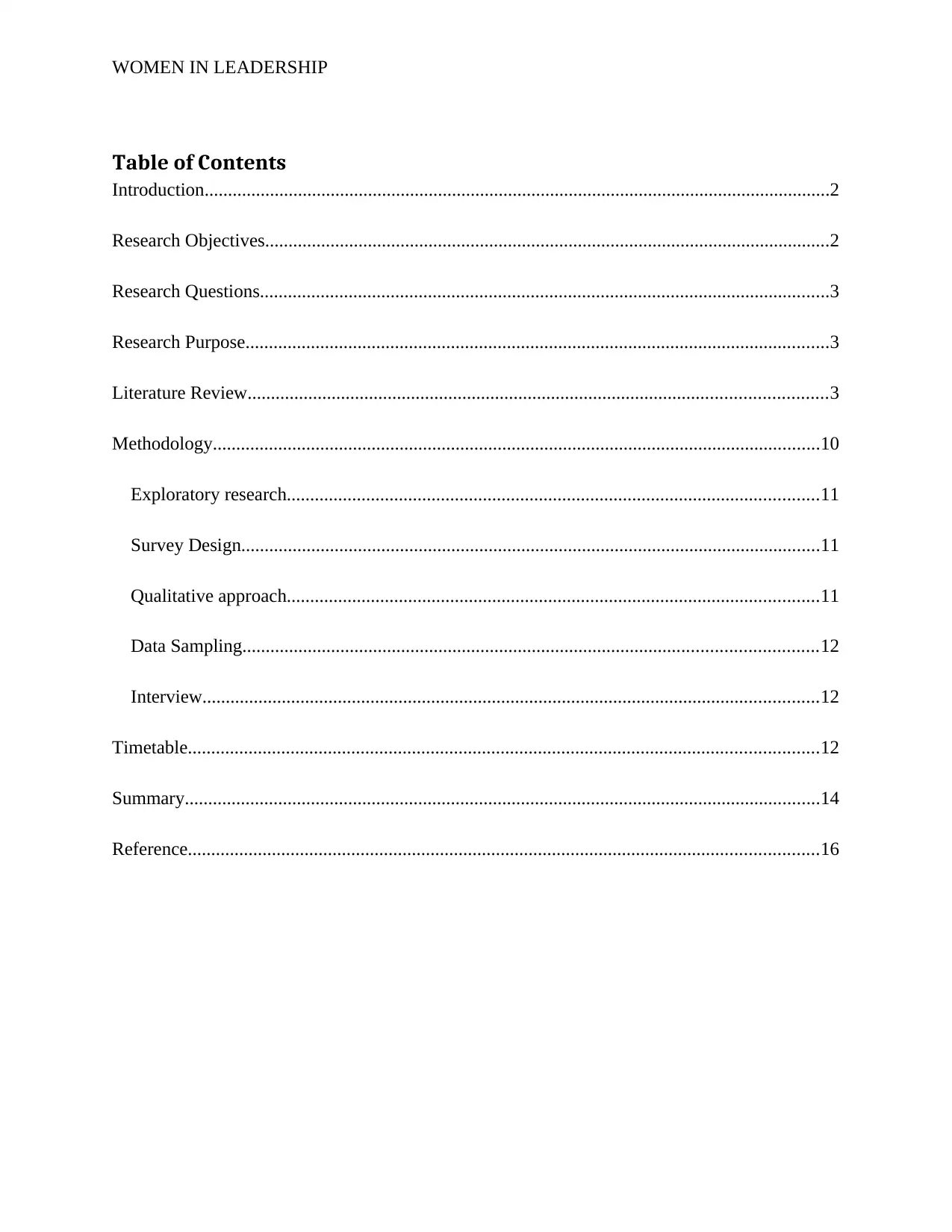
Table of Contents
Introduction......................................................................................................................................2
Research Objectives.........................................................................................................................2
Research Questions..........................................................................................................................3
Research Purpose.............................................................................................................................3
Literature Review............................................................................................................................3
Methodology..................................................................................................................................10
Exploratory research..................................................................................................................11
Survey Design............................................................................................................................11
Qualitative approach..................................................................................................................11
Data Sampling...........................................................................................................................12
Interview....................................................................................................................................12
Timetable.......................................................................................................................................12
Summary........................................................................................................................................14
Reference.......................................................................................................................................16
Table of Contents
Introduction......................................................................................................................................2
Research Objectives.........................................................................................................................2
Research Questions..........................................................................................................................3
Research Purpose.............................................................................................................................3
Literature Review............................................................................................................................3
Methodology..................................................................................................................................10
Exploratory research..................................................................................................................11
Survey Design............................................................................................................................11
Qualitative approach..................................................................................................................11
Data Sampling...........................................................................................................................12
Interview....................................................................................................................................12
Timetable.......................................................................................................................................12
Summary........................................................................................................................................14
Reference.......................................................................................................................................16
WOMEN IN LEADERSHIP
Introduction
It is evident that in order to reach the top of the management women experience some
traits and barriers. On the other side it is popular belief that in political or organizational sphere,
men dominate the leadership positions. However this research primarily focuses on the women
leadership style and performance in the higher position of the organizations. Though the research
tries to analyze the women leadership in large organizations it is also important to consider the
lower level women business professionals and the managerial level aspirants. Through the
research various aspects of women leadership in organizations will be explored. How women
deal with leadership problems, how the women leaders takes certain strategies to improve
organizational culture and how they develop leadership culture in order to manage the
subordinates (Rhode, 2016). It will be useful to explore how the women leadership develops the
characteristics like competent, knowledgeable, progressive and purposeful in the professional
competitive world of business. The research also aims to demonstrate essential information and
data that would highlight the issues and guide towards a solution.
Research Objectives
The objectives of this research are as follows
To define the women leadership style in higher organizations.
To find out what strategies women leadership implement to manage the work force.
To investigate the difference and similarities between men and women leadership.
To highlight the challenges that leadership face in the organizational culture.
To examine the principles and theories that discusses the women leadership and present
useful information.
Introduction
It is evident that in order to reach the top of the management women experience some
traits and barriers. On the other side it is popular belief that in political or organizational sphere,
men dominate the leadership positions. However this research primarily focuses on the women
leadership style and performance in the higher position of the organizations. Though the research
tries to analyze the women leadership in large organizations it is also important to consider the
lower level women business professionals and the managerial level aspirants. Through the
research various aspects of women leadership in organizations will be explored. How women
deal with leadership problems, how the women leaders takes certain strategies to improve
organizational culture and how they develop leadership culture in order to manage the
subordinates (Rhode, 2016). It will be useful to explore how the women leadership develops the
characteristics like competent, knowledgeable, progressive and purposeful in the professional
competitive world of business. The research also aims to demonstrate essential information and
data that would highlight the issues and guide towards a solution.
Research Objectives
The objectives of this research are as follows
To define the women leadership style in higher organizations.
To find out what strategies women leadership implement to manage the work force.
To investigate the difference and similarities between men and women leadership.
To highlight the challenges that leadership face in the organizational culture.
To examine the principles and theories that discusses the women leadership and present
useful information.
⊘ This is a preview!⊘
Do you want full access?
Subscribe today to unlock all pages.

Trusted by 1+ million students worldwide
WOMEN IN LEADERSHIP
Research Questions
Women leadership is a specific area that this research paper focuses on and following are the
research questions that it would try to answer.
1. What leadership style do women leaders most often follow?
2. What are some challenges that women leadership experience? Are those challenges
external or internal?
3. Are women leadership style is different from leadership style of men?
4. How successful are women leaders in large organizations?
Research Purpose
This research will explore various existing theories and ideas that have been discussed in
literature regarding the women leadership in business. The investigation will highlight certain
information that would fulfill the research objectives. The exploration of the organizational
challenges for the women leadership will not only help women business professionals to identify
certain forthcoming issues but also to find out solutions for them. The research will also help to
gather adequate knowledge over the chosen subject that will help the future professionals to
analyze the area more effectively.
Literature Review
How are women represented in the higher institution?
Does Gender Matter? Female Representation on Corporate Boards and Firm Financial
Performance - A Meta-Analysis (2015)
Research Questions
Women leadership is a specific area that this research paper focuses on and following are the
research questions that it would try to answer.
1. What leadership style do women leaders most often follow?
2. What are some challenges that women leadership experience? Are those challenges
external or internal?
3. Are women leadership style is different from leadership style of men?
4. How successful are women leaders in large organizations?
Research Purpose
This research will explore various existing theories and ideas that have been discussed in
literature regarding the women leadership in business. The investigation will highlight certain
information that would fulfill the research objectives. The exploration of the organizational
challenges for the women leadership will not only help women business professionals to identify
certain forthcoming issues but also to find out solutions for them. The research will also help to
gather adequate knowledge over the chosen subject that will help the future professionals to
analyze the area more effectively.
Literature Review
How are women represented in the higher institution?
Does Gender Matter? Female Representation on Corporate Boards and Firm Financial
Performance - A Meta-Analysis (2015)
Paraphrase This Document
Need a fresh take? Get an instant paraphrase of this document with our AI Paraphraser
WOMEN IN LEADERSHIP
This report by Peltzer et al. (2015) meta-analytically investigated the relationship between the
financial performance and representation on management boards. The meta-analysis covered 20
studies related to 3097 organizations that have been discussed in peer reviewed journals. The
studies demonstrated that only 14% of the corporate board members are women. 38% of the
studies dealt with developing countries where rests of the studies are from developed countries.
The study also presented that relationship between the women presence on the boards and firm
performance through a random effects model. The result showed that the correlation mean
weighted non-significant. The report concluded that if other organizational factors are not
considered the women on the corporate boards cannot result in effective financial performance.
The number of women in leadership in higher institutions is lower than that of their men
counterparts (2015)
According to Catalyst (2015) the trend for women leadership is progressing globally and about
4.6% of CEOs are women. In USA 16.9% of the head of corporate organizations are women and
8.1% of them are top earners. Though progress is happening now, it should not also get
unnoticed that by 2013 the mentioned percentage did not progress for previous eight years.
Catalyst also highlights that this static condition of women leadership from previous years
underlines the lack of progress which led to a greater problem. Catalyst demonstrates that there
was only one woman in the CEO list of Fortune 500 of 1998 but the number was 24 in 2014.
Though the number has grown but once it is compared to the male counterpart or the stability of
the growth rate for previous years the result is not as it should. However the situation is even
better in Canada than other developed countries. The Statistics Canada (2012) reported that
women hold 35.4% of all management positions and 22% of all senior positions of Canada.
However the report also highlights the other side, where it shows that the number of women
This report by Peltzer et al. (2015) meta-analytically investigated the relationship between the
financial performance and representation on management boards. The meta-analysis covered 20
studies related to 3097 organizations that have been discussed in peer reviewed journals. The
studies demonstrated that only 14% of the corporate board members are women. 38% of the
studies dealt with developing countries where rests of the studies are from developed countries.
The study also presented that relationship between the women presence on the boards and firm
performance through a random effects model. The result showed that the correlation mean
weighted non-significant. The report concluded that if other organizational factors are not
considered the women on the corporate boards cannot result in effective financial performance.
The number of women in leadership in higher institutions is lower than that of their men
counterparts (2015)
According to Catalyst (2015) the trend for women leadership is progressing globally and about
4.6% of CEOs are women. In USA 16.9% of the head of corporate organizations are women and
8.1% of them are top earners. Though progress is happening now, it should not also get
unnoticed that by 2013 the mentioned percentage did not progress for previous eight years.
Catalyst also highlights that this static condition of women leadership from previous years
underlines the lack of progress which led to a greater problem. Catalyst demonstrates that there
was only one woman in the CEO list of Fortune 500 of 1998 but the number was 24 in 2014.
Though the number has grown but once it is compared to the male counterpart or the stability of
the growth rate for previous years the result is not as it should. However the situation is even
better in Canada than other developed countries. The Statistics Canada (2012) reported that
women hold 35.4% of all management positions and 22% of all senior positions of Canada.
However the report also highlights the other side, where it shows that the number of women
WOMEN IN LEADERSHIP
graduates has increased twice in last 20 years but the women leaders did not increase at the same
rate.
Which factors influence women and men's leadership in the most elite leadership
positions?
Gender and Perceptions of Leadership Effectiveness: A Meta-Analysis of Contextual
Moderators (2014)
Underdahl, Walker and Woehr (2014) in this report primarily focuses on the gender differences
in the top management level of large organizations. In the quantitative analysis the report
addresses the male-female relationship with leadership effectiveness. In the meta-analysis the
report selected 95 studies and took 99 samples. The report finally demonstrates the leadership
effectiveness does not differ much for men or women leadership if the leadership contexts are
judged. But this result also shows that in the self ratings men put themselves in the higher
position than the women. The research also applied Role Congruity Theory to examine the
contextual moderators.
How is education for women aligned with their career goals?
Understanding women's experiences with women-only leadership development programs
in higher education: A mixed methods approach (2016)
Geary (2016) explained that the women at top leadership have mentioned that the early
childhood experiences and leadership exposure have developed their perceptions to the
leadership ability. The professional women at the top management level expressed that their
academic background and smart growing up were their origin of leadership capability. 86% of
graduates has increased twice in last 20 years but the women leaders did not increase at the same
rate.
Which factors influence women and men's leadership in the most elite leadership
positions?
Gender and Perceptions of Leadership Effectiveness: A Meta-Analysis of Contextual
Moderators (2014)
Underdahl, Walker and Woehr (2014) in this report primarily focuses on the gender differences
in the top management level of large organizations. In the quantitative analysis the report
addresses the male-female relationship with leadership effectiveness. In the meta-analysis the
report selected 95 studies and took 99 samples. The report finally demonstrates the leadership
effectiveness does not differ much for men or women leadership if the leadership contexts are
judged. But this result also shows that in the self ratings men put themselves in the higher
position than the women. The research also applied Role Congruity Theory to examine the
contextual moderators.
How is education for women aligned with their career goals?
Understanding women's experiences with women-only leadership development programs
in higher education: A mixed methods approach (2016)
Geary (2016) explained that the women at top leadership have mentioned that the early
childhood experiences and leadership exposure have developed their perceptions to the
leadership ability. The professional women at the top management level expressed that their
academic background and smart growing up were their origin of leadership capability. 86% of
⊘ This is a preview!⊘
Do you want full access?
Subscribe today to unlock all pages.
Trusted by 1+ million students worldwide
WOMEN IN LEADERSHIP
the women stated that they were taught to act nice towards others that help them in the leadership
management. 44% believed that their education taught them to become a good leader and 34%
learned during this phase that sharing point of view is an effective communication strategy
(KPMG, 2015). However a significant number (76%) of the women in the leadership position
believe that they feel they could have learned more about their leadership strategies during the
academic years. 67% of the leaders also believe that the academic curriculum should have
incorporated confidence building curriculum more.
Which are the experiences of those women in top-tier institutional leadership?
KPMG Women’s Leadership Study Moving Women Forward into Leadership Roles.
(2015)
The women leadership has experienced many challenges and they had to overcome many fears
but as the President of Nasdaq Adena Friedman explains that the any challenges she experiences,
turns into motivation and finally that motivation grows to be her confidence. It is not like that the
women leaders are always concerned about overcoming the challenges the management
performance might get affected. Dalynn J. Hoch CFO, Zurich North America, Zurich Insurance
Company believes that the stakeholders also put their credibility and capital on the line for them
that help them to perform well in the leadership role. Maggie Wilderotter believes that the stretch
assignments help them to utilize their full potential and maintain their high performance.
However some believe that the performance of the women leadership must be appreciated more.
Michelle Kydd Lee Chief Innovation Officer, Creative Artists Agency states that the coworkers,
employees and business partners should recognize, celebrate, appreciate and reward when a
woman leader does great work.
the women stated that they were taught to act nice towards others that help them in the leadership
management. 44% believed that their education taught them to become a good leader and 34%
learned during this phase that sharing point of view is an effective communication strategy
(KPMG, 2015). However a significant number (76%) of the women in the leadership position
believe that they feel they could have learned more about their leadership strategies during the
academic years. 67% of the leaders also believe that the academic curriculum should have
incorporated confidence building curriculum more.
Which are the experiences of those women in top-tier institutional leadership?
KPMG Women’s Leadership Study Moving Women Forward into Leadership Roles.
(2015)
The women leadership has experienced many challenges and they had to overcome many fears
but as the President of Nasdaq Adena Friedman explains that the any challenges she experiences,
turns into motivation and finally that motivation grows to be her confidence. It is not like that the
women leaders are always concerned about overcoming the challenges the management
performance might get affected. Dalynn J. Hoch CFO, Zurich North America, Zurich Insurance
Company believes that the stakeholders also put their credibility and capital on the line for them
that help them to perform well in the leadership role. Maggie Wilderotter believes that the stretch
assignments help them to utilize their full potential and maintain their high performance.
However some believe that the performance of the women leadership must be appreciated more.
Michelle Kydd Lee Chief Innovation Officer, Creative Artists Agency states that the coworkers,
employees and business partners should recognize, celebrate, appreciate and reward when a
woman leader does great work.
Paraphrase This Document
Need a fresh take? Get an instant paraphrase of this document with our AI Paraphraser
WOMEN IN LEADERSHIP
Organizational culture, traditional culture, and social systems, society, education, knowledge,
and experiences are factors that influence leadership in higher institutions.
Women and Leadership: Factors That Influence Women's Career Success (2013)
The thesis paper by Elsi Lahti (2013) investigates the factors that help women to reach in the
leadership positions and the advancements in the career. This paper also presented data that state
that globally male leaders are more in number than female leaders. The influential factors are
also discussed factors that could increase the number of women leaders. The qualitative research
is conducted in the empirical study in the thesis. The researcher interviewed four women leaders
of large organizations in Finland and a number of digital questionnaires were delivered to other
top women leaders. The thesis demonstrated that factors like individual, organizational and
societal influence the women leadership. The paper extensively researched on the factors and
highlighted that women’s competence, perception, traditional gender roles and organizational
culture have influential role in the top level corporate career development.
Women and Leadership in the Church: insights from Gender and Management Literature
(2015)
Kirkpatrick (2014) argues how the cultural and social practices ascribe specific roles for women.
In his qualitative study she highlights how media portrays certain occupational categories for
women. The women are mostly represented in the domestic settings but if they are in the
professional world they are often stereotyped. The women are rarely shown in the leadership
position. Graveling (2015) argues that the social forces often play significant role for the women
business professional which developed their self perception rather than their natural perception.
Organizational culture, traditional culture, and social systems, society, education, knowledge,
and experiences are factors that influence leadership in higher institutions.
Women and Leadership: Factors That Influence Women's Career Success (2013)
The thesis paper by Elsi Lahti (2013) investigates the factors that help women to reach in the
leadership positions and the advancements in the career. This paper also presented data that state
that globally male leaders are more in number than female leaders. The influential factors are
also discussed factors that could increase the number of women leaders. The qualitative research
is conducted in the empirical study in the thesis. The researcher interviewed four women leaders
of large organizations in Finland and a number of digital questionnaires were delivered to other
top women leaders. The thesis demonstrated that factors like individual, organizational and
societal influence the women leadership. The paper extensively researched on the factors and
highlighted that women’s competence, perception, traditional gender roles and organizational
culture have influential role in the top level corporate career development.
Women and Leadership in the Church: insights from Gender and Management Literature
(2015)
Kirkpatrick (2014) argues how the cultural and social practices ascribe specific roles for women.
In his qualitative study she highlights how media portrays certain occupational categories for
women. The women are mostly represented in the domestic settings but if they are in the
professional world they are often stereotyped. The women are rarely shown in the leadership
position. Graveling (2015) argues that the social forces often play significant role for the women
business professional which developed their self perception rather than their natural perception.
WOMEN IN LEADERSHIP
The social role theories define the gendered messages that often decide the career development
of women.
Barriers Women face in the higher Institutions
Women on Top: A Systematic Review of the Barriers and Challenges Facing Female
Employees Before and After Entering Leadership Positions (2016)
Hampden (2016) highlights that women leadership in the workplace experience barriers and
challenges that restrict their mobility. The women professionals fail to develop effective skills
because of those restrictions. These barriers also affect the opportunities that they need for
professional advancements.
I really didn't have any problems with the male-female thing until...: Successful women's
experiences in organizations (2015)
It is important to refer what Demaiter and Adams (2004) argued in this context. They highlighted
that most male dominated professions are historically designed by men for men. The job
positions are supported by masculine strengths and supported by masculine strengths and
focused on characteristics of men. This results in positions for women that deserve unfavorable
conditions and more working hours (Blau & Winkler, 2017). The general work environment was
never focused on women professionals and often presents women with operational, structural
and perceptual challenges. The gender biasness and discrimination have always been a part of
male dominated professional world.
Lean in: Women, work, and the will to lead (2013)
The social role theories define the gendered messages that often decide the career development
of women.
Barriers Women face in the higher Institutions
Women on Top: A Systematic Review of the Barriers and Challenges Facing Female
Employees Before and After Entering Leadership Positions (2016)
Hampden (2016) highlights that women leadership in the workplace experience barriers and
challenges that restrict their mobility. The women professionals fail to develop effective skills
because of those restrictions. These barriers also affect the opportunities that they need for
professional advancements.
I really didn't have any problems with the male-female thing until...: Successful women's
experiences in organizations (2015)
It is important to refer what Demaiter and Adams (2004) argued in this context. They highlighted
that most male dominated professions are historically designed by men for men. The job
positions are supported by masculine strengths and supported by masculine strengths and
focused on characteristics of men. This results in positions for women that deserve unfavorable
conditions and more working hours (Blau & Winkler, 2017). The general work environment was
never focused on women professionals and often presents women with operational, structural
and perceptual challenges. The gender biasness and discrimination have always been a part of
male dominated professional world.
Lean in: Women, work, and the will to lead (2013)
⊘ This is a preview!⊘
Do you want full access?
Subscribe today to unlock all pages.
Trusted by 1+ million students worldwide
WOMEN IN LEADERSHIP
According Sandberg (2013) the female professionals tend to compromise with the career because
of their partners or families. Through her qualitative and quantitative research approaches she
states that women professionals lack the aspiration to reach the senior position. The lack of
women in the leadership position can be understood from two organizational aspects that are
organizational culture and strategy. Sandberg concludes that the lack of organizational policies
for supporting the career development of women and effective gender policies are two principle
factors for causing such condition of women leadership in higher organizations.
Women and top leadership positions: Towards an institutional analysis (2014)
Cook and Glass (2014) discussed the value of organizational support and leadership
opportunities in the progression of women leadership The explained the “Old Boy’s Network”
where the men at the management leadership position tend to prefer friends and colleagues to
take their positions and in this process the deserving women for the leadership position get left
out. The men who attended the school or university together favor each other to ride up the
corporate ladder.
Glass Ceiling for Women: A Barrier in Effective Leadership (2014)
They create the organizational structure such a way that enables men to reach the higher position
easily. In this professional world of male dominance, women struggle to enter the leadership
position, fight to destroy the gender bias and achieve the professional progression. Cormier
(2006) with her interviews with the women corporate leaders demonstrates that the fight does not
end with the women reaching the top position (Sharma & Kaur, 2014).
Women and Barriers for Upward Career Advancement (2016)
According Sandberg (2013) the female professionals tend to compromise with the career because
of their partners or families. Through her qualitative and quantitative research approaches she
states that women professionals lack the aspiration to reach the senior position. The lack of
women in the leadership position can be understood from two organizational aspects that are
organizational culture and strategy. Sandberg concludes that the lack of organizational policies
for supporting the career development of women and effective gender policies are two principle
factors for causing such condition of women leadership in higher organizations.
Women and top leadership positions: Towards an institutional analysis (2014)
Cook and Glass (2014) discussed the value of organizational support and leadership
opportunities in the progression of women leadership The explained the “Old Boy’s Network”
where the men at the management leadership position tend to prefer friends and colleagues to
take their positions and in this process the deserving women for the leadership position get left
out. The men who attended the school or university together favor each other to ride up the
corporate ladder.
Glass Ceiling for Women: A Barrier in Effective Leadership (2014)
They create the organizational structure such a way that enables men to reach the higher position
easily. In this professional world of male dominance, women struggle to enter the leadership
position, fight to destroy the gender bias and achieve the professional progression. Cormier
(2006) with her interviews with the women corporate leaders demonstrates that the fight does not
end with the women reaching the top position (Sharma & Kaur, 2014).
Women and Barriers for Upward Career Advancement (2016)
Paraphrase This Document
Need a fresh take? Get an instant paraphrase of this document with our AI Paraphraser
WOMEN IN LEADERSHIP
Saadin et al. (2016) applied quantitative approach to measure the decision making role in
management. The researcher conducted a survey to analyze the relationship between the gender
stereotyping and work life balance. The author chose 63 women members in the public service
and used SPSS or Statistical Package for Social Science Version 20.0. The result represents that
the factors play significant role in the career advancement of the women leaders.
Why women still can't have it all (2015)
Slaughter (2015) discussed that the undervaluation of women leadership in the business world
also affect their decision making capabilities. The author also talks about the invisible barriers
that women face during the advancement to the next level. Slaughter (2015) points out now
women from professional world not only aim for the top leadership position and demands equal
treatment and opportunities. The women aiming for leadership also do not want to select one
option between profession and family. The women who have achieved the leadership position
are now more focused on sustaining the success and work not to lose the credibility.
Methodology
People’s attitude towards women in society might have changed but the women in the
business world are still considered to be less suitable for managerial positions. The main cause of
this must be addressed otherwise the position and participation of women in the leadership
position will remain in the lower side. The organizations must realize that resisting women from
managerial progress is harmful for the organizations too, because they not only lose effective
leadership potential but also the profit that their leadership could have generated. The researcher
will be collecting primary data from the selected group of women business professionals.
Saadin et al. (2016) applied quantitative approach to measure the decision making role in
management. The researcher conducted a survey to analyze the relationship between the gender
stereotyping and work life balance. The author chose 63 women members in the public service
and used SPSS or Statistical Package for Social Science Version 20.0. The result represents that
the factors play significant role in the career advancement of the women leaders.
Why women still can't have it all (2015)
Slaughter (2015) discussed that the undervaluation of women leadership in the business world
also affect their decision making capabilities. The author also talks about the invisible barriers
that women face during the advancement to the next level. Slaughter (2015) points out now
women from professional world not only aim for the top leadership position and demands equal
treatment and opportunities. The women aiming for leadership also do not want to select one
option between profession and family. The women who have achieved the leadership position
are now more focused on sustaining the success and work not to lose the credibility.
Methodology
People’s attitude towards women in society might have changed but the women in the
business world are still considered to be less suitable for managerial positions. The main cause of
this must be addressed otherwise the position and participation of women in the leadership
position will remain in the lower side. The organizations must realize that resisting women from
managerial progress is harmful for the organizations too, because they not only lose effective
leadership potential but also the profit that their leadership could have generated. The researcher
will be collecting primary data from the selected group of women business professionals.
WOMEN IN LEADERSHIP
Secondary data will be collected from researching websites, books and journals (Bryman & Bell,
2015). The researcher will be using existing data and previous knowledge in this research.
Exploratory research
The research design will be exploratory in nature. Exploratory research is useful for
researches where research problems are not identified clearly (Sekaran & Bougie, 2016). The
researcher uses questionnaire as the principle tool for collecting primary data from a selected
group of women employees and managers. The questionnaire is developed to evaluate the
women leadership styles, strategies in organizational culture and the preconceptions and attitudes
about women leaders.
Survey Design
Survey questions will be used to gather necessary data from direct interviewing 40
women business professionals of business organizations. A structured and systematic
questionnaire is used as a survey tool with three definite sections. The first section is designed to
evaluate the participant’ opinions and attitudes focusing on areas like women leadership styles,
characteristics, resistances, acceptance and expectations. Second section is designed to
understand their awareness about progression and stability in the leadership positions. The third
section will focus on the demographics of the participants.
Qualitative approach
The report will be applying qualitative approach. Qualitative elements will be used in this
research to develop the mentioned approach. Qualitative data collection includes action research,
interviews and observation (Myers, 2013). This research method will provide more in depth
knowledge on the selected subject as it is more subjective in nature. Through this method the
Secondary data will be collected from researching websites, books and journals (Bryman & Bell,
2015). The researcher will be using existing data and previous knowledge in this research.
Exploratory research
The research design will be exploratory in nature. Exploratory research is useful for
researches where research problems are not identified clearly (Sekaran & Bougie, 2016). The
researcher uses questionnaire as the principle tool for collecting primary data from a selected
group of women employees and managers. The questionnaire is developed to evaluate the
women leadership styles, strategies in organizational culture and the preconceptions and attitudes
about women leaders.
Survey Design
Survey questions will be used to gather necessary data from direct interviewing 40
women business professionals of business organizations. A structured and systematic
questionnaire is used as a survey tool with three definite sections. The first section is designed to
evaluate the participant’ opinions and attitudes focusing on areas like women leadership styles,
characteristics, resistances, acceptance and expectations. Second section is designed to
understand their awareness about progression and stability in the leadership positions. The third
section will focus on the demographics of the participants.
Qualitative approach
The report will be applying qualitative approach. Qualitative elements will be used in this
research to develop the mentioned approach. Qualitative data collection includes action research,
interviews and observation (Myers, 2013). This research method will provide more in depth
knowledge on the selected subject as it is more subjective in nature. Through this method the
⊘ This is a preview!⊘
Do you want full access?
Subscribe today to unlock all pages.
Trusted by 1+ million students worldwide

1 out of 18


Related Documents


Your All-in-One AI-Powered Toolkit for Academic Success.
+13062052269
info@desklib.com
Available 24*7 on WhatsApp / Email
![[object Object]](/_next/static/media/star-bottom.7253800d.svg)
Unlock your academic potential
Copyright © 2020–2026 A2Z Services. All Rights Reserved. Developed and managed by ZUCOL.