Gender Politics: A Critical Analysis of Women as Second-Class Citizens

Verified

Added on  2023/04/06

|6
|1206
|308
Essay
AI Summary
This essay examines the concept of women as second-class citizens in the context of gender politics, with specific reference to the United States and New Zealand. It discusses the historical underrepresentation of women in leadership positions globally and the changing trends of increased female participation in politics and leadership. The essay presents statistics and examples, such as the increasing number of women in the US Congress and the leadership of Helen Clark in New Zealand, to argue that women are increasingly proving their capabilities and achieving equality with men. It concludes that while challenges remain, particularly concerning the gender wage gap, women are no longer justifiably considered second-class citizens, and gender should not be a barrier to opportunity. The essay references various academic sources to support its analysis and conclusions.

Document Page
Gender Politics
Name
Course
Professor
Date
tabler-icon-diamond-filled.svg

Paraphrase This Document

Need a fresh take? Get an instant paraphrase of this document with our AI Paraphraser
Document Page
Introduction
For quite some time now women have been viewed as second-class citizens where men come
first then women follow and this is in regard to various political positions and other leadership
standpoints across the globe (Burton, 2015 p.67). In recent years, however, the trend has been
changing and women have been getting out of their comfort zone to reclaim various positions
that were previously dominated by men.
This write-up will analyze in detail whether or not women are a second class citizen. With an
explicit reference to two democratic countries; the United States and New Zealand evidence will
be provided to try and answer the above question.
The term second-class citizen refers to an individual or a group of persons who are looked down
upon and discriminated against within various states or maybe political jurisdiction. It is
important to note that this discrimination is regardless of their normal status of being citizens. In
most cases second class citizens have limitations is various aspects such as legal rights as well as
social economic opportunities.
Statistics show that about 79% of the world's leadership positions are occupied by men. This is a
really big challenge to women and as a result of this, they have been termed as a second-class
citizen (Klofstad, Anderson, Peters, 2012 p.45). This is so because they refrain from taking an
active real in various leadership positions as well as politics. For the last two decades, this has
been changing and we see more and more women getting into various leadership positions.
Women leaders are much more preferable over men leaders according to various researches
conducted. This has been attributed to the fact that women leaders are considered to be more
collaborative and female leaders can be trusted over men leaders. A survey carried out in
Document Page
America in the year 2015 indicates that 34% of Americans believe that women leaders can be
trusted compared to 3% that says men are better. 64% said there is no difference in the trust
index between men and women (Dubisch, 2019 p.30).
United States of America
In the United States, for instance, a total of 299 women have served as U.S representatives
and/or senators from the year 1917 when the first women were elected to serve in Congress. In
addition to this, the 2014 elections marked a very important milestone in the history of the
United States. For the first time in the history of the United States, over 100 women will be
serving in Congress. Well, these statistics convey a very important message. They clearly
indicate that women are no longer second-class citizens. In addition to that women also
comprise a large percentage of state-level elected leaders and officials. Statistics indicate that the
number has risen from 4.5% in the late '90s to about 27.5% in 2017. Women have made some
really recommendable progress in the educational sector as well. Despite all this amount of
progress, however, a gender wage gap still persists.
‘The future is female’ is a phrase that is commonly used to refer to the milestones that a woman
has had overtime to overcome male dominance in various areas of expertise. In the United
States for instance, immediately after Hilary Clinton conceded defeat in her nomination
campaign to John McCain, the decorated republican nominee nominated Sarah Palin as his
running mate. Well, this is a very important gesture and it clearly shows that even men believe in
the potential that women have (Latu, Mast, Lammers, Bombari, 2013 p.21). The United States
as a nation has shown that women are not second-class citizens but rather they have considered
them equals to men in that country. This is so because in the United States all people are given
Document Page
equal opportunities regardless of their gender or ethnicity. This is a very essential aspect that
should be eliminated by all countries across the globe. It is time that women are treated as equals
to males (Hall & Bucholtz, 2012 p.89).
New Zealand
New Zealand is also another democratic country where women have taken a very good stand as
fat as leadership issues are concerned. This is a country where women have proven themselves
not to be a second-class citizen (Gal & Kligman, 2012 p.113). This is so because women have
taken various leadership positions from all areas such as politics, corporate leadership just but to
mention a few.
Helen Clark, a much-decorated female leader from New Zealand. This is a woman that has
proven beyond doubt that women too can take various leadership positions and be good in them.
Helen Clark had been a leader of her Labor Party in New Zealand for six years after beating
Jenny Shipley, the first woman prime minister in New Zealand. In her six years of power, Helen
Clark did some really recommendable work through spearheading various reformations. For
instance, she boldly condemned the issue of inherent sexism of parliament.
Helen Clark is considered as not only a great leader in New Zealand but also a source of
inspiration for other young women both in New Zealand and across the globe. She was a leader
that went forward and proved that women can be anything including leading a nation. After her,
other women have succeeded and taken various leadership positions in New Zealand drawing
their inspiration from her. She proved that women are no longer second-class citizens.
Conclusion
tabler-icon-diamond-filled.svg

Paraphrase This Document

Need a fresh take? Get an instant paraphrase of this document with our AI Paraphraser
Document Page
Feminists across the globe have been writing articles and books conveying the need for women
to get into politics and stake a stand-in various leadership positions. The phrase ‘the future is
female' has been used on various occasions to try and explain how things are changing and the
revolution is being spearheaded by women (Maracle, 2018 p.54).
As discussed above, we can clearly see that statistics indicated women are taking the stand.
Gender should not be a setback. In countries like the United States and New Zealand, women
have already proven to be capable of being great leaders and those they can fit in various social
economic positions (Connell, 2013 p.231). It can, therefore, be concluded that women are no
longer second-class citizens but rather they are equals to the men as they can be and do whatever
men can.
Document Page
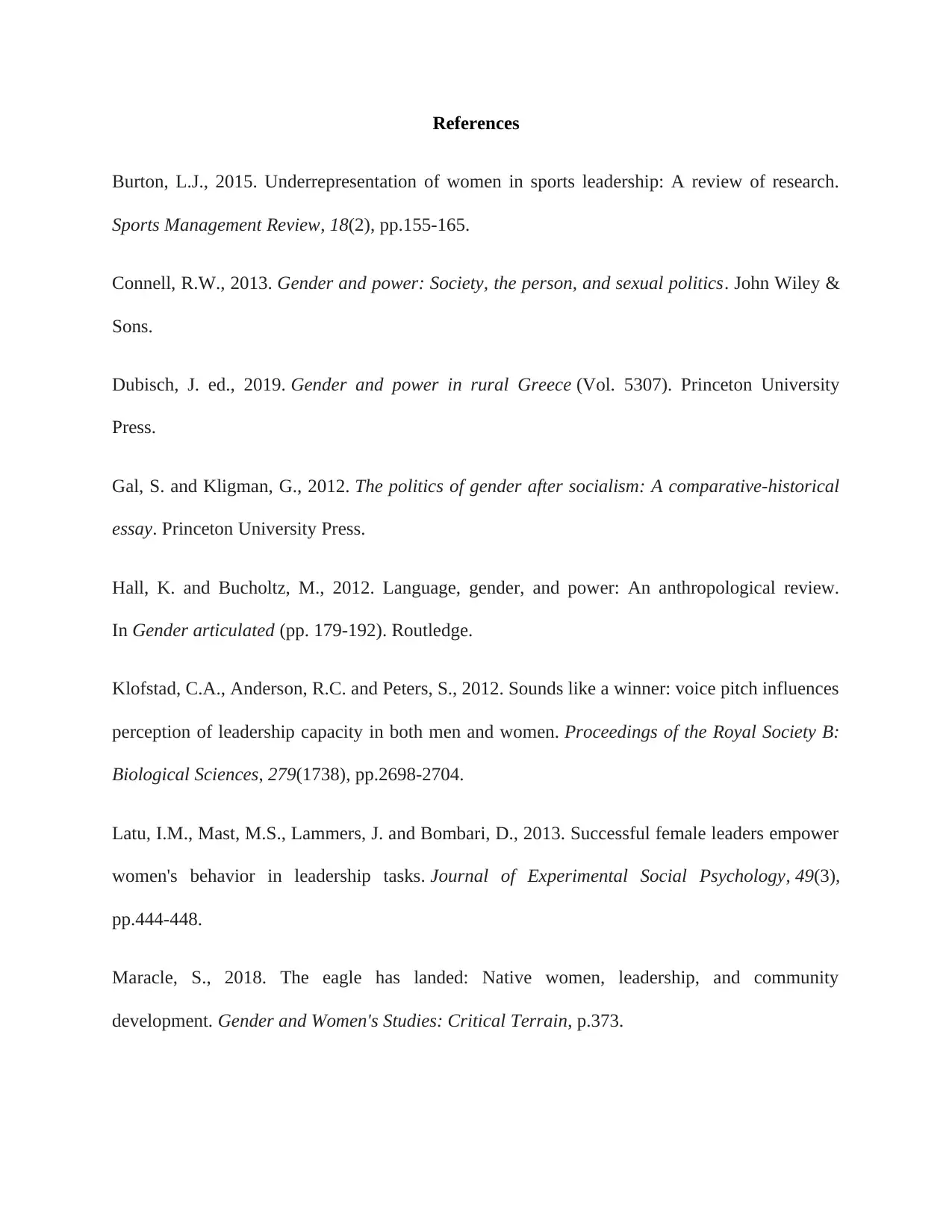
References
Burton, L.J., 2015. Underrepresentation of women in sports leadership: A review of research.
Sports Management Review, 18(2), pp.155-165.
Connell, R.W., 2013. Gender and power: Society, the person, and sexual politics. John Wiley &
Sons.
Dubisch, J. ed., 2019. Gender and power in rural Greece (Vol. 5307). Princeton University
Press.
Gal, S. and Kligman, G., 2012. The politics of gender after socialism: A comparative-historical
essay. Princeton University Press.
Hall, K. and Bucholtz, M., 2012. Language, gender, and power: An anthropological review.
In Gender articulated (pp. 179-192). Routledge.
Klofstad, C.A., Anderson, R.C. and Peters, S., 2012. Sounds like a winner: voice pitch influences
perception of leadership capacity in both men and women. Proceedings of the Royal Society B:
Biological Sciences, 279(1738), pp.2698-2704.
Latu, I.M., Mast, M.S., Lammers, J. and Bombari, D., 2013. Successful female leaders empower
women's behavior in leadership tasks. Journal of Experimental Social Psychology, 49(3),
pp.444-448.
Maracle, S., 2018. The eagle has landed: Native women, leadership, and community
development. Gender and Women's Studies: Critical Terrain, p.373.
chevron_up_icon
1 out of 6
circle_padding
hide_on_mobile
zoom_out_icon
[object Object]