Detailed Report on Health History: Eating Disorders, HPV, and Alcohol

Verified

Added on  2023/06/15

|6
|1210
|339
Report
AI Summary
This report provides a comprehensive overview of critical women's health issues, including eating disorders, high-risk behaviors such as genital warts (HPV), and exposure to teratogenic toxins like alcohol. It emphasizes the importance of awareness, early detection, and appropriate medical intervention for conditions like anorexia nervosa, bulimia nervosa, and binge eating disorder. The report also highlights the significance of HPV vaccination and regular pelvic examinations to prevent cervical cancer and manage genital warts. Furthermore, it addresses the harmful effects of teratogenic substances, particularly alcohol, during pregnancy, stressing the need for education, counseling, and a supportive environment for pregnant women to prevent fetal alcohol syndrome. The document underscores the role of healthcare providers in offering specialized treatment, promoting healthy behaviors, and providing emotional support to address these complex health challenges in women. Desklib offers similar solved assignments for students.
Document Page
Running head: REPORT ON HEALTH HISTORY
REPORT ON HEALTH HISTORY
Name of the student:
Name of the University:
Author note:
tabler-icon-diamond-filled.svg

Paraphrase This Document

Need a fresh take? Get an instant paraphrase of this document with our AI Paraphraser
Document Page
1REPORT ON HEALTH HISTORY
Table of Contents
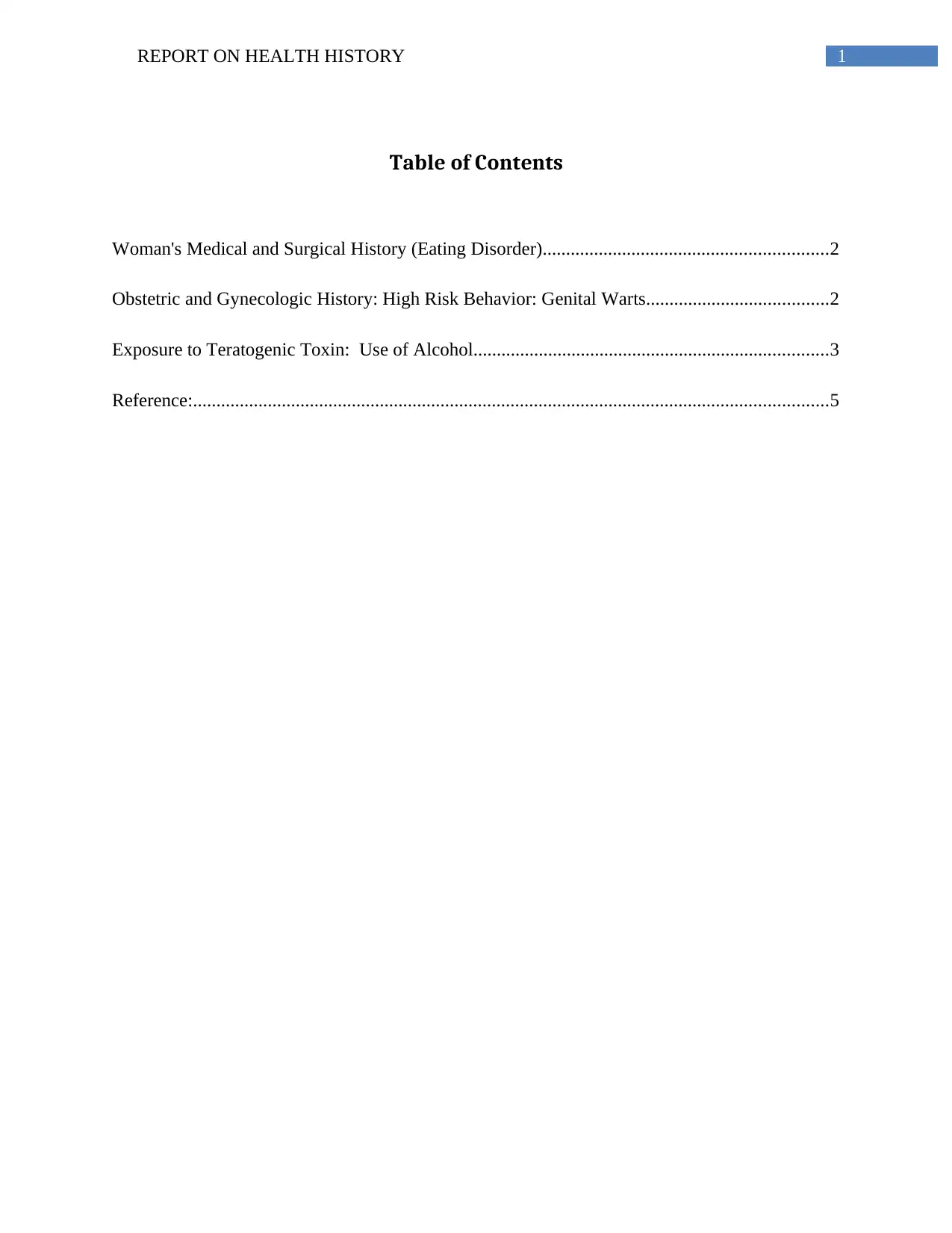
Woman's Medical and Surgical History (Eating Disorder).............................................................2
Obstetric and Gynecologic History: High Risk Behavior: Genital Warts.......................................2
Exposure to Teratogenic Toxin: Use of Alcohol............................................................................3
Reference:........................................................................................................................................5
Document Page
2REPORT ON HEALTH HISTORY
Woman's Medical and Surgical History (Eating Disorder)
Medical history of women states that, most of the women suffer from eating disorder.
The term eating disorder is defined as the habit of irregular eating and distress regarding the
weight and shape of the body. Anorexia Nervosa, Bulimia Nervosa and Binge eating disorder are
the most renounced forms of eating disorder. Such disorder may be defined as overeating or
refusal to eat healthy food. It can affect the health of individual to an extent. People need to be
aware of these disorders to remain healthy (Smink, Hoeken & Hoek, 2013). Some people do not
realize that they are suffering from such disorders. In order to create awareness, proper
information about such disorders needs to be provided to the people through campaign or social
programme. It is important to provide knowledge and benefits of healthy eating habits in the
campaign. Severity of the diseases that can occur due to eating disorder is needed to inform to
the people. The information needs to be provide considering the ethical and cultural facts, so that
people can accept it. The health care service providers should provide special treatment team
regarding this. Monitoring the symptoms of such disorders is important to provide treatment
from the beginning. Special psychotherapy is needed to understand the mature of eating disorder.
After recognizing a person with eating disorder, she needs to concern with an eating disorder
expert, as proper medication is important to provide in order to cure such disorders (Kristeller,
Wolever & Sheets, 2014).
Obstetric and Gynecologic History: High Risk Behavior: Genital Warts
Genital warts are common threat for women. Genital warts are infection, that occur due
to sexual transmission (Smith, 2014). The causative agent is Human Pappilomavirus or HPV.
Document Page
3REPORT ON HEALTH HISTORY
People suffering from genital warts face problems like itching, discomfort and pain. In severe
case, it can also cause cancer of vulva and cervix. Due to lack of information, people fail to
recognize the problem and ignore it, which can cause serious illness like cancer in future. Thus,
it is important to provide proper information related to genital warts in order to create awareness.
Sometimes people hesitate to share problems related to private parts. It is important to provide
knowledge regarding the issues of sexual transmission and make them understand that it is not a
negligible issue. Health care service providers need to communicate to the people in such a way,
so that they can share their problem and understand the treatment process. Most of the people do
not know about the HPV vaccination, thus, information about the vaccine need to be provided to
all (Dochez et al., 2014). Pelvic examination is needed to diagnose the cancer related to genital
warts (Carrier et al., 2015). If a person feel itching or pain in the genitals, she need to concern
with a gynecologist in order to understand the problem. The medication provided by the
specialist could help to reduce the pain and the illness can be cured if diagnosed properly in the
primary stage.
Exposure to Teratogenic Toxin: Use of Alcohol
Teratogenic substances are defined as the substance that can cause congenital
abnormalities. Such substances are harmful, especially during pregnancy. They can
malformation, mutagenesis, carcinogenesis, deficiency related to growth, maternal infections and
pregnancy wastage. Alcohol is considered as teratogenic substance, as it can cause congenital
abnormalities during pregnancy (Lupattelli et al., 2014). Drinking alcohol during pregnancy can
cause fetal alcohol syndrome. The concept of teratogenic substance is not clear to all. Most of the
people are not introduced with the term. Thus, it is important to make people understand the
tabler-icon-diamond-filled.svg

Paraphrase This Document

Need a fresh take? Get an instant paraphrase of this document with our AI Paraphraser
Document Page
4REPORT ON HEALTH HISTORY
harmful effects of teratogenic substances. Teratology is a subject, which deals with the
teratogenic substances and their harmful effects. Research needs to be improved in order to
identify teratogenic substances. This is a serious problem as there is no vaccination available to
prevent or cure the disorders that can occur due to drinking alcohol during pregnancy.
Gynecologists need to provide proper attention to detect that whether the patient is addicted to
alcohol or not. They should make the patient understand the effect of drinking alcohol and how it
can cause harm to their babies. Healthy environment need to be provided to the pregnant women,
so that they can stay without any depression. Counselor needs to communicate with the patient
who is addicted to alcohol. It is important to understand the issues and provide proper
information regarding the risk factors. Pregnancy is an emotional case, so they should give value
to the emotion of the patients. Psychotherapy can address the issue of drinking alcohol better
than any medication.
Document Page
5REPORT ON HEALTH HISTORY
Reference:
Carrier, M., Lazo-Langner, A., Shivakumar, S., Tagalakis, V., Zarychanski, R., Solymoss, S., ...
& Le Gal, G. (2015). Screening for occult cancer in unprovoked venous
thromboembolism. New England Journal of Medicine, 373(8), 697-704.
Dochez, C., Bogers, J. J., Verhelst, R., & Rees, H. (2014). HPV vaccines to prevent cervical
cancer and genital warts: an update. Vaccine, 32(14), 1595-1601.
Kristeller, J., Wolever, R. Q., & Sheets, V. (2014). Mindfulness-based eating awareness training
(MB-EAT) for binge eating: A randomized clinical trial. Mindfulness, 5(3), 282-297.
Lupattelli, A., Picinardi, M., Einarson, A., & Nordeng, H. (2014). Health literacy and its
association with perception of teratogenic risks and health behavior during
pregnancy. Patient education and counseling, 96(2), 171-178.
Smink, F. R., van Hoeken, D., & Hoek, H. W. (2013). Epidemiology, course, and outcome of
eating disorders. Current opinion in psychiatry, 26(6), 543-548.
Smith, H. (2014). Sexually transmitted infections. Professional Nursing Today, 18(1), 29-32.
chevron_up_icon
1 out of 6
circle_padding
hide_on_mobile
zoom_out_icon
[object Object]