Thematic Analysis: Health and Well-being of Women in UK Prisons
VerifiedAdded on 2023/06/10
|33
|6850
|351
Case Study
AI Summary
This qualitative case study investigates perceptions of health and well-being provisions for women in UK prisons using deductive thematic analysis on data collected from online interviews. The study explores issues facing women in prison, including their rights, mental health, and the treatment of transgender prisoners and mothers. The analysis compares public perception with legal standards, highlighting potential gaps in provision and transparency. Key themes include prison experience, reasons for incarceration, perceived treatment, the purpose of prison (punishment vs. rehabilitation), and women's mental health, revealing insights into the discrepancies between expectations and reality within the UK prison system. Desklib offers a variety of solved assignments and past papers for students.
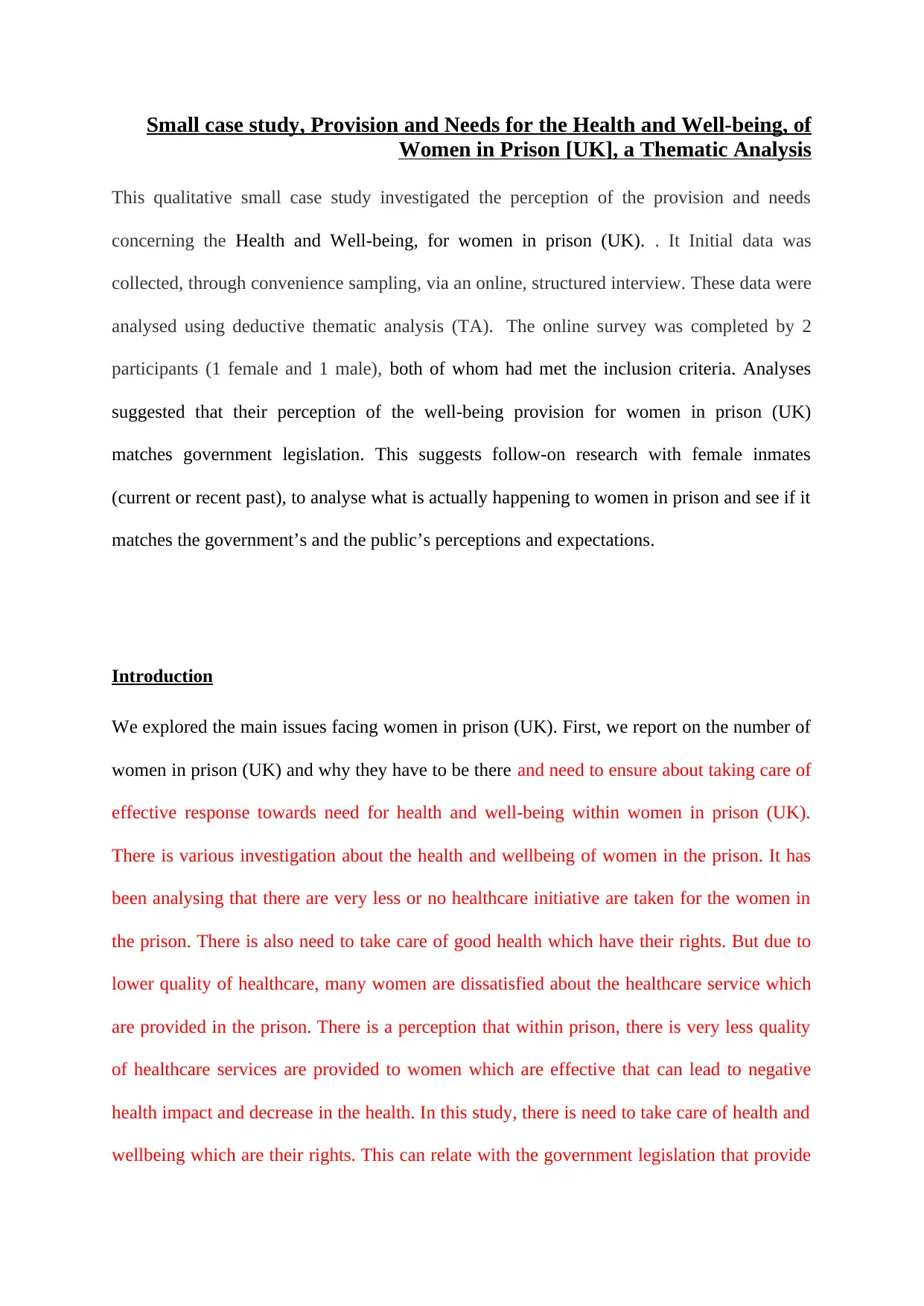
Small case study, Provision and Needs for the Health and Well-being, of
Women in Prison [UK], a Thematic Analysis
This qualitative small case study investigated the perception of the provision and needs
concerning the Health and Well-being, for women in prison (UK). . It Initial data was
collected, through convenience sampling, via an online, structured interview. These data were
analysed using deductive thematic analysis (TA). The online survey was completed by 2
participants (1 female and 1 male), both of whom had met the inclusion criteria. Analyses
suggested that their perception of the well-being provision for women in prison (UK)
matches government legislation. This suggests follow-on research with female inmates
(current or recent past), to analyse what is actually happening to women in prison and see if it
matches the government’s and the public’s perceptions and expectations.
Introduction
We explored the main issues facing women in prison (UK). First, we report on the number of
women in prison (UK) and why they have to be there and need to ensure about taking care of
effective response towards need for health and well-being within women in prison (UK).
There is various investigation about the health and wellbeing of women in the prison. It has
been analysing that there are very less or no healthcare initiative are taken for the women in
the prison. There is also need to take care of good health which have their rights. But due to
lower quality of healthcare, many women are dissatisfied about the healthcare service which
are provided in the prison. There is a perception that within prison, there is very less quality
of healthcare services are provided to women which are effective that can lead to negative
health impact and decrease in the health. In this study, there is need to take care of health and
wellbeing which are their rights. This can relate with the government legislation that provide
Women in Prison [UK], a Thematic Analysis
This qualitative small case study investigated the perception of the provision and needs
concerning the Health and Well-being, for women in prison (UK). . It Initial data was
collected, through convenience sampling, via an online, structured interview. These data were
analysed using deductive thematic analysis (TA). The online survey was completed by 2
participants (1 female and 1 male), both of whom had met the inclusion criteria. Analyses
suggested that their perception of the well-being provision for women in prison (UK)
matches government legislation. This suggests follow-on research with female inmates
(current or recent past), to analyse what is actually happening to women in prison and see if it
matches the government’s and the public’s perceptions and expectations.
Introduction
We explored the main issues facing women in prison (UK). First, we report on the number of
women in prison (UK) and why they have to be there and need to ensure about taking care of
effective response towards need for health and well-being within women in prison (UK).
There is various investigation about the health and wellbeing of women in the prison. It has
been analysing that there are very less or no healthcare initiative are taken for the women in
the prison. There is also need to take care of good health which have their rights. But due to
lower quality of healthcare, many women are dissatisfied about the healthcare service which
are provided in the prison. There is a perception that within prison, there is very less quality
of healthcare services are provided to women which are effective that can lead to negative
health impact and decrease in the health. In this study, there is need to take care of health and
wellbeing which are their rights. This can relate with the government legislation that provide

Paraphrase This Document
Need a fresh take? Get an instant paraphrase of this document with our AI Paraphraser
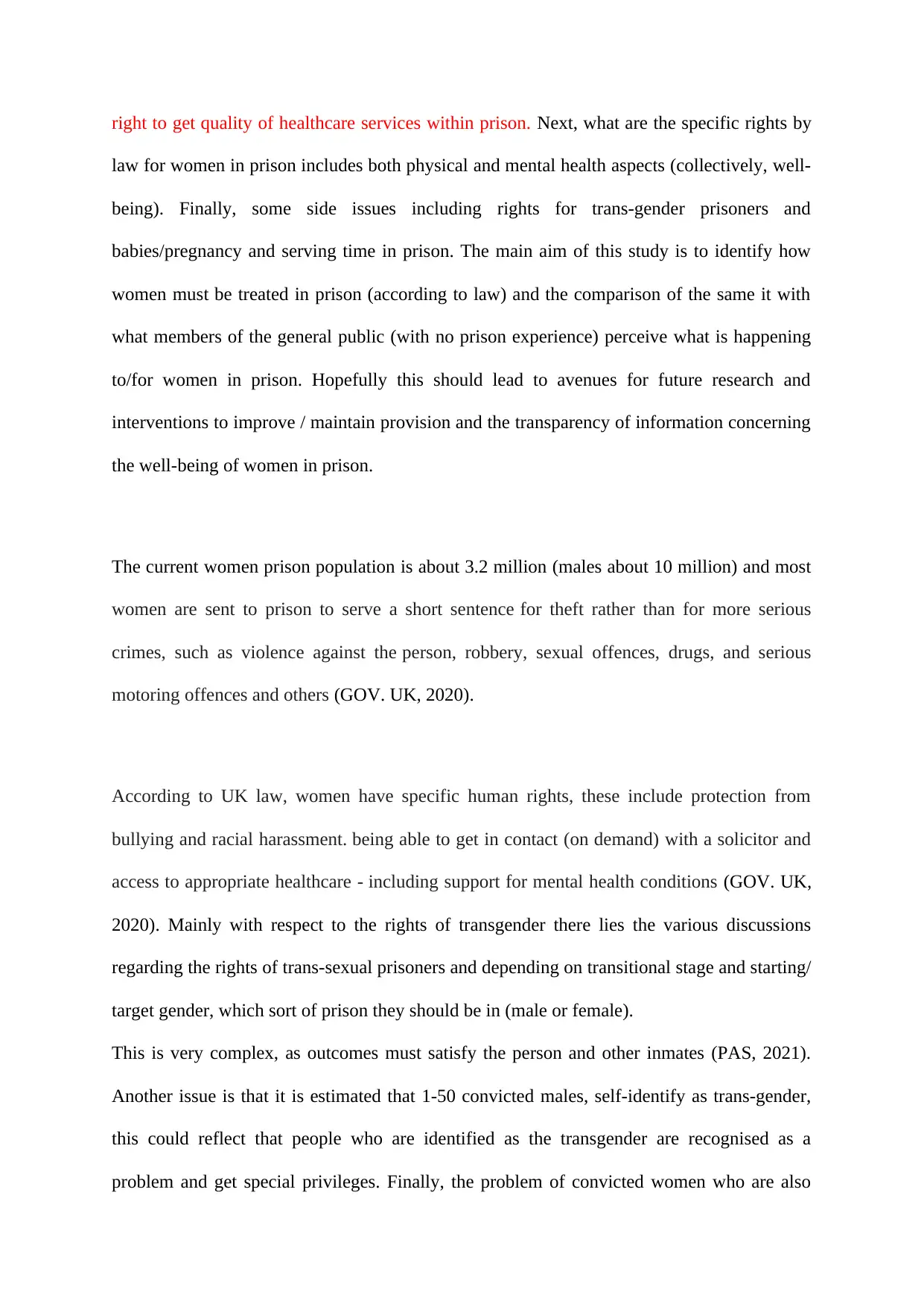
right to get quality of healthcare services within prison. Next, what are the specific rights by
law for women in prison includes both physical and mental health aspects (collectively, well-
being). Finally, some side issues including rights for trans-gender prisoners and
babies/pregnancy and serving time in prison. The main aim of this study is to identify how
women must be treated in prison (according to law) and the comparison of the same it with
what members of the general public (with no prison experience) perceive what is happening
to/for women in prison. Hopefully this should lead to avenues for future research and
interventions to improve / maintain provision and the transparency of information concerning
the well-being of women in prison.
The current women prison population is about 3.2 million (males about 10 million) and most
women are sent to prison to serve a short sentence for theft rather than for more serious
crimes, such as violence against the person, robbery, sexual offences, drugs, and serious
motoring offences and others (GOV. UK, 2020).
According to UK law, women have specific human rights, these include protection from
bullying and racial harassment. being able to get in contact (on demand) with a solicitor and
access to appropriate healthcare - including support for mental health conditions (GOV. UK,
2020). Mainly with respect to the rights of transgender there lies the various discussions
regarding the rights of trans-sexual prisoners and depending on transitional stage and starting/
target gender, which sort of prison they should be in (male or female).
This is very complex, as outcomes must satisfy the person and other inmates (PAS, 2021).
Another issue is that it is estimated that 1-50 convicted males, self-identify as trans-gender,
this could reflect that people who are identified as the transgender are recognised as a
problem and get special privileges. Finally, the problem of convicted women who are also
law for women in prison includes both physical and mental health aspects (collectively, well-
being). Finally, some side issues including rights for trans-gender prisoners and
babies/pregnancy and serving time in prison. The main aim of this study is to identify how
women must be treated in prison (according to law) and the comparison of the same it with
what members of the general public (with no prison experience) perceive what is happening
to/for women in prison. Hopefully this should lead to avenues for future research and
interventions to improve / maintain provision and the transparency of information concerning
the well-being of women in prison.
The current women prison population is about 3.2 million (males about 10 million) and most
women are sent to prison to serve a short sentence for theft rather than for more serious
crimes, such as violence against the person, robbery, sexual offences, drugs, and serious
motoring offences and others (GOV. UK, 2020).
According to UK law, women have specific human rights, these include protection from
bullying and racial harassment. being able to get in contact (on demand) with a solicitor and
access to appropriate healthcare - including support for mental health conditions (GOV. UK,
2020). Mainly with respect to the rights of transgender there lies the various discussions
regarding the rights of trans-sexual prisoners and depending on transitional stage and starting/
target gender, which sort of prison they should be in (male or female).
This is very complex, as outcomes must satisfy the person and other inmates (PAS, 2021).
Another issue is that it is estimated that 1-50 convicted males, self-identify as trans-gender,
this could reflect that people who are identified as the transgender are recognised as a
problem and get special privileges. Finally, the problem of convicted women who are also
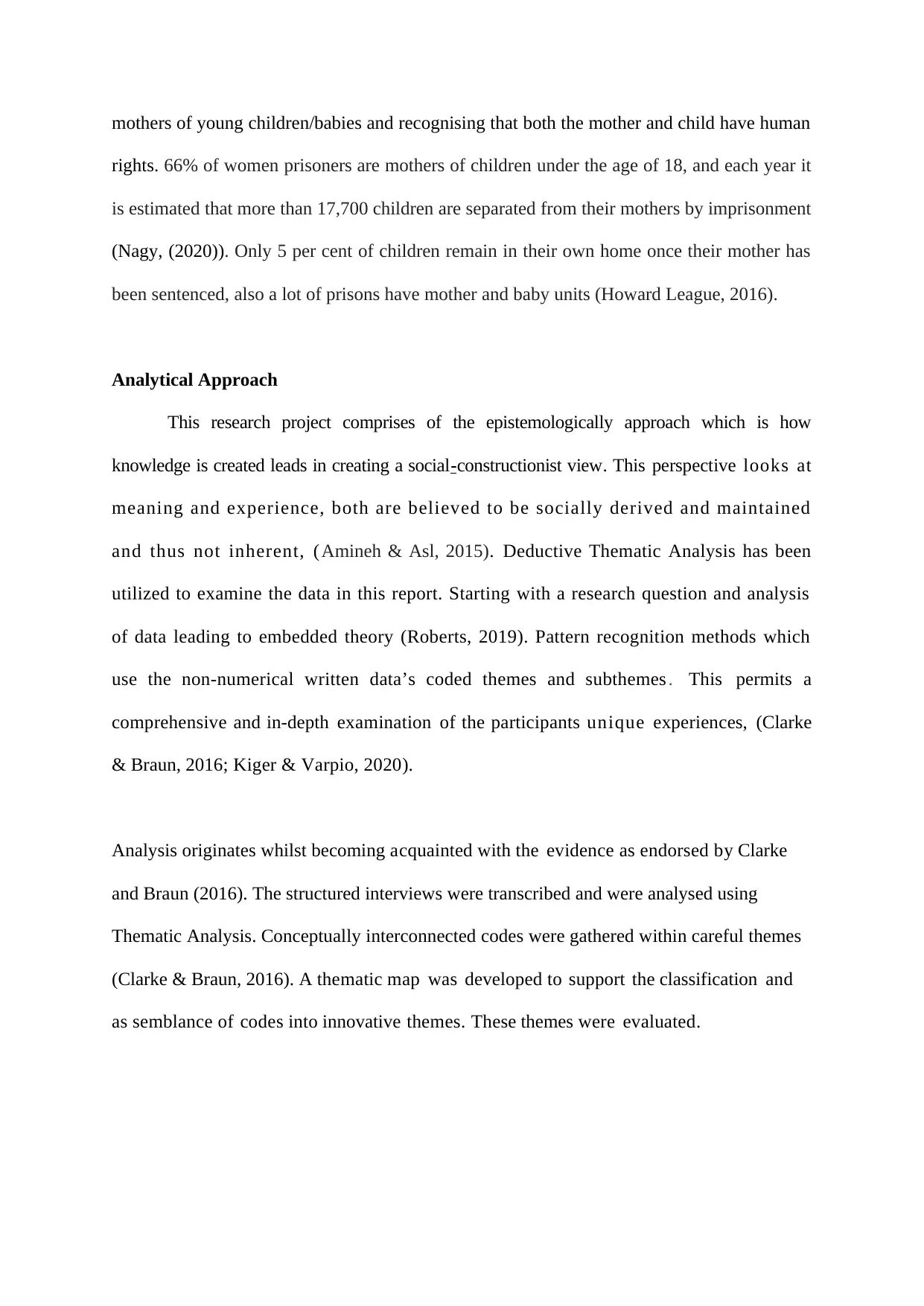
mothers of young children/babies and recognising that both the mother and child have human
rights. 66% of women prisoners are mothers of children under the age of 18, and each year it
is estimated that more than 17,700 children are separated from their mothers by imprisonment
(Nagy, (2020)). Only 5 per cent of children remain in their own home once their mother has
been sentenced, also a lot of prisons have mother and baby units (Howard League, 2016).
Analytical Approach
This research project comprises of the epistemologically approach which is how
knowledge is created leads in creating a social-constructionist view. This perspective looks at
meaning and experience, both are believed to be socially derived and maintained
and thus not inherent, (Amineh & Asl, 2015). Deductive Thematic Analysis has been
utilized to examine the data in this report. Starting with a research question and analysis
of data leading to embedded theory (Roberts, 2019). Pattern recognition methods which
use the non-numerical written data’s coded themes and subthemes . This permits a
comprehensive and in-depth examination of the participants unique experiences, (Clarke
& Braun, 2016; Kiger & Varpio, 2020).
Analysis originates whilst becoming acquainted with the evidence as endorsed by Clarke
and Braun (2016). The structured interviews were transcribed and were analysed using
Thematic Analysis. Conceptually interconnected codes were gathered within careful themes
(Clarke & Braun, 2016). A thematic map was developed to support the classification and
as semblance of codes into innovative themes. These themes were evaluated.
rights. 66% of women prisoners are mothers of children under the age of 18, and each year it
is estimated that more than 17,700 children are separated from their mothers by imprisonment
(Nagy, (2020)). Only 5 per cent of children remain in their own home once their mother has
been sentenced, also a lot of prisons have mother and baby units (Howard League, 2016).
Analytical Approach
This research project comprises of the epistemologically approach which is how
knowledge is created leads in creating a social-constructionist view. This perspective looks at
meaning and experience, both are believed to be socially derived and maintained
and thus not inherent, (Amineh & Asl, 2015). Deductive Thematic Analysis has been
utilized to examine the data in this report. Starting with a research question and analysis
of data leading to embedded theory (Roberts, 2019). Pattern recognition methods which
use the non-numerical written data’s coded themes and subthemes . This permits a
comprehensive and in-depth examination of the participants unique experiences, (Clarke
& Braun, 2016; Kiger & Varpio, 2020).
Analysis originates whilst becoming acquainted with the evidence as endorsed by Clarke
and Braun (2016). The structured interviews were transcribed and were analysed using
Thematic Analysis. Conceptually interconnected codes were gathered within careful themes
(Clarke & Braun, 2016). A thematic map was developed to support the classification and
as semblance of codes into innovative themes. These themes were evaluated.
⊘ This is a preview!⊘
Do you want full access?
Subscribe today to unlock all pages.

Trusted by 1+ million students worldwide
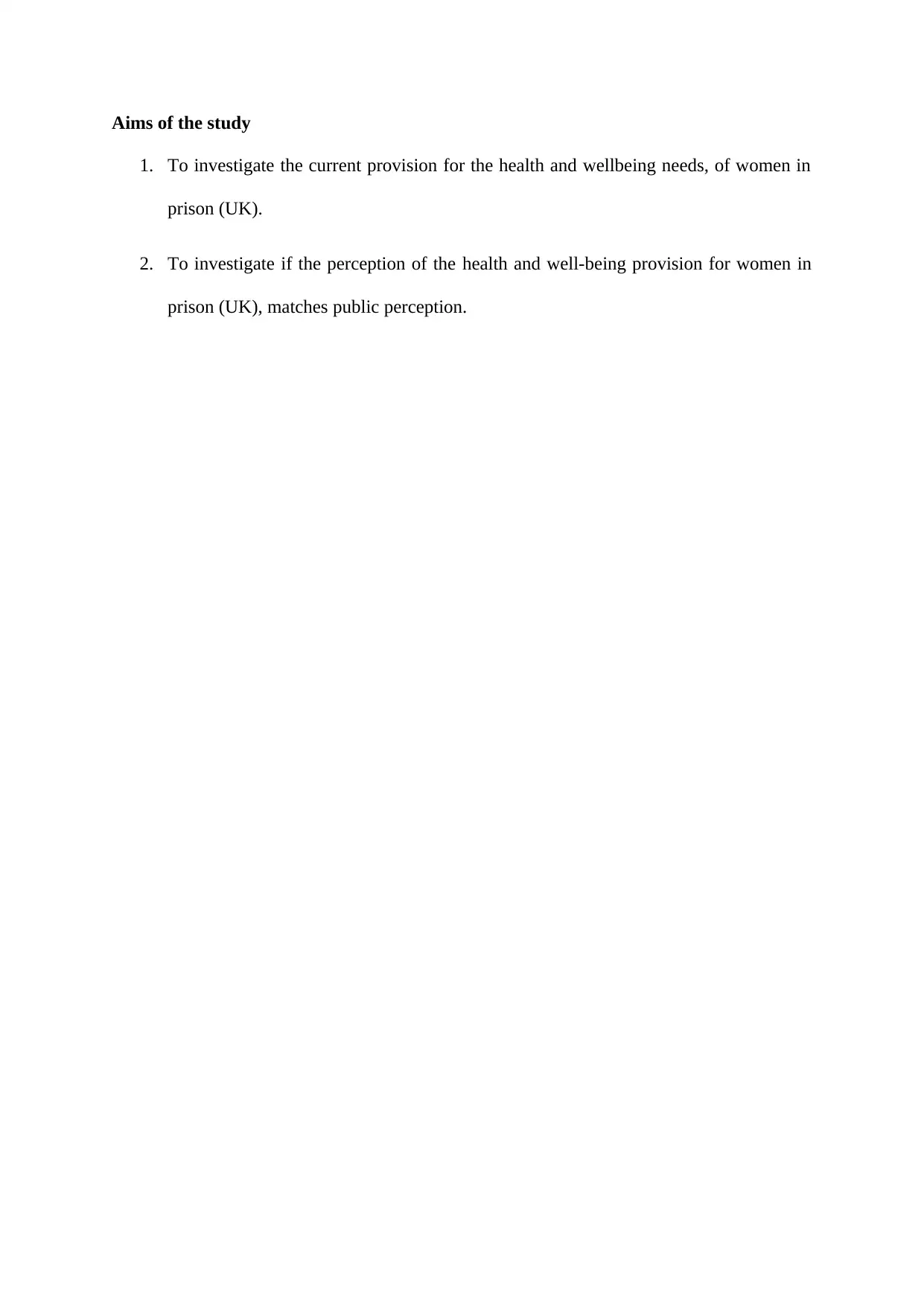
Aims of the study
1. To investigate the current provision for the health and wellbeing needs, of women in
prison (UK).
2. To investigate if the perception of the health and well-being provision for women in
prison (UK), matches public perception.
1. To investigate the current provision for the health and wellbeing needs, of women in
prison (UK).
2. To investigate if the perception of the health and well-being provision for women in
prison (UK), matches public perception.
Paraphrase This Document
Need a fresh take? Get an instant paraphrase of this document with our AI Paraphraser
Method
Design
The research design for this project is qualitative. Qualitative methodology is useful for
measuring, raking, categorizing, identifying patterns, and to collate in depth sensitive data
from participants using online / virtual interviews. The structured interviews were transcribed
and analysed using deductive Thematic Analysis. Rather than relying on a set of limited
questions to extract categorised, minimal choice responses with little or no room for
explanation, qualitative research relies on the participants to provide a more comprehensive
account of their perceptions and experiences (Jackson, Drummond & Camara, 2007). Thus
while addressing the aims of the given study the qualitative approach stands the appropriate
approach.
Participants
This study was a small case study comprising of the aspects of prison experience and good
physical/mental health. The male participant was 23, student and single (no children). The
female participant was 27, employed/student and partnered (1 child).
Materials
The material used to facilitate this study was an online questionnaire (Appendix A),
part one included an ethics statement and participants characteristics and part two
was the structured interview schedule. In order to develop the interview schedule, the
importance of the area of concern needs to be taken care of. And hence It is therefore
Design
The research design for this project is qualitative. Qualitative methodology is useful for
measuring, raking, categorizing, identifying patterns, and to collate in depth sensitive data
from participants using online / virtual interviews. The structured interviews were transcribed
and analysed using deductive Thematic Analysis. Rather than relying on a set of limited
questions to extract categorised, minimal choice responses with little or no room for
explanation, qualitative research relies on the participants to provide a more comprehensive
account of their perceptions and experiences (Jackson, Drummond & Camara, 2007). Thus
while addressing the aims of the given study the qualitative approach stands the appropriate
approach.
Participants
This study was a small case study comprising of the aspects of prison experience and good
physical/mental health. The male participant was 23, student and single (no children). The
female participant was 27, employed/student and partnered (1 child).
Materials
The material used to facilitate this study was an online questionnaire (Appendix A),
part one included an ethics statement and participants characteristics and part two
was the structured interview schedule. In order to develop the interview schedule, the
importance of the area of concern needs to be taken care of. And hence It is therefore
important to highlight the research confidentiality, the right to withdraw and that the research
will be anonymised and the duration of storage and the signposting of supportive services.
Procedure
The online survey was delivered by email, took between 15-30 minutes to complete,
and was returned by email to the research student for analysis. Once the survey was
completed participants were thanked for taking part.
Ethical considerations
All Ethical considerations have been considered, regarding this research and approved. Ethics
approval was sort and granted for the purposes of this study via the University department of
Psychology. Participants who expressed an interest in taking part were contacted by the
research student.
will be anonymised and the duration of storage and the signposting of supportive services.
Procedure
The online survey was delivered by email, took between 15-30 minutes to complete,
and was returned by email to the research student for analysis. Once the survey was
completed participants were thanked for taking part.
Ethical considerations
All Ethical considerations have been considered, regarding this research and approved. Ethics
approval was sort and granted for the purposes of this study via the University department of
Psychology. Participants who expressed an interest in taking part were contacted by the
research student.
⊘ This is a preview!⊘
Do you want full access?
Subscribe today to unlock all pages.
Trusted by 1+ million students worldwide
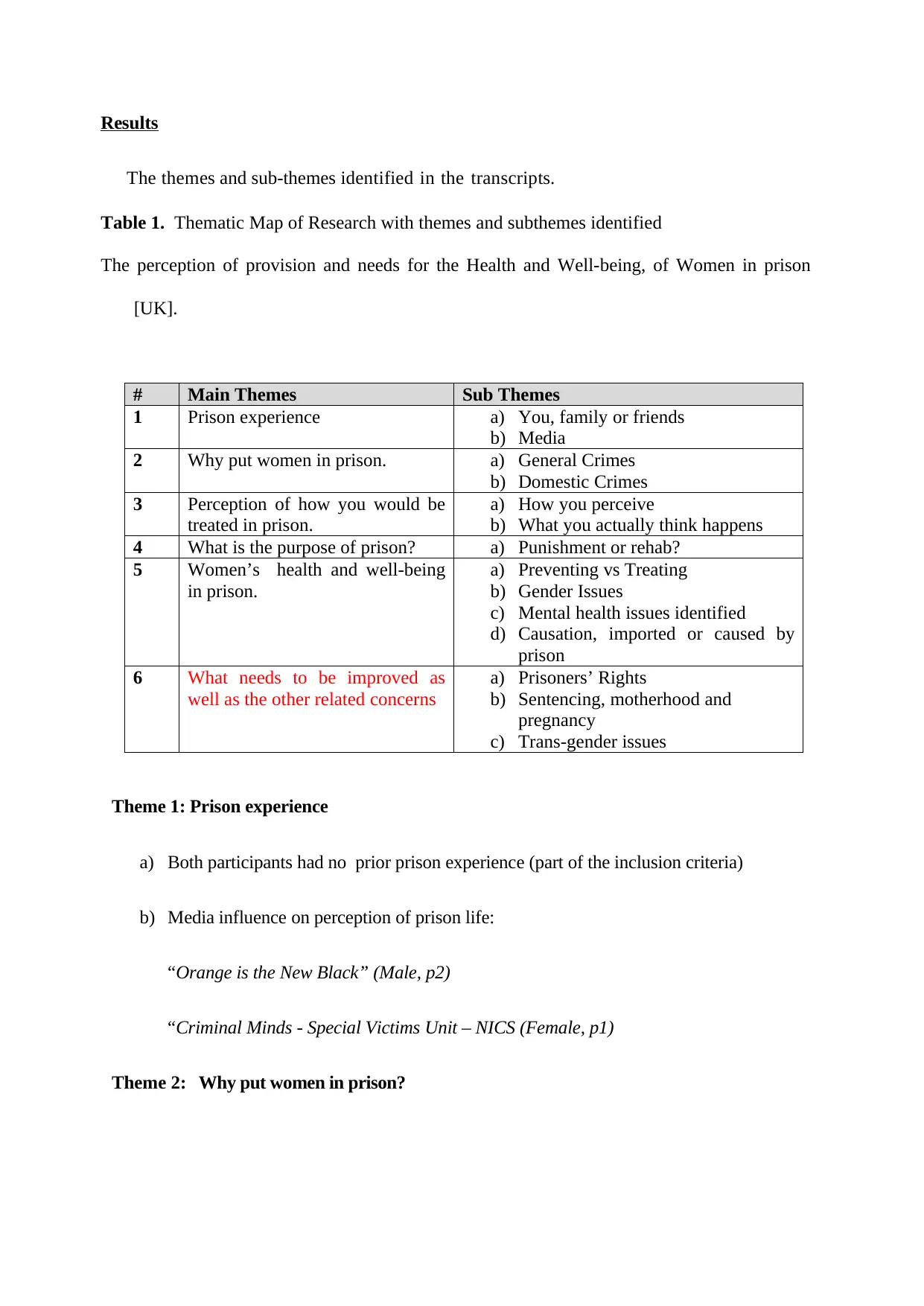
Results
The themes and sub-themes identified in the transcripts.
Table 1. Thematic Map of Research with themes and subthemes identified
The perception of provision and needs for the Health and Well-being, of Women in prison
[UK].
# Main Themes Sub Themes
1 Prison experience a) You, family or friends
b) Media
2 Why put women in prison. a) General Crimes
b) Domestic Crimes
3 Perception of how you would be
treated in prison.
a) How you perceive
b) What you actually think happens
4 What is the purpose of prison? a) Punishment or rehab?
5 Women’s health and well-being
in prison.
a) Preventing vs Treating
b) Gender Issues
c) Mental health issues identified
d) Causation, imported or caused by
prison
6 What needs to be improved as
well as the other related concerns
a) Prisoners’ Rights
b) Sentencing, motherhood and
pregnancy
c) Trans-gender issues
Theme 1: Prison experience
a) Both participants had no prior prison experience (part of the inclusion criteria)
b) Media influence on perception of prison life:
“Orange is the New Black” (Male, p2)
“Criminal Minds - Special Victims Unit – NICS (Female, p1)
Theme 2: Why put women in prison?
The themes and sub-themes identified in the transcripts.
Table 1. Thematic Map of Research with themes and subthemes identified
The perception of provision and needs for the Health and Well-being, of Women in prison
[UK].
# Main Themes Sub Themes
1 Prison experience a) You, family or friends
b) Media
2 Why put women in prison. a) General Crimes
b) Domestic Crimes
3 Perception of how you would be
treated in prison.
a) How you perceive
b) What you actually think happens
4 What is the purpose of prison? a) Punishment or rehab?
5 Women’s health and well-being
in prison.
a) Preventing vs Treating
b) Gender Issues
c) Mental health issues identified
d) Causation, imported or caused by
prison
6 What needs to be improved as
well as the other related concerns
a) Prisoners’ Rights
b) Sentencing, motherhood and
pregnancy
c) Trans-gender issues
Theme 1: Prison experience
a) Both participants had no prior prison experience (part of the inclusion criteria)
b) Media influence on perception of prison life:
“Orange is the New Black” (Male, p2)
“Criminal Minds - Special Victims Unit – NICS (Female, p1)
Theme 2: Why put women in prison?
Paraphrase This Document
Need a fresh take? Get an instant paraphrase of this document with our AI Paraphraser
Similar to that of the men, the women are also subjected to the penalties of various offences
and as a result of which are sentenced for the said acts. Further it can be ascertained that the
most crimes which are being committed by the women are resulted due to they being
aggrieved of the domestic or other related offences which motivates or aggresses them to for
the furtherance of crimes. Offences related to murder, small thefts, abduction of other child
are some of the offences for which they are most penalised. They are also subjected to the
penalties for the violence against the person as well as the property. (Male, p3) Moreover, the
aspect of equal treatment is also one major reason which motivates women for the
furtherance of crimes out of the feelings of revenge. Overall, most of the time because of the
domestic violence as well as the measure of self defence the crimes are carried out by the
women.(Female,p2).
Theme 3: Perception of how you would be treated in prison.
a) Expectation
“I expect to be treated with respect and not to be discriminated against. I would expect my
religious beliefs as well as cultural percepts to be respected. Furthermore, my well-being is
also an important aspect , and hence I expect to take part in education as well as the
activities which are aimed at rehabilitation. “ (Male, p2)
“Perhaps the way in which I look may hamper the way in which I will be treated due to the
colour of my skin and religion. So, unless I do not find a group that look like me, I assume I
would be treated unfairly.” (Female, p2)
b) Reality (perception of)
and as a result of which are sentenced for the said acts. Further it can be ascertained that the
most crimes which are being committed by the women are resulted due to they being
aggrieved of the domestic or other related offences which motivates or aggresses them to for
the furtherance of crimes. Offences related to murder, small thefts, abduction of other child
are some of the offences for which they are most penalised. They are also subjected to the
penalties for the violence against the person as well as the property. (Male, p3) Moreover, the
aspect of equal treatment is also one major reason which motivates women for the
furtherance of crimes out of the feelings of revenge. Overall, most of the time because of the
domestic violence as well as the measure of self defence the crimes are carried out by the
women.(Female,p2).
Theme 3: Perception of how you would be treated in prison.
a) Expectation
“I expect to be treated with respect and not to be discriminated against. I would expect my
religious beliefs as well as cultural percepts to be respected. Furthermore, my well-being is
also an important aspect , and hence I expect to take part in education as well as the
activities which are aimed at rehabilitation. “ (Male, p2)
“Perhaps the way in which I look may hamper the way in which I will be treated due to the
colour of my skin and religion. So, unless I do not find a group that look like me, I assume I
would be treated unfairly.” (Female, p2)
b) Reality (perception of)
“In some respects, they wouldn't match but in general I think these are rights that
prisoners should have.” (Male, p3)
“I fear the reality and expectation may be quite similar.” (Female, p2)
Theme 4: What is prison for?
Punishment/Rehab
“prison is the sharp end of our justice system and ultimately protects the public from
dangerous individuals. It is also the act of punishment for the crimes they have committed.”
(Male, p4)
“Not much to do with rehabilitation, but rather a reinsertion of power by the elites.”
(Female, p2)
Theme 5: Women’s mental health in prison.
a) Focus on Preventing or Treating
“Preventing health problems” (Male, p4)
“I believe inmates should be provided with the same level of care as those outside of prison,
and so health would be just as prioritised as all other important aspects in the outside
world.” (Female, p2)
b) Gender issues
“There is likely to be gender differences however in general preventing and treating health
problems are still fundamentally the same.” (Male, p4)
prisoners should have.” (Male, p3)
“I fear the reality and expectation may be quite similar.” (Female, p2)
Theme 4: What is prison for?
Punishment/Rehab
“prison is the sharp end of our justice system and ultimately protects the public from
dangerous individuals. It is also the act of punishment for the crimes they have committed.”
(Male, p4)
“Not much to do with rehabilitation, but rather a reinsertion of power by the elites.”
(Female, p2)
Theme 5: Women’s mental health in prison.
a) Focus on Preventing or Treating
“Preventing health problems” (Male, p4)
“I believe inmates should be provided with the same level of care as those outside of prison,
and so health would be just as prioritised as all other important aspects in the outside
world.” (Female, p2)
b) Gender issues
“There is likely to be gender differences however in general preventing and treating health
problems are still fundamentally the same.” (Male, p4)
⊘ This is a preview!⊘
Do you want full access?
Subscribe today to unlock all pages.
Trusted by 1+ million students worldwide
“They are designed to complement existing national and international health standards and
guidance for women in prison. Also, the measures reflect fairly wellbeing of men and women
separately.” (Male, p4)
“I was unaware that standard in healthcare was gender specific. Within the UK, I believe
that equality in this retrospect is achieved, especially between gender. Perhaps not to much
when comparing class, ethnicity, or those kind of segregated topics.” (Female, p2)
d) Mental health issues identified
“Anxiety, depression, and self-harm are fundamental issues that women may experience, and
prisons may exacerbate these issues.” (Male, pp 5-6)
“They may be feeling anxious or worried, depressed, sleep problems, weight or appetite
changes etc. These are common signs of mental health problems”. (Male, pp 5-6)
“I feel everyone has a tendency to slip into a mental health or physical health crisis. Going
into prison could therefore be a gateway to this. It does not necessarily mean that everyone
that goes into prison experienced mental or physical health issues. It could just be a stressor
that affects and or increases such issues.” (Female, p3)
e) Causation, imported or caused by prison
“I believe prisons can lead to these health issues especially mental health issues”…... “these
also occur outside of prison.” (Male, p5)
“I would not say created by being in prison, but perhaps assisted for some people who may
not have had issues outside of prison.” (Female p3)
Theme 6: What needs improving and other issues raised
Rights
“They would get essential health care but in reality, it probably isn't sufficient.” (Male, p8)
guidance for women in prison. Also, the measures reflect fairly wellbeing of men and women
separately.” (Male, p4)
“I was unaware that standard in healthcare was gender specific. Within the UK, I believe
that equality in this retrospect is achieved, especially between gender. Perhaps not to much
when comparing class, ethnicity, or those kind of segregated topics.” (Female, p2)
d) Mental health issues identified
“Anxiety, depression, and self-harm are fundamental issues that women may experience, and
prisons may exacerbate these issues.” (Male, pp 5-6)
“They may be feeling anxious or worried, depressed, sleep problems, weight or appetite
changes etc. These are common signs of mental health problems”. (Male, pp 5-6)
“I feel everyone has a tendency to slip into a mental health or physical health crisis. Going
into prison could therefore be a gateway to this. It does not necessarily mean that everyone
that goes into prison experienced mental or physical health issues. It could just be a stressor
that affects and or increases such issues.” (Female, p3)
e) Causation, imported or caused by prison
“I believe prisons can lead to these health issues especially mental health issues”…... “these
also occur outside of prison.” (Male, p5)
“I would not say created by being in prison, but perhaps assisted for some people who may
not have had issues outside of prison.” (Female p3)
Theme 6: What needs improving and other issues raised
Rights
“They would get essential health care but in reality, it probably isn't sufficient.” (Male, p8)
Paraphrase This Document
Need a fresh take? Get an instant paraphrase of this document with our AI Paraphraser
Motherhood/pregnancy and prison
“Depends on the crime but I do think certain provisions should be put in place for pregnant
women in prison…. I agree with them on some aspects as they allow the mother and baby to
live together in a peaceful safe place.” (Male, p8)
Trans-gender issues
“Their full wellbeing should be taking into account and ensuring that they still get equal
treatment to other inmates.” (Male, p8)
Covid-19
It is also worth noting that this study has been completed during a pandemic and responses to
research and interviews has been severely undermined. This has also restricted the possibility
of doing face-to-face interviews and enlisting more candidates directly by approaching on
campus.
“Depends on the crime but I do think certain provisions should be put in place for pregnant
women in prison…. I agree with them on some aspects as they allow the mother and baby to
live together in a peaceful safe place.” (Male, p8)
Trans-gender issues
“Their full wellbeing should be taking into account and ensuring that they still get equal
treatment to other inmates.” (Male, p8)
Covid-19
It is also worth noting that this study has been completed during a pandemic and responses to
research and interviews has been severely undermined. This has also restricted the possibility
of doing face-to-face interviews and enlisting more candidates directly by approaching on
campus.
Discussion
The analysis of data collected in this research, suggested that our two student participant’s
expectations/perception of treatment by prison and prison officers is roughly in line, with that
which legislation suggests. That is mainly that our human rights are and should be respected
for women, regardless of their status.
What stood out from this research is why women and people in general are in prison: “Not
much to do with rehabilitation, but rather a reinsertion of power by the elites.”, which could be
understood as social control by the elite ‘privileged’ class over an oppressed general public.
This also includes the ‘keep them in their place’. (Almeida, 2019).
Also, the female respondent, who self-declared as being ‘black’ and stated: “Perhaps how I
look may affect how I would be treated due to the colour of my skin and religion. So, unless I
do not find a group that look like me, I assume I would be treated unfairly.” This strongly
suggests that dependent on the colour of your skin and religion (eg. Islamic), you may
encounter a negative bias in the prison service. The issues of trans-gender and young mothers
in prison had bland/no responses and indicated either lack of care or knowledge of these issues.
This includes the interest, was a difference in gender response as to why women are in prison:
male, “They could have committed drug or property offences. Also, they may have been
sentenced for violence against a person or robbery”. Female, “Perhaps mostly due to domestic
violence, and what may seem self-defence”. Through this, it includes the understanding about
effective response towards dealing with better impact of learning and understanding the needs
of health and wellbeing to women in prision.
Issues raised by this research, is that it was a very small sample size and although it collected a
deep insight, it lacks generalisability to a larger target population. To improve and advance this
research. This research also suggested further avenues of research including looking at female
The analysis of data collected in this research, suggested that our two student participant’s
expectations/perception of treatment by prison and prison officers is roughly in line, with that
which legislation suggests. That is mainly that our human rights are and should be respected
for women, regardless of their status.
What stood out from this research is why women and people in general are in prison: “Not
much to do with rehabilitation, but rather a reinsertion of power by the elites.”, which could be
understood as social control by the elite ‘privileged’ class over an oppressed general public.
This also includes the ‘keep them in their place’. (Almeida, 2019).
Also, the female respondent, who self-declared as being ‘black’ and stated: “Perhaps how I
look may affect how I would be treated due to the colour of my skin and religion. So, unless I
do not find a group that look like me, I assume I would be treated unfairly.” This strongly
suggests that dependent on the colour of your skin and religion (eg. Islamic), you may
encounter a negative bias in the prison service. The issues of trans-gender and young mothers
in prison had bland/no responses and indicated either lack of care or knowledge of these issues.
This includes the interest, was a difference in gender response as to why women are in prison:
male, “They could have committed drug or property offences. Also, they may have been
sentenced for violence against a person or robbery”. Female, “Perhaps mostly due to domestic
violence, and what may seem self-defence”. Through this, it includes the understanding about
effective response towards dealing with better impact of learning and understanding the needs
of health and wellbeing to women in prision.
Issues raised by this research, is that it was a very small sample size and although it collected a
deep insight, it lacks generalisability to a larger target population. To improve and advance this
research. This research also suggested further avenues of research including looking at female
⊘ This is a preview!⊘
Do you want full access?
Subscribe today to unlock all pages.
Trusted by 1+ million students worldwide

1 out of 33


Related Documents


Your All-in-One AI-Powered Toolkit for Academic Success.
+13062052269
info@desklib.com
Available 24*7 on WhatsApp / Email
![[object Object]](/_next/static/media/star-bottom.7253800d.svg)
Unlock your academic potential
Copyright © 2020–2026 A2Z Services. All Rights Reserved. Developed and managed by ZUCOL.