Unit 3 HRM Report: Workforce Management and Employee Relations
VerifiedAdded on 2020/06/06
|16
|5083
|35
Report
AI Summary
This report delves into the core aspects of Human Resource Management (HRM), examining workforce planning, recruitment strategies, and training and development methodologies. It explores the purpose of workforce planning and the role of the HR manager, comparing the strengths and weaknesses of different recruitment approaches. The report analyzes job advertisements, suitable platforms, and job descriptions while differentiating between training and development, including the identification of training needs and the benefits of a systematic approach, particularly referencing TESCO. Furthermore, the report evaluates the effectiveness of training on return on investment, emphasizing the significance of good employee relations and key elements of employee legislation, providing a comprehensive overview of HRM practices and their impact on organizational success, specifically in the context of Woodhill College.

Unit 3. Human Resource
Management
Management

Paraphrase This Document
Need a fresh take? Get an instant paraphrase of this document with our AI Paraphraser
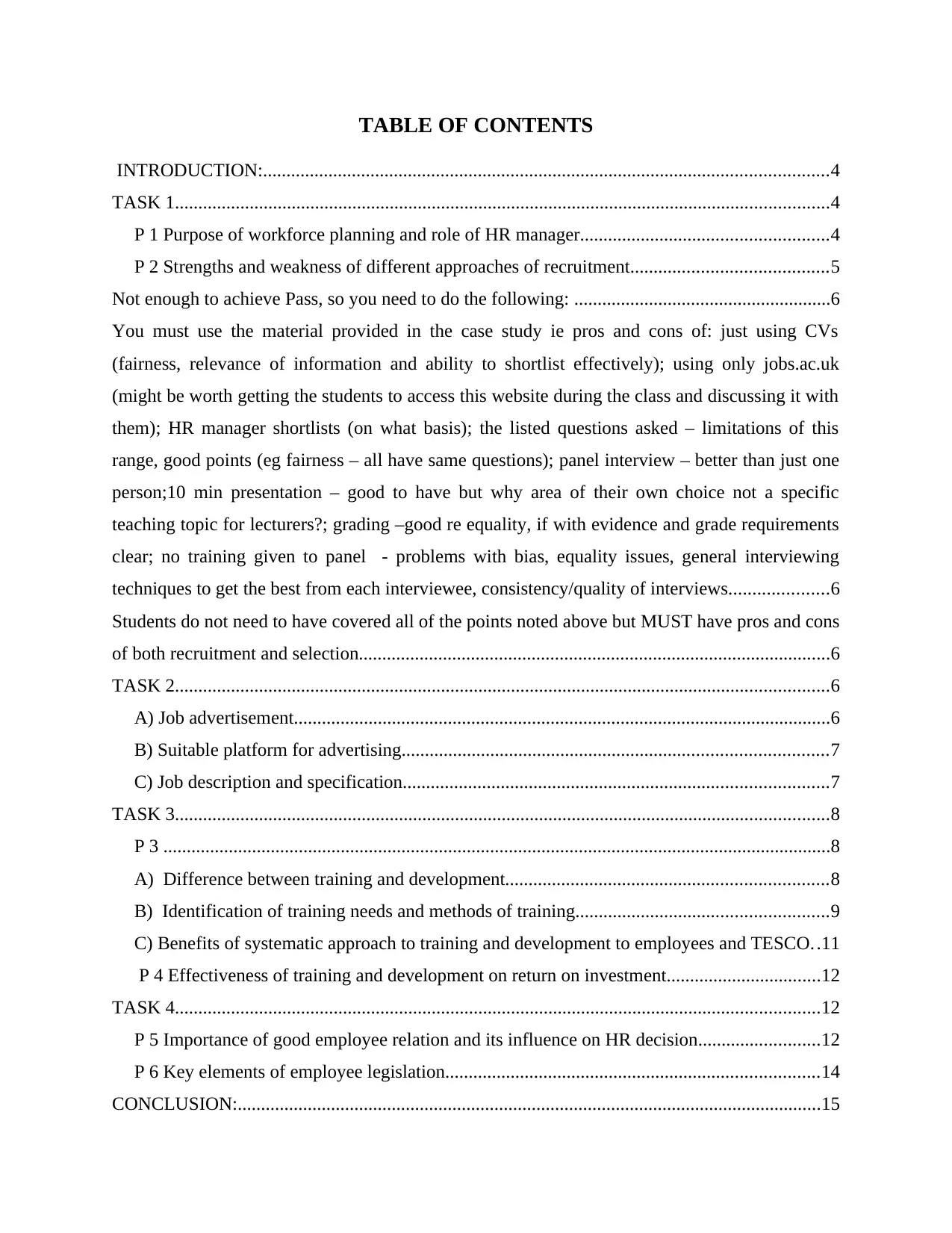
TABLE OF CONTENTS
INTRODUCTION:.........................................................................................................................4
TASK 1............................................................................................................................................4
P 1 Purpose of workforce planning and role of HR manager.....................................................4
P 2 Strengths and weakness of different approaches of recruitment..........................................5
Not enough to achieve Pass, so you need to do the following: .......................................................6
You must use the material provided in the case study ie pros and cons of: just using CVs
(fairness, relevance of information and ability to shortlist effectively); using only jobs.ac.uk
(might be worth getting the students to access this website during the class and discussing it with
them); HR manager shortlists (on what basis); the listed questions asked – limitations of this
range, good points (eg fairness – all have same questions); panel interview – better than just one
person;10 min presentation – good to have but why area of their own choice not a specific
teaching topic for lecturers?; grading –good re equality, if with evidence and grade requirements
clear; no training given to panel - problems with bias, equality issues, general interviewing
techniques to get the best from each interviewee, consistency/quality of interviews.....................6
Students do not need to have covered all of the points noted above but MUST have pros and cons
of both recruitment and selection.....................................................................................................6
TASK 2............................................................................................................................................6
A) Job advertisement...................................................................................................................6
B) Suitable platform for advertising...........................................................................................7
C) Job description and specification...........................................................................................7
TASK 3............................................................................................................................................8
P 3 ...............................................................................................................................................8
A) Difference between training and development.....................................................................8
B) Identification of training needs and methods of training......................................................9
C) Benefits of systematic approach to training and development to employees and TESCO. .11
P 4 Effectiveness of training and development on return on investment.................................12
TASK 4..........................................................................................................................................12
P 5 Importance of good employee relation and its influence on HR decision..........................12
P 6 Key elements of employee legislation................................................................................14
CONCLUSION:.............................................................................................................................15
INTRODUCTION:.........................................................................................................................4
TASK 1............................................................................................................................................4
P 1 Purpose of workforce planning and role of HR manager.....................................................4
P 2 Strengths and weakness of different approaches of recruitment..........................................5
Not enough to achieve Pass, so you need to do the following: .......................................................6
You must use the material provided in the case study ie pros and cons of: just using CVs
(fairness, relevance of information and ability to shortlist effectively); using only jobs.ac.uk
(might be worth getting the students to access this website during the class and discussing it with
them); HR manager shortlists (on what basis); the listed questions asked – limitations of this
range, good points (eg fairness – all have same questions); panel interview – better than just one
person;10 min presentation – good to have but why area of their own choice not a specific
teaching topic for lecturers?; grading –good re equality, if with evidence and grade requirements
clear; no training given to panel - problems with bias, equality issues, general interviewing
techniques to get the best from each interviewee, consistency/quality of interviews.....................6
Students do not need to have covered all of the points noted above but MUST have pros and cons
of both recruitment and selection.....................................................................................................6
TASK 2............................................................................................................................................6
A) Job advertisement...................................................................................................................6
B) Suitable platform for advertising...........................................................................................7
C) Job description and specification...........................................................................................7
TASK 3............................................................................................................................................8
P 3 ...............................................................................................................................................8
A) Difference between training and development.....................................................................8
B) Identification of training needs and methods of training......................................................9
C) Benefits of systematic approach to training and development to employees and TESCO. .11
P 4 Effectiveness of training and development on return on investment.................................12
TASK 4..........................................................................................................................................12
P 5 Importance of good employee relation and its influence on HR decision..........................12
P 6 Key elements of employee legislation................................................................................14
CONCLUSION:.............................................................................................................................15

REFERENCES:.............................................................................................................................16
⊘ This is a preview!⊘
Do you want full access?
Subscribe today to unlock all pages.

Trusted by 1+ million students worldwide
INTRODUCTION:
In every organisation the employees are its main pillars. They are the manpower that is
required for making any product. The process of recruiting and selecting talented employees,
providing training and development, appraising their performance, etc. are the functions of
Human resource management. By making the effective use of workforce in the organisation the
HRM increases their performance. This report is prepared to discuss the purpose of work force
planning and role of HR in it. Further, strengths and weakness of different approaches of
recruitment and selection is shown. What is the difference between training and development and
various methods of training used by TESCO and what will be the benefits of having a systematic
training approach is described. Also, the effectiveness on return on investment of TESCO by
T&D. At last it will show the benefits of maintaining the good employee relation and key
elements of employment legislation.
TASK 1
P 1 Purpose of workforce planning and role of HR manager
It is a process to ensure right people at right place so that they can deliver their skills to
the organisation for achieving long and short-term goals.
Workforce planning is a process in which the organisational needs and requirements are
identified and meet. It is usually done by using the advanced technology. An organisation goal
and objectives can be achieved only with the help of work force. In context with case study
Woodhill college needs to have professionals to continue their operations.
Problem solving- Stressful work environment often create conflicts in the organisation. It helps
in identifying problems and solving it. workforce team can deal with the major and minor issues
arising and always look for improvement. HR manager do planning to take specific steps in
managing problems (Armstrong, and Taylor, 2014)
Forecasting- It is done to make sure that there is always a backup ready in case of emergency. It
shows labour costs, retirement of employees. And what changes may occur. HR prepares
prospects that is useful in developing strategies to improve employee productivity.
In every organisation the employees are its main pillars. They are the manpower that is
required for making any product. The process of recruiting and selecting talented employees,
providing training and development, appraising their performance, etc. are the functions of
Human resource management. By making the effective use of workforce in the organisation the
HRM increases their performance. This report is prepared to discuss the purpose of work force
planning and role of HR in it. Further, strengths and weakness of different approaches of
recruitment and selection is shown. What is the difference between training and development and
various methods of training used by TESCO and what will be the benefits of having a systematic
training approach is described. Also, the effectiveness on return on investment of TESCO by
T&D. At last it will show the benefits of maintaining the good employee relation and key
elements of employment legislation.
TASK 1
P 1 Purpose of workforce planning and role of HR manager
It is a process to ensure right people at right place so that they can deliver their skills to
the organisation for achieving long and short-term goals.
Workforce planning is a process in which the organisational needs and requirements are
identified and meet. It is usually done by using the advanced technology. An organisation goal
and objectives can be achieved only with the help of work force. In context with case study
Woodhill college needs to have professionals to continue their operations.
Problem solving- Stressful work environment often create conflicts in the organisation. It helps
in identifying problems and solving it. workforce team can deal with the major and minor issues
arising and always look for improvement. HR manager do planning to take specific steps in
managing problems (Armstrong, and Taylor, 2014)
Forecasting- It is done to make sure that there is always a backup ready in case of emergency. It
shows labour costs, retirement of employees. And what changes may occur. HR prepares
prospects that is useful in developing strategies to improve employee productivity.
Paraphrase This Document
Need a fresh take? Get an instant paraphrase of this document with our AI Paraphraser
Leadership planning- Hiring right people at right place ensures in smooth running of
operations. Strategic planning helps in identifying key roles in specific employees in moving
forward. Mentorship encourages in meeting business goals and obtaining best results.
Improving KPI's- It improvises key performance areas of employees. Through this it provides a
clear outline of quantitative and qualitative objective to be met in the future.
It is a fully integrated process that helps in planning to avoid talent shortage or surplus.
Woodhill college needs effective professionals to continue with their operations. So the HR
manager role is to identify the needs to workforce and what are the best ways in which it can be
fulfilled.
Staffing- HR manager is responsible for recruiting and selecting the right candidate in the
organisation. So HR manager at woodhill college must find available sources through which staff
can be hired.
Training and development- It is the duty if HR manager to provide training to new staff so that
they can perform effectively. Training helps in gaining skills and abilities that are required to
perform job role.
Appraising performance- HR manager evaluates the performance of employees with set
standard and then rewards them for doing extra ordinary. The HR at woodhill college must
evaluate staff performance so that the entire college results can be improved.
P 2 Strengths and weakness of different approaches of recruitment
Effective recruitment helps in selecting the best candidates at the right place. Various
recruitment approach creates proper planning and responding quickly to arising of new vacancies
to build a pool of qualified candidates. Appropriate approach makes a systematic plan to provide
enough time to hire right rather than hiring at last minute. Different approaches are as follows:-
Internal sources- it is done to attract different candidate from within the organisation. It can be
done various sources like promotion, transfer, etc.
Transfer- it involves transferring of people from one position to another. It does not change any
role or duty but only location or rank.
Promotion- it refers to shifting of persons from low level to high level. This increases the
motivation of other people and they also work harder in order to achieve promotion.
operations. Strategic planning helps in identifying key roles in specific employees in moving
forward. Mentorship encourages in meeting business goals and obtaining best results.
Improving KPI's- It improvises key performance areas of employees. Through this it provides a
clear outline of quantitative and qualitative objective to be met in the future.
It is a fully integrated process that helps in planning to avoid talent shortage or surplus.
Woodhill college needs effective professionals to continue with their operations. So the HR
manager role is to identify the needs to workforce and what are the best ways in which it can be
fulfilled.
Staffing- HR manager is responsible for recruiting and selecting the right candidate in the
organisation. So HR manager at woodhill college must find available sources through which staff
can be hired.
Training and development- It is the duty if HR manager to provide training to new staff so that
they can perform effectively. Training helps in gaining skills and abilities that are required to
perform job role.
Appraising performance- HR manager evaluates the performance of employees with set
standard and then rewards them for doing extra ordinary. The HR at woodhill college must
evaluate staff performance so that the entire college results can be improved.
P 2 Strengths and weakness of different approaches of recruitment
Effective recruitment helps in selecting the best candidates at the right place. Various
recruitment approach creates proper planning and responding quickly to arising of new vacancies
to build a pool of qualified candidates. Appropriate approach makes a systematic plan to provide
enough time to hire right rather than hiring at last minute. Different approaches are as follows:-
Internal sources- it is done to attract different candidate from within the organisation. It can be
done various sources like promotion, transfer, etc.
Transfer- it involves transferring of people from one position to another. It does not change any
role or duty but only location or rank.
Promotion- it refers to shifting of persons from low level to high level. This increases the
motivation of other people and they also work harder in order to achieve promotion.
External sources- in this candidate are recruited from outside the college. It brings in fresh talent
and experience persons. Various methods are:-
advertisement- in this ads are given in newspaper and magazines for recruiting the prospective
candidates (Brewster,and et.al 2014)
Employment exchange- in this employee are recruited with the help of consultancy firm.
Skills inventory- In this various skill sets of employees are compiled together for each job. It
helps in creating list of candidate’s characteristics with addition to minimum requirements
needed in job. from substantial number of candidate’s specific ones can be selected for job.
Example along with bachelor degree, masters can also be required.
Job posting- This strategy helps in systematic process of selection. List of skills required to do
job is posted to produce that type of candidate.
Multi step recruitment- Interviews are done to finding the specific candidates for job.
Interviews are breaking up into many stages depending upon the candidates and HR. After that
the final decision is made. First a brief telephonic conversation is done, then candidate is invited
for face to face interview, this can be done in two steps depending upon the selection policy. It
becomes very challenging for HR to follow this procedure.
Using CV's – The advantage of this is it takes less time and resources to recruit and hire staff .
Also, it is the best method to in which manager just have to analyse on basis of qualification and
experience of candidate. But its disadvantage is it do not provide effective candidate to hire. Just
only be analysing CV's do not give more detailed information of candidate. Also, it is restricts
the various sources through which fresh talent can be hired.
Website- Its advantage is it only provides information of those candidates who are interested in
doing job. Its disadvantage is it is difficult to sort data on basis of knowledge and experience.
TASK 2
A) Job advertisement
JOB OPPORTUNITY
Woodhill college requires a qualified mathematics lecturer who is experienced enough in
and experience persons. Various methods are:-
advertisement- in this ads are given in newspaper and magazines for recruiting the prospective
candidates (Brewster,and et.al 2014)
Employment exchange- in this employee are recruited with the help of consultancy firm.
Skills inventory- In this various skill sets of employees are compiled together for each job. It
helps in creating list of candidate’s characteristics with addition to minimum requirements
needed in job. from substantial number of candidate’s specific ones can be selected for job.
Example along with bachelor degree, masters can also be required.
Job posting- This strategy helps in systematic process of selection. List of skills required to do
job is posted to produce that type of candidate.
Multi step recruitment- Interviews are done to finding the specific candidates for job.
Interviews are breaking up into many stages depending upon the candidates and HR. After that
the final decision is made. First a brief telephonic conversation is done, then candidate is invited
for face to face interview, this can be done in two steps depending upon the selection policy. It
becomes very challenging for HR to follow this procedure.
Using CV's – The advantage of this is it takes less time and resources to recruit and hire staff .
Also, it is the best method to in which manager just have to analyse on basis of qualification and
experience of candidate. But its disadvantage is it do not provide effective candidate to hire. Just
only be analysing CV's do not give more detailed information of candidate. Also, it is restricts
the various sources through which fresh talent can be hired.
Website- Its advantage is it only provides information of those candidates who are interested in
doing job. Its disadvantage is it is difficult to sort data on basis of knowledge and experience.
TASK 2
A) Job advertisement
JOB OPPORTUNITY
Woodhill college requires a qualified mathematics lecturer who is experienced enough in
⊘ This is a preview!⊘
Do you want full access?
Subscribe today to unlock all pages.
Trusted by 1+ million students worldwide
teaching profession.
Qualification required:
Having diploma in mathematics and post-graduation from a recognised university
Experience
Minimum 5 years of experience in teaching profession.
Age:
Between 24 and 35 with excellent health
Interested candidates may send their resume on jobs. ac.uk before 25th December.
HR Manager
Woodhill college
London, UK
B) Suitable platform for advertising
The advertisement can be place in various media that will attract large number of
prospective candidates. It can be placed on social networking sites such as linked in which will
be very beneficial and very cheap. Newspapers can also be considered for attracting large
number of audience through which vacancies can be fulfilled, but it will be very costly and a
time-consuming process. In addition to this the best way is contacting the consultancy agency.
These agencies can be used to fulfil the vacancies. They are having a lot data of candidates
which can best match with given job. Although it is costly but an effective way of recruiting
candidates. Internet can also be used for this purpose.
C) Job description and specification
Job description
Job title- Mathematics lecturer
Duties- Providing quality education to students. English is compulsory. Problem solving skills
and excellent IQ is required.
Role- Role of executive lecturer.
Qualification required:
Having diploma in mathematics and post-graduation from a recognised university
Experience
Minimum 5 years of experience in teaching profession.
Age:
Between 24 and 35 with excellent health
Interested candidates may send their resume on jobs. ac.uk before 25th December.
HR Manager
Woodhill college
London, UK
B) Suitable platform for advertising
The advertisement can be place in various media that will attract large number of
prospective candidates. It can be placed on social networking sites such as linked in which will
be very beneficial and very cheap. Newspapers can also be considered for attracting large
number of audience through which vacancies can be fulfilled, but it will be very costly and a
time-consuming process. In addition to this the best way is contacting the consultancy agency.
These agencies can be used to fulfil the vacancies. They are having a lot data of candidates
which can best match with given job. Although it is costly but an effective way of recruiting
candidates. Internet can also be used for this purpose.
C) Job description and specification
Job description
Job title- Mathematics lecturer
Duties- Providing quality education to students. English is compulsory. Problem solving skills
and excellent IQ is required.
Role- Role of executive lecturer.
Paraphrase This Document
Need a fresh take? Get an instant paraphrase of this document with our AI Paraphraser
Location- College campus
Remuneration- According to the qualification and experience
Job specification
Job mission- it includes the job role of lecturer to provide quality education to students and
performing other duties and roles as well.
Outcomes- Candidate must be able to perform their duty very well. Also, to give best results in
their subject in entire college.
TASK 3
P 3
A) Difference between training and development
Training and development are far away from each other in terms of increasing the
efficiency for doing a specific job. This can be identified by the methods or ways in which it
affects employee performance. There are differences between training and development.
Training is a learning process which helps in delivering and developing the skills that is required
in doing a job. Development is self - learning educational process which helps in gaining
knowledge that leads to overall growth of employees. Training is focused on doing the present
activities in effective way whereas development focuses on activities that are to be done in the
future. Time period in training in generally short term as it is related to only a specific job, but
development is a life lone process and it goes on. Training is an initiative that is designed by
company and is given in groups (Chelladurai, and Kerwin,, 2017)
On the other hand development emphasis on individuals. The objectives defined in training are
how to use a program or protocols in job. Development objectives are open and can be changed
over time by changing habits. Due to short term the main aim of training is related to specific
job position. It provides tools and skills for doing task. Development aims on person’s
professional career by identifying their interests for easy progress by gaining conceptual and
general knowledge. Training is given with the purpose of improving productivity and workforce
Remuneration- According to the qualification and experience
Job specification
Job mission- it includes the job role of lecturer to provide quality education to students and
performing other duties and roles as well.
Outcomes- Candidate must be able to perform their duty very well. Also, to give best results in
their subject in entire college.
TASK 3
P 3
A) Difference between training and development
Training and development are far away from each other in terms of increasing the
efficiency for doing a specific job. This can be identified by the methods or ways in which it
affects employee performance. There are differences between training and development.
Training is a learning process which helps in delivering and developing the skills that is required
in doing a job. Development is self - learning educational process which helps in gaining
knowledge that leads to overall growth of employees. Training is focused on doing the present
activities in effective way whereas development focuses on activities that are to be done in the
future. Time period in training in generally short term as it is related to only a specific job, but
development is a life lone process and it goes on. Training is an initiative that is designed by
company and is given in groups (Chelladurai, and Kerwin,, 2017)
On the other hand development emphasis on individuals. The objectives defined in training are
how to use a program or protocols in job. Development objectives are open and can be changed
over time by changing habits. Due to short term the main aim of training is related to specific
job position. It provides tools and skills for doing task. Development aims on person’s
professional career by identifying their interests for easy progress by gaining conceptual and
general knowledge. Training is given with the purpose of improving productivity and workforce
flexibility. Development changes the attitude with increase in capabilities and skills. Due to
which it improves leadership effectiveness that enables the growth of managers and leaders. It is
also beneficial for organisation in fulfilling the future needs. Training is considered as reactive
process while development is considered as proactive process. Result of effective training will
impact external stimulus i.e. actions in working while development impact internal stimulus i.e.
minds of employees. Training can have negative or positive impact on organisation and
employee, if employee is not interested in training it will have negative impact. Development
always have positive impact and will benefit organisation and employee. Newly joined are often
given training but development are new things related to his work or others. (Brewster,and et.al
2016)
HR manager at woodhill college must provide training to new staff that has been hired. It will be
useful for them to know how to teach students. Also, providing training will be useful in
knowing how they are able to teach. With this the development of candidate can be done. They
can be allowed to teach more than one subject. This will help them in gaining more knowledge.
B) Identification of training needs and methods of training
Identification of training needs can be done in many ways:-
Industry needs- it means that the industry is lacking some essential knowledge at a
particular point. It arrives within the industry and helps organisation to fit into industry.
Job needs- they are directly related to jobs in the organisation. It is researched that
whether any job needs training or not. If yes, then training program is created. its purpose
is to improve the final output of job and identifying the aspects that are related to on the
job training.
Task needs- it is related to a task or project that is needed to be completed within the job.
A job is combination of different tasks so if one or more task is affecting the overall job
productivity, it is necessary to improve that task.
Assessment methods- in this there are three methods. First one is organisational
perspective that is focused on improving the enterprise. It identifies and fulfil the gaps
which exist in skills and knowledge. It determines which part of enterprise requires
which it improves leadership effectiveness that enables the growth of managers and leaders. It is
also beneficial for organisation in fulfilling the future needs. Training is considered as reactive
process while development is considered as proactive process. Result of effective training will
impact external stimulus i.e. actions in working while development impact internal stimulus i.e.
minds of employees. Training can have negative or positive impact on organisation and
employee, if employee is not interested in training it will have negative impact. Development
always have positive impact and will benefit organisation and employee. Newly joined are often
given training but development are new things related to his work or others. (Brewster,and et.al
2016)
HR manager at woodhill college must provide training to new staff that has been hired. It will be
useful for them to know how to teach students. Also, providing training will be useful in
knowing how they are able to teach. With this the development of candidate can be done. They
can be allowed to teach more than one subject. This will help them in gaining more knowledge.
B) Identification of training needs and methods of training
Identification of training needs can be done in many ways:-
Industry needs- it means that the industry is lacking some essential knowledge at a
particular point. It arrives within the industry and helps organisation to fit into industry.
Job needs- they are directly related to jobs in the organisation. It is researched that
whether any job needs training or not. If yes, then training program is created. its purpose
is to improve the final output of job and identifying the aspects that are related to on the
job training.
Task needs- it is related to a task or project that is needed to be completed within the job.
A job is combination of different tasks so if one or more task is affecting the overall job
productivity, it is necessary to improve that task.
Assessment methods- in this there are three methods. First one is organisational
perspective that is focused on improving the enterprise. It identifies and fulfil the gaps
which exist in skills and knowledge. It determines which part of enterprise requires
⊘ This is a preview!⊘
Do you want full access?
Subscribe today to unlock all pages.
Trusted by 1+ million students worldwide
training. Second is task perspective that analysis the skills required to perform job
efficiently. Training needs are identified by job description, questionnaires, etc. it
determines gaps between required and existing skills. Third is individual assessment is
related to strengths and weakness of employees. It shows who needs what type of training
by identifying existing skills and capacity for learning. Each one helps in improving the
effectiveness of enterprise. (Sparrow, Marchington, and et.al., 2016)
Training methods- The first method is on the job training- in this the training is given on
workplace. With the help of OJT proficiency skills can be developed that are easy to learn which
increases productivity and skills of employees. OJT plans consists of job requirements and its
related abilities and skills to learn.
Off the job methods-
Lecturers: It is one of the best method to give theoretical knowledge and is usually in
classroom format. With the help of this problem-solving skills can be developed in
employees. It is used to train a lot people with huge amount of information within brief
time that reduces cost and saves time. Lectures can be given by manager or leader for
imparting technical knowledge.
Conference: It can be used to solve the conflict between two groups. This helps in
inviting the overall enterprise in which a lot of trainee’s participation occurs. This create
a situation in which it becomes difficult to control them. various suggestions and opinions
of different people generated may differ from each other ideas
Seminars- It includes various methods like: lectures, discussions, conferences, etc. every
member of group are involved in this. It is a time-consuming process the trainer can use
many group methods for this activity. also, the trainer must possess skills in conducting a
seminar. (Storey, , 2014)
Role Playing – it helps to solve out issues that occurs at workplace. In this large groups
are spilt into pairs and perform their roles. It is good for employees working with sales
efficiently. Training needs are identified by job description, questionnaires, etc. it
determines gaps between required and existing skills. Third is individual assessment is
related to strengths and weakness of employees. It shows who needs what type of training
by identifying existing skills and capacity for learning. Each one helps in improving the
effectiveness of enterprise. (Sparrow, Marchington, and et.al., 2016)
Training methods- The first method is on the job training- in this the training is given on
workplace. With the help of OJT proficiency skills can be developed that are easy to learn which
increases productivity and skills of employees. OJT plans consists of job requirements and its
related abilities and skills to learn.
Off the job methods-
Lecturers: It is one of the best method to give theoretical knowledge and is usually in
classroom format. With the help of this problem-solving skills can be developed in
employees. It is used to train a lot people with huge amount of information within brief
time that reduces cost and saves time. Lectures can be given by manager or leader for
imparting technical knowledge.
Conference: It can be used to solve the conflict between two groups. This helps in
inviting the overall enterprise in which a lot of trainee’s participation occurs. This create
a situation in which it becomes difficult to control them. various suggestions and opinions
of different people generated may differ from each other ideas
Seminars- It includes various methods like: lectures, discussions, conferences, etc. every
member of group are involved in this. It is a time-consuming process the trainer can use
many group methods for this activity. also, the trainer must possess skills in conducting a
seminar. (Storey, , 2014)
Role Playing – it helps to solve out issues that occurs at workplace. In this large groups
are spilt into pairs and perform their roles. It is good for employees working with sales
Paraphrase This Document
Need a fresh take? Get an instant paraphrase of this document with our AI Paraphraser
and customer service where the trainees assume roles and act out situations connected to
the learning concepts.
Films and videos- it helps in effective decision making on specific issues that are related
to work place issues.
Case study- it is useful for trainees in analysing the real work place issues. It helps in
developing analytical skills of problem solving and learning principles or theories. A
sense of team work can be developed through this. (Marchington, and et.al., 2016.)
C) Benefits of systematic approach to training and development to employees and TESCO
There are many benefits of having systematic approach training:-
Organised approach- it breaks the organisation into distinct phases that facilitates the flow of
information and promotes better understanding. It determines training needs by analysing
employee performance, background, and behaviour. It helps to reach similar understandings
towards organisational objectives. TESCO can analysis their employee’s skills and then make
them decisions for training.
Clarity and responsibility- it helps in determining the responsibility of employees. If any
worker fails in doing so manager may refer back to training. This will recognise the fault of
worker and improves them. TESCO will be able to easily identify workers who needs what type
of training. This will reduce the conflict between employees and managers and TESCO can
improve their workers productivity.
Recognising employee needs- it is useful in determining the future and present needs of
employees. Manager will get to know what worker needs to improve its efficiency. Workers in
TESCO can be trained on various levels so that their goals can be achieved. This will help
company in smooth running of operations. (Sparrow, and et.al, 2016)
Recognising employee abilities- it determines the ability in which worker excel. It brings out
the strength of worker by evaluating it. These strengths are further enhanced for growth and
the learning concepts.
Films and videos- it helps in effective decision making on specific issues that are related
to work place issues.
Case study- it is useful for trainees in analysing the real work place issues. It helps in
developing analytical skills of problem solving and learning principles or theories. A
sense of team work can be developed through this. (Marchington, and et.al., 2016.)
C) Benefits of systematic approach to training and development to employees and TESCO
There are many benefits of having systematic approach training:-
Organised approach- it breaks the organisation into distinct phases that facilitates the flow of
information and promotes better understanding. It determines training needs by analysing
employee performance, background, and behaviour. It helps to reach similar understandings
towards organisational objectives. TESCO can analysis their employee’s skills and then make
them decisions for training.
Clarity and responsibility- it helps in determining the responsibility of employees. If any
worker fails in doing so manager may refer back to training. This will recognise the fault of
worker and improves them. TESCO will be able to easily identify workers who needs what type
of training. This will reduce the conflict between employees and managers and TESCO can
improve their workers productivity.
Recognising employee needs- it is useful in determining the future and present needs of
employees. Manager will get to know what worker needs to improve its efficiency. Workers in
TESCO can be trained on various levels so that their goals can be achieved. This will help
company in smooth running of operations. (Sparrow, and et.al, 2016)
Recognising employee abilities- it determines the ability in which worker excel. It brings out
the strength of worker by evaluating it. These strengths are further enhanced for growth and
development of individual. It boosts up confidence level and ability to do job better. TESCO can
encourage workers growth that will enhance their ability and skills in performing better.
Hands on design- it recognizes that which knowledge and skills must be communicated through
training. This ensures that no incorrect information is given to them. The training program
measures the behaviour and performance of employees. (Chelladurai, and Kerwin, 2017) This
will help TESCO in evaluating skills and abilities of team after training by consulting it with
managers.
P 4 Effectiveness of training and development on return on investment
Drawing up HRM plan- An effective HRM plan with proper number of candidates required
according to job description and specification will help the organisation to focus on achieving
goals. If proper number of employees are recognised, then it becomes easy for HR manager to
divide duties and task in proper way. Workers will do best for the task that has been given to
them and it will lead to increase in productivity of each employee. Giving proper training on
right time will improve their efficiency and hence the overall performance will be enhanced.
T&D- A set of skills and duties that are required to perform a task will help employee in
improving their weakness on right time. Also, regular review of training and development
policies helps in utilising the training programs in effective way. It ensures that performance of
employees is improved and this lead to better working of employees. Effective training also
boosts the profits of company by improving productivity.
Service quality- it is focused on improving the service of customers to make them satisfied.
Policies and procedures must be changed to enhance the public image. It will help in gaining
market share and thus increasing profits. (Brewster,and et.al 2016)
Profitability- It means that profits of firm are increased with more experienced and trained
employees. Their working efficiency is increased and this leads to improve business
productivity. Goals and objectives are achieved in more effective way leading to increase in
profits of firm.
encourage workers growth that will enhance their ability and skills in performing better.
Hands on design- it recognizes that which knowledge and skills must be communicated through
training. This ensures that no incorrect information is given to them. The training program
measures the behaviour and performance of employees. (Chelladurai, and Kerwin, 2017) This
will help TESCO in evaluating skills and abilities of team after training by consulting it with
managers.
P 4 Effectiveness of training and development on return on investment
Drawing up HRM plan- An effective HRM plan with proper number of candidates required
according to job description and specification will help the organisation to focus on achieving
goals. If proper number of employees are recognised, then it becomes easy for HR manager to
divide duties and task in proper way. Workers will do best for the task that has been given to
them and it will lead to increase in productivity of each employee. Giving proper training on
right time will improve their efficiency and hence the overall performance will be enhanced.
T&D- A set of skills and duties that are required to perform a task will help employee in
improving their weakness on right time. Also, regular review of training and development
policies helps in utilising the training programs in effective way. It ensures that performance of
employees is improved and this lead to better working of employees. Effective training also
boosts the profits of company by improving productivity.
Service quality- it is focused on improving the service of customers to make them satisfied.
Policies and procedures must be changed to enhance the public image. It will help in gaining
market share and thus increasing profits. (Brewster,and et.al 2016)
Profitability- It means that profits of firm are increased with more experienced and trained
employees. Their working efficiency is increased and this leads to improve business
productivity. Goals and objectives are achieved in more effective way leading to increase in
profits of firm.
⊘ This is a preview!⊘
Do you want full access?
Subscribe today to unlock all pages.
Trusted by 1+ million students worldwide

1 out of 16


Related Documents


Your All-in-One AI-Powered Toolkit for Academic Success.
+13062052269
info@desklib.com
Available 24*7 on WhatsApp / Email
![[object Object]](/_next/static/media/star-bottom.7253800d.svg)
Unlock your academic potential
Copyright © 2020–2026 A2Z Services. All Rights Reserved. Developed and managed by ZUCOL.