Identifying and Assessing the Risks of Woodside Petroleum Company
VerifiedAdded on 2020/03/23
|21
|5229
|284
Report
AI Summary
This report provides a comprehensive risk assessment of Woodside Petroleum Company, examining the various factors impacting its performance within the Australian oil and gas industry. The analysis includes an executive summary, introduction, and detailed sections covering Woodside's business, the Australian oil and gas industry, and the legal environment. The report utilizes SWOT and PESTEL analyses to evaluate external environmental factors, along with Porter's Five Forces and other relevant factors. It also delves into Woodside's objectives, strategies, business risks, and financial performance, supported by analytical procedures and an overview of the company's management and governance structure. The report highlights the company's strengths, weaknesses, opportunities, and threats, along with political, economic, social, technological, environmental, and legal factors affecting its operations. Financial ratio analysis and an organizational structure diagram are included in the appendices to provide additional insights into Woodside's performance and risk management strategies. The report concludes by emphasizing the importance of risk management in the company's business plan.
Running head: A CASE OF WOODSIDE PETROLEUM COMPANY
Identifying and Assessing the Risks of Material Misstatement through Understanding
the Entity and Its Environment
A case of Woodside Petroleum Company
Name
Institution
Identifying and Assessing the Risks of Material Misstatement through Understanding
the Entity and Its Environment
A case of Woodside Petroleum Company
Name
Institution

Paraphrase This Document
Need a fresh take? Get an instant paraphrase of this document with our AI Paraphraser
A CASE OF WOODSIDE PETROLEUM COMPANY 2
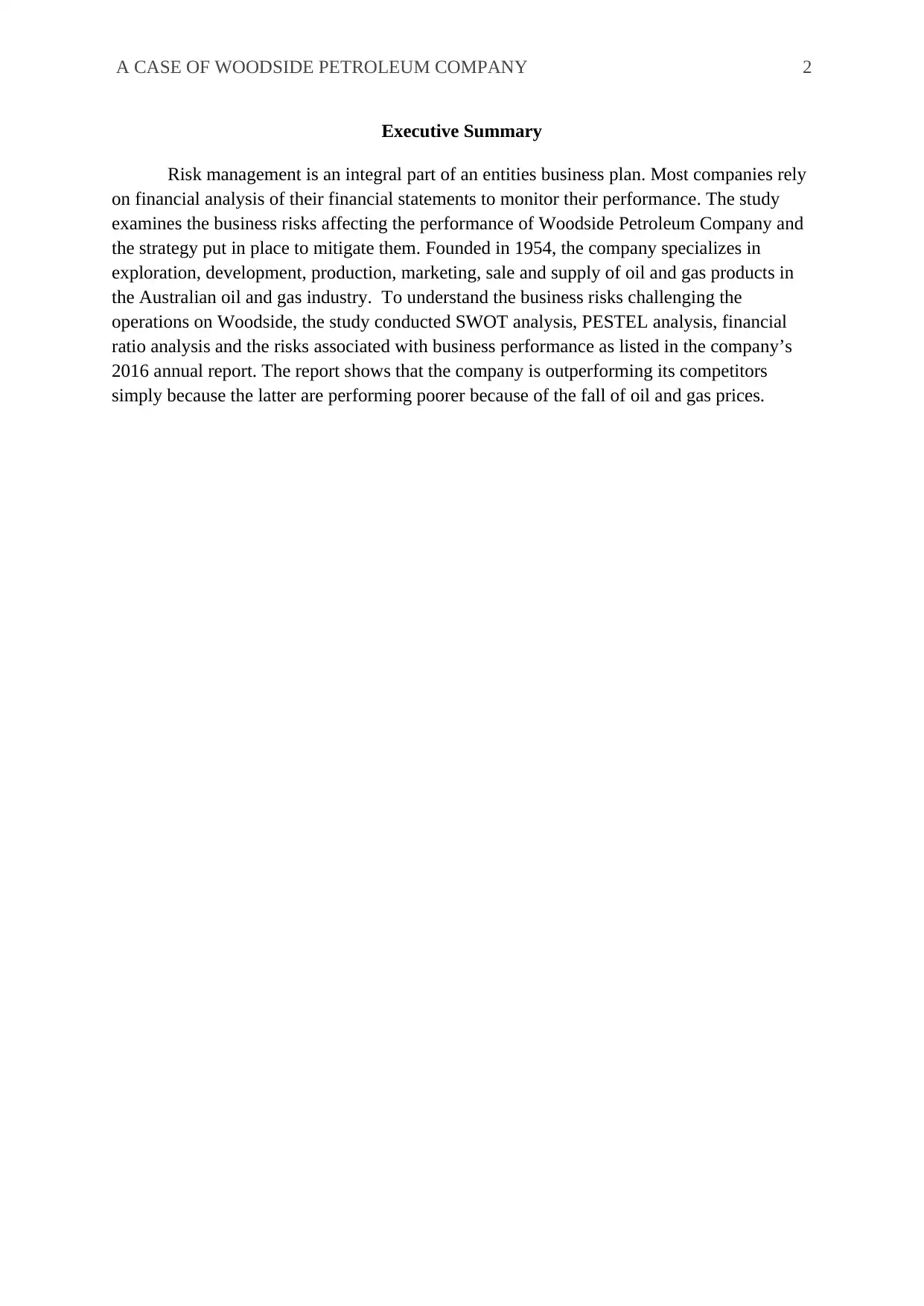
Executive Summary
Risk management is an integral part of an entities business plan. Most companies rely
on financial analysis of their financial statements to monitor their performance. The study
examines the business risks affecting the performance of Woodside Petroleum Company and
the strategy put in place to mitigate them. Founded in 1954, the company specializes in
exploration, development, production, marketing, sale and supply of oil and gas products in
the Australian oil and gas industry. To understand the business risks challenging the
operations on Woodside, the study conducted SWOT analysis, PESTEL analysis, financial
ratio analysis and the risks associated with business performance as listed in the company’s
2016 annual report. The report shows that the company is outperforming its competitors
simply because the latter are performing poorer because of the fall of oil and gas prices.
Executive Summary
Risk management is an integral part of an entities business plan. Most companies rely
on financial analysis of their financial statements to monitor their performance. The study
examines the business risks affecting the performance of Woodside Petroleum Company and
the strategy put in place to mitigate them. Founded in 1954, the company specializes in
exploration, development, production, marketing, sale and supply of oil and gas products in
the Australian oil and gas industry. To understand the business risks challenging the
operations on Woodside, the study conducted SWOT analysis, PESTEL analysis, financial
ratio analysis and the risks associated with business performance as listed in the company’s
2016 annual report. The report shows that the company is outperforming its competitors
simply because the latter are performing poorer because of the fall of oil and gas prices.
A CASE OF WOODSIDE PETROLEUM COMPANY 3
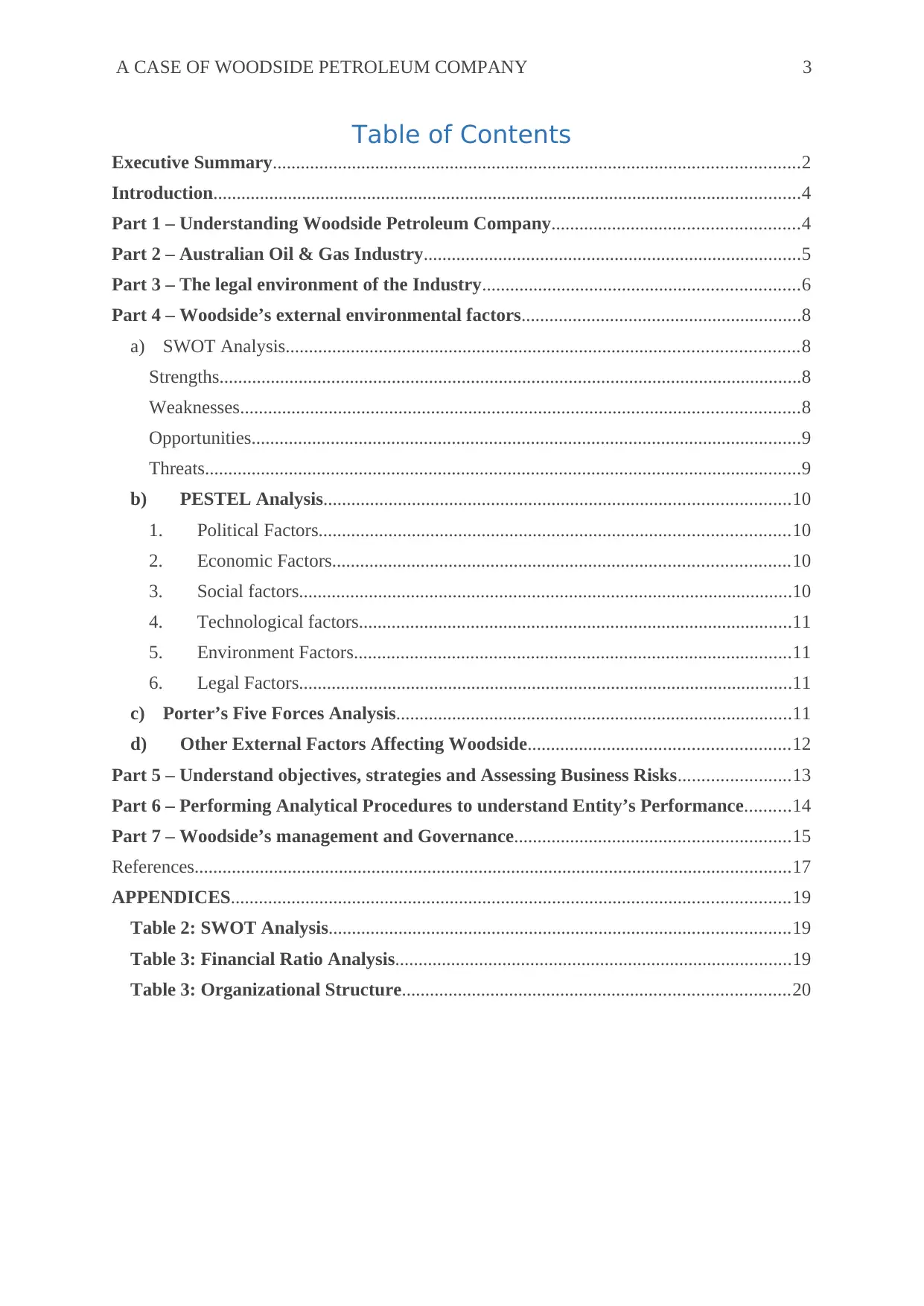
Table of Contents
Executive Summary.................................................................................................................2
Introduction..............................................................................................................................4
Part 1 – Understanding Woodside Petroleum Company.....................................................4
Part 2 – Australian Oil & Gas Industry.................................................................................5
Part 3 – The legal environment of the Industry....................................................................6
Part 4 – Woodside’s external environmental factors............................................................8
a) SWOT Analysis..............................................................................................................8
Strengths.............................................................................................................................8
Weaknesses........................................................................................................................8
Opportunities......................................................................................................................9
Threats................................................................................................................................9
b) PESTEL Analysis....................................................................................................10
1. Political Factors.....................................................................................................10
2. Economic Factors..................................................................................................10
3. Social factors..........................................................................................................10
4. Technological factors.............................................................................................11
5. Environment Factors..............................................................................................11
6. Legal Factors..........................................................................................................11
c) Porter’s Five Forces Analysis.....................................................................................11
d) Other External Factors Affecting Woodside........................................................12
Part 5 – Understand objectives, strategies and Assessing Business Risks........................13
Part 6 – Performing Analytical Procedures to understand Entity’s Performance..........14
Part 7 – Woodside’s management and Governance...........................................................15
References................................................................................................................................17
APPENDICES........................................................................................................................19
Table 2: SWOT Analysis...................................................................................................19
Table 3: Financial Ratio Analysis.....................................................................................19
Table 3: Organizational Structure...................................................................................20
Table of Contents
Executive Summary.................................................................................................................2
Introduction..............................................................................................................................4
Part 1 – Understanding Woodside Petroleum Company.....................................................4
Part 2 – Australian Oil & Gas Industry.................................................................................5
Part 3 – The legal environment of the Industry....................................................................6
Part 4 – Woodside’s external environmental factors............................................................8
a) SWOT Analysis..............................................................................................................8
Strengths.............................................................................................................................8
Weaknesses........................................................................................................................8
Opportunities......................................................................................................................9
Threats................................................................................................................................9
b) PESTEL Analysis....................................................................................................10
1. Political Factors.....................................................................................................10
2. Economic Factors..................................................................................................10
3. Social factors..........................................................................................................10
4. Technological factors.............................................................................................11
5. Environment Factors..............................................................................................11
6. Legal Factors..........................................................................................................11
c) Porter’s Five Forces Analysis.....................................................................................11
d) Other External Factors Affecting Woodside........................................................12
Part 5 – Understand objectives, strategies and Assessing Business Risks........................13
Part 6 – Performing Analytical Procedures to understand Entity’s Performance..........14
Part 7 – Woodside’s management and Governance...........................................................15
References................................................................................................................................17
APPENDICES........................................................................................................................19
Table 2: SWOT Analysis...................................................................................................19
Table 3: Financial Ratio Analysis.....................................................................................19
Table 3: Organizational Structure...................................................................................20
⊘ This is a preview!⊘
Do you want full access?
Subscribe today to unlock all pages.

Trusted by 1+ million students worldwide
A CASE OF WOODSIDE PETROLEUM COMPANY 4
Introduction
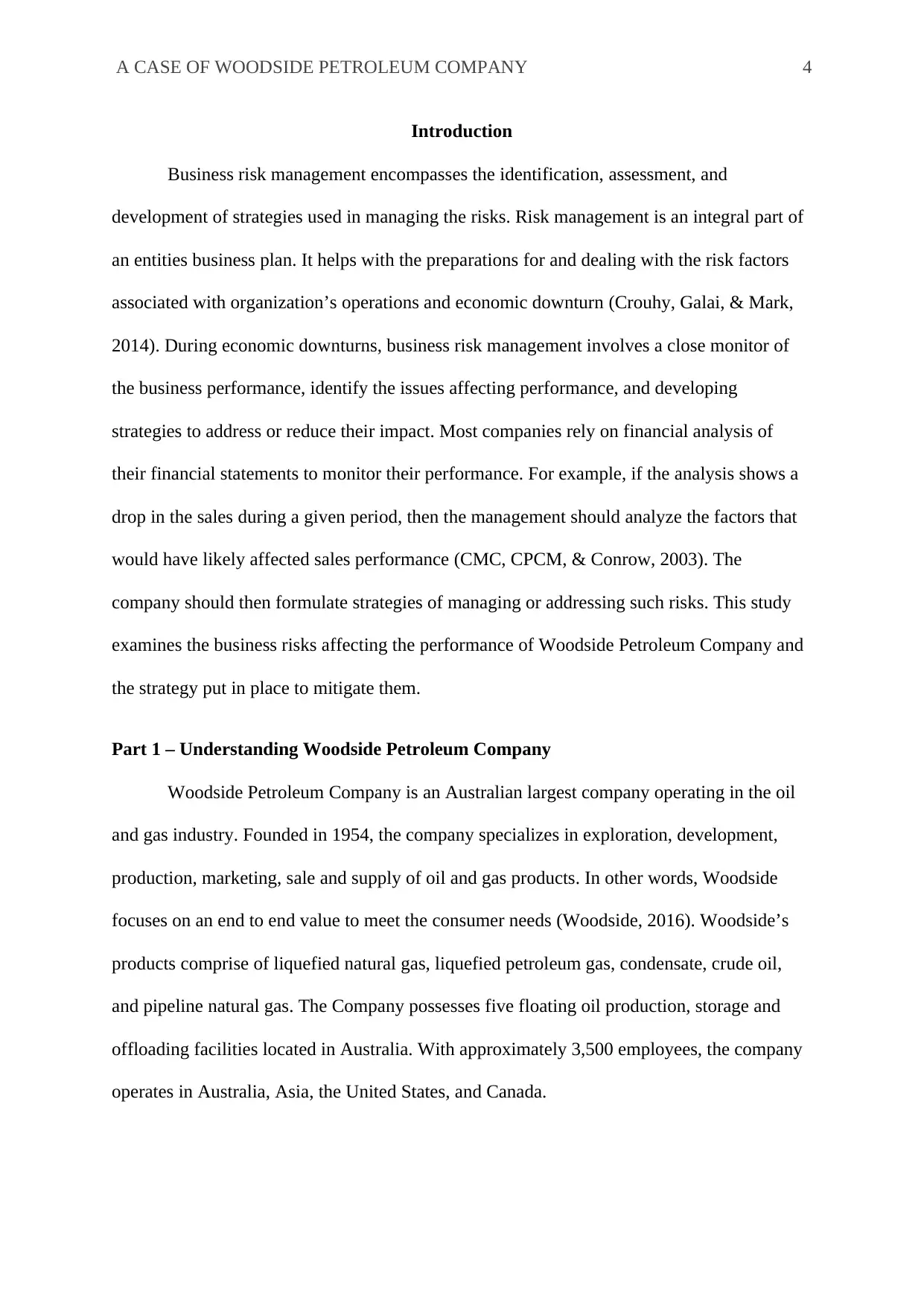
Business risk management encompasses the identification, assessment, and
development of strategies used in managing the risks. Risk management is an integral part of
an entities business plan. It helps with the preparations for and dealing with the risk factors
associated with organization’s operations and economic downturn (Crouhy, Galai, & Mark,
2014). During economic downturns, business risk management involves a close monitor of
the business performance, identify the issues affecting performance, and developing
strategies to address or reduce their impact. Most companies rely on financial analysis of
their financial statements to monitor their performance. For example, if the analysis shows a
drop in the sales during a given period, then the management should analyze the factors that
would have likely affected sales performance (CMC, CPCM, & Conrow, 2003). The
company should then formulate strategies of managing or addressing such risks. This study
examines the business risks affecting the performance of Woodside Petroleum Company and
the strategy put in place to mitigate them.
Part 1 – Understanding Woodside Petroleum Company
Woodside Petroleum Company is an Australian largest company operating in the oil
and gas industry. Founded in 1954, the company specializes in exploration, development,
production, marketing, sale and supply of oil and gas products. In other words, Woodside
focuses on an end to end value to meet the consumer needs (Woodside, 2016). Woodside’s
products comprise of liquefied natural gas, liquefied petroleum gas, condensate, crude oil,
and pipeline natural gas. The Company possesses five floating oil production, storage and
offloading facilities located in Australia. With approximately 3,500 employees, the company
operates in Australia, Asia, the United States, and Canada.
Introduction
Business risk management encompasses the identification, assessment, and
development of strategies used in managing the risks. Risk management is an integral part of
an entities business plan. It helps with the preparations for and dealing with the risk factors
associated with organization’s operations and economic downturn (Crouhy, Galai, & Mark,
2014). During economic downturns, business risk management involves a close monitor of
the business performance, identify the issues affecting performance, and developing
strategies to address or reduce their impact. Most companies rely on financial analysis of
their financial statements to monitor their performance. For example, if the analysis shows a
drop in the sales during a given period, then the management should analyze the factors that
would have likely affected sales performance (CMC, CPCM, & Conrow, 2003). The
company should then formulate strategies of managing or addressing such risks. This study
examines the business risks affecting the performance of Woodside Petroleum Company and
the strategy put in place to mitigate them.
Part 1 – Understanding Woodside Petroleum Company
Woodside Petroleum Company is an Australian largest company operating in the oil
and gas industry. Founded in 1954, the company specializes in exploration, development,
production, marketing, sale and supply of oil and gas products. In other words, Woodside
focuses on an end to end value to meet the consumer needs (Woodside, 2016). Woodside’s
products comprise of liquefied natural gas, liquefied petroleum gas, condensate, crude oil,
and pipeline natural gas. The Company possesses five floating oil production, storage and
offloading facilities located in Australia. With approximately 3,500 employees, the company
operates in Australia, Asia, the United States, and Canada.
Paraphrase This Document
Need a fresh take? Get an instant paraphrase of this document with our AI Paraphraser
A CASE OF WOODSIDE PETROLEUM COMPANY 5
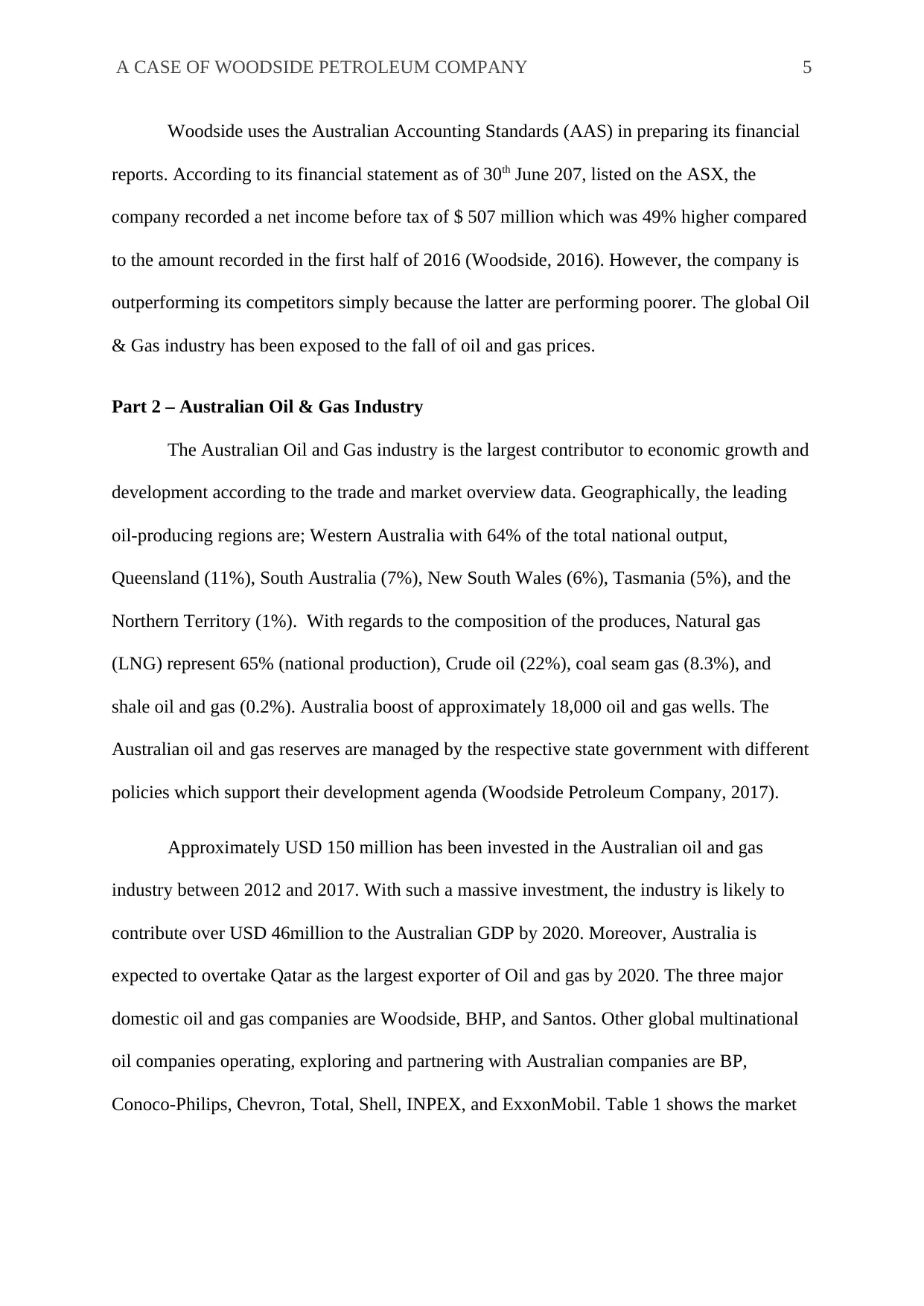
Woodside uses the Australian Accounting Standards (AAS) in preparing its financial
reports. According to its financial statement as of 30th June 207, listed on the ASX, the
company recorded a net income before tax of $ 507 million which was 49% higher compared
to the amount recorded in the first half of 2016 (Woodside, 2016). However, the company is
outperforming its competitors simply because the latter are performing poorer. The global Oil
& Gas industry has been exposed to the fall of oil and gas prices.
Part 2 – Australian Oil & Gas Industry
The Australian Oil and Gas industry is the largest contributor to economic growth and
development according to the trade and market overview data. Geographically, the leading
oil-producing regions are; Western Australia with 64% of the total national output,
Queensland (11%), South Australia (7%), New South Wales (6%), Tasmania (5%), and the
Northern Territory (1%). With regards to the composition of the produces, Natural gas
(LNG) represent 65% (national production), Crude oil (22%), coal seam gas (8.3%), and
shale oil and gas (0.2%). Australia boost of approximately 18,000 oil and gas wells. The
Australian oil and gas reserves are managed by the respective state government with different
policies which support their development agenda (Woodside Petroleum Company, 2017).
Approximately USD 150 million has been invested in the Australian oil and gas
industry between 2012 and 2017. With such a massive investment, the industry is likely to
contribute over USD 46million to the Australian GDP by 2020. Moreover, Australia is
expected to overtake Qatar as the largest exporter of Oil and gas by 2020. The three major
domestic oil and gas companies are Woodside, BHP, and Santos. Other global multinational
oil companies operating, exploring and partnering with Australian companies are BP,
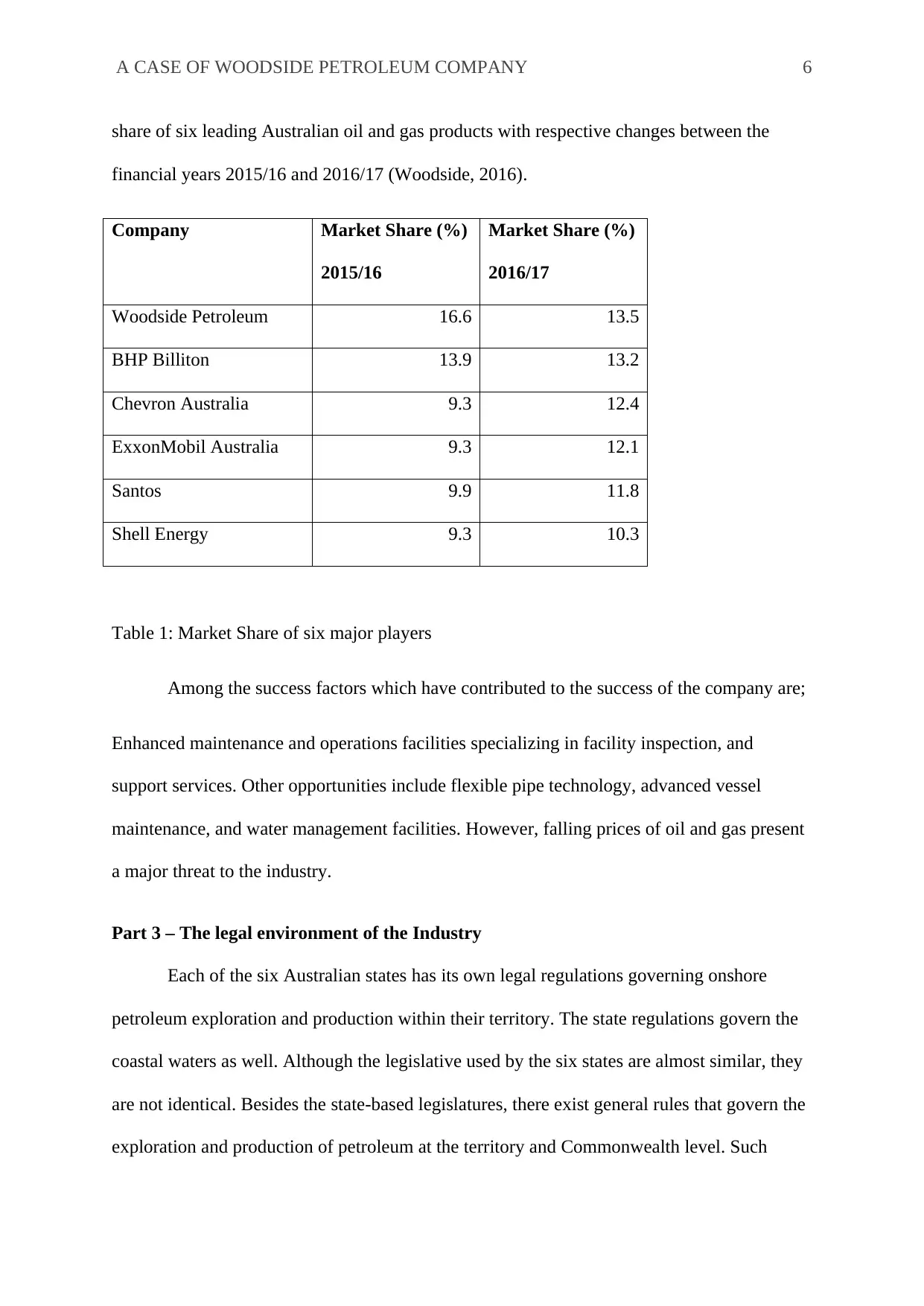
Conoco-Philips, Chevron, Total, Shell, INPEX, and ExxonMobil. Table 1 shows the market
Woodside uses the Australian Accounting Standards (AAS) in preparing its financial
reports. According to its financial statement as of 30th June 207, listed on the ASX, the
company recorded a net income before tax of $ 507 million which was 49% higher compared
to the amount recorded in the first half of 2016 (Woodside, 2016). However, the company is
outperforming its competitors simply because the latter are performing poorer. The global Oil
& Gas industry has been exposed to the fall of oil and gas prices.
Part 2 – Australian Oil & Gas Industry
The Australian Oil and Gas industry is the largest contributor to economic growth and
development according to the trade and market overview data. Geographically, the leading
oil-producing regions are; Western Australia with 64% of the total national output,
Queensland (11%), South Australia (7%), New South Wales (6%), Tasmania (5%), and the
Northern Territory (1%). With regards to the composition of the produces, Natural gas
(LNG) represent 65% (national production), Crude oil (22%), coal seam gas (8.3%), and
shale oil and gas (0.2%). Australia boost of approximately 18,000 oil and gas wells. The
Australian oil and gas reserves are managed by the respective state government with different
policies which support their development agenda (Woodside Petroleum Company, 2017).
Approximately USD 150 million has been invested in the Australian oil and gas
industry between 2012 and 2017. With such a massive investment, the industry is likely to
contribute over USD 46million to the Australian GDP by 2020. Moreover, Australia is
expected to overtake Qatar as the largest exporter of Oil and gas by 2020. The three major
domestic oil and gas companies are Woodside, BHP, and Santos. Other global multinational
oil companies operating, exploring and partnering with Australian companies are BP,
Conoco-Philips, Chevron, Total, Shell, INPEX, and ExxonMobil. Table 1 shows the market
A CASE OF WOODSIDE PETROLEUM COMPANY 6
share of six leading Australian oil and gas products with respective changes between the
financial years 2015/16 and 2016/17 (Woodside, 2016).
Company Market Share (%)
2015/16
Market Share (%)
2016/17
Woodside Petroleum 16.6 13.5
BHP Billiton 13.9 13.2
Chevron Australia 9.3 12.4
ExxonMobil Australia 9.3 12.1
Santos 9.9 11.8
Shell Energy 9.3 10.3
Table 1: Market Share of six major players
Among the success factors which have contributed to the success of the company are;
Enhanced maintenance and operations facilities specializing in facility inspection, and
support services. Other opportunities include flexible pipe technology, advanced vessel
maintenance, and water management facilities. However, falling prices of oil and gas present
a major threat to the industry.
Part 3 – The legal environment of the Industry
Each of the six Australian states has its own legal regulations governing onshore
petroleum exploration and production within their territory. The state regulations govern the
coastal waters as well. Although the legislative used by the six states are almost similar, they
are not identical. Besides the state-based legislatures, there exist general rules that govern the
exploration and production of petroleum at the territory and Commonwealth level. Such
share of six leading Australian oil and gas products with respective changes between the
financial years 2015/16 and 2016/17 (Woodside, 2016).
Company Market Share (%)
2015/16
Market Share (%)
2016/17
Woodside Petroleum 16.6 13.5
BHP Billiton 13.9 13.2
Chevron Australia 9.3 12.4
ExxonMobil Australia 9.3 12.1
Santos 9.9 11.8
Shell Energy 9.3 10.3
Table 1: Market Share of six major players
Among the success factors which have contributed to the success of the company are;
Enhanced maintenance and operations facilities specializing in facility inspection, and
support services. Other opportunities include flexible pipe technology, advanced vessel
maintenance, and water management facilities. However, falling prices of oil and gas present
a major threat to the industry.
Part 3 – The legal environment of the Industry
Each of the six Australian states has its own legal regulations governing onshore
petroleum exploration and production within their territory. The state regulations govern the
coastal waters as well. Although the legislative used by the six states are almost similar, they
are not identical. Besides the state-based legislatures, there exist general rules that govern the
exploration and production of petroleum at the territory and Commonwealth level. Such
⊘ This is a preview!⊘
Do you want full access?
Subscribe today to unlock all pages.
Trusted by 1+ million students worldwide
A CASE OF WOODSIDE PETROLEUM COMPANY 7
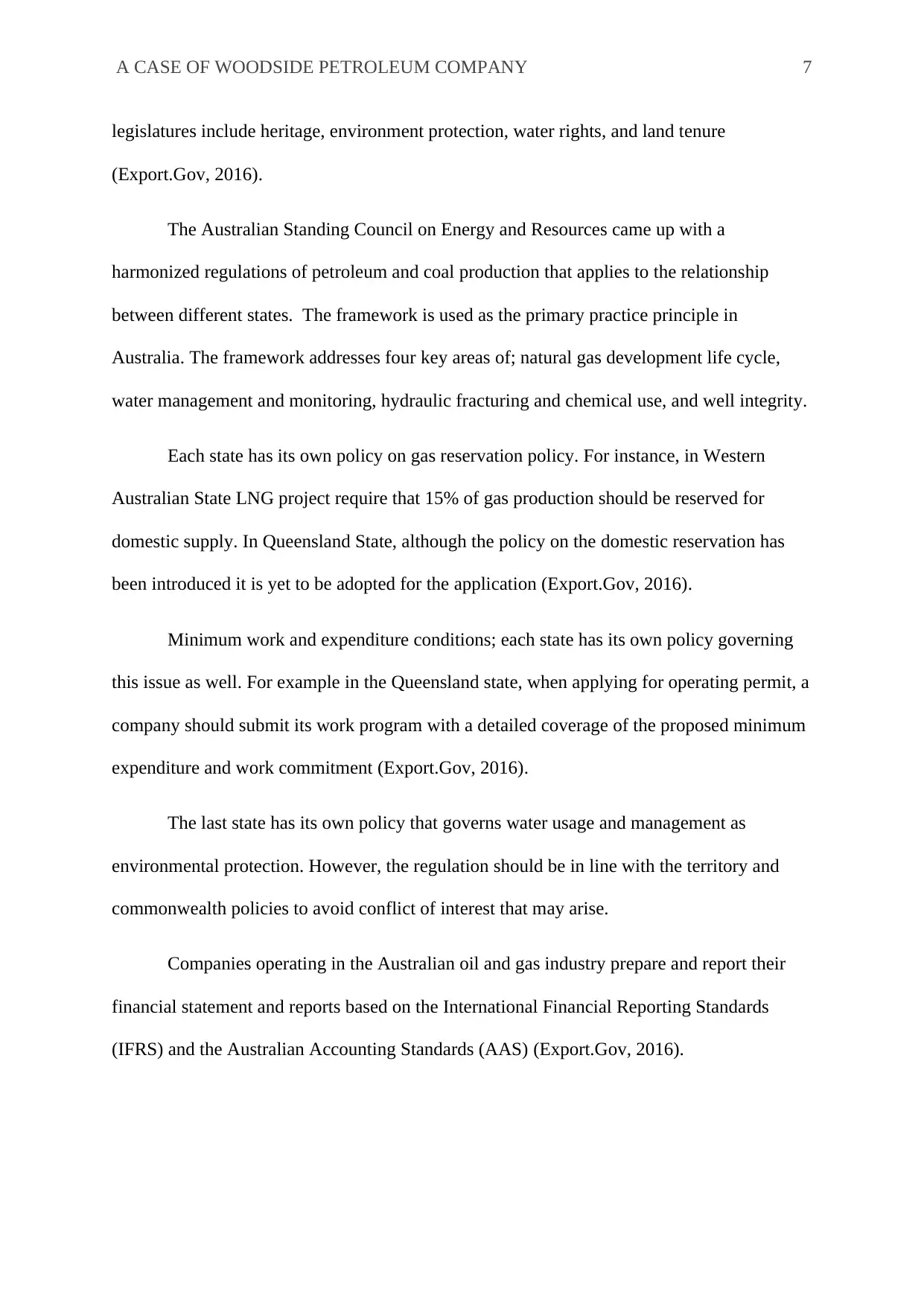
legislatures include heritage, environment protection, water rights, and land tenure
(Export.Gov, 2016).
The Australian Standing Council on Energy and Resources came up with a
harmonized regulations of petroleum and coal production that applies to the relationship
between different states. The framework is used as the primary practice principle in
Australia. The framework addresses four key areas of; natural gas development life cycle,
water management and monitoring, hydraulic fracturing and chemical use, and well integrity.
Each state has its own policy on gas reservation policy. For instance, in Western
Australian State LNG project require that 15% of gas production should be reserved for
domestic supply. In Queensland State, although the policy on the domestic reservation has
been introduced it is yet to be adopted for the application (Export.Gov, 2016).
Minimum work and expenditure conditions; each state has its own policy governing
this issue as well. For example in the Queensland state, when applying for operating permit, a
company should submit its work program with a detailed coverage of the proposed minimum
expenditure and work commitment (Export.Gov, 2016).
The last state has its own policy that governs water usage and management as
environmental protection. However, the regulation should be in line with the territory and
commonwealth policies to avoid conflict of interest that may arise.
Companies operating in the Australian oil and gas industry prepare and report their
financial statement and reports based on the International Financial Reporting Standards
(IFRS) and the Australian Accounting Standards (AAS) (Export.Gov, 2016).
legislatures include heritage, environment protection, water rights, and land tenure
(Export.Gov, 2016).
The Australian Standing Council on Energy and Resources came up with a
harmonized regulations of petroleum and coal production that applies to the relationship
between different states. The framework is used as the primary practice principle in
Australia. The framework addresses four key areas of; natural gas development life cycle,
water management and monitoring, hydraulic fracturing and chemical use, and well integrity.
Each state has its own policy on gas reservation policy. For instance, in Western
Australian State LNG project require that 15% of gas production should be reserved for
domestic supply. In Queensland State, although the policy on the domestic reservation has
been introduced it is yet to be adopted for the application (Export.Gov, 2016).
Minimum work and expenditure conditions; each state has its own policy governing
this issue as well. For example in the Queensland state, when applying for operating permit, a
company should submit its work program with a detailed coverage of the proposed minimum
expenditure and work commitment (Export.Gov, 2016).
The last state has its own policy that governs water usage and management as
environmental protection. However, the regulation should be in line with the territory and
commonwealth policies to avoid conflict of interest that may arise.
Companies operating in the Australian oil and gas industry prepare and report their
financial statement and reports based on the International Financial Reporting Standards
(IFRS) and the Australian Accounting Standards (AAS) (Export.Gov, 2016).
Paraphrase This Document
Need a fresh take? Get an instant paraphrase of this document with our AI Paraphraser
A CASE OF WOODSIDE PETROLEUM COMPANY 8
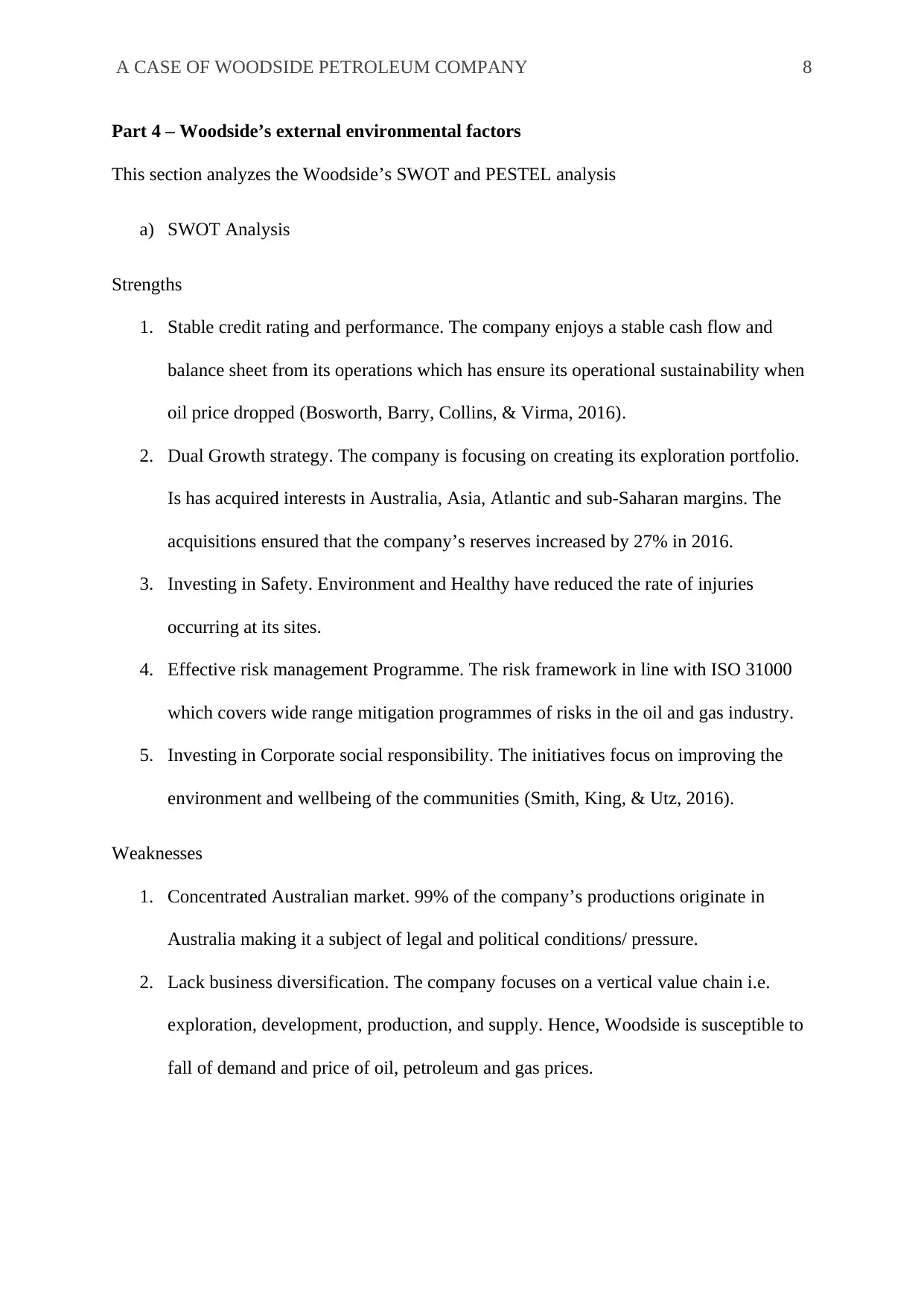
Part 4 – Woodside’s external environmental factors
This section analyzes the Woodside’s SWOT and PESTEL analysis
a) SWOT Analysis
Strengths
1. Stable credit rating and performance. The company enjoys a stable cash flow and
balance sheet from its operations which has ensure its operational sustainability when
oil price dropped (Bosworth, Barry, Collins, & Virma, 2016).
2. Dual Growth strategy. The company is focusing on creating its exploration portfolio.
Is has acquired interests in Australia, Asia, Atlantic and sub-Saharan margins. The
acquisitions ensured that the company’s reserves increased by 27% in 2016.
3. Investing in Safety. Environment and Healthy have reduced the rate of injuries
occurring at its sites.
4. Effective risk management Programme. The risk framework in line with ISO 31000
which covers wide range mitigation programmes of risks in the oil and gas industry.
5. Investing in Corporate social responsibility. The initiatives focus on improving the
environment and wellbeing of the communities (Smith, King, & Utz, 2016).
Weaknesses
1. Concentrated Australian market. 99% of the company’s productions originate in
Australia making it a subject of legal and political conditions/ pressure.
2. Lack business diversification. The company focuses on a vertical value chain i.e.
exploration, development, production, and supply. Hence, Woodside is susceptible to
fall of demand and price of oil, petroleum and gas prices.
Part 4 – Woodside’s external environmental factors
This section analyzes the Woodside’s SWOT and PESTEL analysis
a) SWOT Analysis
Strengths
1. Stable credit rating and performance. The company enjoys a stable cash flow and
balance sheet from its operations which has ensure its operational sustainability when
oil price dropped (Bosworth, Barry, Collins, & Virma, 2016).
2. Dual Growth strategy. The company is focusing on creating its exploration portfolio.
Is has acquired interests in Australia, Asia, Atlantic and sub-Saharan margins. The
acquisitions ensured that the company’s reserves increased by 27% in 2016.
3. Investing in Safety. Environment and Healthy have reduced the rate of injuries
occurring at its sites.
4. Effective risk management Programme. The risk framework in line with ISO 31000
which covers wide range mitigation programmes of risks in the oil and gas industry.
5. Investing in Corporate social responsibility. The initiatives focus on improving the
environment and wellbeing of the communities (Smith, King, & Utz, 2016).
Weaknesses
1. Concentrated Australian market. 99% of the company’s productions originate in
Australia making it a subject of legal and political conditions/ pressure.
2. Lack business diversification. The company focuses on a vertical value chain i.e.
exploration, development, production, and supply. Hence, Woodside is susceptible to
fall of demand and price of oil, petroleum and gas prices.
A CASE OF WOODSIDE PETROLEUM COMPANY 9
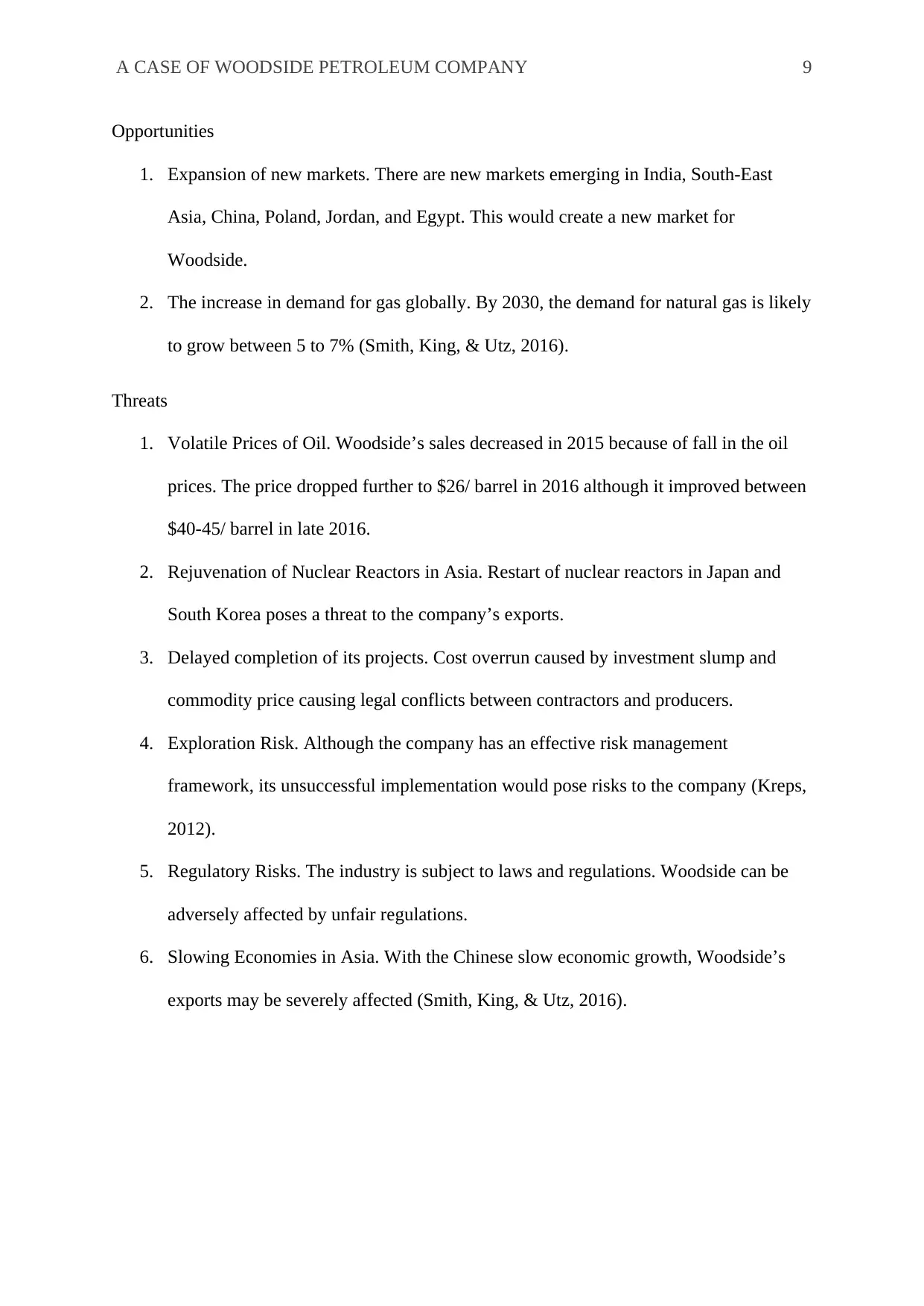
Opportunities
1. Expansion of new markets. There are new markets emerging in India, South-East
Asia, China, Poland, Jordan, and Egypt. This would create a new market for
Woodside.
2. The increase in demand for gas globally. By 2030, the demand for natural gas is likely
to grow between 5 to 7% (Smith, King, & Utz, 2016).
Threats
1. Volatile Prices of Oil. Woodside’s sales decreased in 2015 because of fall in the oil
prices. The price dropped further to $26/ barrel in 2016 although it improved between
$40-45/ barrel in late 2016.
2. Rejuvenation of Nuclear Reactors in Asia. Restart of nuclear reactors in Japan and
South Korea poses a threat to the company’s exports.
3. Delayed completion of its projects. Cost overrun caused by investment slump and
commodity price causing legal conflicts between contractors and producers.
4. Exploration Risk. Although the company has an effective risk management
framework, its unsuccessful implementation would pose risks to the company (Kreps,
2012).
5. Regulatory Risks. The industry is subject to laws and regulations. Woodside can be
adversely affected by unfair regulations.
6. Slowing Economies in Asia. With the Chinese slow economic growth, Woodside’s
exports may be severely affected (Smith, King, & Utz, 2016).
Opportunities
1. Expansion of new markets. There are new markets emerging in India, South-East
Asia, China, Poland, Jordan, and Egypt. This would create a new market for
Woodside.
2. The increase in demand for gas globally. By 2030, the demand for natural gas is likely
to grow between 5 to 7% (Smith, King, & Utz, 2016).
Threats
1. Volatile Prices of Oil. Woodside’s sales decreased in 2015 because of fall in the oil
prices. The price dropped further to $26/ barrel in 2016 although it improved between
$40-45/ barrel in late 2016.
2. Rejuvenation of Nuclear Reactors in Asia. Restart of nuclear reactors in Japan and
South Korea poses a threat to the company’s exports.
3. Delayed completion of its projects. Cost overrun caused by investment slump and
commodity price causing legal conflicts between contractors and producers.
4. Exploration Risk. Although the company has an effective risk management
framework, its unsuccessful implementation would pose risks to the company (Kreps,
2012).
5. Regulatory Risks. The industry is subject to laws and regulations. Woodside can be
adversely affected by unfair regulations.
6. Slowing Economies in Asia. With the Chinese slow economic growth, Woodside’s
exports may be severely affected (Smith, King, & Utz, 2016).
⊘ This is a preview!⊘
Do you want full access?
Subscribe today to unlock all pages.
Trusted by 1+ million students worldwide
A CASE OF WOODSIDE PETROLEUM COMPANY
10
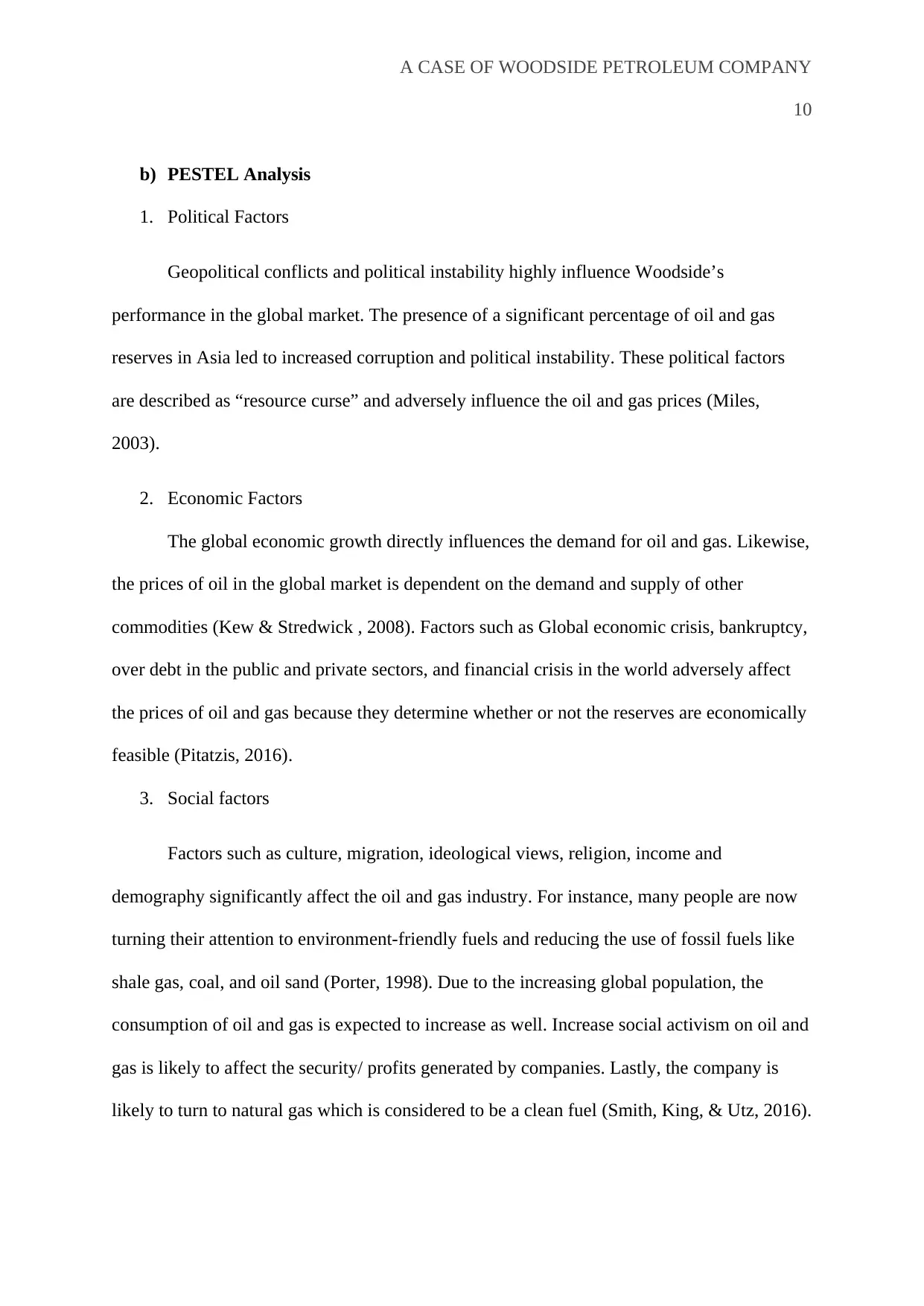
b) PESTEL Analysis
1. Political Factors
Geopolitical conflicts and political instability highly influence Woodside’s
performance in the global market. The presence of a significant percentage of oil and gas
reserves in Asia led to increased corruption and political instability. These political factors
are described as “resource curse” and adversely influence the oil and gas prices (Miles,
2003).
2. Economic Factors
The global economic growth directly influences the demand for oil and gas. Likewise,
the prices of oil in the global market is dependent on the demand and supply of other
commodities (Kew & Stredwick , 2008). Factors such as Global economic crisis, bankruptcy,
over debt in the public and private sectors, and financial crisis in the world adversely affect
the prices of oil and gas because they determine whether or not the reserves are economically
feasible (Pitatzis, 2016).
3. Social factors
Factors such as culture, migration, ideological views, religion, income and
demography significantly affect the oil and gas industry. For instance, many people are now
turning their attention to environment-friendly fuels and reducing the use of fossil fuels like
shale gas, coal, and oil sand (Porter, 1998). Due to the increasing global population, the
consumption of oil and gas is expected to increase as well. Increase social activism on oil and
gas is likely to affect the security/ profits generated by companies. Lastly, the company is
likely to turn to natural gas which is considered to be a clean fuel (Smith, King, & Utz, 2016).
10
b) PESTEL Analysis
1. Political Factors
Geopolitical conflicts and political instability highly influence Woodside’s
performance in the global market. The presence of a significant percentage of oil and gas
reserves in Asia led to increased corruption and political instability. These political factors
are described as “resource curse” and adversely influence the oil and gas prices (Miles,
2003).
2. Economic Factors
The global economic growth directly influences the demand for oil and gas. Likewise,
the prices of oil in the global market is dependent on the demand and supply of other
commodities (Kew & Stredwick , 2008). Factors such as Global economic crisis, bankruptcy,
over debt in the public and private sectors, and financial crisis in the world adversely affect
the prices of oil and gas because they determine whether or not the reserves are economically
feasible (Pitatzis, 2016).
3. Social factors
Factors such as culture, migration, ideological views, religion, income and
demography significantly affect the oil and gas industry. For instance, many people are now
turning their attention to environment-friendly fuels and reducing the use of fossil fuels like
shale gas, coal, and oil sand (Porter, 1998). Due to the increasing global population, the
consumption of oil and gas is expected to increase as well. Increase social activism on oil and
gas is likely to affect the security/ profits generated by companies. Lastly, the company is
likely to turn to natural gas which is considered to be a clean fuel (Smith, King, & Utz, 2016).
Paraphrase This Document
Need a fresh take? Get an instant paraphrase of this document with our AI Paraphraser
A CASE OF WOODSIDE PETROLEUM COMPANY
11
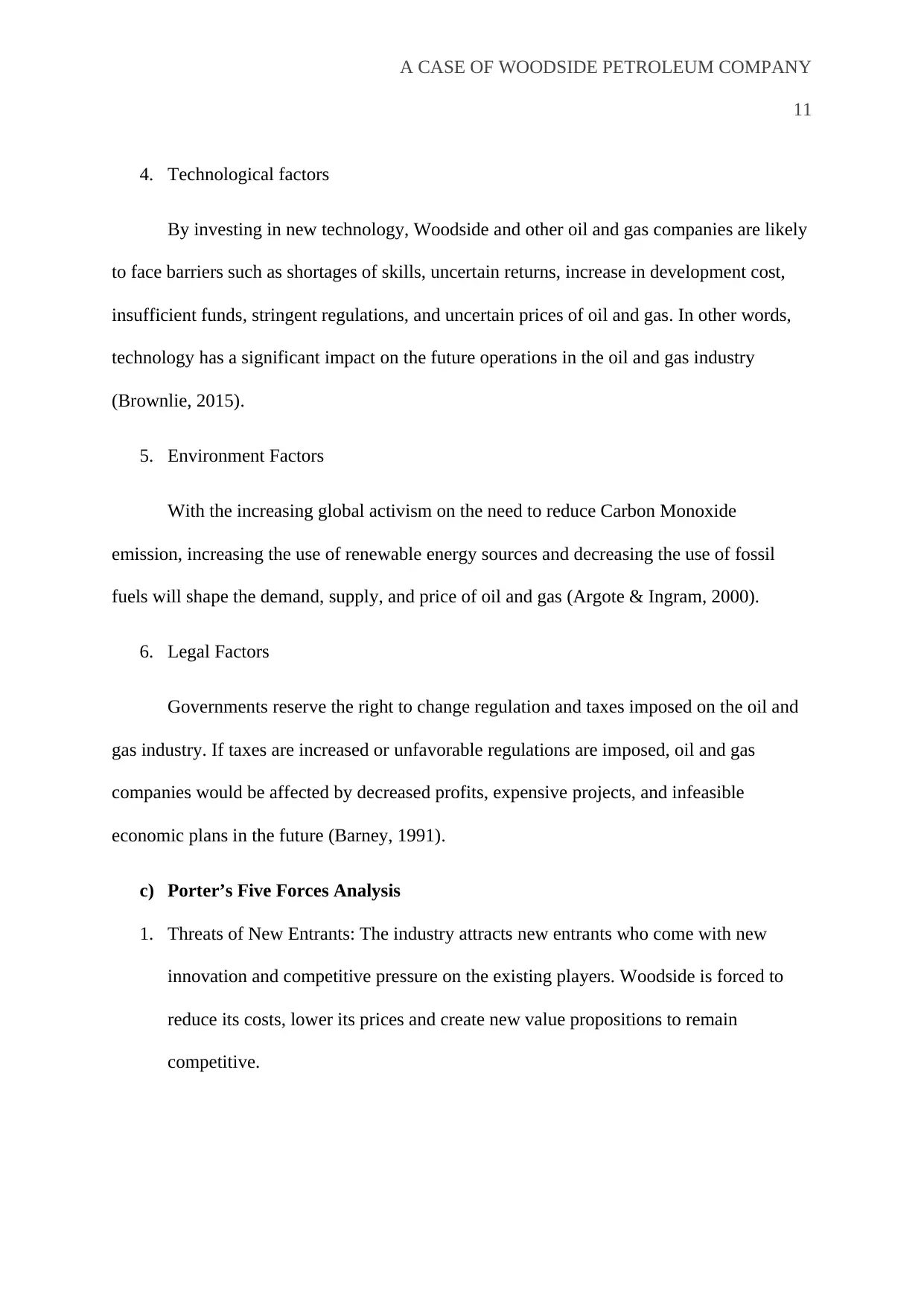
4. Technological factors
By investing in new technology, Woodside and other oil and gas companies are likely
to face barriers such as shortages of skills, uncertain returns, increase in development cost,
insufficient funds, stringent regulations, and uncertain prices of oil and gas. In other words,
technology has a significant impact on the future operations in the oil and gas industry
(Brownlie, 2015).
5. Environment Factors
With the increasing global activism on the need to reduce Carbon Monoxide
emission, increasing the use of renewable energy sources and decreasing the use of fossil
fuels will shape the demand, supply, and price of oil and gas (Argote & Ingram, 2000).
6. Legal Factors
Governments reserve the right to change regulation and taxes imposed on the oil and
gas industry. If taxes are increased or unfavorable regulations are imposed, oil and gas
companies would be affected by decreased profits, expensive projects, and infeasible
economic plans in the future (Barney, 1991).
c) Porter’s Five Forces Analysis
1. Threats of New Entrants: The industry attracts new entrants who come with new
innovation and competitive pressure on the existing players. Woodside is forced to
reduce its costs, lower its prices and create new value propositions to remain
competitive.
11
4. Technological factors
By investing in new technology, Woodside and other oil and gas companies are likely
to face barriers such as shortages of skills, uncertain returns, increase in development cost,
insufficient funds, stringent regulations, and uncertain prices of oil and gas. In other words,
technology has a significant impact on the future operations in the oil and gas industry
(Brownlie, 2015).
5. Environment Factors
With the increasing global activism on the need to reduce Carbon Monoxide
emission, increasing the use of renewable energy sources and decreasing the use of fossil
fuels will shape the demand, supply, and price of oil and gas (Argote & Ingram, 2000).
6. Legal Factors
Governments reserve the right to change regulation and taxes imposed on the oil and
gas industry. If taxes are increased or unfavorable regulations are imposed, oil and gas
companies would be affected by decreased profits, expensive projects, and infeasible
economic plans in the future (Barney, 1991).
c) Porter’s Five Forces Analysis
1. Threats of New Entrants: The industry attracts new entrants who come with new
innovation and competitive pressure on the existing players. Woodside is forced to
reduce its costs, lower its prices and create new value propositions to remain
competitive.
A CASE OF WOODSIDE PETROLEUM COMPANY
12
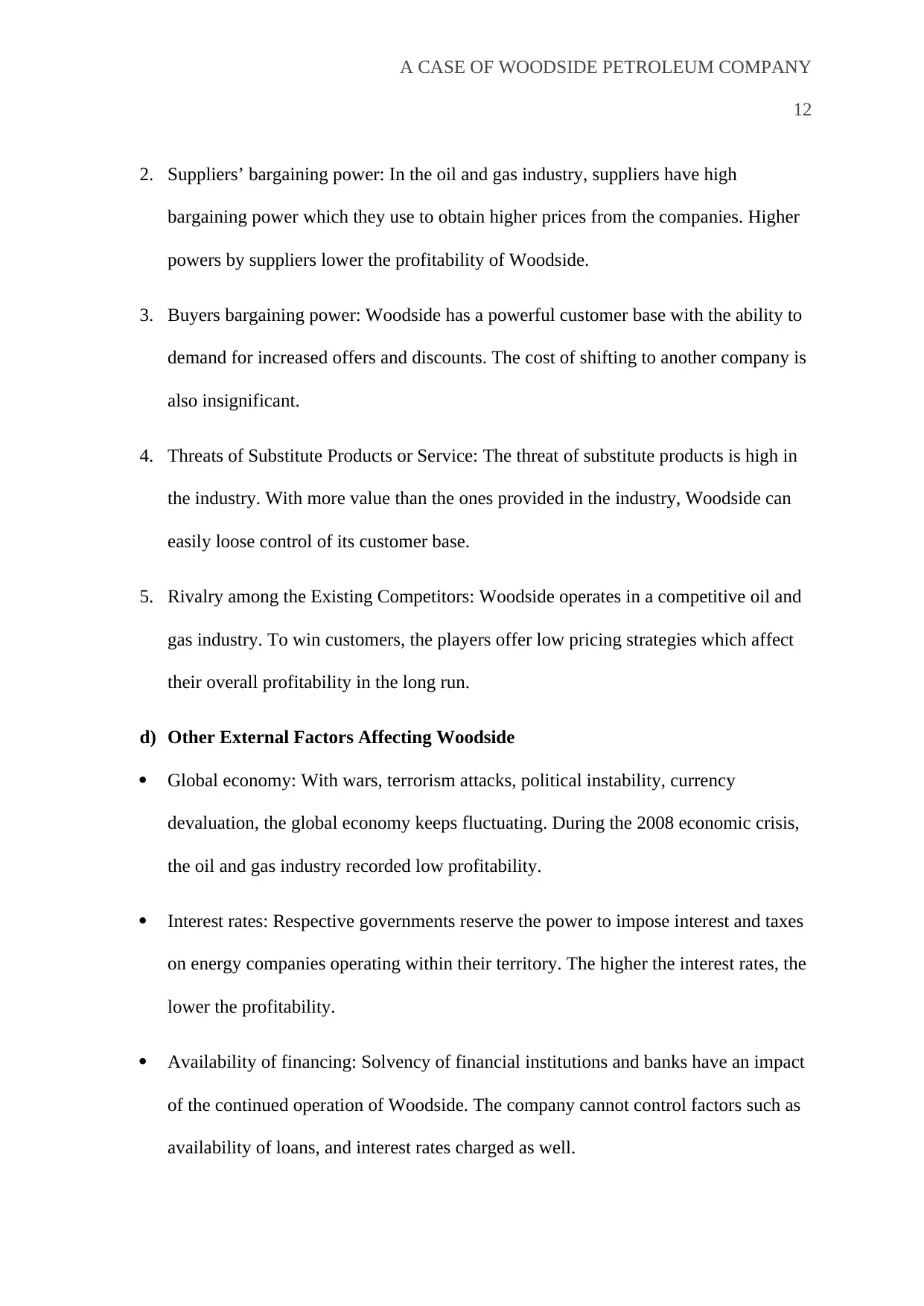
2. Suppliers’ bargaining power: In the oil and gas industry, suppliers have high
bargaining power which they use to obtain higher prices from the companies. Higher
powers by suppliers lower the profitability of Woodside.
3. Buyers bargaining power: Woodside has a powerful customer base with the ability to
demand for increased offers and discounts. The cost of shifting to another company is
also insignificant.
4. Threats of Substitute Products or Service: The threat of substitute products is high in
the industry. With more value than the ones provided in the industry, Woodside can
easily loose control of its customer base.
5. Rivalry among the Existing Competitors: Woodside operates in a competitive oil and
gas industry. To win customers, the players offer low pricing strategies which affect
their overall profitability in the long run.
d) Other External Factors Affecting Woodside
Global economy: With wars, terrorism attacks, political instability, currency
devaluation, the global economy keeps fluctuating. During the 2008 economic crisis,
the oil and gas industry recorded low profitability.
Interest rates: Respective governments reserve the power to impose interest and taxes
on energy companies operating within their territory. The higher the interest rates, the
lower the profitability.
Availability of financing: Solvency of financial institutions and banks have an impact
of the continued operation of Woodside. The company cannot control factors such as
availability of loans, and interest rates charged as well.
12
2. Suppliers’ bargaining power: In the oil and gas industry, suppliers have high
bargaining power which they use to obtain higher prices from the companies. Higher
powers by suppliers lower the profitability of Woodside.
3. Buyers bargaining power: Woodside has a powerful customer base with the ability to
demand for increased offers and discounts. The cost of shifting to another company is
also insignificant.
4. Threats of Substitute Products or Service: The threat of substitute products is high in
the industry. With more value than the ones provided in the industry, Woodside can
easily loose control of its customer base.
5. Rivalry among the Existing Competitors: Woodside operates in a competitive oil and
gas industry. To win customers, the players offer low pricing strategies which affect
their overall profitability in the long run.
d) Other External Factors Affecting Woodside
Global economy: With wars, terrorism attacks, political instability, currency
devaluation, the global economy keeps fluctuating. During the 2008 economic crisis,
the oil and gas industry recorded low profitability.
Interest rates: Respective governments reserve the power to impose interest and taxes
on energy companies operating within their territory. The higher the interest rates, the
lower the profitability.
Availability of financing: Solvency of financial institutions and banks have an impact
of the continued operation of Woodside. The company cannot control factors such as
availability of loans, and interest rates charged as well.
⊘ This is a preview!⊘
Do you want full access?
Subscribe today to unlock all pages.
Trusted by 1+ million students worldwide

1 out of 21


Related Documents


Your All-in-One AI-Powered Toolkit for Academic Success.
+13062052269
info@desklib.com
Available 24*7 on WhatsApp / Email
![[object Object]](/_next/static/media/star-bottom.7253800d.svg)
Unlock your academic potential
Copyright © 2020–2026 A2Z Services. All Rights Reserved. Developed and managed by ZUCOL.