Analysis of Woolworths Group's 2016 Financial Statements

Verified

Added on  2020/05/16

|8
|1782
|62
AI Summary
The task is to conduct a comprehensive analysis of Woolworths Group's 2016 financial statements with particular attention to adherence to International Financial Reporting Standards (IFRS). Key areas of focus include evaluating depreciation methods for property, plant, and equipment as well as intangible assets, investigating any impairment losses recorded during the year, and assessing revenue recognition practices. The assignment aims to understand how these accounting policies influence Woolworths Group's financial outcomes. Students will need to scrutinize related notes in the financial statements and draw conclusions about the company’s financial health and reporting transparency.
Document Page
Running head: FINANCIAL ACCOUNTING
Financial Accounting
Name of the Student:
Name of the University:
Author Note
tabler-icon-diamond-filled.svg

Paraphrase This Document

Need a fresh take? Get an instant paraphrase of this document with our AI Paraphraser
Document Page
1FINANCIAL ACCOUNTING
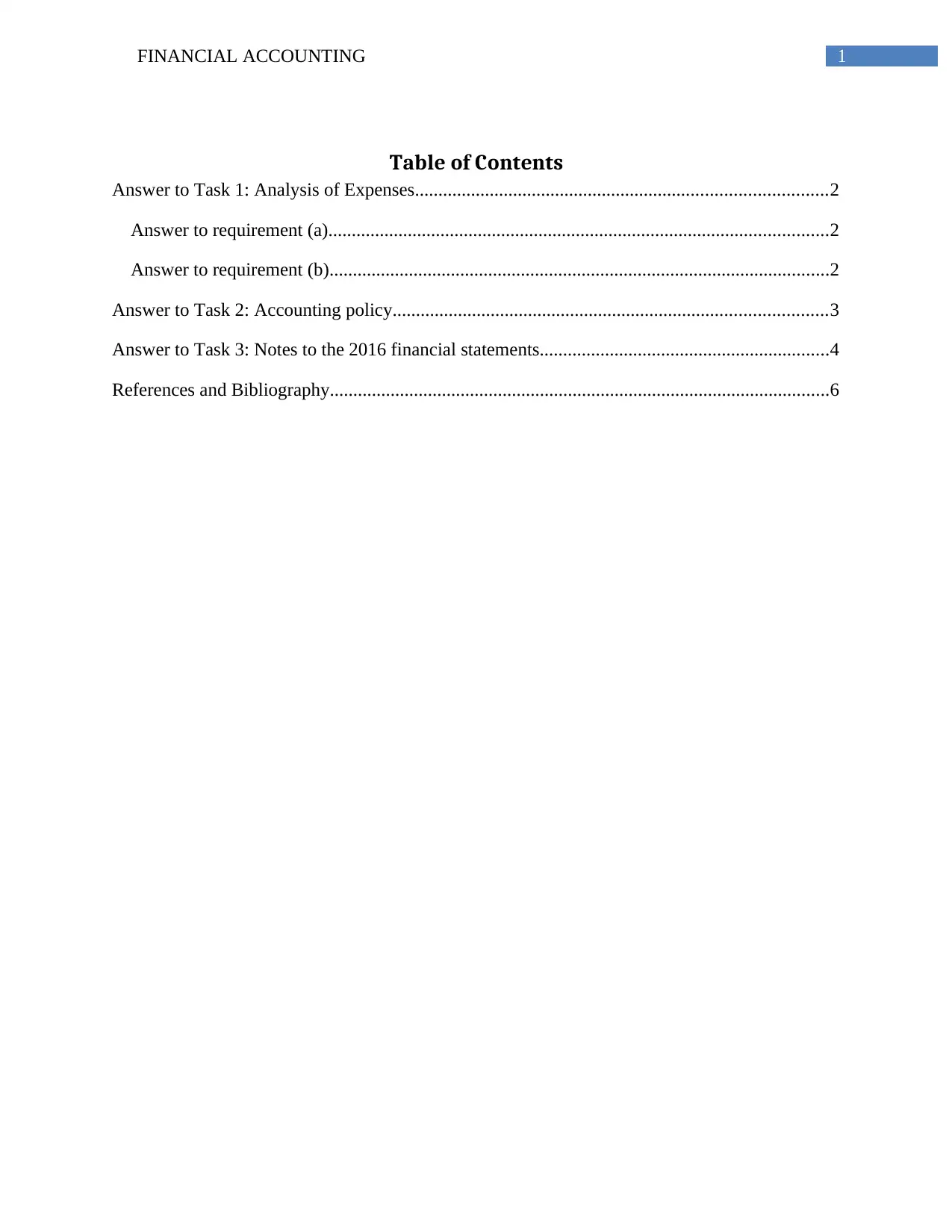
Table of Contents
Answer to Task 1: Analysis of Expenses........................................................................................2
Answer to requirement (a)...........................................................................................................2
Answer to requirement (b)...........................................................................................................2
Answer to Task 2: Accounting policy.............................................................................................3
Answer to Task 3: Notes to the 2016 financial statements..............................................................4
References and Bibliography...........................................................................................................6
Document Page
2FINANCIAL ACCOUNTING
Answer to Task 1: Analysis of Expenses
Answer to requirement (a)
The issue presented in the question is that the nature of expenses that have been incurred
by the organization of Woolworths for the financial year of 2016 has been asked to clarify. In
order to answer the presented questions, the financial report for 2016 has been chosen.
In order to answer the presented question, at first, the concept of the categorization of
expenses on the basis of nature or function should be understood. The categorization of expenses
on the basis of nature can be described as the expenses that have been included in the income
statement of the organization, that have essentially been disclosed according to their nature. The
particular instance of the accounts that have been classified on the basis of nature are wages and
salaries and rent expenses etc (Kanapickienė & Grundienė, 2015).
On the other hand, the expenses that have been classified on the basis of function are the
cost of goods sold account, selling expenses and administrative expenses. It should be noted here
that the classification of the expenses on the basis of nature does not exclude the need for
disclosing the expenses on the basis of nature (Mignolet, 2017).
Now, in the case of the chosen organization, Woolworths Group the expenses that have
been disclosed in the financial statements have been classified on the basis of function. This is
because the expenses that have been included in the income statement have been disclosed
depending on the function that the particular expense serves like cost of sales, branch expenses,
administration expenses, and financing costs. Moreover, the gross profit has been calculated
from the income statement of the Group signifying the fact that the expenses have been disclosed
on the basis of their function.
Answer to requirement (b)
The possible reasons for the different methods of classification of expenses used, are as
follows:
The expenses are classified on the basis of their nature when the number of expenses that
have been incurred by the firm are less.
Document Page
3FINANCIAL ACCOUNTING
The expenses are classified on the basis of their function when the number of expenses
that have been incurred by the firm are more.
In case of Woolworths Limited, there have not been a varied degree of expenses which
have enabled the management of the corporate entity to segregate the expenses on the
basis of nature (Bunsis, 2015).
Moreover, the particular action of classifying the expenses also results in the clarified
representation of the financial statements of the company thus, facilitating the fair image
of the financial condition of the company (Bunsis, 2015).
Answer to Task 2: Accounting policy
Before the identification of the three issues from the annual report of Woolworths
Limited, the particulars of the AASB 108 have to be understood. The AASB 108 defines the
accounting policies that should be mandatorily complied with by the organizations. Accounting
policies are the specific principles, procedures and the regulations that are utilized by the
corporate entities for preparing the financial statements of the company.
The AASB 108 standard also defines the change in accounting estimate that may be
utilized by the management of the company for adjusting the carrying amount of an asset or
liability. The changes in the accounting estimates may be undertaken by an organization for the
new developments in the accounting principles or the rectification of the accounting errors that
have may occur at the time of preparation of the financial statements (Kanapickienė &
Grundienė, 2015).
Another major accounting terms that has been mentioned in the AASB 108 is
impracticable. A certain requirement is considered impracticable when the entity is unable to
apply it after making every reasonable effort to do so.
In case of Woolworths, the management of the corporate entity has provided the required
disclosure in the accounting statements of the company in regards to the change in the
accounting estimates or policies. One of the major critical accounting estimates that have been
undertaken by the company is in regards to the determination of the useful life of assets. It has
been mentioned in the annual report of the company in the financial year of 2016 that the process
of estimation of the remaining useful lives requires enhanced management and reviewing at an
tabler-icon-diamond-filled.svg

Paraphrase This Document

Need a fresh take? Get an instant paraphrase of this document with our AI Paraphraser
Document Page
4FINANCIAL ACCOUNTING
annual interval. The useful lives have been altered, the net value of the asset that has been
written down is depreciated since the date when the revised accounting policy had been
published. This is done in order to adhere to the AASB 116. However, an interesting fact that has
been mentioned in the annual report of the company is that the depreciation that has been
recognized in the prior financial years has not been changed (Mignolet, 2017).
The second issue that has been provided in the annual report of the company is in regards
to the significant accounting policy disclosure. This has been presented in regards to the other
financial liabilities. The total amount in other financial liabilities for the financial year of 2015
represents a value of $1075 and that for the financial year of 2016 reflects a value of $180 . This
unprecedented fall or rise in the borrowings has been explained in the accounting disclosure in
regards to significant accounting policies. The unprecedented rise has been due to the valuation
of the put option liability in Hydrox.
The third issue has been identified in regards to the valuation of the intangible assets like
brand names, liquor and gaming licenses. It has been further mentioned in the provided
disclosure that the group recognizes the impairment of the intangible assets of $320 million in
relation to continuing operations and $119.4 million for discontinued operations.
Answer to Task 3: Notes to the 2016 financial statements
It has been produced in the annual report of the company that the property, plant and
equipment have been measured at cost that has been reduced by the accumulated depreciation or
amortization and the accumulated impairment losses. It has been further disclosed in the annual
report that the cost in regards to the self-constructed assets essentially includes the material costs,
direct labor costs and a portion of the overheads (Rodriguez & Kaczmarek, 2016).
Moreover, it has been disclosed in the financial report of the company, the assets of
Woolworths Limited have been depreciated on a straight-line basis. The useful lives of the
different fixed assets of the company have been mentioned as follows:
Buildings – 25 to 40 years
Plant and Equipment – 2.5 to 10 years
Leasehold improvements – up to a maximum of 25 years
Document Page
5FINANCIAL ACCOUNTING
Furthermore, it has been disclosed in the annual report of the company that the revenue
that have been derived from the sales of the assets are recognized on the date of the sales of the
asset. The particular gain or loss derived from the sale of the asset has been included in the
Consolidated Statement of Profit or Loss. The impairment of the property, plant and equipment,
intangible assets and the assets designated for sales have been done on the basis of the continuing
operations and the discontinued operations. The impairment of the assets that are to be carried
out are tested either annually or when there is an indication in regards to the impairment of the
asset. The impairment essentially reveals the recoverable amount and helps the assessor to
determine whether the impairment will lead to a potential gain or loss (Minnis & Sutherland,
2017).
Document Page
6FINANCIAL ACCOUNTING
References and Bibliography
Biddle, G. C. (2015). The Role of Financial Statements in Reporting Financial Performance. In
Accounting & Finance/IASB Research Forum.
Bunsis, H. (2015). Analyzing University and College Financial Statements. Journal of Collective
Bargaining in the Academy, (10), 7.
Hoyle, J. B., Schaefer, T., & Doupnik, T. (2015). Advanced accounting. McGraw Hill.
Israelsen, C., & Feuz, D. (2014). Farm and Ranch Financial Statements.
Juárez, F. (2015). Chaos and complexity in financial statements. Chaos and complexity theory
for management: Nonlinear Dynamics, 1-33.
Kanapickienė, R., & Grundienė, Ž. (2015). The model of fraud detection in financial statements
by means of financial ratios. Procedia-Social and Behavioral Sciences, 213, 321-327.
McInnis, J. M., Yu, Y., & Yust, C. G. (2018). Does Fair Value Accounting Provide More Useful
Financial Statements Than Current GAAP For Banks?. The Accounting Review.
Mignolet, F. (2017). A study on the expected impact of IFRS 17 on the transparency of financial
statements of insurance companies.
Minnis, M., & Sutherland, A. (2017). Financial statements as monitoring mechanisms: Evidence
from small commercial loans. Journal of Accounting Research, 55(1), 197-233.
Moroney, R., & Trotman, K. T. (2016). Differences in Auditors' Materiality Assessments When
Auditing Financial Statements and Sustainability Reports. Contemporary Accounting
Research, 33(2), 551-575.
Rodriguez, J., & Kaczmarek, P. (2016). Financial Statements. Visualizing Financial Data, 183-
215.
Rouxelin, F., Wongsunwai, W., & Yehuda, N. (2015). Aggregate cost stickiness in GAAP
financial statements and future unemployment rate. The Accounting Review.
tabler-icon-diamond-filled.svg

Paraphrase This Document

Need a fresh take? Get an instant paraphrase of this document with our AI Paraphraser
Document Page
7FINANCIAL ACCOUNTING
Woolworthsgroup.com.au. (2018) Retrieved 3 February 2018, from
https://www.woolworthsgroup.com.au/icms_docs/185865_annual-
report-2016.pdf
chevron_up_icon
1 out of 8
circle_padding
hide_on_mobile
zoom_out_icon
[object Object]