Report on Effective Business Communication for Woolworths, Australia
VerifiedAdded on 2020/05/16
|11
|2415
|30
Report
AI Summary
This report analyzes effective business communication, focusing on the case of Woolworths, an Australian supermarket chain. It explores both verbal and non-verbal communication methods, including face-to-face interactions, telephonic communication, written correspondence, and non-verbal cues like facial expressions and body language. The report provides examples of both excellent communication, such as resolving customer issues, and poor communication, like failing to address customer complaints, and discusses the factors contributing to each. It identifies factors that support effective communication, such as active listening, maintaining eye contact, and conflict resolution, while also highlighting barriers like cultural diversity, personal conflicts, and lack of attention. The analysis emphasizes the impact of communication on Woolworths' productivity, customer relationships, and overall business success, concluding that effective communication is crucial for organizational achievement and offers valuable insights for business development.
Running head: EFFECTIVE BUSINESS COMMUNICATION
Effective Business Communication
Name of the Student:
Name of the University:
Author’s Note:
Effective Business Communication
Name of the Student:
Name of the University:
Author’s Note:

Paraphrase This Document
Need a fresh take? Get an instant paraphrase of this document with our AI Paraphraser
1EFFECTIVE BUSINESS COMMUNICATION
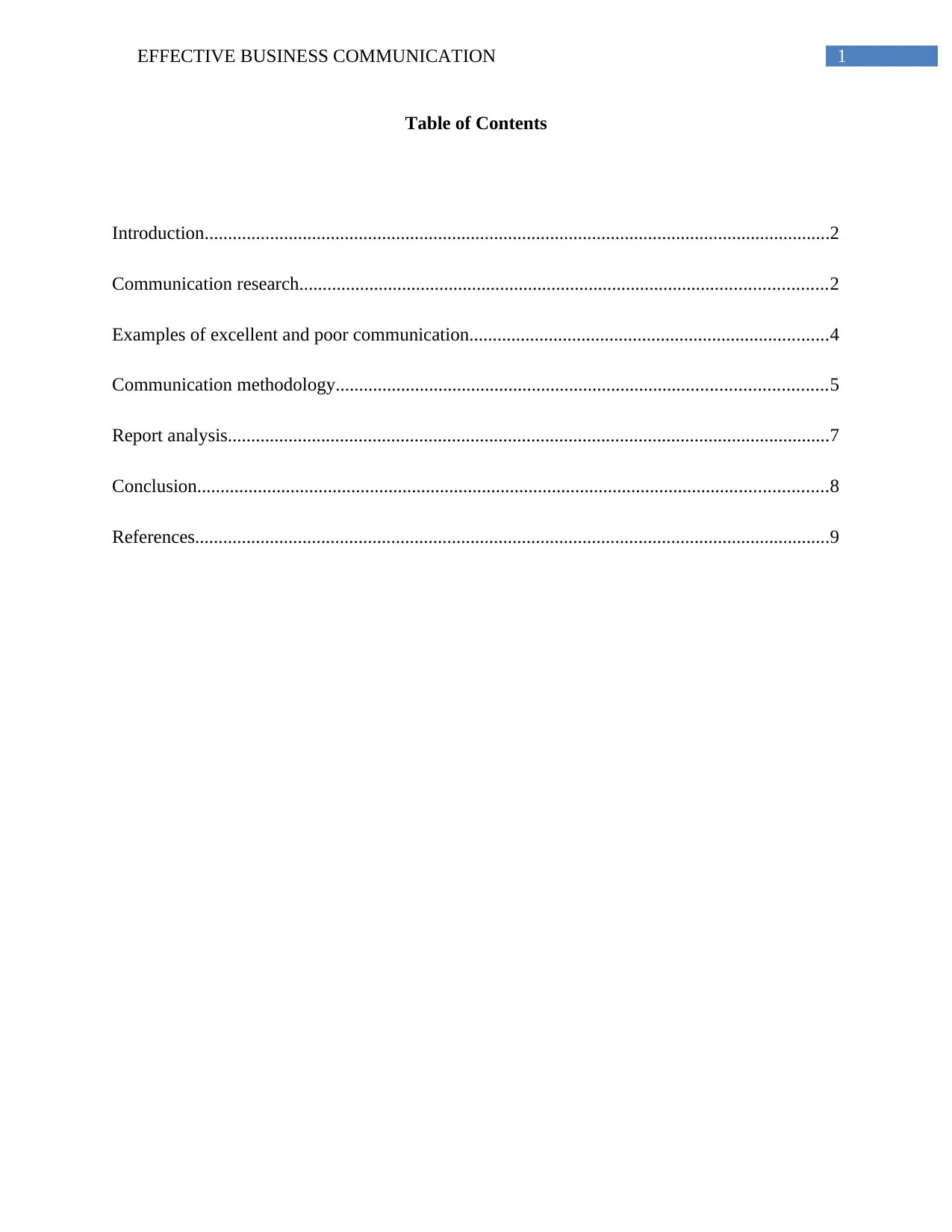
Table of Contents
Introduction......................................................................................................................................2
Communication research.................................................................................................................2
Examples of excellent and poor communication.............................................................................4
Communication methodology.........................................................................................................5
Report analysis.................................................................................................................................7
Conclusion.......................................................................................................................................8
References........................................................................................................................................9
Table of Contents
Introduction......................................................................................................................................2
Communication research.................................................................................................................2
Examples of excellent and poor communication.............................................................................4
Communication methodology.........................................................................................................5
Report analysis.................................................................................................................................7
Conclusion.......................................................................................................................................8
References........................................................................................................................................9
2EFFECTIVE BUSINESS COMMUNICATION
Introduction
Effective communication determines the success of the business organizations, as this
provides an opportunity to be productive thereby, ensuring effective business operations.
Effective communication can also help in motivating and engaging the employees by
communicating with them. Both verbal and non-verbal communication highlights effective
communication at the workplace that helps in developing a capable workforce for achieving
organizational goals and objectives (Bovee, Thill & Raina, 2016). Thus, effective
communication helps in communicating with the customers, employees and the associated
business stakeholders. However, lack of effective communication hampers business operations
and productivity. Therefore, it is essential for the business organizations to develop strategies
that ensure effective communication.
This report identifies and explains the types or forms of communication used, explains
both excellent and poor communication with suitable examples along with discussing the factors
and reasons behind successful and unsuccessful communication and explaining the reason how
the particular communication improved or damaged the business for Woolworths, Australia.
Communication research
Woolworths is a supermarket in Australia that sales groceries, magazines, pet products,
baby supplies, stationery items and health and beauty products. Based on the type of business
operations of Woolworths, effective communication is crucial. Effective communication
provides an opportunity for Woolworth to increase productivity and maximize sales (Shockley-
Zalabak, 2014). Verbal and non-verbal communications are the most used communication forms
Introduction
Effective communication determines the success of the business organizations, as this
provides an opportunity to be productive thereby, ensuring effective business operations.
Effective communication can also help in motivating and engaging the employees by
communicating with them. Both verbal and non-verbal communication highlights effective
communication at the workplace that helps in developing a capable workforce for achieving
organizational goals and objectives (Bovee, Thill & Raina, 2016). Thus, effective
communication helps in communicating with the customers, employees and the associated
business stakeholders. However, lack of effective communication hampers business operations
and productivity. Therefore, it is essential for the business organizations to develop strategies
that ensure effective communication.
This report identifies and explains the types or forms of communication used, explains
both excellent and poor communication with suitable examples along with discussing the factors
and reasons behind successful and unsuccessful communication and explaining the reason how
the particular communication improved or damaged the business for Woolworths, Australia.
Communication research
Woolworths is a supermarket in Australia that sales groceries, magazines, pet products,
baby supplies, stationery items and health and beauty products. Based on the type of business
operations of Woolworths, effective communication is crucial. Effective communication
provides an opportunity for Woolworth to increase productivity and maximize sales (Shockley-
Zalabak, 2014). Verbal and non-verbal communications are the most used communication forms
⊘ This is a preview!⊘
Do you want full access?
Subscribe today to unlock all pages.

Trusted by 1+ million students worldwide
3EFFECTIVE BUSINESS COMMUNICATION
that are used by Woolworths. The verbal communication includes written and spoken
communication whereas non-verbal communication includes expression and body language. The
use of verbal communication allows Woolworths to share things by using words (Krum, 2013).
The different types of verbal communication includes
Face-to-face communication: Face-to-face communication allowed the company to
share their thoughts and ideas in terms of business with the employees, stakeholders and
customers thereby, increasing productivity. Telephonic communication: Telephonic conversation is a type of verbal communication
where both the parties exchange ideas and message from a distance without being
physically present. Telephonic communication allows Woolworths to ensure effective
communication between different branches and customers (Austin & Pinkleton, 2015). Writing a letter: Penning down the thoughts, ideas and strategies for the business is also
a type of effective communication that Woolworths can use for keeping an official record
of the business strategies. Giving advice: Woolworths can use verbal communication for giving advice to the
employees in terms of effective business operations. Making announcements: As a supermarket, Woolworths have to develop their business
strategies and inform the staffs at regular interval. Thus, verbal communication allows the
company to make announcements to the employees in the store (Arnold & Boggs, 2015).
Apart from the verbal communications, Woolworths can use types of non-verbal communication
types for successful business operations. The types of non-verbal communication include:
that are used by Woolworths. The verbal communication includes written and spoken
communication whereas non-verbal communication includes expression and body language. The
use of verbal communication allows Woolworths to share things by using words (Krum, 2013).
The different types of verbal communication includes
Face-to-face communication: Face-to-face communication allowed the company to
share their thoughts and ideas in terms of business with the employees, stakeholders and
customers thereby, increasing productivity. Telephonic communication: Telephonic conversation is a type of verbal communication
where both the parties exchange ideas and message from a distance without being
physically present. Telephonic communication allows Woolworths to ensure effective
communication between different branches and customers (Austin & Pinkleton, 2015). Writing a letter: Penning down the thoughts, ideas and strategies for the business is also
a type of effective communication that Woolworths can use for keeping an official record
of the business strategies. Giving advice: Woolworths can use verbal communication for giving advice to the
employees in terms of effective business operations. Making announcements: As a supermarket, Woolworths have to develop their business
strategies and inform the staffs at regular interval. Thus, verbal communication allows the
company to make announcements to the employees in the store (Arnold & Boggs, 2015).
Apart from the verbal communications, Woolworths can use types of non-verbal communication
types for successful business operations. The types of non-verbal communication include:
Paraphrase This Document
Need a fresh take? Get an instant paraphrase of this document with our AI Paraphraser
4EFFECTIVE BUSINESS COMMUNICATION
Facial expressions: Appropriate use of facial expression help Woolworths to
communicate use suitable expressions for communicating with the employees and the
customers. Gestures: The use of appropriate gestures by Woolworths help in showing respect to the
other party while communication thereby, ensuring effective sharing of ideas. Appearance: Woolworths emphasizes in obtaining appropriate appearances from the
employees that help in attracting customers and increasing sales (Knapp, Hall & Horgan,
2013). Body language and posture: Appropriate body language and posture also helps in
ensuring effective communication, as this helps in creating a positive impact on the
fellow workers and customers. Eye-contact: It is essential for maintaining an eye-contact while communicating, as this
helps in convincing and assuring the other party involved in communication (Burgoon,
Guerrero & Floyd, 2016).
Examples of excellent and poor communication
Effective communication is essential for the business organizations, as this provides an
opportunity to interact with the surrounding people in order to communicate relevant business
information and ideas (Wigham & Chanier, 2013). Thus, it is essential for Woolworths to
establish successful business communication in order to ensure successful business operations.
As Woolworths is a supermarket and deals with thousands of customers daily, one of the
examples of excellent communication was recorded, when the Woolworths solved the issue of a
customer by excellent communication. Once a customer reported maggots in the packaged meat
Facial expressions: Appropriate use of facial expression help Woolworths to
communicate use suitable expressions for communicating with the employees and the
customers. Gestures: The use of appropriate gestures by Woolworths help in showing respect to the
other party while communication thereby, ensuring effective sharing of ideas. Appearance: Woolworths emphasizes in obtaining appropriate appearances from the
employees that help in attracting customers and increasing sales (Knapp, Hall & Horgan,
2013). Body language and posture: Appropriate body language and posture also helps in
ensuring effective communication, as this helps in creating a positive impact on the
fellow workers and customers. Eye-contact: It is essential for maintaining an eye-contact while communicating, as this
helps in convincing and assuring the other party involved in communication (Burgoon,
Guerrero & Floyd, 2016).
Examples of excellent and poor communication
Effective communication is essential for the business organizations, as this provides an
opportunity to interact with the surrounding people in order to communicate relevant business
information and ideas (Wigham & Chanier, 2013). Thus, it is essential for Woolworths to
establish successful business communication in order to ensure successful business operations.
As Woolworths is a supermarket and deals with thousands of customers daily, one of the
examples of excellent communication was recorded, when the Woolworths solved the issue of a
customer by excellent communication. Once a customer reported maggots in the packaged meat
5EFFECTIVE BUSINESS COMMUNICATION
that was bought from the Woolworths departmental store. This was a case of ineffective
packaging by the company and hampered the customer service. However, the problem was soon
resolved by excellent communication that was managed and ensured by the management of
Woolworths. Initially, the customer service executive established both verbal and non-verbal
communication with the customer in order to gather required information about the incident. The
customer service executive used appropriate language, tone, body posture, appearance and eye-
contact while communicating (Onwuegbuzie & Byers, 2014). As a result, the customer was
convinced and assured that it was unintentional and was ready to co-operate and Woolworths
exchanged the packaged product free of cost for the customer.
On the other hand, Woolworths recorded an example of poor communication when a
customer was left unattended in spite of having issues in terms of the product purchased from the
departmental store. The customer service executive used inappropriate tone, posture and body
language while addressing the issue and also failed to communicate the issue with the higher
management by writing it. As a result, the customer was unsatisfied, as the issue was poorly
communicated and took time for resolving. Thus, Woolworths lost a valuable customer due to
poor communication thereby, hampering the business.
Communication methodology
The factors that helped Woolworths in ensuring effective communication include:
Maintaining eye-contact: Maintaining eye-contact is one of the factors that help in
maintaining effective communication, as the individuals feel connected due to eye-
contact. For instance, maintaining eye-contact with the customers at Woolworths helps
that was bought from the Woolworths departmental store. This was a case of ineffective
packaging by the company and hampered the customer service. However, the problem was soon
resolved by excellent communication that was managed and ensured by the management of
Woolworths. Initially, the customer service executive established both verbal and non-verbal
communication with the customer in order to gather required information about the incident. The
customer service executive used appropriate language, tone, body posture, appearance and eye-
contact while communicating (Onwuegbuzie & Byers, 2014). As a result, the customer was
convinced and assured that it was unintentional and was ready to co-operate and Woolworths
exchanged the packaged product free of cost for the customer.
On the other hand, Woolworths recorded an example of poor communication when a
customer was left unattended in spite of having issues in terms of the product purchased from the
departmental store. The customer service executive used inappropriate tone, posture and body
language while addressing the issue and also failed to communicate the issue with the higher
management by writing it. As a result, the customer was unsatisfied, as the issue was poorly
communicated and took time for resolving. Thus, Woolworths lost a valuable customer due to
poor communication thereby, hampering the business.
Communication methodology
The factors that helped Woolworths in ensuring effective communication include:
Maintaining eye-contact: Maintaining eye-contact is one of the factors that help in
maintaining effective communication, as the individuals feel connected due to eye-
contact. For instance, maintaining eye-contact with the customers at Woolworths helps
⊘ This is a preview!⊘
Do you want full access?
Subscribe today to unlock all pages.
Trusted by 1+ million students worldwide
6EFFECTIVE BUSINESS COMMUNICATION
the customer care executive to convince, assure and relate to them easily (Afshari et al.,
2014). Resolving conflicts: Lack of conflicts help in effective communication, as the individuals
at work can communicate with each other without hesitation thereby, ensuring clear flow
of information at work (Finch et al., 2013) Active listening: Active listening helps in ensuring effective communication, as this
provides an opportunity for the individuals to keep their personal agenda aside and
consider the perspectives and viewpoints of the surrounding people (Dehghani,
Mosalanejad & Dehghan-Nayeri, 2015). Being prepared: The individuals need to be prepared by gathering adequate information
in terms of business before communicating, as this helps in active participation and co-
operation.
The barriers that hampered Woolworths in establishing effective communication include:
Cultural diversity: Difference in cultures hampered effective communication at
Woolworths, as individuals from different cultural background do not prefer to
communicate with individuals due to distinct cultural preferences and beliefs (Pfaff et al.,
2014). Personal conflicts: Difference in individual beliefs, habits and attitudes resulted in
personal conflicts among the employees at Woolworths, as individuals do not prefer to
work by keeping their personal agenda aside. Lack of attention: Lack of attention by the employees at Woolworths has resulted in
ineffective communication, as this resulted in noticing and incorporating the minute
details is the necessary for successful business (Muduli et al., 2013).
the customer care executive to convince, assure and relate to them easily (Afshari et al.,
2014). Resolving conflicts: Lack of conflicts help in effective communication, as the individuals
at work can communicate with each other without hesitation thereby, ensuring clear flow
of information at work (Finch et al., 2013) Active listening: Active listening helps in ensuring effective communication, as this
provides an opportunity for the individuals to keep their personal agenda aside and
consider the perspectives and viewpoints of the surrounding people (Dehghani,
Mosalanejad & Dehghan-Nayeri, 2015). Being prepared: The individuals need to be prepared by gathering adequate information
in terms of business before communicating, as this helps in active participation and co-
operation.
The barriers that hampered Woolworths in establishing effective communication include:
Cultural diversity: Difference in cultures hampered effective communication at
Woolworths, as individuals from different cultural background do not prefer to
communicate with individuals due to distinct cultural preferences and beliefs (Pfaff et al.,
2014). Personal conflicts: Difference in individual beliefs, habits and attitudes resulted in
personal conflicts among the employees at Woolworths, as individuals do not prefer to
work by keeping their personal agenda aside. Lack of attention: Lack of attention by the employees at Woolworths has resulted in
ineffective communication, as this resulted in noticing and incorporating the minute
details is the necessary for successful business (Muduli et al., 2013).
Paraphrase This Document
Need a fresh take? Get an instant paraphrase of this document with our AI Paraphraser
7EFFECTIVE BUSINESS COMMUNICATION
Lack of eye-contact: Lack of eye-contact while communicating with the fellow
employees and the customers hampers effective communication, as the individuals fail to
convince and assure the other party. Lack of credibility: Lack of preparation hampers effective communication, as the
individuals have no idea of what to say and contribute while discussion. Lack of active listening: Individuals lack the ability of active listening that hampers
effective communication, as the individuals keep on communicating their thoughts
without considering the viewpoints of others (Gray et al., 2013).
Report analysis
Active listening, maintaining eye-contact and being attentive help Woolworths in ensuring
effective communication thereby, helping the business in terms of productivity. Maintaining
strict eye-contact helped the employees of Woolworths to relate to the customers better as well
as convince and support them in their purchasing decisions. Additionally, communicating with
the fellow workers by maintaining eye-contact helps in building a strong relationship thereby,
making work fun (Siegman & Feldstein, 2014). Active listening provides an opportunity for the
individuals at Woolworths to be prepared by listening to others perspectives and work mutually
by keeping personal agenda aside.
However, on the contrary, cultural diversity hampered communication at Woolworths.
This is because the individuals working at Woolworths belonged to different cultural background
due to which they have distinctive beliefs, attitudes and habits. As a result, the cultural
differences of the employees at Woolworths restricted the employees to ensure effective
communication. This hampered the clear flow of information within the organization thereby,
Lack of eye-contact: Lack of eye-contact while communicating with the fellow
employees and the customers hampers effective communication, as the individuals fail to
convince and assure the other party. Lack of credibility: Lack of preparation hampers effective communication, as the
individuals have no idea of what to say and contribute while discussion. Lack of active listening: Individuals lack the ability of active listening that hampers
effective communication, as the individuals keep on communicating their thoughts
without considering the viewpoints of others (Gray et al., 2013).
Report analysis
Active listening, maintaining eye-contact and being attentive help Woolworths in ensuring
effective communication thereby, helping the business in terms of productivity. Maintaining
strict eye-contact helped the employees of Woolworths to relate to the customers better as well
as convince and support them in their purchasing decisions. Additionally, communicating with
the fellow workers by maintaining eye-contact helps in building a strong relationship thereby,
making work fun (Siegman & Feldstein, 2014). Active listening provides an opportunity for the
individuals at Woolworths to be prepared by listening to others perspectives and work mutually
by keeping personal agenda aside.
However, on the contrary, cultural diversity hampered communication at Woolworths.
This is because the individuals working at Woolworths belonged to different cultural background
due to which they have distinctive beliefs, attitudes and habits. As a result, the cultural
differences of the employees at Woolworths restricted the employees to ensure effective
communication. This hampered the clear flow of information within the organization thereby,
8EFFECTIVE BUSINESS COMMUNICATION
leading to decreased sales and productivity. Lack of effective communication also resulted in the
loss of loyal customers for Woolworths (Mandal, 2014).
Conclusion
In this report, it can be concluded that effective communication is crucial for the business
organizations to succeed. From the report, it can be evident that Woolworths used both verbal
and non-verbal communication for communicating with the employees and the customers.
Successful verbal and non-verbal communication allowed Woolworths to ensure the clear flow
of information within the company thereby, keeping everyone updated about the organizational
business strategies and policies. Woolworths have encountered situations where the management
has highlighted both excellent and poor communication that has benefitted and hampered the
business for Woolworths. The factors affecting positive communication at Woolworths include
active listening, being prepared, resolving personal conflicts and maintaining eye-contact. On the
other hand, the potential barriers that hampered communication at Woolworths include cultural
diversity, lack of credibility and personal conflicts. The barriers to effective communication have
resulted in the loss of business and loyal customers for Woolworths.
leading to decreased sales and productivity. Lack of effective communication also resulted in the
loss of loyal customers for Woolworths (Mandal, 2014).
Conclusion
In this report, it can be concluded that effective communication is crucial for the business
organizations to succeed. From the report, it can be evident that Woolworths used both verbal
and non-verbal communication for communicating with the employees and the customers.
Successful verbal and non-verbal communication allowed Woolworths to ensure the clear flow
of information within the company thereby, keeping everyone updated about the organizational
business strategies and policies. Woolworths have encountered situations where the management
has highlighted both excellent and poor communication that has benefitted and hampered the
business for Woolworths. The factors affecting positive communication at Woolworths include
active listening, being prepared, resolving personal conflicts and maintaining eye-contact. On the
other hand, the potential barriers that hampered communication at Woolworths include cultural
diversity, lack of credibility and personal conflicts. The barriers to effective communication have
resulted in the loss of business and loyal customers for Woolworths.
⊘ This is a preview!⊘
Do you want full access?
Subscribe today to unlock all pages.
Trusted by 1+ million students worldwide
9EFFECTIVE BUSINESS COMMUNICATION
References
Afshari, M., Bakar, K. A., Luan, W. S., Samah, B. A., & Fooi, F. S. (2014). Factors affecting
teachers’ use of information and communication technology. International Journal of
Instruction, 2(1).
Arnold, E. C., & Boggs, K. U. (2015). Interpersonal Relationships-E-Book: Professional
Communication Skills for Nurses. Elsevier Health Sciences.
Austin, E. W., & Pinkleton, B. E. (2015). Strategic public relations management: Planning and
managing effective communication campaigns (Vol. 10). Routledge.
Bovée, C. L., Thill, J. V., & Raina, R. L. (2016). Business communication today. Pearson
Education India.
Burgoon, J. K., Guerrero, L. K., & Floyd, K. (2016). Nonverbal communication. Routledge.
Dehghani, A., Mosalanejad, L., & Dehghan-Nayeri, N. (2015). Factors affecting professional
ethics in nursing practice in Iran: a qualitative study. BMC medical ethics, 16(1), 61.
Finch, D. J., Hamilton, L. K., Baldwin, R., & Zehner, M. (2013). An exploratory study of factors
affecting undergraduate employability. Education+ Training, 55(7), 681-704.
Gray, R., Vitak, J., Easton, E. W., & Ellison, N. B. (2013). Examining social adjustment to
college in the age of social media: Factors influencing successful transitions and
persistence. Computers & Education, 67, 193-207.
Knapp, M. L., Hall, J. A., & Horgan, T. G. (2013). Nonverbal communication in human
interaction. Cengage Learning.
References
Afshari, M., Bakar, K. A., Luan, W. S., Samah, B. A., & Fooi, F. S. (2014). Factors affecting
teachers’ use of information and communication technology. International Journal of
Instruction, 2(1).
Arnold, E. C., & Boggs, K. U. (2015). Interpersonal Relationships-E-Book: Professional
Communication Skills for Nurses. Elsevier Health Sciences.
Austin, E. W., & Pinkleton, B. E. (2015). Strategic public relations management: Planning and
managing effective communication campaigns (Vol. 10). Routledge.
Bovée, C. L., Thill, J. V., & Raina, R. L. (2016). Business communication today. Pearson
Education India.
Burgoon, J. K., Guerrero, L. K., & Floyd, K. (2016). Nonverbal communication. Routledge.
Dehghani, A., Mosalanejad, L., & Dehghan-Nayeri, N. (2015). Factors affecting professional
ethics in nursing practice in Iran: a qualitative study. BMC medical ethics, 16(1), 61.
Finch, D. J., Hamilton, L. K., Baldwin, R., & Zehner, M. (2013). An exploratory study of factors
affecting undergraduate employability. Education+ Training, 55(7), 681-704.
Gray, R., Vitak, J., Easton, E. W., & Ellison, N. B. (2013). Examining social adjustment to
college in the age of social media: Factors influencing successful transitions and
persistence. Computers & Education, 67, 193-207.
Knapp, M. L., Hall, J. A., & Horgan, T. G. (2013). Nonverbal communication in human
interaction. Cengage Learning.
Paraphrase This Document
Need a fresh take? Get an instant paraphrase of this document with our AI Paraphraser
10EFFECTIVE BUSINESS COMMUNICATION
Krum, R. (2013). Cool infographics: Effective communication with data visualization and
design. John Wiley & Sons.
Mandal, F. B. (2014). Nonverbal communication in humans. Journal of human behavior in the
social environment, 24(4), 417-421.
Muduli, K., Govindan, K., Barve, A., Kannan, D., & Geng, Y. (2013). Role of behavioural
factors in green supply chain management implementation in Indian mining
industries. Resources, Conservation and Recycling, 76, 50-60.
Onwuegbuzie, A. J., & Byers, V. T. (2014). An exemplar for combining the collection, analysis,
and interpretations of verbal and nonverbal data in qualitative research. International
Journal of Education, 6(1), 183.
Pfaff, K., Baxter, P., Jack, S., & Ploeg, J. (2014). An integrative review of the factors influencing
new graduate nurse engagement in interprofessional collaboration. Journal of advanced
nursing, 70(1), 4-20.
Shockley-Zalabak, P. (2014). Fundamentals of organizational communication. Pearson.
Siegman, A. W., & Feldstein, S. (Eds.). (2014). Nonverbal behavior and communication.
Psychology Press.
Wigham, C. R., & Chanier, T. (2013). A study of verbal and nonverbal communication in
Second Life–the ARCHI21 experience. ReCALL, 25(1), 63-84.
Krum, R. (2013). Cool infographics: Effective communication with data visualization and
design. John Wiley & Sons.
Mandal, F. B. (2014). Nonverbal communication in humans. Journal of human behavior in the
social environment, 24(4), 417-421.
Muduli, K., Govindan, K., Barve, A., Kannan, D., & Geng, Y. (2013). Role of behavioural
factors in green supply chain management implementation in Indian mining
industries. Resources, Conservation and Recycling, 76, 50-60.
Onwuegbuzie, A. J., & Byers, V. T. (2014). An exemplar for combining the collection, analysis,
and interpretations of verbal and nonverbal data in qualitative research. International
Journal of Education, 6(1), 183.
Pfaff, K., Baxter, P., Jack, S., & Ploeg, J. (2014). An integrative review of the factors influencing
new graduate nurse engagement in interprofessional collaboration. Journal of advanced
nursing, 70(1), 4-20.
Shockley-Zalabak, P. (2014). Fundamentals of organizational communication. Pearson.
Siegman, A. W., & Feldstein, S. (Eds.). (2014). Nonverbal behavior and communication.
Psychology Press.
Wigham, C. R., & Chanier, T. (2013). A study of verbal and nonverbal communication in
Second Life–the ARCHI21 experience. ReCALL, 25(1), 63-84.

1 out of 11


Related Documents


Your All-in-One AI-Powered Toolkit for Academic Success.
+13062052269
info@desklib.com
Available 24*7 on WhatsApp / Email
![[object Object]](/_next/static/media/star-bottom.7253800d.svg)
Unlock your academic potential
Copyright © 2020–2026 A2Z Services. All Rights Reserved. Developed and managed by ZUCOL.