Comparative Analysis of Word of Mouth Research Designs and Findings

Verified

Added on  2023/01/06

|8
|1200
|31
Report
AI Summary
This report provides a comparative analysis of two research studies focusing on word-of-mouth (WOM) effectiveness. The first study, Sweeney (2008), investigates factors influencing WOM effectiveness from the receiver's perspective, utilizing focus group discussions and critical incident forms. It aims to determine factors influencing WOM effectiveness, receiver outcomes, and the conceptual model associated with consumer experiences. The second study, Sweeney (2014), examines factors enhancing WOM influence, specifically the impact of positive and negative service-related messages, using an online survey of consumers. The study investigates the effects of service product, interpersonal, and message factors on WOM influence. Both studies provide valuable insights into the dynamics of WOM in marketing, including methodologies, aims, sample sizes, data reporting methods, and limitations. The report highlights the methodologies, findings, and limitations of each study, offering a comprehensive overview of WOM research and its implications for marketing strategies. The report concludes with a discussion of the strengths and weaknesses of each approach, providing a basis for further research in the field of WOM marketing.

Document Page
tabler-icon-diamond-filled.svg

Paraphrase This Document

Need a fresh take? Get an instant paraphrase of this document with our AI Paraphraser
Document Page
Discussion of different research designs
Document Page
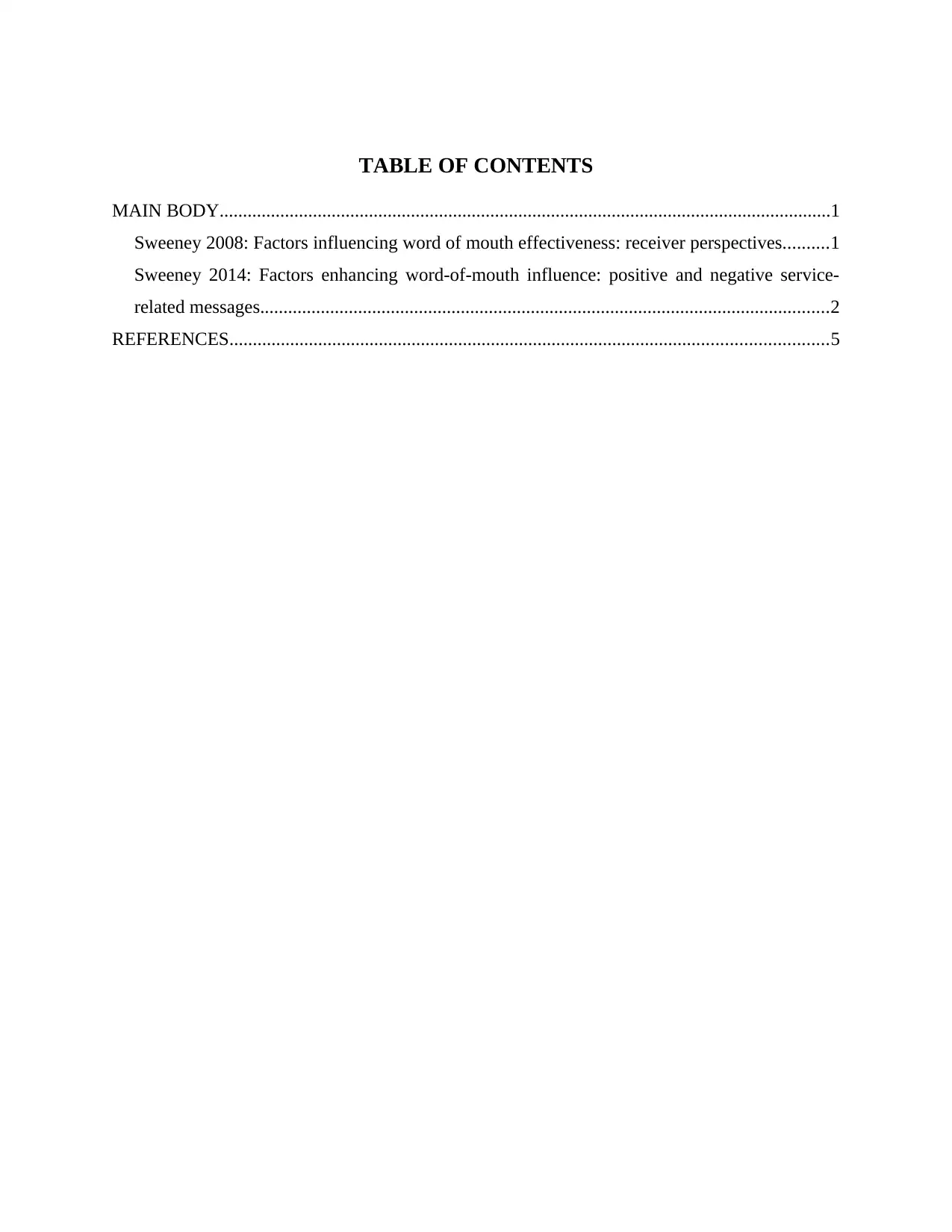
TABLE OF CONTENTS
MAIN BODY...................................................................................................................................1
Sweeney 2008: Factors influencing word of mouth effectiveness: receiver perspectives..........1
Sweeney 2014: Factors enhancing word-of-mouth influence: positive and negative service-
related messages..........................................................................................................................2
REFERENCES................................................................................................................................5
Document Page
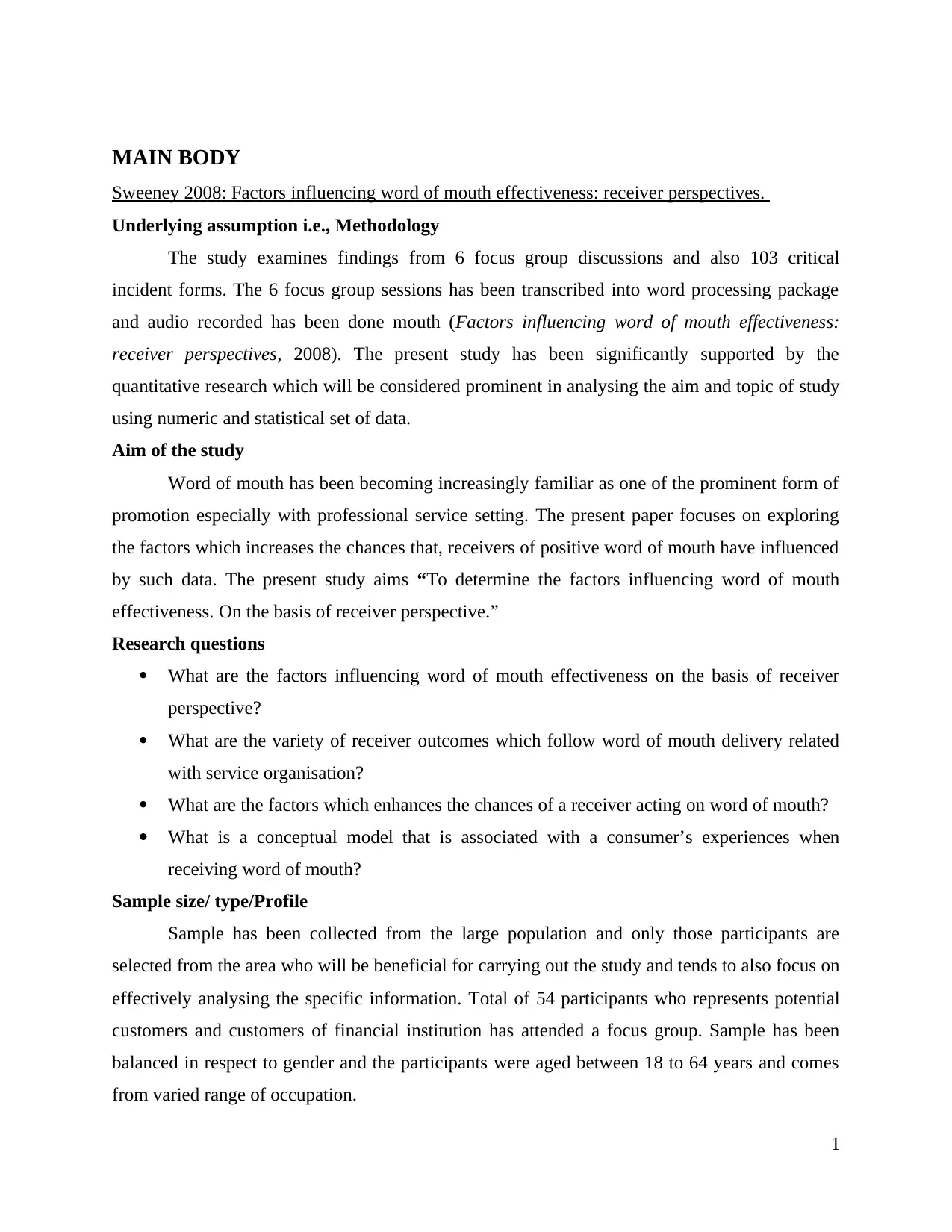
MAIN BODY
Sweeney 2008: Factors influencing word of mouth effectiveness: receiver perspectives.
Underlying assumption i.e., Methodology
The study examines findings from 6 focus group discussions and also 103 critical
incident forms. The 6 focus group sessions has been transcribed into word processing package
and audio recorded has been done mouth (Factors influencing word of mouth effectiveness:
receiver perspectives, 2008). The present study has been significantly supported by the
quantitative research which will be considered prominent in analysing the aim and topic of study
using numeric and statistical set of data.
Aim of the study
Word of mouth has been becoming increasingly familiar as one of the prominent form of
promotion especially with professional service setting. The present paper focuses on exploring
the factors which increases the chances that, receivers of positive word of mouth have influenced
by such data. The present study aims To determine the factors influencing word of mouth
effectiveness. On the basis of receiver perspective.”
Research questions
What are the factors influencing word of mouth effectiveness on the basis of receiver
perspective?
What are the variety of receiver outcomes which follow word of mouth delivery related
with service organisation?
What are the factors which enhances the chances of a receiver acting on word of mouth?
What is a conceptual model that is associated with a consumer’s experiences when
receiving word of mouth?
Sample size/ type/Profile
Sample has been collected from the large population and only those participants are
selected from the area who will be beneficial for carrying out the study and tends to also focus on
effectively analysing the specific information. Total of 54 participants who represents potential
customers and customers of financial institution has attended a focus group. Sample has been
balanced in respect to gender and the participants were aged between 18 to 64 years and comes
from varied range of occupation.
1
tabler-icon-diamond-filled.svg

Paraphrase This Document

Need a fresh take? Get an instant paraphrase of this document with our AI Paraphraser
Document Page
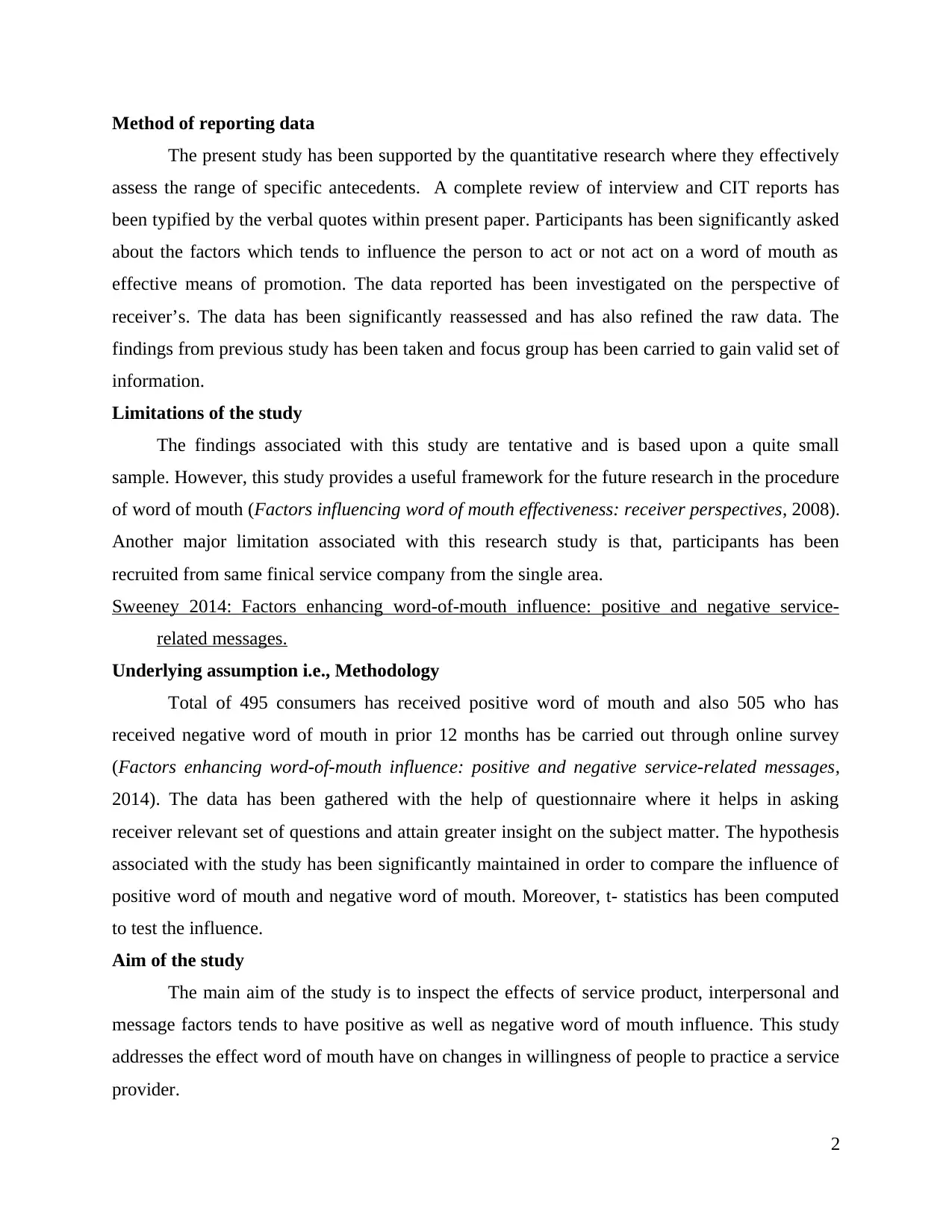
Method of reporting data
The present study has been supported by the quantitative research where they effectively
assess the range of specific antecedents. A complete review of interview and CIT reports has
been typified by the verbal quotes within present paper. Participants has been significantly asked
about the factors which tends to influence the person to act or not act on a word of mouth as
effective means of promotion. The data reported has been investigated on the perspective of
receiver’s. The data has been significantly reassessed and has also refined the raw data. The
findings from previous study has been taken and focus group has been carried to gain valid set of
information.
Limitations of the study
The findings associated with this study are tentative and is based upon a quite small
sample. However, this study provides a useful framework for the future research in the procedure
of word of mouth (Factors influencing word of mouth effectiveness: receiver perspectives, 2008).
Another major limitation associated with this research study is that, participants has been
recruited from same finical service company from the single area.
Sweeney 2014: Factors enhancing word-of-mouth influence: positive and negative service-
related messages.
Underlying assumption i.e., Methodology
Total of 495 consumers has received positive word of mouth and also 505 who has
received negative word of mouth in prior 12 months has be carried out through online survey
(Factors enhancing word-of-mouth influence: positive and negative service-related messages,
2014). The data has been gathered with the help of questionnaire where it helps in asking
receiver relevant set of questions and attain greater insight on the subject matter. The hypothesis
associated with the study has been significantly maintained in order to compare the influence of
positive word of mouth and negative word of mouth. Moreover, t- statistics has been computed
to test the influence.
Aim of the study
The main aim of the study is to inspect the effects of service product, interpersonal and
message factors tends to have positive as well as negative word of mouth influence. This study
addresses the effect word of mouth have on changes in willingness of people to practice a service
provider.
2
Document Page
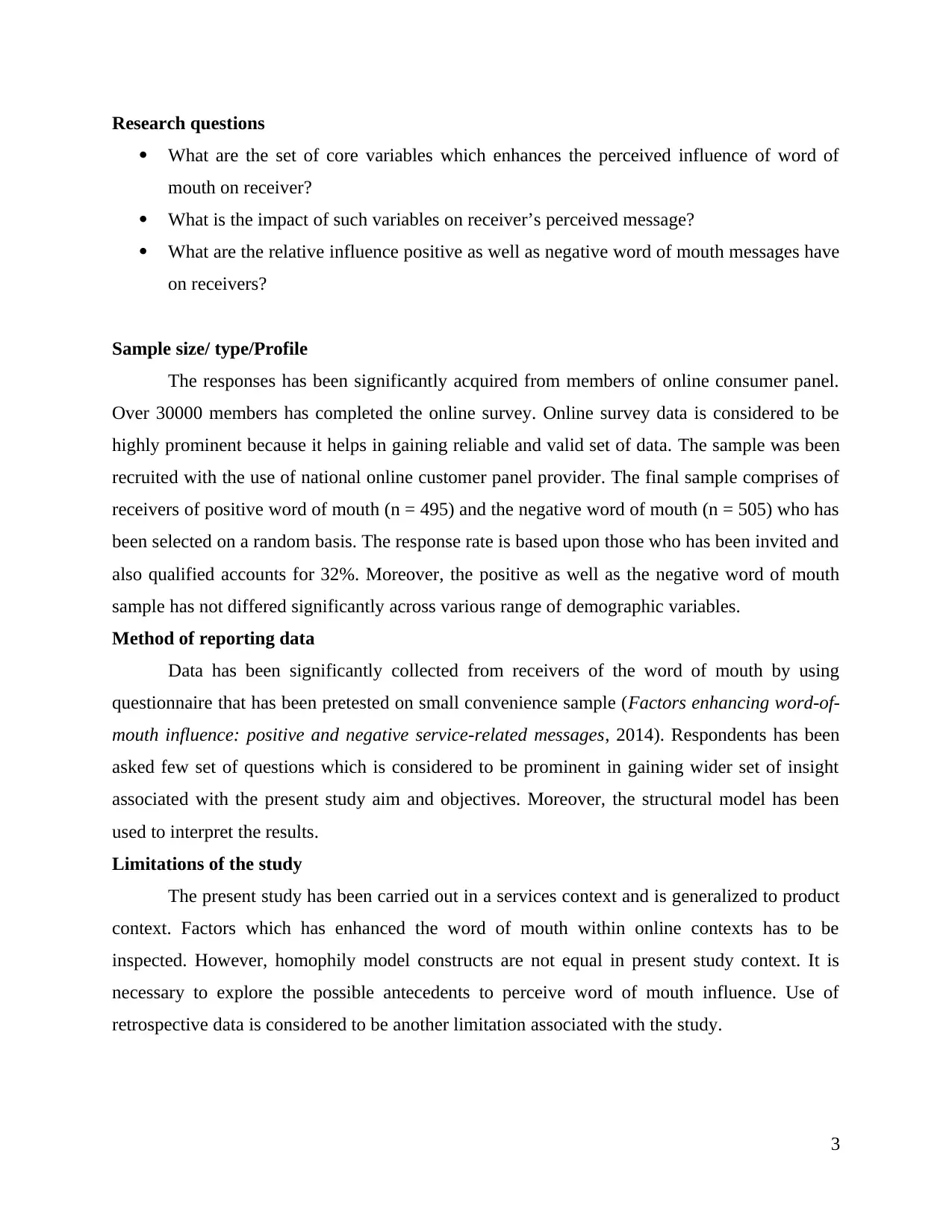
Research questions
What are the set of core variables which enhances the perceived influence of word of
mouth on receiver?
What is the impact of such variables on receiver’s perceived message?
What are the relative influence positive as well as negative word of mouth messages have
on receivers?
Sample size/ type/Profile
The responses has been significantly acquired from members of online consumer panel.
Over 30000 members has completed the online survey. Online survey data is considered to be
highly prominent because it helps in gaining reliable and valid set of data. The sample was been
recruited with the use of national online customer panel provider. The final sample comprises of
receivers of positive word of mouth (n = 495) and the negative word of mouth (n = 505) who has
been selected on a random basis. The response rate is based upon those who has been invited and
also qualified accounts for 32%. Moreover, the positive as well as the negative word of mouth
sample has not differed significantly across various range of demographic variables.
Method of reporting data
Data has been significantly collected from receivers of the word of mouth by using
questionnaire that has been pretested on small convenience sample (Factors enhancing word-of-
mouth influence: positive and negative service-related messages, 2014). Respondents has been
asked few set of questions which is considered to be prominent in gaining wider set of insight
associated with the present study aim and objectives. Moreover, the structural model has been
used to interpret the results.
Limitations of the study
The present study has been carried out in a services context and is generalized to product
context. Factors which has enhanced the word of mouth within online contexts has to be
inspected. However, homophily model constructs are not equal in present study context. It is
necessary to explore the possible antecedents to perceive word of mouth influence. Use of
retrospective data is considered to be another limitation associated with the study.
3
Document Page
4
tabler-icon-diamond-filled.svg

Paraphrase This Document

Need a fresh take? Get an instant paraphrase of this document with our AI Paraphraser
Document Page
REFERENCES
Online
Factors influencing word of mouth effectiveness: receiver perspectives. 2008. [ONLINE].
Available through< file:///C:/Users/Admin/AppData/Local/Temp/Rar$DIa0.607/sweeney
%202008.pdf >
Factors enhancing word-of-mouth influence: positive and negative service-related messages.
2014. [ONLINE]. Available
through<file:///C:/Users/Admin/AppData/Local/Temp/Rar$DIa0.485/sweeney%202014.pdf>
5
chevron_up_icon
1 out of 8
circle_padding
hide_on_mobile
zoom_out_icon
[object Object]