Sociology Report: Analyzing Work Life Balance in Contemporary Mexico

Verified

Added on  2022/11/18

|5
|780
|134
Report
AI Summary
This report provides an overview of work-life balance in Mexico, highlighting the challenges faced by Mexican workers. The report begins with an introduction defining work-life balance and then focuses on the situation in Mexico. It discusses the country's poor ranking in work-life balance, the issues of long working hours, low salaries, and lack of fixed working hours. The report then reviews existing policies and programs, such as the Mexican Constitution and the Federal Labor Law, and suggests beneficial policies like parental part-time work, maternity/parenting toolkits, and health insurance policies. The report concludes by emphasizing the need for policy implementation to improve work-life balance in Mexico. The report is a valuable resource for understanding the sociological aspects of work and life in Mexico, including relevant statistics and policy recommendations. The report uses data from multiple sources to support its findings, including OECD and World Atlas. It also includes a bibliography of sources used.
Document Page
RUNNING HEAD: WORK LIFE STABILITY
SOCIOLOGY
tabler-icon-diamond-filled.svg

Paraphrase This Document

Need a fresh take? Get an instant paraphrase of this document with our AI Paraphraser
Document Page
WORK LIFE STABILITY
1
Contents
Introduction......................................................................................................................................2
Mexico.............................................................................................................................................2
Current issue....................................................................................................................................2
Policies and Programs......................................................................................................................3
Beneficial policies...........................................................................................................................3
Conclusion.......................................................................................................................................3
Bibliography....................................................................................................................................4
Document Page
WORK LIFE STABILITY
2
Introduction
The study report is prepared on the topic ‘Work Life Balance’. It refers to the stability
needed by an employed individual between time allotted for work and other aspects of life. It
includes aspects such as private interest, domestic and relaxation activities (Delecta, 2011). The
basic aim of the discussion is to pour light on the chief aspect prevailing in Mexico with respect
to work life balance. Furthermore, it provides a chance to increase the awareness related to the
given topic.
Mexico
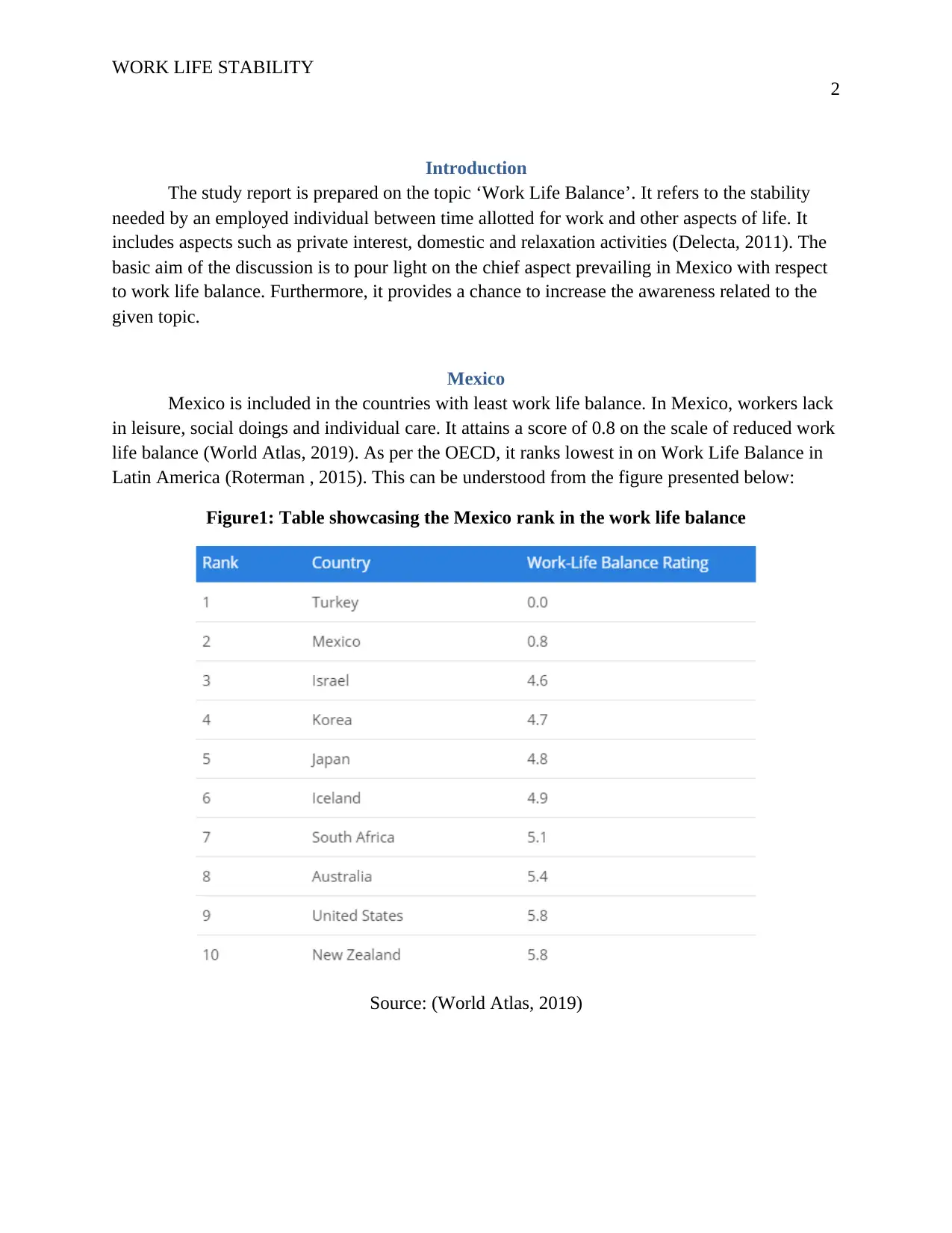
Mexico is included in the countries with least work life balance. In Mexico, workers lack
in leisure, social doings and individual care. It attains a score of 0.8 on the scale of reduced work
life balance (World Atlas, 2019). As per the OECD, it ranks lowest in on Work Life Balance in
Latin America (Roterman , 2015). This can be understood from the figure presented below:
Figure1: Table showcasing the Mexico rank in the work life balance
Source: (World Atlas, 2019)
Document Page
WORK LIFE STABILITY
3
Current issue
The Mexicans are facing a major issue in balancing their personal and professional life. It
has resulted in reduction in the social connections. This is because of the less involvement in
social gatherings and events. It is analyzed that Mexicans are facing low work life balance
because of the following reasons:
As compared to Western European countries, Mexicans attain low salaries. In order to
earn a decent salary Mexicans work for more than 50 hours a week. A majority of
Mexico’s middle class is engaged in long working hours.
Another reason for the low work life balance is that working hours are not fixed.
Additionally, Mexican law does not regulate the employees working hour. Thus, working
hours is usually depends on individual’s job and the organization.
As per the Mexican holiday regulation, employed Mexicans are given only one week of
paid holidays. Additionally, they can claim paid holidays only after the completion of
one-year service in a company (Fagan, 2012).
Policies and Programs
1. ‘Mexican Constitution and the Federal Labor Law’ emphasizes on anti-discrimination
law based on issues related to work life.
2. ‘Article 123’ focuses on workers right for an eight-hour work in an organization. It also
involves
3. ‘Federal Labor Law’ safeguards the employees in aspects related to working conditions
and working schedules.
4. ‘LFT’ allow the employed fathers for the right to parental leave (Castro , 2019).
Beneficial policies
1. Parental part time work: A policy supporting young parents should be developed. This
could be done by reducing the weekly working hours of the new parents.
2. Maternity and Parenting toolkit: A policy for initiating the parenting toolkit should be
developed. This will help support the
3. Health insurance policy: Mexican gives priority to health. Thus, policies regarding the
same should be developed (Rani, 2011).
Conclusion
The report focuses on the topic ‘Work Life Balance’. The discussion mentioned above
concludes that poor work life balance is a serious issue in Mexico. However, it can reduce
largely if the implementation of beneficial policies is given prior attention.
tabler-icon-diamond-filled.svg

Paraphrase This Document

Need a fresh take? Get an instant paraphrase of this document with our AI Paraphraser
Document Page
WORK LIFE STABILITY
4
Bibliography
Castro , M. R. (2019, September 10). Work-Life in Mexico: Policy, Practice and Culture.
Retrieved from Executive Briefing Work :
https://www.bc.edu/content/dam/files/centers/cwf/research/publications3/
executivebriefingseries-2/ExecutiveBriefing_Work-LifeinMexico.pdf
Delecta, P. (2011). Work life balance. International Journal of Current Research, 3(4), 186-189.
Fagan, C. L.-T. (2012). The influence of working time arrangements on work-life integration
or'balance': a review of the international evidence. Geneva: ILO.
Rani, S. V. (2011). Work/life balance reflections on employee satisfaction. Serbian Journal of
Management, 6(1).
Roterman , N. (2015, January 19). OECD Ranks Mexico Lowest Country in Latin American on
Work-Life Balance. Retrieved from Pvangels : http://pvangels.com/news-
mexico/14422/oecd-ranks-mexico-lowest-on-work-life-balance
World Atlas. (2019, Septemeber 10). 10 Countries With The Worst Work-Life Balance. Retrieved
from World Atlas: https://www.worldatlas.com/articles/10-countries-with-the-
worst-work-life-balance.html
chevron_up_icon
1 out of 5
circle_padding
hide_on_mobile
zoom_out_icon
[object Object]