Analyzing Injury Management, Compensation Systems & Processes
VerifiedAdded on 2024/05/20
|9
|3295
|108
Report
AI Summary
This report provides a comprehensive overview of Injury & Incident Management Systems (I&IMS) and the worker compensation process, emphasizing their importance in ensuring workplace safety and employee well-being. It details the critical steps within an I&IMS, including event identification, initial response, reporting, investigation, and corrective action, alongside an explanation of the worker compensation process, covering claim submission, processing, and benefits disbursement. The report also includes a practical application of these systems in a scenario involving an injured employee, Sarah, outlining the immediate responses, reporting procedures, investigative actions, and corrective measures necessary. Furthermore, it evaluates the effectiveness of local (New Zealand's ACC) and international (OSHA in the US) systems, comparing them to the designed processes, highlighting the significance of prevention, early intervention, and financial support for injured workers. The document underscores the legal and ethical responsibilities of businesses to maintain safe workplaces and support employees through effective I&IMS and worker compensation programs.
Table of Contents
Part 1: Injury & Incident Management System and Worker Compensation Process......................1
Injury & Incident Management System (I&IMS)........................................................................1
Identification of an event:.........................................................................................................1
Initial Response:.......................................................................................................................1
Reporting an event:..................................................................................................................1
Investigation.............................................................................................................................1
Corrective Action:....................................................................................................................2
Worker Compensation Process Overview...................................................................................2
Important Steps.........................................................................................................................2
Claims processing.....................................................................................................................2
Benefits Disbursement.............................................................................................................2
Justifications.............................................................................................................................3
Part 2: Implementation of the Systems & Processes.......................................................................3
Instantly Response:...................................................................................................................3
Reporting the Incident:.............................................................................................................3
Investigation.............................................................................................................................4
Corrective Action:....................................................................................................................4
The process for worker compensation:........................................................................................4
Part 3: Evaluation of the Effectiveness of Local and International Systems & Processes..............5
a) Evaluation of Systems and Processes:.....................................................................................5
Local (New Zealand) Organization: The Accident Compensation Corporation (ACC).............5
International Organisation (OSHA in the US).............................................................................5
b) Comparison to Own Design.....................................................................................................6
References........................................................................................................................................6
Part 1: Injury & Incident Management System and Worker Compensation Process......................1
Injury & Incident Management System (I&IMS)........................................................................1
Identification of an event:.........................................................................................................1
Initial Response:.......................................................................................................................1
Reporting an event:..................................................................................................................1
Investigation.............................................................................................................................1
Corrective Action:....................................................................................................................2
Worker Compensation Process Overview...................................................................................2
Important Steps.........................................................................................................................2
Claims processing.....................................................................................................................2
Benefits Disbursement.............................................................................................................2
Justifications.............................................................................................................................3
Part 2: Implementation of the Systems & Processes.......................................................................3
Instantly Response:...................................................................................................................3
Reporting the Incident:.............................................................................................................3
Investigation.............................................................................................................................4
Corrective Action:....................................................................................................................4
The process for worker compensation:........................................................................................4
Part 3: Evaluation of the Effectiveness of Local and International Systems & Processes..............5
a) Evaluation of Systems and Processes:.....................................................................................5
Local (New Zealand) Organization: The Accident Compensation Corporation (ACC).............5
International Organisation (OSHA in the US).............................................................................5
b) Comparison to Own Design.....................................................................................................6
References........................................................................................................................................6

Paraphrase This Document
Need a fresh take? Get an instant paraphrase of this document with our AI Paraphraser
Part 1: Injury & Incident Management System and Worker Compensation Process
The safety of employees will always be the most important criterion in the running of a business.
The process of worker compensation together with the optimum I&IMS plan contributes to
dignity, wellness and fairness of workplaces. Therefore, fewer casualties, fewer accidents, and
faster medical care will be possible. In this extended conversation, we talk about the basic things
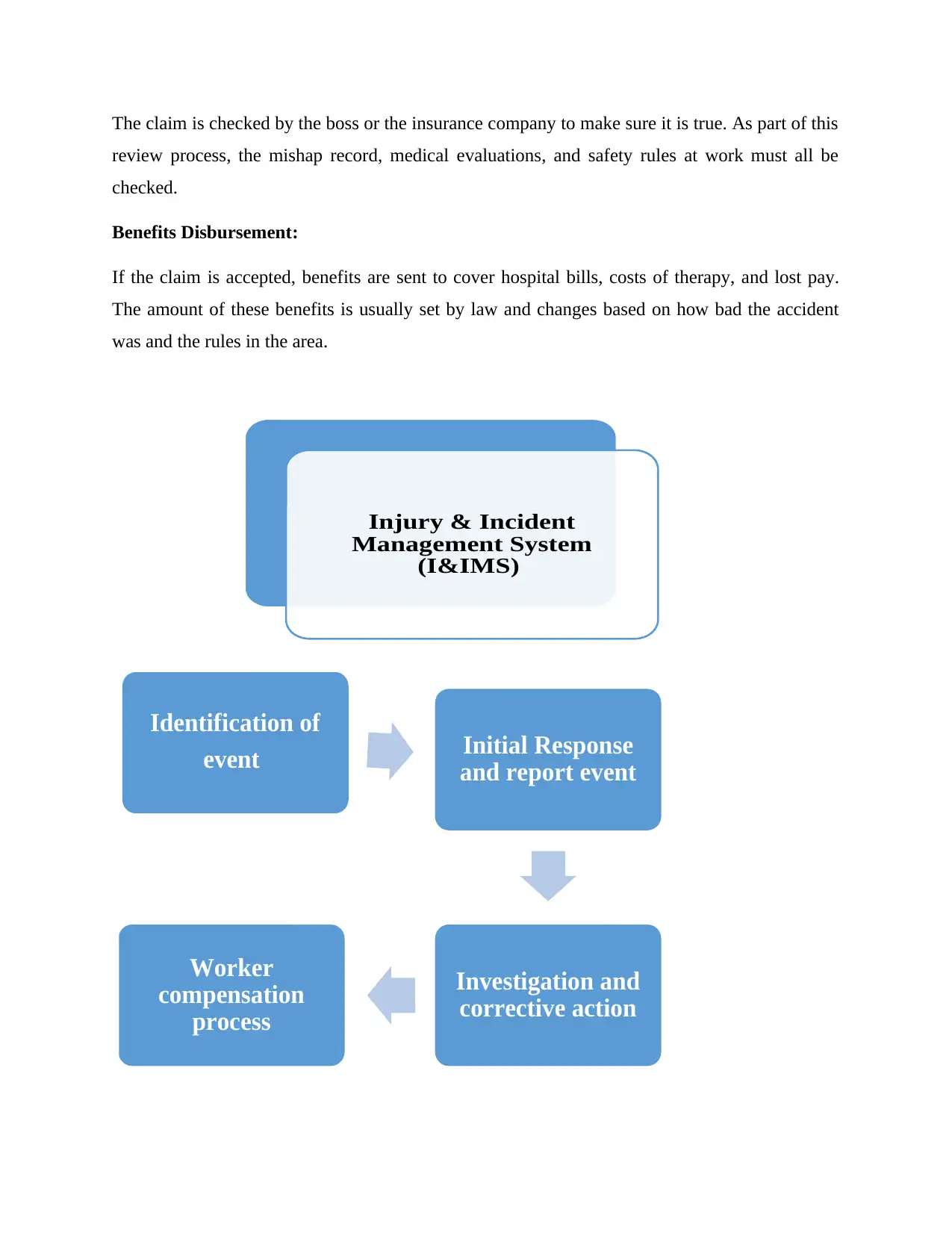
of an I & IMS having an example of a flowchart and the importance of the Worker
Compensation.
Injury & Incident Management System (I&IMS)
An Injury and Incident Management System is the integrated approach for controlling and
preventing the incidents. In this particular scenario, the main objective is to avoid delays at each
situation and make sure that things are done in a correct manner so that the workers do not suffer
and that similar problems are prevented from happening in the near future. The process is based
on multiple specific elements.
Identification of an event:
The starting point of this process is a chance when an employee or a witness files a case. In this
case, the quick recognition is an important element of the whole management process and it
gives the likelihood of further procedures. Teams, underwent extensive training in spotting the
unusual or hazardous situations and reporting these, right away, to their supervisors or safety
officers.
Initial Response:
Instantaneously, an event is reported is the time for the supervisor to safeguard the area and
guarantee the security of all the people in the crime scene. It may be the necessity to provide the
patient with physical care, such as changing the diaper, calling for help, or, in unavoidable cases,
leaving the area. The first step is to ensure that the wrecks are not getting more created and then
that everything is being under control.
Reporting an event:
Once the initial reaction steps have been taken, the event must be properly recorded. This
paperwork usually has information like the date, time, and place of the event, as well as an
account of what happened and the names of people who were there or saw it happen. Reporting
The safety of employees will always be the most important criterion in the running of a business.
The process of worker compensation together with the optimum I&IMS plan contributes to
dignity, wellness and fairness of workplaces. Therefore, fewer casualties, fewer accidents, and
faster medical care will be possible. In this extended conversation, we talk about the basic things
of an I & IMS having an example of a flowchart and the importance of the Worker
Compensation.
Injury & Incident Management System (I&IMS)
An Injury and Incident Management System is the integrated approach for controlling and
preventing the incidents. In this particular scenario, the main objective is to avoid delays at each
situation and make sure that things are done in a correct manner so that the workers do not suffer
and that similar problems are prevented from happening in the near future. The process is based
on multiple specific elements.
Identification of an event:
The starting point of this process is a chance when an employee or a witness files a case. In this
case, the quick recognition is an important element of the whole management process and it
gives the likelihood of further procedures. Teams, underwent extensive training in spotting the
unusual or hazardous situations and reporting these, right away, to their supervisors or safety
officers.
Initial Response:
Instantaneously, an event is reported is the time for the supervisor to safeguard the area and
guarantee the security of all the people in the crime scene. It may be the necessity to provide the
patient with physical care, such as changing the diaper, calling for help, or, in unavoidable cases,
leaving the area. The first step is to ensure that the wrecks are not getting more created and then
that everything is being under control.
Reporting an event:
Once the initial reaction steps have been taken, the event must be properly recorded. This
paperwork usually has information like the date, time, and place of the event, as well as an
account of what happened and the names of people who were there or saw it happen. Reporting
things correctly is important for legal and compliance reasons, and it also keeps a record for later
use.
Investigation:
The goal of a good investigation is to find out what happened. In this step, witnesses are often
questioned, the scene of the crime is looked at, and any relevant tools or methods are studied. It
is necessary that the review in this case performs not only the task of finding the problem, but
also the task of discovering factors that can lead to the problem in the future. Such review should
be complete and fair.
Corrective Action:
Based on what the study found, corrective actions are planned and carried out to make sure that
similar problems don't happen again. Some of these steps could be updating training programs,
making changes to tools, or making communication methods better. Using an I&IMS isn't just
required by law; it also shows that a company cares about the health and safety of its workers.
Organizations do business through proper execution of the plans as doing so, cuts cost of
probably to have business at a loss or loss of time leading to even more loses which are mostly
expensive. In the end, Its and I concern will form just a part of connection between the partners
and will also strengthen the company's image among them.
Worker Compensation Process Overview:
The Worker's Compensation case is one of the cases which is meant to serve workers who suffer
from work-related injuries or illness. This process leads to the fact that wounded employees get
monetary assistance and medical care so they can recuperate without being angry at their
problems with money.
Important Steps:
Submission of claim:
A worker who has suffered injury or is a representative of the worker completes the claim and
attaches the medical reports, incident report, and any other documents explaining what occurred.
Claims processing:
use.
Investigation:
The goal of a good investigation is to find out what happened. In this step, witnesses are often
questioned, the scene of the crime is looked at, and any relevant tools or methods are studied. It
is necessary that the review in this case performs not only the task of finding the problem, but
also the task of discovering factors that can lead to the problem in the future. Such review should
be complete and fair.
Corrective Action:
Based on what the study found, corrective actions are planned and carried out to make sure that
similar problems don't happen again. Some of these steps could be updating training programs,
making changes to tools, or making communication methods better. Using an I&IMS isn't just
required by law; it also shows that a company cares about the health and safety of its workers.
Organizations do business through proper execution of the plans as doing so, cuts cost of
probably to have business at a loss or loss of time leading to even more loses which are mostly
expensive. In the end, Its and I concern will form just a part of connection between the partners
and will also strengthen the company's image among them.
Worker Compensation Process Overview:
The Worker's Compensation case is one of the cases which is meant to serve workers who suffer
from work-related injuries or illness. This process leads to the fact that wounded employees get
monetary assistance and medical care so they can recuperate without being angry at their
problems with money.
Important Steps:
Submission of claim:
A worker who has suffered injury or is a representative of the worker completes the claim and
attaches the medical reports, incident report, and any other documents explaining what occurred.
Claims processing:
⊘ This is a preview!⊘
Do you want full access?
Subscribe today to unlock all pages.

Trusted by 1+ million students worldwide
The claim is checked by the boss or the insurance company to make sure it is true. As part of this
review process, the mishap record, medical evaluations, and safety rules at work must all be
checked.
Benefits Disbursement:
If the claim is accepted, benefits are sent to cover hospital bills, costs of therapy, and lost pay.
The amount of these benefits is usually set by law and changes based on how bad the accident
was and the rules in the area.
Injury & Incident
Management System
(I&IMS)
Identification of
event Initial Response
and report event
Investigation and
corrective action
Worker
compensation
process
review process, the mishap record, medical evaluations, and safety rules at work must all be
checked.
Benefits Disbursement:
If the claim is accepted, benefits are sent to cover hospital bills, costs of therapy, and lost pay.
The amount of these benefits is usually set by law and changes based on how bad the accident
was and the rules in the area.
Injury & Incident
Management System
(I&IMS)
Identification of
event Initial Response
and report event
Investigation and
corrective action
Worker
compensation
process
Paraphrase This Document
Need a fresh take? Get an instant paraphrase of this document with our AI Paraphraser
Figure 1: Flowchart Injury & Incident Management System and Worker Compensation
Process
Justifications:
Not only is worker's compensation required by law in many places, it's also an important part of
making sure employees are safe and healthy. Workers' compensation helps wounded workers
stay financially stable and shows that the company cares about their employees. Also, it
encourages workers to be safe, raises confidence, and inspires them. Any business needs to have
both a good Injury & Incident Management System and a full Worker Compensation Process.
These methods make it easier to handle accidents at work, keep the workplace safe, and make
sure that affected workers get the help they need. Putting these systems in place will stay an
important part of good operational management, even as businesses change. This shows how
important it is for employees to be safe and healthy to reach company goals.
Part 2: Implementation of the Systems & Processes:
Referring to the flowchart in Part 1, putting systems and processes into place for Sarah would
require several important steps to keep her safe, get her the right medical care, fully document
the incident, find out what went wrong, make things right, and make it easier for her to get
worker's compensation benefits. All of these steps are necessary to not only meet the current
needs but also make things better in the long run when dealing with these kinds of situations.
Instantly Response:
When Sarah told her boss about what happened, he or she should have stepped in right away.
This quick reaction is very important for showing that the company cares about worker safety.
The boss should have checked to see if Sarah was no longer in immediate danger from the angry
patient as a first step. Some of them could offer her a way of transportation or help her to have a
chance to take a rest from being scared in a good place. It is obvious that first aid was worth to
be taken soon after this. It might be the belief of the police or the narrative by which the
medicine is applied on her wound as it is needed. Medical intervention at the post incident stage
is fundamental in that it deals with any immediate health concerns and recording of the injuries
accurately for purposes of claim or investigation.
Process
Justifications:
Not only is worker's compensation required by law in many places, it's also an important part of
making sure employees are safe and healthy. Workers' compensation helps wounded workers
stay financially stable and shows that the company cares about their employees. Also, it
encourages workers to be safe, raises confidence, and inspires them. Any business needs to have
both a good Injury & Incident Management System and a full Worker Compensation Process.
These methods make it easier to handle accidents at work, keep the workplace safe, and make
sure that affected workers get the help they need. Putting these systems in place will stay an
important part of good operational management, even as businesses change. This shows how
important it is for employees to be safe and healthy to reach company goals.
Part 2: Implementation of the Systems & Processes:
Referring to the flowchart in Part 1, putting systems and processes into place for Sarah would
require several important steps to keep her safe, get her the right medical care, fully document
the incident, find out what went wrong, make things right, and make it easier for her to get
worker's compensation benefits. All of these steps are necessary to not only meet the current
needs but also make things better in the long run when dealing with these kinds of situations.
Instantly Response:
When Sarah told her boss about what happened, he or she should have stepped in right away.
This quick reaction is very important for showing that the company cares about worker safety.
The boss should have checked to see if Sarah was no longer in immediate danger from the angry
patient as a first step. Some of them could offer her a way of transportation or help her to have a
chance to take a rest from being scared in a good place. It is obvious that first aid was worth to
be taken soon after this. It might be the belief of the police or the narrative by which the
medicine is applied on her wound as it is needed. Medical intervention at the post incident stage
is fundamental in that it deals with any immediate health concerns and recording of the injuries
accurately for purposes of claim or investigation.
Reporting the Incident:
The other pivotal thing you should enumerate should be the sequence of events along with the
facts. Written down everything his boss could remember like time and location of the event,
what led to the altercation, reason and nature of the incident, was the first crucial step. By this
token, Sarah's reactions which include her immediate response or not have to be identified
precisely too. Such files form the crux of the considerations for what went right and what went
wrong and is also accountable internally and externally which is based on the legal instructions.
On the other hand, the handling of such situation should be also with care and kept secret so that
Sarah considers the relatives and friends around her and she get the support instead of being
judged or involvement into trouble.
Investigation:
After the first reaction and report, the event should be looked into quickly and thoroughly by a
designated team or person. The goal of this review should be to find any widespread problems or
gaps in current procedures that led to the event. For instance, if violent behaviour was expected,
the review should check to see if there were enough safeguards in place or if staff were properly
trained to handle such scenarios. The review should also look at what bystanders, other staff
members, and maybe even the patient have to say, as long as it can be done safely and correctly.
The goal is to get a full picture of what happened so that effective steps can be taken to fix
things.
Corrective Action:
Based on what the study found, corrective steps need to be made and put into place. Possible
changes include updating safety rules, giving staff better training on how to calm down an
argument, boosting security, or even altering how patients are handled. For example, if the study
shows that staff often have to deal with angry patients who don't feel ready, a focused training
program can be made to give them the skills they need to handle these situations well. Also, if
the event happened because of a lack of proper security measures, changes could be made, like
adding more security staff or better emergency contact systems.
The process for worker compensation:
In the end, Sarah should be shown how to file for worker's compensation. This includes helping
her fill out the paperwork she needs to make a claim, learning about her rights under the worker's
compensation law, and getting the medical care and support services she needs. It is both the law
The other pivotal thing you should enumerate should be the sequence of events along with the
facts. Written down everything his boss could remember like time and location of the event,
what led to the altercation, reason and nature of the incident, was the first crucial step. By this
token, Sarah's reactions which include her immediate response or not have to be identified
precisely too. Such files form the crux of the considerations for what went right and what went
wrong and is also accountable internally and externally which is based on the legal instructions.
On the other hand, the handling of such situation should be also with care and kept secret so that
Sarah considers the relatives and friends around her and she get the support instead of being
judged or involvement into trouble.
Investigation:
After the first reaction and report, the event should be looked into quickly and thoroughly by a
designated team or person. The goal of this review should be to find any widespread problems or
gaps in current procedures that led to the event. For instance, if violent behaviour was expected,
the review should check to see if there were enough safeguards in place or if staff were properly
trained to handle such scenarios. The review should also look at what bystanders, other staff
members, and maybe even the patient have to say, as long as it can be done safely and correctly.
The goal is to get a full picture of what happened so that effective steps can be taken to fix
things.
Corrective Action:
Based on what the study found, corrective steps need to be made and put into place. Possible
changes include updating safety rules, giving staff better training on how to calm down an
argument, boosting security, or even altering how patients are handled. For example, if the study
shows that staff often have to deal with angry patients who don't feel ready, a focused training
program can be made to give them the skills they need to handle these situations well. Also, if
the event happened because of a lack of proper security measures, changes could be made, like
adding more security staff or better emergency contact systems.
The process for worker compensation:
In the end, Sarah should be shown how to file for worker's compensation. This includes helping
her fill out the paperwork she needs to make a claim, learning about her rights under the worker's
compensation law, and getting the medical care and support services she needs. It is both the law
⊘ This is a preview!⊘
Do you want full access?
Subscribe today to unlock all pages.
Trusted by 1+ million students worldwide
and the right thing to do to make sure Sarah gets all the rewards she is entitled to. Sarah should
always have help and be kept up to date on how her case is going and what is being done to stop
similar things from happening. This all-around method not only helps her get better but also
makes her trust the safety steps at work again. To sum up, putting Sarah's report's systems and
processes into action is a difficult but necessary set of steps that must be taken with care, skill,
and an eye on both short-term and long-term safety gains. By taking care of all of these issues
properly, the company can not only help Sarah get better but also make the workplace safer and
better prepared for future events like this one.
Part 3: Evaluation of the Effectiveness of Local and International Systems & Processes
a) Evaluation of Systems and Processes:
Local (New Zealand) Organization: The Accident Compensation Corporation (ACC)
New Zealand's Accident Compensation Corporation (ACC) is one of the most important
organizations in the field of health and safety at work. It addresses all the injuries and illnesses
that happen in the working area and has a no-fault basis which offers the injured workers medical
resources, help with their recovery, and money for paid wages no matter who was to blame. This
plan is particular important because it avoids lawsuits that usually hold up the process of
recovering seriously-ill people. Therefore, if this plan is put into place, it will help people get
well. The ACC's philosophy is on prevention, early intervention which quicken the time for
workers returning to the work. They not only heal the employee but also helps to avoid the
economic costs of long-term absences from work places. For instance, in situations like the case
of Sarah who needs to take longer time in recuperation due to the injury which would prevent her
from doing her work, the ACC's preemptive measures make sure as her recovery demands will
allow, she gets quick care and support which later put her back to work. Moreover, ACC 's
efficiency is also proved in the statement that it is not just meant for instant medical assistance
but much more. Notably, it enlists long-term rehabilitation treatment and gives out financial
assistance. This holistic approach to help employees becomes not only physically but financially
stable which will do them a favor and give them more energy to return to their work.
International Organisation (OSHA in the US):
In the US, on the other hand, the Occupational Safety and Health Administration (OSHA) serves
value as the association that is responsible and in charge of safety rules and inspections in the
always have help and be kept up to date on how her case is going and what is being done to stop
similar things from happening. This all-around method not only helps her get better but also
makes her trust the safety steps at work again. To sum up, putting Sarah's report's systems and
processes into action is a difficult but necessary set of steps that must be taken with care, skill,
and an eye on both short-term and long-term safety gains. By taking care of all of these issues
properly, the company can not only help Sarah get better but also make the workplace safer and
better prepared for future events like this one.
Part 3: Evaluation of the Effectiveness of Local and International Systems & Processes
a) Evaluation of Systems and Processes:
Local (New Zealand) Organization: The Accident Compensation Corporation (ACC)
New Zealand's Accident Compensation Corporation (ACC) is one of the most important
organizations in the field of health and safety at work. It addresses all the injuries and illnesses
that happen in the working area and has a no-fault basis which offers the injured workers medical
resources, help with their recovery, and money for paid wages no matter who was to blame. This
plan is particular important because it avoids lawsuits that usually hold up the process of
recovering seriously-ill people. Therefore, if this plan is put into place, it will help people get
well. The ACC's philosophy is on prevention, early intervention which quicken the time for
workers returning to the work. They not only heal the employee but also helps to avoid the
economic costs of long-term absences from work places. For instance, in situations like the case
of Sarah who needs to take longer time in recuperation due to the injury which would prevent her
from doing her work, the ACC's preemptive measures make sure as her recovery demands will
allow, she gets quick care and support which later put her back to work. Moreover, ACC 's
efficiency is also proved in the statement that it is not just meant for instant medical assistance
but much more. Notably, it enlists long-term rehabilitation treatment and gives out financial
assistance. This holistic approach to help employees becomes not only physically but financially
stable which will do them a favor and give them more energy to return to their work.
International Organisation (OSHA in the US):
In the US, on the other hand, the Occupational Safety and Health Administration (OSHA) serves
value as the association that is responsible and in charge of safety rules and inspections in the
Paraphrase This Document
Need a fresh take? Get an instant paraphrase of this document with our AI Paraphraser
work place. OSHA stipulates that employer shall ensure a safe work environment and he must
report all the accidents and illnesses happened at the work. The administration is responsible for
rule making that facilitates employers' understanding of their role to save workers from being
injured. Such principles are sad to say more comprehensive. They contain a wide range of issues
– from machine guards to safe ways how to handle dangerous chemicals. In the US the Insurance
companies cover for any accident that has happened but only when the providers and the
vehicles are insured. In contrast to the ACC, the US system can lead to a lot of lawsuits. One of
the major differences which the states in the United States have is the way they handle
workmen's' compensation. In general, it gives similar benefits to the ACC, like medical care and
money for lost wages, but it can be harder to understand the laws. This can cause delays and
disagreements about who is eligible for pay and how much. This can make it harder for injured
workers to get back to work and prolong their pain. Furthermore, OSHA's rules may not always
work as expected; this depends a lot on how strong and well-enforced the laws are in each
individual state. Because of this, people in different states may not be as protected as they are in
others. This is very different from New Zealand, where the ACC covers everyone the same way.
b) Comparison to Own Design:
The ACC and OSHA systems are foundationally similar to the Injury & Incident Management
system that was created to be used in a healthcare setting. All three stress how important it is to
report accidents quickly, make sure employees can get medical care quickly, and give hurt
workers a lot of money to help them out. This triad is the basis of good safety and health
management at work, which aims to make injuries at work less harmful for both workers and
employers. However, the developed system stands out because it includes organization-specific
processes and procedures that are specifically made for the healthcare setting. For instance, it has
specific incident management guidelines for dealing with difficult patients, which happens a lot
in healthcare settings and can be hard. These procedures give healthcare workers clear
instructions and steps to follow to make sure they handle these situations effectively and safely,
which lowers the risk of injuries in the long run. In addition, the system is designed to be
flexible, especially with the help of a flowchart template that can be changed to fit the needs of
the organization and specific events that happen at work. In healthcare, where a lot of different
things can happen, from getting infectious diseases to hurting yourself while caring for patients,
this ability to change is very important. In conclusion, both the ACC and OSHA have strong
report all the accidents and illnesses happened at the work. The administration is responsible for
rule making that facilitates employers' understanding of their role to save workers from being
injured. Such principles are sad to say more comprehensive. They contain a wide range of issues
– from machine guards to safe ways how to handle dangerous chemicals. In the US the Insurance
companies cover for any accident that has happened but only when the providers and the
vehicles are insured. In contrast to the ACC, the US system can lead to a lot of lawsuits. One of
the major differences which the states in the United States have is the way they handle
workmen's' compensation. In general, it gives similar benefits to the ACC, like medical care and
money for lost wages, but it can be harder to understand the laws. This can cause delays and
disagreements about who is eligible for pay and how much. This can make it harder for injured
workers to get back to work and prolong their pain. Furthermore, OSHA's rules may not always
work as expected; this depends a lot on how strong and well-enforced the laws are in each
individual state. Because of this, people in different states may not be as protected as they are in
others. This is very different from New Zealand, where the ACC covers everyone the same way.
b) Comparison to Own Design:
The ACC and OSHA systems are foundationally similar to the Injury & Incident Management
system that was created to be used in a healthcare setting. All three stress how important it is to
report accidents quickly, make sure employees can get medical care quickly, and give hurt
workers a lot of money to help them out. This triad is the basis of good safety and health
management at work, which aims to make injuries at work less harmful for both workers and
employers. However, the developed system stands out because it includes organization-specific
processes and procedures that are specifically made for the healthcare setting. For instance, it has
specific incident management guidelines for dealing with difficult patients, which happens a lot
in healthcare settings and can be hard. These procedures give healthcare workers clear
instructions and steps to follow to make sure they handle these situations effectively and safely,
which lowers the risk of injuries in the long run. In addition, the system is designed to be
flexible, especially with the help of a flowchart template that can be changed to fit the needs of
the organization and specific events that happen at work. In healthcare, where a lot of different
things can happen, from getting infectious diseases to hurting yourself while caring for patients,
this ability to change is very important. In conclusion, both the ACC and OSHA have strong
safety and health standards for the workplace. However, the customized Injury & Incident
Management system has improvements that are especially helpful in the healthcare sector. This
design takes into account the unique problems and needs of healthcare situations. It not only
follows best practices in general, but it also protects healthcare workers from these risks, making
the workplace safer and more supportive.
References:
Health Information Privacy Code 1994 http://www.legislation.govt.nz/act/publi
c/1993/0028/latest/DLM296639.html
Act, A. B. Mental Health Legislation in New Zealand.
Moore, J., & Mello, M. M. (2017). Improving reconciliation following medical injury: a
qualitative study of responses to patient safety incidents in New Zealand. BMJ Quality &
Safety, 26(10), 788-798.
Davis, P., Lay-Yee, R., Briant, R., & Scott, A. (2003). Preventable in-hospital medical injury
under the “no fault” system in New Zealand. BMJ Quality & Safety, 12(4), 251-256.
Boniface, C. R. (2021). The legal impact of artificial intelligence on the New Zealand health
system.
Keefe, E. (2016). What is the risk to safety and confidentiality in light of advancing mobile
technology for patients undergoing hospital treatment in New Zealand?: a descriptive
exploratory study.
Wallis, K. (2013). Professional accountability of doctors in New Zealand.
Skegg, P. D. G. (2011). A FORTUNATE EXPERIMENT? NEW ZEALAND'S EXPERIENCE
WITH A LEGISLATED CODE OF PATIENTS'RIGHTS. Medical Law Review, 19(2), 235-266.
Mental Health (Compulsory Assessment and Treatment) Act 1992
http://www.legislation.govt.nz/act/public /1992/0046/latest/DLM262176.html
Health & Safety in Employment Act 1992 http://www.business.govt.nz/worksafe
Management system has improvements that are especially helpful in the healthcare sector. This
design takes into account the unique problems and needs of healthcare situations. It not only
follows best practices in general, but it also protects healthcare workers from these risks, making
the workplace safer and more supportive.
References:
Health Information Privacy Code 1994 http://www.legislation.govt.nz/act/publi
c/1993/0028/latest/DLM296639.html
Act, A. B. Mental Health Legislation in New Zealand.
Moore, J., & Mello, M. M. (2017). Improving reconciliation following medical injury: a
qualitative study of responses to patient safety incidents in New Zealand. BMJ Quality &
Safety, 26(10), 788-798.
Davis, P., Lay-Yee, R., Briant, R., & Scott, A. (2003). Preventable in-hospital medical injury
under the “no fault” system in New Zealand. BMJ Quality & Safety, 12(4), 251-256.
Boniface, C. R. (2021). The legal impact of artificial intelligence on the New Zealand health
system.
Keefe, E. (2016). What is the risk to safety and confidentiality in light of advancing mobile
technology for patients undergoing hospital treatment in New Zealand?: a descriptive
exploratory study.
Wallis, K. (2013). Professional accountability of doctors in New Zealand.
Skegg, P. D. G. (2011). A FORTUNATE EXPERIMENT? NEW ZEALAND'S EXPERIENCE
WITH A LEGISLATED CODE OF PATIENTS'RIGHTS. Medical Law Review, 19(2), 235-266.
Mental Health (Compulsory Assessment and Treatment) Act 1992
http://www.legislation.govt.nz/act/public /1992/0046/latest/DLM262176.html
Health & Safety in Employment Act 1992 http://www.business.govt.nz/worksafe
⊘ This is a preview!⊘
Do you want full access?
Subscribe today to unlock all pages.
Trusted by 1+ million students worldwide

1 out of 9


Related Documents


Your All-in-One AI-Powered Toolkit for Academic Success.
+13062052269
info@desklib.com
Available 24*7 on WhatsApp / Email
![[object Object]](/_next/static/media/star-bottom.7253800d.svg)
Unlock your academic potential
Copyright © 2020–2026 A2Z Services. All Rights Reserved. Developed and managed by ZUCOL.