Impact of Growing Age on Workforce & Healthcare: ICT Research Project
VerifiedAdded on 2023/01/13
|13
|2650
|54
Project
AI Summary
This project analyzes the adverse implications of growing age on the workforce and healthcare services in England and Wales. It begins with an introduction and background, posing research questions about the impacts of growing age on workforce, the increased demand for healthcare, and potential solutions. A literature review summarizes existing research on these topics. The project then details the research methodology, including the use of ICT skills for data gathering and analysis, specifically mentioning the use of Microsoft Excel. Data analysis is presented in tables, examining the number of individuals in different age groups and genders. The findings reveal trends in the aging population and their implications. Finally, the project offers recommendations for organizations and legal authorities to address these challenges, such as opening new care homes and hiring older employees as supervisors. The project concludes with an overview of the impact of growing age on the workforce and healthcare services.

Numeracy and ICT
Skills in Research
Skills in Research

Paraphrase This Document
Need a fresh take? Get an instant paraphrase of this document with our AI Paraphraser

Table of Contents
PROJECT 2......................................................................................................................................1
Aim..............................................................................................................................................1
Introduction and back ground......................................................................................................1
Research questions.......................................................................................................................1
Literature review..........................................................................................................................1
Research methodology.................................................................................................................2
Data analysis................................................................................................................................3
Findings........................................................................................................................................6
..........................................................................................................................................................8
Recommendations........................................................................................................................8
CONCLUSION................................................................................................................................9
REFERENCES..............................................................................................................................10
PROJECT 2......................................................................................................................................1
Aim..............................................................................................................................................1
Introduction and back ground......................................................................................................1
Research questions.......................................................................................................................1
Literature review..........................................................................................................................1
Research methodology.................................................................................................................2
Data analysis................................................................................................................................3
Findings........................................................................................................................................6
..........................................................................................................................................................8
Recommendations........................................................................................................................8
CONCLUSION................................................................................................................................9
REFERENCES..............................................................................................................................10
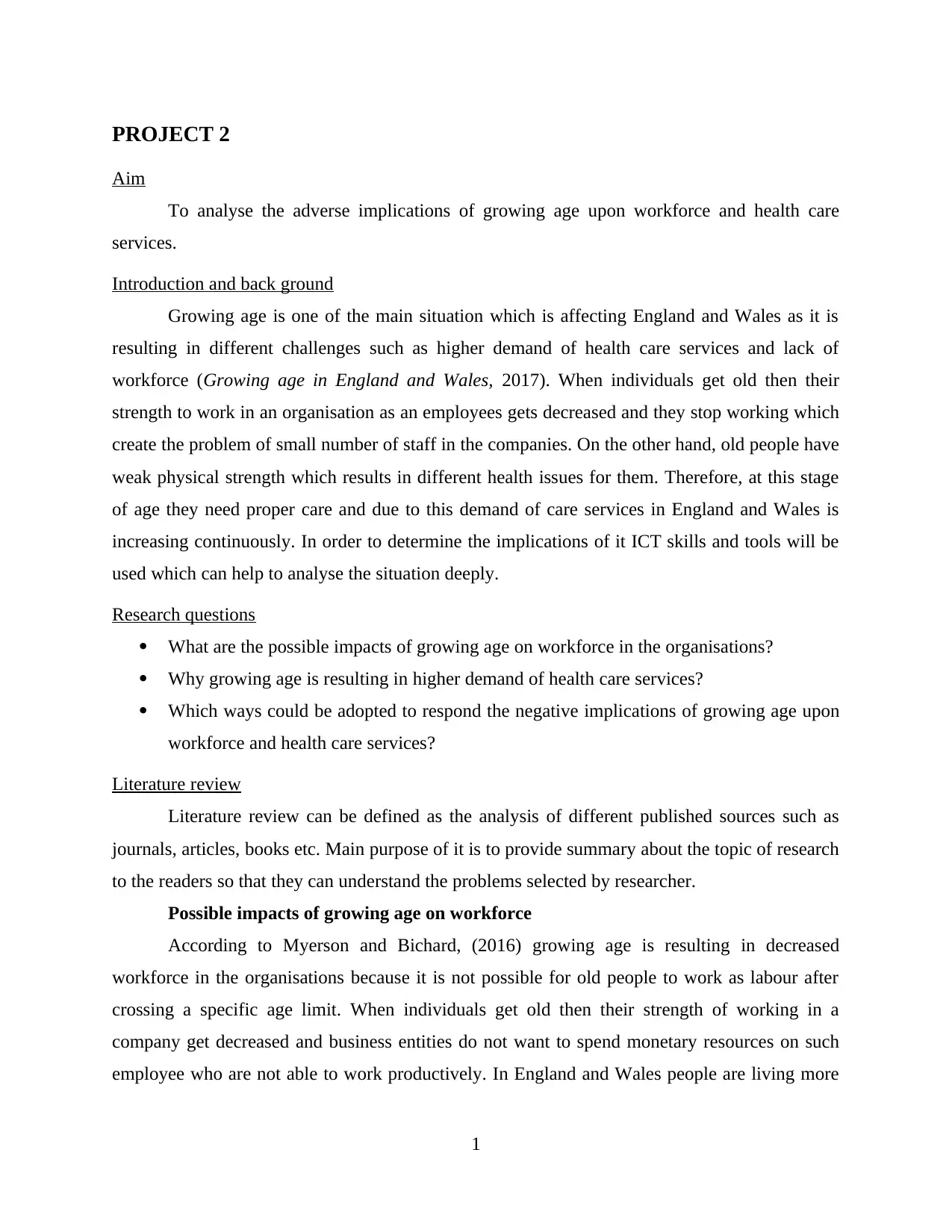
PROJECT 2
Aim
To analyse the adverse implications of growing age upon workforce and health care
services.
Introduction and back ground
Growing age is one of the main situation which is affecting England and Wales as it is
resulting in different challenges such as higher demand of health care services and lack of
workforce (Growing age in England and Wales, 2017). When individuals get old then their
strength to work in an organisation as an employees gets decreased and they stop working which
create the problem of small number of staff in the companies. On the other hand, old people have
weak physical strength which results in different health issues for them. Therefore, at this stage
of age they need proper care and due to this demand of care services in England and Wales is
increasing continuously. In order to determine the implications of it ICT skills and tools will be
used which can help to analyse the situation deeply.
Research questions
What are the possible impacts of growing age on workforce in the organisations?
Why growing age is resulting in higher demand of health care services?
Which ways could be adopted to respond the negative implications of growing age upon
workforce and health care services?
Literature review
Literature review can be defined as the analysis of different published sources such as
journals, articles, books etc. Main purpose of it is to provide summary about the topic of research
to the readers so that they can understand the problems selected by researcher.
Possible impacts of growing age on workforce
According to Myerson and Bichard, (2016) growing age is resulting in decreased
workforce in the organisations because it is not possible for old people to work as labour after
crossing a specific age limit. When individuals get old then their strength of working in a
company get decreased and business entities do not want to spend monetary resources on such
employee who are not able to work productively. In England and Wales people are living more
1
Aim
To analyse the adverse implications of growing age upon workforce and health care
services.
Introduction and back ground
Growing age is one of the main situation which is affecting England and Wales as it is
resulting in different challenges such as higher demand of health care services and lack of
workforce (Growing age in England and Wales, 2017). When individuals get old then their
strength to work in an organisation as an employees gets decreased and they stop working which
create the problem of small number of staff in the companies. On the other hand, old people have
weak physical strength which results in different health issues for them. Therefore, at this stage
of age they need proper care and due to this demand of care services in England and Wales is
increasing continuously. In order to determine the implications of it ICT skills and tools will be
used which can help to analyse the situation deeply.
Research questions
What are the possible impacts of growing age on workforce in the organisations?
Why growing age is resulting in higher demand of health care services?
Which ways could be adopted to respond the negative implications of growing age upon
workforce and health care services?
Literature review
Literature review can be defined as the analysis of different published sources such as
journals, articles, books etc. Main purpose of it is to provide summary about the topic of research
to the readers so that they can understand the problems selected by researcher.
Possible impacts of growing age on workforce
According to Myerson and Bichard, (2016) growing age is resulting in decreased
workforce in the organisations because it is not possible for old people to work as labour after
crossing a specific age limit. When individuals get old then their strength of working in a
company get decreased and business entities do not want to spend monetary resources on such
employee who are not able to work productively. In England and Wales people are living more
1
⊘ This is a preview!⊘
Do you want full access?
Subscribe today to unlock all pages.

Trusted by 1+ million students worldwide
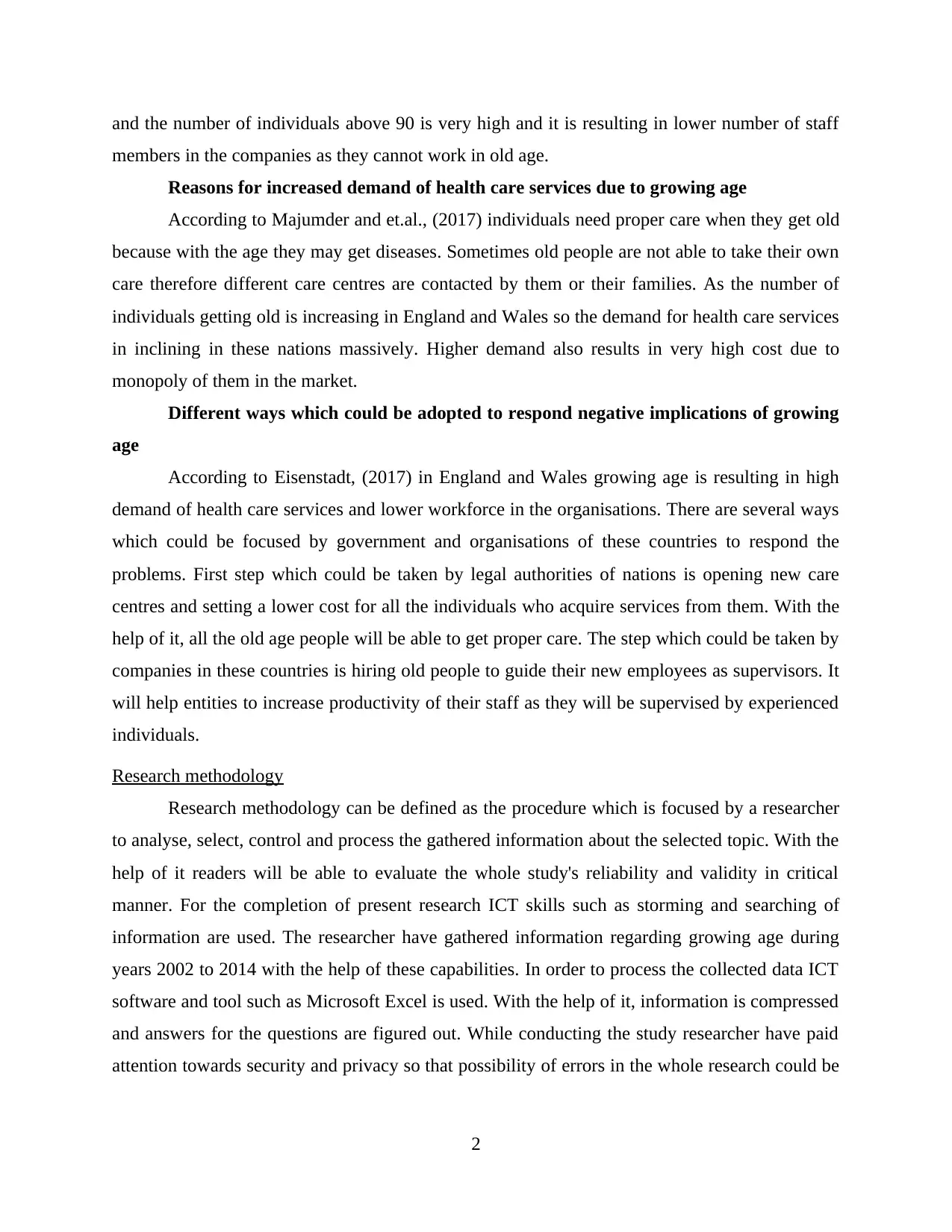
and the number of individuals above 90 is very high and it is resulting in lower number of staff
members in the companies as they cannot work in old age.
Reasons for increased demand of health care services due to growing age
According to Majumder and et.al., (2017) individuals need proper care when they get old
because with the age they may get diseases. Sometimes old people are not able to take their own
care therefore different care centres are contacted by them or their families. As the number of
individuals getting old is increasing in England and Wales so the demand for health care services
in inclining in these nations massively. Higher demand also results in very high cost due to
monopoly of them in the market.
Different ways which could be adopted to respond negative implications of growing
age
According to Eisenstadt, (2017) in England and Wales growing age is resulting in high
demand of health care services and lower workforce in the organisations. There are several ways
which could be focused by government and organisations of these countries to respond the
problems. First step which could be taken by legal authorities of nations is opening new care
centres and setting a lower cost for all the individuals who acquire services from them. With the
help of it, all the old age people will be able to get proper care. The step which could be taken by
companies in these countries is hiring old people to guide their new employees as supervisors. It
will help entities to increase productivity of their staff as they will be supervised by experienced
individuals.
Research methodology
Research methodology can be defined as the procedure which is focused by a researcher
to analyse, select, control and process the gathered information about the selected topic. With the
help of it readers will be able to evaluate the whole study's reliability and validity in critical
manner. For the completion of present research ICT skills such as storming and searching of
information are used. The researcher have gathered information regarding growing age during
years 2002 to 2014 with the help of these capabilities. In order to process the collected data ICT
software and tool such as Microsoft Excel is used. With the help of it, information is compressed
and answers for the questions are figured out. While conducting the study researcher have paid
attention towards security and privacy so that possibility of errors in the whole research could be
2
members in the companies as they cannot work in old age.
Reasons for increased demand of health care services due to growing age
According to Majumder and et.al., (2017) individuals need proper care when they get old
because with the age they may get diseases. Sometimes old people are not able to take their own
care therefore different care centres are contacted by them or their families. As the number of
individuals getting old is increasing in England and Wales so the demand for health care services
in inclining in these nations massively. Higher demand also results in very high cost due to
monopoly of them in the market.
Different ways which could be adopted to respond negative implications of growing
age
According to Eisenstadt, (2017) in England and Wales growing age is resulting in high
demand of health care services and lower workforce in the organisations. There are several ways
which could be focused by government and organisations of these countries to respond the
problems. First step which could be taken by legal authorities of nations is opening new care
centres and setting a lower cost for all the individuals who acquire services from them. With the
help of it, all the old age people will be able to get proper care. The step which could be taken by
companies in these countries is hiring old people to guide their new employees as supervisors. It
will help entities to increase productivity of their staff as they will be supervised by experienced
individuals.
Research methodology
Research methodology can be defined as the procedure which is focused by a researcher
to analyse, select, control and process the gathered information about the selected topic. With the
help of it readers will be able to evaluate the whole study's reliability and validity in critical
manner. For the completion of present research ICT skills such as storming and searching of
information are used. The researcher have gathered information regarding growing age during
years 2002 to 2014 with the help of these capabilities. In order to process the collected data ICT
software and tool such as Microsoft Excel is used. With the help of it, information is compressed
and answers for the questions are figured out. While conducting the study researcher have paid
attention towards security and privacy so that possibility of errors in the whole research could be
2
Paraphrase This Document
Need a fresh take? Get an instant paraphrase of this document with our AI Paraphraser
ignored. The tools have guided to analyse the information of growing age collected from office
for national statistics, 2015 (Office for national statistics, 2015).
Data analysis
When researchers cleanse and analyse the information which is gathered from the reliable
sources then the whole procedure is known as data analysis. Main goals of it is to discover
appropriate information and support decision making of readers (Aiyar and Ebeke, 2017). The
data which is gathered from office for national statistics, 2015 for the purpose of finding answers
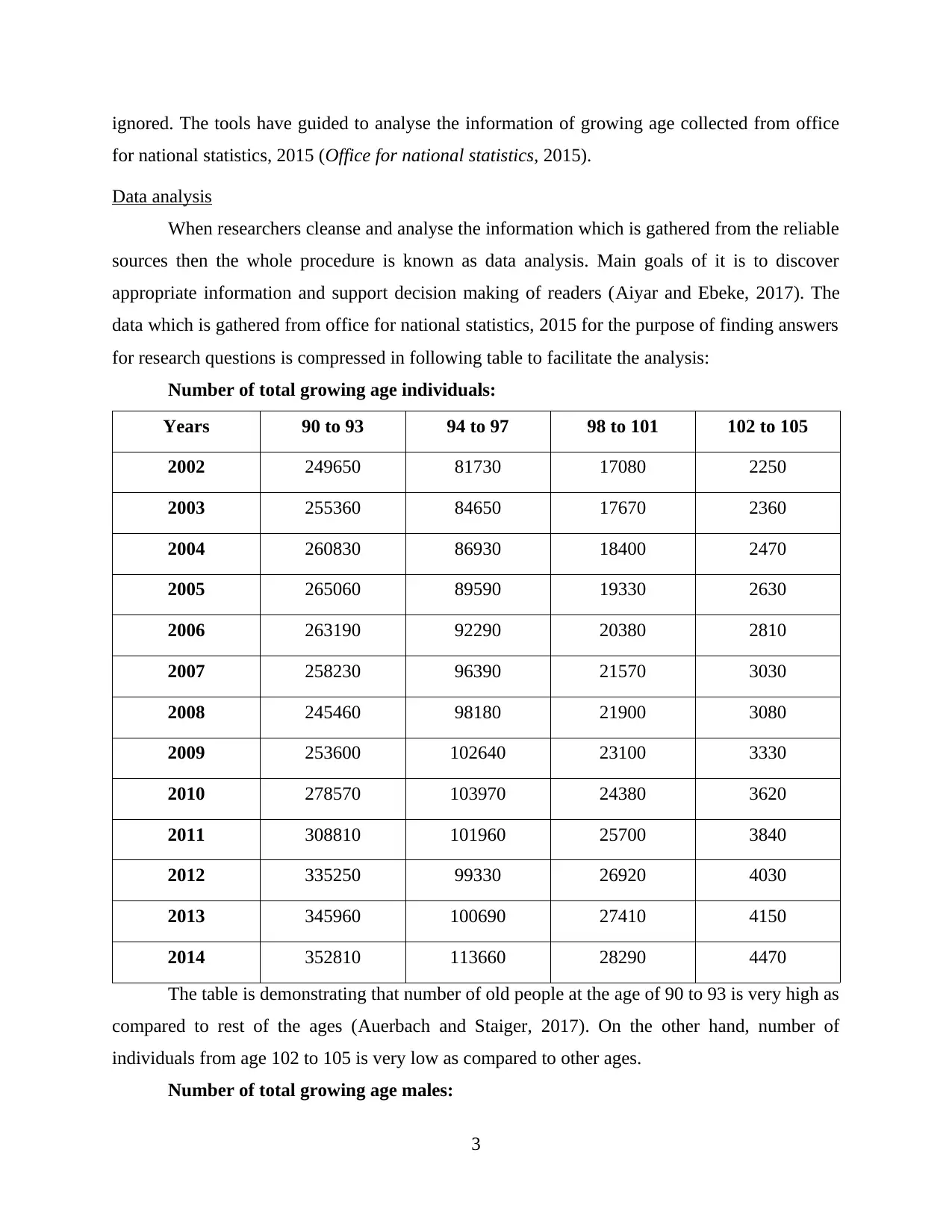
for research questions is compressed in following table to facilitate the analysis:
Number of total growing age individuals:
Years 90 to 93 94 to 97 98 to 101 102 to 105
2002 249650 81730 17080 2250
2003 255360 84650 17670 2360
2004 260830 86930 18400 2470
2005 265060 89590 19330 2630
2006 263190 92290 20380 2810
2007 258230 96390 21570 3030
2008 245460 98180 21900 3080
2009 253600 102640 23100 3330
2010 278570 103970 24380 3620
2011 308810 101960 25700 3840
2012 335250 99330 26920 4030
2013 345960 100690 27410 4150
2014 352810 113660 28290 4470
The table is demonstrating that number of old people at the age of 90 to 93 is very high as
compared to rest of the ages (Auerbach and Staiger, 2017). On the other hand, number of
individuals from age 102 to 105 is very low as compared to other ages.
Number of total growing age males:
3
for national statistics, 2015 (Office for national statistics, 2015).
Data analysis
When researchers cleanse and analyse the information which is gathered from the reliable
sources then the whole procedure is known as data analysis. Main goals of it is to discover
appropriate information and support decision making of readers (Aiyar and Ebeke, 2017). The
data which is gathered from office for national statistics, 2015 for the purpose of finding answers
for research questions is compressed in following table to facilitate the analysis:
Number of total growing age individuals:
Years 90 to 93 94 to 97 98 to 101 102 to 105
2002 249650 81730 17080 2250
2003 255360 84650 17670 2360
2004 260830 86930 18400 2470
2005 265060 89590 19330 2630
2006 263190 92290 20380 2810
2007 258230 96390 21570 3030
2008 245460 98180 21900 3080
2009 253600 102640 23100 3330
2010 278570 103970 24380 3620
2011 308810 101960 25700 3840
2012 335250 99330 26920 4030
2013 345960 100690 27410 4150
2014 352810 113660 28290 4470
The table is demonstrating that number of old people at the age of 90 to 93 is very high as
compared to rest of the ages (Auerbach and Staiger, 2017). On the other hand, number of
individuals from age 102 to 105 is very low as compared to other ages.
Number of total growing age males:
3
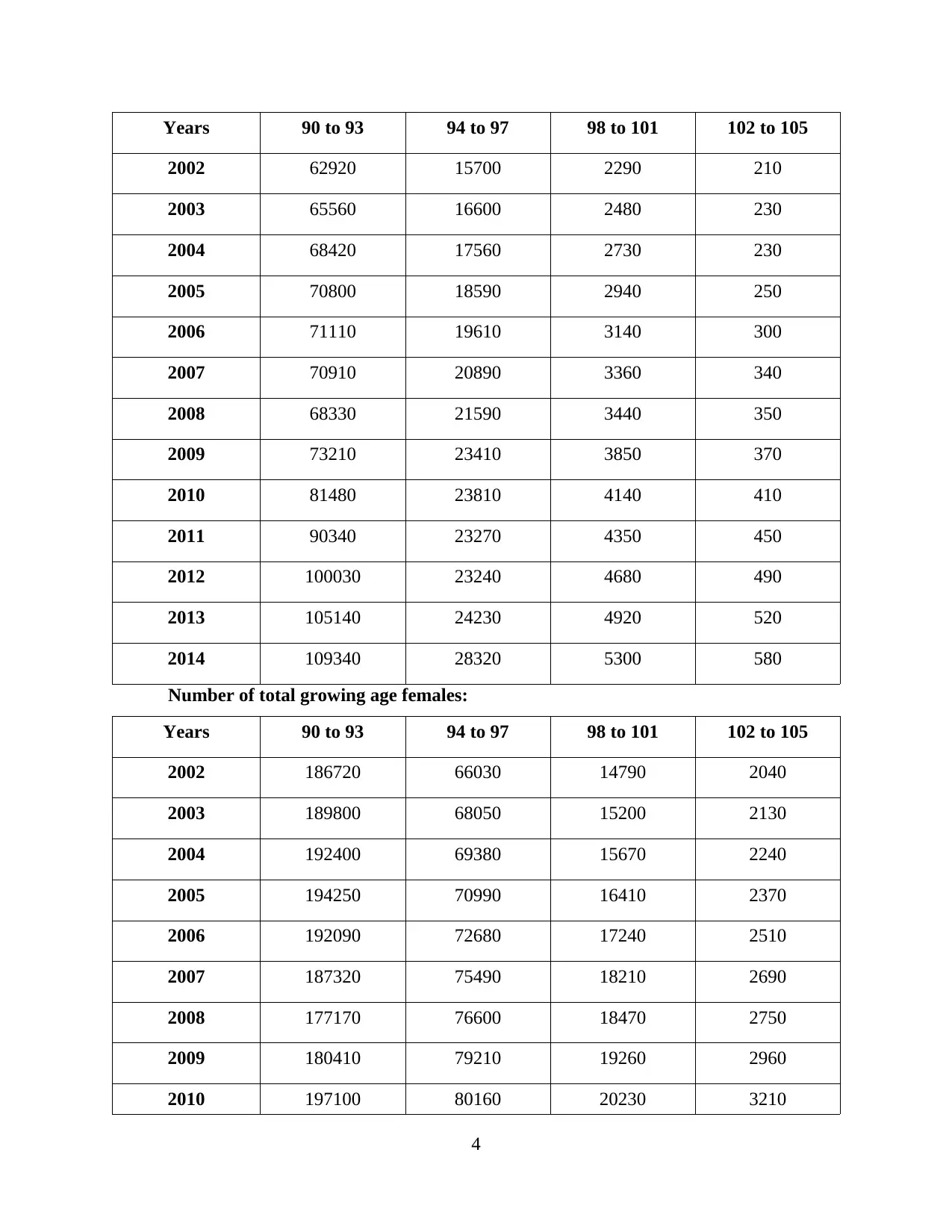
Years 90 to 93 94 to 97 98 to 101 102 to 105
2002 62920 15700 2290 210
2003 65560 16600 2480 230
2004 68420 17560 2730 230
2005 70800 18590 2940 250
2006 71110 19610 3140 300
2007 70910 20890 3360 340
2008 68330 21590 3440 350
2009 73210 23410 3850 370
2010 81480 23810 4140 410
2011 90340 23270 4350 450
2012 100030 23240 4680 490
2013 105140 24230 4920 520
2014 109340 28320 5300 580
Number of total growing age females:
Years 90 to 93 94 to 97 98 to 101 102 to 105
2002 186720 66030 14790 2040
2003 189800 68050 15200 2130
2004 192400 69380 15670 2240
2005 194250 70990 16410 2370
2006 192090 72680 17240 2510
2007 187320 75490 18210 2690
2008 177170 76600 18470 2750
2009 180410 79210 19260 2960
2010 197100 80160 20230 3210
4
2002 62920 15700 2290 210
2003 65560 16600 2480 230
2004 68420 17560 2730 230
2005 70800 18590 2940 250
2006 71110 19610 3140 300
2007 70910 20890 3360 340
2008 68330 21590 3440 350
2009 73210 23410 3850 370
2010 81480 23810 4140 410
2011 90340 23270 4350 450
2012 100030 23240 4680 490
2013 105140 24230 4920 520
2014 109340 28320 5300 580
Number of total growing age females:
Years 90 to 93 94 to 97 98 to 101 102 to 105
2002 186720 66030 14790 2040
2003 189800 68050 15200 2130
2004 192400 69380 15670 2240
2005 194250 70990 16410 2370
2006 192090 72680 17240 2510
2007 187320 75490 18210 2690
2008 177170 76600 18470 2750
2009 180410 79210 19260 2960
2010 197100 80160 20230 3210
4
⊘ This is a preview!⊘
Do you want full access?
Subscribe today to unlock all pages.
Trusted by 1+ million students worldwide
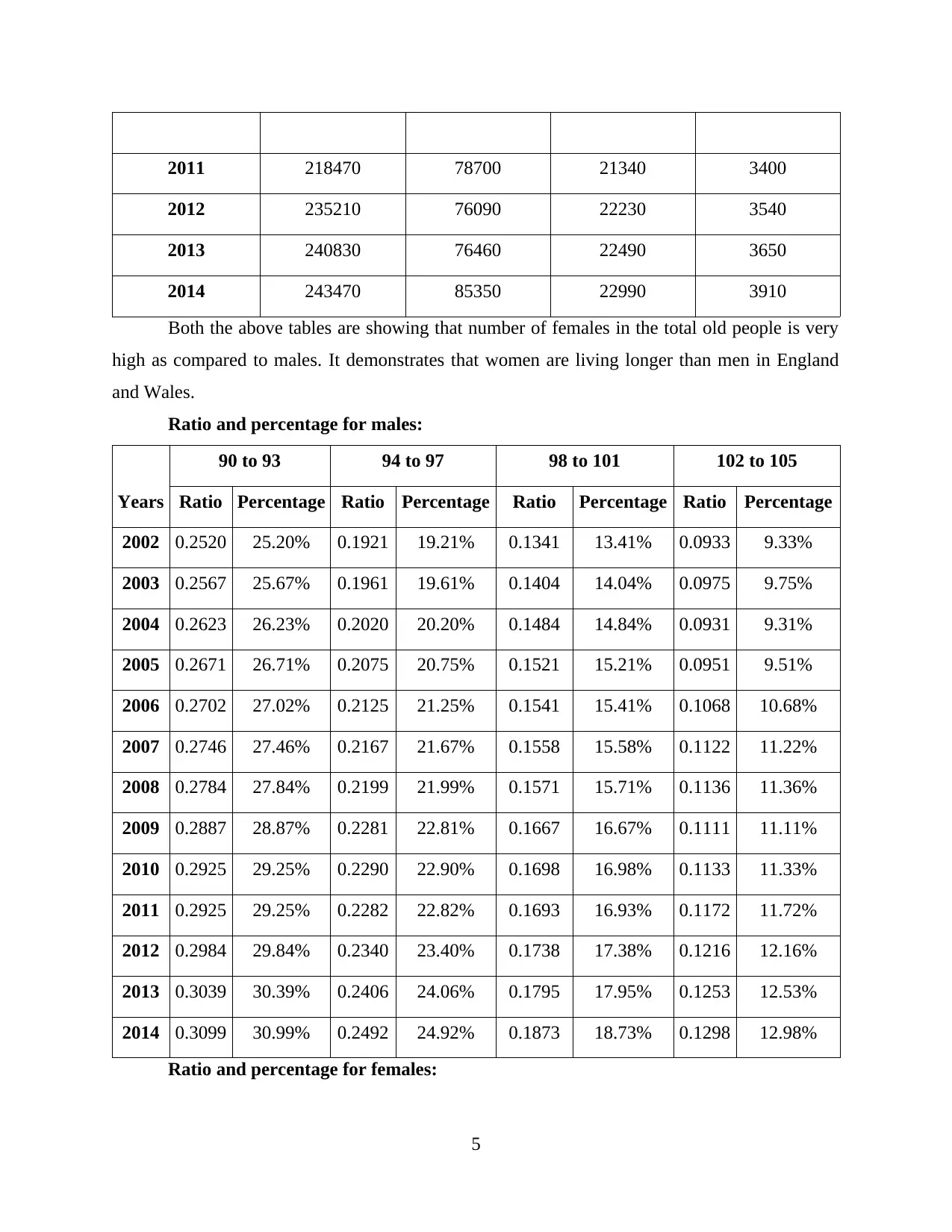
2011 218470 78700 21340 3400
2012 235210 76090 22230 3540
2013 240830 76460 22490 3650
2014 243470 85350 22990 3910
Both the above tables are showing that number of females in the total old people is very
high as compared to males. It demonstrates that women are living longer than men in England
and Wales.
Ratio and percentage for males:
Years
90 to 93 94 to 97 98 to 101 102 to 105
Ratio Percentage Ratio Percentage Ratio Percentage Ratio Percentage
2002 0.2520 25.20% 0.1921 19.21% 0.1341 13.41% 0.0933 9.33%
2003 0.2567 25.67% 0.1961 19.61% 0.1404 14.04% 0.0975 9.75%
2004 0.2623 26.23% 0.2020 20.20% 0.1484 14.84% 0.0931 9.31%
2005 0.2671 26.71% 0.2075 20.75% 0.1521 15.21% 0.0951 9.51%
2006 0.2702 27.02% 0.2125 21.25% 0.1541 15.41% 0.1068 10.68%
2007 0.2746 27.46% 0.2167 21.67% 0.1558 15.58% 0.1122 11.22%
2008 0.2784 27.84% 0.2199 21.99% 0.1571 15.71% 0.1136 11.36%
2009 0.2887 28.87% 0.2281 22.81% 0.1667 16.67% 0.1111 11.11%
2010 0.2925 29.25% 0.2290 22.90% 0.1698 16.98% 0.1133 11.33%
2011 0.2925 29.25% 0.2282 22.82% 0.1693 16.93% 0.1172 11.72%
2012 0.2984 29.84% 0.2340 23.40% 0.1738 17.38% 0.1216 12.16%
2013 0.3039 30.39% 0.2406 24.06% 0.1795 17.95% 0.1253 12.53%
2014 0.3099 30.99% 0.2492 24.92% 0.1873 18.73% 0.1298 12.98%
Ratio and percentage for females:
5
2012 235210 76090 22230 3540
2013 240830 76460 22490 3650
2014 243470 85350 22990 3910
Both the above tables are showing that number of females in the total old people is very
high as compared to males. It demonstrates that women are living longer than men in England
and Wales.
Ratio and percentage for males:
Years
90 to 93 94 to 97 98 to 101 102 to 105
Ratio Percentage Ratio Percentage Ratio Percentage Ratio Percentage
2002 0.2520 25.20% 0.1921 19.21% 0.1341 13.41% 0.0933 9.33%
2003 0.2567 25.67% 0.1961 19.61% 0.1404 14.04% 0.0975 9.75%
2004 0.2623 26.23% 0.2020 20.20% 0.1484 14.84% 0.0931 9.31%
2005 0.2671 26.71% 0.2075 20.75% 0.1521 15.21% 0.0951 9.51%
2006 0.2702 27.02% 0.2125 21.25% 0.1541 15.41% 0.1068 10.68%
2007 0.2746 27.46% 0.2167 21.67% 0.1558 15.58% 0.1122 11.22%
2008 0.2784 27.84% 0.2199 21.99% 0.1571 15.71% 0.1136 11.36%
2009 0.2887 28.87% 0.2281 22.81% 0.1667 16.67% 0.1111 11.11%
2010 0.2925 29.25% 0.2290 22.90% 0.1698 16.98% 0.1133 11.33%
2011 0.2925 29.25% 0.2282 22.82% 0.1693 16.93% 0.1172 11.72%
2012 0.2984 29.84% 0.2340 23.40% 0.1738 17.38% 0.1216 12.16%
2013 0.3039 30.39% 0.2406 24.06% 0.1795 17.95% 0.1253 12.53%
2014 0.3099 30.99% 0.2492 24.92% 0.1873 18.73% 0.1298 12.98%
Ratio and percentage for females:
5
Paraphrase This Document
Need a fresh take? Get an instant paraphrase of this document with our AI Paraphraser
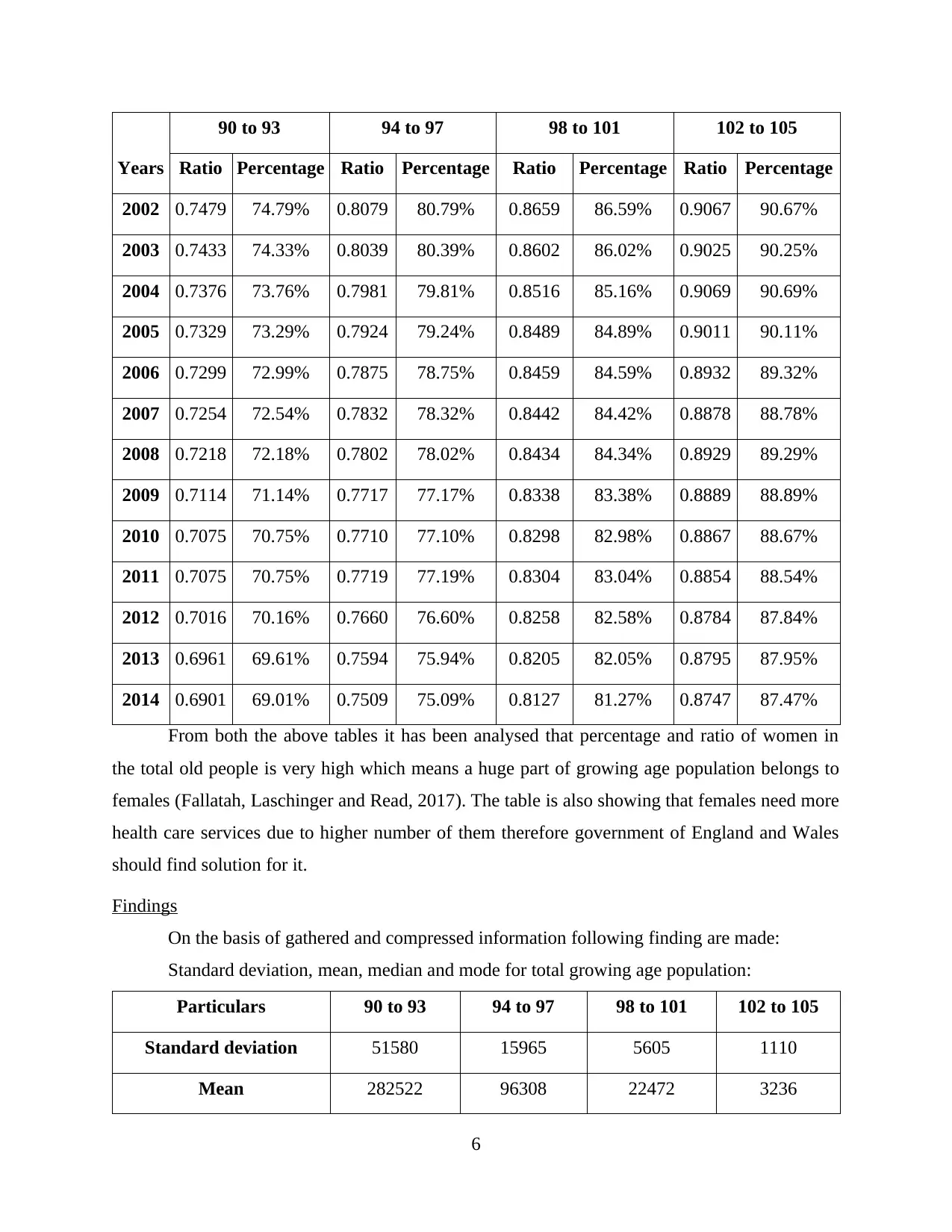
Years
90 to 93 94 to 97 98 to 101 102 to 105
Ratio Percentage Ratio Percentage Ratio Percentage Ratio Percentage
2002 0.7479 74.79% 0.8079 80.79% 0.8659 86.59% 0.9067 90.67%
2003 0.7433 74.33% 0.8039 80.39% 0.8602 86.02% 0.9025 90.25%
2004 0.7376 73.76% 0.7981 79.81% 0.8516 85.16% 0.9069 90.69%
2005 0.7329 73.29% 0.7924 79.24% 0.8489 84.89% 0.9011 90.11%
2006 0.7299 72.99% 0.7875 78.75% 0.8459 84.59% 0.8932 89.32%
2007 0.7254 72.54% 0.7832 78.32% 0.8442 84.42% 0.8878 88.78%
2008 0.7218 72.18% 0.7802 78.02% 0.8434 84.34% 0.8929 89.29%
2009 0.7114 71.14% 0.7717 77.17% 0.8338 83.38% 0.8889 88.89%
2010 0.7075 70.75% 0.7710 77.10% 0.8298 82.98% 0.8867 88.67%
2011 0.7075 70.75% 0.7719 77.19% 0.8304 83.04% 0.8854 88.54%
2012 0.7016 70.16% 0.7660 76.60% 0.8258 82.58% 0.8784 87.84%
2013 0.6961 69.61% 0.7594 75.94% 0.8205 82.05% 0.8795 87.95%
2014 0.6901 69.01% 0.7509 75.09% 0.8127 81.27% 0.8747 87.47%
From both the above tables it has been analysed that percentage and ratio of women in
the total old people is very high which means a huge part of growing age population belongs to
females (Fallatah, Laschinger and Read, 2017). The table is also showing that females need more
health care services due to higher number of them therefore government of England and Wales
should find solution for it.
Findings
On the basis of gathered and compressed information following finding are made:
Standard deviation, mean, median and mode for total growing age population:
Particulars 90 to 93 94 to 97 98 to 101 102 to 105
Standard deviation 51580 15965 5605 1110
Mean 282522 96308 22472 3236
6
90 to 93 94 to 97 98 to 101 102 to 105
Ratio Percentage Ratio Percentage Ratio Percentage Ratio Percentage
2002 0.7479 74.79% 0.8079 80.79% 0.8659 86.59% 0.9067 90.67%
2003 0.7433 74.33% 0.8039 80.39% 0.8602 86.02% 0.9025 90.25%
2004 0.7376 73.76% 0.7981 79.81% 0.8516 85.16% 0.9069 90.69%
2005 0.7329 73.29% 0.7924 79.24% 0.8489 84.89% 0.9011 90.11%
2006 0.7299 72.99% 0.7875 78.75% 0.8459 84.59% 0.8932 89.32%
2007 0.7254 72.54% 0.7832 78.32% 0.8442 84.42% 0.8878 88.78%
2008 0.7218 72.18% 0.7802 78.02% 0.8434 84.34% 0.8929 89.29%
2009 0.7114 71.14% 0.7717 77.17% 0.8338 83.38% 0.8889 88.89%
2010 0.7075 70.75% 0.7710 77.10% 0.8298 82.98% 0.8867 88.67%
2011 0.7075 70.75% 0.7719 77.19% 0.8304 83.04% 0.8854 88.54%
2012 0.7016 70.16% 0.7660 76.60% 0.8258 82.58% 0.8784 87.84%
2013 0.6961 69.61% 0.7594 75.94% 0.8205 82.05% 0.8795 87.95%
2014 0.6901 69.01% 0.7509 75.09% 0.8127 81.27% 0.8747 87.47%
From both the above tables it has been analysed that percentage and ratio of women in
the total old people is very high which means a huge part of growing age population belongs to
females (Fallatah, Laschinger and Read, 2017). The table is also showing that females need more
health care services due to higher number of them therefore government of England and Wales
should find solution for it.
Findings
On the basis of gathered and compressed information following finding are made:
Standard deviation, mean, median and mode for total growing age population:
Particulars 90 to 93 94 to 97 98 to 101 102 to 105
Standard deviation 51580 15965 5605 1110
Mean 282522 96308 22472 3236
6
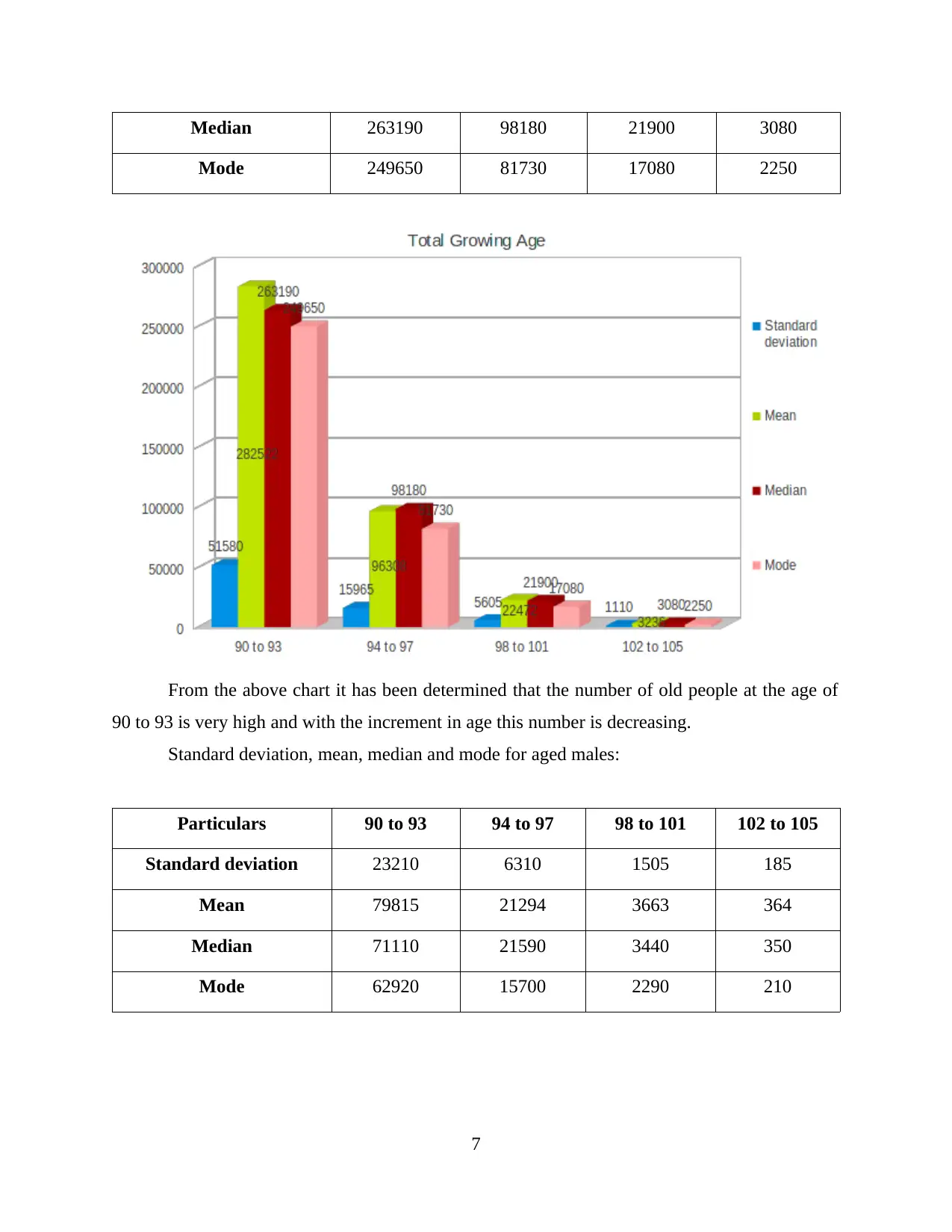
Median 263190 98180 21900 3080
Mode 249650 81730 17080 2250
From the above chart it has been determined that the number of old people at the age of
90 to 93 is very high and with the increment in age this number is decreasing.
Standard deviation, mean, median and mode for aged males:
Particulars 90 to 93 94 to 97 98 to 101 102 to 105
Standard deviation 23210 6310 1505 185
Mean 79815 21294 3663 364
Median 71110 21590 3440 350
Mode 62920 15700 2290 210
7
Mode 249650 81730 17080 2250
From the above chart it has been determined that the number of old people at the age of
90 to 93 is very high and with the increment in age this number is decreasing.
Standard deviation, mean, median and mode for aged males:
Particulars 90 to 93 94 to 97 98 to 101 102 to 105
Standard deviation 23210 6310 1505 185
Mean 79815 21294 3663 364
Median 71110 21590 3440 350
Mode 62920 15700 2290 210
7
⊘ This is a preview!⊘
Do you want full access?
Subscribe today to unlock all pages.
Trusted by 1+ million students worldwide
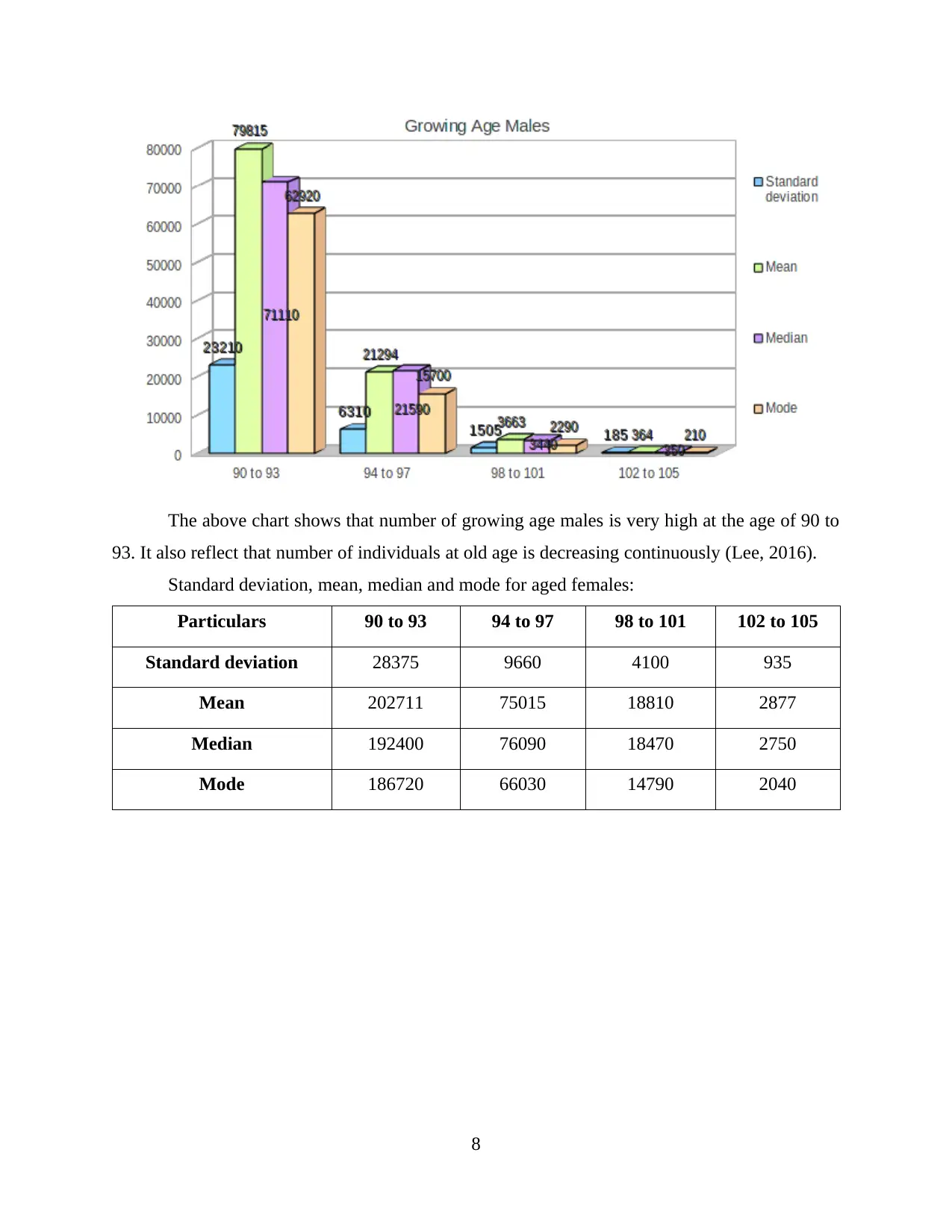
The above chart shows that number of growing age males is very high at the age of 90 to
93. It also reflect that number of individuals at old age is decreasing continuously (Lee, 2016).
Standard deviation, mean, median and mode for aged females:
Particulars 90 to 93 94 to 97 98 to 101 102 to 105
Standard deviation 28375 9660 4100 935
Mean 202711 75015 18810 2877
Median 192400 76090 18470 2750
Mode 186720 66030 14790 2040
8
93. It also reflect that number of individuals at old age is decreasing continuously (Lee, 2016).
Standard deviation, mean, median and mode for aged females:
Particulars 90 to 93 94 to 97 98 to 101 102 to 105
Standard deviation 28375 9660 4100 935
Mean 202711 75015 18810 2877
Median 192400 76090 18470 2750
Mode 186720 66030 14790 2040
8
Paraphrase This Document
Need a fresh take? Get an instant paraphrase of this document with our AI Paraphraser
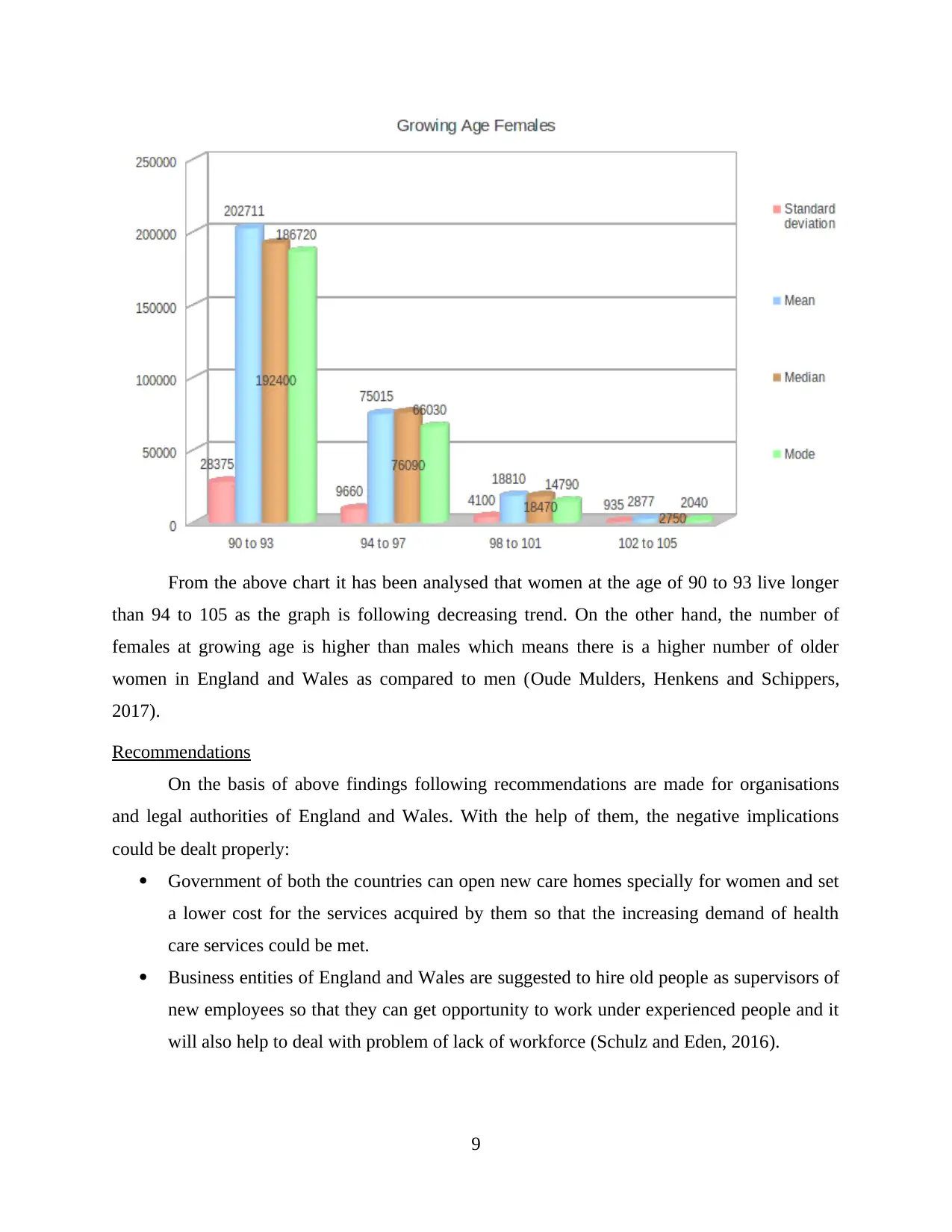
From the above chart it has been analysed that women at the age of 90 to 93 live longer
than 94 to 105 as the graph is following decreasing trend. On the other hand, the number of
females at growing age is higher than males which means there is a higher number of older
women in England and Wales as compared to men (Oude Mulders, Henkens and Schippers,
2017).
Recommendations
On the basis of above findings following recommendations are made for organisations
and legal authorities of England and Wales. With the help of them, the negative implications
could be dealt properly:
Government of both the countries can open new care homes specially for women and set
a lower cost for the services acquired by them so that the increasing demand of health
care services could be met.
Business entities of England and Wales are suggested to hire old people as supervisors of
new employees so that they can get opportunity to work under experienced people and it
will also help to deal with problem of lack of workforce (Schulz and Eden, 2016).
9
than 94 to 105 as the graph is following decreasing trend. On the other hand, the number of
females at growing age is higher than males which means there is a higher number of older
women in England and Wales as compared to men (Oude Mulders, Henkens and Schippers,
2017).
Recommendations
On the basis of above findings following recommendations are made for organisations
and legal authorities of England and Wales. With the help of them, the negative implications
could be dealt properly:
Government of both the countries can open new care homes specially for women and set
a lower cost for the services acquired by them so that the increasing demand of health
care services could be met.
Business entities of England and Wales are suggested to hire old people as supervisors of
new employees so that they can get opportunity to work under experienced people and it
will also help to deal with problem of lack of workforce (Schulz and Eden, 2016).
9
CONCLUSION
From the above study it has been concluded that growing age is the state of age where
individuals get old and due to their old age different adverse situations may take place. These are
higher demand of health care services and lower workforce. For the purpose of responding these
conditions properly various ways could be adopted by legal authorities and organisations. Some
of them are opening new care homes, setting lower cost for their facilities and companies can
hire old people as their advisors and supervisors of new staff.
10
From the above study it has been concluded that growing age is the state of age where
individuals get old and due to their old age different adverse situations may take place. These are
higher demand of health care services and lower workforce. For the purpose of responding these
conditions properly various ways could be adopted by legal authorities and organisations. Some
of them are opening new care homes, setting lower cost for their facilities and companies can
hire old people as their advisors and supervisors of new staff.
10
⊘ This is a preview!⊘
Do you want full access?
Subscribe today to unlock all pages.
Trusted by 1+ million students worldwide

1 out of 13


Related Documents


Your All-in-One AI-Powered Toolkit for Academic Success.
+13062052269
info@desklib.com
Available 24*7 on WhatsApp / Email
![[object Object]](/_next/static/media/star-bottom.7253800d.svg)
Unlock your academic potential
Copyright © 2020–2026 A2Z Services. All Rights Reserved. Developed and managed by ZUCOL.