Analysis of a Workplace Learning Situation: Medical University Context
VerifiedAdded on 2023/04/20
|9
|2449
|133
Report
AI Summary
This report provides an analysis of a workplace learning situation within a medical university, focusing on a clinical setting where junior and senior interns collaborate under the guidance of a teacher to diagnose a patient with a brain injury. The study outlines the context, learning situation, and roles of participants, including the interns, the teacher (who is also a doctor), and the patient. A key problem identified is the varying levels of clinical experience among the interns. The report applies the cognitive apprenticeship theory to evaluate the learning environment, examining how the learning situation aligns with the theory's principles. The analysis reveals that the situation incorporates elements of the cognitive apprenticeship theory, such as the teacher acting as a coach, providing real-life scenarios for practice, and encouraging the interns to reproduce skills. Finally, recommendations are provided to address the issue of differing experience levels and to foster better collaborative learning among the interns.

Running head: Workplace learning situation analysis
ASSIGNMENT 6.4
WORKPLACE LEARNING SITUATION ANALYSIS
ASSIGNMENT 6.4
WORKPLACE LEARNING SITUATION ANALYSIS

Paraphrase This Document
Need a fresh take? Get an instant paraphrase of this document with our AI Paraphraser
1
Workplace learning situation analysis
Abstract
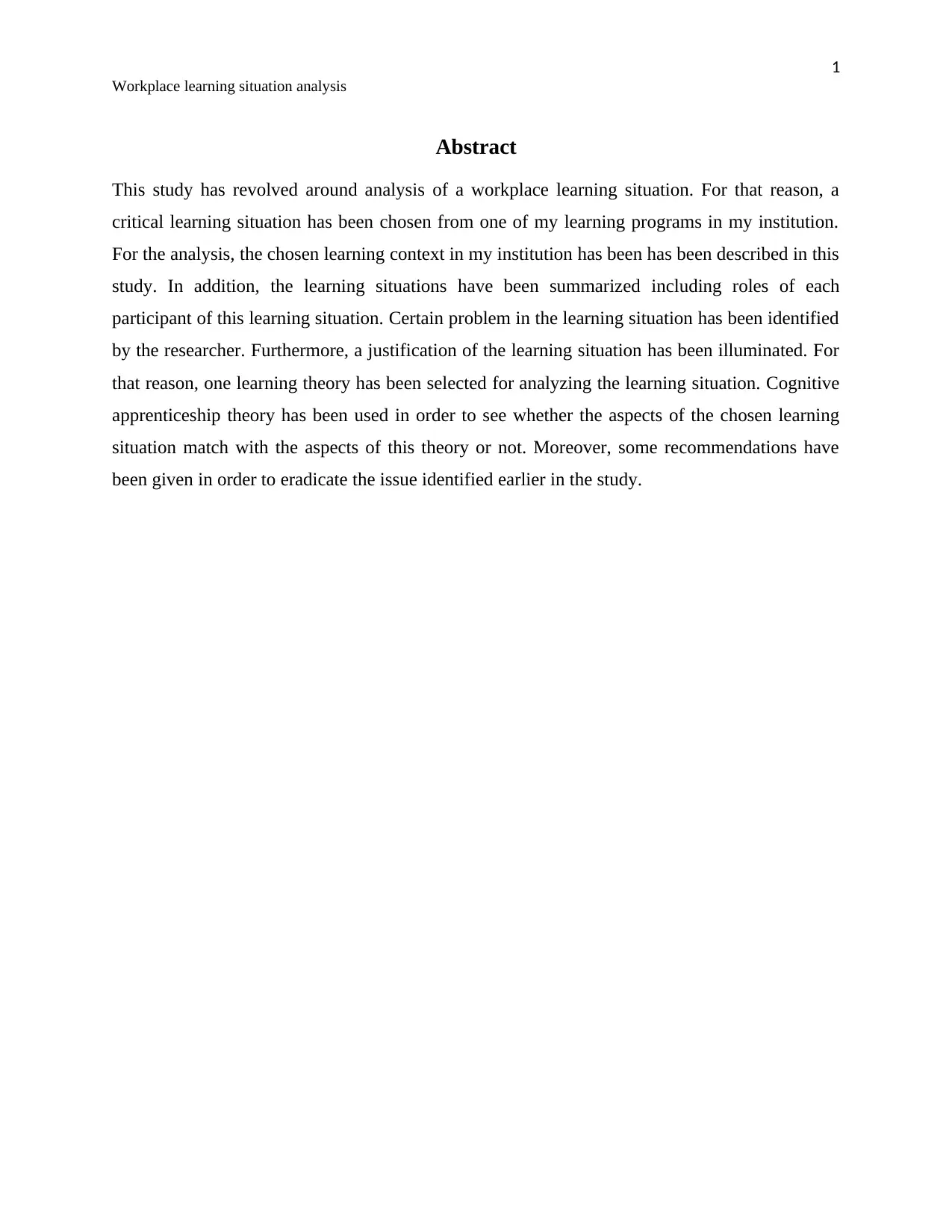
This study has revolved around analysis of a workplace learning situation. For that reason, a
critical learning situation has been chosen from one of my learning programs in my institution.
For the analysis, the chosen learning context in my institution has been has been described in this
study. In addition, the learning situations have been summarized including roles of each
participant of this learning situation. Certain problem in the learning situation has been identified
by the researcher. Furthermore, a justification of the learning situation has been illuminated. For
that reason, one learning theory has been selected for analyzing the learning situation. Cognitive
apprenticeship theory has been used in order to see whether the aspects of the chosen learning
situation match with the aspects of this theory or not. Moreover, some recommendations have
been given in order to eradicate the issue identified earlier in the study.
Workplace learning situation analysis
Abstract
This study has revolved around analysis of a workplace learning situation. For that reason, a
critical learning situation has been chosen from one of my learning programs in my institution.
For the analysis, the chosen learning context in my institution has been has been described in this
study. In addition, the learning situations have been summarized including roles of each
participant of this learning situation. Certain problem in the learning situation has been identified
by the researcher. Furthermore, a justification of the learning situation has been illuminated. For
that reason, one learning theory has been selected for analyzing the learning situation. Cognitive
apprenticeship theory has been used in order to see whether the aspects of the chosen learning
situation match with the aspects of this theory or not. Moreover, some recommendations have
been given in order to eradicate the issue identified earlier in the study.
2
Workplace learning situation analysis
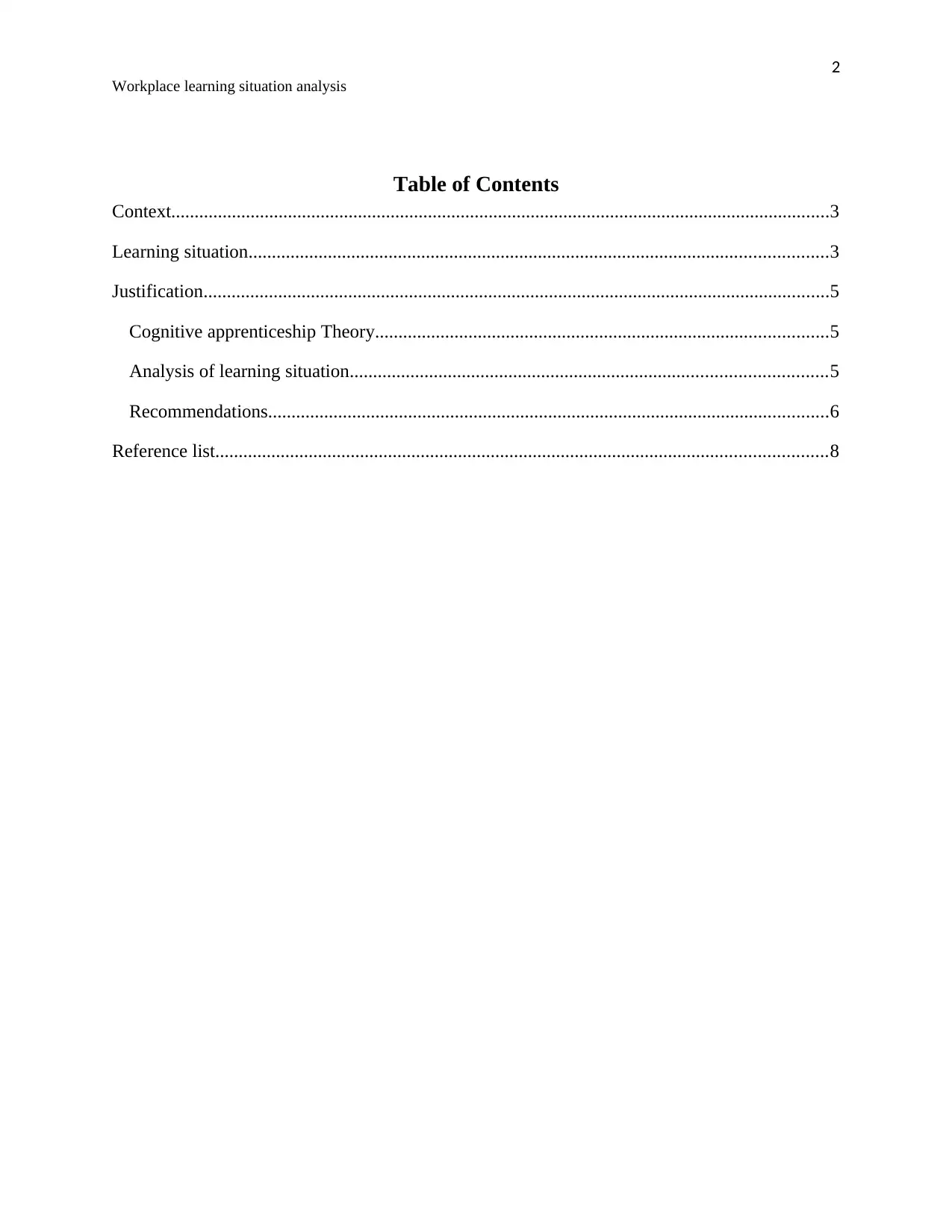
Table of Contents
Context.............................................................................................................................................3
Learning situation............................................................................................................................3
Justification......................................................................................................................................5
Cognitive apprenticeship Theory.................................................................................................5
Analysis of learning situation......................................................................................................5
Recommendations........................................................................................................................6
Reference list...................................................................................................................................8
Workplace learning situation analysis
Table of Contents
Context.............................................................................................................................................3
Learning situation............................................................................................................................3
Justification......................................................................................................................................5
Cognitive apprenticeship Theory.................................................................................................5
Analysis of learning situation......................................................................................................5
Recommendations........................................................................................................................6
Reference list...................................................................................................................................8
⊘ This is a preview!⊘
Do you want full access?
Subscribe today to unlock all pages.

Trusted by 1+ million students worldwide
3
Workplace learning situation analysis
Context
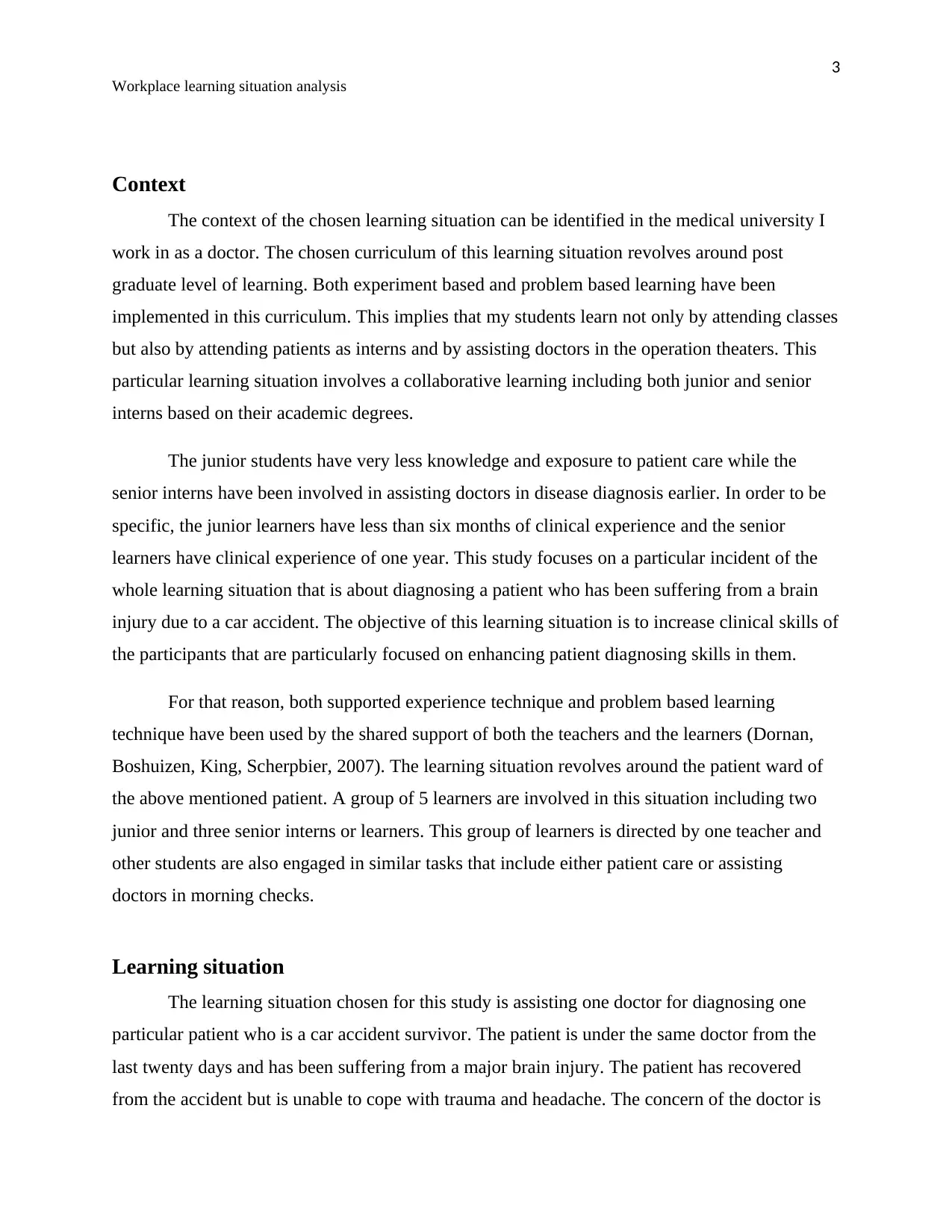
The context of the chosen learning situation can be identified in the medical university I
work in as a doctor. The chosen curriculum of this learning situation revolves around post
graduate level of learning. Both experiment based and problem based learning have been
implemented in this curriculum. This implies that my students learn not only by attending classes
but also by attending patients as interns and by assisting doctors in the operation theaters. This
particular learning situation involves a collaborative learning including both junior and senior
interns based on their academic degrees.
The junior students have very less knowledge and exposure to patient care while the
senior interns have been involved in assisting doctors in disease diagnosis earlier. In order to be
specific, the junior learners have less than six months of clinical experience and the senior
learners have clinical experience of one year. This study focuses on a particular incident of the
whole learning situation that is about diagnosing a patient who has been suffering from a brain
injury due to a car accident. The objective of this learning situation is to increase clinical skills of
the participants that are particularly focused on enhancing patient diagnosing skills in them.
For that reason, both supported experience technique and problem based learning
technique have been used by the shared support of both the teachers and the learners (Dornan,
Boshuizen, King, Scherpbier, 2007). The learning situation revolves around the patient ward of
the above mentioned patient. A group of 5 learners are involved in this situation including two
junior and three senior interns or learners. This group of learners is directed by one teacher and
other students are also engaged in similar tasks that include either patient care or assisting
doctors in morning checks.
Learning situation
The learning situation chosen for this study is assisting one doctor for diagnosing one
particular patient who is a car accident survivor. The patient is under the same doctor from the
last twenty days and has been suffering from a major brain injury. The patient has recovered
from the accident but is unable to cope with trauma and headache. The concern of the doctor is
Workplace learning situation analysis
Context
The context of the chosen learning situation can be identified in the medical university I
work in as a doctor. The chosen curriculum of this learning situation revolves around post
graduate level of learning. Both experiment based and problem based learning have been
implemented in this curriculum. This implies that my students learn not only by attending classes
but also by attending patients as interns and by assisting doctors in the operation theaters. This
particular learning situation involves a collaborative learning including both junior and senior
interns based on their academic degrees.
The junior students have very less knowledge and exposure to patient care while the
senior interns have been involved in assisting doctors in disease diagnosis earlier. In order to be
specific, the junior learners have less than six months of clinical experience and the senior
learners have clinical experience of one year. This study focuses on a particular incident of the
whole learning situation that is about diagnosing a patient who has been suffering from a brain
injury due to a car accident. The objective of this learning situation is to increase clinical skills of
the participants that are particularly focused on enhancing patient diagnosing skills in them.
For that reason, both supported experience technique and problem based learning
technique have been used by the shared support of both the teachers and the learners (Dornan,
Boshuizen, King, Scherpbier, 2007). The learning situation revolves around the patient ward of
the above mentioned patient. A group of 5 learners are involved in this situation including two
junior and three senior interns or learners. This group of learners is directed by one teacher and
other students are also engaged in similar tasks that include either patient care or assisting
doctors in morning checks.
Learning situation
The learning situation chosen for this study is assisting one doctor for diagnosing one
particular patient who is a car accident survivor. The patient is under the same doctor from the
last twenty days and has been suffering from a major brain injury. The patient has recovered
from the accident but is unable to cope with trauma and headache. The concern of the doctor is
Paraphrase This Document
Need a fresh take? Get an instant paraphrase of this document with our AI Paraphraser
4
Workplace learning situation analysis
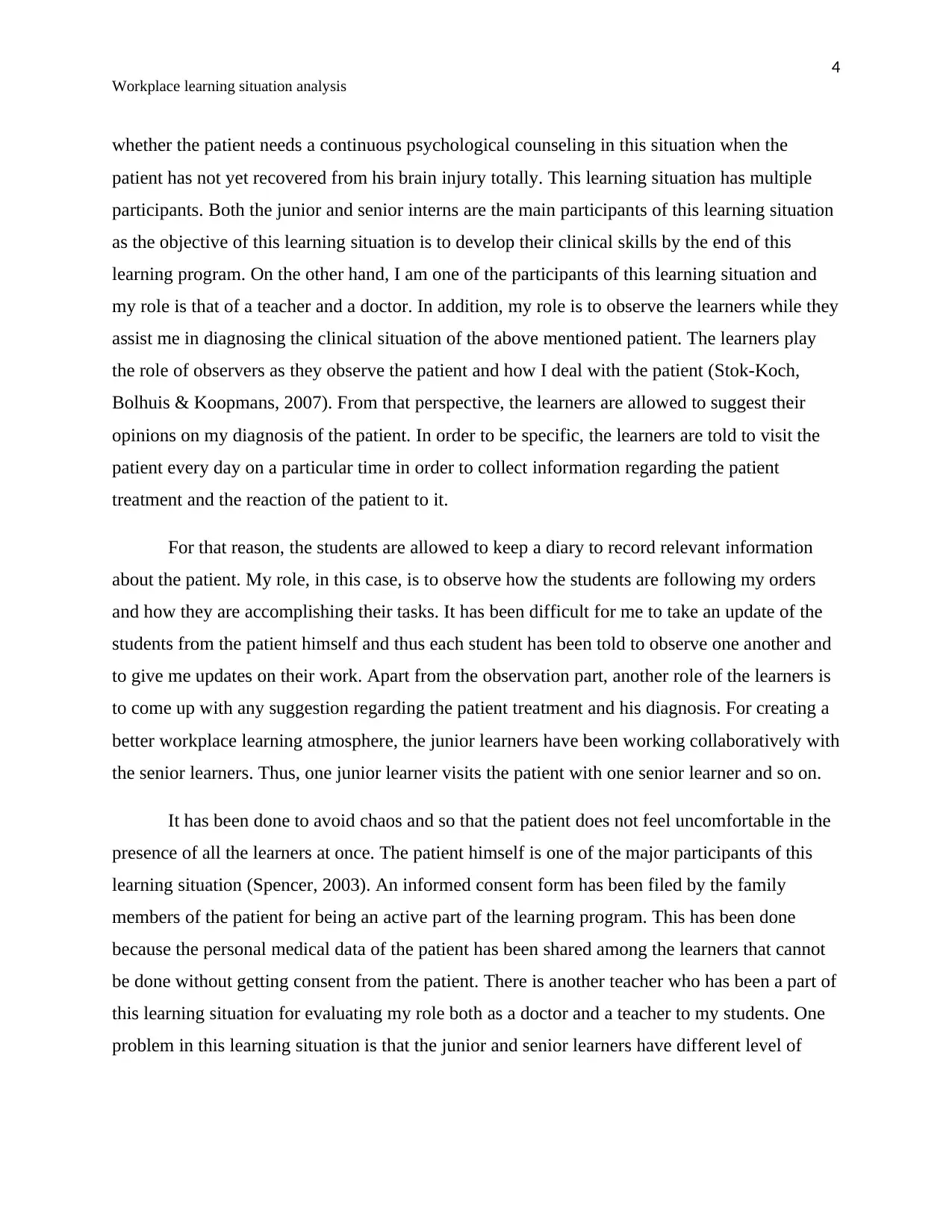
whether the patient needs a continuous psychological counseling in this situation when the
patient has not yet recovered from his brain injury totally. This learning situation has multiple
participants. Both the junior and senior interns are the main participants of this learning situation
as the objective of this learning situation is to develop their clinical skills by the end of this
learning program. On the other hand, I am one of the participants of this learning situation and
my role is that of a teacher and a doctor. In addition, my role is to observe the learners while they
assist me in diagnosing the clinical situation of the above mentioned patient. The learners play
the role of observers as they observe the patient and how I deal with the patient (Stok-Koch,
Bolhuis & Koopmans, 2007). From that perspective, the learners are allowed to suggest their
opinions on my diagnosis of the patient. In order to be specific, the learners are told to visit the
patient every day on a particular time in order to collect information regarding the patient
treatment and the reaction of the patient to it.
For that reason, the students are allowed to keep a diary to record relevant information
about the patient. My role, in this case, is to observe how the students are following my orders
and how they are accomplishing their tasks. It has been difficult for me to take an update of the
students from the patient himself and thus each student has been told to observe one another and
to give me updates on their work. Apart from the observation part, another role of the learners is
to come up with any suggestion regarding the patient treatment and his diagnosis. For creating a
better workplace learning atmosphere, the junior learners have been working collaboratively with
the senior learners. Thus, one junior learner visits the patient with one senior learner and so on.
It has been done to avoid chaos and so that the patient does not feel uncomfortable in the
presence of all the learners at once. The patient himself is one of the major participants of this
learning situation (Spencer, 2003). An informed consent form has been filed by the family
members of the patient for being an active part of the learning program. This has been done
because the personal medical data of the patient has been shared among the learners that cannot
be done without getting consent from the patient. There is another teacher who has been a part of
this learning situation for evaluating my role both as a doctor and a teacher to my students. One
problem in this learning situation is that the junior and senior learners have different level of
Workplace learning situation analysis
whether the patient needs a continuous psychological counseling in this situation when the
patient has not yet recovered from his brain injury totally. This learning situation has multiple
participants. Both the junior and senior interns are the main participants of this learning situation
as the objective of this learning situation is to develop their clinical skills by the end of this
learning program. On the other hand, I am one of the participants of this learning situation and
my role is that of a teacher and a doctor. In addition, my role is to observe the learners while they
assist me in diagnosing the clinical situation of the above mentioned patient. The learners play
the role of observers as they observe the patient and how I deal with the patient (Stok-Koch,
Bolhuis & Koopmans, 2007). From that perspective, the learners are allowed to suggest their
opinions on my diagnosis of the patient. In order to be specific, the learners are told to visit the
patient every day on a particular time in order to collect information regarding the patient
treatment and the reaction of the patient to it.
For that reason, the students are allowed to keep a diary to record relevant information
about the patient. My role, in this case, is to observe how the students are following my orders
and how they are accomplishing their tasks. It has been difficult for me to take an update of the
students from the patient himself and thus each student has been told to observe one another and
to give me updates on their work. Apart from the observation part, another role of the learners is
to come up with any suggestion regarding the patient treatment and his diagnosis. For creating a
better workplace learning atmosphere, the junior learners have been working collaboratively with
the senior learners. Thus, one junior learner visits the patient with one senior learner and so on.
It has been done to avoid chaos and so that the patient does not feel uncomfortable in the
presence of all the learners at once. The patient himself is one of the major participants of this
learning situation (Spencer, 2003). An informed consent form has been filed by the family
members of the patient for being an active part of the learning program. This has been done
because the personal medical data of the patient has been shared among the learners that cannot
be done without getting consent from the patient. There is another teacher who has been a part of
this learning situation for evaluating my role both as a doctor and a teacher to my students. One
problem in this learning situation is that the junior and senior learners have different level of
5
Workplace learning situation analysis
clinical experience and thus the senior learners overpower the juniors while giving any
suggestions to me regarding the patient diagnosis.
Justification
Cognitive apprenticeship Theory
The theory chosen for analyzing the learning situation is the cognitive apprenticeship
theory. This theory helps the teacher to teach professional skills to the learners. Thus, the
framework is based upon the process of teaching the professional skill building to the learners
who have very less experience regarding those particular skills that is being taught. This theory
has been created from constructivist approaches to learning. Thus, the component of cognitive
ability is highly important here. One of the main elements of this theory revolves around the fact
that sometimes teachers fail to deal with certain issues that work as a hindrance in the way of the
learning of the students. According to Dolmans, Wolfhagen, Heineman & Scherpbier (2008), this
theory helps the teacher to make the students involve and engage in the learning process
themselves so that they can contribute in learning the skills actively.
For that reason, the learners are allowed to practice the skills whole acting like interns
under the supervision of the teachers. The supervision of the teacher is needed according to this
theory as the learners are all novices who need proper guidance from the teacher in order to enact
their roles apprentices or interns. The role of the students in the learning process is to observe the
teacher so that they can learn from how the teacher deals with a real life learning situation. Three
main factors of the success of this framework include self motivation of the learners, their
consistent attention and their ability to reproduce the skill that has been taught to them via real
life practice (Stalmeijer, Dolmans, Wolfhagen & Scherpbier, 2009). The context of the learning
situation is very important in this case because the strategies and activities of learning depend on
what kind of learning context the learners and the teachers are dealing with. This framework has
three consecutive stages that include associative stage, cognitive stage and autonomous stage.
The terms denote that the teacher is allowed to teach for a certain amount of time and the main
learning process is done through independent learning of the learners. Moreover, the teacher tries
to transfer own skills to the learners by teaching them the skills in a real life scenario.
Workplace learning situation analysis
clinical experience and thus the senior learners overpower the juniors while giving any
suggestions to me regarding the patient diagnosis.
Justification
Cognitive apprenticeship Theory
The theory chosen for analyzing the learning situation is the cognitive apprenticeship
theory. This theory helps the teacher to teach professional skills to the learners. Thus, the
framework is based upon the process of teaching the professional skill building to the learners
who have very less experience regarding those particular skills that is being taught. This theory
has been created from constructivist approaches to learning. Thus, the component of cognitive
ability is highly important here. One of the main elements of this theory revolves around the fact
that sometimes teachers fail to deal with certain issues that work as a hindrance in the way of the
learning of the students. According to Dolmans, Wolfhagen, Heineman & Scherpbier (2008), this
theory helps the teacher to make the students involve and engage in the learning process
themselves so that they can contribute in learning the skills actively.
For that reason, the learners are allowed to practice the skills whole acting like interns
under the supervision of the teachers. The supervision of the teacher is needed according to this
theory as the learners are all novices who need proper guidance from the teacher in order to enact
their roles apprentices or interns. The role of the students in the learning process is to observe the
teacher so that they can learn from how the teacher deals with a real life learning situation. Three
main factors of the success of this framework include self motivation of the learners, their
consistent attention and their ability to reproduce the skill that has been taught to them via real
life practice (Stalmeijer, Dolmans, Wolfhagen & Scherpbier, 2009). The context of the learning
situation is very important in this case because the strategies and activities of learning depend on
what kind of learning context the learners and the teachers are dealing with. This framework has
three consecutive stages that include associative stage, cognitive stage and autonomous stage.
The terms denote that the teacher is allowed to teach for a certain amount of time and the main
learning process is done through independent learning of the learners. Moreover, the teacher tries
to transfer own skills to the learners by teaching them the skills in a real life scenario.
⊘ This is a preview!⊘
Do you want full access?
Subscribe today to unlock all pages.
Trusted by 1+ million students worldwide
6
Workplace learning situation analysis
Analysis of learning situation
As per the learning situation, it has been seen that five learners enact as interns under the
teacher who has been involved in treating a patient with a major brain injury and post accident
trauma. The learners have been conditioned to learn clinical skills such as patient care and
patient diagnosis. Patient observation is one of the simplest and right ways to diagnose any
patient as the patients can convey their clinical problems more accurately than anyone else. The
teacher plays two roles including that of a teacher or trainer and that of a doctor. It has been
noticed that the learning situation follows certain characteristics of the cognitive apprenticeship
theory. For example, the main objective of this learning program is to make the learners
competent in clinical skills.
On the other hand, the teacher works as a coach to the interns who not only teach them
clinical skills but also observe them in order to come up with plans that can be beneficial for
them to prosper (Stok-Koch, Bolhuis & Koopmans, 2007). On the other hand, one real life
situation has been chosen for this learning program that is the patient’s ward. Thus, the learners
are learning clinical skills through practicing them under the guidance of the teacher or the
coach. As mentioned in the learning situation, the teacher allows the learners to give him
suggestions on how to diagnose the patient. This proves that the learners have been given
opportunities to reproduce the skills after observing the skills of the coach.
The patient himself works as a textbook for the learners as they are allowed to visit the
patient to record his whereabouts. This allows the learners to properly retain the needed
knowledge about patient care by being involved in a similar situation themselves. As per the
description of the present learning situation, it can be said that the learners are in the associative
stage. In order to elaborate, this can be mentioned that the learners have been interpreting
mistakes related to cognitive stage where they acted just like observer of the teacher in order to
understand the needed clinical skills (Spencer, 2003). In this stage, the learners have been trying
to eliminate the misinterpretation regarding their observations so that they can strengthen their
clinical skills. So, it can be said that the learners will be able to be experts in practicing their
clinical skills as the learning session ends.
Workplace learning situation analysis
Analysis of learning situation
As per the learning situation, it has been seen that five learners enact as interns under the
teacher who has been involved in treating a patient with a major brain injury and post accident
trauma. The learners have been conditioned to learn clinical skills such as patient care and
patient diagnosis. Patient observation is one of the simplest and right ways to diagnose any
patient as the patients can convey their clinical problems more accurately than anyone else. The
teacher plays two roles including that of a teacher or trainer and that of a doctor. It has been
noticed that the learning situation follows certain characteristics of the cognitive apprenticeship
theory. For example, the main objective of this learning program is to make the learners
competent in clinical skills.
On the other hand, the teacher works as a coach to the interns who not only teach them
clinical skills but also observe them in order to come up with plans that can be beneficial for
them to prosper (Stok-Koch, Bolhuis & Koopmans, 2007). On the other hand, one real life
situation has been chosen for this learning program that is the patient’s ward. Thus, the learners
are learning clinical skills through practicing them under the guidance of the teacher or the
coach. As mentioned in the learning situation, the teacher allows the learners to give him
suggestions on how to diagnose the patient. This proves that the learners have been given
opportunities to reproduce the skills after observing the skills of the coach.
The patient himself works as a textbook for the learners as they are allowed to visit the
patient to record his whereabouts. This allows the learners to properly retain the needed
knowledge about patient care by being involved in a similar situation themselves. As per the
description of the present learning situation, it can be said that the learners are in the associative
stage. In order to elaborate, this can be mentioned that the learners have been interpreting
mistakes related to cognitive stage where they acted just like observer of the teacher in order to
understand the needed clinical skills (Spencer, 2003). In this stage, the learners have been trying
to eliminate the misinterpretation regarding their observations so that they can strengthen their
clinical skills. So, it can be said that the learners will be able to be experts in practicing their
clinical skills as the learning session ends.
Paraphrase This Document
Need a fresh take? Get an instant paraphrase of this document with our AI Paraphraser
7
Workplace learning situation analysis
Recommendations
It has been seen that there is a problem in the learning situation regarding different level
of clinical experience. In addition, they are also in different academic level that is making
obstacles in a proper collaborative learning. In this regard, this can also be mentioned that these
learners have diverse cognitive levels. Thus, this issue can be improved by giving them scope to
build a professional rapport among themselves. In this way they can share their own clinical
experiences with one another and that can be helpful for all of them in the long run. On the other
hand, it has been seen that the senior interns sometimes overpowers the juniors. In that case,
various learning activities can be given to the senior students that will make them direct the
junior students. This strategy can make the senior students more responsible towards each and
other and thus they may involve themselves in enhancing learning of the junior students.
Workplace learning situation analysis
Recommendations
It has been seen that there is a problem in the learning situation regarding different level
of clinical experience. In addition, they are also in different academic level that is making
obstacles in a proper collaborative learning. In this regard, this can also be mentioned that these
learners have diverse cognitive levels. Thus, this issue can be improved by giving them scope to
build a professional rapport among themselves. In this way they can share their own clinical
experiences with one another and that can be helpful for all of them in the long run. On the other
hand, it has been seen that the senior interns sometimes overpowers the juniors. In that case,
various learning activities can be given to the senior students that will make them direct the
junior students. This strategy can make the senior students more responsible towards each and
other and thus they may involve themselves in enhancing learning of the junior students.
8
Workplace learning situation analysis
Reference list
Dolmans, D. H. J. M., Wolfhagen, I. H. A. P., Heineman, E., & Scherpbier, A. J. J. A. (2008).
Factors adversely affecting student learning in the clinical learning environment: a
student perspective. Education for Health, 21(3), 32. Retrieved on: 11th Feb, 2019, From:
http://www.educationforhealth.net/article.asp?issn=1357-
6283;year=2008;volume=21;issue=3;spage=32;epage=32;aulast=Dolmans
Dornan, T., Boshuizen, H., King, N., Scherpbier, A. (2007). Experience-based learning: A model
linking the processes and outcomes of medical students’ workplace learning. Medical
Education, 41, 84-91. doi:10.1111/j.1365-2929.2006.02652.x
Spencer, J. (2003). ABC of learning and teaching in medicine: Learning and teaching in the
clinical environment. British Medical Journal, 326, 591-594. doi:
10.1136/bmj.326.7389.591
Stalmeijer, R. E., Dolmans, D. H. J. M., Wolfhagen, I. H. A. P., & Scherpbier, A. J. J. A.
(2009).Cognitive apprenticeship in clinical practice: Can it stimulate learning in the
opinion of students? Advances in Health Sciences Education, 14, 535-546.
doi:10.1007/s10459-008-9136-0
Stok-Koch, L., Bolhuis, S., & Koopmans, R. T. C. M. (2007). Identifying factors that influence
workplace learning in postgraduate medical education. Education for Health, 20(1), 8.
Retrieved on: 11th Feb, 2019, From: http://www.educationforhealth.net/article.asp?
issn=1357-6283;year=2007;volume=20;issue=1;spage=8;epage=8;aulast=Stok-Koch
Workplace learning situation analysis
Reference list
Dolmans, D. H. J. M., Wolfhagen, I. H. A. P., Heineman, E., & Scherpbier, A. J. J. A. (2008).
Factors adversely affecting student learning in the clinical learning environment: a
student perspective. Education for Health, 21(3), 32. Retrieved on: 11th Feb, 2019, From:
http://www.educationforhealth.net/article.asp?issn=1357-
6283;year=2008;volume=21;issue=3;spage=32;epage=32;aulast=Dolmans
Dornan, T., Boshuizen, H., King, N., Scherpbier, A. (2007). Experience-based learning: A model
linking the processes and outcomes of medical students’ workplace learning. Medical
Education, 41, 84-91. doi:10.1111/j.1365-2929.2006.02652.x
Spencer, J. (2003). ABC of learning and teaching in medicine: Learning and teaching in the
clinical environment. British Medical Journal, 326, 591-594. doi:
10.1136/bmj.326.7389.591
Stalmeijer, R. E., Dolmans, D. H. J. M., Wolfhagen, I. H. A. P., & Scherpbier, A. J. J. A.
(2009).Cognitive apprenticeship in clinical practice: Can it stimulate learning in the
opinion of students? Advances in Health Sciences Education, 14, 535-546.
doi:10.1007/s10459-008-9136-0
Stok-Koch, L., Bolhuis, S., & Koopmans, R. T. C. M. (2007). Identifying factors that influence
workplace learning in postgraduate medical education. Education for Health, 20(1), 8.
Retrieved on: 11th Feb, 2019, From: http://www.educationforhealth.net/article.asp?
issn=1357-6283;year=2007;volume=20;issue=1;spage=8;epage=8;aulast=Stok-Koch
⊘ This is a preview!⊘
Do you want full access?
Subscribe today to unlock all pages.
Trusted by 1+ million students worldwide

1 out of 9


Related Documents


Your All-in-One AI-Powered Toolkit for Academic Success.
+13062052269
info@desklib.com
Available 24*7 on WhatsApp / Email
![[object Object]](/_next/static/media/star-bottom.7253800d.svg)
Unlock your academic potential
Copyright © 2020–2026 A2Z Services. All Rights Reserved. Developed and managed by ZUCOL.