UOW Nursing: Workplace Culture and Practice Development Essay
VerifiedAdded on 2023/01/20
|10
|2994
|77
Essay
AI Summary
This essay delves into the concept of workplace culture within the healthcare context, focusing on its theoretical underpinnings and practical implications for practice development. It begins by exploring the "Effective workplace culture framework" and its key attributes, enabling factors, and consequences. The essay then examines how effective workplace culture impacts clinical care, specifically in areas such as patient outcomes and staff satisfaction, with a strong emphasis on person-centered care. Individual and organizational enablers, including transformational leadership, skilled facilitation, role clarification, flattened management, and human resource management support, are discussed in detail. The essay also analyzes the role of care practitioners, policies, service provision, and advocates in fostering a positive and effective workplace culture, ensuring the needs of both patients and caregivers are met. The conclusion highlights the importance of these factors in achieving high-quality, client-centered healthcare.
0
Running head: TOOLS FOR PRATICE DEVELOPMENT
TOOLS FOR PRACTICE DEVELOPMENT
Running head: TOOLS FOR PRATICE DEVELOPMENT
TOOLS FOR PRACTICE DEVELOPMENT

Paraphrase This Document
Need a fresh take? Get an instant paraphrase of this document with our AI Paraphraser

1
TOOLS FOR PRATICE DEVELOPMENT
Table of Contents
Introduction................................................................................................................................2
Theory of Effective Workplace Culture.....................................................................................2
The implication for practice.......................................................................................................5
Conclusion..................................................................................................................................7
Reference List............................................................................................................................8
TOOLS FOR PRATICE DEVELOPMENT
Table of Contents
Introduction................................................................................................................................2
Theory of Effective Workplace Culture.....................................................................................2
The implication for practice.......................................................................................................5
Conclusion..................................................................................................................................7
Reference List............................................................................................................................8
2
TOOLS FOR PRATICE DEVELOPMENT
Introduction
The effective workplace culture is the one that is mainly person-centred and continues to
adopt the change for healthcare needs. This workplace culture is evidence-based and it
involves the identification of the external and internal barriers to change through the critique,
structured reflection, and contestation. The healthcare context thoroughly needs effective
workplace culture as there are continuous development and change in the healthcare
department. The effective workplace culture would interpret the thorough development of
work and care given to the service users. There are leadership theories and approaches
discussed in the study that related the individual and organisational development. The
implication of the practices would help in the understanding of how the theories can affect
the effective workplace culture. The study shows that there is transformational leadership,
role clarification for the individual development and the transparent management, decision
making and human resource management are the tools for the organisational development.
Theory of Effective Workplace Culture
The workplace culture defines the need for a few theories and concepts for the individual
need and development in the healthcare organisation.
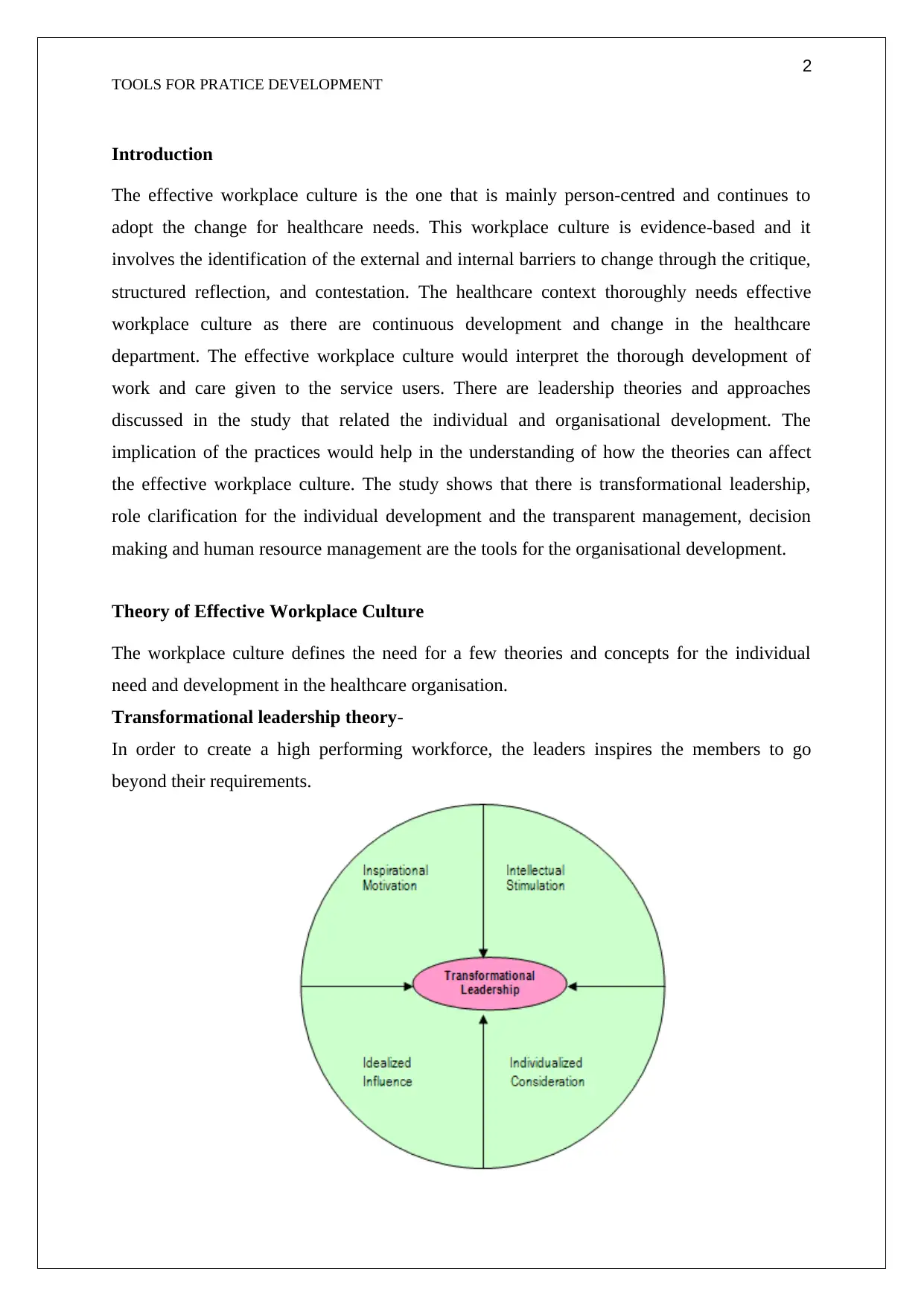
Transformational leadership theory-
In order to create a high performing workforce, the leaders inspires the members to go
beyond their requirements.
TOOLS FOR PRATICE DEVELOPMENT
Introduction
The effective workplace culture is the one that is mainly person-centred and continues to
adopt the change for healthcare needs. This workplace culture is evidence-based and it
involves the identification of the external and internal barriers to change through the critique,
structured reflection, and contestation. The healthcare context thoroughly needs effective
workplace culture as there are continuous development and change in the healthcare
department. The effective workplace culture would interpret the thorough development of
work and care given to the service users. There are leadership theories and approaches
discussed in the study that related the individual and organisational development. The
implication of the practices would help in the understanding of how the theories can affect
the effective workplace culture. The study shows that there is transformational leadership,
role clarification for the individual development and the transparent management, decision
making and human resource management are the tools for the organisational development.
Theory of Effective Workplace Culture
The workplace culture defines the need for a few theories and concepts for the individual
need and development in the healthcare organisation.
Transformational leadership theory-
In order to create a high performing workforce, the leaders inspires the members to go
beyond their requirements.
⊘ This is a preview!⊘
Do you want full access?
Subscribe today to unlock all pages.

Trusted by 1+ million students worldwide
3
TOOLS FOR PRATICE DEVELOPMENT
Figure 1: Transformational Leadership Theory
(Source: Ghasabeh, Soosay & Reaiche, 2015)
The figure shows that in the transformational theory there are four quadrants namely,
inspirational motivation, which is the driving factor for the consistent promotion of vision
and mission of the organisation through proper interaction between service users and service
providers (Ghasabeh, Soosay & Reaiche, 2015).
Intellectual stimulation leads the leaders to stimulate the individual to encourage the members
to become innovative. In the healthcare scenario, the individual can be innovative in
communicating through new ways with service users.
The idealised influence helps the leaders to sacrifice personal gains and individual
consideration help the individual to make a decision and implement those.
Skilled Facilitation-
As opined by Martin & Manley (2018) this approach helps in the development of the values
and is actually a systemic approach towards facilitation. In healthcare organisations, this
facilitation approach helps the care practitioners to increase the quality in their decision-
making, increase the decision commitment and relationship building with the service users.
This defines the ways through which a person can develop in an effective manner. The skill
facilitator model enables and identifies the core elements for the relationship among the care
practitioner and the people taking their service. This also helps to develop teamwork and
communication. This help in the development of the behaviours among the team members
and the service users.
Role Clarification-
Role clarification is very important in effective collaboration at the inter-professional level
(Ambrose-Miller & Ashcroft, 2016). In the clinical teams, the roles need to clearly define as
poor clarity might lead to a reduction of effectiveness. This values and the culture of the
clinical area must be clarified to the practitioners. In the healthcare organisations, the shared
values of employees play an important role in designing the culture of the place. The team
and must be clarified about the growing recognition of the healthcare organisation.
Organizational
The health care organizations are responsible to make an organizational culture that enables
the clients or care-users, to be the centre of the care process. The process demands some
enabling factors for reaching the targeted goal. The organizational enabling factors will be
discussed in this section along with the essential attributes.
● Flattened and transparent management
TOOLS FOR PRATICE DEVELOPMENT
Figure 1: Transformational Leadership Theory
(Source: Ghasabeh, Soosay & Reaiche, 2015)
The figure shows that in the transformational theory there are four quadrants namely,
inspirational motivation, which is the driving factor for the consistent promotion of vision
and mission of the organisation through proper interaction between service users and service
providers (Ghasabeh, Soosay & Reaiche, 2015).
Intellectual stimulation leads the leaders to stimulate the individual to encourage the members
to become innovative. In the healthcare scenario, the individual can be innovative in
communicating through new ways with service users.
The idealised influence helps the leaders to sacrifice personal gains and individual
consideration help the individual to make a decision and implement those.
Skilled Facilitation-
As opined by Martin & Manley (2018) this approach helps in the development of the values
and is actually a systemic approach towards facilitation. In healthcare organisations, this
facilitation approach helps the care practitioners to increase the quality in their decision-
making, increase the decision commitment and relationship building with the service users.
This defines the ways through which a person can develop in an effective manner. The skill
facilitator model enables and identifies the core elements for the relationship among the care
practitioner and the people taking their service. This also helps to develop teamwork and
communication. This help in the development of the behaviours among the team members
and the service users.
Role Clarification-
Role clarification is very important in effective collaboration at the inter-professional level
(Ambrose-Miller & Ashcroft, 2016). In the clinical teams, the roles need to clearly define as
poor clarity might lead to a reduction of effectiveness. This values and the culture of the
clinical area must be clarified to the practitioners. In the healthcare organisations, the shared
values of employees play an important role in designing the culture of the place. The team
and must be clarified about the growing recognition of the healthcare organisation.
Organizational
The health care organizations are responsible to make an organizational culture that enables
the clients or care-users, to be the centre of the care process. The process demands some
enabling factors for reaching the targeted goal. The organizational enabling factors will be
discussed in this section along with the essential attributes.
● Flattened and transparent management
Paraphrase This Document
Need a fresh take? Get an instant paraphrase of this document with our AI Paraphraser
4
TOOLS FOR PRATICE DEVELOPMENT
Organizational enablers include flattened and transparent management. It can be
characterized by well-developed management, includes the participation of others and
involves non-hierarchical management structures and processes (Nolan et al. 2004). The
professional that is working in this management team is considered as the partners in solution
and not a problem. This kind of management allows every stakeholder to participate
collaboratively in decision making allows open communication and positive attitudes towards
work.
● An enabling approach to leadership and decision making
Another enabling factor of the organization to maintain effective work-culture is to encourage
good leadership in all the levels of the organization. Good leadership will allow all the
employees of the organization to participate in the strategy, making, implementation and
monitoring them (Newman, Papadopoulos & Melifonu, 2000). It becomes easy for the
organization to meet the goal of making an environment of trust. This also empowers the
employees to maintain consistency in providing services to the clients or care-users.
Moreover, the essential attributes of good communication are teamwork, collaborative
decision making, high support and challenge and more. Evidence and development are also
facilitated expertise and develop leadership.
● Organizational readiness
The organizational is required to be ready for accepting change in the organization. The
previous history of change in the organization helps to be prepared and plan for refinement of
the organization through the application of social and technical systems (Nelson et al. 2002).
This can be attributed to a positive attitude of the organization towards change.
Organizational excellence will not diminish if there is proper planning for the sustainable
development of the organization. The readiness of the organization may create a safe work
culture.
● Human resource management support
The most important enabler of the health care organization is the Human Resource
Management support. This department is responsible for maintaining the values of the
organization in relation to the recruitment of the employees and their selection (McCormack
et al. 2009). The department also tries to meet the expectations of the staffs that help to make
them satisfy and reduce turnover. Moreover, this department provides training to the
employees by judging their needs and ensures their learning and development for the future.
The organization can gain the trust of the employees and can achieve collaborative
participation of them.
TOOLS FOR PRATICE DEVELOPMENT
Organizational enablers include flattened and transparent management. It can be
characterized by well-developed management, includes the participation of others and
involves non-hierarchical management structures and processes (Nolan et al. 2004). The
professional that is working in this management team is considered as the partners in solution
and not a problem. This kind of management allows every stakeholder to participate
collaboratively in decision making allows open communication and positive attitudes towards
work.
● An enabling approach to leadership and decision making
Another enabling factor of the organization to maintain effective work-culture is to encourage
good leadership in all the levels of the organization. Good leadership will allow all the
employees of the organization to participate in the strategy, making, implementation and
monitoring them (Newman, Papadopoulos & Melifonu, 2000). It becomes easy for the
organization to meet the goal of making an environment of trust. This also empowers the
employees to maintain consistency in providing services to the clients or care-users.
Moreover, the essential attributes of good communication are teamwork, collaborative
decision making, high support and challenge and more. Evidence and development are also
facilitated expertise and develop leadership.
● Organizational readiness
The organizational is required to be ready for accepting change in the organization. The
previous history of change in the organization helps to be prepared and plan for refinement of
the organization through the application of social and technical systems (Nelson et al. 2002).
This can be attributed to a positive attitude of the organization towards change.
Organizational excellence will not diminish if there is proper planning for the sustainable
development of the organization. The readiness of the organization may create a safe work
culture.
● Human resource management support
The most important enabler of the health care organization is the Human Resource
Management support. This department is responsible for maintaining the values of the
organization in relation to the recruitment of the employees and their selection (McCormack
et al. 2009). The department also tries to meet the expectations of the staffs that help to make
them satisfy and reduce turnover. Moreover, this department provides training to the
employees by judging their needs and ensures their learning and development for the future.
The organization can gain the trust of the employees and can achieve collaborative
participation of them.
5
TOOLS FOR PRATICE DEVELOPMENT
In an organization the person-centeredness, lifelong learning of the employees and other
attributes discussed earlier can be realized in practice. These allow the employees to think
innovatively and creatively that increases workplace effectiveness (Moore et al. 2017). The
change is driven by the needs and wants of the care uses and the community.
The implication for practice
The individual and the organizational enabling factors and the attributes are required to
implement by the health care teams if they aim to develop an effective workplace culture.
Care provided by the practitioners
The care practitioners need to know about their own effectiveness and have to become skilled
facilitators before starting their practice. Additionally, they are required to work
collaboratively with other employees. The enabling factors such as transformational
leadership where persons try to transform their leadership qualities to modify the same by
applying own knowledge and insight as well (Benevides Carretta & Mandell, 2016). The
leadership is not all about leading a team; leaders are required to pay attention to the culture
role-modeling the shared values and the leaders aim at achieving the common vision by
engaging their thoughts and emotions. Care practitioners are required to facilitate the
effectiveness of other people. The practitioners and the skilled facilitators try to make the
other people of the organization in order to facilitate changes within the individuals according
to the context for the better organizational outcome. In order to achieve cultural change in the
organization, it is important to develop the clinical leaders and the facilitators.
According to (Moore et al. 2017), the practitioners need to explore their own skills and
qualities to facilitate changes in the organization. Moreover, the practitioners have to have
clear knowledge about their jobs and roles should clear to them. Therefore, evidence-based
practice and critical thinking are involved in role clarity and clear exp4ectations. By applying
these enablers the Total Quality Management is implemented.
Policies
The health care policy considers the fact that cultural change can be achieved through
leadership. Moreover, teamwork indicates that there is an effective culture in the
organization. Health care policy focuses on the quality of health care. The policy also
suggests that effective culture can be achieved through learning and from the practices. The
care should be person-centered or client-centered. Moreover, the clinical care of the clients
should be safe and effective that satisfies the client's needs along with providing them quality
TOOLS FOR PRATICE DEVELOPMENT
In an organization the person-centeredness, lifelong learning of the employees and other
attributes discussed earlier can be realized in practice. These allow the employees to think
innovatively and creatively that increases workplace effectiveness (Moore et al. 2017). The
change is driven by the needs and wants of the care uses and the community.
The implication for practice
The individual and the organizational enabling factors and the attributes are required to
implement by the health care teams if they aim to develop an effective workplace culture.
Care provided by the practitioners
The care practitioners need to know about their own effectiveness and have to become skilled
facilitators before starting their practice. Additionally, they are required to work
collaboratively with other employees. The enabling factors such as transformational
leadership where persons try to transform their leadership qualities to modify the same by
applying own knowledge and insight as well (Benevides Carretta & Mandell, 2016). The
leadership is not all about leading a team; leaders are required to pay attention to the culture
role-modeling the shared values and the leaders aim at achieving the common vision by
engaging their thoughts and emotions. Care practitioners are required to facilitate the
effectiveness of other people. The practitioners and the skilled facilitators try to make the
other people of the organization in order to facilitate changes within the individuals according
to the context for the better organizational outcome. In order to achieve cultural change in the
organization, it is important to develop the clinical leaders and the facilitators.
According to (Moore et al. 2017), the practitioners need to explore their own skills and
qualities to facilitate changes in the organization. Moreover, the practitioners have to have
clear knowledge about their jobs and roles should clear to them. Therefore, evidence-based
practice and critical thinking are involved in role clarity and clear exp4ectations. By applying
these enablers the Total Quality Management is implemented.
Policies
The health care policy considers the fact that cultural change can be achieved through
leadership. Moreover, teamwork indicates that there is an effective culture in the
organization. Health care policy focuses on the quality of health care. The policy also
suggests that effective culture can be achieved through learning and from the practices. The
care should be person-centered or client-centered. Moreover, the clinical care of the clients
should be safe and effective that satisfies the client's needs along with providing them quality
⊘ This is a preview!⊘
Do you want full access?
Subscribe today to unlock all pages.
Trusted by 1+ million students worldwide
6
TOOLS FOR PRATICE DEVELOPMENT
care. The policies of health care also suggest that the caregivers should improve themselves
continuously; they have to implement innovative ideas in the health care practice in order to
respond and handle quickly the changing environment of the organization. However, there is
no clear framework for guiding the clinical leaders throughout the cultural change.
Service provision
In order to provide service and keeping a clear concept of the required treatment in the future
care of the care users the organization should have clear service provision (American
Diabetes Association. 2016). If there is an effective leader in the care management team the
service will be effective to the health care users. In order to enhance the support and facilitate
active learning outcomes, the provision of supervision is important. Not only the service
provider but the mentorship and coaching are also required to facilitate the effectiveness of
the service.
Needs of clients and care givers
In order to meet the needs and expectations of the care users both the enabling factors should
be implemented. The individual expertise can be an important facilitator of the promotion of
effective culture in the organization (Castro, et al. 2016). The transformational leadership
requires changing or modification of the characters of the team leaders by applying their
insight and knowledge. If the skills of the staffs can be facilitated the clients will definitely
get the quality care from the staffs of the organization. The organization requires readiness
before getting in front of change in the organization. The human resource department plays a
crucial role in selecting the staffs for different roles in the organization. Therefore, before
providing service to the client's staff of the organization will have a clear vision of the
required services.
Role of advocates in the care of clients and the care givers
The role of an advocate in the health care organization id related to the care users as well as
to the caregivers. In the organization, the first responsibility of an advocate is to identify the
issues that are happening in the organization and making the organizational leader aware of
those incidents. The advocate helps to understand and make choices that help in making the
decision for a client (Tobiano et al. 2015). The advocate of the organization empowers the
care users to inform others about their needs and opinions too. The advocate ensures that the
care users are getting the service they have rights for. Not only that while working in
collaboration with other organizations on a project the advocate helps to protect the rights of
the organization and keeps the organization from getting affected by any kind of legal
TOOLS FOR PRATICE DEVELOPMENT
care. The policies of health care also suggest that the caregivers should improve themselves
continuously; they have to implement innovative ideas in the health care practice in order to
respond and handle quickly the changing environment of the organization. However, there is
no clear framework for guiding the clinical leaders throughout the cultural change.
Service provision
In order to provide service and keeping a clear concept of the required treatment in the future
care of the care users the organization should have clear service provision (American
Diabetes Association. 2016). If there is an effective leader in the care management team the
service will be effective to the health care users. In order to enhance the support and facilitate
active learning outcomes, the provision of supervision is important. Not only the service
provider but the mentorship and coaching are also required to facilitate the effectiveness of
the service.
Needs of clients and care givers
In order to meet the needs and expectations of the care users both the enabling factors should
be implemented. The individual expertise can be an important facilitator of the promotion of
effective culture in the organization (Castro, et al. 2016). The transformational leadership
requires changing or modification of the characters of the team leaders by applying their
insight and knowledge. If the skills of the staffs can be facilitated the clients will definitely
get the quality care from the staffs of the organization. The organization requires readiness
before getting in front of change in the organization. The human resource department plays a
crucial role in selecting the staffs for different roles in the organization. Therefore, before
providing service to the client's staff of the organization will have a clear vision of the
required services.
Role of advocates in the care of clients and the care givers
The role of an advocate in the health care organization id related to the care users as well as
to the caregivers. In the organization, the first responsibility of an advocate is to identify the
issues that are happening in the organization and making the organizational leader aware of
those incidents. The advocate helps to understand and make choices that help in making the
decision for a client (Tobiano et al. 2015). The advocate of the organization empowers the
care users to inform others about their needs and opinions too. The advocate ensures that the
care users are getting the service they have rights for. Not only that while working in
collaboration with other organizations on a project the advocate helps to protect the rights of
the organization and keeps the organization from getting affected by any kind of legal
Paraphrase This Document
Need a fresh take? Get an instant paraphrase of this document with our AI Paraphraser
7
TOOLS FOR PRATICE DEVELOPMENT
allegation. The advocates help the vulnerable cared users to safeguard their rights (Ross, Tod
& Clarke, 2015).
The organization
The implications of the theory of effective workplace culture can surely improve the quality
of the care provided to the care users. As a consequence of this, the needs of the clients, care
users and communities can be met through the client-centered way. The implications of
individual and organizational enablers help to empower the staffs, uplift the standard of care
and help to meet the goals of the organization.
Conclusion
The present study sheds light on the theories of effective workplace culture that include some
framework. The individual and the organizational enablers help the healthcare organization to
meet the needs and want of the clients. The individual enabling factors include
transformational leadership, role clarification and skilled facilitation. On the other hand, the
organizational enablers include transparent and flattened management, the readiness of the
organization, leadership and decision making and human resource departmental support.
However, there are some essential attributes that come as a result of the application of the
enabling factors such as person-centered care, leadership development, and use of the
evidence, teamwork, and safety of the clients, facilitates communication among the staffs and
the care users. All of these factor work as the determining factors of quality health care
service to the clients.
TOOLS FOR PRATICE DEVELOPMENT
allegation. The advocates help the vulnerable cared users to safeguard their rights (Ross, Tod
& Clarke, 2015).
The organization
The implications of the theory of effective workplace culture can surely improve the quality
of the care provided to the care users. As a consequence of this, the needs of the clients, care
users and communities can be met through the client-centered way. The implications of
individual and organizational enablers help to empower the staffs, uplift the standard of care
and help to meet the goals of the organization.
Conclusion
The present study sheds light on the theories of effective workplace culture that include some
framework. The individual and the organizational enablers help the healthcare organization to
meet the needs and want of the clients. The individual enabling factors include
transformational leadership, role clarification and skilled facilitation. On the other hand, the
organizational enablers include transparent and flattened management, the readiness of the
organization, leadership and decision making and human resource departmental support.
However, there are some essential attributes that come as a result of the application of the
enabling factors such as person-centered care, leadership development, and use of the
evidence, teamwork, and safety of the clients, facilitates communication among the staffs and
the care users. All of these factor work as the determining factors of quality health care
service to the clients.
8
TOOLS FOR PRATICE DEVELOPMENT
Reference List
Ambrose-Miller, W., & Ashcroft, R. (2016). Challenges faced by social workers as members
of interprofessional collaborative health care teams. Health & social work, 41(2),
pp.101-109.
American Diabetes Association. (2016). 3. Foundations of care and comprehensive medical
evaluation. Diabetes Care, 39(Supplement 1), S23-S35. Retrieved on: 30.05.2019,
Retrieved from:
http://care.diabetesjournals.org/content/diacare/39/Supplement_1/S23.full.pdf
Benevides, T. W., Carretta, H. J., & Mandell, D. S. (2016). Differences in perceived need for
medical, therapeutic, and family support services among children with
ASD. Pediatrics, 137(Supplement 2), S176-S185. Retrieved on: 30.05.2019,
Retrieved from: https://scholar.google.co.in/scholar?
output=instlink&q=info:M7Ayg43FgCIJ:scholar.google.com/
&hl=en&as_sdt=0,5&as_ylo=2015&scillfp=2832756011027396793&oi=lle
Castro, E. M., Van Regenmortel, T., Vanhaecht, K., Sermeus, W., & Van Hecke, A. (2016).
Patient empowerment, patient participation and patient-centeredness in hospital care:
a concept analysis based on a literature review. Patient education and
counseling, 99(12), 1923-1939. Retrieved on: 30.05.2019, Retrieved from:
https://www.researchgate.net/profile/Eva_Castro9/publication/305415824_Patient_em
powerment_patient_participation_and_patient-
centeredness_in_hospital_care_A_concept_analysis_based_on_a_literature_review/
links/5b83c78b4585151fd13531ce/Patient-empowerment-patient-participation-and-
patient-centeredness-in-hospital-care-A-concept-analysis-based-on-a-literature-
review.pdf
Ghasabeh, M. S., Soosay, C., & Reaiche, C. (2015). The emerging role of transformational
leadership. The Journal of Developing Areas, 49(6), pp. 459-467.
Martin, A., & Manley, K. (2018). Developing standards for an integrated approach to
workplace facilitation for interprofessional teams in health and social care contexts: a
Delphi study. Journal of interprofessional care, 32(1), pp. 41-51.
McCormack, B., Henderson, E., Wilson, V., Wright, J. (2009) Making practice visible: The
Workplace Culture Critical Analysis Tool (WCCAT) Practice Development in Health
TOOLS FOR PRATICE DEVELOPMENT
Reference List
Ambrose-Miller, W., & Ashcroft, R. (2016). Challenges faced by social workers as members
of interprofessional collaborative health care teams. Health & social work, 41(2),
pp.101-109.
American Diabetes Association. (2016). 3. Foundations of care and comprehensive medical
evaluation. Diabetes Care, 39(Supplement 1), S23-S35. Retrieved on: 30.05.2019,
Retrieved from:
http://care.diabetesjournals.org/content/diacare/39/Supplement_1/S23.full.pdf
Benevides, T. W., Carretta, H. J., & Mandell, D. S. (2016). Differences in perceived need for
medical, therapeutic, and family support services among children with
ASD. Pediatrics, 137(Supplement 2), S176-S185. Retrieved on: 30.05.2019,
Retrieved from: https://scholar.google.co.in/scholar?
output=instlink&q=info:M7Ayg43FgCIJ:scholar.google.com/
&hl=en&as_sdt=0,5&as_ylo=2015&scillfp=2832756011027396793&oi=lle
Castro, E. M., Van Regenmortel, T., Vanhaecht, K., Sermeus, W., & Van Hecke, A. (2016).
Patient empowerment, patient participation and patient-centeredness in hospital care:
a concept analysis based on a literature review. Patient education and
counseling, 99(12), 1923-1939. Retrieved on: 30.05.2019, Retrieved from:
https://www.researchgate.net/profile/Eva_Castro9/publication/305415824_Patient_em
powerment_patient_participation_and_patient-
centeredness_in_hospital_care_A_concept_analysis_based_on_a_literature_review/
links/5b83c78b4585151fd13531ce/Patient-empowerment-patient-participation-and-
patient-centeredness-in-hospital-care-A-concept-analysis-based-on-a-literature-
review.pdf
Ghasabeh, M. S., Soosay, C., & Reaiche, C. (2015). The emerging role of transformational
leadership. The Journal of Developing Areas, 49(6), pp. 459-467.
Martin, A., & Manley, K. (2018). Developing standards for an integrated approach to
workplace facilitation for interprofessional teams in health and social care contexts: a
Delphi study. Journal of interprofessional care, 32(1), pp. 41-51.
McCormack, B., Henderson, E., Wilson, V., Wright, J. (2009) Making practice visible: The
Workplace Culture Critical Analysis Tool (WCCAT) Practice Development in Health
⊘ This is a preview!⊘
Do you want full access?
Subscribe today to unlock all pages.
Trusted by 1+ million students worldwide
9
TOOLS FOR PRATICE DEVELOPMENT
Care.Vol.8. No. 1. pp 28-43. Retrieved on: 30.05.2019, Retrieved from:
https://onlinelibrary.wiley.com/doi/pdf/10.1002/pdh.273
Moore, L., Britten, N., Lydahl, D., Naldemirci, Ö., Elam, M., & Wolf, A. (2017). Barriers
and facilitators to the implementation of person‐centred care in different healthcare
contexts. Scandinavian journal of caring sciences, 31(4), 662-673. Retrieved on:
30.05.2019, Retrieved from:
https://onlinelibrary.wiley.com/doi/pdf/10.1111/scs.12376
Nelson, E., Batalden, P., Huber, T., Mohr, J., Godfrey, M., Headrick, L., Wasson, J. (2002)
Microsystems in health care: Part 1. Learning from high-performing front-line clinical
units. Journal of Quality Improvement. Vol. 8. No. 9. pp 472-493. Retrieved on:
30.05.2019, Retrieved from:
http://lsatqdm.qdmnet.com/qdm/microsystems/JQIPart1.pdf
Newman, M., Papadopoulos, I., Melifonu, R. (2000) Developing organisational systems and
culture to support evidence-based practice: the experience of the Evidence-Based
Ward Project. Evidence Based Nursing. Vol. 3(7). No. 4. pp 103-105. Retrieved on:
30.05.2019, Retrieved from: https://ebn.bmj.com/content/ebnurs/3/4/103.full.pdf
Nolan, M., Davies, S., Brown, J., Keady, J., Nolan, J. (2004) Beyond ‘person-centred’ care: a
new vision for gerontological nursing. International Journal of Older People Nursing.
Vol. 13. No. 3(9). pp 45-53. Retrieved on: 30.05.2019, Retrieved from:
https://pdfs.semanticscholar.org/39ea/350be36006c9170ec509406d408ea48b2061.pdf
Ross, H., Tod, A. M., & Clarke, A. (2015). Understanding and achieving person‐centred care:
the nurse perspective. Journal of Clinical Nursing, 24(9-10), 1223-1233. Retrieved
on: 30.05.2019, Retrieved from: http://eprints.whiterose.ac.uk/94177/1/JCN
%20Understanding%20person-centred%20care%20Pre%20Publication.pdf
Tobiano, G., Bucknall, T., Marshall, A., Guinane, J., & Chaboyer, W. (2015). Nurses' views
of patient participation in nursing care. Journal of advanced nursing, 71(12), 2741-
2752. Retrieved on: 30.05.2019, Retrieved from:
https://www.academia.edu/download/49823868/Tobiano_et_al-2015-
Journal_of_Advanced_Nursing.pdf
TOOLS FOR PRATICE DEVELOPMENT
Care.Vol.8. No. 1. pp 28-43. Retrieved on: 30.05.2019, Retrieved from:
https://onlinelibrary.wiley.com/doi/pdf/10.1002/pdh.273
Moore, L., Britten, N., Lydahl, D., Naldemirci, Ö., Elam, M., & Wolf, A. (2017). Barriers
and facilitators to the implementation of person‐centred care in different healthcare
contexts. Scandinavian journal of caring sciences, 31(4), 662-673. Retrieved on:
30.05.2019, Retrieved from:
https://onlinelibrary.wiley.com/doi/pdf/10.1111/scs.12376
Nelson, E., Batalden, P., Huber, T., Mohr, J., Godfrey, M., Headrick, L., Wasson, J. (2002)
Microsystems in health care: Part 1. Learning from high-performing front-line clinical
units. Journal of Quality Improvement. Vol. 8. No. 9. pp 472-493. Retrieved on:
30.05.2019, Retrieved from:
http://lsatqdm.qdmnet.com/qdm/microsystems/JQIPart1.pdf
Newman, M., Papadopoulos, I., Melifonu, R. (2000) Developing organisational systems and
culture to support evidence-based practice: the experience of the Evidence-Based
Ward Project. Evidence Based Nursing. Vol. 3(7). No. 4. pp 103-105. Retrieved on:
30.05.2019, Retrieved from: https://ebn.bmj.com/content/ebnurs/3/4/103.full.pdf
Nolan, M., Davies, S., Brown, J., Keady, J., Nolan, J. (2004) Beyond ‘person-centred’ care: a
new vision for gerontological nursing. International Journal of Older People Nursing.
Vol. 13. No. 3(9). pp 45-53. Retrieved on: 30.05.2019, Retrieved from:
https://pdfs.semanticscholar.org/39ea/350be36006c9170ec509406d408ea48b2061.pdf
Ross, H., Tod, A. M., & Clarke, A. (2015). Understanding and achieving person‐centred care:
the nurse perspective. Journal of Clinical Nursing, 24(9-10), 1223-1233. Retrieved
on: 30.05.2019, Retrieved from: http://eprints.whiterose.ac.uk/94177/1/JCN
%20Understanding%20person-centred%20care%20Pre%20Publication.pdf
Tobiano, G., Bucknall, T., Marshall, A., Guinane, J., & Chaboyer, W. (2015). Nurses' views
of patient participation in nursing care. Journal of advanced nursing, 71(12), 2741-
2752. Retrieved on: 30.05.2019, Retrieved from:
https://www.academia.edu/download/49823868/Tobiano_et_al-2015-
Journal_of_Advanced_Nursing.pdf

1 out of 10


Related Documents


Your All-in-One AI-Powered Toolkit for Academic Success.
+13062052269
info@desklib.com
Available 24*7 on WhatsApp / Email
![[object Object]](/_next/static/media/star-bottom.7253800d.svg)
Unlock your academic potential
Copyright © 2020–2026 A2Z Services. All Rights Reserved. Developed and managed by ZUCOL.