Analysis of Workplace Discrimination and Employee Satisfaction at M&S
VerifiedAdded on 2022/12/14
|15
|4022
|474
Report
AI Summary
This research proposal investigates workplace discrimination and its effects on employee satisfaction and performance at Marks & Spencer. The introduction provides an overview of the topic, the organization, and the problem statement, setting the stage for the research objectives, questions, and rationale. The literature review delves into the reasons for discrimination, including sex, gender, disability, age, language, and race, and analyzes their impact on employee satisfaction and performance. The methodology outlines the research approach, while the timeline provides a schedule for the research activities. The study aims to identify the causes of discrimination, assess its impact on employee morale and productivity, and explore strategies to minimize discriminatory practices, such as developing written policies, establishing grievance processes, educating employees, and partnering with community groups. The research emphasizes the importance of creating a healthy work environment and promoting diversity to improve the overall performance and image of the organization.
Research proposal
(To analyse concept of workplace discrimination and
its impact on employees satisfaction and performance.
A study on Marks & Spencer. )
(To analyse concept of workplace discrimination and
its impact on employees satisfaction and performance.
A study on Marks & Spencer. )

Paraphrase This Document
Need a fresh take? Get an instant paraphrase of this document with our AI Paraphraser
Table of Contents
INTRODUCTION...........................................................................................................................3
Research title..........................................................................................................................3
Overview to the topic.............................................................................................................3
Overview of organisation.......................................................................................................3
Problem statement..................................................................................................................3
Research objectives................................................................................................................3
Research questions.................................................................................................................4
Research rational....................................................................................................................4
LITERATURE REVIEW................................................................................................................4
METHODOLOGY..........................................................................................................................9
TIMELINE.....................................................................................................................................11
REFERENCES..............................................................................................................................13
APPENDIX 1.................................................................................................................................14
Questionnaire........................................................................................................................14
INTRODUCTION...........................................................................................................................3
Research title..........................................................................................................................3
Overview to the topic.............................................................................................................3
Overview of organisation.......................................................................................................3
Problem statement..................................................................................................................3
Research objectives................................................................................................................3
Research questions.................................................................................................................4
Research rational....................................................................................................................4
LITERATURE REVIEW................................................................................................................4
METHODOLOGY..........................................................................................................................9
TIMELINE.....................................................................................................................................11
REFERENCES..............................................................................................................................13
APPENDIX 1.................................................................................................................................14
Questionnaire........................................................................................................................14
INTRODUCTION
Research title
To analyse concept of workplace discrimination and its impact on employees
satisfaction and performance. A study on Marks & Spencer.
Overview to the topic
Workplace discrimination is one of the serious topics which separate employees on the
basis of some prejudice and differential treatment is given to them (Dhanani, Beus and Joseph,
2018). Under workplace discrimination various practices are involved such as unfair means,
harassment, retaliation and many more. Workplace discrimination arises when an employee is
not treated in optimal manner by which employees do not feel satisfied and happy working with
that organisation. This research is associated with developing understanding regarding
discrimination and its impact over organisation and several ways in which these issues can be
mitigated.
Overview of organisation
Marks & Spencer is one of the leading fashion retailers which is headquartered in
London, UK. The company is selling their most of the products on own label in which they are
selling clothing, products and food products. The company is having their business in global
level so this is requisite for them that to have appropriate management over workplace
discrimination as the company is having huge number of employees.
Problem statement
This research is based over workplace discrimination and such practices which are
leading to develop discrimination at workplace (Plickert and Sterling, 2017). In current time
workplace discrimination is the major issue which creates boundaries within individual to
perform in real manner. Besides this there are some reasons which propounds workplace
discrimination so this report is acquiring those scenarios in which problem of discrimination is
being faced by individual along with practices could be used to remove the same.
Research title
To analyse concept of workplace discrimination and its impact on employees
satisfaction and performance. A study on Marks & Spencer.
Overview to the topic
Workplace discrimination is one of the serious topics which separate employees on the
basis of some prejudice and differential treatment is given to them (Dhanani, Beus and Joseph,
2018). Under workplace discrimination various practices are involved such as unfair means,
harassment, retaliation and many more. Workplace discrimination arises when an employee is
not treated in optimal manner by which employees do not feel satisfied and happy working with
that organisation. This research is associated with developing understanding regarding
discrimination and its impact over organisation and several ways in which these issues can be
mitigated.
Overview of organisation
Marks & Spencer is one of the leading fashion retailers which is headquartered in
London, UK. The company is selling their most of the products on own label in which they are
selling clothing, products and food products. The company is having their business in global
level so this is requisite for them that to have appropriate management over workplace
discrimination as the company is having huge number of employees.
Problem statement
This research is based over workplace discrimination and such practices which are
leading to develop discrimination at workplace (Plickert and Sterling, 2017). In current time
workplace discrimination is the major issue which creates boundaries within individual to
perform in real manner. Besides this there are some reasons which propounds workplace
discrimination so this report is acquiring those scenarios in which problem of discrimination is
being faced by individual along with practices could be used to remove the same.
⊘ This is a preview!⊘
Do you want full access?
Subscribe today to unlock all pages.

Trusted by 1+ million students worldwide
Research objectives
To investigate reasons of discrimination over workplace in Marks & Spencer.
To examine the impact of workplace discrimination on employee satisfaction and
performance in the workplace of Marks & Spencer.
To explore the strategies to minimise practices of workplace discrimination at Marks &
Spencer.
Research questions
What are the reasons of discrimination at workplace of Marks & Spencer?
What is the impact of workplace discrimination over employee satisfaction and
performance in the workplace of Marks & Spencer?
What are the strategies used to minimise practices of discrimination workplace of Marks
& Spencer?
Research rational
The major rational of this research is to understand different concepts of workplace
discrimination and such strategies by which these practices can be eliminated (Turkmenoglu,
2020). Current research is associated with dual perspectives such as personal and professional.
In the context of personal aspect with the help of this the researcher may develop some skills
such as analytical skills, research skills and many more. On the other hand in the context of
professional aspect this research will enable to learn such skills so that further researches can be
carried out by them in effective manner.
LITERATURE REVIEW
What are the reasons of discrimination at workplace of Marks & Spencer?
According to Papke (2018), Discrimination can be simply termed as a situation where
some employees are treated in less favourable manner as compared to other employees in the
workplace. It’s the result of certain prejudices and it is said to be occurred when any employee
of organization is treated in unjustified manner based on different factors such as Gender,
sexuality, race, religion, maternity, disability etc. It is unlawful to do any form of discrimination
To investigate reasons of discrimination over workplace in Marks & Spencer.
To examine the impact of workplace discrimination on employee satisfaction and
performance in the workplace of Marks & Spencer.
To explore the strategies to minimise practices of workplace discrimination at Marks &
Spencer.
Research questions
What are the reasons of discrimination at workplace of Marks & Spencer?
What is the impact of workplace discrimination over employee satisfaction and
performance in the workplace of Marks & Spencer?
What are the strategies used to minimise practices of discrimination workplace of Marks
& Spencer?
Research rational
The major rational of this research is to understand different concepts of workplace
discrimination and such strategies by which these practices can be eliminated (Turkmenoglu,
2020). Current research is associated with dual perspectives such as personal and professional.
In the context of personal aspect with the help of this the researcher may develop some skills
such as analytical skills, research skills and many more. On the other hand in the context of
professional aspect this research will enable to learn such skills so that further researches can be
carried out by them in effective manner.
LITERATURE REVIEW
What are the reasons of discrimination at workplace of Marks & Spencer?
According to Papke (2018), Discrimination can be simply termed as a situation where
some employees are treated in less favourable manner as compared to other employees in the
workplace. It’s the result of certain prejudices and it is said to be occurred when any employee
of organization is treated in unjustified manner based on different factors such as Gender,
sexuality, race, religion, maternity, disability etc. It is unlawful to do any form of discrimination
Paraphrase This Document
Need a fresh take? Get an instant paraphrase of this document with our AI Paraphraser
and it should not be promoted in any organization. There are number of reasons leading to any
form of unfavourable discrimination and below given are some of the common reasons of
discrimination that occurs in different organizations:
Sex and Gender Discrimination: This is one of the very common ground of
discrimination noticed in number of workplaces. This are the result of mentality which
thinks that one gender or sex is superior as compared to other. It discriminates by giving
unfavourable job roles, pay, locations etc. There are various laws like Equal pay act
those are aimed at reducing such discriminations.
Disability Discriminations: There are people born with certain disabilities or provided
with during their life journey. There are number of peoples that discriminates and treat
those persons unfavourably in terms of their job positions, rights, education etc. They
are socially isolated at certain times. It is responsibility of employer to make reasonable
accommodations in their office structure and work environment for disabled employees.
Discrimination based on Age: It includes Ageism stereotyping based on someone’s
age at workplace. There are certain norms and beliefs which are created and used for
such discrimination or subordination with employees based on their age. It is mostly
towards elderly people or children. There are certain exceptions to these like retirement
age defined by government in laws.
Language Discriminations: In today’s world of globalization, there are no limits on
boundaries. Different people with diversified culture and language preferences come
together. But there are certain people who discriminate between relevance of those
languages and give unfavourable treatment to employees who speak in some different
language or are not so comfortable in common work language. This must be avoided to
cause any discomfort to employee at workplace.
Race or Ethnicity: This form of discriminations is the result of some real and perceived
racial and ethnic differences. It is the result of cheap belief that says some humans have
superiority over others in race. In modern days, racism is most often based on social
perceptions of biological differences between peoples. These superiorities and
inferiorities can be based on presumed shared inheritable traits, abilities, or qualities.
Reverse Discrimination: As the name suggests, these are opposite of general types of
discriminations. In most of the above given types of discriminations, it mostly happens
form of unfavourable discrimination and below given are some of the common reasons of
discrimination that occurs in different organizations:
Sex and Gender Discrimination: This is one of the very common ground of
discrimination noticed in number of workplaces. This are the result of mentality which
thinks that one gender or sex is superior as compared to other. It discriminates by giving
unfavourable job roles, pay, locations etc. There are various laws like Equal pay act
those are aimed at reducing such discriminations.
Disability Discriminations: There are people born with certain disabilities or provided
with during their life journey. There are number of peoples that discriminates and treat
those persons unfavourably in terms of their job positions, rights, education etc. They
are socially isolated at certain times. It is responsibility of employer to make reasonable
accommodations in their office structure and work environment for disabled employees.
Discrimination based on Age: It includes Ageism stereotyping based on someone’s
age at workplace. There are certain norms and beliefs which are created and used for
such discrimination or subordination with employees based on their age. It is mostly
towards elderly people or children. There are certain exceptions to these like retirement
age defined by government in laws.
Language Discriminations: In today’s world of globalization, there are no limits on
boundaries. Different people with diversified culture and language preferences come
together. But there are certain people who discriminate between relevance of those
languages and give unfavourable treatment to employees who speak in some different
language or are not so comfortable in common work language. This must be avoided to
cause any discomfort to employee at workplace.
Race or Ethnicity: This form of discriminations is the result of some real and perceived
racial and ethnic differences. It is the result of cheap belief that says some humans have
superiority over others in race. In modern days, racism is most often based on social
perceptions of biological differences between peoples. These superiorities and
inferiorities can be based on presumed shared inheritable traits, abilities, or qualities.
Reverse Discrimination: As the name suggests, these are opposite of general types of
discriminations. In most of the above given types of discriminations, it mostly happens
against minority group or class of peoples whereas reverse discrimination is
unfavourable action or activity against majority group in favour of minority class of
people. Groups can be classified based on disability, ethnicity, gender, nationality, race,
sex etc. This may be seeking to redress social inequalities certain times.
What is the impact of workplace discrimination over employee satisfaction and performance
in the workplace of Marks & Spencer?
According to Heilman and Caleo (2018), discrimination is the result of inequalities
which may results in poor morale of employee and high employee turnover. The role of
employees is associated with providing such aspects by which overall efficiency of the business
can be enhanced. On the other hand when practices related to workplace discrimination are
existed within organisation, morale of employees can be decreased and through this full
abilities of employees can’t be used by the business for attaining business objectives. In this
manner employee do not feel and enjoy their working at working premises. On the other hand
as employees are treated as asset for an organisation but in case when they are not happy about
used practices within their organisation this is imperative that they will not contribute to
optimal manner accordance with their capabilities. This is the major reason which leads
employees to face various issues in relation to develop such aspects by which they are not
willing to contribute in fuller manner and lack behind. Further this can be said that employees
are the pillars for the organisation which provides support to the business as in context of
attaining growth opportunities and meeting business objectives as well.
Impact of workplace discrimination over employee satisfaction: According to
Harnois and Bastos (2018),Employee satisfaction is the aspect which is being generated by
providing level of comfort and such environment to employee by which employees can be
contribute to the business in fuller manner. For developing such culture of corporation this is
imperative for the business to obtain employee satisfaction in order to boost confidence of their
employees and to develop their capabilities as well. In case when workplace discrimination is
existed then this will lead the employees to minimise their value of efforts within organisation
which turns to be greatest reason of dissatisfaction among employees. When employees are
aware about discrepancies in behaviour of employees with each other, then morale of
employees may be decreased due to which they can stay within an organisation as they are not
unfavourable action or activity against majority group in favour of minority class of
people. Groups can be classified based on disability, ethnicity, gender, nationality, race,
sex etc. This may be seeking to redress social inequalities certain times.
What is the impact of workplace discrimination over employee satisfaction and performance
in the workplace of Marks & Spencer?
According to Heilman and Caleo (2018), discrimination is the result of inequalities
which may results in poor morale of employee and high employee turnover. The role of
employees is associated with providing such aspects by which overall efficiency of the business
can be enhanced. On the other hand when practices related to workplace discrimination are
existed within organisation, morale of employees can be decreased and through this full
abilities of employees can’t be used by the business for attaining business objectives. In this
manner employee do not feel and enjoy their working at working premises. On the other hand
as employees are treated as asset for an organisation but in case when they are not happy about
used practices within their organisation this is imperative that they will not contribute to
optimal manner accordance with their capabilities. This is the major reason which leads
employees to face various issues in relation to develop such aspects by which they are not
willing to contribute in fuller manner and lack behind. Further this can be said that employees
are the pillars for the organisation which provides support to the business as in context of
attaining growth opportunities and meeting business objectives as well.
Impact of workplace discrimination over employee satisfaction: According to
Harnois and Bastos (2018),Employee satisfaction is the aspect which is being generated by
providing level of comfort and such environment to employee by which employees can be
contribute to the business in fuller manner. For developing such culture of corporation this is
imperative for the business to obtain employee satisfaction in order to boost confidence of their
employees and to develop their capabilities as well. In case when workplace discrimination is
existed then this will lead the employees to minimise their value of efforts within organisation
which turns to be greatest reason of dissatisfaction among employees. When employees are
aware about discrepancies in behaviour of employees with each other, then morale of
employees may be decreased due to which they can stay within an organisation as they are not
⊘ This is a preview!⊘
Do you want full access?
Subscribe today to unlock all pages.
Trusted by 1+ million students worldwide
being able to perform effectively. Job satisfaction is dependent over level of comfort and
belongingness given to employees so that they can perform in better way and enhance period of
retention.
Impact of workplace discrimination over employee performance: According to
(Agbozo and et. al., 2017) Employee performance is one of the significant aspects which are
wholly dependent upon level of surroundings given to them. An employee is working in order
to use their skills and capabilities for attaining objectives of the organisation for which they are
working. This is reason that all organisations are primarily working to provide such
environment to their employees in which they can feel better and contribute in effective
manner. When workplace discrimination is existed within workplace then this will lead in
mismanagement within organisational functions as employees are not satisfied and resultantly
their performance will be decreased. So this can be said that workplace discrimination is having
direct negative impact over decreased performance of an individual which affects
organisational prominence and image in adverse manner as well.
What are the strategies used to minimise practices of discrimination at workplace of Marks &
Spencer?
According to Gronholm and et. al., (2017), Workplace discrimination is one of the trending
problems faced by every organization including Marks & Spencer. Every organization is
committed to eliminate those unfavourable practices to produce a healthy work environment. It
is even said that Business owners who care about their reputation and brand value and who
works with principle of doing good thing required to put effort to counter discrimination and
encourage those diversities. Below given are some of the strategies that can be used by Marks
& Spencer for preventing and eliminating any form of workplace discrimination:
Develop a written policy that defines rules and procedures: Creating and framing a
discrimination elimination policy and rules can be the appropriate first steps towards
minimizing discrimination practices at workplace by Marks & Spencer. It should take
the signature of every employee in employee handbook shared while recruitment so that
their acceptance to these policies can be secured. The policy should have guidelines on
belongingness given to employees so that they can perform in better way and enhance period of
retention.
Impact of workplace discrimination over employee performance: According to
(Agbozo and et. al., 2017) Employee performance is one of the significant aspects which are
wholly dependent upon level of surroundings given to them. An employee is working in order
to use their skills and capabilities for attaining objectives of the organisation for which they are
working. This is reason that all organisations are primarily working to provide such
environment to their employees in which they can feel better and contribute in effective
manner. When workplace discrimination is existed within workplace then this will lead in
mismanagement within organisational functions as employees are not satisfied and resultantly
their performance will be decreased. So this can be said that workplace discrimination is having
direct negative impact over decreased performance of an individual which affects
organisational prominence and image in adverse manner as well.
What are the strategies used to minimise practices of discrimination at workplace of Marks &
Spencer?
According to Gronholm and et. al., (2017), Workplace discrimination is one of the trending
problems faced by every organization including Marks & Spencer. Every organization is
committed to eliminate those unfavourable practices to produce a healthy work environment. It
is even said that Business owners who care about their reputation and brand value and who
works with principle of doing good thing required to put effort to counter discrimination and
encourage those diversities. Below given are some of the strategies that can be used by Marks
& Spencer for preventing and eliminating any form of workplace discrimination:
Develop a written policy that defines rules and procedures: Creating and framing a
discrimination elimination policy and rules can be the appropriate first steps towards
minimizing discrimination practices at workplace by Marks & Spencer. It should take
the signature of every employee in employee handbook shared while recruitment so that
their acceptance to these policies can be secured. The policy should have guidelines on
Paraphrase This Document
Need a fresh take? Get an instant paraphrase of this document with our AI Paraphraser
every form of discrimination and steps that needs to be taken by employees in case any
such unfavourable behaviour is noticed.
Establish a consistent process for resolving discrimination issues: Once proper
policies and guidelines are defined by Marks & Spencer, the next step they should take
is to set up a appropriate and fast redressal process for those grievances reported by any
of the employee even if the discrimination occurrence is not causing any legal jeopardy
to them. It is necessary to have such justified process because absence of this or
lingering redressal process can lead to losing trust and credibility with their employees.
This established process should fit size and structure of the organization.
Continually educate employees on their role in preventing discrimination: This
strategy or measure will help Marks and Spencer to be proactive and avoid any form of
discrimination at workplace. Marks and Spencer can conduct some anti-discrimination
training programs regularly within the organization for their employees to spread
awareness among them of consequences of such practices and what activities causes the
same. These is even required lawfully in most of the countries. They should also
conduct separate enhanced programs for supervisory and managerial employees so that
they can help in preventing such discriminations.
Partner with community groups: There are number of social groups dedicatedly
working towards eliminating any kind of discrimination at workplace. Marks and
Spencer could research and be part of any such community groups which will help them
to expand their hiring among specific populations and gather some fruitful advice on
improving diversity. This can help them in identifying people with relevant expertise,
language skills and geographical locations.
Eliminating hiring biases: Marks & Spencer should strategize and review their hiring
process of employees and make required modifications in their processes such that any
form of biased recruitment can be avoided and the process should be carried out in most
justified manner. Employee who is provided with responsibility of hiring should be able
to understand non-traditional resumes and international credentials as well.
such unfavourable behaviour is noticed.
Establish a consistent process for resolving discrimination issues: Once proper
policies and guidelines are defined by Marks & Spencer, the next step they should take
is to set up a appropriate and fast redressal process for those grievances reported by any
of the employee even if the discrimination occurrence is not causing any legal jeopardy
to them. It is necessary to have such justified process because absence of this or
lingering redressal process can lead to losing trust and credibility with their employees.
This established process should fit size and structure of the organization.
Continually educate employees on their role in preventing discrimination: This
strategy or measure will help Marks and Spencer to be proactive and avoid any form of
discrimination at workplace. Marks and Spencer can conduct some anti-discrimination
training programs regularly within the organization for their employees to spread
awareness among them of consequences of such practices and what activities causes the
same. These is even required lawfully in most of the countries. They should also
conduct separate enhanced programs for supervisory and managerial employees so that
they can help in preventing such discriminations.
Partner with community groups: There are number of social groups dedicatedly
working towards eliminating any kind of discrimination at workplace. Marks and
Spencer could research and be part of any such community groups which will help them
to expand their hiring among specific populations and gather some fruitful advice on
improving diversity. This can help them in identifying people with relevant expertise,
language skills and geographical locations.
Eliminating hiring biases: Marks & Spencer should strategize and review their hiring
process of employees and make required modifications in their processes such that any
form of biased recruitment can be avoided and the process should be carried out in most
justified manner. Employee who is provided with responsibility of hiring should be able
to understand non-traditional resumes and international credentials as well.
METHODOLOGY
Research methodology is defined as such practices and techniques which are used
within research in order to gather and analyse information regarding topic. This section within
research is highly important for researcher as this allows readers to validate and analyse data
gathered by researcher. Research methodology is helpful in conducting research in appropriate
manner so that various dimensions within research can be covered. Under this research,
research onion method is used which is elaborated as under:
Research Philosophy: Research Philosophy is defined as such plans and action plans
which are used by researcher in order to analyse research topic in depth manner (Horrigan-Kell,
Millar and Dowling, 2016). These actions and action plans are helpful within research for
executing the overall research in systematic manner along with aligning with research
objectives as well. There are two types of research Philosophies such as interpretivism and
positivism as both of these Philosophies are helping researcher to form a particular path to
attain research objectives. Under this research positivism philosophy will be used by researcher
in order to execute overall research in optimal manner.
Research approach: Research approach is defined as such aspects in which detailed
information can be collected related to research and evident based conclusion can be formed.
Research approach is associated with framing such decisions which are helpful in conducting
the research in appropriate manner along with gaining high effectiveness. Research approaches
are of two types such as inductive and deductive (Van den Berg and Struwig, 2017). Under this
research deductive approach will be used so that to get assistance over framing logical and
effective conclusion.
Research method: Research methods are defined as choice of data collection in which
researcher tends to use various methods for summarising and analysing research in more
appropriate manner. There are two types of research methods such as quantitative and
qualitative. These are the methods which can be used by researcher in order to frame effective
results and generate authentic information as well. Under this research quantitative and
Research methodology is defined as such practices and techniques which are used
within research in order to gather and analyse information regarding topic. This section within
research is highly important for researcher as this allows readers to validate and analyse data
gathered by researcher. Research methodology is helpful in conducting research in appropriate
manner so that various dimensions within research can be covered. Under this research,
research onion method is used which is elaborated as under:
Research Philosophy: Research Philosophy is defined as such plans and action plans
which are used by researcher in order to analyse research topic in depth manner (Horrigan-Kell,
Millar and Dowling, 2016). These actions and action plans are helpful within research for
executing the overall research in systematic manner along with aligning with research
objectives as well. There are two types of research Philosophies such as interpretivism and
positivism as both of these Philosophies are helping researcher to form a particular path to
attain research objectives. Under this research positivism philosophy will be used by researcher
in order to execute overall research in optimal manner.
Research approach: Research approach is defined as such aspects in which detailed
information can be collected related to research and evident based conclusion can be formed.
Research approach is associated with framing such decisions which are helpful in conducting
the research in appropriate manner along with gaining high effectiveness. Research approaches
are of two types such as inductive and deductive (Van den Berg and Struwig, 2017). Under this
research deductive approach will be used so that to get assistance over framing logical and
effective conclusion.
Research method: Research methods are defined as choice of data collection in which
researcher tends to use various methods for summarising and analysing research in more
appropriate manner. There are two types of research methods such as quantitative and
qualitative. These are the methods which can be used by researcher in order to frame effective
results and generate authentic information as well. Under this research quantitative and
⊘ This is a preview!⊘
Do you want full access?
Subscribe today to unlock all pages.
Trusted by 1+ million students worldwide
qualitative both methods will be used by researcher in order to draw accurate results. In the
terms of quantitative research method questionnaire will be used and in qualitative research
method information is collected through literature review.
Research strategy: Research strategy is defined as those set of actions which are used
by researcher in order to accumulate various information in appropriate manner. There is
several research strategies that can be used by researcher for gathering information and to
analyse research topic in required manner. These research strategies are survey, case study and
many more. Under the current research the research is going to use survey and under survey
questionnaire will be used. On the other hand in order to frame accurate judgement with the
help of secondary data literature review will be used so that overall appropriateness can be
gathered.
Data collection: Data collection is defined as such methods which are used by
researcher in order to accumulate data and information associated with research so that overall
judgment can be made. In another words it can be said that data collection is one of the most
crucial part of the research which is used for gathering the entire related information with the
research so that to attain research objectives as well. There are two major methods of data
collection such as primary and secondary, both of these methods are useful in developing
overall research and attaining research objectives as well. In this research, the research will be
using both of these methods in order to gain appropriate benefits within research. In terms of
primary data collection method questionnaire will be used and in terms of secondary data
collection literature review will be used. These methods will be helpful in developing research
efforts in such a manner that overall research objectives can be attained in early stage.
Sampling: Sampling is defined as the method which is used in order to statistical
analyse the research topic by selecting number of observant from larger population. Sampling is
all about selecting subset out of individual that have some specific characteristics and that may
be helpful in conducting research in appropriate manner along with attaining research
objectives as well. There are two types of sampling methods such as probabilistic and non-
probabilistic (Taherdoost, 2016). Under this research probabilistic sampling will be used by
researcher in order to develop research in such a manner that overall objectives of the research
can be attained. Besides this probabilistic sampling will enable the researcher to gain views of
terms of quantitative research method questionnaire will be used and in qualitative research
method information is collected through literature review.
Research strategy: Research strategy is defined as those set of actions which are used
by researcher in order to accumulate various information in appropriate manner. There is
several research strategies that can be used by researcher for gathering information and to
analyse research topic in required manner. These research strategies are survey, case study and
many more. Under the current research the research is going to use survey and under survey
questionnaire will be used. On the other hand in order to frame accurate judgement with the
help of secondary data literature review will be used so that overall appropriateness can be
gathered.
Data collection: Data collection is defined as such methods which are used by
researcher in order to accumulate data and information associated with research so that overall
judgment can be made. In another words it can be said that data collection is one of the most
crucial part of the research which is used for gathering the entire related information with the
research so that to attain research objectives as well. There are two major methods of data
collection such as primary and secondary, both of these methods are useful in developing
overall research and attaining research objectives as well. In this research, the research will be
using both of these methods in order to gain appropriate benefits within research. In terms of
primary data collection method questionnaire will be used and in terms of secondary data
collection literature review will be used. These methods will be helpful in developing research
efforts in such a manner that overall research objectives can be attained in early stage.
Sampling: Sampling is defined as the method which is used in order to statistical
analyse the research topic by selecting number of observant from larger population. Sampling is
all about selecting subset out of individual that have some specific characteristics and that may
be helpful in conducting research in appropriate manner along with attaining research
objectives as well. There are two types of sampling methods such as probabilistic and non-
probabilistic (Taherdoost, 2016). Under this research probabilistic sampling will be used by
researcher in order to develop research in such a manner that overall objectives of the research
can be attained. Besides this probabilistic sampling will enable the researcher to gain views of
Paraphrase This Document
Need a fresh take? Get an instant paraphrase of this document with our AI Paraphraser
various respondents so that to attain real results out of research. Under this 30 respondents are
taken in order to execute research and these respondents are employees of Marks & Spencer.
Time frame: Time frame is defined as such time which is required to complete research
in order to attain research objectives. There are two types of time frame which can be used by
researcher such as longitudinal and cross sectional. Under this research cross-sectional time
horizon will be used as this is a multi-dimensional approach used in order to frame research
objectives.
TIMELINE
Gantt chart
Gantt chart is defined as such method which can be used by researcher in order to
provide time to each and every activity. This is helpful in providing appropriate insight to the
research so that each activity can be completed within scheduled time. Gantt chart is used as a
management tool which helps the researcher to plan and schedule such activities in order to
attain research objectives in appropriate manner. This will help the researcher to simplify
complex projects in such a manner that all the efforts can be used in order to gain objectives in
optimal manner.
taken in order to execute research and these respondents are employees of Marks & Spencer.
Time frame: Time frame is defined as such time which is required to complete research
in order to attain research objectives. There are two types of time frame which can be used by
researcher such as longitudinal and cross sectional. Under this research cross-sectional time
horizon will be used as this is a multi-dimensional approach used in order to frame research
objectives.
TIMELINE
Gantt chart
Gantt chart is defined as such method which can be used by researcher in order to
provide time to each and every activity. This is helpful in providing appropriate insight to the
research so that each activity can be completed within scheduled time. Gantt chart is used as a
management tool which helps the researcher to plan and schedule such activities in order to
attain research objectives in appropriate manner. This will help the researcher to simplify
complex projects in such a manner that all the efforts can be used in order to gain objectives in
optimal manner.
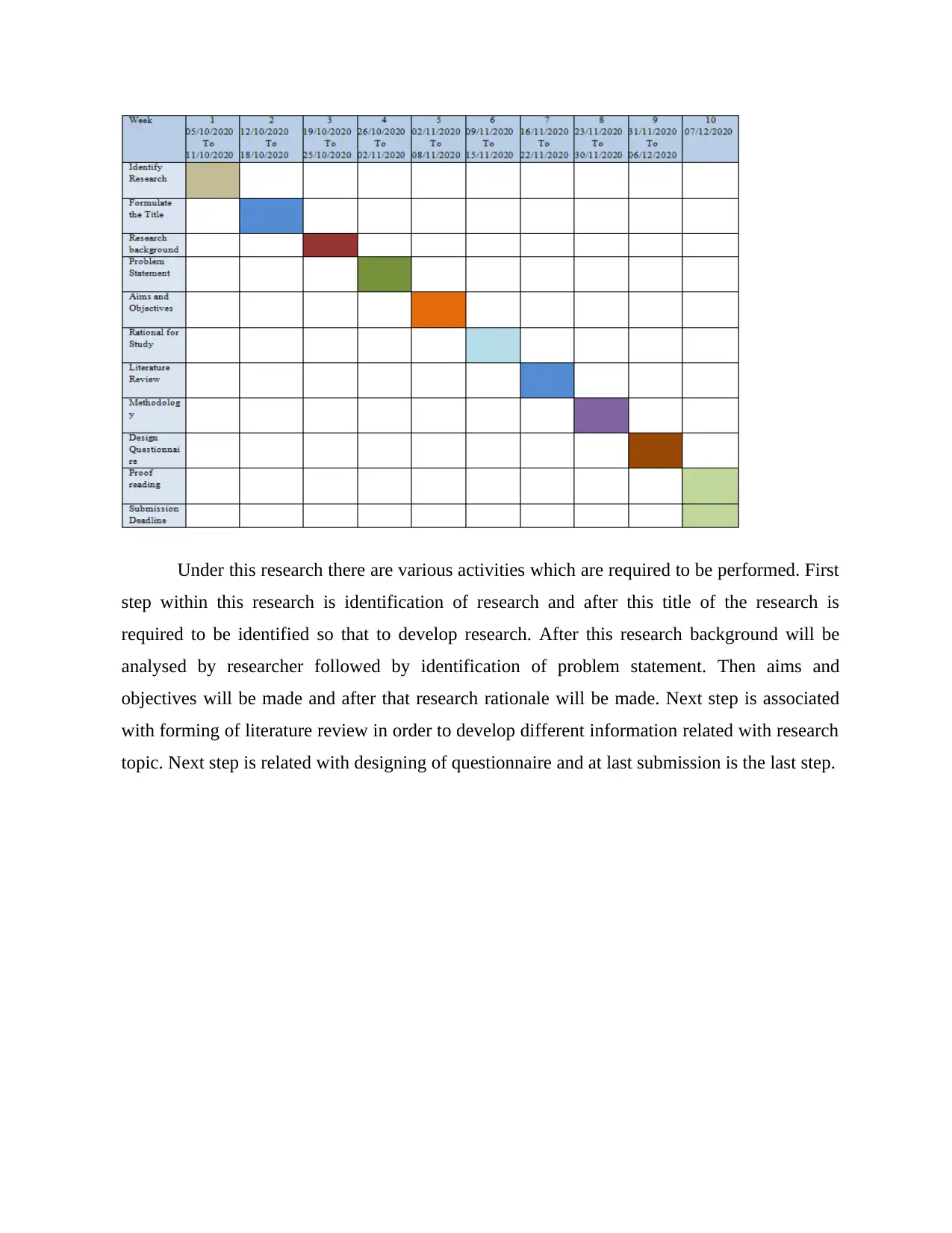
Under this research there are various activities which are required to be performed. First
step within this research is identification of research and after this title of the research is
required to be identified so that to develop research. After this research background will be
analysed by researcher followed by identification of problem statement. Then aims and
objectives will be made and after that research rationale will be made. Next step is associated
with forming of literature review in order to develop different information related with research
topic. Next step is related with designing of questionnaire and at last submission is the last step.
step within this research is identification of research and after this title of the research is
required to be identified so that to develop research. After this research background will be
analysed by researcher followed by identification of problem statement. Then aims and
objectives will be made and after that research rationale will be made. Next step is associated
with forming of literature review in order to develop different information related with research
topic. Next step is related with designing of questionnaire and at last submission is the last step.
⊘ This is a preview!⊘
Do you want full access?
Subscribe today to unlock all pages.
Trusted by 1+ million students worldwide

1 out of 15


Related Documents


Your All-in-One AI-Powered Toolkit for Academic Success.
+13062052269
info@desklib.com
Available 24*7 on WhatsApp / Email
![[object Object]](/_next/static/media/star-bottom.7253800d.svg)
Unlock your academic potential
Copyright © 2020–2026 A2Z Services. All Rights Reserved. Developed and managed by ZUCOL.