Managing Diversity: Workplace Implementation and Evaluation
VerifiedAdded on 2019/10/30
|7
|1129
|101
Report
AI Summary
This report delves into the multifaceted aspects of managing diversity within an organizational context. It begins by examining the importance of scoping workforce diversity within the industry sector, emphasizing the impact of internal factors and industry regulations on innovation and organizational capacity. The report then explores integrating diversity into workplace operations, highlighting the significance of inclusivity in fostering a positive work environment and enhancing brand reputation. Furthermore, it addresses the implementation of diversity across the workplace, emphasizing the need for tailored approaches, resource allocation, and employee training. Finally, the report concludes by discussing the crucial aspects of reviewing and evaluating diversity initiatives, stressing the importance of regular feedback and alignment with organizational goals. References to relevant academic sources are included to support the arguments presented, providing a comprehensive overview of managing diversity in the workplace.
Running Head: MANAGING DIVERSITY
Managing Diversity
Name of the Student:
Name of the University:
Author note:
Managing Diversity
Name of the Student:
Name of the University:
Author note:
Paraphrase This Document
Need a fresh take? Get an instant paraphrase of this document with our AI Paraphraser

1MANAGING DIVERSITY
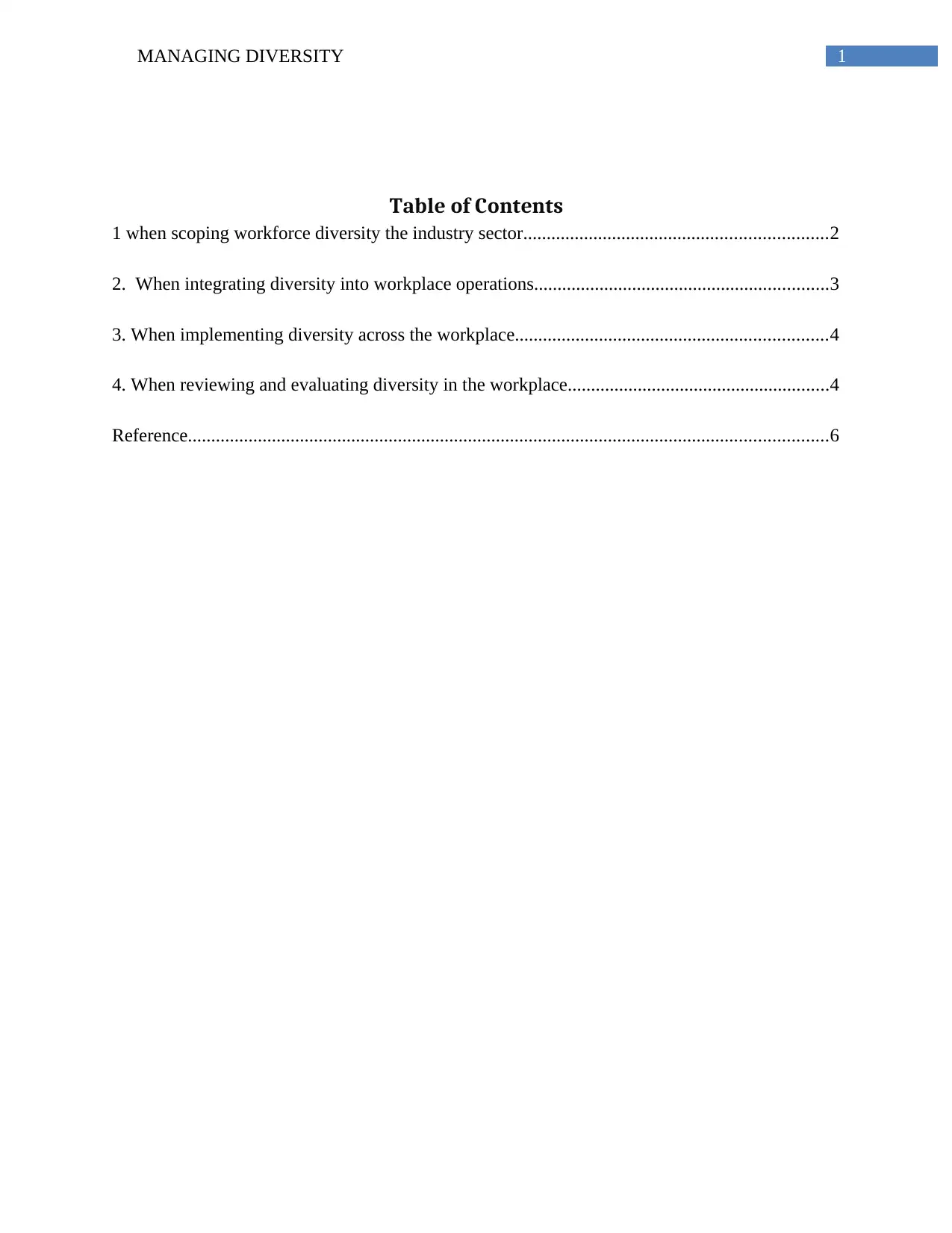
Table of Contents
1 when scoping workforce diversity the industry sector.................................................................2
2. When integrating diversity into workplace operations...............................................................3
3. When implementing diversity across the workplace...................................................................4
4. When reviewing and evaluating diversity in the workplace........................................................4
Reference.........................................................................................................................................6
Table of Contents
1 when scoping workforce diversity the industry sector.................................................................2
2. When integrating diversity into workplace operations...............................................................3
3. When implementing diversity across the workplace...................................................................4
4. When reviewing and evaluating diversity in the workplace........................................................4
Reference.........................................................................................................................................6

2MANAGING DIVERSITY
1 when scoping workforce diversity the industry sector
The nature of diversity in the company, which is an internal factor, will affect the
innovation capacity of the organisation. The industry rules of claiming diversity will also
affect the organisation. The diverse population and habitats are the main reason to justify
this policy (Oswick and Noon 2014)
Even though they may be culturally different, they may have important skills crucial for
work requirements (Chrobot-Mason, Ruderman and Nishii 2013). The quantifying of the
human resource is essential to cover all the aspects in requirement of business
distributing equally.
Key skills and experiences are certainly required in the work environment keeping in
mind about the positive work culture of different sector and industry. The diversity will
be important for increasing the opportunities and experience for overall organisational
growth as well as the growth of individual employees (Valls and Kyriakides 2013).
The internal standards and procedures are there to keep the business in the right track
with respect to legal obligations they have to meet. They are helpful in guiding people in
the best way to achieve the organisational goals as well as retain a diverse resource of
employment (Ashman 2014).
Objective of the incorporating inclusive engagement rules must be carried out with care.
This will ensure the correct and equitable division. The task division among the diverse
work culture must be divide with specific work requirements, should be shared between
the personnel with communicated objectives.
1 when scoping workforce diversity the industry sector
The nature of diversity in the company, which is an internal factor, will affect the
innovation capacity of the organisation. The industry rules of claiming diversity will also
affect the organisation. The diverse population and habitats are the main reason to justify
this policy (Oswick and Noon 2014)
Even though they may be culturally different, they may have important skills crucial for
work requirements (Chrobot-Mason, Ruderman and Nishii 2013). The quantifying of the
human resource is essential to cover all the aspects in requirement of business
distributing equally.
Key skills and experiences are certainly required in the work environment keeping in
mind about the positive work culture of different sector and industry. The diversity will
be important for increasing the opportunities and experience for overall organisational
growth as well as the growth of individual employees (Valls and Kyriakides 2013).
The internal standards and procedures are there to keep the business in the right track
with respect to legal obligations they have to meet. They are helpful in guiding people in
the best way to achieve the organisational goals as well as retain a diverse resource of
employment (Ashman 2014).
Objective of the incorporating inclusive engagement rules must be carried out with care.
This will ensure the correct and equitable division. The task division among the diverse
work culture must be divide with specific work requirements, should be shared between
the personnel with communicated objectives.
⊘ This is a preview!⊘
Do you want full access?
Subscribe today to unlock all pages.

Trusted by 1+ million students worldwide

3MANAGING DIVERSITY
2. When integrating diversity into workplace operations
With respect to scope and diversity, the review plan will encourage the employees to
smoothly transact the work practises and they will be cheered if the inclusivity is given
importance. They feel valued and this can greatly help is gaining balance in the
workplace (Arends 2014). The happy work culture can lift the brand equity and
reputation, which will lead to employees to remain in organisation rather than leaving.
Needing the diversity element in fulfilling the tasks on time are monitored for
effectiveness and integration of the standards is required in the diversity resources of the
organisation, monitoring and upgrading with the requirements are also needed in the
business enterprise (Oswick and Noon, 2014).
The identification of the reviewing process will have a positive impact and when the
standard policies are reviewed the cycle of development will follow the course. The
development will be evidence, which can be ensured by the reviewing process. The
policies needs be always aligned with the organisational mission and vision. The pre-
planned approach to the policy change will support the changes in the policy. The
purpose of this is to meet the specific requirements of the task performed guarded by this
policy (Valls and Kyriakides 2013).
Monitoring and evaluation system will serve the purpose of organisational needs in all
areas. The process of implementing the new guidelines and combining them with the
work process will be effective if they are monitored. A plan will be supportive of the
policy changes (Chrobot-Mason, Ruderma and Nishii 2013). It must be made cleared that
the requirement met to carry the tasks to their completion.
2. When integrating diversity into workplace operations
With respect to scope and diversity, the review plan will encourage the employees to
smoothly transact the work practises and they will be cheered if the inclusivity is given
importance. They feel valued and this can greatly help is gaining balance in the
workplace (Arends 2014). The happy work culture can lift the brand equity and
reputation, which will lead to employees to remain in organisation rather than leaving.
Needing the diversity element in fulfilling the tasks on time are monitored for
effectiveness and integration of the standards is required in the diversity resources of the
organisation, monitoring and upgrading with the requirements are also needed in the
business enterprise (Oswick and Noon, 2014).
The identification of the reviewing process will have a positive impact and when the
standard policies are reviewed the cycle of development will follow the course. The
development will be evidence, which can be ensured by the reviewing process. The
policies needs be always aligned with the organisational mission and vision. The pre-
planned approach to the policy change will support the changes in the policy. The
purpose of this is to meet the specific requirements of the task performed guarded by this
policy (Valls and Kyriakides 2013).
Monitoring and evaluation system will serve the purpose of organisational needs in all
areas. The process of implementing the new guidelines and combining them with the
work process will be effective if they are monitored. A plan will be supportive of the
policy changes (Chrobot-Mason, Ruderma and Nishii 2013). It must be made cleared that
the requirement met to carry the tasks to their completion.
Paraphrase This Document
Need a fresh take? Get an instant paraphrase of this document with our AI Paraphraser

4MANAGING DIVERSITY
3. When implementing diversity across the workplace
The company must be bigger than expected and the people in the managing positions
will be hard handle by some persons. The consultation with the different teams will be
easy to implement and take charge at the same time. The cost benefit analysis of the
resources in need will also be required for implementation (Arends 2014).
Implementing the new process and diversity incorporation will also need time, money
and standard practises evolving system(Thomas 2012).
Because supporting the individuals will need, ensured specific needs accommodation.
The diversity practises accommodation will need for development and can accurately
initialise the new work process (Thomas 2012).
Because the skill enhancement will need proper training for the employees, this part is
needed for the part. It will give clear information in the socioeconomic and culture
awareness, skills and knowledge to apply in various situations. Coaching method may
be applied to the direct staff and serious instruction must be given to the personnel
(Oswick and Noon 2014).
The employees will behave if they watch that the seniors in the inclusive behaviours
regarding the diversity implementation, the probable atmosphere will set it in motion.
4. When reviewing and evaluating diversity in the workplace
The regular reviews and feedbacks from the employees will help in the everyday process
and inclusion in the standard process will help the organisational developments.
This process will ensure the follow-up measures that may be the needs people. Obtaining
feedback will help in determining the actions that need to be taken based on the feedback.
3. When implementing diversity across the workplace
The company must be bigger than expected and the people in the managing positions
will be hard handle by some persons. The consultation with the different teams will be
easy to implement and take charge at the same time. The cost benefit analysis of the
resources in need will also be required for implementation (Arends 2014).
Implementing the new process and diversity incorporation will also need time, money
and standard practises evolving system(Thomas 2012).
Because supporting the individuals will need, ensured specific needs accommodation.
The diversity practises accommodation will need for development and can accurately
initialise the new work process (Thomas 2012).
Because the skill enhancement will need proper training for the employees, this part is
needed for the part. It will give clear information in the socioeconomic and culture
awareness, skills and knowledge to apply in various situations. Coaching method may
be applied to the direct staff and serious instruction must be given to the personnel
(Oswick and Noon 2014).
The employees will behave if they watch that the seniors in the inclusive behaviours
regarding the diversity implementation, the probable atmosphere will set it in motion.
4. When reviewing and evaluating diversity in the workplace
The regular reviews and feedbacks from the employees will help in the everyday process
and inclusion in the standard process will help the organisational developments.
This process will ensure the follow-up measures that may be the needs people. Obtaining
feedback will help in determining the actions that need to be taken based on the feedback.

5MANAGING DIVERSITY
The value of the organisation will help in achieving the organisations goals and
objectives. The organisation is liable to make diversity in culture and thus making the
important for the workplace to change. The equality and diversity must be valued
(Arends 2014).
The value of the organisation will help in achieving the organisations goals and
objectives. The organisation is liable to make diversity in culture and thus making the
important for the workplace to change. The equality and diversity must be valued
(Arends 2014).
⊘ This is a preview!⊘
Do you want full access?
Subscribe today to unlock all pages.

Trusted by 1+ million students worldwide

6MANAGING DIVERSITY
Reference
Arends, R., 2014. Learning to teach. McGraw-Hill Higher Education.
Ashman, A., 2014. Education for inclusion and diversity. Pearson Australia.
Chrobot-Mason, D., Ruderman, M.N. and Nishii, L.H., 2013. Leadership in a diverse workplace.
In The Oxford handbook of diversity and work.
Oswick, C. and Noon, M., 2014. Discourses of diversity, equality and inclusion: trenchant
formulations or transient fashions?. British Journal of Management, 25(1), pp.23-39.
Thomas, K.M. ed., 2012. Diversity resistance in organizations. Psychology Press.
Valls, R. and Kyriakides, L., 2013. The power of Interactive Groups: how diversity of adults
volunteering in classroom groups can promote inclusion and success for children of vulnerable
minority ethnic populations. Cambridge Journal of Education, 43(1), pp.17-33.
Reference
Arends, R., 2014. Learning to teach. McGraw-Hill Higher Education.
Ashman, A., 2014. Education for inclusion and diversity. Pearson Australia.
Chrobot-Mason, D., Ruderman, M.N. and Nishii, L.H., 2013. Leadership in a diverse workplace.
In The Oxford handbook of diversity and work.
Oswick, C. and Noon, M., 2014. Discourses of diversity, equality and inclusion: trenchant
formulations or transient fashions?. British Journal of Management, 25(1), pp.23-39.
Thomas, K.M. ed., 2012. Diversity resistance in organizations. Psychology Press.
Valls, R. and Kyriakides, L., 2013. The power of Interactive Groups: how diversity of adults
volunteering in classroom groups can promote inclusion and success for children of vulnerable
minority ethnic populations. Cambridge Journal of Education, 43(1), pp.17-33.
1 out of 7
Related Documents
Your All-in-One AI-Powered Toolkit for Academic Success.
+13062052269
info@desklib.com
Available 24*7 on WhatsApp / Email
Unlock your academic potential
Copyright © 2020–2026 A2Z Services. All Rights Reserved. Developed and managed by ZUCOL.