Workplace Law Assignment: Case Study on Employee vs. Contractor
VerifiedAdded on 2020/03/01
|11
|2056
|221
Report
AI Summary
This report analyzes a workplace law case study involving Davy and ABC company. The assignment addresses three key legal issues: determining whether Davy is an employee or an independent contractor, assessing whether ABC breached the Fair Work Act by requiring Davy to contract with DEF, and determining ABC's obligation to provide Davy with a termination notice. The report applies the multi-factor test to classify Davy's employment status, examines sham contracting provisions under the Fair Work Act, and evaluates ABC's compliance with national employment standards regarding termination and redundancy pay. The analysis draws upon relevant legislation, case law, and legal principles to provide a comprehensive understanding of the legal issues presented in the case study. The report concludes that Davy is considered an employee, ABC breached the Fair Work Act, and ABC was obligated to provide Davy with a termination notice and redundancy pay.


Paraphrase This Document
Need a fresh take? Get an instant paraphrase of this document with our AI Paraphraser
WORKPLACE LAW 2
Contents
Question 1........................................................................................................................................3
The Legal Issue............................................................................................................................3
The Relevant Law........................................................................................................................3
Application of the Law to the Facts.............................................................................................4
Conclusion...................................................................................................................................5
Question 2........................................................................................................................................5
The Legal Issue............................................................................................................................5
The Relevant Law........................................................................................................................5
Application of the Law to the Facts.............................................................................................6
Conclusion...................................................................................................................................7
Question 3........................................................................................................................................7
The Legal Issue............................................................................................................................7
The Relevant Law........................................................................................................................7
Application of the Law to the Facts.............................................................................................8
Conclusion...................................................................................................................................9
References......................................................................................................................................10
Contents
Question 1........................................................................................................................................3
The Legal Issue............................................................................................................................3
The Relevant Law........................................................................................................................3
Application of the Law to the Facts.............................................................................................4
Conclusion...................................................................................................................................5
Question 2........................................................................................................................................5
The Legal Issue............................................................................................................................5
The Relevant Law........................................................................................................................5
Application of the Law to the Facts.............................................................................................6
Conclusion...................................................................................................................................7
Question 3........................................................................................................................................7
The Legal Issue............................................................................................................................7
The Relevant Law........................................................................................................................7
Application of the Law to the Facts.............................................................................................8
Conclusion...................................................................................................................................9
References......................................................................................................................................10
WORKPLACE LAW 3
Question 1
The Legal Issue
Whether Davy would be considered as an employee of ABC, or not?
The Relevant Law
There is a difference when it comes to an independent contractor and an employee and
the people who fall under each of these categories, have different rights and liabilities. A contract
of service or an employment contract is entered into for creating a relation between employer-
employee and this governs the relationship between the employer and their employee (Murray
2016).
In order to determine the working relationship, earlier the control test and the integration
tests were used, but these two tests have been merged with the multi factor test. The multi factor
test which was initially introduced in the matter of Stevens v Brodribb Sawmilling Co Pty Ltd
[1986] HCA 1. This test was affirmed later on in the matter of Hollis v Vabu Pty Limited (2001)
207 CLR 21 and is commonly used since then. This test dictates that different factors have to be
taken into consideration, depending upon the circumstances present, to denote if an employer
employee relationship is indeed present (Find Law 2017).
So, in this regard, the wearing of uniform, the word hours, the providing of equipments
and machinery, the paid holidays, the tax benefits, and different other factors are taken into
consideration. Some of the differences between the two include that the work of the independent
contractor can be delegated; though, the work of the employee cannot be. Also, the employer is
Question 1
The Legal Issue
Whether Davy would be considered as an employee of ABC, or not?
The Relevant Law
There is a difference when it comes to an independent contractor and an employee and
the people who fall under each of these categories, have different rights and liabilities. A contract
of service or an employment contract is entered into for creating a relation between employer-
employee and this governs the relationship between the employer and their employee (Murray
2016).
In order to determine the working relationship, earlier the control test and the integration
tests were used, but these two tests have been merged with the multi factor test. The multi factor
test which was initially introduced in the matter of Stevens v Brodribb Sawmilling Co Pty Ltd
[1986] HCA 1. This test was affirmed later on in the matter of Hollis v Vabu Pty Limited (2001)
207 CLR 21 and is commonly used since then. This test dictates that different factors have to be
taken into consideration, depending upon the circumstances present, to denote if an employer
employee relationship is indeed present (Find Law 2017).
So, in this regard, the wearing of uniform, the word hours, the providing of equipments
and machinery, the paid holidays, the tax benefits, and different other factors are taken into
consideration. Some of the differences between the two include that the work of the independent
contractor can be delegated; though, the work of the employee cannot be. Also, the employer is
⊘ This is a preview!⊘
Do you want full access?
Subscribe today to unlock all pages.

Trusted by 1+ million students worldwide
WORKPLACE LAW 4
liable for the acts of the employee due to the concept of vicarious liability. The working hours of
an independent contractor cannot be regulated by the employer, but the same can be done for the
employee.
In order to make a decision regarding a person being an employee and a person being an
independent contractor, the control over the employee is to be seen as was given through the case
of Zuijs v Wirth Brothers Pty Ltd [1955] HCA 73. As per this case, the degree to which a person
can be controlled would denote the status and in this regard, the actual control over the
individual is irrelevant. Wearing uniforms was deemed as the presence of employer employee
relationship in the case of Humberstone v Northern Timber Mills (1949) 79 CLR 389 (Marshall
2006).
So, all the possible situations revolving around the employment have to be considered. It
has also been stated under this test that a single list or criteria cannot determine this status and so,
different aspects had to be evaluated. Hollis v Vabu Pty Limited saw the employer was held
vicariously liable for the bicycle courier, who was considered as an employee, due to factors like
being provided the bicycle by company, being paid on a flat fall for each delivery and for
wearing the uniform, along with having strict start timings (Bogg and Freedland 2013, 283).
Application of the Law to the Facts
In order to determine the status of Davy, the multi factor test discussed above would have
to be applied. ABC had the control over Davy as he did whatever was asked by them. He even
signed the letter just because he was asked to do so, which showed the control of ABC over
Davy. Davy was integrated properly in the business of ABC as he wore the uniform provided by
liable for the acts of the employee due to the concept of vicarious liability. The working hours of
an independent contractor cannot be regulated by the employer, but the same can be done for the
employee.
In order to make a decision regarding a person being an employee and a person being an
independent contractor, the control over the employee is to be seen as was given through the case
of Zuijs v Wirth Brothers Pty Ltd [1955] HCA 73. As per this case, the degree to which a person
can be controlled would denote the status and in this regard, the actual control over the
individual is irrelevant. Wearing uniforms was deemed as the presence of employer employee
relationship in the case of Humberstone v Northern Timber Mills (1949) 79 CLR 389 (Marshall
2006).
So, all the possible situations revolving around the employment have to be considered. It
has also been stated under this test that a single list or criteria cannot determine this status and so,
different aspects had to be evaluated. Hollis v Vabu Pty Limited saw the employer was held
vicariously liable for the bicycle courier, who was considered as an employee, due to factors like
being provided the bicycle by company, being paid on a flat fall for each delivery and for
wearing the uniform, along with having strict start timings (Bogg and Freedland 2013, 283).
Application of the Law to the Facts
In order to determine the status of Davy, the multi factor test discussed above would have
to be applied. ABC had the control over Davy as he did whatever was asked by them. He even
signed the letter just because he was asked to do so, which showed the control of ABC over
Davy. Davy was integrated properly in the business of ABC as he wore the uniform provided by
Paraphrase This Document
Need a fresh take? Get an instant paraphrase of this document with our AI Paraphraser
WORKPLACE LAW 5
them. And on the basis of Humberstone v Northern Timber Mills, this would make him an
employee of the company.
Davy was an employee, who was expressly told to sign a letter to make him the
subcontractor. This shows control of the company over Davy which would make him an
employee. ABC used his work allocations and provided him with the requisite equipments and
cleaning materials, which would again make him an employee of the company. Wearing the
company uniform, based on the wishes of Davy could be taken both ways; but as he wore the
uniform daily, he would be considered as an employee of the company, as he was representing
the company by wearing the uniform. Davy drove the company vehicle and the mobile supplied
by the company. This again shows that he was an employee of the company.
Conclusion
To conclude, on the basis of multi factor test, Davy would be considered as an employee
of ABC.
Question 2
The Legal Issue
Whether ABC has breached the Fair Work Act by requiring Davy to contract to DEF, or
not?
The Relevant Law
The Fair Work Act, 2009 (Cth) prohibits the employers from representing their
relationship in a wrong manner by indulging in sham contracting (Fair Work Ombudsman
them. And on the basis of Humberstone v Northern Timber Mills, this would make him an
employee of the company.
Davy was an employee, who was expressly told to sign a letter to make him the
subcontractor. This shows control of the company over Davy which would make him an
employee. ABC used his work allocations and provided him with the requisite equipments and
cleaning materials, which would again make him an employee of the company. Wearing the
company uniform, based on the wishes of Davy could be taken both ways; but as he wore the
uniform daily, he would be considered as an employee of the company, as he was representing
the company by wearing the uniform. Davy drove the company vehicle and the mobile supplied
by the company. This again shows that he was an employee of the company.
Conclusion
To conclude, on the basis of multi factor test, Davy would be considered as an employee
of ABC.
Question 2
The Legal Issue
Whether ABC has breached the Fair Work Act by requiring Davy to contract to DEF, or
not?
The Relevant Law
The Fair Work Act, 2009 (Cth) prohibits the employers from representing their
relationship in a wrong manner by indulging in sham contracting (Fair Work Ombudsman
WORKPLACE LAW 6
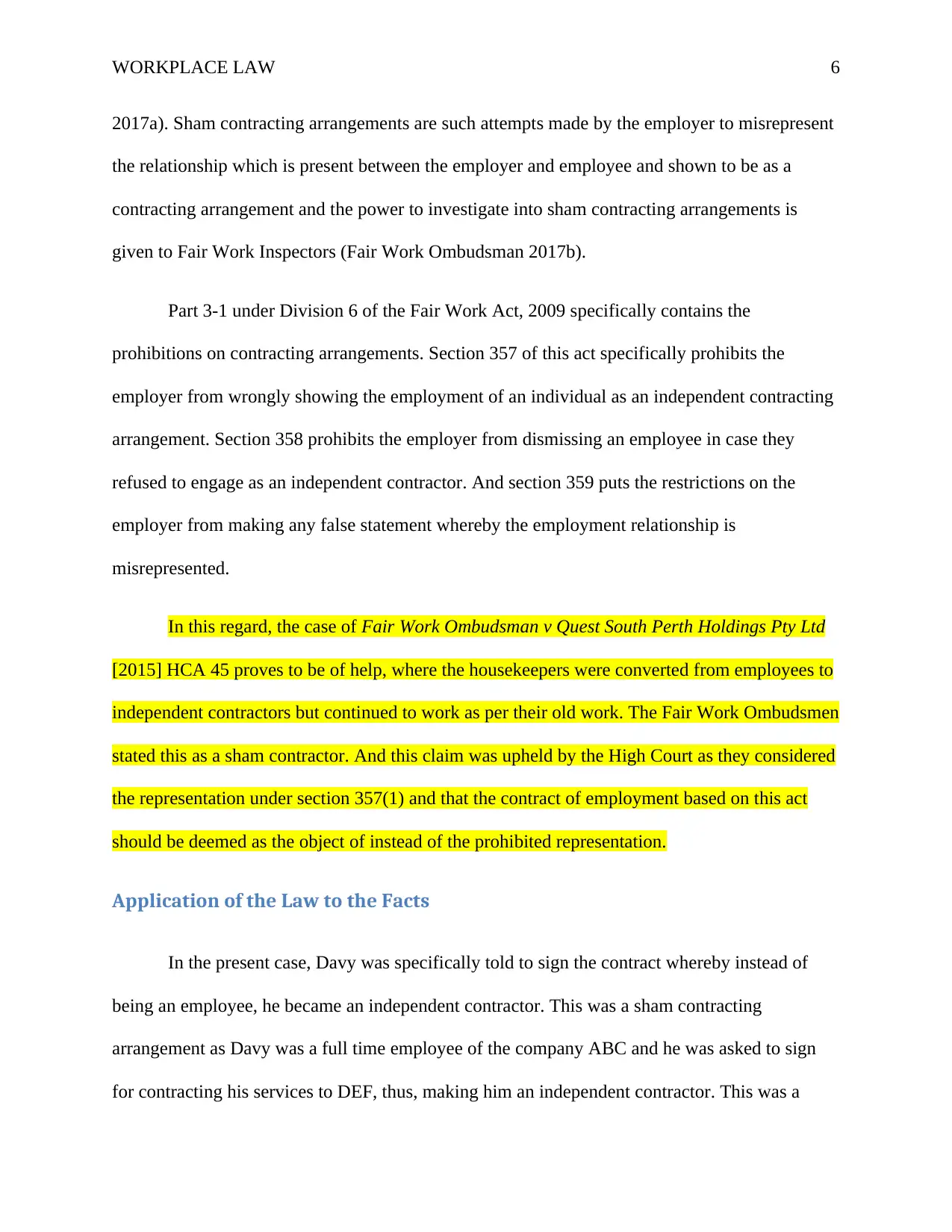
2017a). Sham contracting arrangements are such attempts made by the employer to misrepresent
the relationship which is present between the employer and employee and shown to be as a
contracting arrangement and the power to investigate into sham contracting arrangements is
given to Fair Work Inspectors (Fair Work Ombudsman 2017b).
Part 3-1 under Division 6 of the Fair Work Act, 2009 specifically contains the
prohibitions on contracting arrangements. Section 357 of this act specifically prohibits the
employer from wrongly showing the employment of an individual as an independent contracting
arrangement. Section 358 prohibits the employer from dismissing an employee in case they
refused to engage as an independent contractor. And section 359 puts the restrictions on the
employer from making any false statement whereby the employment relationship is
misrepresented.
In this regard, the case of Fair Work Ombudsman v Quest South Perth Holdings Pty Ltd
[2015] HCA 45 proves to be of help, where the housekeepers were converted from employees to
independent contractors but continued to work as per their old work. The Fair Work Ombudsmen
stated this as a sham contractor. And this claim was upheld by the High Court as they considered
the representation under section 357(1) and that the contract of employment based on this act
should be deemed as the object of instead of the prohibited representation.
Application of the Law to the Facts
In the present case, Davy was specifically told to sign the contract whereby instead of
being an employee, he became an independent contractor. This was a sham contracting
arrangement as Davy was a full time employee of the company ABC and he was asked to sign
for contracting his services to DEF, thus, making him an independent contractor. This was a
2017a). Sham contracting arrangements are such attempts made by the employer to misrepresent
the relationship which is present between the employer and employee and shown to be as a
contracting arrangement and the power to investigate into sham contracting arrangements is
given to Fair Work Inspectors (Fair Work Ombudsman 2017b).
Part 3-1 under Division 6 of the Fair Work Act, 2009 specifically contains the
prohibitions on contracting arrangements. Section 357 of this act specifically prohibits the
employer from wrongly showing the employment of an individual as an independent contracting
arrangement. Section 358 prohibits the employer from dismissing an employee in case they
refused to engage as an independent contractor. And section 359 puts the restrictions on the
employer from making any false statement whereby the employment relationship is
misrepresented.
In this regard, the case of Fair Work Ombudsman v Quest South Perth Holdings Pty Ltd
[2015] HCA 45 proves to be of help, where the housekeepers were converted from employees to
independent contractors but continued to work as per their old work. The Fair Work Ombudsmen
stated this as a sham contractor. And this claim was upheld by the High Court as they considered
the representation under section 357(1) and that the contract of employment based on this act
should be deemed as the object of instead of the prohibited representation.
Application of the Law to the Facts
In the present case, Davy was specifically told to sign the contract whereby instead of
being an employee, he became an independent contractor. This was a sham contracting
arrangement as Davy was a full time employee of the company ABC and he was asked to sign
for contracting his services to DEF, thus, making him an independent contractor. This was a
⊘ This is a preview!⊘
Do you want full access?
Subscribe today to unlock all pages.
Trusted by 1+ million students worldwide
WORKPLACE LAW 7
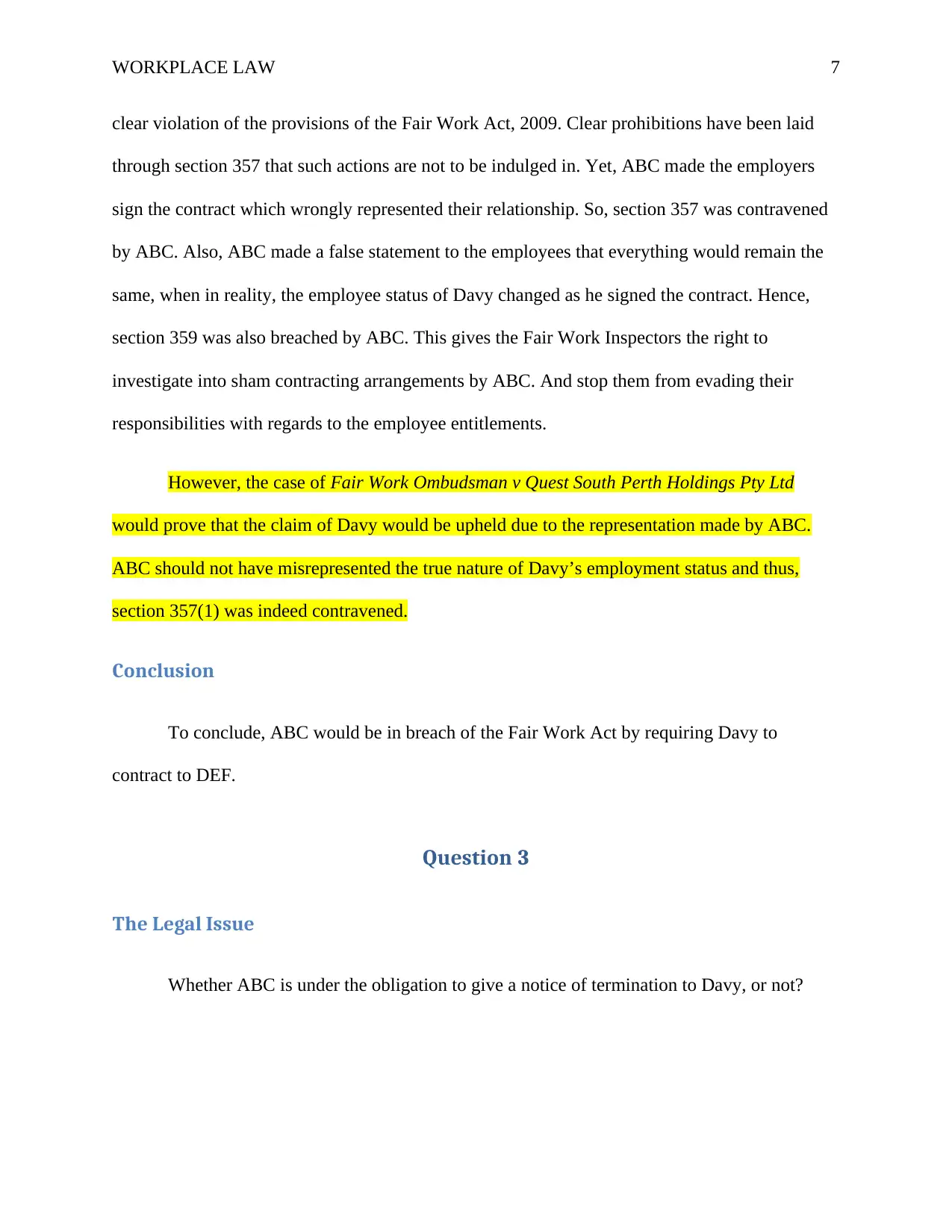
clear violation of the provisions of the Fair Work Act, 2009. Clear prohibitions have been laid
through section 357 that such actions are not to be indulged in. Yet, ABC made the employers
sign the contract which wrongly represented their relationship. So, section 357 was contravened
by ABC. Also, ABC made a false statement to the employees that everything would remain the
same, when in reality, the employee status of Davy changed as he signed the contract. Hence,
section 359 was also breached by ABC. This gives the Fair Work Inspectors the right to
investigate into sham contracting arrangements by ABC. And stop them from evading their
responsibilities with regards to the employee entitlements.
However, the case of Fair Work Ombudsman v Quest South Perth Holdings Pty Ltd
would prove that the claim of Davy would be upheld due to the representation made by ABC.
ABC should not have misrepresented the true nature of Davy’s employment status and thus,
section 357(1) was indeed contravened.
Conclusion
To conclude, ABC would be in breach of the Fair Work Act by requiring Davy to
contract to DEF.
Question 3
The Legal Issue
Whether ABC is under the obligation to give a notice of termination to Davy, or not?
clear violation of the provisions of the Fair Work Act, 2009. Clear prohibitions have been laid
through section 357 that such actions are not to be indulged in. Yet, ABC made the employers
sign the contract which wrongly represented their relationship. So, section 357 was contravened
by ABC. Also, ABC made a false statement to the employees that everything would remain the
same, when in reality, the employee status of Davy changed as he signed the contract. Hence,
section 359 was also breached by ABC. This gives the Fair Work Inspectors the right to
investigate into sham contracting arrangements by ABC. And stop them from evading their
responsibilities with regards to the employee entitlements.
However, the case of Fair Work Ombudsman v Quest South Perth Holdings Pty Ltd
would prove that the claim of Davy would be upheld due to the representation made by ABC.
ABC should not have misrepresented the true nature of Davy’s employment status and thus,
section 357(1) was indeed contravened.
Conclusion
To conclude, ABC would be in breach of the Fair Work Act by requiring Davy to
contract to DEF.
Question 3
The Legal Issue
Whether ABC is under the obligation to give a notice of termination to Davy, or not?
Paraphrase This Document
Need a fresh take? Get an instant paraphrase of this document with our AI Paraphraser
WORKPLACE LAW 8
The Relevant Law
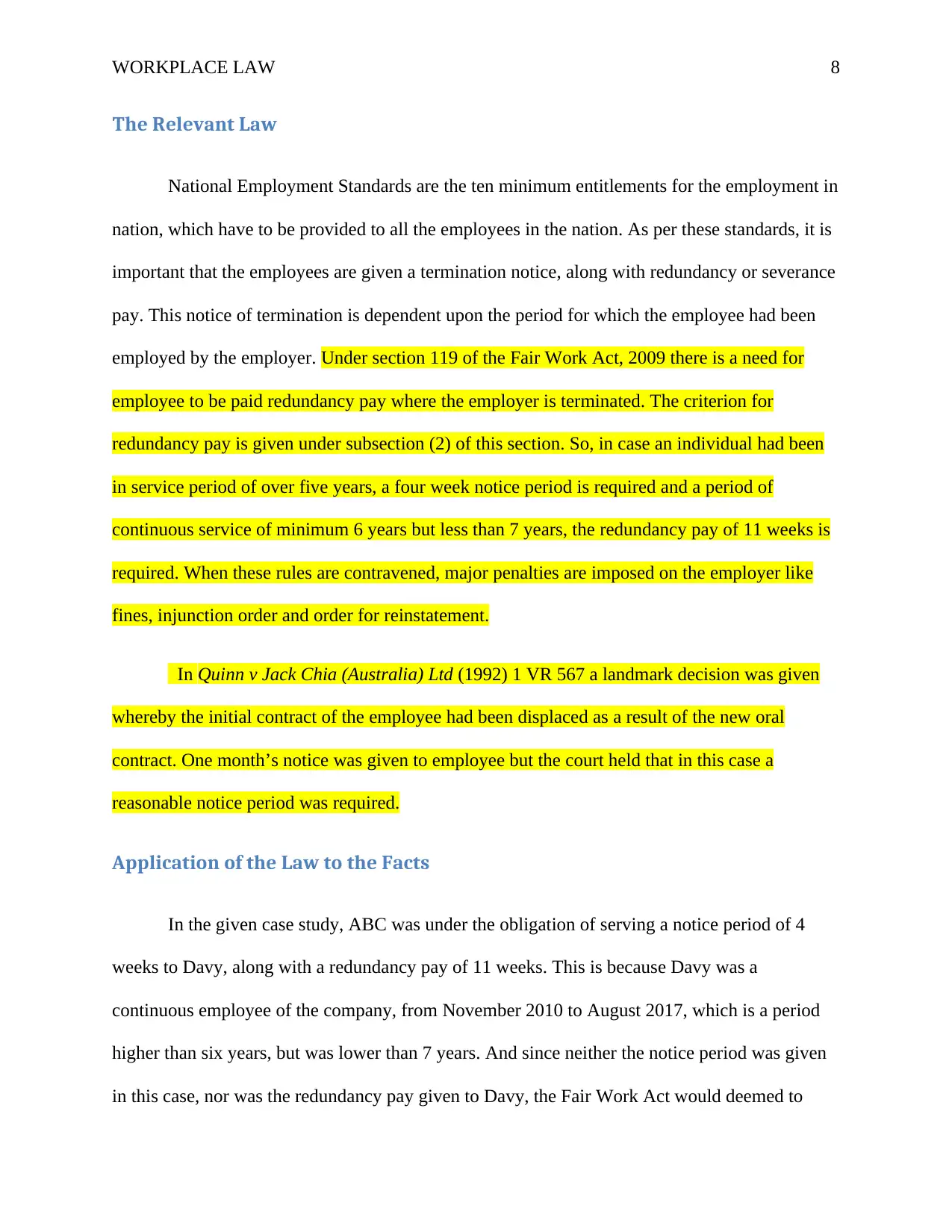
National Employment Standards are the ten minimum entitlements for the employment in
nation, which have to be provided to all the employees in the nation. As per these standards, it is
important that the employees are given a termination notice, along with redundancy or severance
pay. This notice of termination is dependent upon the period for which the employee had been
employed by the employer. Under section 119 of the Fair Work Act, 2009 there is a need for
employee to be paid redundancy pay where the employer is terminated. The criterion for
redundancy pay is given under subsection (2) of this section. So, in case an individual had been
in service period of over five years, a four week notice period is required and a period of
continuous service of minimum 6 years but less than 7 years, the redundancy pay of 11 weeks is
required. When these rules are contravened, major penalties are imposed on the employer like
fines, injunction order and order for reinstatement.
In Quinn v Jack Chia (Australia) Ltd (1992) 1 VR 567 a landmark decision was given
whereby the initial contract of the employee had been displaced as a result of the new oral
contract. One month’s notice was given to employee but the court held that in this case a
reasonable notice period was required.
Application of the Law to the Facts
In the given case study, ABC was under the obligation of serving a notice period of 4
weeks to Davy, along with a redundancy pay of 11 weeks. This is because Davy was a
continuous employee of the company, from November 2010 to August 2017, which is a period
higher than six years, but was lower than 7 years. And since neither the notice period was given
in this case, nor was the redundancy pay given to Davy, the Fair Work Act would deemed to
The Relevant Law
National Employment Standards are the ten minimum entitlements for the employment in
nation, which have to be provided to all the employees in the nation. As per these standards, it is
important that the employees are given a termination notice, along with redundancy or severance
pay. This notice of termination is dependent upon the period for which the employee had been
employed by the employer. Under section 119 of the Fair Work Act, 2009 there is a need for
employee to be paid redundancy pay where the employer is terminated. The criterion for
redundancy pay is given under subsection (2) of this section. So, in case an individual had been
in service period of over five years, a four week notice period is required and a period of
continuous service of minimum 6 years but less than 7 years, the redundancy pay of 11 weeks is
required. When these rules are contravened, major penalties are imposed on the employer like
fines, injunction order and order for reinstatement.
In Quinn v Jack Chia (Australia) Ltd (1992) 1 VR 567 a landmark decision was given
whereby the initial contract of the employee had been displaced as a result of the new oral
contract. One month’s notice was given to employee but the court held that in this case a
reasonable notice period was required.
Application of the Law to the Facts
In the given case study, ABC was under the obligation of serving a notice period of 4
weeks to Davy, along with a redundancy pay of 11 weeks. This is because Davy was a
continuous employee of the company, from November 2010 to August 2017, which is a period
higher than six years, but was lower than 7 years. And since neither the notice period was given
in this case, nor was the redundancy pay given to Davy, the Fair Work Act would deemed to
WORKPLACE LAW 9
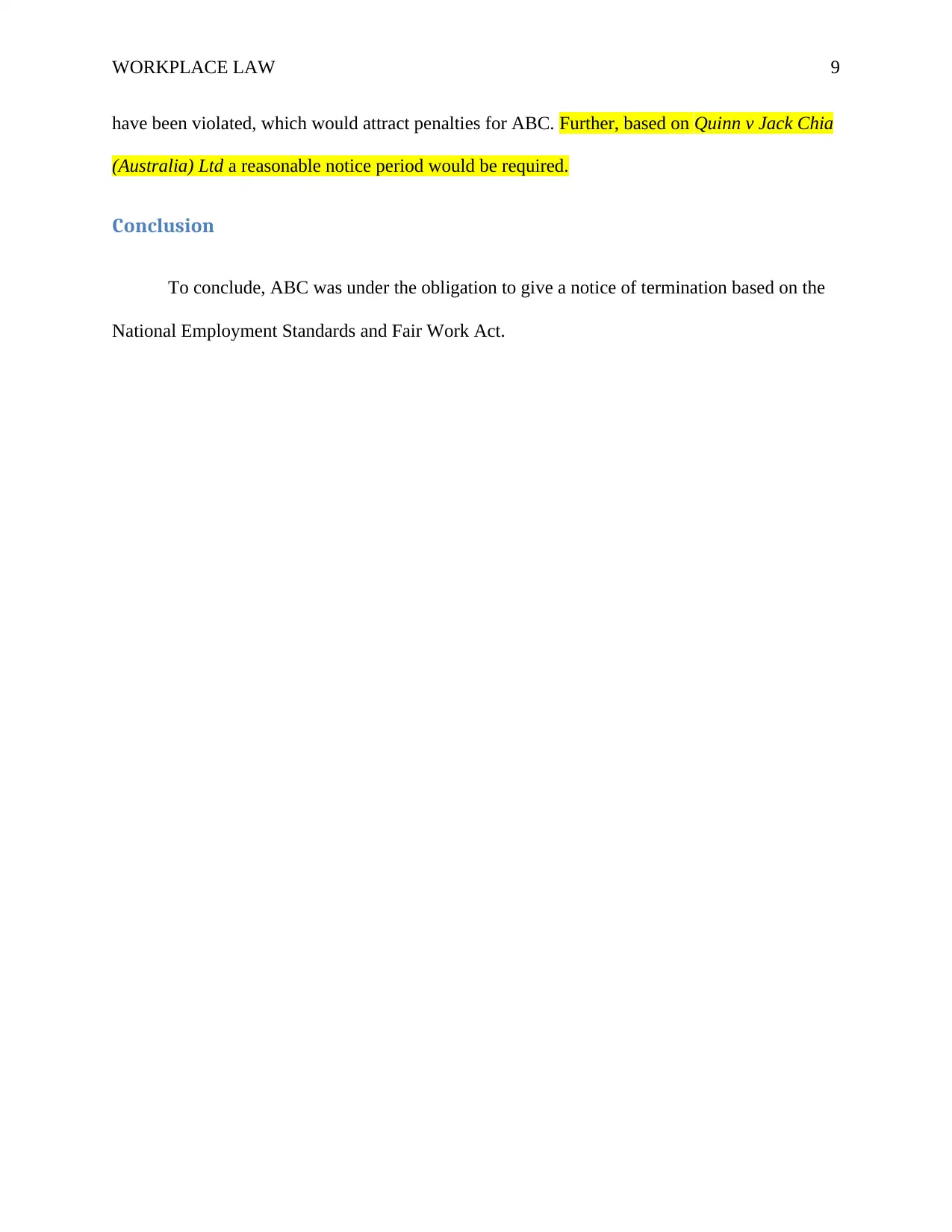
have been violated, which would attract penalties for ABC. Further, based on Quinn v Jack Chia
(Australia) Ltd a reasonable notice period would be required.
Conclusion
To conclude, ABC was under the obligation to give a notice of termination based on the
National Employment Standards and Fair Work Act.
have been violated, which would attract penalties for ABC. Further, based on Quinn v Jack Chia
(Australia) Ltd a reasonable notice period would be required.
Conclusion
To conclude, ABC was under the obligation to give a notice of termination based on the
National Employment Standards and Fair Work Act.
⊘ This is a preview!⊘
Do you want full access?
Subscribe today to unlock all pages.
Trusted by 1+ million students worldwide
WORKPLACE LAW 10
References
Australian Workplace Lawyers. 2017. Minimum terms and conditions of employment.
http://www.workplace-lawyers.com.au/employees/minimum-terms-and-conditions/
Bogg, Alan and Freedland, Mark. 2016. The Contract of Employment. Oxford: Oxford
University Press.
Fair Work Ombudsman. 2014. Workers’ Rights A guide for employees.
http://www.lsc.sa.gov.au/resources/Workers_Rights_Booklet_0614.pdf
Fair Work Ombudsman. 2017a. Independent contractors. https://www.fairwork.gov.au/find-
help-for/independent-contractors
Find Law. 2017. What is an independent contractor and how does an independent contractor
differ from an employee? http://www.findlaw.com.au/articles/4515/what-is-an-
independent-contractor-and-how-does-an-.aspx
Hollis v Vabu Pty Limited. 2001. 207 CLR 21.
Humberstone v Northern Timber Mills. 1949. 79 CLR 389.
Marshall, Brenda. 2006. “Working it out- Employee or independent contractor?” The National
Legal Eagle, 12(2): 14-19.
Murray, Jean. 2016. Difference between Independent Contractor and Employee.
https://www.thebalance.com/independent-contractor-or-employee-what-s-the-difference-
397912
References
Australian Workplace Lawyers. 2017. Minimum terms and conditions of employment.
http://www.workplace-lawyers.com.au/employees/minimum-terms-and-conditions/
Bogg, Alan and Freedland, Mark. 2016. The Contract of Employment. Oxford: Oxford
University Press.
Fair Work Ombudsman. 2014. Workers’ Rights A guide for employees.
http://www.lsc.sa.gov.au/resources/Workers_Rights_Booklet_0614.pdf
Fair Work Ombudsman. 2017a. Independent contractors. https://www.fairwork.gov.au/find-
help-for/independent-contractors
Find Law. 2017. What is an independent contractor and how does an independent contractor
differ from an employee? http://www.findlaw.com.au/articles/4515/what-is-an-
independent-contractor-and-how-does-an-.aspx
Hollis v Vabu Pty Limited. 2001. 207 CLR 21.
Humberstone v Northern Timber Mills. 1949. 79 CLR 389.
Marshall, Brenda. 2006. “Working it out- Employee or independent contractor?” The National
Legal Eagle, 12(2): 14-19.
Murray, Jean. 2016. Difference between Independent Contractor and Employee.
https://www.thebalance.com/independent-contractor-or-employee-what-s-the-difference-
397912
Paraphrase This Document
Need a fresh take? Get an instant paraphrase of this document with our AI Paraphraser

WORKPLACE LAW 11

1 out of 11


Related Documents


Your All-in-One AI-Powered Toolkit for Academic Success.
+13062052269
info@desklib.com
Available 24*7 on WhatsApp / Email
![[object Object]](/_next/static/media/star-bottom.7253800d.svg)
Unlock your academic potential
Copyright © 2020–2026 A2Z Services. All Rights Reserved. Developed and managed by ZUCOL.