Analyzing Informal Workplace Learning: Promoting Factors and Benefits
VerifiedAdded on 2023/06/04
|14
|4648
|231
Report
AI Summary
This report provides a comprehensive analysis of informal workplace learning, emphasizing its significance in achieving organizational goals. It explores how employees acquire skills through participation, observation, and trial and error, highlighting the communities of practice theory and various informal learning methods such as learning by doing, coaching, appraisals, job rotation, and work shadowing. The report identifies factors promoting informal learning, including leadership, open communication, innovation culture, and job competition, while also addressing constraints like limited career opportunities, negative organizational culture, time constraints, and limited financial resources. Furthermore, it examines the influence of personality traits on learning effectiveness, particularly through the trait theory and the OCEAN model. The report concludes by outlining the benefits of enhancing informal workplace learning for both individuals and the organization and offering recommendations for promoting a conducive learning environment. Desklib offers more resources for students seeking solved assignments and study materials.

Running head: INFORMAL WORKPLACE LEARNING 1
Informal learning
Student Name
Institution
Informal learning
Student Name
Institution

Paraphrase This Document
Need a fresh take? Get an instant paraphrase of this document with our AI Paraphraser
INFORMAL WORKPLACE LEARNING 2
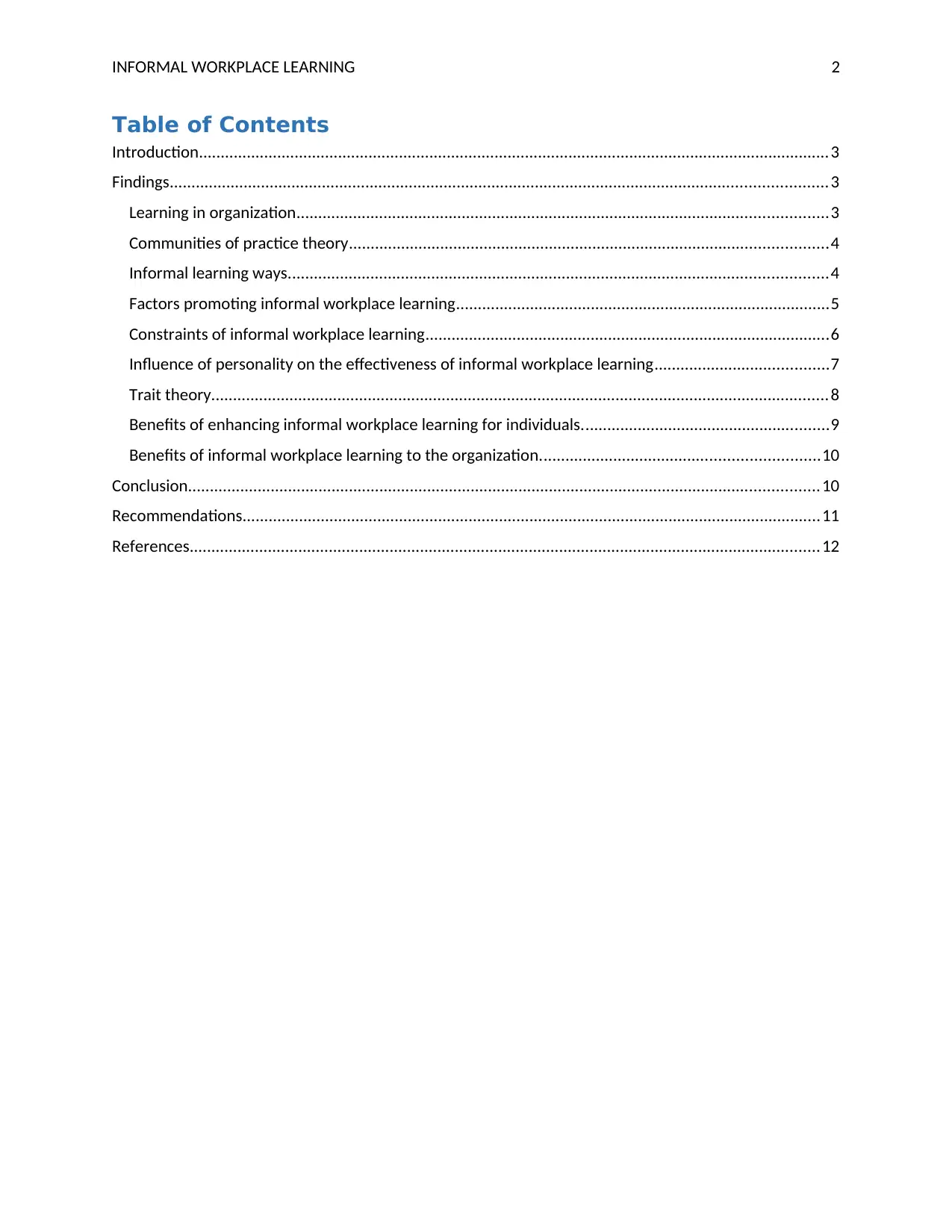
Table of Contents
Introduction.................................................................................................................................................3
Findings.......................................................................................................................................................3
Learning in organization..........................................................................................................................3
Communities of practice theory..............................................................................................................4
Informal learning ways............................................................................................................................4
Factors promoting informal workplace learning......................................................................................5
Constraints of informal workplace learning.............................................................................................6
Influence of personality on the effectiveness of informal workplace learning........................................7
Trait theory..............................................................................................................................................8
Benefits of enhancing informal workplace learning for individuals.........................................................9
Benefits of informal workplace learning to the organization................................................................10
Conclusion.................................................................................................................................................10
Recommendations.....................................................................................................................................11
References.................................................................................................................................................12
Table of Contents
Introduction.................................................................................................................................................3
Findings.......................................................................................................................................................3
Learning in organization..........................................................................................................................3
Communities of practice theory..............................................................................................................4
Informal learning ways............................................................................................................................4
Factors promoting informal workplace learning......................................................................................5
Constraints of informal workplace learning.............................................................................................6
Influence of personality on the effectiveness of informal workplace learning........................................7
Trait theory..............................................................................................................................................8
Benefits of enhancing informal workplace learning for individuals.........................................................9
Benefits of informal workplace learning to the organization................................................................10
Conclusion.................................................................................................................................................10
Recommendations.....................................................................................................................................11
References.................................................................................................................................................12
INFORMAL WORKPLACE LEARNING 3
Introduction
Organizations have set goals and objectives which must be attained if the organization wants to
succeed. To achieve the goals the employees must embrace continuous learning so as to gain the skills
and knowledge required to accomplish the assigned tasks (Fullan, 2012). Individuals can learn in various
ways such as formal learning, informal learning and incidental learning in the organization. Informal
learning entails individuals gaining knowledge through participation, observation and through trial and
error. The employee does not need to undergo only formal learning so as to gain knowledge. Informal
learning in the workplace is more vital as it has more practicality than formal learning. Top management
in the organization should promote informal learning in the organization as it is much cheaper and also
does not consume a lot of useful organization time (Dabbagh, & Kitsantas, 2012). This report is written to
highlight how individuals learn in workplaces, factors that promote informal workplace learning,
constraints that hinder informal workplace learning. The report will also address the potential benefits of
informal workplace learning and give recommendations that can enhance informal learning.
Findings
Learning in organization
Employees in every organization learn different skills in different ways. The gained skills help in
career advancement which results in job satisfaction and job security. There are various theories which
have been proposed to explain how individuals learn by participation. One of the theory is;
Communities of practice theory
The theory was advocated for by jean lave and Etienne Wenger in an attempt to explain how
informal learning takes place. They stated that knowledge is well gained through collaboration or through
interaction. Human beings have been social creatures should also learn different aspects of life through
interaction so as to make the learning process fun (Euerby, & Burns, 2012). Active engagement and
participation are the best way of gaining knowledge and skills as knowledge is well demonstrated through
competence. The process of learning through interaction helps both parties to gain knowledge because
new ideas will be exchanged in the process.
Informal learning ways.
Learning by doing
Employees in the organization learn by attempting to perform a task they have never performed
before and this will help to increase the knowledge of the involved staff (Levitt, List, & Syverson, 2013).
Introduction
Organizations have set goals and objectives which must be attained if the organization wants to
succeed. To achieve the goals the employees must embrace continuous learning so as to gain the skills
and knowledge required to accomplish the assigned tasks (Fullan, 2012). Individuals can learn in various
ways such as formal learning, informal learning and incidental learning in the organization. Informal
learning entails individuals gaining knowledge through participation, observation and through trial and
error. The employee does not need to undergo only formal learning so as to gain knowledge. Informal
learning in the workplace is more vital as it has more practicality than formal learning. Top management
in the organization should promote informal learning in the organization as it is much cheaper and also
does not consume a lot of useful organization time (Dabbagh, & Kitsantas, 2012). This report is written to
highlight how individuals learn in workplaces, factors that promote informal workplace learning,
constraints that hinder informal workplace learning. The report will also address the potential benefits of
informal workplace learning and give recommendations that can enhance informal learning.
Findings
Learning in organization
Employees in every organization learn different skills in different ways. The gained skills help in
career advancement which results in job satisfaction and job security. There are various theories which
have been proposed to explain how individuals learn by participation. One of the theory is;
Communities of practice theory
The theory was advocated for by jean lave and Etienne Wenger in an attempt to explain how
informal learning takes place. They stated that knowledge is well gained through collaboration or through
interaction. Human beings have been social creatures should also learn different aspects of life through
interaction so as to make the learning process fun (Euerby, & Burns, 2012). Active engagement and
participation are the best way of gaining knowledge and skills as knowledge is well demonstrated through
competence. The process of learning through interaction helps both parties to gain knowledge because
new ideas will be exchanged in the process.
Informal learning ways.
Learning by doing
Employees in the organization learn by attempting to perform a task they have never performed
before and this will help to increase the knowledge of the involved staff (Levitt, List, & Syverson, 2013).
⊘ This is a preview!⊘
Do you want full access?
Subscribe today to unlock all pages.

Trusted by 1+ million students worldwide
INFORMAL WORKPLACE LEARNING 4
This type of learning can be called trial and error method as the employee tries until an optimum solution
is attained.
Coaching and mentoring.
Managers or supervisors in the organization can decide to coach their subordinates so that they
can perform their tasks well. The manager mentors the junior staff and ensures that the employee
performs the assigned tasks in the right manner so as to avoid mistakes in the organization (Bok, et
al.2013). The manager and the junior staff usually have a cordial relationship for this kind of informal
workplace learning to take place.
Appraisals
Appraisals help employees in the organization to gauge their performance against the set targets.
The provided feedback enables the employees to learn their areas of improvement and this will help them
to correct their mistakes (Daley, 2012). The feedback sometimes usually has commented on how the staff
can perform better and accomplish tasks more effectively. The gives the employee a learning opportunity
as such mistakes will never be repeated in future.
Job rotation
Apart from being an internal control mechanism in the organization, job rotation gives employees
in the organization a chance to learn through participation and doing a certain task (Deyoe, & Fox, 2012).
Job rotation enables the staff to learn to perform almost all the duties in the organization effectively and
efficiently without the need of attending classrooms.
Work shadowing
This involves an employee observing what another employee is performing the assigned duties.
Although the staff does not get a chance to perform the duties in the process of learning, the skills gained
are more practical than knowledge gained in a classroom environment (Meyers, Erickson, & Small,
2013). This helps interns in many organization to informally learn how to perform various duties that are
related to their areas of specialization.
Promotions, briefings, site visits, and case studies
Employees in the organizations also learn through promotions because there are new duties that
are associated with the promotion. The new duties give an employee a chance to learn new skills and
knowledge that could not have been gained were it not for the promotion. Briefings also give staff a
chance to know how a certain task should be handled and accomplished (Mabey, 2013). Site visits also
This type of learning can be called trial and error method as the employee tries until an optimum solution
is attained.
Coaching and mentoring.
Managers or supervisors in the organization can decide to coach their subordinates so that they
can perform their tasks well. The manager mentors the junior staff and ensures that the employee
performs the assigned tasks in the right manner so as to avoid mistakes in the organization (Bok, et
al.2013). The manager and the junior staff usually have a cordial relationship for this kind of informal
workplace learning to take place.
Appraisals
Appraisals help employees in the organization to gauge their performance against the set targets.
The provided feedback enables the employees to learn their areas of improvement and this will help them
to correct their mistakes (Daley, 2012). The feedback sometimes usually has commented on how the staff
can perform better and accomplish tasks more effectively. The gives the employee a learning opportunity
as such mistakes will never be repeated in future.
Job rotation
Apart from being an internal control mechanism in the organization, job rotation gives employees
in the organization a chance to learn through participation and doing a certain task (Deyoe, & Fox, 2012).
Job rotation enables the staff to learn to perform almost all the duties in the organization effectively and
efficiently without the need of attending classrooms.
Work shadowing
This involves an employee observing what another employee is performing the assigned duties.
Although the staff does not get a chance to perform the duties in the process of learning, the skills gained
are more practical than knowledge gained in a classroom environment (Meyers, Erickson, & Small,
2013). This helps interns in many organization to informally learn how to perform various duties that are
related to their areas of specialization.
Promotions, briefings, site visits, and case studies
Employees in the organizations also learn through promotions because there are new duties that
are associated with the promotion. The new duties give an employee a chance to learn new skills and
knowledge that could not have been gained were it not for the promotion. Briefings also give staff a
chance to know how a certain task should be handled and accomplished (Mabey, 2013). Site visits also
Paraphrase This Document
Need a fresh take? Get an instant paraphrase of this document with our AI Paraphraser
INFORMAL WORKPLACE LEARNING 5
enable staff to learn in the workplace as there is a chance to practically see what usually takes place in the
sites. Case studies also enable staff to gain knowledge informally as the employee can compare the
outcomes of different scenarios and gain knowledge of what should be done in case a similar scenario
occurs in the organization.
Factors promoting informal workplace learning
There are various factors that encourage informal learning in the firm and the factors include;
Leadership and management in the organization
Leadership in the organization should create a conducive environment that will promote informal
learning in the workplace. A positive organizational culture that promotes collaboration should be
encouraged so that employees can learn through interaction. According to communities of practice theory,
individuals learn well through collaboration and knowledge is well gained through socialization. The
management should also encourage employees in the organization to increase their skills and knowledge
(Rambe, 2012). The management can also encourage job rotation which gives employees the chance to
perform various duties in the organization and this promotes informal workplace learning. The leaders
should also lead by example and demonstrate the importance of informal learning in the organization so
as to encourage the subordinates to follow in their footsteps.
Open communication.
Open communication in the organization promotes informal learning as communication is the
foundation of collaboration in the organization. Channels of communication should be established so that
communication in the organization can be effective. Open communication will promote socialization
which helps in the informal learning process (Jeon, & Kim, 2012). Communication skills also involve
feedback which enables employees to learn through performance appraisals in the organization. Efficient
communication also helps the employees to know what is expected of them and if there is a need to gain
extra knowledge and skills to perform their tasks in the organization. This will encourage the employees
to try to gain new skills so as to perform the assigned tasks well.
Innovation culture
Innovations and inventions are achieved through trial and error processes. The working culture in
the organization should encourage innovation culture so that employees in the organization can learn new
skills and knowledge in an attempt to create new ways of performing tasks (Ankli, & Palliam, 2012).
Innovations cannot occur without gaining new skills and knowledge and this can only be achieved
through learning and informal workplace learning will be promoted.
enable staff to learn in the workplace as there is a chance to practically see what usually takes place in the
sites. Case studies also enable staff to gain knowledge informally as the employee can compare the
outcomes of different scenarios and gain knowledge of what should be done in case a similar scenario
occurs in the organization.
Factors promoting informal workplace learning
There are various factors that encourage informal learning in the firm and the factors include;
Leadership and management in the organization
Leadership in the organization should create a conducive environment that will promote informal
learning in the workplace. A positive organizational culture that promotes collaboration should be
encouraged so that employees can learn through interaction. According to communities of practice theory,
individuals learn well through collaboration and knowledge is well gained through socialization. The
management should also encourage employees in the organization to increase their skills and knowledge
(Rambe, 2012). The management can also encourage job rotation which gives employees the chance to
perform various duties in the organization and this promotes informal workplace learning. The leaders
should also lead by example and demonstrate the importance of informal learning in the organization so
as to encourage the subordinates to follow in their footsteps.
Open communication.
Open communication in the organization promotes informal learning as communication is the
foundation of collaboration in the organization. Channels of communication should be established so that
communication in the organization can be effective. Open communication will promote socialization
which helps in the informal learning process (Jeon, & Kim, 2012). Communication skills also involve
feedback which enables employees to learn through performance appraisals in the organization. Efficient
communication also helps the employees to know what is expected of them and if there is a need to gain
extra knowledge and skills to perform their tasks in the organization. This will encourage the employees
to try to gain new skills so as to perform the assigned tasks well.
Innovation culture
Innovations and inventions are achieved through trial and error processes. The working culture in
the organization should encourage innovation culture so that employees in the organization can learn new
skills and knowledge in an attempt to create new ways of performing tasks (Ankli, & Palliam, 2012).
Innovations cannot occur without gaining new skills and knowledge and this can only be achieved
through learning and informal workplace learning will be promoted.
INFORMAL WORKPLACE LEARNING 6
Less job security and satisfaction
Employees work so as to fulfill various needs which include basic needs, social needs, and even
self-actualization. Job security is also one of the need that employees try to fulfill. If the employee has
less job security, the staff will try as much as possible to learn skills and knowledge of performing
different roles in the organization. This helps the employee to secure other job opportunities in case there
is downsizing in the organization (Livingstone, 2012). Less job satisfaction will also encourage
employees to informally learn how to perform different duties in the organization. This will also enable
the employee to have a chance to get a job that will have to provide the needed satisfaction. Less job
security and satisfaction will encourage staff to learn different skills informally so as to increase their
chances of securing a more satisfying job.
Increased job competition.
With limited job opportunities, employees try as much as possible to learn new skills each day so
that they can compete favorably for the available job opportunities. Employees want to gain more
knowledge so as to become indispensable in case of downsizing because the experts will be retained. This
pushes staff to informally learn in their workplaces so that they can have job security in the organization.
Constraints of informal workplace learning
Informal workplace learning is also faced by various challenges in the organization that cannot be
overlooked. The challenges hinder the process of learning and also discourage employees in the
organization from learning new skills and knowledge. The challenges include;
Limited opportunities for career advancements
Employees who have no potential of furthering their careers will not make efforts of trying to
gain new skills and knowledge. This is because they will have no chance of putting the acquired skills
into good use. This will discourage staff in the organization and informal learning will be limited
(Thorpe, & Gordon, 2012). The organization may also fail to assure the employee of any potential career
advancement and this will also discourage the employees due to lack of promotion opportunities in the
organization.
Negative organizational culture
Informal workplace learning is promoted by a positive organizational culture that creates a
conducive environment for collaboration and socialization. Negative organizational culture will not create
the needed environment that will encourage innovation culture in the organization. Informal learning in
an organization usually takes place through teamwork and socialization which are absent in negative
Less job security and satisfaction
Employees work so as to fulfill various needs which include basic needs, social needs, and even
self-actualization. Job security is also one of the need that employees try to fulfill. If the employee has
less job security, the staff will try as much as possible to learn skills and knowledge of performing
different roles in the organization. This helps the employee to secure other job opportunities in case there
is downsizing in the organization (Livingstone, 2012). Less job satisfaction will also encourage
employees to informally learn how to perform different duties in the organization. This will also enable
the employee to have a chance to get a job that will have to provide the needed satisfaction. Less job
security and satisfaction will encourage staff to learn different skills informally so as to increase their
chances of securing a more satisfying job.
Increased job competition.
With limited job opportunities, employees try as much as possible to learn new skills each day so
that they can compete favorably for the available job opportunities. Employees want to gain more
knowledge so as to become indispensable in case of downsizing because the experts will be retained. This
pushes staff to informally learn in their workplaces so that they can have job security in the organization.
Constraints of informal workplace learning
Informal workplace learning is also faced by various challenges in the organization that cannot be
overlooked. The challenges hinder the process of learning and also discourage employees in the
organization from learning new skills and knowledge. The challenges include;
Limited opportunities for career advancements
Employees who have no potential of furthering their careers will not make efforts of trying to
gain new skills and knowledge. This is because they will have no chance of putting the acquired skills
into good use. This will discourage staff in the organization and informal learning will be limited
(Thorpe, & Gordon, 2012). The organization may also fail to assure the employee of any potential career
advancement and this will also discourage the employees due to lack of promotion opportunities in the
organization.
Negative organizational culture
Informal workplace learning is promoted by a positive organizational culture that creates a
conducive environment for collaboration and socialization. Negative organizational culture will not create
the needed environment that will encourage innovation culture in the organization. Informal learning in
an organization usually takes place through teamwork and socialization which are absent in negative
⊘ This is a preview!⊘
Do you want full access?
Subscribe today to unlock all pages.
Trusted by 1+ million students worldwide
INFORMAL WORKPLACE LEARNING 7
organizational culture setting (Boud, & Hager, 2012). This kind of culture will also discourage open
communication which also critical in enhancing informal learning in the firm. This will discourage the
employees in the organization and informal workplace will be hindered. Poor organization culture is also
associated with poor management that will not encourage informal learning in the organization.
Time constraints
The employees in the organization may not have free time that will enable them to go through
different case studies and job shadow. The tight schedule will deny the employee a chance to learn new
skills and knowledge. Time constraints will, therefore, prevent informal workplace learning from taking
place. Time constraints will also hinder site visits which also helps employees to informally learn.
Limited financial resources
With cost cutting operations in the organization, the firm may not have enough resources that will
facilitate some informal learning activities in the organization such as site visits. Feedback is also given
after performing performance appraisals and some a very costly. This will prevent the staff from learning
new skills and knowledge. Financial constraints will, therefore, prevent effective informal workplace
learning from taking place.
Influence of personality on the effectiveness of informal
workplace learning
Informal learning in different workplaces requires different personalities so that effective learning
can take place. People in the organization have different personality characteristics. Some personality
characteristics enable effective informal workplace learning while others hinder the process of learning.
There are various theories which have been put forward to explain personality characteristics. One of the
theory is;
Trait theory
The theory was advocated for by various scholars in their approach to identify, describe and
measure human traits. One of the theorists were Robert McCrae and Paul Costa who came up with big
five personality traits that describe characteristics of human beings when socializing (Milfont, & Sibley,
2012). The identified human personality traits can be referred to as ocean which is an acronym for
openness, conscientiousness, extraversion, agreeableness, and neuroticism. People with different
personalities behave differently. Some of the personality traits that foster informal workplace learning
include;
Openness
organizational culture setting (Boud, & Hager, 2012). This kind of culture will also discourage open
communication which also critical in enhancing informal learning in the firm. This will discourage the
employees in the organization and informal workplace will be hindered. Poor organization culture is also
associated with poor management that will not encourage informal learning in the organization.
Time constraints
The employees in the organization may not have free time that will enable them to go through
different case studies and job shadow. The tight schedule will deny the employee a chance to learn new
skills and knowledge. Time constraints will, therefore, prevent informal workplace learning from taking
place. Time constraints will also hinder site visits which also helps employees to informally learn.
Limited financial resources
With cost cutting operations in the organization, the firm may not have enough resources that will
facilitate some informal learning activities in the organization such as site visits. Feedback is also given
after performing performance appraisals and some a very costly. This will prevent the staff from learning
new skills and knowledge. Financial constraints will, therefore, prevent effective informal workplace
learning from taking place.
Influence of personality on the effectiveness of informal
workplace learning
Informal learning in different workplaces requires different personalities so that effective learning
can take place. People in the organization have different personality characteristics. Some personality
characteristics enable effective informal workplace learning while others hinder the process of learning.
There are various theories which have been put forward to explain personality characteristics. One of the
theory is;
Trait theory
The theory was advocated for by various scholars in their approach to identify, describe and
measure human traits. One of the theorists were Robert McCrae and Paul Costa who came up with big
five personality traits that describe characteristics of human beings when socializing (Milfont, & Sibley,
2012). The identified human personality traits can be referred to as ocean which is an acronym for
openness, conscientiousness, extraversion, agreeableness, and neuroticism. People with different
personalities behave differently. Some of the personality traits that foster informal workplace learning
include;
Openness
Paraphrase This Document
Need a fresh take? Get an instant paraphrase of this document with our AI Paraphraser
INFORMAL WORKPLACE LEARNING 8
People with openness kind of personality are eager to learn new things in the workplace. The
personality also enables people to have the desire to have new experiences. The desire to learn new things
enables people in the organization to learn what they do not know and this helps in enhancing informal
workplace learning (Yakunina, Weigold, Weigold, Hercegovac, & Elsayed, 2012). The trait also enables
organization members to be imaginative and have a variety of interests and this forms the catalyst for
informal learning in the organization. Imagination leads to innovation and inventions and innovation
culture boosts workplace learning.
Conscientiousness.
People with this kind of personality are careful, organized and efficient. The people also have a
tendency of performing tasks well so as to avoid mistakes. These traits will enhance informal workplace
learning as the desire to perform tasks correctly will force the employees to learn new skills and
knowledge that will enable them to perform the tasks required (Bogg, & Roberts, 2012). Being organized
and efficient will also enable the individual to have extra time to learn new skills which will enable the
performance of duties efficiently. The employees will also have the drive to achieve different milestones
in relation to their careers and also the satisfaction of different needs. The desire to achieve will
encourage people in the organization to learn more so that the dreams can come true and this will help to
enable informal workplace learning.
Extraversion
This personality will enable effective informal workplace learning as individuals who possess this
kind of personality trait are energetic and talkative. People with great socialization skills informally learn
well than introverts. Communication in the organization fosters informal learning and extraversion
personality is behind effective communication in the organization (Seidman, 2013). This kind of
personality leads to the creation of a positive culture in the organization that promotes collaboration and
teamwork. Collaboration in the organization is one of the driving forces behind informal workplace
learning. The energetic behavior also enables people to be eager to experience new things and have the
positive energy required to explore different things which leads to innovation and inventions in the firm.
Agreeableness
People with this kind of personality are cooperative and friendly. Friendly nature will enable
informal learning in the organization as employees can approach each other for consultation purposes and
share different skills and knowledge. The friendly nature also enables socialization which leads to
collaboration and sharing of ideas and opinions that lead to learning informally (Boyce, Wood, &
People with openness kind of personality are eager to learn new things in the workplace. The
personality also enables people to have the desire to have new experiences. The desire to learn new things
enables people in the organization to learn what they do not know and this helps in enhancing informal
workplace learning (Yakunina, Weigold, Weigold, Hercegovac, & Elsayed, 2012). The trait also enables
organization members to be imaginative and have a variety of interests and this forms the catalyst for
informal learning in the organization. Imagination leads to innovation and inventions and innovation
culture boosts workplace learning.
Conscientiousness.
People with this kind of personality are careful, organized and efficient. The people also have a
tendency of performing tasks well so as to avoid mistakes. These traits will enhance informal workplace
learning as the desire to perform tasks correctly will force the employees to learn new skills and
knowledge that will enable them to perform the tasks required (Bogg, & Roberts, 2012). Being organized
and efficient will also enable the individual to have extra time to learn new skills which will enable the
performance of duties efficiently. The employees will also have the drive to achieve different milestones
in relation to their careers and also the satisfaction of different needs. The desire to achieve will
encourage people in the organization to learn more so that the dreams can come true and this will help to
enable informal workplace learning.
Extraversion
This personality will enable effective informal workplace learning as individuals who possess this
kind of personality trait are energetic and talkative. People with great socialization skills informally learn
well than introverts. Communication in the organization fosters informal learning and extraversion
personality is behind effective communication in the organization (Seidman, 2013). This kind of
personality leads to the creation of a positive culture in the organization that promotes collaboration and
teamwork. Collaboration in the organization is one of the driving forces behind informal workplace
learning. The energetic behavior also enables people to be eager to experience new things and have the
positive energy required to explore different things which leads to innovation and inventions in the firm.
Agreeableness
People with this kind of personality are cooperative and friendly. Friendly nature will enable
informal learning in the organization as employees can approach each other for consultation purposes and
share different skills and knowledge. The friendly nature also enables socialization which leads to
collaboration and sharing of ideas and opinions that lead to learning informally (Boyce, Wood, &
INFORMAL WORKPLACE LEARNING 9
Powdthavee, 2013). People in the organization will also be able to cooperate in the process of learning
and this will encourage informal learning in the organization. People with agreeableness personality are
also optimistic and this will encourage informal learning with the hope that better opportunities lie ahead.
Benefits of enhancing informal workplace learning for
individuals.
Enhancing informal workplace learning has numerous benefits to the involved individuals and
they include;
Improves knowledge retention
Constant learning will enable the employees to retain the majority of the knowledge which has
been acquired both formally and informally. Learning informally also enables acquisition of new
knowledge which will help in the efficient and effective execution of assigned duties (Nisbet, Lincoln, &
Dunn, 2013). This will lead to the achievement of set goals and objectives. The employee may also get a
promotion or a reward for performing duties effectively. Knowledge retention also improves the
employee’s chances of competing favorably for limited career advancement in the industry.
No requirements of the learning plan.
Informal learning does not involve numerous tests which the learner is supposed to pass. Informal
learning makes learning to be more fun and learners are more relaxed and this will lead to the
accomplishment of the learning process. This is because the employees are self-motivated and have an
interest in learning new skills and knowledge (Noe, Tews, & Marand, 2013). The employee does not also
have to set aside various activities to plan for examinations and assignments. This encourages employees
to learn and improve on different sets of skills.
Less costly
Informal workplace learning is much cheaper than formal learning because there is no purchase
of learning materials and other costs which are associated with formal learning. Learning through job
shadowing has no associated costs and the employee is able to gain valuable knowledge which will
enable effective performance of duties in the firm.
No time constraints
Informal workplace learning does not require a lot of time as learning takes place through various
ways such as learning by doing, appraisal and job shadowing (Noe, Tews, & Marand, 2013). Such ways
Powdthavee, 2013). People in the organization will also be able to cooperate in the process of learning
and this will encourage informal learning in the organization. People with agreeableness personality are
also optimistic and this will encourage informal learning with the hope that better opportunities lie ahead.
Benefits of enhancing informal workplace learning for
individuals.
Enhancing informal workplace learning has numerous benefits to the involved individuals and
they include;
Improves knowledge retention
Constant learning will enable the employees to retain the majority of the knowledge which has
been acquired both formally and informally. Learning informally also enables acquisition of new
knowledge which will help in the efficient and effective execution of assigned duties (Nisbet, Lincoln, &
Dunn, 2013). This will lead to the achievement of set goals and objectives. The employee may also get a
promotion or a reward for performing duties effectively. Knowledge retention also improves the
employee’s chances of competing favorably for limited career advancement in the industry.
No requirements of the learning plan.
Informal learning does not involve numerous tests which the learner is supposed to pass. Informal
learning makes learning to be more fun and learners are more relaxed and this will lead to the
accomplishment of the learning process. This is because the employees are self-motivated and have an
interest in learning new skills and knowledge (Noe, Tews, & Marand, 2013). The employee does not also
have to set aside various activities to plan for examinations and assignments. This encourages employees
to learn and improve on different sets of skills.
Less costly
Informal workplace learning is much cheaper than formal learning because there is no purchase
of learning materials and other costs which are associated with formal learning. Learning through job
shadowing has no associated costs and the employee is able to gain valuable knowledge which will
enable effective performance of duties in the firm.
No time constraints
Informal workplace learning does not require a lot of time as learning takes place through various
ways such as learning by doing, appraisal and job shadowing (Noe, Tews, & Marand, 2013). Such ways
⊘ This is a preview!⊘
Do you want full access?
Subscribe today to unlock all pages.
Trusted by 1+ million students worldwide
INFORMAL WORKPLACE LEARNING 10
of learning enable employees to gain relevant skills and knowledge which will enable career advancement
without wasting a lot of time sitting in a classroom.
Benefits of informal workplace learning to the organization.
Employee informal learning in the workplace has various benefits for the organization. The
benefits include;
Creation of a learning organization.
Learning organization is able to transform itself to adapt to different aspects which will enable it
to compete favorably with its competitors. Through informal learning, the organization will also have a
lot of innovations and inventions which will lead to the creation of competitive advantage (Bernadette van
Rijn, Yang, & Sanders, 2013). The organization will also be able to learn and grow in the right direction.
This will lead to maximum returns to shareholders and achievement of the set goals and objectives.
Collaboration Avenue
Informal learning will lead to employee collaborations and team works which lead to the sharing
of ideas and opinions which lead to solutions for different challenges in the organization. Collaboration
leads to fostering a positive working environment in the organization which leads to job satisfaction
(Bernadette van Rijn, Yang, & Sanders, 2013). Job satisfaction leads to employee retention and talent
acquisition. Low employee turnover will help to avoid disruptions and costs which are associated with
hiring new staff.
Conclusion
There are various ways which can be used to acquire new knowledge and skills. The learning
ways include formal learning, informal learning, and incidental learning. Individuals in different
organizations learn informally in different ways which include; learning by doing, mentoring and
coaching, job shadowing, promotions, site visits job rotation and appraisal. Effective leadership and
management, innovative culture, open communication, and less job satisfaction and security are some of
the aspects which promote informal workplace learning. Poor organization culture and limited
opportunity for career growth hinder informal learning in the organization. Openness, Conscientiousness,
Extraversion, and Agreeableness are personality traits which promote effective informal workplace
learning. Informal learning has various benefits to individuals and the organization which cannot be
ignored.
of learning enable employees to gain relevant skills and knowledge which will enable career advancement
without wasting a lot of time sitting in a classroom.
Benefits of informal workplace learning to the organization.
Employee informal learning in the workplace has various benefits for the organization. The
benefits include;
Creation of a learning organization.
Learning organization is able to transform itself to adapt to different aspects which will enable it
to compete favorably with its competitors. Through informal learning, the organization will also have a
lot of innovations and inventions which will lead to the creation of competitive advantage (Bernadette van
Rijn, Yang, & Sanders, 2013). The organization will also be able to learn and grow in the right direction.
This will lead to maximum returns to shareholders and achievement of the set goals and objectives.
Collaboration Avenue
Informal learning will lead to employee collaborations and team works which lead to the sharing
of ideas and opinions which lead to solutions for different challenges in the organization. Collaboration
leads to fostering a positive working environment in the organization which leads to job satisfaction
(Bernadette van Rijn, Yang, & Sanders, 2013). Job satisfaction leads to employee retention and talent
acquisition. Low employee turnover will help to avoid disruptions and costs which are associated with
hiring new staff.
Conclusion
There are various ways which can be used to acquire new knowledge and skills. The learning
ways include formal learning, informal learning, and incidental learning. Individuals in different
organizations learn informally in different ways which include; learning by doing, mentoring and
coaching, job shadowing, promotions, site visits job rotation and appraisal. Effective leadership and
management, innovative culture, open communication, and less job satisfaction and security are some of
the aspects which promote informal workplace learning. Poor organization culture and limited
opportunity for career growth hinder informal learning in the organization. Openness, Conscientiousness,
Extraversion, and Agreeableness are personality traits which promote effective informal workplace
learning. Informal learning has various benefits to individuals and the organization which cannot be
ignored.
Paraphrase This Document
Need a fresh take? Get an instant paraphrase of this document with our AI Paraphraser
INFORMAL WORKPLACE LEARNING 11
Recommendations
There are various aspects which can be implemented or improved in the firm to enhance informal
learning in the organization. The recommendations include;
Opportunities for growth. Availability of career growth opportunities will encourage employees
in the organization to embrace informal learning so as to improve their skills and knowledge (Tynjälä,
2013). The organization should implement promotion strategies to fill senior positions in the organization
instead of hiring new employees.
Positive organization culture. The organization should embrace positive organization culture
which will create a conducive environment for teamwork and collaboration. The positive culture will also
encourage open communication which leads to effective movement of information, ideas, and knowledge
(Tynjälä, 2013). The collaboration will enhance innovation in the organization and foster acquisition of
new knowledge through exploration.
Effective leadership. Effective leadership values the ideas and opinions of others when making
critical decisions. Sharing ideas before making decisions will lead to acquiring of new information which
can be used to develop solutions for various challenges facing the organization (Tynjälä, 2013). The
leader should also lead by example and a creative environment that will encourage a learning
organization.
Recommendations
There are various aspects which can be implemented or improved in the firm to enhance informal
learning in the organization. The recommendations include;
Opportunities for growth. Availability of career growth opportunities will encourage employees
in the organization to embrace informal learning so as to improve their skills and knowledge (Tynjälä,
2013). The organization should implement promotion strategies to fill senior positions in the organization
instead of hiring new employees.
Positive organization culture. The organization should embrace positive organization culture
which will create a conducive environment for teamwork and collaboration. The positive culture will also
encourage open communication which leads to effective movement of information, ideas, and knowledge
(Tynjälä, 2013). The collaboration will enhance innovation in the organization and foster acquisition of
new knowledge through exploration.
Effective leadership. Effective leadership values the ideas and opinions of others when making
critical decisions. Sharing ideas before making decisions will lead to acquiring of new information which
can be used to develop solutions for various challenges facing the organization (Tynjälä, 2013). The
leader should also lead by example and a creative environment that will encourage a learning
organization.
INFORMAL WORKPLACE LEARNING 12
References
Ankli, R. E., & Palliam, R. (2012). Enabling a motivated workforce: exploring the sources of
motivation. Development and Learning in Organizations: An International Journal, 26(2),
7-10.
Bernadette van Rijn, M., Yang, H., & Sanders, K. (2013). Understanding employees' informal
workplace learning: The joint influence of career motivation and self-construal. Career
development international, 18(6), 610-628.
Bogg, T., & Roberts, B. W. (2012). The case for conscientiousness: Evidence and implications for a
personality trait marker of health and longevity. Annals of Behavioral Medicine, 45(3), 278-
288.
Bok, H. G., Teunissen, P. W., Favier, R. P., Rietbroek, N. J., Theyse, L. F., Brommer, H., ... &
Jaarsma, D. A. (2013). Programmatic assessment of competency-based workplace
learning: when theory meets practice. BMC medical education, 13(1), 123.
Boud, D., & Hager, P. (2012). Re-thinking continuing professional development through changing
metaphors and location in professional practices. Studies in continuing education, 34(1), 17-30.
Boyce, C. J., Wood, A. M., & Powdthavee, N. (2013). Is personality fixed? Personality changes as
much as “variable” economic factors and more strongly predicts changes to life
satisfaction. Social indicators research, 111(1), 287-305.
Dabbagh, N., & Kitsantas, A. (2012). Personal Learning Environments, social media, and self-
regulated learning: A natural formula for connecting formal and informal learning. The Internet
and higher education, 15(1), 3-8.
Daley, D. M. (2012). Strategic human resources management. Public Personnel Management, 120-
125.
Deyoe, R. H., & Fox, T. L. (2012). Identifying strategies to minimize workplace conflict due to
generational differences. Journal of Behavioral Studies in Business, 5, 1.
References
Ankli, R. E., & Palliam, R. (2012). Enabling a motivated workforce: exploring the sources of
motivation. Development and Learning in Organizations: An International Journal, 26(2),
7-10.
Bernadette van Rijn, M., Yang, H., & Sanders, K. (2013). Understanding employees' informal
workplace learning: The joint influence of career motivation and self-construal. Career
development international, 18(6), 610-628.
Bogg, T., & Roberts, B. W. (2012). The case for conscientiousness: Evidence and implications for a
personality trait marker of health and longevity. Annals of Behavioral Medicine, 45(3), 278-
288.
Bok, H. G., Teunissen, P. W., Favier, R. P., Rietbroek, N. J., Theyse, L. F., Brommer, H., ... &
Jaarsma, D. A. (2013). Programmatic assessment of competency-based workplace
learning: when theory meets practice. BMC medical education, 13(1), 123.
Boud, D., & Hager, P. (2012). Re-thinking continuing professional development through changing
metaphors and location in professional practices. Studies in continuing education, 34(1), 17-30.
Boyce, C. J., Wood, A. M., & Powdthavee, N. (2013). Is personality fixed? Personality changes as
much as “variable” economic factors and more strongly predicts changes to life
satisfaction. Social indicators research, 111(1), 287-305.
Dabbagh, N., & Kitsantas, A. (2012). Personal Learning Environments, social media, and self-
regulated learning: A natural formula for connecting formal and informal learning. The Internet
and higher education, 15(1), 3-8.
Daley, D. M. (2012). Strategic human resources management. Public Personnel Management, 120-
125.
Deyoe, R. H., & Fox, T. L. (2012). Identifying strategies to minimize workplace conflict due to
generational differences. Journal of Behavioral Studies in Business, 5, 1.
⊘ This is a preview!⊘
Do you want full access?
Subscribe today to unlock all pages.
Trusted by 1+ million students worldwide

1 out of 14


Related Documents


Your All-in-One AI-Powered Toolkit for Academic Success.
+13062052269
info@desklib.com
Available 24*7 on WhatsApp / Email
![[object Object]](/_next/static/media/star-bottom.7253800d.svg)
Unlock your academic potential
Copyright © 2020–2026 A2Z Services. All Rights Reserved. Developed and managed by ZUCOL.