Workplace Skills Evaluation: LLN Assessment for Catering Assistant
VerifiedAdded on 2023/04/06
|27
|3946
|215
Practical Assignment
AI Summary
This document provides a sample Work Role LLN (Language, Literacy, and Numeracy) Evaluation Form for a Catering Assistant, dated March 19, 2019. The form assesses the individual's skills in reading, writing, oral communication, and numeracy within the context of their job role. It uses the Australian Core Skills Framework (ACSF) levels to evaluate the individual's capabilities in various workplace tasks, considering factors such as context familiarity, text complexity, and task complexity. Examples of tasks and expected skills are provided for each ACSF level, ranging from basic skills like following simple instructions to more complex skills such as analyzing data and preparing reports. The evaluation covers different aspects of the job, including understanding instructions, interpreting information, writing reports, and participating in workplace improvement processes, offering a comprehensive overview of the skills required for the role.
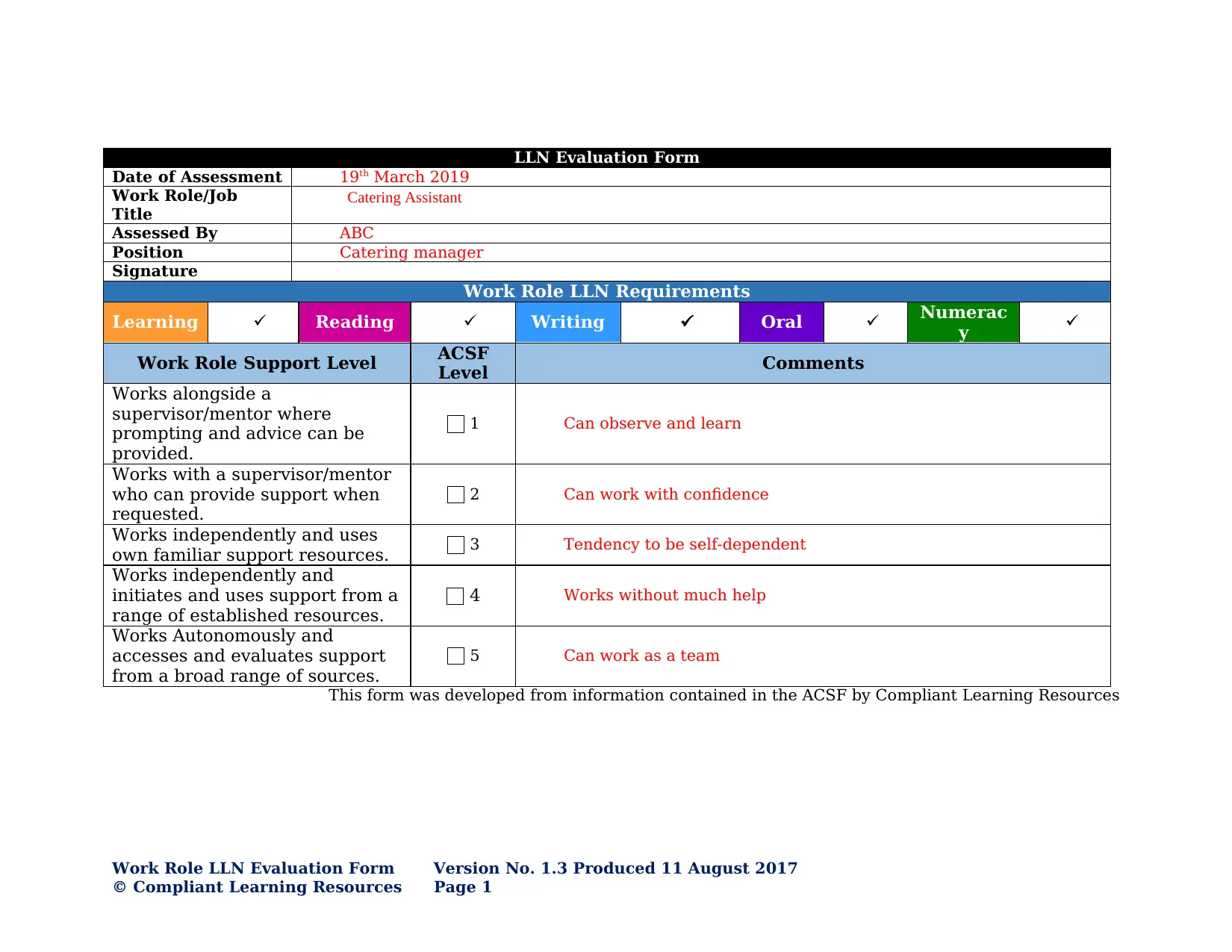
LLN Evaluation Form
Date of Assessment 19th March 2019
Work Role/Job
Title
Catering Assistant
Assessed By ABC
Position Catering manager
Signature
Work Role LLN Requirements
Learning Reading Writing Oral Numerac
y
Work Role Support Level ACSF
Level Comments
Works alongside a
supervisor/mentor where
prompting and advice can be
provided.
1 Can observe and learn
Works with a supervisor/mentor
who can provide support when
requested.
2 Can work with confidence
Works independently and uses
own familiar support resources. 3 Tendency to be self-dependent
Works independently and
initiates and uses support from a
range of established resources.
4 Works without much help
Works Autonomously and
accesses and evaluates support
from a broad range of sources.
5 Can work as a team
This form was developed from information contained in the ACSF by Compliant Learning Resources
Work Role LLN Evaluation Form Version No. 1.3 Produced 11 August 2017
© Compliant Learning Resources Page 1
Date of Assessment 19th March 2019
Work Role/Job
Title
Catering Assistant
Assessed By ABC
Position Catering manager
Signature
Work Role LLN Requirements
Learning Reading Writing Oral Numerac
y
Work Role Support Level ACSF
Level Comments
Works alongside a
supervisor/mentor where
prompting and advice can be
provided.
1 Can observe and learn
Works with a supervisor/mentor
who can provide support when
requested.
2 Can work with confidence
Works independently and uses
own familiar support resources. 3 Tendency to be self-dependent
Works independently and
initiates and uses support from a
range of established resources.
4 Works without much help
Works Autonomously and
accesses and evaluates support
from a broad range of sources.
5 Can work as a team
This form was developed from information contained in the ACSF by Compliant Learning Resources
Work Role LLN Evaluation Form Version No. 1.3 Produced 11 August 2017
© Compliant Learning Resources Page 1

Paraphrase This Document
Need a fresh take? Get an instant paraphrase of this document with our AI Paraphraser
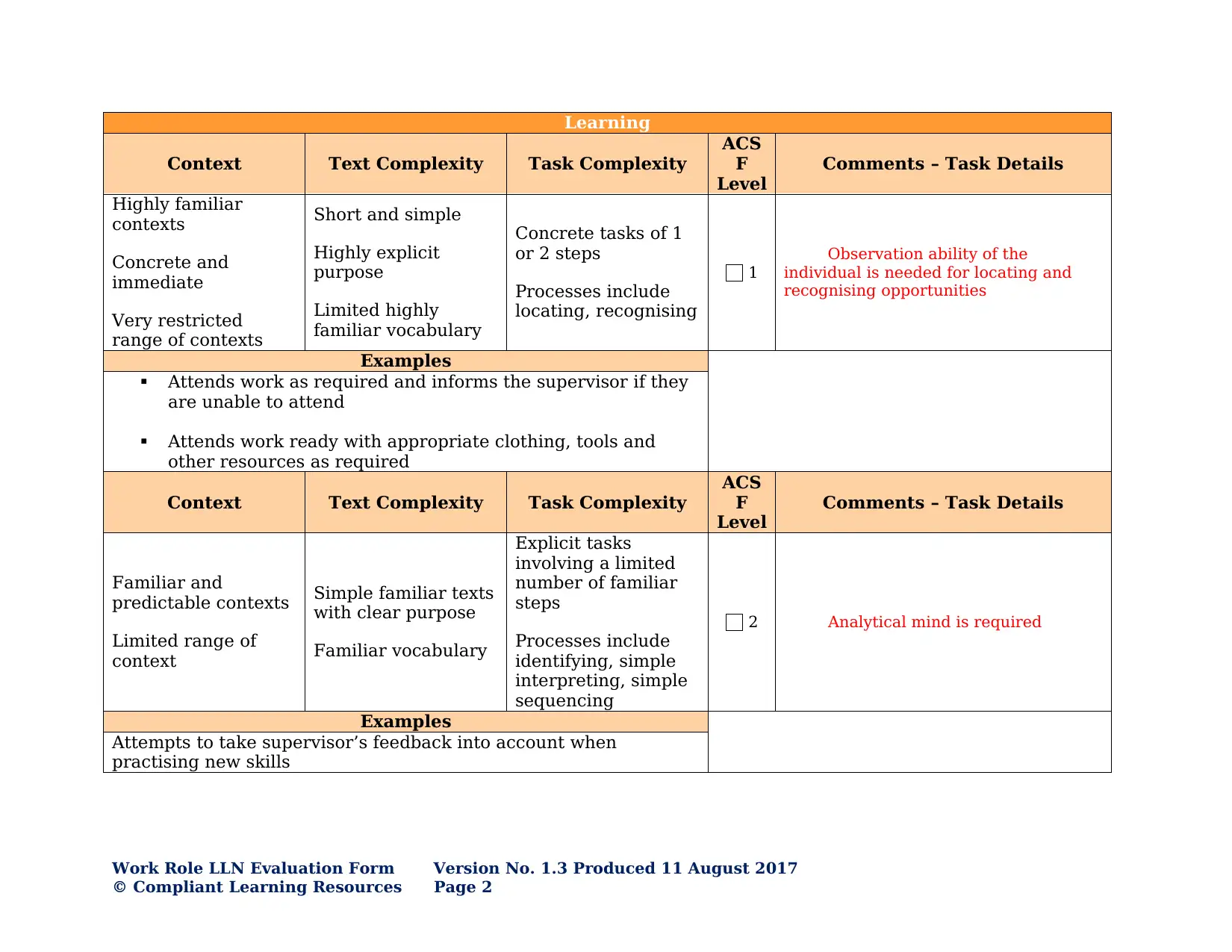
Learning
Context Text Complexity Task Complexity
ACS
F
Level
Comments – Task Details
Highly familiar
contexts
Concrete and
immediate
Very restricted
range of contexts
Short and simple
Highly explicit
purpose
Limited highly
familiar vocabulary
Concrete tasks of 1
or 2 steps
Processes include
locating, recognising
1
Observation ability of the
individual is needed for locating and
recognising opportunities
Examples
Attends work as required and informs the supervisor if they
are unable to attend
Attends work ready with appropriate clothing, tools and
other resources as required
Context Text Complexity Task Complexity
ACS
F
Level
Comments – Task Details
Familiar and
predictable contexts
Limited range of
context
Simple familiar texts
with clear purpose
Familiar vocabulary
Explicit tasks
involving a limited
number of familiar
steps
Processes include
identifying, simple
interpreting, simple
sequencing
2 Analytical mind is required
Examples
Attempts to take supervisor’s feedback into account when
practising new skills
Work Role LLN Evaluation Form Version No. 1.3 Produced 11 August 2017
© Compliant Learning Resources Page 2
Context Text Complexity Task Complexity
ACS
F
Level
Comments – Task Details
Highly familiar
contexts
Concrete and
immediate
Very restricted
range of contexts
Short and simple
Highly explicit
purpose
Limited highly
familiar vocabulary
Concrete tasks of 1
or 2 steps
Processes include
locating, recognising
1
Observation ability of the
individual is needed for locating and
recognising opportunities
Examples
Attends work as required and informs the supervisor if they
are unable to attend
Attends work ready with appropriate clothing, tools and
other resources as required
Context Text Complexity Task Complexity
ACS
F
Level
Comments – Task Details
Familiar and
predictable contexts
Limited range of
context
Simple familiar texts
with clear purpose
Familiar vocabulary
Explicit tasks
involving a limited
number of familiar
steps
Processes include
identifying, simple
interpreting, simple
sequencing
2 Analytical mind is required
Examples
Attempts to take supervisor’s feedback into account when
practising new skills
Work Role LLN Evaluation Form Version No. 1.3 Produced 11 August 2017
© Compliant Learning Resources Page 2
Context Text Complexity Task Complexity
ACS
F
Level
Comments – Task Details
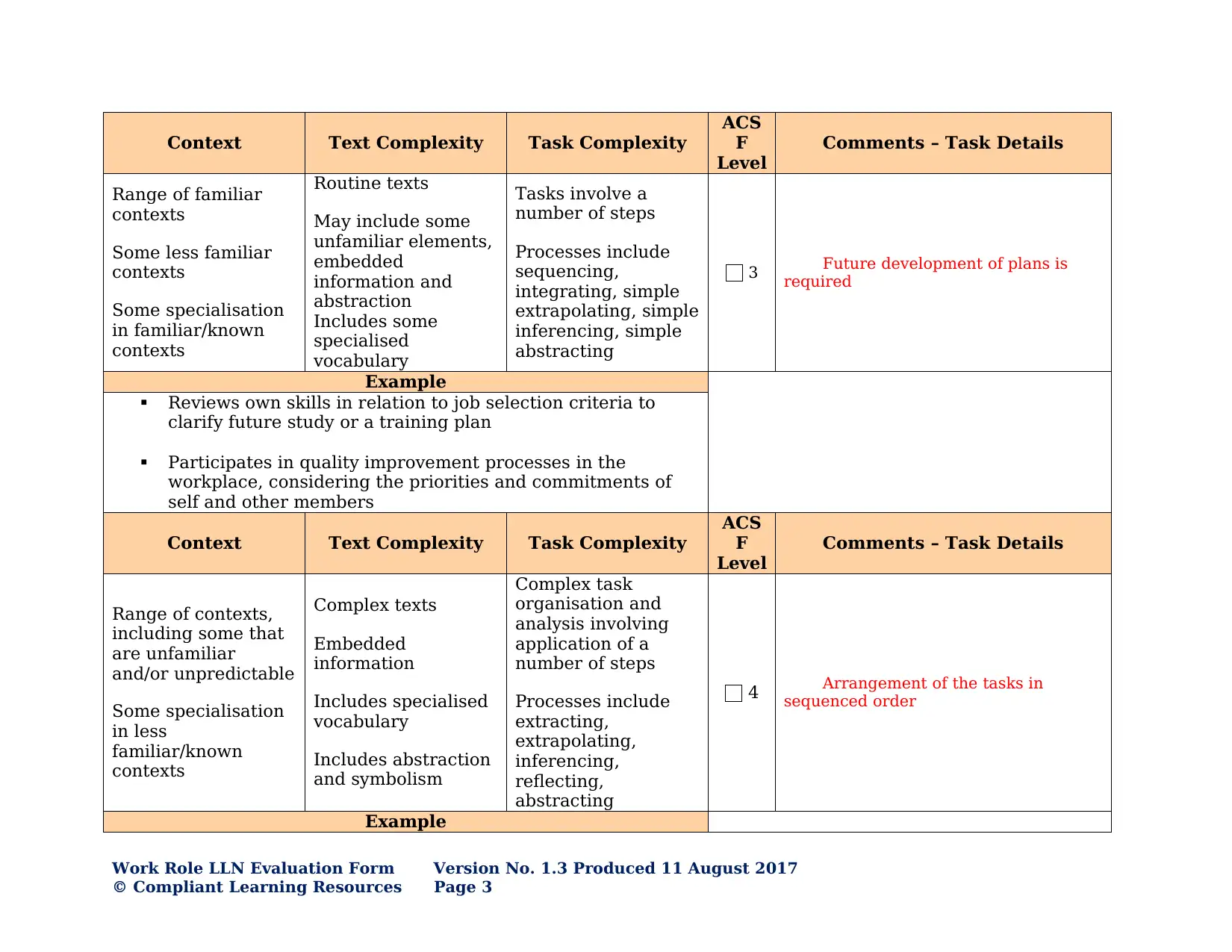
Range of familiar
contexts
Some less familiar
contexts
Some specialisation
in familiar/known
contexts
Routine texts
May include some
unfamiliar elements,
embedded
information and
abstraction
Includes some
specialised
vocabulary
Tasks involve a
number of steps
Processes include
sequencing,
integrating, simple
extrapolating, simple
inferencing, simple
abstracting
3 Future development of plans is
required
Example
Reviews own skills in relation to job selection criteria to
clarify future study or a training plan
Participates in quality improvement processes in the
workplace, considering the priorities and commitments of
self and other members
Context Text Complexity Task Complexity
ACS
F
Level
Comments – Task Details
Range of contexts,
including some that
are unfamiliar
and/or unpredictable
Some specialisation
in less
familiar/known
contexts
Complex texts
Embedded
information
Includes specialised
vocabulary
Includes abstraction
and symbolism
Complex task
organisation and
analysis involving
application of a
number of steps
Processes include
extracting,
extrapolating,
inferencing,
reflecting,
abstracting
4 Arrangement of the tasks in
sequenced order
Example
Work Role LLN Evaluation Form Version No. 1.3 Produced 11 August 2017
© Compliant Learning Resources Page 3
ACS
F
Level
Comments – Task Details
Range of familiar
contexts
Some less familiar
contexts
Some specialisation
in familiar/known
contexts
Routine texts
May include some
unfamiliar elements,
embedded
information and
abstraction
Includes some
specialised
vocabulary
Tasks involve a
number of steps
Processes include
sequencing,
integrating, simple
extrapolating, simple
inferencing, simple
abstracting
3 Future development of plans is
required
Example
Reviews own skills in relation to job selection criteria to
clarify future study or a training plan
Participates in quality improvement processes in the
workplace, considering the priorities and commitments of
self and other members
Context Text Complexity Task Complexity
ACS
F
Level
Comments – Task Details
Range of contexts,
including some that
are unfamiliar
and/or unpredictable
Some specialisation
in less
familiar/known
contexts
Complex texts
Embedded
information
Includes specialised
vocabulary
Includes abstraction
and symbolism
Complex task
organisation and
analysis involving
application of a
number of steps
Processes include
extracting,
extrapolating,
inferencing,
reflecting,
abstracting
4 Arrangement of the tasks in
sequenced order
Example
Work Role LLN Evaluation Form Version No. 1.3 Produced 11 August 2017
© Compliant Learning Resources Page 3
⊘ This is a preview!⊘
Do you want full access?
Subscribe today to unlock all pages.

Trusted by 1+ million students worldwide
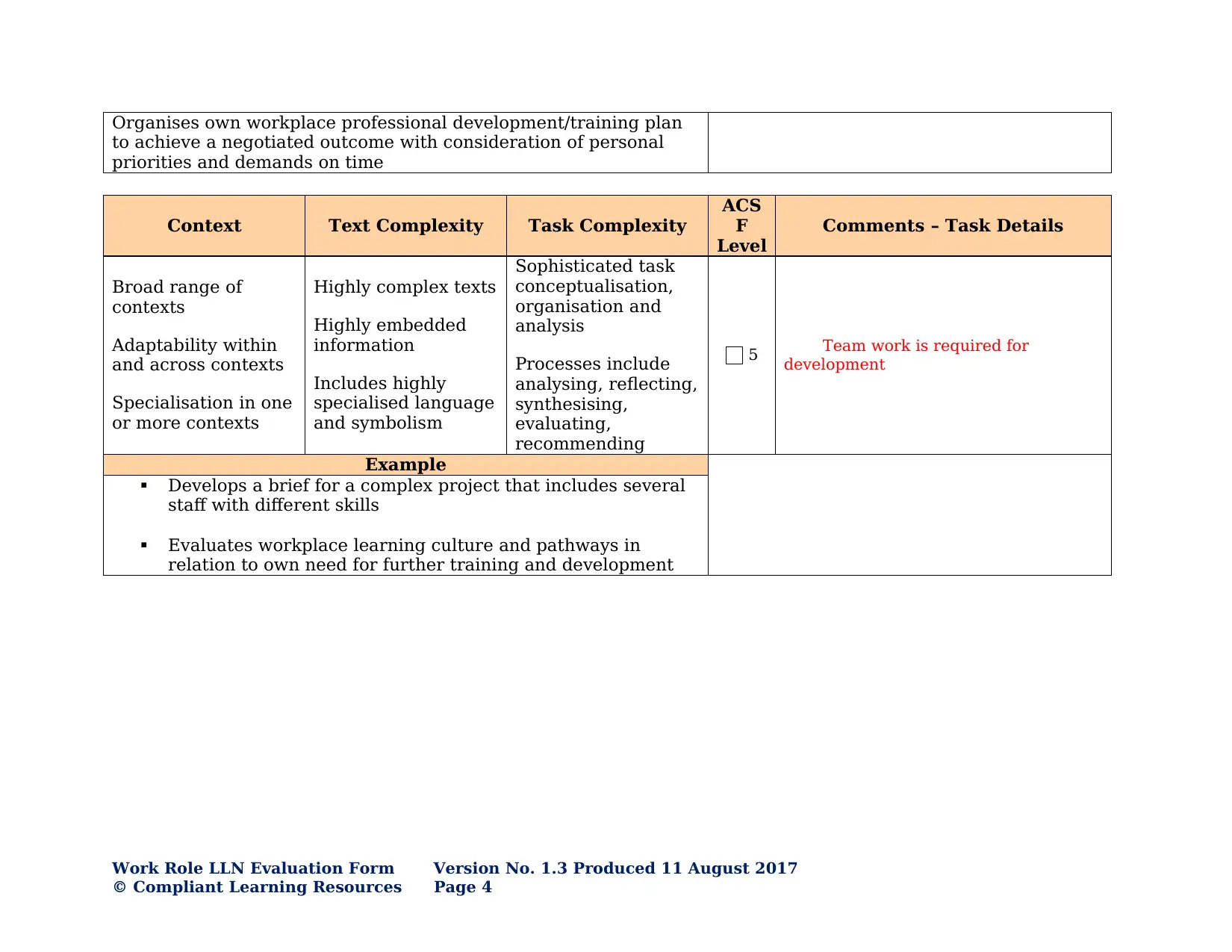
Organises own workplace professional development/training plan
to achieve a negotiated outcome with consideration of personal
priorities and demands on time
Context Text Complexity Task Complexity
ACS
F
Level
Comments – Task Details
Broad range of
contexts
Adaptability within
and across contexts
Specialisation in one
or more contexts
Highly complex texts
Highly embedded
information
Includes highly
specialised language
and symbolism
Sophisticated task
conceptualisation,
organisation and
analysis
Processes include
analysing, reflecting,
synthesising,
evaluating,
recommending
5 Team work is required for
development
Example
Develops a brief for a complex project that includes several
staff with different skills
Evaluates workplace learning culture and pathways in
relation to own need for further training and development
Work Role LLN Evaluation Form Version No. 1.3 Produced 11 August 2017
© Compliant Learning Resources Page 4
to achieve a negotiated outcome with consideration of personal
priorities and demands on time
Context Text Complexity Task Complexity
ACS
F
Level
Comments – Task Details
Broad range of
contexts
Adaptability within
and across contexts
Specialisation in one
or more contexts
Highly complex texts
Highly embedded
information
Includes highly
specialised language
and symbolism
Sophisticated task
conceptualisation,
organisation and
analysis
Processes include
analysing, reflecting,
synthesising,
evaluating,
recommending
5 Team work is required for
development
Example
Develops a brief for a complex project that includes several
staff with different skills
Evaluates workplace learning culture and pathways in
relation to own need for further training and development
Work Role LLN Evaluation Form Version No. 1.3 Produced 11 August 2017
© Compliant Learning Resources Page 4
Paraphrase This Document
Need a fresh take? Get an instant paraphrase of this document with our AI Paraphraser
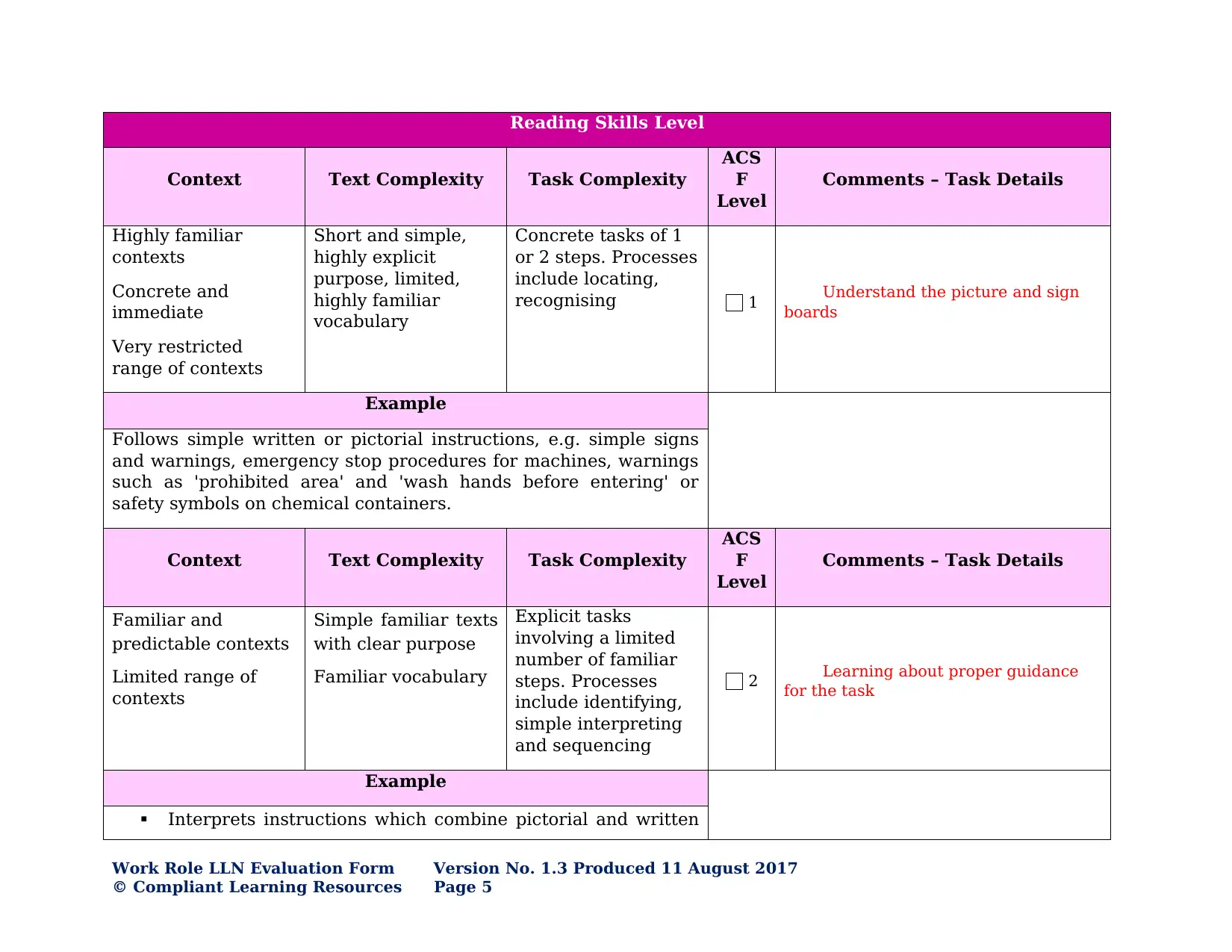
Reading Skills Level
Context Text Complexity Task Complexity
ACS
F
Level
Comments – Task Details
Highly familiar
contexts
Concrete and
immediate
Very restricted
range of contexts
Short and simple,
highly explicit
purpose, limited,
highly familiar
vocabulary
Concrete tasks of 1
or 2 steps. Processes
include locating,
recognising 1 Understand the picture and sign
boards
Example
Follows simple written or pictorial instructions, e.g. simple signs
and warnings, emergency stop procedures for machines, warnings
such as 'prohibited area' and 'wash hands before entering' or
safety symbols on chemical containers.
Context Text Complexity Task Complexity
ACS
F
Level
Comments – Task Details
Familiar and
predictable contexts
Limited range of
contexts
Simple familiar texts
with clear purpose
Familiar vocabulary
Explicit tasks
involving a limited
number of familiar
steps. Processes
include identifying,
simple interpreting
and sequencing
2 Learning about proper guidance
for the task
Example
Interprets instructions which combine pictorial and written
Work Role LLN Evaluation Form Version No. 1.3 Produced 11 August 2017
© Compliant Learning Resources Page 5
Context Text Complexity Task Complexity
ACS
F
Level
Comments – Task Details
Highly familiar
contexts
Concrete and
immediate
Very restricted
range of contexts
Short and simple,
highly explicit
purpose, limited,
highly familiar
vocabulary
Concrete tasks of 1
or 2 steps. Processes
include locating,
recognising 1 Understand the picture and sign
boards
Example
Follows simple written or pictorial instructions, e.g. simple signs
and warnings, emergency stop procedures for machines, warnings
such as 'prohibited area' and 'wash hands before entering' or
safety symbols on chemical containers.
Context Text Complexity Task Complexity
ACS
F
Level
Comments – Task Details
Familiar and
predictable contexts
Limited range of
contexts
Simple familiar texts
with clear purpose
Familiar vocabulary
Explicit tasks
involving a limited
number of familiar
steps. Processes
include identifying,
simple interpreting
and sequencing
2 Learning about proper guidance
for the task
Example
Interprets instructions which combine pictorial and written
Work Role LLN Evaluation Form Version No. 1.3 Produced 11 August 2017
© Compliant Learning Resources Page 5
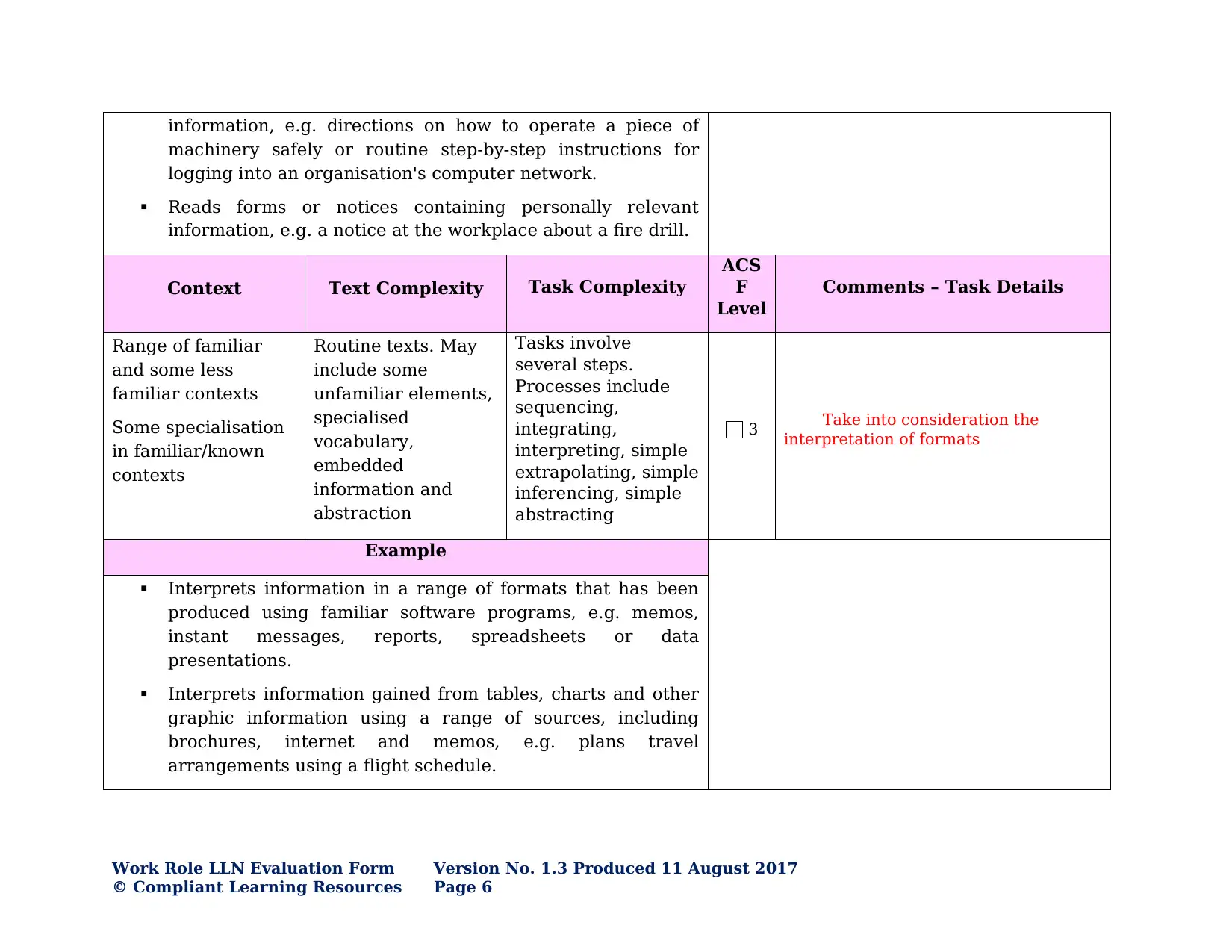
information, e.g. directions on how to operate a piece of
machinery safely or routine step-by-step instructions for
logging into an organisation's computer network.
Reads forms or notices containing personally relevant
information, e.g. a notice at the workplace about a fire drill.
Context Text Complexity Task Complexity
ACS
F
Level
Comments – Task Details
Range of familiar
and some less
familiar contexts
Some specialisation
in familiar/known
contexts
Routine texts. May
include some
unfamiliar elements,
specialised
vocabulary,
embedded
information and
abstraction
Tasks involve
several steps.
Processes include
sequencing,
integrating,
interpreting, simple
extrapolating, simple
inferencing, simple
abstracting
3 Take into consideration the
interpretation of formats
Example
Interprets information in a range of formats that has been
produced using familiar software programs, e.g. memos,
instant messages, reports, spreadsheets or data
presentations.
Interprets information gained from tables, charts and other
graphic information using a range of sources, including
brochures, internet and memos, e.g. plans travel
arrangements using a flight schedule.
Work Role LLN Evaluation Form Version No. 1.3 Produced 11 August 2017
© Compliant Learning Resources Page 6
machinery safely or routine step-by-step instructions for
logging into an organisation's computer network.
Reads forms or notices containing personally relevant
information, e.g. a notice at the workplace about a fire drill.
Context Text Complexity Task Complexity
ACS
F
Level
Comments – Task Details
Range of familiar
and some less
familiar contexts
Some specialisation
in familiar/known
contexts
Routine texts. May
include some
unfamiliar elements,
specialised
vocabulary,
embedded
information and
abstraction
Tasks involve
several steps.
Processes include
sequencing,
integrating,
interpreting, simple
extrapolating, simple
inferencing, simple
abstracting
3 Take into consideration the
interpretation of formats
Example
Interprets information in a range of formats that has been
produced using familiar software programs, e.g. memos,
instant messages, reports, spreadsheets or data
presentations.
Interprets information gained from tables, charts and other
graphic information using a range of sources, including
brochures, internet and memos, e.g. plans travel
arrangements using a flight schedule.
Work Role LLN Evaluation Form Version No. 1.3 Produced 11 August 2017
© Compliant Learning Resources Page 6
⊘ This is a preview!⊘
Do you want full access?
Subscribe today to unlock all pages.
Trusted by 1+ million students worldwide
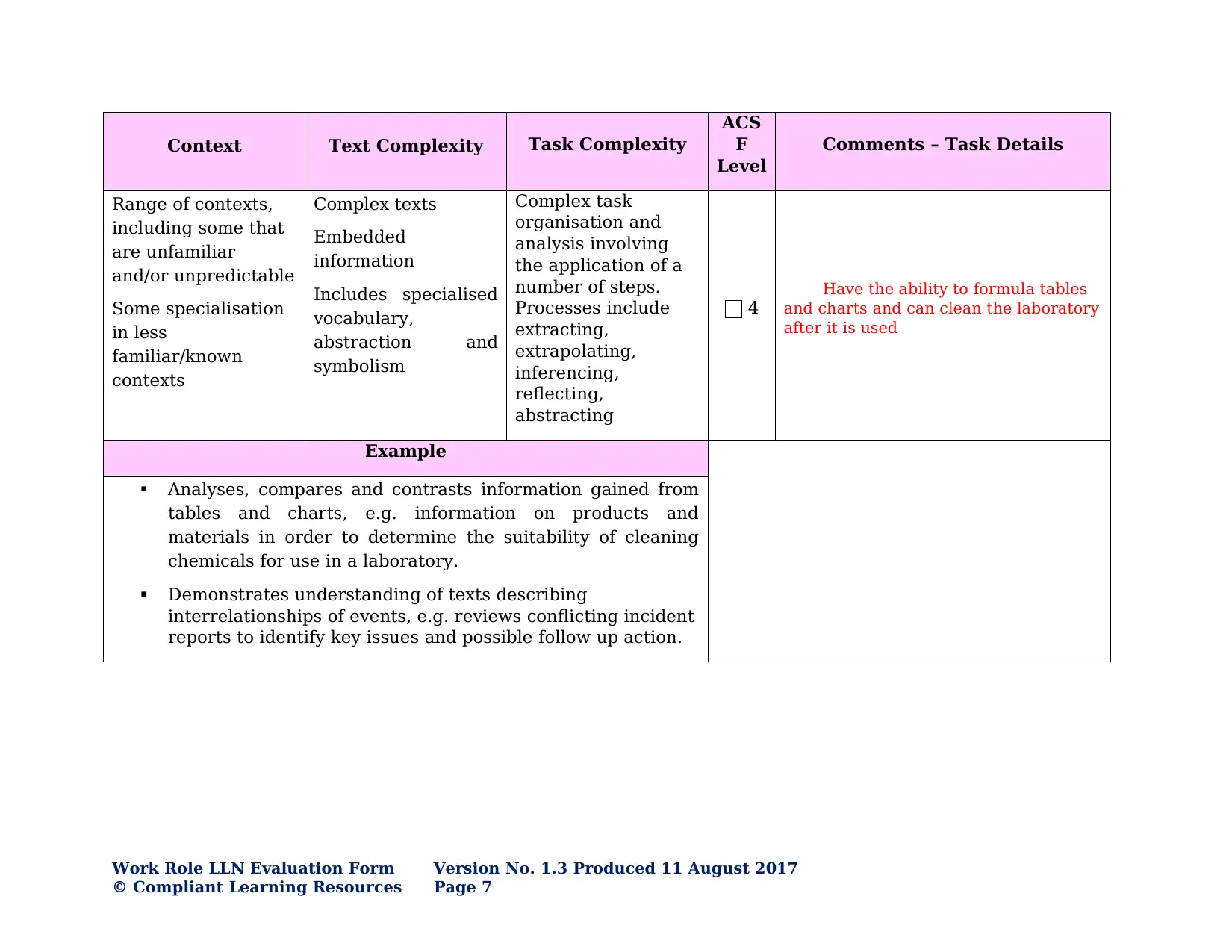
Context Text Complexity Task Complexity
ACS
F
Level
Comments – Task Details
Range of contexts,
including some that
are unfamiliar
and/or unpredictable
Some specialisation
in less
familiar/known
contexts
Complex texts
Embedded
information
Includes specialised
vocabulary,
abstraction and
symbolism
Complex task
organisation and
analysis involving
the application of a
number of steps.
Processes include
extracting,
extrapolating,
inferencing,
reflecting,
abstracting
4
Have the ability to formula tables
and charts and can clean the laboratory
after it is used
Example
Analyses, compares and contrasts information gained from
tables and charts, e.g. information on products and
materials in order to determine the suitability of cleaning
chemicals for use in a laboratory.
Demonstrates understanding of texts describing
interrelationships of events, e.g. reviews conflicting incident
reports to identify key issues and possible follow up action.
Work Role LLN Evaluation Form Version No. 1.3 Produced 11 August 2017
© Compliant Learning Resources Page 7
ACS
F
Level
Comments – Task Details
Range of contexts,
including some that
are unfamiliar
and/or unpredictable
Some specialisation
in less
familiar/known
contexts
Complex texts
Embedded
information
Includes specialised
vocabulary,
abstraction and
symbolism
Complex task
organisation and
analysis involving
the application of a
number of steps.
Processes include
extracting,
extrapolating,
inferencing,
reflecting,
abstracting
4
Have the ability to formula tables
and charts and can clean the laboratory
after it is used
Example
Analyses, compares and contrasts information gained from
tables and charts, e.g. information on products and
materials in order to determine the suitability of cleaning
chemicals for use in a laboratory.
Demonstrates understanding of texts describing
interrelationships of events, e.g. reviews conflicting incident
reports to identify key issues and possible follow up action.
Work Role LLN Evaluation Form Version No. 1.3 Produced 11 August 2017
© Compliant Learning Resources Page 7
Paraphrase This Document
Need a fresh take? Get an instant paraphrase of this document with our AI Paraphraser
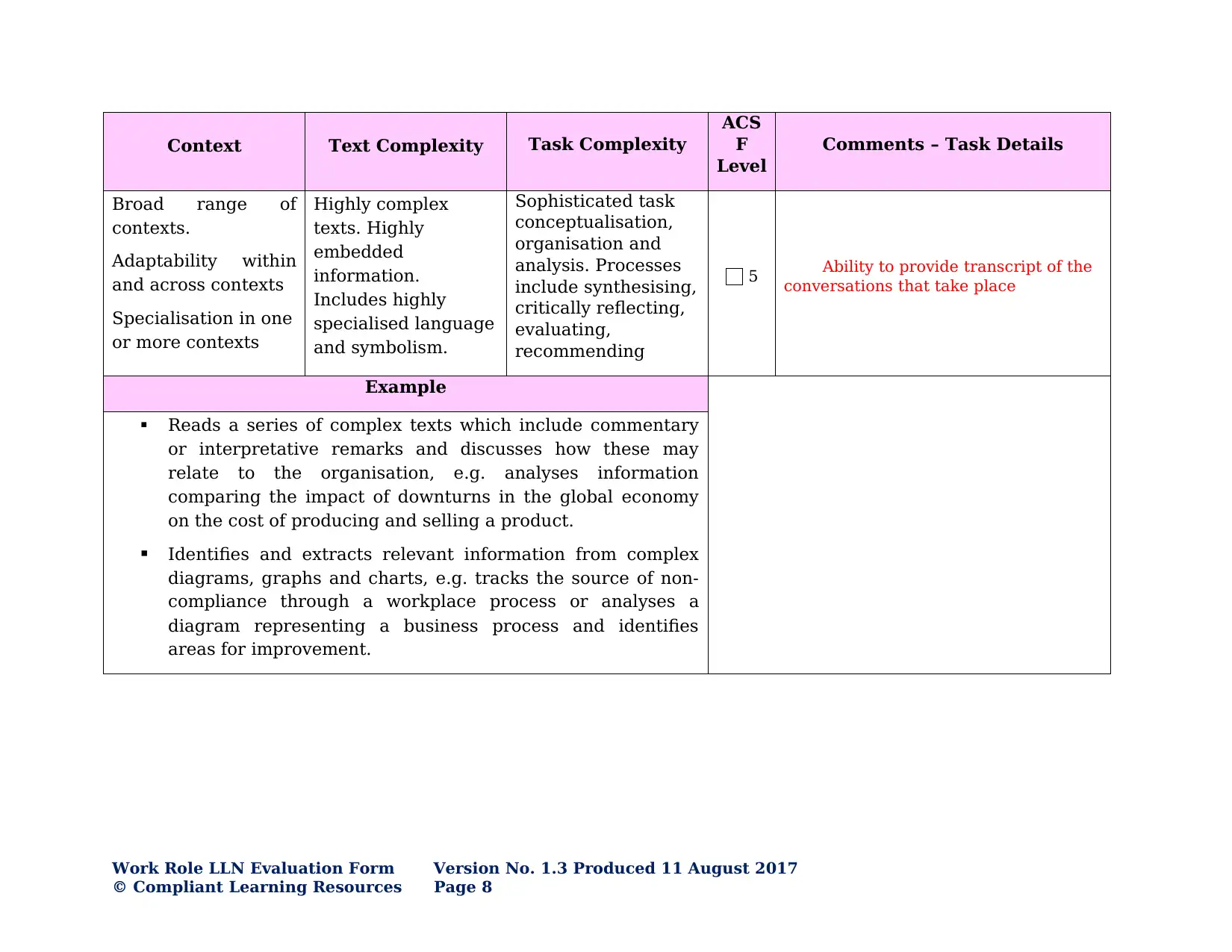
Context Text Complexity Task Complexity
ACS
F
Level
Comments – Task Details
Broad range of
contexts.
Adaptability within
and across contexts
Specialisation in one
or more contexts
Highly complex
texts. Highly
embedded
information.
Includes highly
specialised language
and symbolism.
Sophisticated task
conceptualisation,
organisation and
analysis. Processes
include synthesising,
critically reflecting,
evaluating,
recommending
5 Ability to provide transcript of the
conversations that take place
Example
Reads a series of complex texts which include commentary
or interpretative remarks and discusses how these may
relate to the organisation, e.g. analyses information
comparing the impact of downturns in the global economy
on the cost of producing and selling a product.
Identifies and extracts relevant information from complex
diagrams, graphs and charts, e.g. tracks the source of non-
compliance through a workplace process or analyses a
diagram representing a business process and identifies
areas for improvement.
Work Role LLN Evaluation Form Version No. 1.3 Produced 11 August 2017
© Compliant Learning Resources Page 8
ACS
F
Level
Comments – Task Details
Broad range of
contexts.
Adaptability within
and across contexts
Specialisation in one
or more contexts
Highly complex
texts. Highly
embedded
information.
Includes highly
specialised language
and symbolism.
Sophisticated task
conceptualisation,
organisation and
analysis. Processes
include synthesising,
critically reflecting,
evaluating,
recommending
5 Ability to provide transcript of the
conversations that take place
Example
Reads a series of complex texts which include commentary
or interpretative remarks and discusses how these may
relate to the organisation, e.g. analyses information
comparing the impact of downturns in the global economy
on the cost of producing and selling a product.
Identifies and extracts relevant information from complex
diagrams, graphs and charts, e.g. tracks the source of non-
compliance through a workplace process or analyses a
diagram representing a business process and identifies
areas for improvement.
Work Role LLN Evaluation Form Version No. 1.3 Produced 11 August 2017
© Compliant Learning Resources Page 8
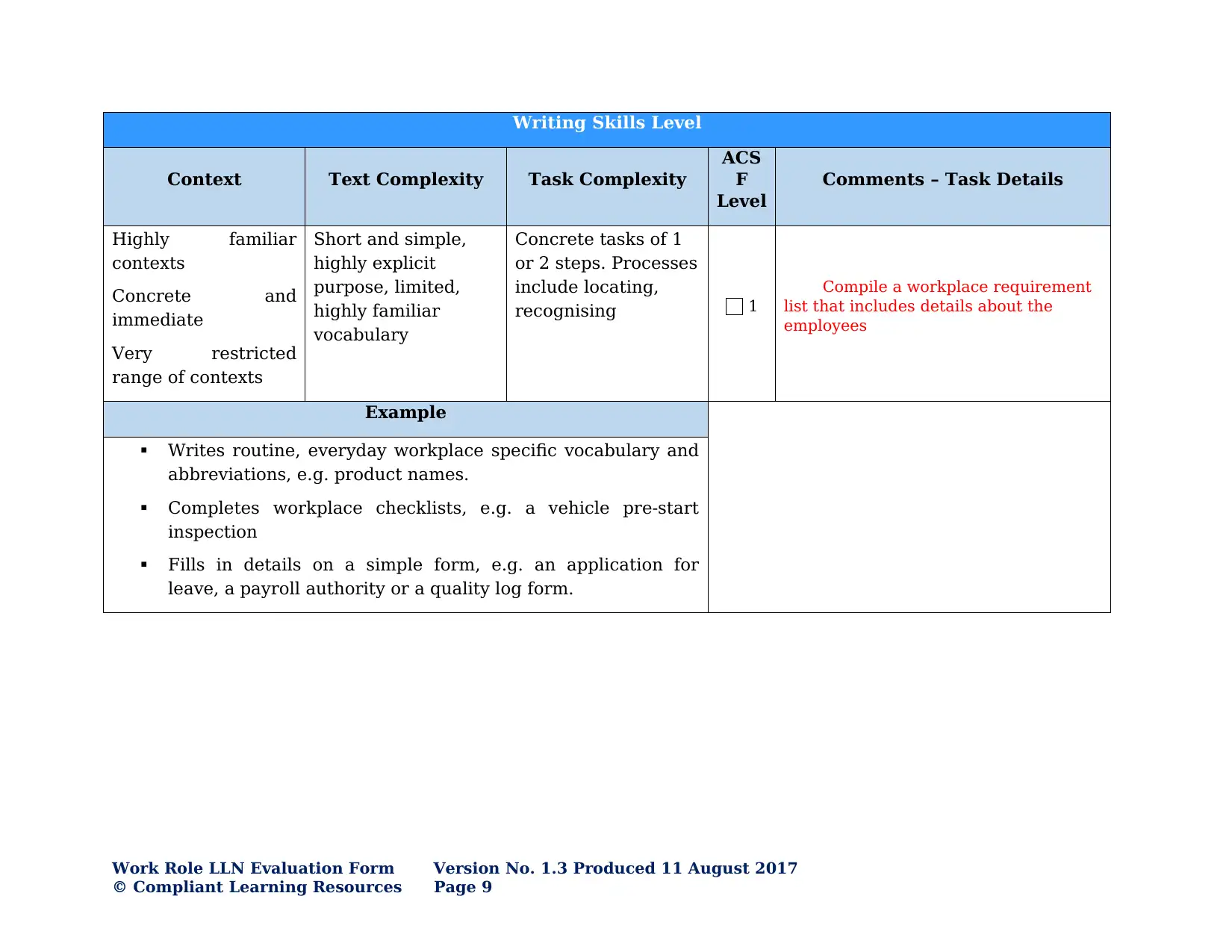
Writing Skills Level
Context Text Complexity Task Complexity
ACS
F
Level
Comments – Task Details
Highly familiar
contexts
Concrete and
immediate
Very restricted
range of contexts
Short and simple,
highly explicit
purpose, limited,
highly familiar
vocabulary
Concrete tasks of 1
or 2 steps. Processes
include locating,
recognising 1
Compile a workplace requirement
list that includes details about the
employees
Example
Writes routine, everyday workplace specific vocabulary and
abbreviations, e.g. product names.
Completes workplace checklists, e.g. a vehicle pre-start
inspection
Fills in details on a simple form, e.g. an application for
leave, a payroll authority or a quality log form.
Work Role LLN Evaluation Form Version No. 1.3 Produced 11 August 2017
© Compliant Learning Resources Page 9
Context Text Complexity Task Complexity
ACS
F
Level
Comments – Task Details
Highly familiar
contexts
Concrete and
immediate
Very restricted
range of contexts
Short and simple,
highly explicit
purpose, limited,
highly familiar
vocabulary
Concrete tasks of 1
or 2 steps. Processes
include locating,
recognising 1
Compile a workplace requirement
list that includes details about the
employees
Example
Writes routine, everyday workplace specific vocabulary and
abbreviations, e.g. product names.
Completes workplace checklists, e.g. a vehicle pre-start
inspection
Fills in details on a simple form, e.g. an application for
leave, a payroll authority or a quality log form.
Work Role LLN Evaluation Form Version No. 1.3 Produced 11 August 2017
© Compliant Learning Resources Page 9
⊘ This is a preview!⊘
Do you want full access?
Subscribe today to unlock all pages.
Trusted by 1+ million students worldwide
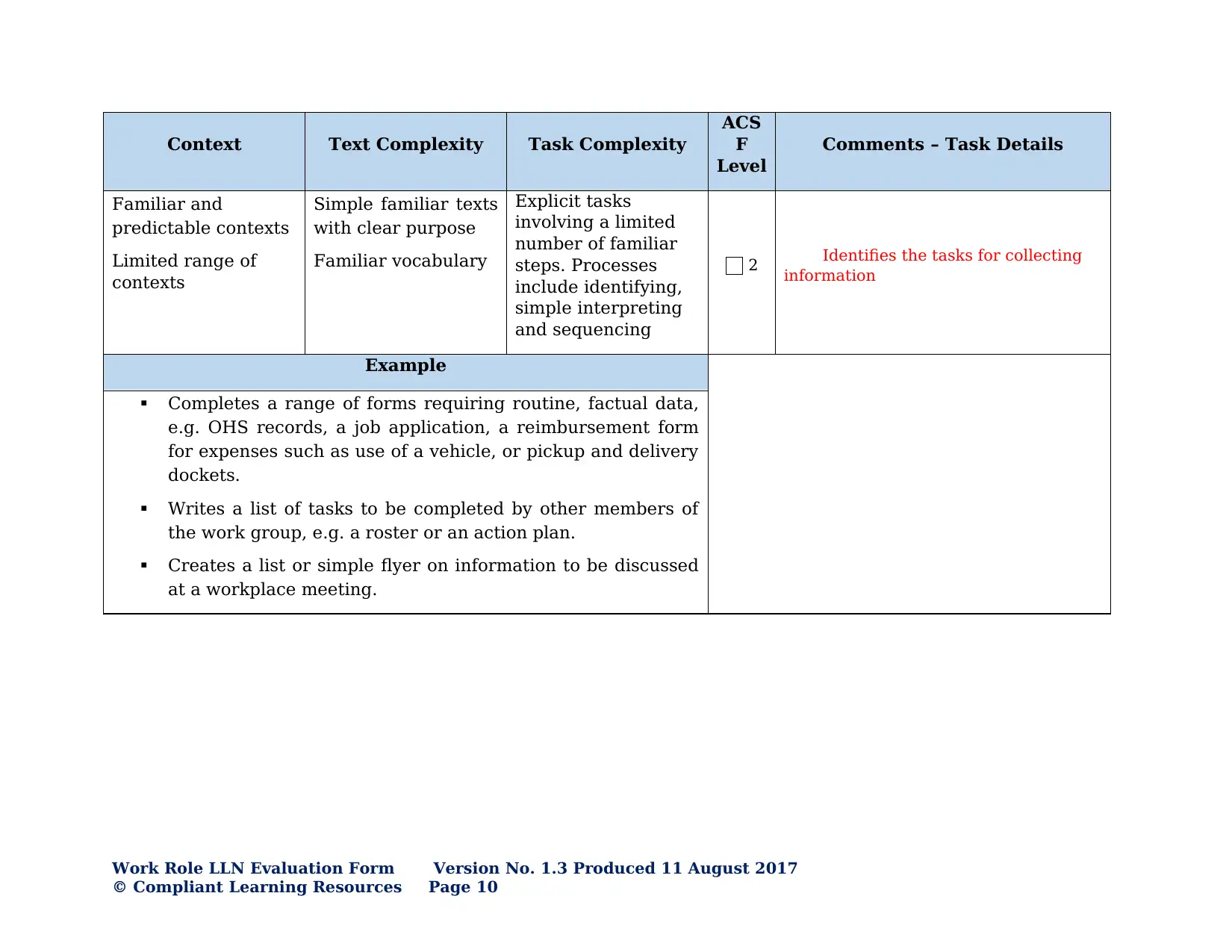
Context Text Complexity Task Complexity
ACS
F
Level
Comments – Task Details
Familiar and
predictable contexts
Limited range of
contexts
Simple familiar texts
with clear purpose
Familiar vocabulary
Explicit tasks
involving a limited
number of familiar
steps. Processes
include identifying,
simple interpreting
and sequencing
2 Identifies the tasks for collecting
information
Example
Completes a range of forms requiring routine, factual data,
e.g. OHS records, a job application, a reimbursement form
for expenses such as use of a vehicle, or pickup and delivery
dockets.
Writes a list of tasks to be completed by other members of
the work group, e.g. a roster or an action plan.
Creates a list or simple flyer on information to be discussed
at a workplace meeting.
Work Role LLN Evaluation Form Version No. 1.3 Produced 11 August 2017
© Compliant Learning Resources Page 10
ACS
F
Level
Comments – Task Details
Familiar and
predictable contexts
Limited range of
contexts
Simple familiar texts
with clear purpose
Familiar vocabulary
Explicit tasks
involving a limited
number of familiar
steps. Processes
include identifying,
simple interpreting
and sequencing
2 Identifies the tasks for collecting
information
Example
Completes a range of forms requiring routine, factual data,
e.g. OHS records, a job application, a reimbursement form
for expenses such as use of a vehicle, or pickup and delivery
dockets.
Writes a list of tasks to be completed by other members of
the work group, e.g. a roster or an action plan.
Creates a list or simple flyer on information to be discussed
at a workplace meeting.
Work Role LLN Evaluation Form Version No. 1.3 Produced 11 August 2017
© Compliant Learning Resources Page 10
Paraphrase This Document
Need a fresh take? Get an instant paraphrase of this document with our AI Paraphraser
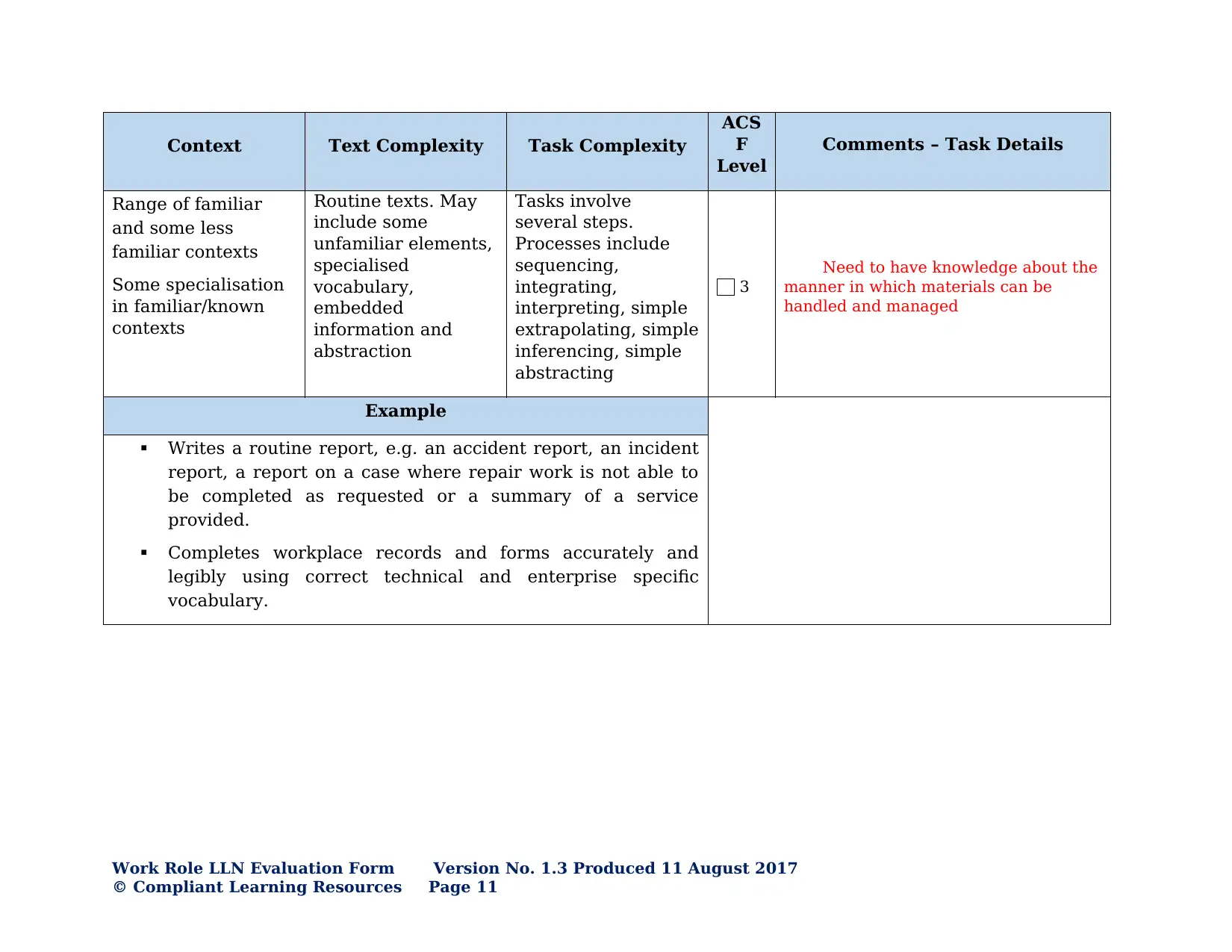
Context Text Complexity Task Complexity
ACS
F
Level
Comments – Task Details
Range of familiar
and some less
familiar contexts
Some specialisation
in familiar/known
contexts
Routine texts. May
include some
unfamiliar elements,
specialised
vocabulary,
embedded
information and
abstraction
Tasks involve
several steps.
Processes include
sequencing,
integrating,
interpreting, simple
extrapolating, simple
inferencing, simple
abstracting
3
Need to have knowledge about the
manner in which materials can be
handled and managed
Example
Writes a routine report, e.g. an accident report, an incident
report, a report on a case where repair work is not able to
be completed as requested or a summary of a service
provided.
Completes workplace records and forms accurately and
legibly using correct technical and enterprise specific
vocabulary.
Work Role LLN Evaluation Form Version No. 1.3 Produced 11 August 2017
© Compliant Learning Resources Page 11
ACS
F
Level
Comments – Task Details
Range of familiar
and some less
familiar contexts
Some specialisation
in familiar/known
contexts
Routine texts. May
include some
unfamiliar elements,
specialised
vocabulary,
embedded
information and
abstraction
Tasks involve
several steps.
Processes include
sequencing,
integrating,
interpreting, simple
extrapolating, simple
inferencing, simple
abstracting
3
Need to have knowledge about the
manner in which materials can be
handled and managed
Example
Writes a routine report, e.g. an accident report, an incident
report, a report on a case where repair work is not able to
be completed as requested or a summary of a service
provided.
Completes workplace records and forms accurately and
legibly using correct technical and enterprise specific
vocabulary.
Work Role LLN Evaluation Form Version No. 1.3 Produced 11 August 2017
© Compliant Learning Resources Page 11
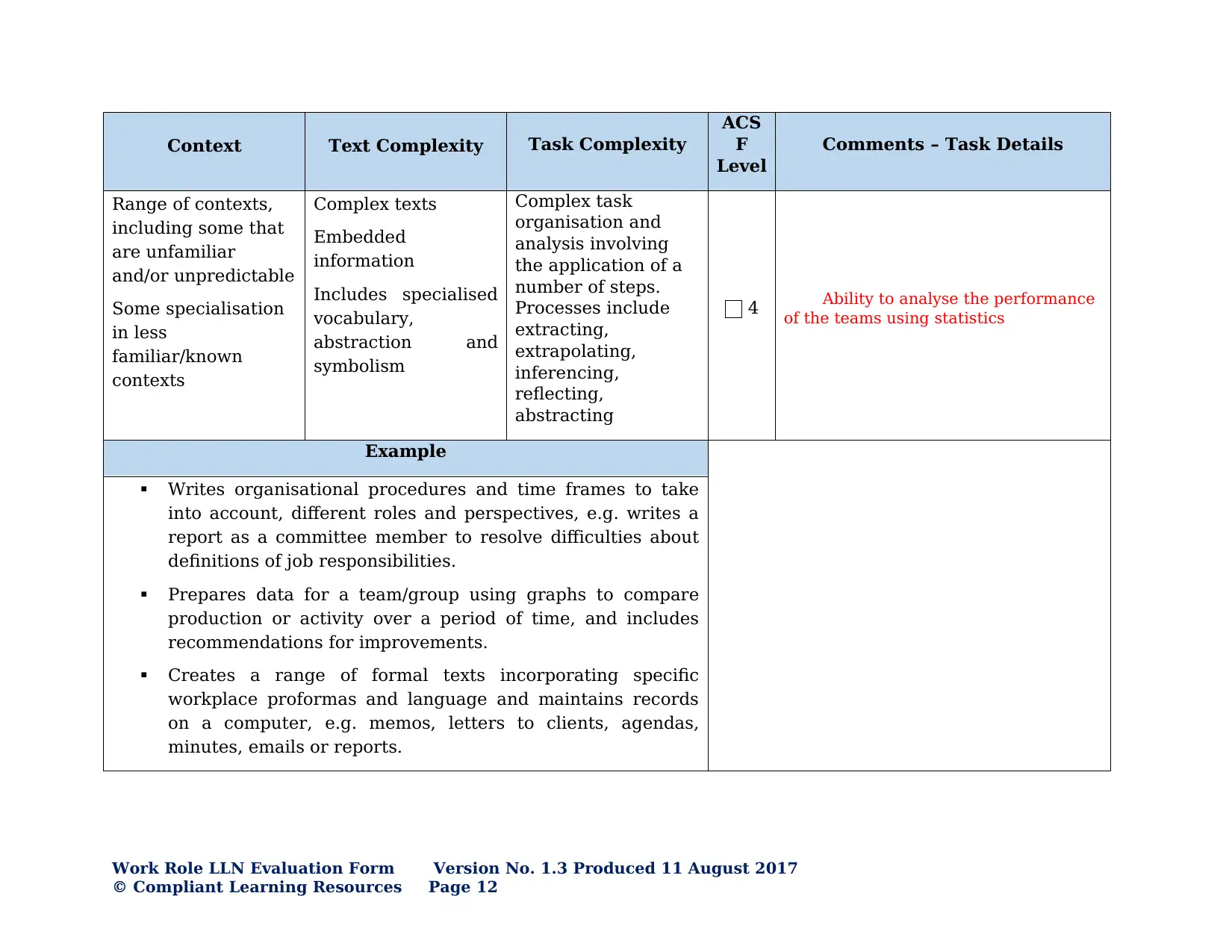
Context Text Complexity Task Complexity
ACS
F
Level
Comments – Task Details
Range of contexts,
including some that
are unfamiliar
and/or unpredictable
Some specialisation
in less
familiar/known
contexts
Complex texts
Embedded
information
Includes specialised
vocabulary,
abstraction and
symbolism
Complex task
organisation and
analysis involving
the application of a
number of steps.
Processes include
extracting,
extrapolating,
inferencing,
reflecting,
abstracting
4 Ability to analyse the performance
of the teams using statistics
Example
Writes organisational procedures and time frames to take
into account, different roles and perspectives, e.g. writes a
report as a committee member to resolve difficulties about
definitions of job responsibilities.
Prepares data for a team/group using graphs to compare
production or activity over a period of time, and includes
recommendations for improvements.
Creates a range of formal texts incorporating specific
workplace proformas and language and maintains records
on a computer, e.g. memos, letters to clients, agendas,
minutes, emails or reports.
Work Role LLN Evaluation Form Version No. 1.3 Produced 11 August 2017
© Compliant Learning Resources Page 12
ACS
F
Level
Comments – Task Details
Range of contexts,
including some that
are unfamiliar
and/or unpredictable
Some specialisation
in less
familiar/known
contexts
Complex texts
Embedded
information
Includes specialised
vocabulary,
abstraction and
symbolism
Complex task
organisation and
analysis involving
the application of a
number of steps.
Processes include
extracting,
extrapolating,
inferencing,
reflecting,
abstracting
4 Ability to analyse the performance
of the teams using statistics
Example
Writes organisational procedures and time frames to take
into account, different roles and perspectives, e.g. writes a
report as a committee member to resolve difficulties about
definitions of job responsibilities.
Prepares data for a team/group using graphs to compare
production or activity over a period of time, and includes
recommendations for improvements.
Creates a range of formal texts incorporating specific
workplace proformas and language and maintains records
on a computer, e.g. memos, letters to clients, agendas,
minutes, emails or reports.
Work Role LLN Evaluation Form Version No. 1.3 Produced 11 August 2017
© Compliant Learning Resources Page 12
⊘ This is a preview!⊘
Do you want full access?
Subscribe today to unlock all pages.
Trusted by 1+ million students worldwide

1 out of 27


Related Documents


Your All-in-One AI-Powered Toolkit for Academic Success.
+13062052269
info@desklib.com
Available 24*7 on WhatsApp / Email
![[object Object]](/_next/static/media/star-bottom.7253800d.svg)
Unlock your academic potential
Copyright © 2020–2026 A2Z Services. All Rights Reserved. Developed and managed by ZUCOL.