EAW 9 - Workplace Trust and Relationships: A Detailed Analysis

Verified

Added on  2023/04/19

|8
|1983
|458
Report
AI Summary
This report provides a comprehensive analysis of workplace trust and relationships, drawing on the Prisoner's Dilemma game and an evaluation of personal behaviors. The author reflects on lessons learned from the Prisoner's Dilemma, emphasizing the importance of collaboration and trust in achieving goals. The report details how the author collaborated within a team and with an opposing team, noting observed behaviors and potential improvements for future interactions. Key learnings on workplace trust are discussed, highlighting its role in fostering a positive work environment and enhancing employee motivation. The author identifies their strongest behaviors as 'getting better' and 'demonstrating respect,' providing examples to support these assertions. Areas for further development are also acknowledged, focusing on 'delivering results' and 'practicing accountability,' with specific instances illustrating these challenges. The report concludes with references to relevant literature, emphasizing the importance of continuous improvement and responsible leadership.
Document Page
1
EAW 9 Workplace trust and relationship
Student Name
Student ID
tabler-icon-diamond-filled.svg

Paraphrase This Document

Need a fresh take? Get an instant paraphrase of this document with our AI Paraphraser
Document Page
2
EAW 9 Workplace trust and relationship
Assessment 9.1
Contents
Part 1 Prisoners Dilemma
Part 2 Trust Behaviours
Part 1 Prisoner’s Dilemma
1. Assignment the Prisoner's Dilemma
Q1. Describe the Lessons You Learned from the Prisoner’s Dilemma
From the prisoner’s dilemma, I learned that collaboration and trust are two key aspects of
meeting a collaborative goal or target. Furthermore, I also released that collaboration and
trusts are closely related and both function together to come up with solutions. Although trust
is not easily built, it is essential in an organizational context as it helps in enhancement of
close relationship among employees hence providing an effective decision. For example, if the
two prisoners could have trusted each other and collaborated to remain silent, they could face
the only one-year sentence that is beneficial to both parties as compared to five-year-jail when
both parties confess and 10-year jail when one party confess and the other party remains
silence. Therefore, I can conclude that if people want to accomplish an expected goal and
come up with an effective solution that is beneficial to themselves and organization, they must
work as a team and further trust each other to avoid workplace conflicts.
How did you collaborate as a team?
As a team, we collaborated by first assessing the problem in hand that needed a collaborative
Document Page
3
solution. We sat down, discussed the long- term and short- term goals to achieve, how we are
going to achieve, and further divided roles so that each team member knows what he or she is
supposed to do. In addition, the nominated team leader aligned individual expectations and
shared expectations of the team and we motivated each other. We trusted each team member
will complete his or her task on time and further, we established timelines and metrics. The
team leader also provided a shared progress update after some time in order for team members
to know when the project is accomplished. Before the set deadline approached, everyone was
through with his or her tasks and we, therefore, combined them together and had the final
project with us.
How did you collaborate with the opposing team?
I collaborated with opposing team by coming up with clear goals that developed a deep
understanding of what we are trying to do and how we can accomplish it effectively within a
short period. With clear and common goals set, the opposing team was motivated and they
developed an interest to work towards the common objectives and goals. For example, when I
explained to them how the project that was about to take 15 days to be accomplished by an
individual would take only 7 days to be accomplished by the team, the opposing team
responded positively and find it beneficial, cost-saving and time-saving, so they all agreed to
collaborate. Furthermore, I also allowed space for ideas from the opposing team in order to
come up with a collaborative solution and also for them to feel like a part of the project. After
combining ideas we divided tasks among ourselves, set deadlines, expectations and then we
worked as a team towards meeting our collaborative target.
What behaviors did you observe and how did these make you feel?
Document Page
4
I observed negative behaviors from team members and I was really disappointed. Furthermore,
I had to confront some members as I felt they were letting us down and acting as a barrier
towards achieving our goal and target. For example, I observed that some team members were
not fully committed to delivering their tasks within the set deadlines. This behavior gave team
members and the team leader a very difficult time as he had to follow them now and then to
determine their progress. I also observed there were poor relationships among the group
members with two or three members disagreeing time by time. Although I mitigated the
problem by designing group standards and limiting their interactions, the trust and confidence
of accomplishing the project within the projected time eroded as these team members did not
meet expectations. Other behavior I observed included inadequate transparency and sharing of
formation among the members and behind-the-scenes conversations.
What would you do differently if you played this again in a different team?
If I played the game in a different group, first, I would ensure there is effective communication
among the members as I observed in my previous group that conflicts and ideological
differences among the team members aroused from poor communication and social skills.
Furthermore, poor relationships and behind-the-scenes conversations were facilitated by poor
social skills (the way people interact) and poor communication skills (courtesy and etiquette).
Therefore, if I would play in another team, I would allocate a suggestion box for team
members to communicate anonymously about the key areas they feel not satisfied. I would
also provide brief training on communication and social skills before the beginning of a
project.
Other Comments?
When collaborating, people should remain humble in order to accept the ideas of other team
tabler-icon-diamond-filled.svg

Paraphrase This Document

Need a fresh take? Get an instant paraphrase of this document with our AI Paraphraser
Document Page
5
members. Furthermore, through humility, the team leader is able to respond to other team
members in a positive manner. The response boosts the morale of team members and
therefore, members develop a sense of ownership in the collaborated task and their degree of
commitment and engagement increases.
Part 2 Workplace Trust and Relationships
Q2. Describe your key learnings on Trust in the Workplace
I learned that trust is a key factor for maintaining or improving work-based relationship
because it develops effective working environment, breaks and makes organizational culture,
better relationships with managers, supervisors and other employees, and also helps in
minimizations of workforce conflicts. Furthermore, I have also learned that trust increases
employees’ motivations and morale and therefore team members contribute significantly and
become more productive. Trusts increase the collaborations and teamwork in the organization
as people are able to work together with each member meeting the set goals and targets. Trust
also improves efficiency, increases speed and therefore decreases costs of hiring more staff in
the workplace. In addition, trust also increases employee loyalty and therefore employees are
likely to engage and commit themselves to an organization for long. Trust also empower
effective decision-making and decreases the hostility that might arise in the workplace. Trust
in the workplace also helps to overcome change resistance and further breaks down isolation
behaviors and corporate silos that might impact the way employees carry their daily duties.
Furthermore, Trusts facilitate creativity and innovation in the workplace as it enhances sharing
and developing of ideas among the employees.
Document Page
6
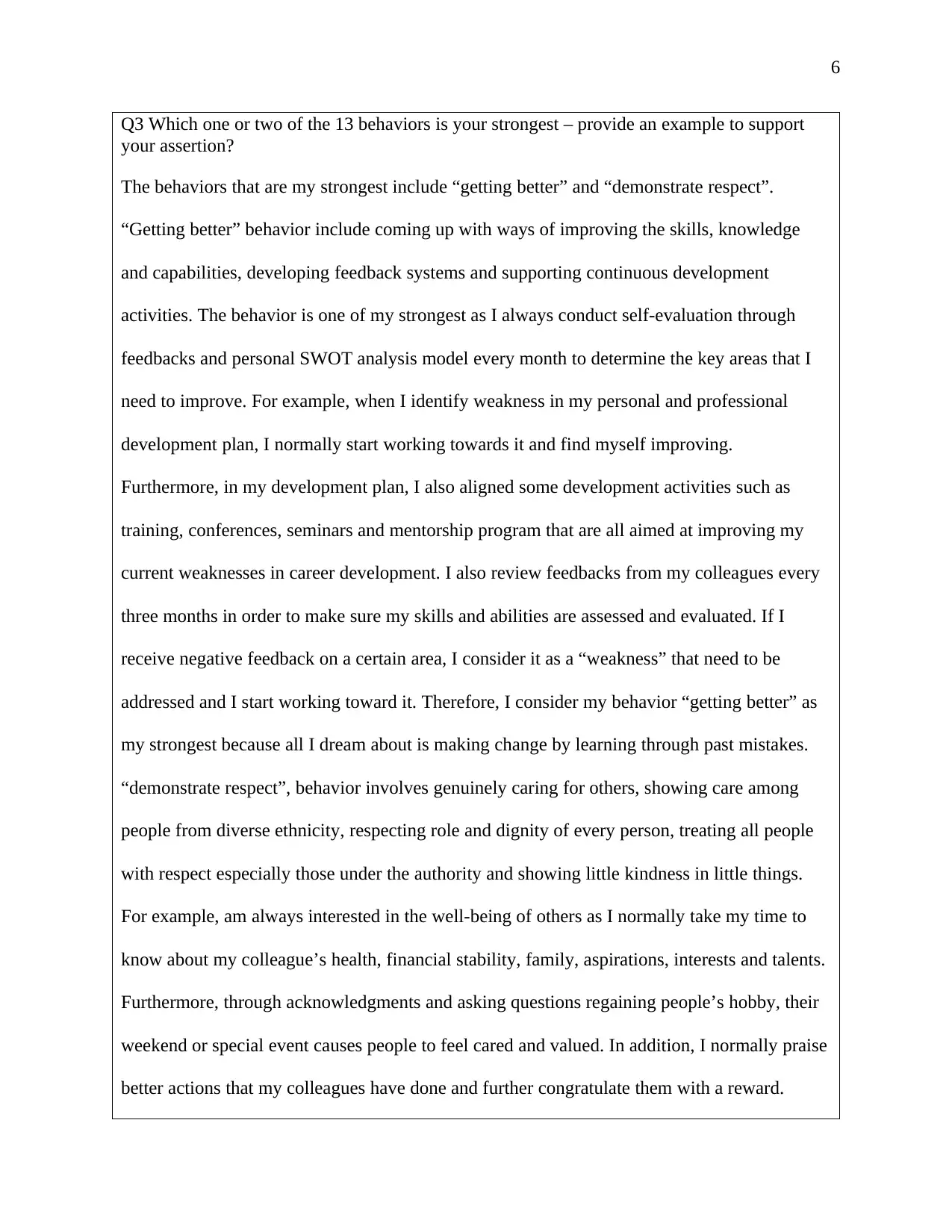
Q3 Which one or two of the 13 behaviors is your strongest – provide an example to support
your assertion?
The behaviors that are my strongest include “getting better” and “demonstrate respect”.
“Getting better” behavior include coming up with ways of improving the skills, knowledge
and capabilities, developing feedback systems and supporting continuous development
activities. The behavior is one of my strongest as I always conduct self-evaluation through
feedbacks and personal SWOT analysis model every month to determine the key areas that I
need to improve. For example, when I identify weakness in my personal and professional
development plan, I normally start working towards it and find myself improving.
Furthermore, in my development plan, I also aligned some development activities such as
training, conferences, seminars and mentorship program that are all aimed at improving my
current weaknesses in career development. I also review feedbacks from my colleagues every
three months in order to make sure my skills and abilities are assessed and evaluated. If I
receive negative feedback on a certain area, I consider it as a “weakness” that need to be
addressed and I start working toward it. Therefore, I consider my behavior “getting better” as
my strongest because all I dream about is making change by learning through past mistakes.
“demonstrate respect”, behavior involves genuinely caring for others, showing care among
people from diverse ethnicity, respecting role and dignity of every person, treating all people
with respect especially those under the authority and showing little kindness in little things.
For example, am always interested in the well-being of others as I normally take my time to
know about my colleague’s health, financial stability, family, aspirations, interests and talents.
Furthermore, through acknowledgments and asking questions regaining people’s hobby, their
weekend or special event causes people to feel cared and valued. In addition, I normally praise
better actions that my colleagues have done and further congratulate them with a reward.
Document Page
7
Q4 Which one or two of the 13 behaviors do you need to develop further – provide an example
to support your assertion?
The behaviors that I urgently need to develop further is “deliver results” and “practice and
accountability. “Deliver results” behavior expects a person establish an effective track of good
performances, accomplish the tasks delegated and be on time or within a budget. However,
basing on my personal self-evaluation and the way I have handled previous tasks, I have not
been able to deliver effective results. For example, am very poor in multi-tasking and therefore
delivering effective results on a very busy environment remains to be my greatest challenge.
When I reflect back to my previous targets, deadlines and outcomes, it is clear that my results
are inconsistent with sometimes performing well and meeting targets and other times failing to
meet the deadlines. Furthermore, weighing both situations, it is clear that most of the time I
have failed to deliver tasks within the set deadlines. I have also had so many excuses after
failing to deliver with sometimes complaining about power failure, technical problems with
my computer, network failures and poor leadership.
“Practice accountability” is another key behavior that I need to improve. “Practice
accountability” involves a person holding himself or herself accountable, holding others
accountable and taking responsibility for results. However, I do not like taking responsibility
for results or holding accountable for other people mistakes. For example, If we were working
on a particular project that I was a team leader and it fails to deliver as expected, I normally
start blaming team members for playing a part towards the failure of the project. In addition,
although am a team leader, I believe “everybody should carry his or her own cross” and
therefore I do not take responsibilities. Hord (2009) once said,” a true team leader takes
tabler-icon-diamond-filled.svg

Paraphrase This Document

Need a fresh take? Get an instant paraphrase of this document with our AI Paraphraser
Document Page
8
responsibilities of other members” and therefore I need to improve on this area in order to be
the effective team leader in the future.
References
Hord, S.M., 2009. Professional learning communities. Journal of staff development, 30(1),
pp.40-43.
chevron_up_icon
1 out of 8
circle_padding
hide_on_mobile
zoom_out_icon
[object Object]