Simio Simulation: Label Printer Workstation Analysis and Design
VerifiedAdded on 2023/01/05
|14
|1931
|79
Project
AI Summary
This project report focuses on the performance evaluation, analysis, and design of a label printer workstation using discrete event simulation software, specifically Simio. The report begins with an introduction, problem statement, and justification, followed by a literature review on discrete event simulation methodologies. The methodology section details data collection, model building, verification, and validation processes. Key variables, including employee numbers, machine counts, processing times, and inter-arrival times, are defined. The project uses secondary data from academic sources and previous studies to construct a Simio model of the workstation. The report outlines experimental scenarios and analyses, with the aim of identifying areas for improvement. The Simio simulation software allows for the creation of various scenarios by manipulating input variables. The findings include a time action plan, and the report concludes with recommendations for workstation optimization. The project provides a practical application of discrete event simulation in a manufacturing setting, with a focus on enhancing productivity and efficiency. The report also references several relevant studies and provides a Simio model as an appendix.

Performance evaluation, analysis and design of label printer workstation using discrete event
simulation (Simio)
simulation (Simio)
Paraphrase This Document
Need a fresh take? Get an instant paraphrase of this document with our AI Paraphraser

1
Abstract
Abstract

2
Table of Contents
1. Introduction.........................................................................................................................3
2. Statement of the Problem....................................................................................................3
3. Significance of the Problem................................................................................................3
4. Purpose of the Project.........................................................................................................3
5. Definitions..........................................................................................................................3
6. Assumptions........................................................................................................................3
7. Delimitations.......................................................................................................................3
8. Limitations..........................................................................................................................3
9. Review of literature............................................................................................................4
10. Procedures.......................................................................................................................6
11. Data or Findings..............................................................................................................7
12. Time action plan..............................................................................................................7
13. Conclusion.......................................................................................................................7
14. References.......................................................................................................................7
15. Appendices......................................................................................................................7
Table of Contents
1. Introduction.........................................................................................................................3
2. Statement of the Problem....................................................................................................3
3. Significance of the Problem................................................................................................3
4. Purpose of the Project.........................................................................................................3
5. Definitions..........................................................................................................................3
6. Assumptions........................................................................................................................3
7. Delimitations.......................................................................................................................3
8. Limitations..........................................................................................................................3
9. Review of literature............................................................................................................4
10. Procedures.......................................................................................................................6
11. Data or Findings..............................................................................................................7
12. Time action plan..............................................................................................................7
13. Conclusion.......................................................................................................................7
14. References.......................................................................................................................7
15. Appendices......................................................................................................................7
⊘ This is a preview!⊘
Do you want full access?
Subscribe today to unlock all pages.

Trusted by 1+ million students worldwide

3
1. Introduction
This report gives an overview of the discrete event simulation analysis carried out.
Here the SIMIO software tool is used for the development of design and simulation. At first,
the basic design is developed using the SIMIO software. Then the simulation will be
conducted. Conducted methodology and findings are explained in this report.
2. Statement of the Problem
3. Significance of the Problem
4. Purpose of the Project
5. Definitions
6. Assumptions
7. Delimitations
1. Introduction
This report gives an overview of the discrete event simulation analysis carried out.
Here the SIMIO software tool is used for the development of design and simulation. At first,
the basic design is developed using the SIMIO software. Then the simulation will be
conducted. Conducted methodology and findings are explained in this report.
2. Statement of the Problem
3. Significance of the Problem
4. Purpose of the Project
5. Definitions
6. Assumptions
7. Delimitations
Paraphrase This Document
Need a fresh take? Get an instant paraphrase of this document with our AI Paraphraser

4
8. Limitations
8. Limitations

5
9. Review of literature
Important objectives and challenges in today’s manufacturing environment include
the introduction of new products variants and the designing and developing of reconfigurable
manufacturing systems. Due to changing customer requirements, products development time
is shorter and manufacturing system’s ability to physically reconfigure is important. The
objective of this research is to investigate and support the reconfigurability of a
manufacturing system by applying hybridized Agent-based and Discrete-Event simulation
modelling technique. Emergent behavior of the simulation model, when various
modifications take place in the system, is examined. The benefits of this framework are
decentralized control and collaborative decision making using the UML object-oriented
modelling technique, flexible reaction to system changes in terms of product variety and
possible system disturbances, and system performance improvement. AnyLogic multi-
method simulation modelling platform is utilized to design and create different types of
agents. The proposed simulation model results are demonstrated and verified in a case study
using the configurable assembly Learning Factory (iFactory) in the Intelligent Manufacturing
Systems (IMS) Center at the University of Windsor. The benefits and limitations of the
proposed framework are discussed.
The proposed framework for hybrid agent-based discrete event simulation has several
advantages in terms of using state charts behaviour models for constructing different agents
types which forms the agent-based simulation model and using different types of if-then-else
coding for condition analysis for each agent enables the changeability of the iFactory model
for better managing the product variety. Also, process modelling agent blocks definition
enables creation of discrete-event simulation model through AnyLogic software for the real-
time control of different processes performances and sequencing of production which
previously defined agents hybridizes throughout the discrete event model in order to have
meaningful function. On the other hand, there is also a disadvantage when using this
framework which is the medium-high level of complexity to build the hybrid simulation
model because in a different and bigger size case study it might be needed to develop
complicated java codes and relationships between different agent types to deliver the required
functions.
9. Review of literature
Important objectives and challenges in today’s manufacturing environment include
the introduction of new products variants and the designing and developing of reconfigurable
manufacturing systems. Due to changing customer requirements, products development time
is shorter and manufacturing system’s ability to physically reconfigure is important. The
objective of this research is to investigate and support the reconfigurability of a
manufacturing system by applying hybridized Agent-based and Discrete-Event simulation
modelling technique. Emergent behavior of the simulation model, when various
modifications take place in the system, is examined. The benefits of this framework are
decentralized control and collaborative decision making using the UML object-oriented
modelling technique, flexible reaction to system changes in terms of product variety and
possible system disturbances, and system performance improvement. AnyLogic multi-
method simulation modelling platform is utilized to design and create different types of
agents. The proposed simulation model results are demonstrated and verified in a case study
using the configurable assembly Learning Factory (iFactory) in the Intelligent Manufacturing
Systems (IMS) Center at the University of Windsor. The benefits and limitations of the
proposed framework are discussed.
The proposed framework for hybrid agent-based discrete event simulation has several
advantages in terms of using state charts behaviour models for constructing different agents
types which forms the agent-based simulation model and using different types of if-then-else
coding for condition analysis for each agent enables the changeability of the iFactory model
for better managing the product variety. Also, process modelling agent blocks definition
enables creation of discrete-event simulation model through AnyLogic software for the real-
time control of different processes performances and sequencing of production which
previously defined agents hybridizes throughout the discrete event model in order to have
meaningful function. On the other hand, there is also a disadvantage when using this
framework which is the medium-high level of complexity to build the hybrid simulation
model because in a different and bigger size case study it might be needed to develop
complicated java codes and relationships between different agent types to deliver the required
functions.
⊘ This is a preview!⊘
Do you want full access?
Subscribe today to unlock all pages.

Trusted by 1+ million students worldwide

6
Building motorized energy works had some problems. Replication is mainly used for
modelling and application of these systems. Examples are crankshaft machining line, engine
final assembly, etc. Various appliances and program sub-associations are gathered in isolated
structures. The entire sub-associations are gathered to the broadcast association. There are
several parts among an energy association plant that describes problematic mannerisms
because of the changing environment of building procedures. The example for a top arbitrary
process is the parts where testing occurs and the entire association is detected for the current
characteristics. Replication is a helpful device for detecting the mannerisms of the
problematic structures. This paperwork deliberates for the requirements and applications of
distinct things replication in the model of building structures for energy associations. The
merits of these solicitations of replication are demonstrated by utilizing a training of the
entire engine checking as well as the part of the renovation.
Distinct occurrence replication had highly used in the modelling as well as the
operation of motorized energy construction schemes. Specifically, in engine and broadcast
generation structures the part of analysis had highly active as well as it needs cautious
considerations for modelling and working viewpoint. Distinct occurrence replication had
utilized in the areas of modelling and analysis as well as the ordering of the assessment for
better outputs. The main problems in PLC had been inspected by utilizing replication to
protect time and expenditure at a definite application. It offered a solicitation of replication in
the area of modelling of the same systems. The main goal of this paper had to present the
reader to a minute problematic part in motorized building structures where replication had
been incremented by utilizing it as a model as well as for repairing purposes.
Building motorized energy works had some problems. Replication is mainly used for
modelling and application of these systems. Examples are crankshaft machining line, engine
final assembly, etc. Various appliances and program sub-associations are gathered in isolated
structures. The entire sub-associations are gathered to the broadcast association. There are
several parts among an energy association plant that describes problematic mannerisms
because of the changing environment of building procedures. The example for a top arbitrary
process is the parts where testing occurs and the entire association is detected for the current
characteristics. Replication is a helpful device for detecting the mannerisms of the
problematic structures. This paperwork deliberates for the requirements and applications of
distinct things replication in the model of building structures for energy associations. The
merits of these solicitations of replication are demonstrated by utilizing a training of the
entire engine checking as well as the part of the renovation.
Distinct occurrence replication had highly used in the modelling as well as the
operation of motorized energy construction schemes. Specifically, in engine and broadcast
generation structures the part of analysis had highly active as well as it needs cautious
considerations for modelling and working viewpoint. Distinct occurrence replication had
utilized in the areas of modelling and analysis as well as the ordering of the assessment for
better outputs. The main problems in PLC had been inspected by utilizing replication to
protect time and expenditure at a definite application. It offered a solicitation of replication in
the area of modelling of the same systems. The main goal of this paper had to present the
reader to a minute problematic part in motorized building structures where replication had
been incremented by utilizing it as a model as well as for repairing purposes.
Paraphrase This Document
Need a fresh take? Get an instant paraphrase of this document with our AI Paraphraser

7
10. Procedures
10.1Problem Analysis
At the initial stage, the given problem is analyzed deeply. From those requirements of
the project are identified. Also, the need for this project and its significance on the
performance improvement are analyzed in this stage.
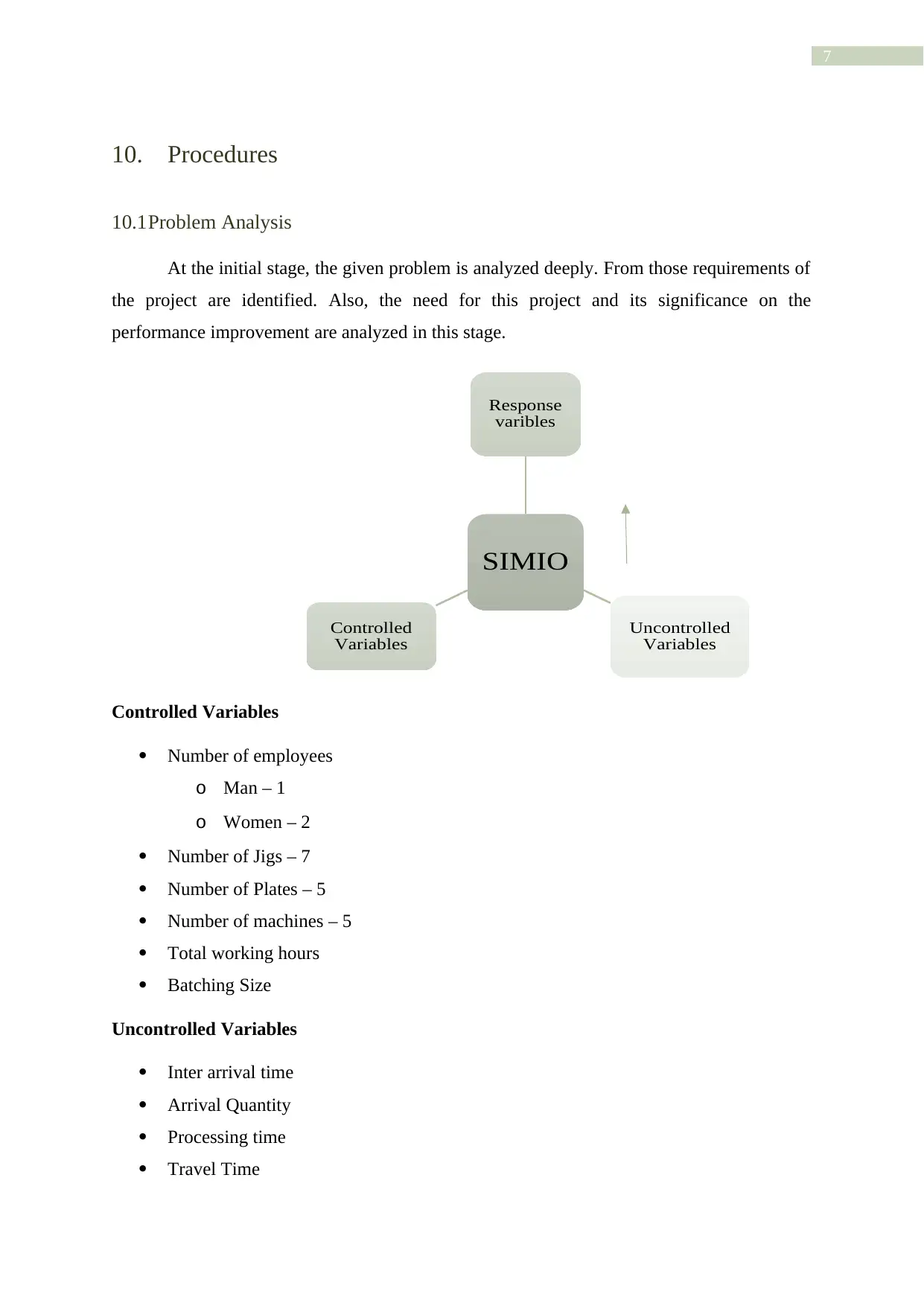
Controlled Variables
Number of employees
o Man – 1
o Women – 2
Number of Jigs – 7
Number of Plates – 5
Number of machines – 5
Total working hours
Batching Size
Uncontrolled Variables
Inter arrival time
Arrival Quantity
Processing time
Travel Time
SIMIO
Response
varibles
Uncontrolled
Variables
Controlled
Variables
10. Procedures
10.1Problem Analysis
At the initial stage, the given problem is analyzed deeply. From those requirements of
the project are identified. Also, the need for this project and its significance on the
performance improvement are analyzed in this stage.
Controlled Variables
Number of employees
o Man – 1
o Women – 2
Number of Jigs – 7
Number of Plates – 5
Number of machines – 5
Total working hours
Batching Size
Uncontrolled Variables
Inter arrival time
Arrival Quantity
Processing time
Travel Time
SIMIO
Response
varibles
Uncontrolled
Variables
Controlled
Variables

8
Response Variables
Average time in systems
Average number in systems
Average utilization of employees
Average machine utilization
10.2 Literature review process
Then the project starts with literature analysis. Where the different pieces of literature
related to the discrete event simulation process are reviewed. From the literature review, we
can get the basic outline of the process. It acts as guidelines to do the project.
10.3 Data Collection
For carry out the simulation, we need some data like inter-arrival time etc. These data
are collected from the previous works. In this research, all the data used are secondary data.
They are collected from the standard resources like previous study, thesis and academic
journals etc.
10.4 Model building
10.5 Verification and Validation
The computer simulation program executes due to the analysis of verification. The
purpose of the abstract simulation model is validation. It is a precise depiction of the correct
system that is modeled. The base architecture indicated the present condition of the
construction method of the company. The verification and validation are completed through
this architecture. A small validation was achieved by determining the consequences of the
parameters output. It was from the base architecture with the help of manufacture employees
of the company.
10.6 Experimentation
To create experimentation, we must create, verify and validate the base architecture.
This experimentation is mostly used for developing scenarios by altering organized input
variables. It is used to develop the base architecture. Model building implies validation and
verification. Experimentation was completed repeatedly, development was done in steps as
Response Variables
Average time in systems
Average number in systems
Average utilization of employees
Average machine utilization
10.2 Literature review process
Then the project starts with literature analysis. Where the different pieces of literature
related to the discrete event simulation process are reviewed. From the literature review, we
can get the basic outline of the process. It acts as guidelines to do the project.
10.3 Data Collection
For carry out the simulation, we need some data like inter-arrival time etc. These data
are collected from the previous works. In this research, all the data used are secondary data.
They are collected from the standard resources like previous study, thesis and academic
journals etc.
10.4 Model building
10.5 Verification and Validation
The computer simulation program executes due to the analysis of verification. The
purpose of the abstract simulation model is validation. It is a precise depiction of the correct
system that is modeled. The base architecture indicated the present condition of the
construction method of the company. The verification and validation are completed through
this architecture. A small validation was achieved by determining the consequences of the
parameters output. It was from the base architecture with the help of manufacture employees
of the company.
10.6 Experimentation
To create experimentation, we must create, verify and validate the base architecture.
This experimentation is mostly used for developing scenarios by altering organized input
variables. It is used to develop the base architecture. Model building implies validation and
verification. Experimentation was completed repeatedly, development was done in steps as
⊘ This is a preview!⊘
Do you want full access?
Subscribe today to unlock all pages.

Trusted by 1+ million students worldwide

9
the learning curve was accumulated. The number of repetition per both scenarios were
estimated by the experimentation.
10.7 Analysis & Recommendations
When adequate research was done, the last phase had to examine the outcome as well
as to provide a reference for device enhancement. This training utilized Simio Replication as
well as Planning Software, made by Simio LLC, for construction of this design. Simio
implements an entity dependent attitude to the software, creating the contrasting presentation,
such as for modeling line up policy for enhancing the happiness of consumer. [17], or
detecting a process in a port planning method [18], and calculating invention link power
utilization [19]. By using Simio, users can choose to construct chunks from libraries. Then
sketchily put them in the design by simplest drag-and-drop methods. Every construction
chunk denotes a corporeal element in a usual system like server, workspace, carrier, operator
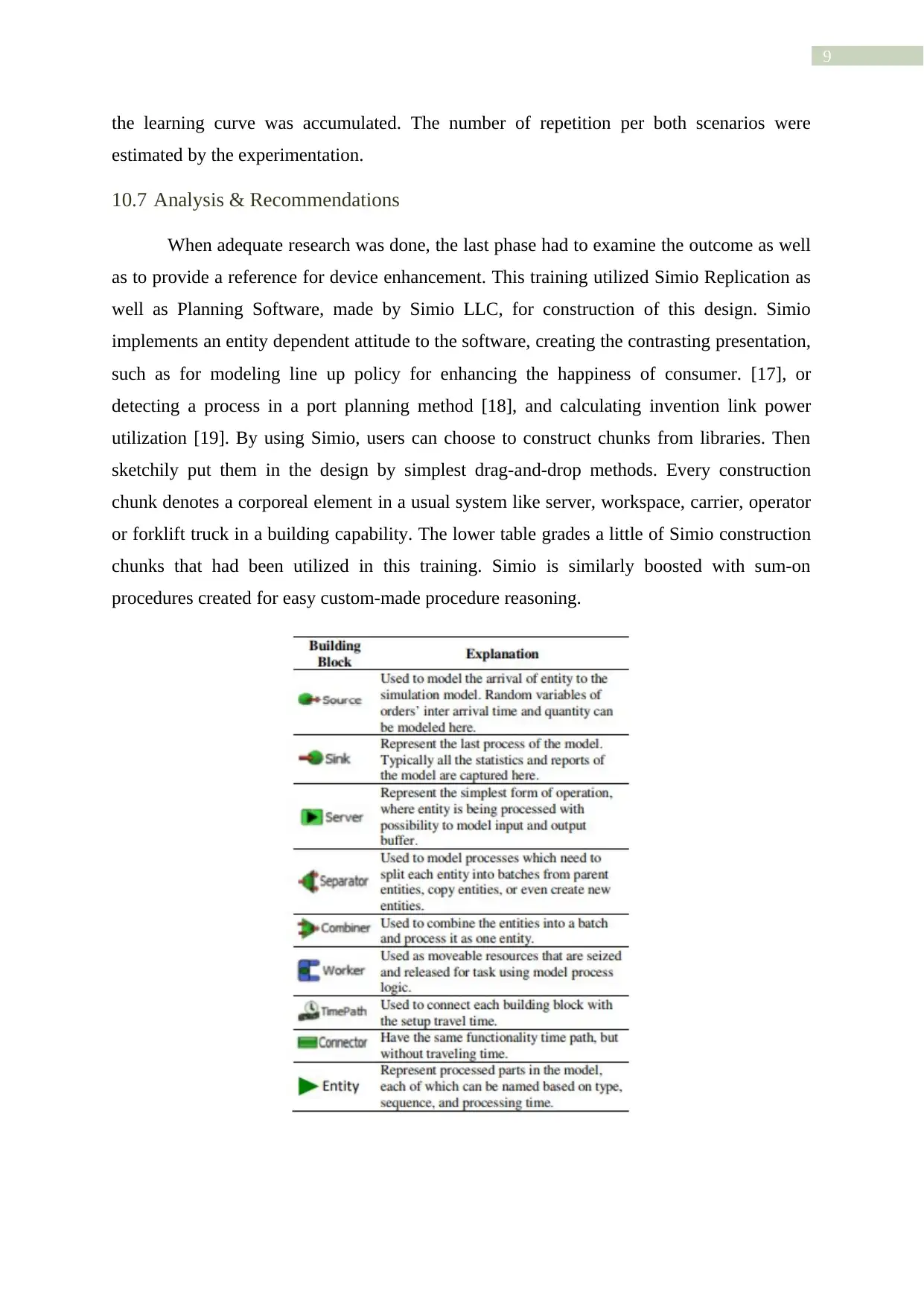
or forklift truck in a building capability. The lower table grades a little of Simio construction
chunks that had been utilized in this training. Simio is similarly boosted with sum-on
procedures created for easy custom-made procedure reasoning.
the learning curve was accumulated. The number of repetition per both scenarios were
estimated by the experimentation.
10.7 Analysis & Recommendations
When adequate research was done, the last phase had to examine the outcome as well
as to provide a reference for device enhancement. This training utilized Simio Replication as
well as Planning Software, made by Simio LLC, for construction of this design. Simio
implements an entity dependent attitude to the software, creating the contrasting presentation,
such as for modeling line up policy for enhancing the happiness of consumer. [17], or
detecting a process in a port planning method [18], and calculating invention link power
utilization [19]. By using Simio, users can choose to construct chunks from libraries. Then
sketchily put them in the design by simplest drag-and-drop methods. Every construction
chunk denotes a corporeal element in a usual system like server, workspace, carrier, operator
or forklift truck in a building capability. The lower table grades a little of Simio construction
chunks that had been utilized in this training. Simio is similarly boosted with sum-on
procedures created for easy custom-made procedure reasoning.
Paraphrase This Document
Need a fresh take? Get an instant paraphrase of this document with our AI Paraphraser

10
11. Data or Findings
12. Time action plan
13. Conclusion
11. Data or Findings
12. Time action plan
13. Conclusion

11
14. References
Barrera-Diaz, C., Oscarsson, J., Lidberg, S., & Sellgren, T. (2018). Discrete Event Simulation
Output Data-Handling System in an Automotive Manufacturing Plant. Procedia
Manufacturing, 25, 23-30. doi: 10.1016/j.promfg.2018.06.053
Bokrantz, J., Skoogh, A., Lämkull, D., Hanna, A., & Perera, T. (2017). Data quality problems
in discrete event simulation of manufacturing operations. SIMULATION, 94(11), 1009-
1025. doi: 10.1177/0037549717742954
Kampa, A., Gołda, G., & Paprocka, I. (2017). Discrete Event Simulation Method as a Tool
for Improvement of Manufacturing Systems. Computers, 6(1), 10. doi:
10.3390/computers6010010
Morshedzadeh, I., Oscarsson, J., Ng, A., Aslam, T., & Frantzén, M. (2018). Multi-level
management of discrete event simulation models in a product lifecycle management
framework. Procedia Manufacturing, 25, 74-81. doi: 10.1016/j.promfg.2018.06.059
Omogbai, O., & Salonitis, K. (2016). Manufacturing System Lean Improvement Design
Using Discrete Event Simulation. Procedia CIRP, 57, 195-200. doi:
10.1016/j.procir.2016.11.034
Patil, R. (2012). Discrete Event Simulation for Increasing Productivity in Digital
Manufacturing. SSRN Electronic Journal. doi: 10.2139/ssrn.2105005
Rana, M., Jobayer, M., Kumar, R., & Mostafizur, M. (2012). A Discrete Event Barber Shop
Simulation. International Journal Of Advanced Computer Science And
Applications, 3(2). doi: 10.14569/ijacsa.2012.030212
Stoldt, J., Schlegel, A., & Putz, M. (2016). Enhanced integration of energy-related
considerations in discrete event simulation for manufacturing applications. Journal Of
Simulation, 10(2), 113-122. doi: 10.1057/jos.2015.24
Velumani, S., & Tang, H. (2017). Operations Status and Bottleneck Analysis and
Improvement of a Batch Process Manufacturing Line Using Discrete Event
Simulation. Procedia Manufacturing, 10, 100-111. doi: 10.1016/j.promfg.2017.07.033
14. References
Barrera-Diaz, C., Oscarsson, J., Lidberg, S., & Sellgren, T. (2018). Discrete Event Simulation
Output Data-Handling System in an Automotive Manufacturing Plant. Procedia
Manufacturing, 25, 23-30. doi: 10.1016/j.promfg.2018.06.053
Bokrantz, J., Skoogh, A., Lämkull, D., Hanna, A., & Perera, T. (2017). Data quality problems
in discrete event simulation of manufacturing operations. SIMULATION, 94(11), 1009-
1025. doi: 10.1177/0037549717742954
Kampa, A., Gołda, G., & Paprocka, I. (2017). Discrete Event Simulation Method as a Tool
for Improvement of Manufacturing Systems. Computers, 6(1), 10. doi:
10.3390/computers6010010
Morshedzadeh, I., Oscarsson, J., Ng, A., Aslam, T., & Frantzén, M. (2018). Multi-level
management of discrete event simulation models in a product lifecycle management
framework. Procedia Manufacturing, 25, 74-81. doi: 10.1016/j.promfg.2018.06.059
Omogbai, O., & Salonitis, K. (2016). Manufacturing System Lean Improvement Design
Using Discrete Event Simulation. Procedia CIRP, 57, 195-200. doi:
10.1016/j.procir.2016.11.034
Patil, R. (2012). Discrete Event Simulation for Increasing Productivity in Digital
Manufacturing. SSRN Electronic Journal. doi: 10.2139/ssrn.2105005
Rana, M., Jobayer, M., Kumar, R., & Mostafizur, M. (2012). A Discrete Event Barber Shop
Simulation. International Journal Of Advanced Computer Science And
Applications, 3(2). doi: 10.14569/ijacsa.2012.030212
Stoldt, J., Schlegel, A., & Putz, M. (2016). Enhanced integration of energy-related
considerations in discrete event simulation for manufacturing applications. Journal Of
Simulation, 10(2), 113-122. doi: 10.1057/jos.2015.24
Velumani, S., & Tang, H. (2017). Operations Status and Bottleneck Analysis and
Improvement of a Batch Process Manufacturing Line Using Discrete Event
Simulation. Procedia Manufacturing, 10, 100-111. doi: 10.1016/j.promfg.2017.07.033
⊘ This is a preview!⊘
Do you want full access?
Subscribe today to unlock all pages.

Trusted by 1+ million students worldwide
1 out of 14
Related Documents
Your All-in-One AI-Powered Toolkit for Academic Success.
+13062052269
info@desklib.com
Available 24*7 on WhatsApp / Email
Unlock your academic potential
Copyright © 2020–2026 A2Z Services. All Rights Reserved. Developed and managed by ZUCOL.