University Project: System Analysis and Design for World Tours Report

Verified

Added on  2023/01/16

|11
|1767
|74
Report
AI Summary
This report presents a system analysis for World Tours, an online travel and tour company. The assignment focuses on the Software Development Life Cycle (SDLC), exploring various methodologies like the Waterfall Model, and adaptive/predictive methods. The chosen methodology for World Tours is the Waterfall Model. The report details requirement gathering, including both functional requirements such as customer registration, tour information viewing, and online payment, and non-functional requirements. An activity diagram is provided to illustrate the system's execution procedure. The report concludes by summarizing the design, structure, and execution procedure of the system, offering a comprehensive overview of the software development process for World Tours.

Document Page
Running head: SYSTEM ANALYSIS FOR WORLD TOURS
System Analysis for World Tours
Name of the student:
Name of the university:
Author Note:
tabler-icon-diamond-filled.svg

Paraphrase This Document

Need a fresh take? Get an instant paraphrase of this document with our AI Paraphraser
Document Page
1SYSTEM ANALYSIS FOR WORLD TOURS
Executive Summary
The main perception of the assignment is to deal with software development life cycle of an
online tours and travels. In this report, the company as chosen is named as World Tours. The
methodology used for the development of the software development life cycle is provide in
the report, which clearly states the flow of the system. Moreover, the activity diagram of the
system flow is also provided which clearly states the execution procedure of the system.
Document Page
2SYSTEM ANALYSIS FOR WORLD TOURS
Table of Contents
1. Introduction............................................................................................................................3
2. Methodologies........................................................................................................................3
2.1 System Development Life Cycle.....................................................................................3
2.2 Adaptive and Predictive methods for SDLC....................................................................5
2.3 Chosen Methodology for World Tours............................................................................5
2.4 Requirement Gathering....................................................................................................6
2.5 Requirements of the system.............................................................................................7
2.6 Requirement Modelling...................................................................................................7
3. Conclusion..............................................................................................................................9
References................................................................................................................................10
Document Page
3SYSTEM ANALYSIS FOR WORLD TOURS
1. Introduction
The perception of this assignment is to deal with the methodologies and methods that
are associated with the system of World Tours. This online portal provides its users with the
different types of offered packages, the overall guide of the tour, as well as with the
information of the staffs that are associated with the tour (Giaoutzi, 2017). In this assignment
the system development life cycle of the online travel management system, the
methodologies used for the overall enhancement of the cycle as well as the modelling
structures are also provided.
2. Methodologies
2.1 System Development Life Cycle
The System Development Life Cycle is said to be a conceptual model, which is used
in project management for describing the stages of an information system development
project (Abrahamsson et al., 2017). A system analyst uses this SDLC for developing the
information system, including the requirements, the validation, the validation of the owner
following analysis, implementation, investigation, design as well as maintenance.
The System Development Life Cycle goes through seven phases (Lemke, 2018).
These phases are described below:
Planning: This phase focuses on the project scope. The outputs of this phase includes plans
of the project, schedules regarding the project, the estimated costs as well as with the
requirements for the procurement of the whole system.
Requirements: The software development team then starts gathering the information
regarding the requirements of the system that is to be developed.
tabler-icon-diamond-filled.svg

Paraphrase This Document

Need a fresh take? Get an instant paraphrase of this document with our AI Paraphraser
Document Page
4SYSTEM ANALYSIS FOR WORLD TOURS
Designing: After the requirements have been gathered, the design procedure is carried out
which uses the patterns that are established for the architectural development of the system.
Software Development: This phase deals with the actual development procedure of the
software. The output from this phase is a testable as well as a functional software.
Testing: In this phase of the SDLC, the functional software is tested using the methods like
unit testing, quality of code as well as integration testing. The output of this phase is an
effective software that is said to be ready for the deployment in the environment of
production.
Deployment: This phase deals with the deployment of the software in high-level as well as in
low-level enterprises. The output of this phase deals with the production release of the
particular software.
Operations and Maintenance: This is the phase where the maintenance of the software is to
be constantly done so that it can be ensured that the operation of the whole system is quite
effective.
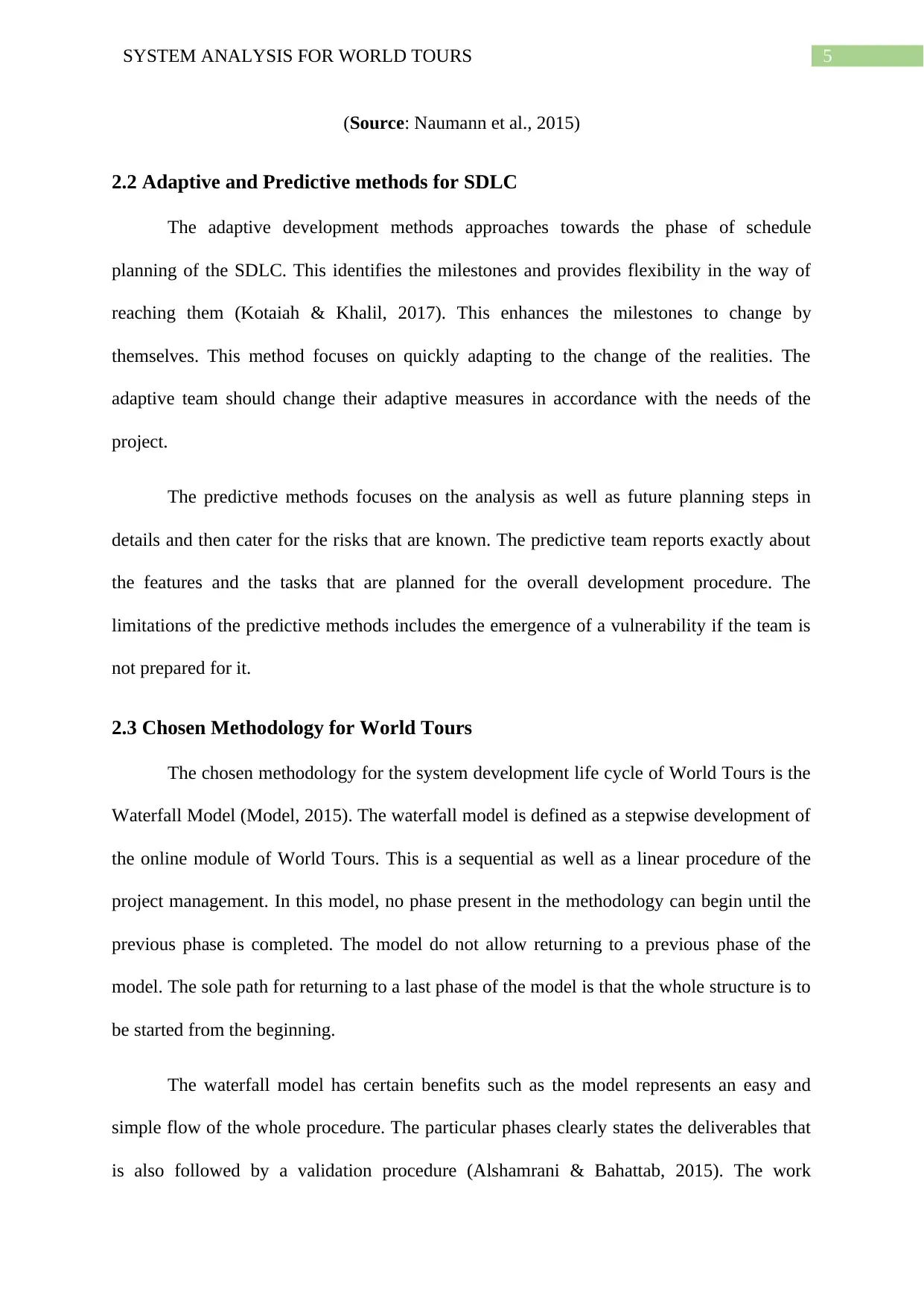
The diagrammatic representation of the system development life cycle is provided
below:
System Development Life Cycle
Document Page
5SYSTEM ANALYSIS FOR WORLD TOURS
(Source: Naumann et al., 2015)
2.2 Adaptive and Predictive methods for SDLC
The adaptive development methods approaches towards the phase of schedule
planning of the SDLC. This identifies the milestones and provides flexibility in the way of
reaching them (Kotaiah & Khalil, 2017). This enhances the milestones to change by
themselves. This method focuses on quickly adapting to the change of the realities. The
adaptive team should change their adaptive measures in accordance with the needs of the
project.
The predictive methods focuses on the analysis as well as future planning steps in
details and then cater for the risks that are known. The predictive team reports exactly about
the features and the tasks that are planned for the overall development procedure. The
limitations of the predictive methods includes the emergence of a vulnerability if the team is
not prepared for it.
2.3 Chosen Methodology for World Tours
The chosen methodology for the system development life cycle of World Tours is the
Waterfall Model (Model, 2015). The waterfall model is defined as a stepwise development of
the online module of World Tours. This is a sequential as well as a linear procedure of the
project management. In this model, no phase present in the methodology can begin until the
previous phase is completed. The model do not allow returning to a previous phase of the
model. The sole path for returning to a last phase of the model is that the whole structure is to
be started from the beginning.
The waterfall model has certain benefits such as the model represents an easy and
simple flow of the whole procedure. The particular phases clearly states the deliverables that
is also followed by a validation procedure (Alshamrani & Bahattab, 2015). The work
Document Page
6SYSTEM ANALYSIS FOR WORLD TOURS
progress can be tracked in an effective way. It is a very effective model for coping with the
overall business requirements. This model is very simple as well as feasible. The effective
water model is stated in the picture below:
Waterfall Model
(Source: Created by author)
2.4 Requirement Gathering
From the above case study, the requirements are said to be comprehensive
information that are needed to start with the project. These requirements can be noted for the
client’s end in a various number of ways that includes interview session with the client, the
questionnaires that are to be asked regarding the information of the clients and brainstorming
from the software developer’s end (Ratul, Ahmed & Gisan, 2019).
tabler-icon-diamond-filled.svg

Paraphrase This Document

Need a fresh take? Get an instant paraphrase of this document with our AI Paraphraser
Document Page
7SYSTEM ANALYSIS FOR WORLD TOURS
The interview procedure will help to have a critical face-to-face analysis of the whole
system requirements that will be mentioned by the client.
The questionnaires may be hand written and this has to be provided in a documented
format to the software development team.
2.5 Requirements of the system
The requirements of a system may be divided into two parts:
Functional Requirements: The functional requirements of the system for the development of
the online tours are stated as follows:
a) Registration of the customers is necessary for logging in to the website.
b) The customers can have the view of all the information regarding the hotel as well as
destinations.
c) The customers van review the places before booking.
d) The booking confirmation of the selected destination is to be verified from the admin end.
e) The secure payment gateway is to be used by the customers for making payment online.
Non-Functional Requirements: The non-functional requirements of the system for World
tours are sated below:
a) The customers do not have the authority to challenge the system for the fun travel.
b) The customers should be provided with the facility to add new places in the system.
2.6 Requirement Modelling
The activity diagram for the assessment of the requirements of the module is provided
below:
Document Page
8SYSTEM ANALYSIS FOR WORLD TOURS
ACTIVITY DIAGRAM
(Source: Created by Author)
Document Page
9SYSTEM ANALYSIS FOR WORLD TOURS
3. Conclusion
This above assignment deals with the Software Development Life Cycle of the online
tours and travels company that is World Tours. The Waterfall Model is provided which is
said to be an effective one for the development of the online module of the system. Finally,
the assignment is concluded with the activity diagram of the execution procedure of the
whole system. Thus it can be said that this assignment puts an overall reflection of the design
of the system, the system structure as well as the execution procedure of the whole system.
tabler-icon-diamond-filled.svg

Paraphrase This Document

Need a fresh take? Get an instant paraphrase of this document with our AI Paraphraser
Document Page
10SYSTEM ANALYSIS FOR WORLD TOURS
References
Abrahamsson, P., Salo, O., Ronkainen, J., & Warsta, J. (2017). Agile software development
methods: Review and analysis. arXiv preprint arXiv:1709.08439.
Alshamrani, A., & Bahattab, A. (2015). A comparison between three SDLC models waterfall
model, spiral model, and Incremental/Iterative model. International Journal of
Computer Science Issues (IJCSI), 12(1), 106.
Giaoutzi, M. (2017). Tourism and regional development: New pathways. Routledge.
Kotaiah, B., & Khalil, M. A. (2017). Approaches for development of Software Projects:
Agile methodology. International Journal of Advanced Research in Computer
Science, 8(1).
Lemke, G. (2018). The Software Development Life Cycle and Its Application.
Model, W. (2015). Waterfall model. Luettavissa: http://www. waterfall-model. com/. Luettu,
3.
Naumann, S., Kern, E., Dick, M., & Johann, T. (2015). Sustainable software engineering:
Process and quality models, life cycle, and social aspects. In ICT Innovations for
Sustainability (pp. 191-205). Springer, Cham.
Ratul, A. S., Ahmed, S., & Gisan, F. (2019). Travelersofbd: An Online Travelers Platform
(Doctoral dissertation).
chevron_up_icon
1 out of 11
circle_padding
hide_on_mobile
zoom_out_icon
[object Object]