Law of International Trade: A Report on WTO Legislation and Sources
VerifiedAdded on 2023/06/12
|10
|3097
|498
Report
AI Summary
This report provides an overview of the World Trade Organization (WTO) law and its role in governing international trade. It emphasizes the legislation, rules, and regulations that support trade between nations, focusing on trade liberalization and the WTO's intervention in complex trade situations. The report discusses the WTO's role in overseeing trade in goods, services, and intellectual property, promoting liberalization while accommodating member state expectations. It also covers the essential rules and legislative requirements for companies involved in international trade, such as proper trading plans, technology utilization, capital protection, market analysis, and fair pricing. Furthermore, it explores the sources of WTO law, including regional legislations, primary and secondary sources, case laws, and general customs, highlighting the organization's commitment to fairness and ethical conduct in international trade transactions. Desklib provides this and other solved assignments to aid students in their studies.
LAW OF INTERNATIONAL
TRADE
1
TRADE
1

Paraphrase This Document
Need a fresh take? Get an instant paraphrase of this document with our AI Paraphraser
Table of Contents
INTRODUCTION...........................................................................................................................3
MAIN BODY...................................................................................................................................3
Assessment question....................................................................................................................3
CONCLUSION ...............................................................................................................................9
REFERENCES................................................................................................................................9
2
INTRODUCTION...........................................................................................................................3
MAIN BODY...................................................................................................................................3
Assessment question....................................................................................................................3
CONCLUSION ...............................................................................................................................9
REFERENCES................................................................................................................................9
2
INTRODUCTION
International trade is defined as any trade make across the boarder. Commerce performs
in the international market is determined as the international trade in business terminology. This
project will be based on the case study of WTO. Henceforth, report would emphasis on the WTO
law and legislation. Furthermore, actual sources related to the WTO law will also discuss in the
project.
MAIN BODY.
Assessment question
WTO offer the legislation that involve all the rules, regulations, norms that support the
international trade in between states. The role of the WTO is to intervene in the complex
situation to identify the suitable solution and funding to address and overcome to the respective
situation. Trade liberalization is one of the core aspect that directed by the WTO organization.
Role WTO play is to support the trade features at international level. The role of the WTO is to
look at the international trade occur in between the member states and the organization. This
further cover goods, service and intellectual property (Anaya and Anghie, 2021). The role of the
WTO is to promote liberalization and permit to the expectations of the member state. This
further involve the rule and regulation regarding the customer tariff and other respective barriers.
This support and allow the international trade hustle free and more convenient for the potential
customers in the market. The aim of the WTO rules and regulation is to support the organization
involved in the international trade to make a smooth trade process and further to empower to the
institutions to support the overall engagement in case of international trade.
According to the rues and regulations associated with the WTO there are a certain rules
which need to cope up in order to complete the entire trade practice at international level. Parties
involve in the international trade must use a proper trading plan. This is must and necessary to
execute the whole trade practice (Bickel, 2021). This is also required to treat the trading like a
business. Technology should also be used toe execute the whole trade. In today's technology
become a significant and most essential part of ever y trading operation perform. This is a
3
International trade is defined as any trade make across the boarder. Commerce performs
in the international market is determined as the international trade in business terminology. This
project will be based on the case study of WTO. Henceforth, report would emphasis on the WTO
law and legislation. Furthermore, actual sources related to the WTO law will also discuss in the
project.
MAIN BODY.
Assessment question
WTO offer the legislation that involve all the rules, regulations, norms that support the
international trade in between states. The role of the WTO is to intervene in the complex
situation to identify the suitable solution and funding to address and overcome to the respective
situation. Trade liberalization is one of the core aspect that directed by the WTO organization.
Role WTO play is to support the trade features at international level. The role of the WTO is to
look at the international trade occur in between the member states and the organization. This
further cover goods, service and intellectual property (Anaya and Anghie, 2021). The role of the
WTO is to promote liberalization and permit to the expectations of the member state. This
further involve the rule and regulation regarding the customer tariff and other respective barriers.
This support and allow the international trade hustle free and more convenient for the potential
customers in the market. The aim of the WTO rules and regulation is to support the organization
involved in the international trade to make a smooth trade process and further to empower to the
institutions to support the overall engagement in case of international trade.
According to the rues and regulations associated with the WTO there are a certain rules
which need to cope up in order to complete the entire trade practice at international level. Parties
involve in the international trade must use a proper trading plan. This is must and necessary to
execute the whole trade practice (Bickel, 2021). This is also required to treat the trading like a
business. Technology should also be used toe execute the whole trade. In today's technology
become a significant and most essential part of ever y trading operation perform. This is a
3
⊘ This is a preview!⊘
Do you want full access?
Subscribe today to unlock all pages.

Trusted by 1+ million students worldwide
significant part of the institutions and organizations involved in trading practice that they must
use the technology that can support to the international trade practice. Protection of the stardom
capital is also required while executing and performing to the WTO trade practice. Studying the
whole market is also essential while conducting the trade at the international level. Developing
trading methodology is also required while performing the WTO trade at an international level.
The role of the WTO is to provide a safer space where trade in international market can execute
in the best of its capacity.
There are a various laws and legislative requirements companies and the organizations
are required to meet at the international level in order toe execute the international trade. Proper
billing must be make in order to make the international trade practice. All transactions
conducted at the international level must be authorized in the form of proper billing and such
related requirements. The role of the WTO is to stop the illegal trade occur at the international
market place. This is essential for the institutions to completely avoid the illegal trade practices
at an international market space (Bowen and Broz, 2021). This is another legislative
requirements that companies need to set a maximum retail price in international market. Pricing
related control is necessary while dealing in the international market space. This is significant
requirements of the international market place that businesses need to set a maximum retail price
which they can access from the customers in any given situation. The role of the WTO is closely
monitored the pricing practices adopted by the businesses in international market space. In
general situation WTO support the domestic policy related to pricing set by the regional
government. The role of the WTO is not clash with the regional laws of different countries rather
the work of the WTO is to support the smooth and most can invest trade in the internation
market. WTO deal with wide range of products such as agriculture, textiles, clothing, banking,
telecommunication, government purchases, industrial standards, product safety, food
sanitization, intellectual property and such other aspects.
WTO is one of its own kind of organization that play a fundamental role in supporting the
international trade practices. The focus of the organization is to create a suitable and trustworthy
atmosphere at an international market that can provide and facilitate the institutions to establish
the best level of trading activities and outcomes as an organisation. Any kind of international trad
occur is a part of the WTO legislative requirements. The role WTO play is entire that the trade is
occurred according to the rules and regulations of the regional market and also there is not any
4
use the technology that can support to the international trade practice. Protection of the stardom
capital is also required while executing and performing to the WTO trade practice. Studying the
whole market is also essential while conducting the trade at the international level. Developing
trading methodology is also required while performing the WTO trade at an international level.
The role of the WTO is to provide a safer space where trade in international market can execute
in the best of its capacity.
There are a various laws and legislative requirements companies and the organizations
are required to meet at the international level in order toe execute the international trade. Proper
billing must be make in order to make the international trade practice. All transactions
conducted at the international level must be authorized in the form of proper billing and such
related requirements. The role of the WTO is to stop the illegal trade occur at the international
market place. This is essential for the institutions to completely avoid the illegal trade practices
at an international market space (Bowen and Broz, 2021). This is another legislative
requirements that companies need to set a maximum retail price in international market. Pricing
related control is necessary while dealing in the international market space. This is significant
requirements of the international market place that businesses need to set a maximum retail price
which they can access from the customers in any given situation. The role of the WTO is closely
monitored the pricing practices adopted by the businesses in international market space. In
general situation WTO support the domestic policy related to pricing set by the regional
government. The role of the WTO is not clash with the regional laws of different countries rather
the work of the WTO is to support the smooth and most can invest trade in the internation
market. WTO deal with wide range of products such as agriculture, textiles, clothing, banking,
telecommunication, government purchases, industrial standards, product safety, food
sanitization, intellectual property and such other aspects.
WTO is one of its own kind of organization that play a fundamental role in supporting the
international trade practices. The focus of the organization is to create a suitable and trustworthy
atmosphere at an international market that can provide and facilitate the institutions to establish
the best level of trading activities and outcomes as an organisation. Any kind of international trad
occur is a part of the WTO legislative requirements. The role WTO play is entire that the trade is
occurred according to the rules and regulations of the regional market and also there is not any
4
Paraphrase This Document
Need a fresh take? Get an instant paraphrase of this document with our AI Paraphraser
fraud involved in making the international trade (Delimatsis, 2021). As the international;
satisfaction involve foreign currency exchange as well which make it more strategic by nature.
This is required for the WTO to analysis the whole practice and make it more significant and
specific in such a manner that more healthy and supportive culture can create to execute the
international trade practices in the market. Earlier there was not anybody that can regulate the all
the international transactions that may take p;ace. After the formation of the WTO it completely
looks at the legislative requiems and fundamentals of the international transactions occur
between the organization and institutions. Generally the rules and regulations of the WTO are
made and developed in such a manner that they can go by the legislative and different kinds of
requirements associated with the regional market space.
There are certain laws and regulations which are mandatory for the WTO to fulfil which
involve non-discrimination. This is essential that in discrimination should take place while
making and conducting the international trade. This is one of the major legislative requirements
associated with WTO. It is essential that no discrimination should take place while dealing
internationally with any entity and organization. Reciprocity is another principle associated with
the WTO. Reciprocity involve exchanging the things with other individual in order to gain some
mutual advantages and benefits. This is one of the most significant and effective legislative
requirements related to the WTO (Gruszczynski, 2021). International trade is conducted by
focusing on some mutual advantages and benefits derive out of executing the whole international
trade practice. Reciprocity allows the organizations and entities involved with the international
trade practice to establishes the mutual ground at which respective transaction may take a place.
Market access is also a significant part of the WTO legislation. This is important that in the
international market space proper access is allocated to the stakeholders and investors to
approach the international market strategically. International martlet space hold the huge amount
of territory and space which allow the organization and stakeholders to approach respective
market area in more strategic manner. Market access involve opening up the territorial space for
the international organization to carry out the trading activities. This is one of the most
significant part associated with the WTO Legislation. Advertisement is one of the core tactic. It
is essential that the local government of the region must support the international access for
foreign companies involved in the transactions.
5
satisfaction involve foreign currency exchange as well which make it more strategic by nature.
This is required for the WTO to analysis the whole practice and make it more significant and
specific in such a manner that more healthy and supportive culture can create to execute the
international trade practices in the market. Earlier there was not anybody that can regulate the all
the international transactions that may take p;ace. After the formation of the WTO it completely
looks at the legislative requiems and fundamentals of the international transactions occur
between the organization and institutions. Generally the rules and regulations of the WTO are
made and developed in such a manner that they can go by the legislative and different kinds of
requirements associated with the regional market space.
There are certain laws and regulations which are mandatory for the WTO to fulfil which
involve non-discrimination. This is essential that in discrimination should take place while
making and conducting the international trade. This is one of the major legislative requirements
associated with WTO. It is essential that no discrimination should take place while dealing
internationally with any entity and organization. Reciprocity is another principle associated with
the WTO. Reciprocity involve exchanging the things with other individual in order to gain some
mutual advantages and benefits. This is one of the most significant and effective legislative
requirements related to the WTO (Gruszczynski, 2021). International trade is conducted by
focusing on some mutual advantages and benefits derive out of executing the whole international
trade practice. Reciprocity allows the organizations and entities involved with the international
trade practice to establishes the mutual ground at which respective transaction may take a place.
Market access is also a significant part of the WTO legislation. This is important that in the
international market space proper access is allocated to the stakeholders and investors to
approach the international market strategically. International martlet space hold the huge amount
of territory and space which allow the organization and stakeholders to approach respective
market area in more strategic manner. Market access involve opening up the territorial space for
the international organization to carry out the trading activities. This is one of the most
significant part associated with the WTO Legislation. Advertisement is one of the core tactic. It
is essential that the local government of the region must support the international access for
foreign companies involved in the transactions.
5
Ensuring fairness in international trade is also associated with the WTO code of conducts.
This is important that the organization must ensure a complete fairness while dealing in
international market space. This is required fact that the organization must cope up in the
international market space in fair manner (Pemmaraju, 2021). Fair competition involve allowing
every single entity to deal with the market space in equal and fair manner. WTO carry an
involvement in ensuring a complete fairness in the international market.
Source of WTO law.
Source are denoted as the fair reason behind the law is forming. Sources are the basis at
which law is designed and formed by the institutions. WTO make sure that trade at the
international level is executing in fair and effective manner (Zeng, 2021). In order to design and
implement different laws there are plenty of sources that are explored and used to create a
legislation in international market space. These sources allow the WTO to formulate the
legislative requirements in the best way possible. Following are the sources used by the WTO
while making legislations and laws.
WTO analysis the legislations created in the regional market space. This become one of
the major source of creating any professional code of practice related to the international
transaction. Regional law and legislations become the fundamental basis at which WTO can
form and create laws and legislations. This is part of the primary and secondary method or
technique to create and design a suitable legislation and law to execute the international trade in
the economy. Primary sources may further involve collecting the information at an individual
level by appointing someone to approach the sources and respective authorities of law making in
order to collect the required information and data. Primary source is very authentic and convince
source that play a vital role in the process of law making in international market space.
Secondary sources are also used in order to create a proper law by the WTO (Ramazanov, 2021).
This involves referring to the legislation and books to establish a proper and fundamental law
that can support the core aim and objectives of the WTO. Secondary sources are verified and
allow the institutions toe stablish a proper legislation that may deal with the expectations of the
stakeholders in the international market space. Primary and secondary sources are the most
appropriate one in order to establish and create laws and legislations. Regional laws of different
countries are also gone through as a part of the secondary source of law creation in legislation.
This empowers to the WTO to create a proper and right guidelines and regulations to conduct the
6
This is important that the organization must ensure a complete fairness while dealing in
international market space. This is required fact that the organization must cope up in the
international market space in fair manner (Pemmaraju, 2021). Fair competition involve allowing
every single entity to deal with the market space in equal and fair manner. WTO carry an
involvement in ensuring a complete fairness in the international market.
Source of WTO law.
Source are denoted as the fair reason behind the law is forming. Sources are the basis at
which law is designed and formed by the institutions. WTO make sure that trade at the
international level is executing in fair and effective manner (Zeng, 2021). In order to design and
implement different laws there are plenty of sources that are explored and used to create a
legislation in international market space. These sources allow the WTO to formulate the
legislative requirements in the best way possible. Following are the sources used by the WTO
while making legislations and laws.
WTO analysis the legislations created in the regional market space. This become one of
the major source of creating any professional code of practice related to the international
transaction. Regional law and legislations become the fundamental basis at which WTO can
form and create laws and legislations. This is part of the primary and secondary method or
technique to create and design a suitable legislation and law to execute the international trade in
the economy. Primary sources may further involve collecting the information at an individual
level by appointing someone to approach the sources and respective authorities of law making in
order to collect the required information and data. Primary source is very authentic and convince
source that play a vital role in the process of law making in international market space.
Secondary sources are also used in order to create a proper law by the WTO (Ramazanov, 2021).
This involves referring to the legislation and books to establish a proper and fundamental law
that can support the core aim and objectives of the WTO. Secondary sources are verified and
allow the institutions toe stablish a proper legislation that may deal with the expectations of the
stakeholders in the international market space. Primary and secondary sources are the most
appropriate one in order to establish and create laws and legislations. Regional laws of different
countries are also gone through as a part of the secondary source of law creation in legislation.
This empowers to the WTO to create a proper and right guidelines and regulations to conduct the
6
⊘ This is a preview!⊘
Do you want full access?
Subscribe today to unlock all pages.
Trusted by 1+ million students worldwide
better amount of law in the international market space. Sources are required to be strong enough
to challenge every doubt and query arise at the time of formation of law in international market
space.
Case laws are also referred in order to make regulations. This is another fundamental
source that is used to create a legal application or rules. Case laws involve the previous case
studios which WTO conduct to formulate and design the required legislative implications in
order to approach the trade at an international level in more efficient and effective manner
(Reimers, 2022). Case laws provide a right strategic and legal direction to the organisation which
can favour in creation of laws in the institutions. Previous case laws are studied so that all the
areas can cover by the WTO. These case laws support the WTO to identify all core areas that
seek a regulation and code of practices so that international transactions can get more
convenience and ethics.
General customs are also involve while framing a proper regulation in case of the
international transactions are occurred. This is an important strategic choice associated with the
law making. WTO set the general customs and standards at which the international transaction
must be based on. While developing and designing a suitable legislative actions these customs
take into the consideration so that proper rules an regulations can frame and design (Tong and
Tang, 2022). General customers generally involve all the key aspects and strategic areas that
should be covered while designing a suitable rule and regulation in context to the international
trade transaction. General customs are more like a norms that need to address while dealing in
the international market. These are the values and standards international transaction must meet.
This is another key source of making rules and regulations by the WTO In the
international trade transactions. The authority guide the WTO about all the core areas that
require some kind of rule and regulation which can favour the respective authority to develop the
suitable regulations and rules. Law making is a very important aspect as once certain law or
regulation is applied it is very difficult to take it back. Further the implications of the law create
an immediate effect on the society. Authority analysis the whole situation and make required
actions in order to strengthen the existing laws and rules or regulations in the international
transactions (Van den Bossche and Zdouc, 2021). Authority is made of few members who
understand the whole process of law making along with they are much aware with the
international business practice adopted. The role of authority is significant in order to design and
7
to challenge every doubt and query arise at the time of formation of law in international market
space.
Case laws are also referred in order to make regulations. This is another fundamental
source that is used to create a legal application or rules. Case laws involve the previous case
studios which WTO conduct to formulate and design the required legislative implications in
order to approach the trade at an international level in more efficient and effective manner
(Reimers, 2022). Case laws provide a right strategic and legal direction to the organisation which
can favour in creation of laws in the institutions. Previous case laws are studied so that all the
areas can cover by the WTO. These case laws support the WTO to identify all core areas that
seek a regulation and code of practices so that international transactions can get more
convenience and ethics.
General customs are also involve while framing a proper regulation in case of the
international transactions are occurred. This is an important strategic choice associated with the
law making. WTO set the general customs and standards at which the international transaction
must be based on. While developing and designing a suitable legislative actions these customs
take into the consideration so that proper rules an regulations can frame and design (Tong and
Tang, 2022). General customers generally involve all the key aspects and strategic areas that
should be covered while designing a suitable rule and regulation in context to the international
trade transaction. General customs are more like a norms that need to address while dealing in
the international market. These are the values and standards international transaction must meet.
This is another key source of making rules and regulations by the WTO In the
international trade transactions. The authority guide the WTO about all the core areas that
require some kind of rule and regulation which can favour the respective authority to develop the
suitable regulations and rules. Law making is a very important aspect as once certain law or
regulation is applied it is very difficult to take it back. Further the implications of the law create
an immediate effect on the society. Authority analysis the whole situation and make required
actions in order to strengthen the existing laws and rules or regulations in the international
transactions (Van den Bossche and Zdouc, 2021). Authority is made of few members who
understand the whole process of law making along with they are much aware with the
international business practice adopted. The role of authority is significant in order to design and
7
Paraphrase This Document
Need a fresh take? Get an instant paraphrase of this document with our AI Paraphraser
develop the suitable rules ad regulations that can fundamentally support to the international
business entities to conduct and execute the business transactions in the best way possible. Book
of authority mentioned all the strategic plan to improve the current or existing legislation along
with it also include introduction new features to the existing regulation in order to make it better.
The above stated sources are among the core ways to design and develop a suitable law
or legislation. All these sources are used strategically so that proper structure can be established
in process to design and develop a suitable legislation and law in the international trade context.
All these sources always amend which allow the WTO to direct the law making as per the
current strategic need and requirements of the constitutions. Along with these core sources other
sources are also explored which are unofficial (Wauters, 2021). All these are the officials source
that the WTO is authorise to use in order to process the law making further. Apart from these
unauthorised sources also take a part in establishing and strengthening the rules and regulation or
law making to provide the right strategic direction to the international trade practices occur.
Sources become prominent when it comes to creating a law and legislation. It is
important that any source WTO use must be fundamentally strong to support all aspects of law
making. Law making is a critical process as there must not be any question on certain rule or
regulation or a law that has been made by the WTO. It should cover all areas of the international
business. The aim of the WTO is to creates suitable culture and environment that can favour to
the stakeholders in delivering the most effective and suitable business operations in international
economy. Sources that are consumed in preparing laws and legislations must be supportive
enough with all the various aspects and elements.
CONCLUSION
WTO play a role in delivering the effective level of international business operations. The
aim of the organisation is to support the best suitable law making which can empower to
establishes a most favourable culture and environment. International business transactions are
complex many times which require strong rules and regulations. WTO Play a significant role in
making laws to strengthen the international business transactions which can favour to all
organisations and institutes engaged in international trade.
8
business entities to conduct and execute the business transactions in the best way possible. Book
of authority mentioned all the strategic plan to improve the current or existing legislation along
with it also include introduction new features to the existing regulation in order to make it better.
The above stated sources are among the core ways to design and develop a suitable law
or legislation. All these sources are used strategically so that proper structure can be established
in process to design and develop a suitable legislation and law in the international trade context.
All these sources always amend which allow the WTO to direct the law making as per the
current strategic need and requirements of the constitutions. Along with these core sources other
sources are also explored which are unofficial (Wauters, 2021). All these are the officials source
that the WTO is authorise to use in order to process the law making further. Apart from these
unauthorised sources also take a part in establishing and strengthening the rules and regulation or
law making to provide the right strategic direction to the international trade practices occur.
Sources become prominent when it comes to creating a law and legislation. It is
important that any source WTO use must be fundamentally strong to support all aspects of law
making. Law making is a critical process as there must not be any question on certain rule or
regulation or a law that has been made by the WTO. It should cover all areas of the international
business. The aim of the WTO is to creates suitable culture and environment that can favour to
the stakeholders in delivering the most effective and suitable business operations in international
economy. Sources that are consumed in preparing laws and legislations must be supportive
enough with all the various aspects and elements.
CONCLUSION
WTO play a role in delivering the effective level of international business operations. The
aim of the organisation is to support the best suitable law making which can empower to
establishes a most favourable culture and environment. International business transactions are
complex many times which require strong rules and regulations. WTO Play a significant role in
making laws to strengthen the international business transactions which can favour to all
organisations and institutes engaged in international trade.
8
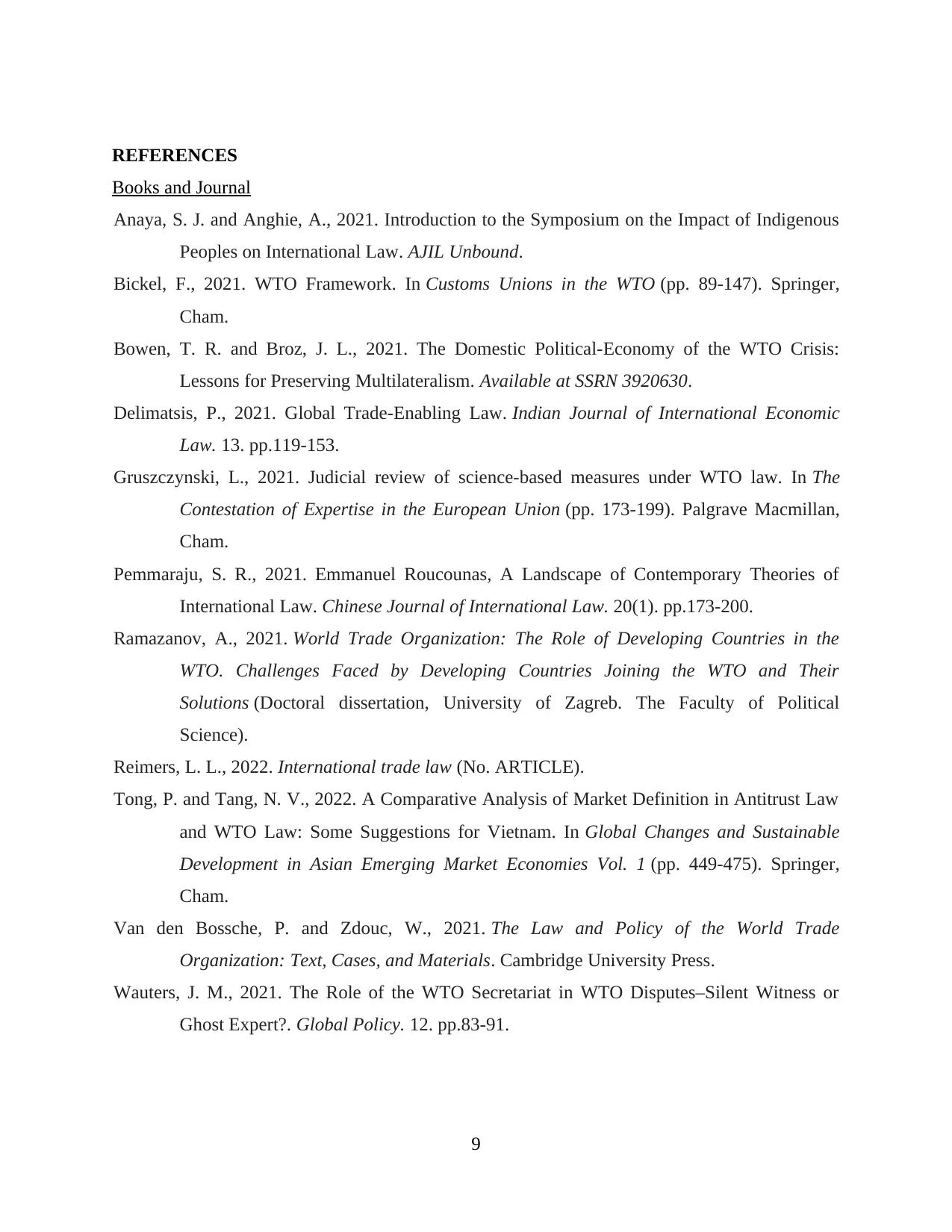
REFERENCES
Books and Journal
Anaya, S. J. and Anghie, A., 2021. Introduction to the Symposium on the Impact of Indigenous
Peoples on International Law. AJIL Unbound.
Bickel, F., 2021. WTO Framework. In Customs Unions in the WTO (pp. 89-147). Springer,
Cham.
Bowen, T. R. and Broz, J. L., 2021. The Domestic Political-Economy of the WTO Crisis:
Lessons for Preserving Multilateralism. Available at SSRN 3920630.
Delimatsis, P., 2021. Global Trade-Enabling Law. Indian Journal of International Economic
Law. 13. pp.119-153.
Gruszczynski, L., 2021. Judicial review of science-based measures under WTO law. In The
Contestation of Expertise in the European Union (pp. 173-199). Palgrave Macmillan,
Cham.
Pemmaraju, S. R., 2021. Emmanuel Roucounas, A Landscape of Contemporary Theories of
International Law. Chinese Journal of International Law. 20(1). pp.173-200.
Ramazanov, A., 2021. World Trade Organization: The Role of Developing Countries in the
WTO. Challenges Faced by Developing Countries Joining the WTO and Their
Solutions (Doctoral dissertation, University of Zagreb. The Faculty of Political
Science).
Reimers, L. L., 2022. International trade law (No. ARTICLE).
Tong, P. and Tang, N. V., 2022. A Comparative Analysis of Market Definition in Antitrust Law
and WTO Law: Some Suggestions for Vietnam. In Global Changes and Sustainable
Development in Asian Emerging Market Economies Vol. 1 (pp. 449-475). Springer,
Cham.
Van den Bossche, P. and Zdouc, W., 2021. The Law and Policy of the World Trade
Organization: Text, Cases, and Materials. Cambridge University Press.
Wauters, J. M., 2021. The Role of the WTO Secretariat in WTO Disputes–Silent Witness or
Ghost Expert?. Global Policy. 12. pp.83-91.
9
Books and Journal
Anaya, S. J. and Anghie, A., 2021. Introduction to the Symposium on the Impact of Indigenous
Peoples on International Law. AJIL Unbound.
Bickel, F., 2021. WTO Framework. In Customs Unions in the WTO (pp. 89-147). Springer,
Cham.
Bowen, T. R. and Broz, J. L., 2021. The Domestic Political-Economy of the WTO Crisis:
Lessons for Preserving Multilateralism. Available at SSRN 3920630.
Delimatsis, P., 2021. Global Trade-Enabling Law. Indian Journal of International Economic
Law. 13. pp.119-153.
Gruszczynski, L., 2021. Judicial review of science-based measures under WTO law. In The
Contestation of Expertise in the European Union (pp. 173-199). Palgrave Macmillan,
Cham.
Pemmaraju, S. R., 2021. Emmanuel Roucounas, A Landscape of Contemporary Theories of
International Law. Chinese Journal of International Law. 20(1). pp.173-200.
Ramazanov, A., 2021. World Trade Organization: The Role of Developing Countries in the
WTO. Challenges Faced by Developing Countries Joining the WTO and Their
Solutions (Doctoral dissertation, University of Zagreb. The Faculty of Political
Science).
Reimers, L. L., 2022. International trade law (No. ARTICLE).
Tong, P. and Tang, N. V., 2022. A Comparative Analysis of Market Definition in Antitrust Law
and WTO Law: Some Suggestions for Vietnam. In Global Changes and Sustainable
Development in Asian Emerging Market Economies Vol. 1 (pp. 449-475). Springer,
Cham.
Van den Bossche, P. and Zdouc, W., 2021. The Law and Policy of the World Trade
Organization: Text, Cases, and Materials. Cambridge University Press.
Wauters, J. M., 2021. The Role of the WTO Secretariat in WTO Disputes–Silent Witness or
Ghost Expert?. Global Policy. 12. pp.83-91.
9
⊘ This is a preview!⊘
Do you want full access?
Subscribe today to unlock all pages.
Trusted by 1+ million students worldwide
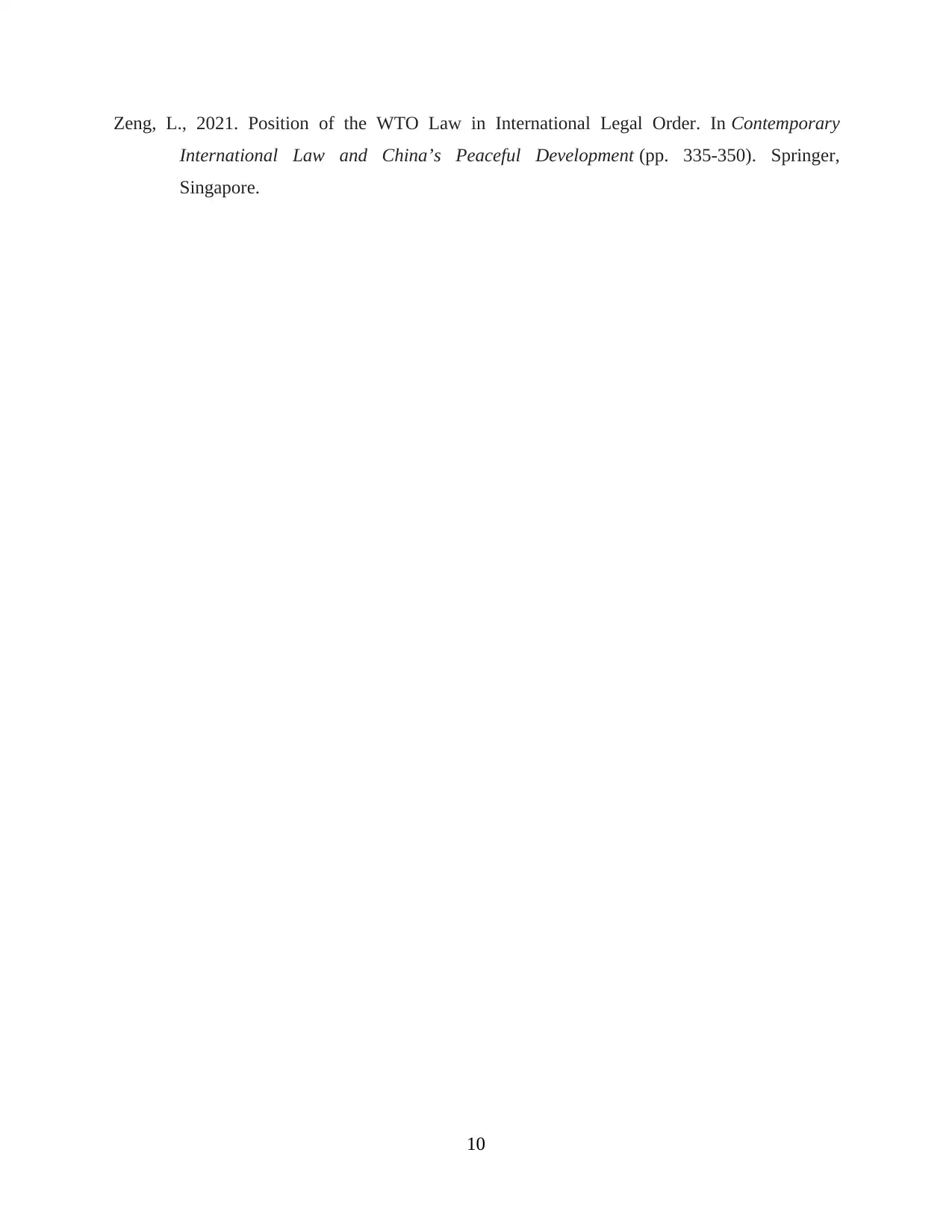
Zeng, L., 2021. Position of the WTO Law in International Legal Order. In Contemporary
International Law and China’s Peaceful Development (pp. 335-350). Springer,
Singapore.
10
International Law and China’s Peaceful Development (pp. 335-350). Springer,
Singapore.
10

1 out of 10


Related Documents


Your All-in-One AI-Powered Toolkit for Academic Success.
+13062052269
info@desklib.com
Available 24*7 on WhatsApp / Email
![[object Object]](/_next/static/media/star-bottom.7253800d.svg)
Unlock your academic potential
Copyright © 2020–2026 A2Z Services. All Rights Reserved. Developed and managed by ZUCOL.