Microbiology Report: Xylanase Production from Sugarcane Bagasse
VerifiedAdded on 2023/01/16
|12
|2600
|82
Report
AI Summary
This report details a study on xylanase production using Aspergillus niger through solid-state fermentation, utilizing sugarcane bagasse as a substrate. The research aimed to optimize physical and chemical parameters, such as temperature, pH, and nitrogen/carbon sources, to enhance xylanase yield. The study highlights sugarcane bagasse's cost-effectiveness and availability compared to other substrates. The methodology includes isolating Aspergillus niger, xylanolytic screening, solid-state fermentation, enzyme extraction, and assays for xylanase and protein. Results indicate that sugarcane bagasse at an optimum temperature of 30°C and pH of 6, with xylose and sodium nitrate supplementation, promotes xylanase production. The report emphasizes the potential of this approach in waste utilization and environmental hazard reduction, concluding with recommendations for further research and industrial applications.
Running head: MICROBIOLOGY
1
Microbiology
Student’s Name
Institutional Affiliation
1
Microbiology
Student’s Name
Institutional Affiliation

Paraphrase This Document
Need a fresh take? Get an instant paraphrase of this document with our AI Paraphraser
MICROBIOLOGY 2
Microbiology
Abstract
Xylanase production using Aspergillus niger through solid state fermentation was
done using various substances. The substances were obtained under a low cost of operation in
solid-state cultivation. The solid-state cultivation is most preferred to liquid cultivation. The
main aim of this research is to enhance production of Xylanase using Aspergillus niger
through optimization of chemical and physical parameters that are involved in the solid-state
fermentation. The primary raw materials to be used in the production of Xylanase is the sugar
bagasse. The sugar bagasse is known to increase the production of xylanase as compared to
other raw materials like paddy straw, sawdust, and wheat bran. For high yield production of
xylanase the physical parameters such as pH and temperature need to be optimized (Irfan et
al., 2016). The optimum temperature was set at 30 and the pH of 6. Sodium nitrate and xylose
were used as nitrogen and carbon sources (Adhyaru, Bhatt, & Modi, 2015). The production of
enzyme xylanase using sugar bagasse is cheaper and readily available as compared to other
waste products like sawdust, wheat bran and paddy straw.
Microbiology
Abstract
Xylanase production using Aspergillus niger through solid state fermentation was
done using various substances. The substances were obtained under a low cost of operation in
solid-state cultivation. The solid-state cultivation is most preferred to liquid cultivation. The
main aim of this research is to enhance production of Xylanase using Aspergillus niger
through optimization of chemical and physical parameters that are involved in the solid-state
fermentation. The primary raw materials to be used in the production of Xylanase is the sugar
bagasse. The sugar bagasse is known to increase the production of xylanase as compared to
other raw materials like paddy straw, sawdust, and wheat bran. For high yield production of
xylanase the physical parameters such as pH and temperature need to be optimized (Irfan et
al., 2016). The optimum temperature was set at 30 and the pH of 6. Sodium nitrate and xylose
were used as nitrogen and carbon sources (Adhyaru, Bhatt, & Modi, 2015). The production of
enzyme xylanase using sugar bagasse is cheaper and readily available as compared to other
waste products like sawdust, wheat bran and paddy straw.
MICROBIOLOGY 3
Contents
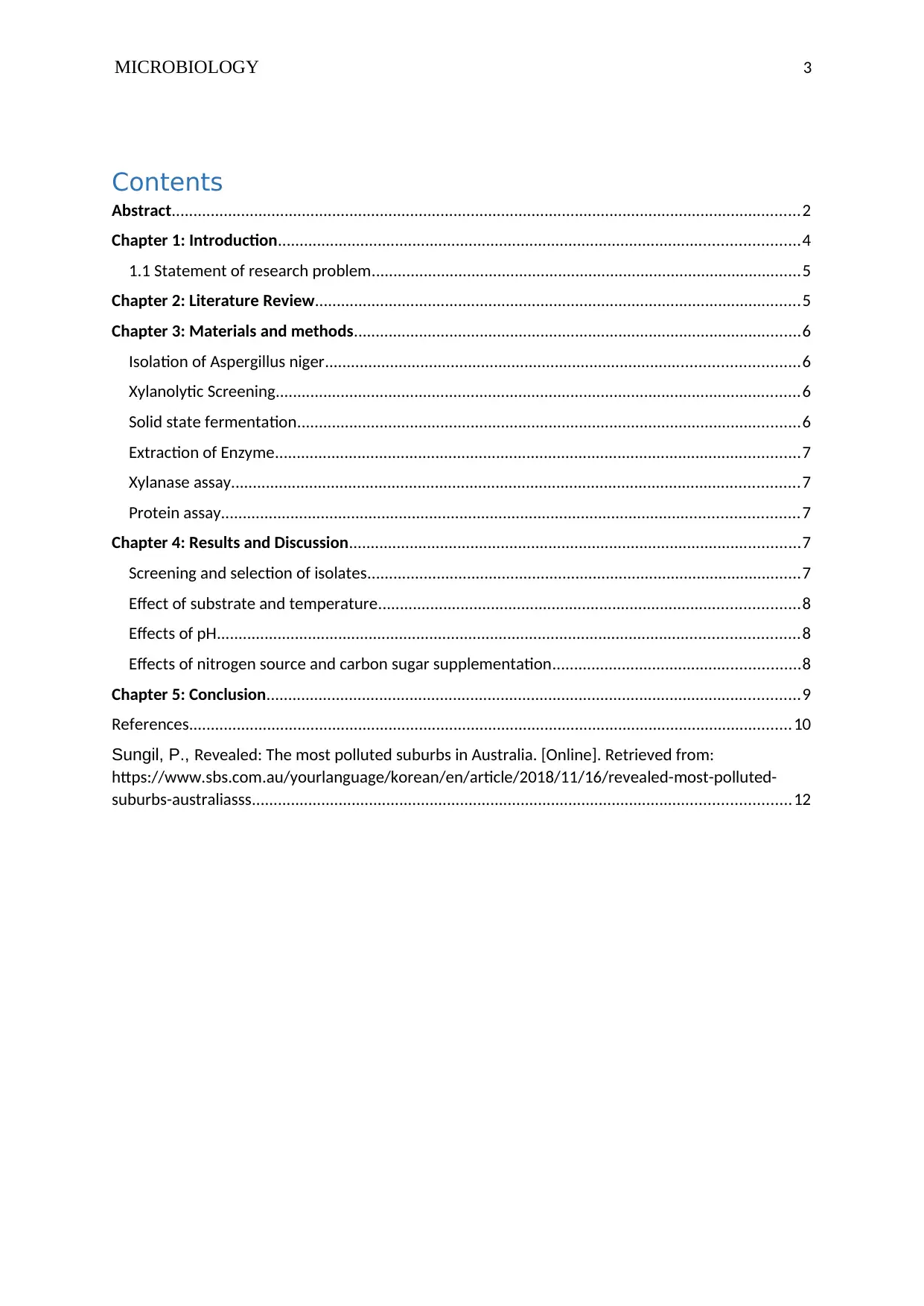
Abstract.................................................................................................................................................2
Chapter 1: Introduction........................................................................................................................4
1.1 Statement of research problem...................................................................................................5
Chapter 2: Literature Review................................................................................................................5
Chapter 3: Materials and methods.......................................................................................................6
Isolation of Aspergillus niger.............................................................................................................6
Xylanolytic Screening.........................................................................................................................6
Solid state fermentation....................................................................................................................6
Extraction of Enzyme.........................................................................................................................7
Xylanase assay...................................................................................................................................7
Protein assay.....................................................................................................................................7
Chapter 4: Results and Discussion........................................................................................................7
Screening and selection of isolates....................................................................................................7
Effect of substrate and temperature.................................................................................................8
Effects of pH......................................................................................................................................8
Effects of nitrogen source and carbon sugar supplementation.........................................................8
Chapter 5: Conclusion...........................................................................................................................9
References...........................................................................................................................................10
Sungil, P., Revealed: The most polluted suburbs in Australia. [Online]. Retrieved from:
https://www.sbs.com.au/yourlanguage/korean/en/article/2018/11/16/revealed-most-polluted-
suburbs-australiasss............................................................................................................................12
Contents
Abstract.................................................................................................................................................2
Chapter 1: Introduction........................................................................................................................4
1.1 Statement of research problem...................................................................................................5
Chapter 2: Literature Review................................................................................................................5
Chapter 3: Materials and methods.......................................................................................................6
Isolation of Aspergillus niger.............................................................................................................6
Xylanolytic Screening.........................................................................................................................6
Solid state fermentation....................................................................................................................6
Extraction of Enzyme.........................................................................................................................7
Xylanase assay...................................................................................................................................7
Protein assay.....................................................................................................................................7
Chapter 4: Results and Discussion........................................................................................................7
Screening and selection of isolates....................................................................................................7
Effect of substrate and temperature.................................................................................................8
Effects of pH......................................................................................................................................8
Effects of nitrogen source and carbon sugar supplementation.........................................................8
Chapter 5: Conclusion...........................................................................................................................9
References...........................................................................................................................................10
Sungil, P., Revealed: The most polluted suburbs in Australia. [Online]. Retrieved from:
https://www.sbs.com.au/yourlanguage/korean/en/article/2018/11/16/revealed-most-polluted-
suburbs-australiasss............................................................................................................................12
⊘ This is a preview!⊘
Do you want full access?
Subscribe today to unlock all pages.

Trusted by 1+ million students worldwide
MICROBIOLOGY 4
Chapter 1: Introduction
The sugarcane bagasse contains lignin, cellulose, and hemicellulose at a varying
percentage. Hydrolysis of all the waste components is required for them to be utilized in the
chemical and fuel production (Geng, and Su, 2015). Xylanase is the second most abundant
polysaccharide, and therefore enzyme xylanase can be used in food processing and other
industries such as sugar, feed, and ethanol. Usually, xylan has to be converted to
xylooligosaccharides or xylose in the process of bioconversion.
Lignin is bound to xylan using an ester bond to the residue of 4-o-methyl-D-
glucuronic acid. When endo-xylanase undergo depolymerization, the polymeric substance is
converted to xylose and xylooligosaccharides (José, et al., 2015). Xylanases are becoming the
major group of enzymes in most industries with significant application in pulp and paper
industries (Neves, Pitarelo, & Ramos, 2016). The enzyme xylanases are also of great
significance to paper, and pulp industries since the hydrolysis of xylan enable the lignin
release from paper pulp and minimize the usage of chlorine.
Xylan forms the second most abundant polysaccharide besides xylose and the main
component of hemicellulose that is found in the sugar bagasse. Hemicellulose is the
polysaccharide of the cell wall which occurs in the association with the glucans and cellulose.
The cell wall of sugarcane bagasse is a material in which xylan, lignin, and cellulose are
linked closely. The constituents of sugarcane bagasse amount to about 90% of the total dry
weight (Liu, et al., 2017). The extractives may also represent an important part of the dry
Chapter 1: Introduction
The sugarcane bagasse contains lignin, cellulose, and hemicellulose at a varying
percentage. Hydrolysis of all the waste components is required for them to be utilized in the
chemical and fuel production (Geng, and Su, 2015). Xylanase is the second most abundant
polysaccharide, and therefore enzyme xylanase can be used in food processing and other
industries such as sugar, feed, and ethanol. Usually, xylan has to be converted to
xylooligosaccharides or xylose in the process of bioconversion.
Lignin is bound to xylan using an ester bond to the residue of 4-o-methyl-D-
glucuronic acid. When endo-xylanase undergo depolymerization, the polymeric substance is
converted to xylose and xylooligosaccharides (José, et al., 2015). Xylanases are becoming the
major group of enzymes in most industries with significant application in pulp and paper
industries (Neves, Pitarelo, & Ramos, 2016). The enzyme xylanases are also of great
significance to paper, and pulp industries since the hydrolysis of xylan enable the lignin
release from paper pulp and minimize the usage of chlorine.
Xylan forms the second most abundant polysaccharide besides xylose and the main
component of hemicellulose that is found in the sugar bagasse. Hemicellulose is the
polysaccharide of the cell wall which occurs in the association with the glucans and cellulose.
The cell wall of sugarcane bagasse is a material in which xylan, lignin, and cellulose are
linked closely. The constituents of sugarcane bagasse amount to about 90% of the total dry
weight (Liu, et al., 2017). The extractives may also represent an important part of the dry
Paraphrase This Document
Need a fresh take? Get an instant paraphrase of this document with our AI Paraphraser
MICROBIOLOGY 5
weight in the raw material. The sugarcane bagasse can be used to screen and isolate the
fungus Aspergillus niger in the production of the enzyme xylanase.
1.1 Statement of research problem
Wastes from industries and food-processing plants are usually available in large
quantities in most parts of the world. The wastes become an abundant source of the physical,
biological and chemical hazard if not taken care. Sugarcane bagasse is a major cause of air
pollution especially in Australia. Therefore, it is fundamental to initiate a program that will
optimize recycling of sugarcane bagasse. Currently, air pollution in Australia is a big issue
since it has been linked to over 3000 premature deaths annually among the low income
citizens, (Sungil, 2018). Also, air pollution has negatively impacted the tourism sector in the
country since visitors with breathing problems are recommended to avoid the polluted
suburbs (Dickson, 2015). Thus, utilizing bagasse in the production of xylanase shall curb the
air pollution crisis.
Chapter 2: Literature Review
According to Arora, Patel, & Pruthi, (2016), sugarcane bagasse has been identified as
one of the microbiological media which is cost effective and readily available. A similar
concept has been stressed by Al-Farsi, Bakir, Marzouqi, & Thomas, (2019) that sugarcane
bagasse is produced by most industries worldwide and in large quantities. Sugarcane bagasse
has been identified as a source of energy in the production of lipase by use of Aspergillus
emphasized by Garcia, et al., (2018). The advantage of using sugarcane bagasse has been
illustrated by Sindhu, Gnansounou, Bino, & Pandey, (2016) that sugarcane bagasse meets the
weight in the raw material. The sugarcane bagasse can be used to screen and isolate the
fungus Aspergillus niger in the production of the enzyme xylanase.
1.1 Statement of research problem
Wastes from industries and food-processing plants are usually available in large
quantities in most parts of the world. The wastes become an abundant source of the physical,
biological and chemical hazard if not taken care. Sugarcane bagasse is a major cause of air
pollution especially in Australia. Therefore, it is fundamental to initiate a program that will
optimize recycling of sugarcane bagasse. Currently, air pollution in Australia is a big issue
since it has been linked to over 3000 premature deaths annually among the low income
citizens, (Sungil, 2018). Also, air pollution has negatively impacted the tourism sector in the
country since visitors with breathing problems are recommended to avoid the polluted
suburbs (Dickson, 2015). Thus, utilizing bagasse in the production of xylanase shall curb the
air pollution crisis.
Chapter 2: Literature Review
According to Arora, Patel, & Pruthi, (2016), sugarcane bagasse has been identified as
one of the microbiological media which is cost effective and readily available. A similar
concept has been stressed by Al-Farsi, Bakir, Marzouqi, & Thomas, (2019) that sugarcane
bagasse is produced by most industries worldwide and in large quantities. Sugarcane bagasse
has been identified as a source of energy in the production of lipase by use of Aspergillus
emphasized by Garcia, et al., (2018). The advantage of using sugarcane bagasse has been
illustrated by Sindhu, Gnansounou, Bino, & Pandey, (2016) that sugarcane bagasse meets the
MICROBIOLOGY 6
requirements for fungal growth, therefore, can be used as fungal media replacing other media
which are expensive. A similar concept has also been highlighted by Dos Reis, et al., (2018)
that sugarcane bagasse residue is used as an energy source and low carbon in the growth of
fungi as media.
Chapter 3: Materials and methods
Isolation of Aspergillus niger
The medium used in the isolation of Aspergillus niger was Potato Dextrose Agar
using the agricultural soil sample (Reddy, & Krishnan, 2016). 1.0 gram of agricultural soil
sample was suspended in 10ml distilled water and vigorously shook for 15minutes. 0.5ml of
the diluted suspension was then spread on the PDA using a rod followed by incubation for
five days at 37°C (Iqbal, & Utara, 2016). The colonies were individually observed under the
specific based on the characteristics and identification features in the manual used. The
isolates of fungi were finally cultured for purification and examination purposes for
xylanolytic activities.
Xylanolytic Screening
Screening activities of xylanase were done on Malt Extract Agar that contains 0.1%
sugarcane bagasse. Plates were then incubated for 48hrs at 29° C followed by staining with a
solution of iodine for 12min. The positive isolates of xylanase were then detected depending
on the clear zones of the hydrolysis process.
Solid state fermentation
requirements for fungal growth, therefore, can be used as fungal media replacing other media
which are expensive. A similar concept has also been highlighted by Dos Reis, et al., (2018)
that sugarcane bagasse residue is used as an energy source and low carbon in the growth of
fungi as media.
Chapter 3: Materials and methods
Isolation of Aspergillus niger
The medium used in the isolation of Aspergillus niger was Potato Dextrose Agar
using the agricultural soil sample (Reddy, & Krishnan, 2016). 1.0 gram of agricultural soil
sample was suspended in 10ml distilled water and vigorously shook for 15minutes. 0.5ml of
the diluted suspension was then spread on the PDA using a rod followed by incubation for
five days at 37°C (Iqbal, & Utara, 2016). The colonies were individually observed under the
specific based on the characteristics and identification features in the manual used. The
isolates of fungi were finally cultured for purification and examination purposes for
xylanolytic activities.
Xylanolytic Screening
Screening activities of xylanase were done on Malt Extract Agar that contains 0.1%
sugarcane bagasse. Plates were then incubated for 48hrs at 29° C followed by staining with a
solution of iodine for 12min. The positive isolates of xylanase were then detected depending
on the clear zones of the hydrolysis process.
Solid state fermentation
⊘ This is a preview!⊘
Do you want full access?
Subscribe today to unlock all pages.
Trusted by 1+ million students worldwide
MICROBIOLOGY 7
The flask containing 10gram of the sugarcane bagasse was used in the cultivation of
Aspergillus niger. 15ml of Mendel’s medium was then added. The medium after being
autoclaved it was incubated at a temperature of 30°C for 7days.
Extraction of Enzyme
After cultivation, 60ml of cold water was added to the solid-state fermentation. The
mixture underwent centrifugation at about 5000 rpm for 15min. Filtration was done to
separate the biomass residue from the suspension using the Whatman paper. The main source
for preparation of enzyme was supernatant free cell.
Xylanase assay
The supernatant free cell was utilized as a source of enzyme sample. Sugarcane
substrate was used to measure the xylanases activity. The reducing process was determined
by an acid technique called Dinitrosalicylic acid method using xylose as standard. The xylose
released was spectrophotometrically measured at 540nm.
Protein assay
The Lowry method was used in the protein assay. The broth known as Czapek-Dox
with the sugarcane bagasse was mixed with the fungus Aspergillus niger and then incubated.
Examination of the supernatant was performed at an interval of 24hrs using the Lowry
method for protein assay.
Chapter 4: Results and Discussion
Screening and selection of isolates
The flask containing 10gram of the sugarcane bagasse was used in the cultivation of
Aspergillus niger. 15ml of Mendel’s medium was then added. The medium after being
autoclaved it was incubated at a temperature of 30°C for 7days.
Extraction of Enzyme
After cultivation, 60ml of cold water was added to the solid-state fermentation. The
mixture underwent centrifugation at about 5000 rpm for 15min. Filtration was done to
separate the biomass residue from the suspension using the Whatman paper. The main source
for preparation of enzyme was supernatant free cell.
Xylanase assay
The supernatant free cell was utilized as a source of enzyme sample. Sugarcane
substrate was used to measure the xylanases activity. The reducing process was determined
by an acid technique called Dinitrosalicylic acid method using xylose as standard. The xylose
released was spectrophotometrically measured at 540nm.
Protein assay
The Lowry method was used in the protein assay. The broth known as Czapek-Dox
with the sugarcane bagasse was mixed with the fungus Aspergillus niger and then incubated.
Examination of the supernatant was performed at an interval of 24hrs using the Lowry
method for protein assay.
Chapter 4: Results and Discussion
Screening and selection of isolates
Paraphrase This Document
Need a fresh take? Get an instant paraphrase of this document with our AI Paraphraser
MICROBIOLOGY 8
The screening process indicates the behavior of the isolates on the media. The isolates
exhibited xylanolytic activities on the malt extract agar with clear diameter zones of about
30-45mm. The identification of isolates was based on morphologies whether they possessed
distinct conidiophores. The growth of isolates on Malt Extract Agar indicates the turning of
mycelia from white to yellow then finally black during maturation.
Effect of substrate and temperature
The agricultural wastes consist of paddy straw. Sawdust, wheat and sugarcane
bagasse were examined as the essential substrates for the growth and xylanase production
using Aspergillus niger (Uday, et al. 2017). However, the results after incubation for 5days
indicates that sugarcane bagasse as one of the cheapest and cost effective substrate to be used
for xylanase production using Aspergillus niger. A temperature range of 27°C - 45°C was
established for production of enzyme xylanase. The activity was 1.84 U/ml on sugarcane
bagasse as substrate by Aspergillus niger.
Effects of pH
The medium pH was regulated to a specific pH range through the addition of 0.1M
hydrochloric acid. The purified enzyme was then confirmed in the pH range of 5-9. The pH
of 6 was established for production xylanase and activity of 1.68 U/ml on sugarcane bagasse
by Aspergillus niger
Effects of nitrogen source and carbon sugar supplementation
The screening process indicates the behavior of the isolates on the media. The isolates
exhibited xylanolytic activities on the malt extract agar with clear diameter zones of about
30-45mm. The identification of isolates was based on morphologies whether they possessed
distinct conidiophores. The growth of isolates on Malt Extract Agar indicates the turning of
mycelia from white to yellow then finally black during maturation.
Effect of substrate and temperature
The agricultural wastes consist of paddy straw. Sawdust, wheat and sugarcane
bagasse were examined as the essential substrates for the growth and xylanase production
using Aspergillus niger (Uday, et al. 2017). However, the results after incubation for 5days
indicates that sugarcane bagasse as one of the cheapest and cost effective substrate to be used
for xylanase production using Aspergillus niger. A temperature range of 27°C - 45°C was
established for production of enzyme xylanase. The activity was 1.84 U/ml on sugarcane
bagasse as substrate by Aspergillus niger.
Effects of pH
The medium pH was regulated to a specific pH range through the addition of 0.1M
hydrochloric acid. The purified enzyme was then confirmed in the pH range of 5-9. The pH
of 6 was established for production xylanase and activity of 1.68 U/ml on sugarcane bagasse
by Aspergillus niger
Effects of nitrogen source and carbon sugar supplementation
MICROBIOLOGY 9
Sugar supplementation may act as inducers or carbon sources. The xylose addition
results in an increase in the substrates for xylanase production as compared to the cultivation
without xylose (Seyi-Amole, & Onilude, 2018). The presence of nitrogen source on the
production of xylanase was examined as well. Sodium nitrate was found to facilitate
production of the enzyme xylanase by Aspergillus niger.
Chapter 5: Conclusion
Production of xylanase utilizing sugarcane bagasse is considered the cheapest way
due to the availability of the waste products in the nearby sugarcane companies. The
production process also plays a significant role in reducing environmental hazards. The high
production of xylanase requires an optimum condition of temperature and pH. Therefore, I
will recommend the production of xylanase using waste materials especially sugarcane
bagasse for isolation and screening of fungi due to its efficiency and low cost.
Sugar supplementation may act as inducers or carbon sources. The xylose addition
results in an increase in the substrates for xylanase production as compared to the cultivation
without xylose (Seyi-Amole, & Onilude, 2018). The presence of nitrogen source on the
production of xylanase was examined as well. Sodium nitrate was found to facilitate
production of the enzyme xylanase by Aspergillus niger.
Chapter 5: Conclusion
Production of xylanase utilizing sugarcane bagasse is considered the cheapest way
due to the availability of the waste products in the nearby sugarcane companies. The
production process also plays a significant role in reducing environmental hazards. The high
production of xylanase requires an optimum condition of temperature and pH. Therefore, I
will recommend the production of xylanase using waste materials especially sugarcane
bagasse for isolation and screening of fungi due to its efficiency and low cost.
⊘ This is a preview!⊘
Do you want full access?
Subscribe today to unlock all pages.
Trusted by 1+ million students worldwide
MICROBIOLOGY
10
References
Adhyaru, D. N., Bhatt, N. S., & Modi, H. A. (2015). Optimization of upstream and
downstream process parameters for cellulase-poor-thermo-solvent-stable xylanase
production and extraction by Aspergillus tubingensis FDHN1. Bioresources and
bioprocessing, 2(1), 3.
Al-Farsi, M., Al Bakir, A., Al Marzouqi, H., & Thomas, R. (2019). Production of single cell
protein from date waste. By-Products of Palm Trees and Their Applications, 11, 302.
Arora, N., Patel, A., Pruthi, P. A., & Pruthi, V. (2016). Boosting TAG accumulation with
improved biodiesel production from novel oleaginous microalgae Scenedesmus sp.
IITRIND2 was utilizing waste sugarcane bagasse aqueous extract (SBAE). Applied
biochemistry and biotechnology, 180(1), 109-121.
Dickson w, (2015). Better health channel [online]. Retrieved from:
https://www.betterhealth.vic.gov.au/health/healthyliving/air-pollution.
Dos Reis, C. B. L., Sobucki, L., Mazutti, M. A., Guedes, J. V. C., & Jacques, R. J. S. (2018).
Production of Chitinase from Metarhizium anisopliae by Solid-State Fermentation
Using Sugarcane Bagasse as Substrate. Industrial Biotechnology, 14(4), 230-234.
Garcia, N. F. L., da Silva Santos, F. R., Bocchini, D. A., da Paz, M. F., Fonseca, G. G., &
Leite, R. S. R. (2018). Catalytic properties of celluloses’ and hemicellulase produced
by Lichtheimia ramosa: Potential for sugarcane bagasse saccharification. Industrial
crops and products, 122, 49-56.
10
References
Adhyaru, D. N., Bhatt, N. S., & Modi, H. A. (2015). Optimization of upstream and
downstream process parameters for cellulase-poor-thermo-solvent-stable xylanase
production and extraction by Aspergillus tubingensis FDHN1. Bioresources and
bioprocessing, 2(1), 3.
Al-Farsi, M., Al Bakir, A., Al Marzouqi, H., & Thomas, R. (2019). Production of single cell
protein from date waste. By-Products of Palm Trees and Their Applications, 11, 302.
Arora, N., Patel, A., Pruthi, P. A., & Pruthi, V. (2016). Boosting TAG accumulation with
improved biodiesel production from novel oleaginous microalgae Scenedesmus sp.
IITRIND2 was utilizing waste sugarcane bagasse aqueous extract (SBAE). Applied
biochemistry and biotechnology, 180(1), 109-121.
Dickson w, (2015). Better health channel [online]. Retrieved from:
https://www.betterhealth.vic.gov.au/health/healthyliving/air-pollution.
Dos Reis, C. B. L., Sobucki, L., Mazutti, M. A., Guedes, J. V. C., & Jacques, R. J. S. (2018).
Production of Chitinase from Metarhizium anisopliae by Solid-State Fermentation
Using Sugarcane Bagasse as Substrate. Industrial Biotechnology, 14(4), 230-234.
Garcia, N. F. L., da Silva Santos, F. R., Bocchini, D. A., da Paz, M. F., Fonseca, G. G., &
Leite, R. S. R. (2018). Catalytic properties of celluloses’ and hemicellulase produced
by Lichtheimia ramosa: Potential for sugarcane bagasse saccharification. Industrial
crops and products, 122, 49-56.
Paraphrase This Document
Need a fresh take? Get an instant paraphrase of this document with our AI Paraphraser
MICROBIOLOGY
11
Geng k. And Su R. (2015). Sugarcane Bagasse: A Potential Medium for Fungal Cultures.
[online], Retrieved from: https://www.hindawi.com/journals/cjb/2014/840505/
Iqbal, J., & Utara, U. (2016). Isolation of Aspergillus niger Strains from Soil and their
Screening and Optimization for Enhanced Citric Acid Production using Cane
Molasses as Carbon Source.
Irfan, M., Asghar, U., Nadeem, M., Nelofer, R., & Syed, Q. (2016). Optimization of process
parameters for xylanase production by Bacillus sp. in submerged
fermentation. Journal of Radiation Research and Applied Sciences, 9(2), 139-147.
José, C., Lino, A. G., Colodette, J. L., Lima, C. F., Gutiérrez, A., Martinez, Á. T., ... &
Rencoret, J. (2015). Differences in the chemical structure of the lignin from sugarcane
bagasse and straw. Biomass and Bioenergy, 81, 322-338.
Liu, Z. J., Lan, T. Q., Li, H., Gao, X., & Zhang, H. (2017). Effect of bisulfite treatment on
composition, structure, enzymatic hydrolysis and cellulase adsorption profiles of
sugarcane bagasse. Bioresource technology, 223, 27-33,
Neves, P. V., Pitarelo, A. P., & Ramos, L. P. (2016). Production of cellulosic ethanol from
sugarcane bagasse by steam explosion: Effect of extractives content, acid catalysis,
and different fermentation technologies. Bioresource technology, 208, 184-194.
Reddy, S. S., & Krishnan, C. (2016). Production of xylooligosaccharides in SSF by Bacillus
subtilis KCX006 producing β-xylosidase-free endo-xylanase and multiple xylan
debranching enzymes. Preparative Biochemistry and Biotechnology, 46(1), 49-55.
11
Geng k. And Su R. (2015). Sugarcane Bagasse: A Potential Medium for Fungal Cultures.
[online], Retrieved from: https://www.hindawi.com/journals/cjb/2014/840505/
Iqbal, J., & Utara, U. (2016). Isolation of Aspergillus niger Strains from Soil and their
Screening and Optimization for Enhanced Citric Acid Production using Cane
Molasses as Carbon Source.
Irfan, M., Asghar, U., Nadeem, M., Nelofer, R., & Syed, Q. (2016). Optimization of process
parameters for xylanase production by Bacillus sp. in submerged
fermentation. Journal of Radiation Research and Applied Sciences, 9(2), 139-147.
José, C., Lino, A. G., Colodette, J. L., Lima, C. F., Gutiérrez, A., Martinez, Á. T., ... &
Rencoret, J. (2015). Differences in the chemical structure of the lignin from sugarcane
bagasse and straw. Biomass and Bioenergy, 81, 322-338.
Liu, Z. J., Lan, T. Q., Li, H., Gao, X., & Zhang, H. (2017). Effect of bisulfite treatment on
composition, structure, enzymatic hydrolysis and cellulase adsorption profiles of
sugarcane bagasse. Bioresource technology, 223, 27-33,
Neves, P. V., Pitarelo, A. P., & Ramos, L. P. (2016). Production of cellulosic ethanol from
sugarcane bagasse by steam explosion: Effect of extractives content, acid catalysis,
and different fermentation technologies. Bioresource technology, 208, 184-194.
Reddy, S. S., & Krishnan, C. (2016). Production of xylooligosaccharides in SSF by Bacillus
subtilis KCX006 producing β-xylosidase-free endo-xylanase and multiple xylan
debranching enzymes. Preparative Biochemistry and Biotechnology, 46(1), 49-55.
MICROBIOLOGY
12
Seyi-Amole, D. O., & Onilude, A. A. (2018). Influence of carbon and nitrogen sources on the
spore yield of Trichoderma harzianum in fed-batch culture.
Sindhu, R., Gnansounou, E., Binod, P., & Pandey, A. (2016). Bioconversion of sugarcane
crop residue for value-added products–An overview. Renewable Energy, 98, 203-215.
Sungil, P., Revealed: The most polluted suburbs in Australia. [Online]. Retrieved from:
https://www.sbs.com.au/yourlanguage/korean/en/article/2018/11/16/revealed-most-
polluted-suburbs-australiasss
Uday, U. S. P., Majumdar, R., Tiwari, O. N., Mishra, U., Mondal, A., Bandyopadhyay, T. K.,
& Bhunia, B. (2017). Isolation, screening, and characterization of novel extracellular
xylanase from Aspergillus niger (KP874102. 1) and its application in orange peel
hydrolysis. International journal of biological macromolecules, 105, 401-409.
12
Seyi-Amole, D. O., & Onilude, A. A. (2018). Influence of carbon and nitrogen sources on the
spore yield of Trichoderma harzianum in fed-batch culture.
Sindhu, R., Gnansounou, E., Binod, P., & Pandey, A. (2016). Bioconversion of sugarcane
crop residue for value-added products–An overview. Renewable Energy, 98, 203-215.
Sungil, P., Revealed: The most polluted suburbs in Australia. [Online]. Retrieved from:
https://www.sbs.com.au/yourlanguage/korean/en/article/2018/11/16/revealed-most-
polluted-suburbs-australiasss
Uday, U. S. P., Majumdar, R., Tiwari, O. N., Mishra, U., Mondal, A., Bandyopadhyay, T. K.,
& Bhunia, B. (2017). Isolation, screening, and characterization of novel extracellular
xylanase from Aspergillus niger (KP874102. 1) and its application in orange peel
hydrolysis. International journal of biological macromolecules, 105, 401-409.
⊘ This is a preview!⊘
Do you want full access?
Subscribe today to unlock all pages.
Trusted by 1+ million students worldwide

1 out of 12


Your All-in-One AI-Powered Toolkit for Academic Success.
+13062052269
info@desklib.com
Available 24*7 on WhatsApp / Email
![[object Object]](/_next/static/media/star-bottom.7253800d.svg)
Unlock your academic potential
Copyright © 2020–2026 A2Z Services. All Rights Reserved. Developed and managed by ZUCOL.