Financial Risks Assessment: XYZ Corporation Property Finance Project

Verified

Added on  2023/06/11

|5
|397
|50
Report
AI Summary
This report assesses the financial risks associated with XYZ Corporation's property finance project, located in Mays Hill, NSW. It identifies key risks such as credit, specific, operational, liquidity, market, and equity risk. The analysis focuses on credit risk, highlighting the potential for default and its impact on investors and creditors. The report suggests risk management strategies, including fundamental, technical, and quantitative analysis, to measure security intrinsic value. It also emphasizes the importance of internal cash availability, healthy cash flow, refinancing options, and diversified funding solutions. The report concludes by recommending a moderate gearing level and sensitive analysis to balance timing, profitability, gearing, flexibility, and certainty.
Document Page
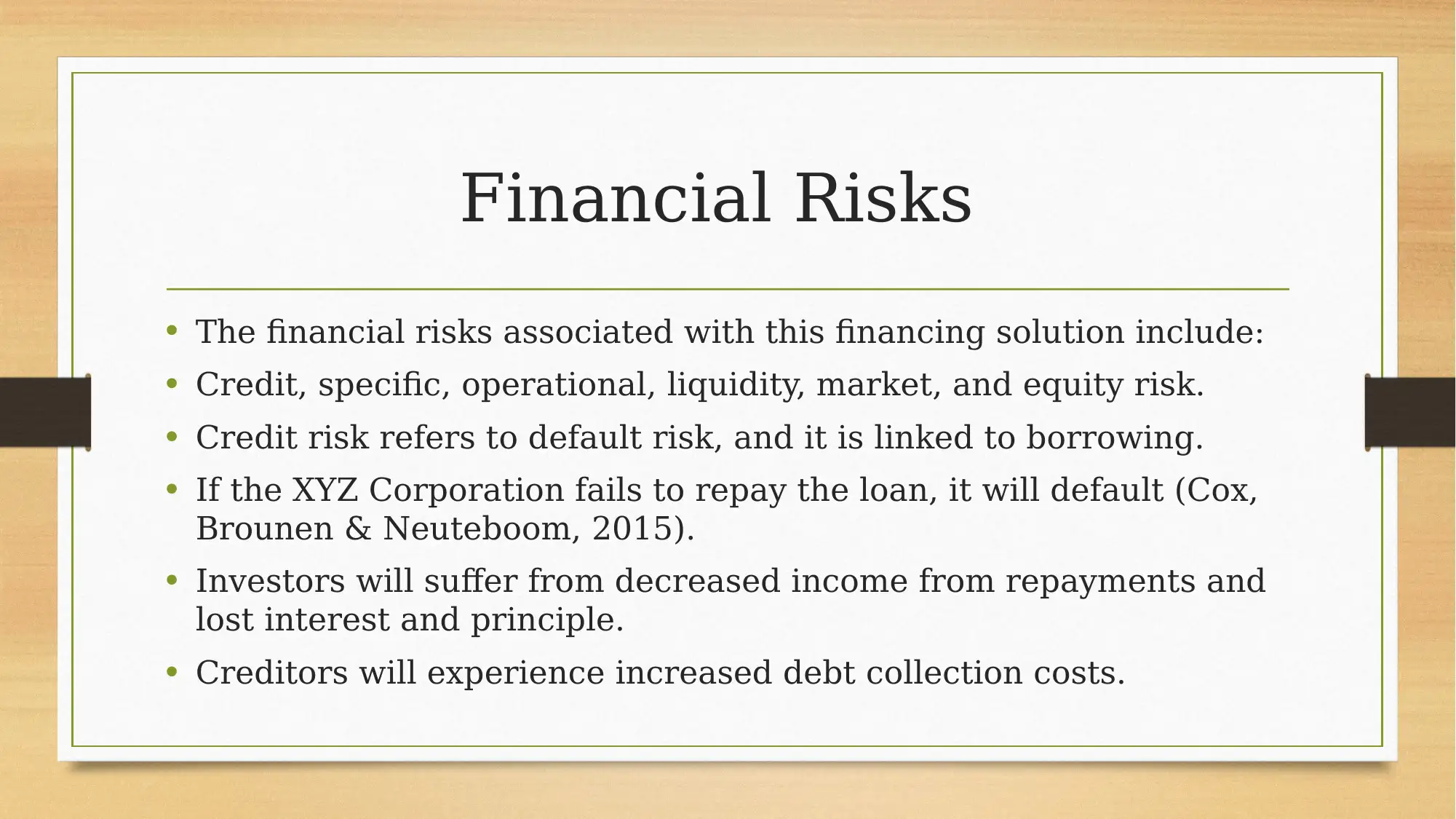
Financial Risks
Name
Institutional Affiliation
tabler-icon-diamond-filled.svg

Paraphrase This Document

Need a fresh take? Get an instant paraphrase of this document with our AI Paraphraser
Document Page
Financial Risks
The financial risks associated with this financing solution include:
Credit, specific, operational, liquidity, market, and equity risk.
Credit risk refers to default risk, and it is linked to borrowing.
If the XYZ Corporation fails to repay the loan, it will default (Cox,
Brounen & Neuteboom, 2015).
Investors will suffer from decreased income from repayments and
lost interest and principle.
Creditors will experience increased debt collection costs.
Document Page
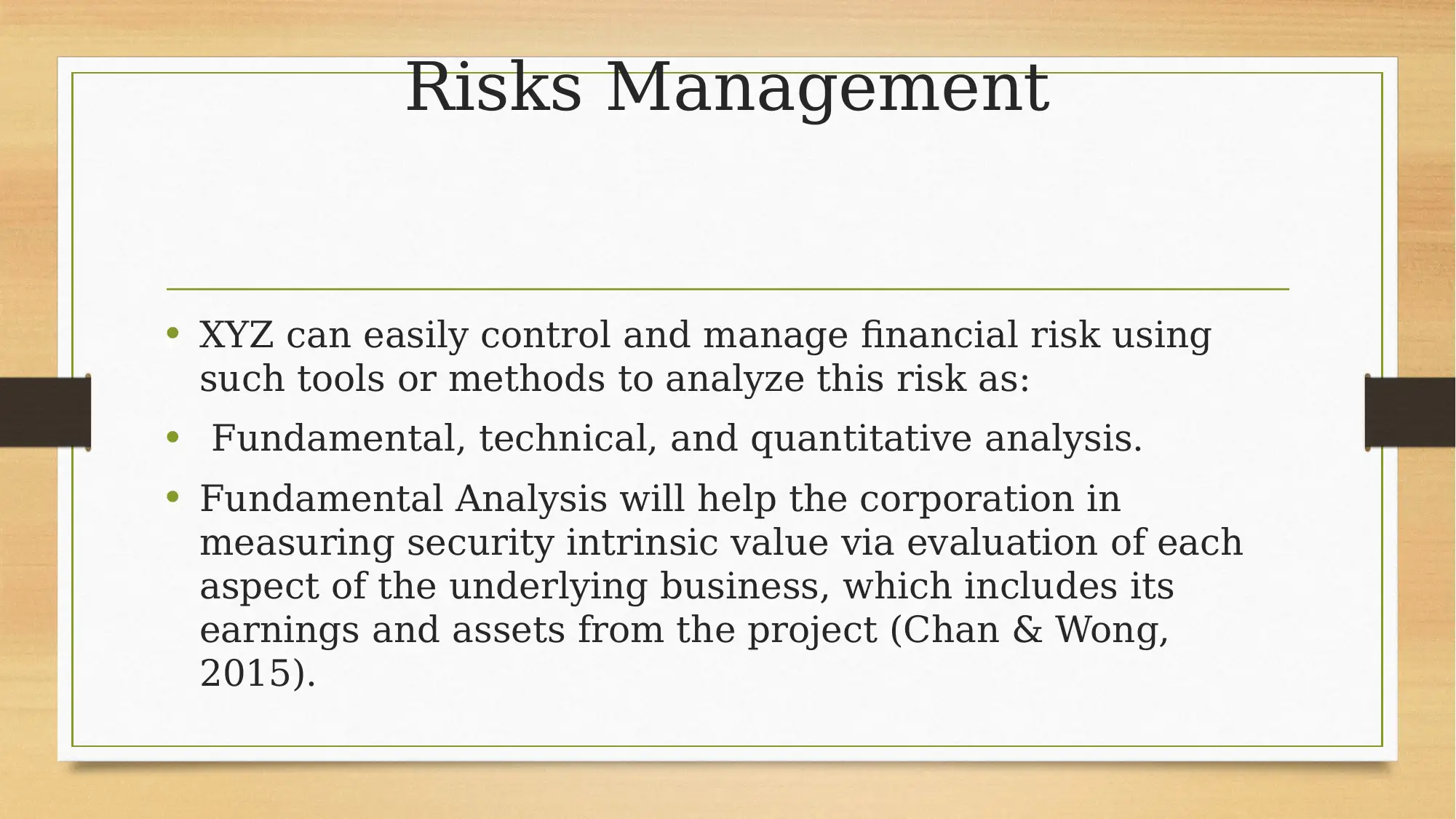
Risks Management
XYZ can easily control and manage financial risk using
such tools or methods to analyze this risk as:
Fundamental, technical, and quantitative analysis.
Fundamental Analysis will help the corporation in
measuring security intrinsic value via evaluation of each
aspect of the underlying business, which includes its
earnings and assets from the project (Chan & Wong,
2015).
Document Page
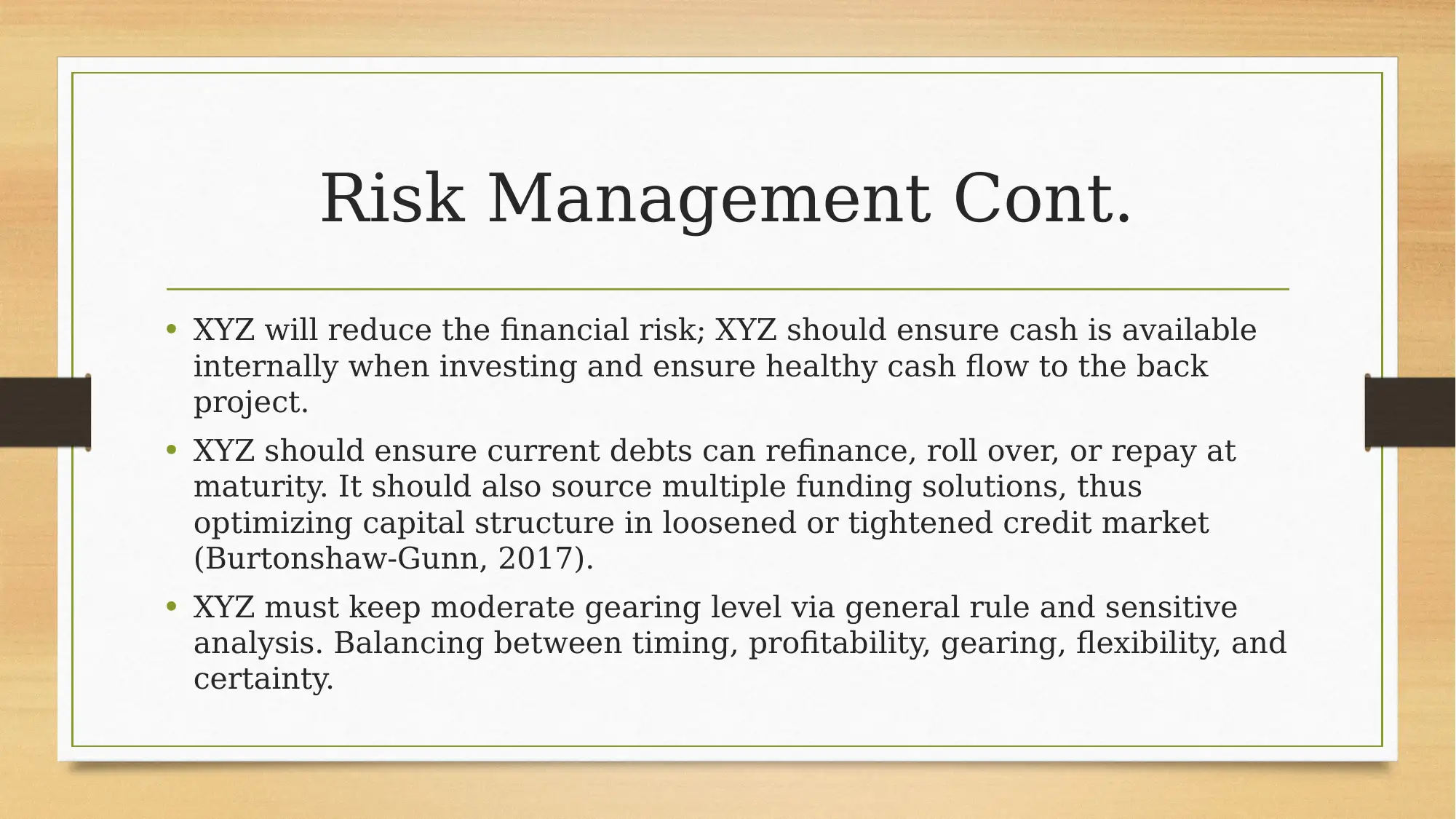
Risk Management Cont.
XYZ will reduce the financial risk; XYZ should ensure cash is available
internally when investing and ensure healthy cash flow to the back
project.
XYZ should ensure current debts can refinance, roll over, or repay at
maturity. It should also source multiple funding solutions, thus
optimizing capital structure in loosened or tightened credit market
(Burtonshaw-Gunn, 2017).
XYZ must keep moderate gearing level via general rule and sensitive
analysis. Balancing between timing, profitability, gearing, flexibility, and
certainty.
tabler-icon-diamond-filled.svg

Paraphrase This Document

Need a fresh take? Get an instant paraphrase of this document with our AI Paraphraser
Document Page
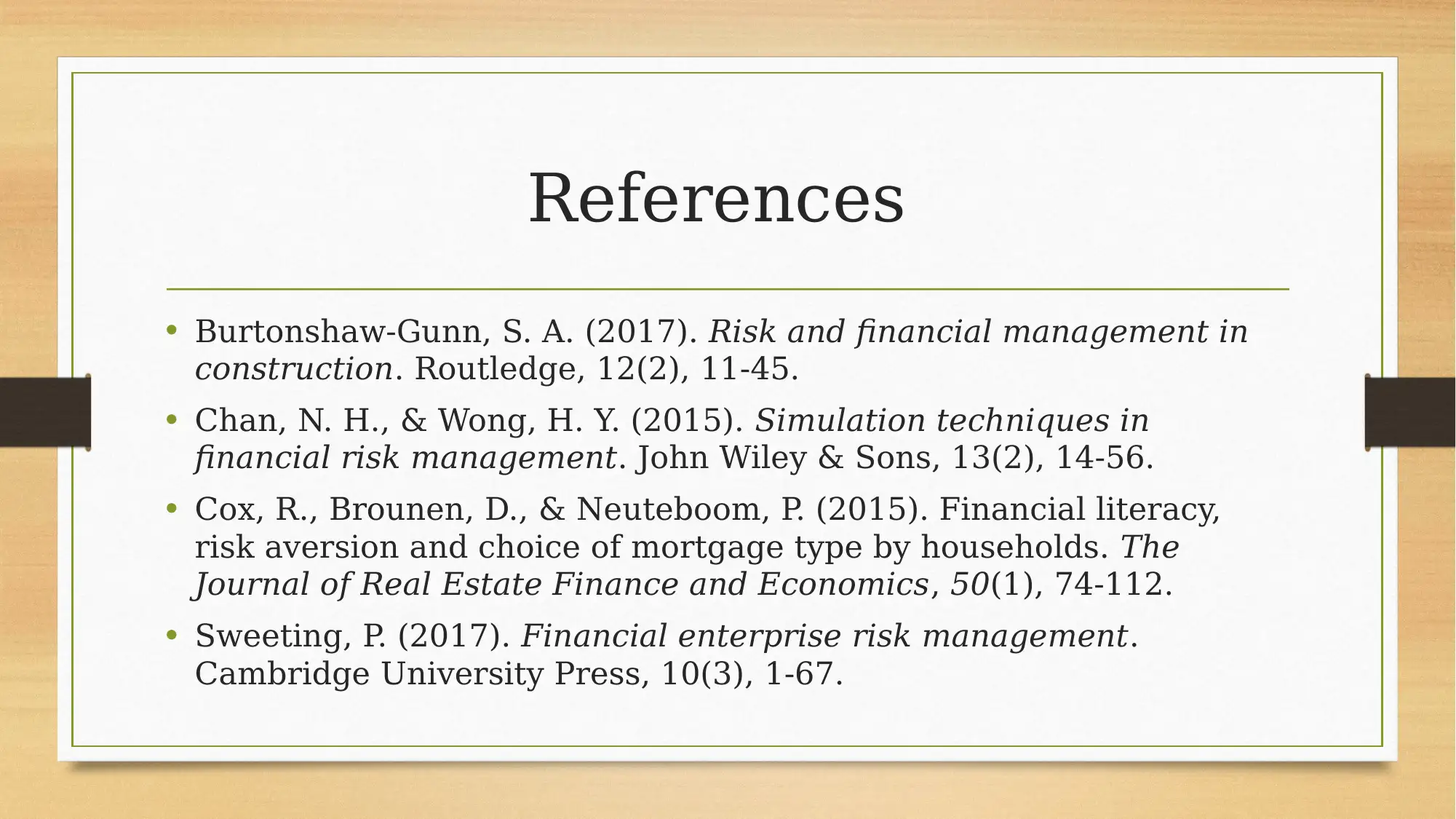
References
Burtonshaw-Gunn, S. A. (2017). Risk and financial management in
construction. Routledge, 12(2), 11-45.
Chan, N. H., & Wong, H. Y. (2015). Simulation techniques in
financial risk management. John Wiley & Sons, 13(2), 14-56.
Cox, R., Brounen, D., & Neuteboom, P. (2015). Financial literacy,
risk aversion and choice of mortgage type by households. The
Journal of Real Estate Finance and Economics, 50(1), 74-112.
Sweeting, P. (2017). Financial enterprise risk management.
Cambridge University Press, 10(3), 1-67.
chevron_up_icon
1 out of 5
circle_padding
hide_on_mobile
zoom_out_icon
[object Object]