Strategic SWOT Analysis for Ya Kun Kaya Toast in Singapore
VerifiedAdded on 2020/04/07
|20
|4803
|331
AI Summary
This assignment requires conducting a SWOT (Strengths, Weaknesses, Opportunities, Threats) analysis of Ya Kun Kaya Toast, a prominent Singaporean breakfast staple known for its kaya toast. The objective is to evaluate the internal and external factors influencing the business to strategize effectively for future growth. Students will analyze strengths such as brand recognition and product quality, weaknesses like limited geographic presence, opportunities including market expansion and menu diversification, and threats from competition and changing consumer preferences. The analysis should consider data from various sources mentioned in the bibliography, providing a comprehensive overview of Ya Kun Kaya Toast's business landscape.
Running head: YA KUN
Marketing Strategy and Plan
[Ya Kun]
Name of eth student:
Name of the university:
Author note:
Marketing Strategy and Plan
[Ya Kun]
Name of eth student:
Name of the university:
Author note:

Paraphrase This Document
Need a fresh take? Get an instant paraphrase of this document with our AI Paraphraser
1YA KUN
Executive summary
This paper is a complete guide on the basics of marketing. The paper presents the different
marketing strategies of the Ya Kun Company, which is headquartered in Singapore. The
company with its unique mixing strategy has blended success in its favour. The unique
presentation of traditional coffee with Kaya Toast and mixing it up with the modern taste has
positioned it in the list of top coffee companies in Singapore. It is only after to ToastBox in
relation to sales growth and number of outlets. The company also operates in some other
parts of world such as UAE, China etc. It is planning to operate in some potential markets
such as India, Malaysia, Maldives, Brunei and Thailand. It operates smartly such as
positioning the location of coffee outlets in places close to business areas and airports. The
paper depicts the style of marketing that Ya Kun uses such as working in collaboration with
the Singapore Tourism Board to attract the tourists as well. They have staffs, which have
utmost customer service skills that helps customers feel to be in a friendly environment. They
train their staffs at training centre working with the live customers. This is a unique way of
training the fresh talents because it would nurture them with utmost customer service skills
through analysing their flaws while interacting to the customers. The company works
strategically to attain every possible opportunity and to dislodge any possible threats such as
they dislodged their financial inability by switching to franchisees concept at their earlier
days. The paper presents a very creative story of an innovative company that knows no
boundary and believes in fostering to take full advantage of the created opportunities.
Executive summary
This paper is a complete guide on the basics of marketing. The paper presents the different
marketing strategies of the Ya Kun Company, which is headquartered in Singapore. The
company with its unique mixing strategy has blended success in its favour. The unique
presentation of traditional coffee with Kaya Toast and mixing it up with the modern taste has
positioned it in the list of top coffee companies in Singapore. It is only after to ToastBox in
relation to sales growth and number of outlets. The company also operates in some other
parts of world such as UAE, China etc. It is planning to operate in some potential markets
such as India, Malaysia, Maldives, Brunei and Thailand. It operates smartly such as
positioning the location of coffee outlets in places close to business areas and airports. The
paper depicts the style of marketing that Ya Kun uses such as working in collaboration with
the Singapore Tourism Board to attract the tourists as well. They have staffs, which have
utmost customer service skills that helps customers feel to be in a friendly environment. They
train their staffs at training centre working with the live customers. This is a unique way of
training the fresh talents because it would nurture them with utmost customer service skills
through analysing their flaws while interacting to the customers. The company works
strategically to attain every possible opportunity and to dislodge any possible threats such as
they dislodged their financial inability by switching to franchisees concept at their earlier
days. The paper presents a very creative story of an innovative company that knows no
boundary and believes in fostering to take full advantage of the created opportunities.
2YA KUN
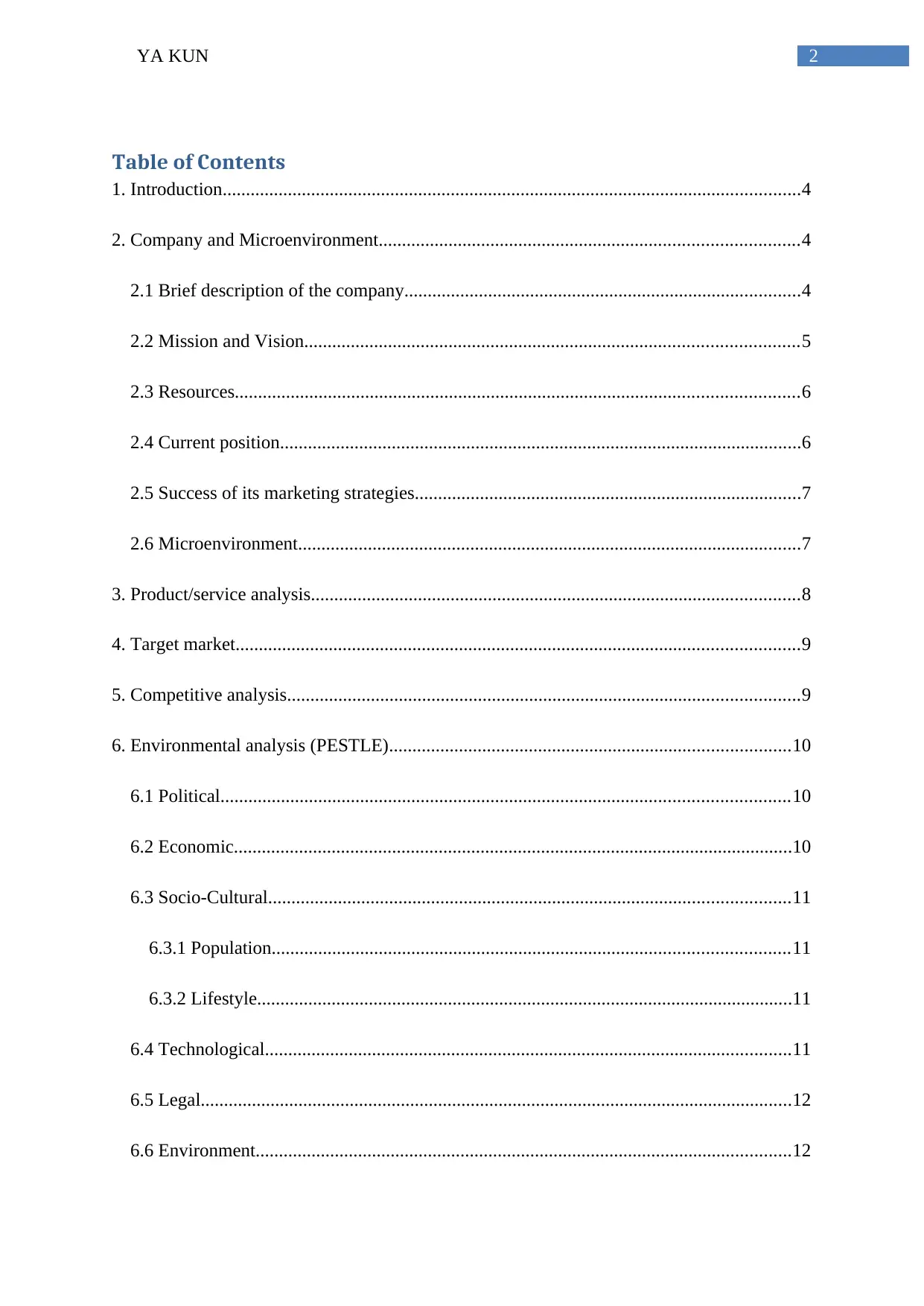
Table of Contents
1. Introduction............................................................................................................................4
2. Company and Microenvironment..........................................................................................4
2.1 Brief description of the company.....................................................................................4
2.2 Mission and Vision..........................................................................................................5
2.3 Resources.........................................................................................................................6
2.4 Current position................................................................................................................6
2.5 Success of its marketing strategies...................................................................................7
2.6 Microenvironment............................................................................................................7
3. Product/service analysis.........................................................................................................8
4. Target market.........................................................................................................................9
5. Competitive analysis..............................................................................................................9
6. Environmental analysis (PESTLE)......................................................................................10
6.1 Political..........................................................................................................................10
6.2 Economic........................................................................................................................10
6.3 Socio-Cultural................................................................................................................11
6.3.1 Population...............................................................................................................11
6.3.2 Lifestyle...................................................................................................................11
6.4 Technological.................................................................................................................11
6.5 Legal...............................................................................................................................12
6.6 Environment...................................................................................................................12
Table of Contents
1. Introduction............................................................................................................................4
2. Company and Microenvironment..........................................................................................4
2.1 Brief description of the company.....................................................................................4
2.2 Mission and Vision..........................................................................................................5
2.3 Resources.........................................................................................................................6
2.4 Current position................................................................................................................6
2.5 Success of its marketing strategies...................................................................................7
2.6 Microenvironment............................................................................................................7
3. Product/service analysis.........................................................................................................8
4. Target market.........................................................................................................................9
5. Competitive analysis..............................................................................................................9
6. Environmental analysis (PESTLE)......................................................................................10
6.1 Political..........................................................................................................................10
6.2 Economic........................................................................................................................10
6.3 Socio-Cultural................................................................................................................11
6.3.1 Population...............................................................................................................11
6.3.2 Lifestyle...................................................................................................................11
6.4 Technological.................................................................................................................11
6.5 Legal...............................................................................................................................12
6.6 Environment...................................................................................................................12
⊘ This is a preview!⊘
Do you want full access?
Subscribe today to unlock all pages.

Trusted by 1+ million students worldwide
3YA KUN
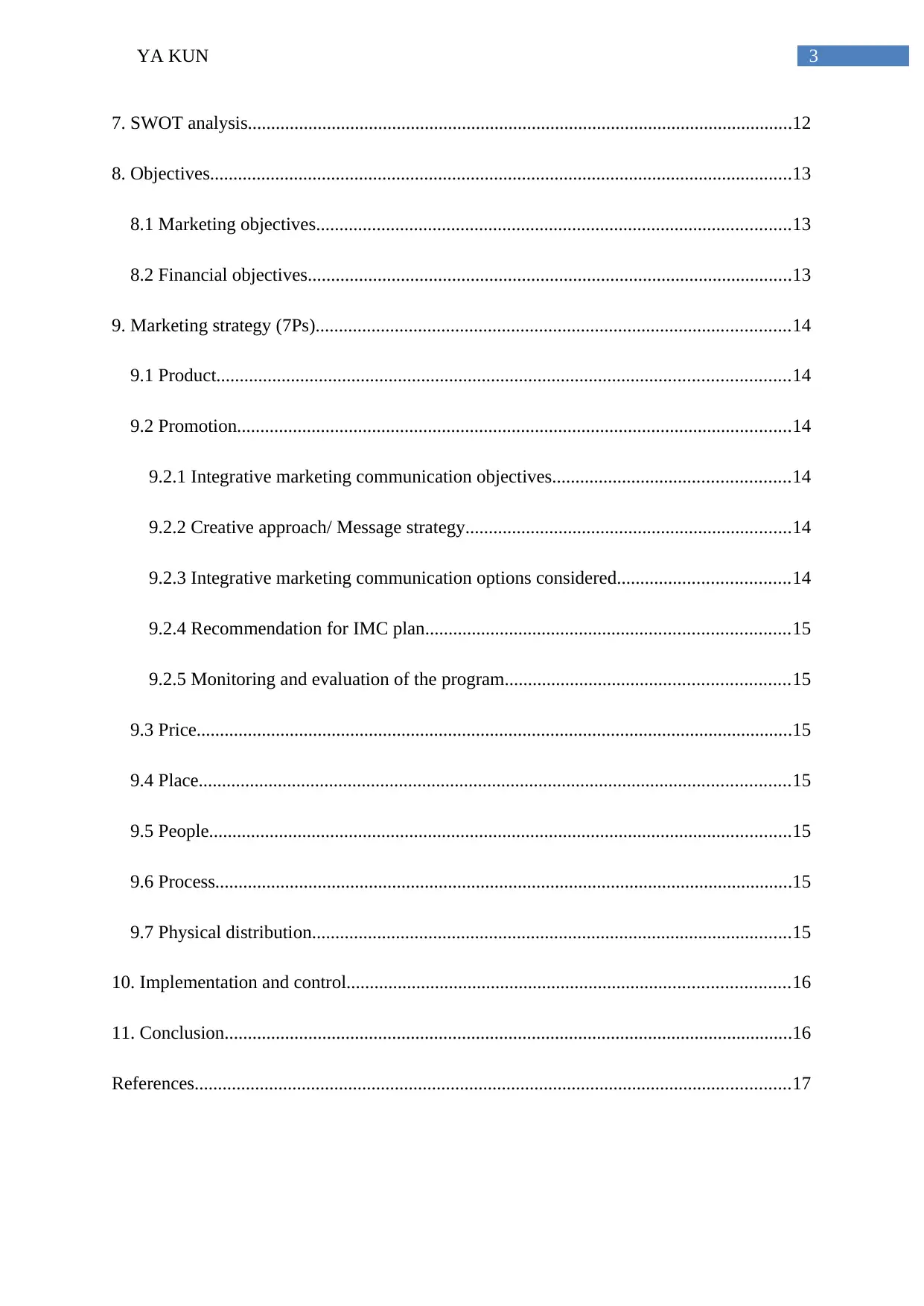
7. SWOT analysis.....................................................................................................................12
8. Objectives.............................................................................................................................13
8.1 Marketing objectives......................................................................................................13
8.2 Financial objectives........................................................................................................13
9. Marketing strategy (7Ps)......................................................................................................14
9.1 Product...........................................................................................................................14
9.2 Promotion.......................................................................................................................14
9.2.1 Integrative marketing communication objectives...................................................14
9.2.2 Creative approach/ Message strategy......................................................................14
9.2.3 Integrative marketing communication options considered.....................................14
9.2.4 Recommendation for IMC plan..............................................................................15
9.2.5 Monitoring and evaluation of the program.............................................................15
9.3 Price................................................................................................................................15
9.4 Place...............................................................................................................................15
9.5 People.............................................................................................................................15
9.6 Process............................................................................................................................15
9.7 Physical distribution.......................................................................................................15
10. Implementation and control...............................................................................................16
11. Conclusion..........................................................................................................................16
References................................................................................................................................17
7. SWOT analysis.....................................................................................................................12
8. Objectives.............................................................................................................................13
8.1 Marketing objectives......................................................................................................13
8.2 Financial objectives........................................................................................................13
9. Marketing strategy (7Ps)......................................................................................................14
9.1 Product...........................................................................................................................14
9.2 Promotion.......................................................................................................................14
9.2.1 Integrative marketing communication objectives...................................................14
9.2.2 Creative approach/ Message strategy......................................................................14
9.2.3 Integrative marketing communication options considered.....................................14
9.2.4 Recommendation for IMC plan..............................................................................15
9.2.5 Monitoring and evaluation of the program.............................................................15
9.3 Price................................................................................................................................15
9.4 Place...............................................................................................................................15
9.5 People.............................................................................................................................15
9.6 Process............................................................................................................................15
9.7 Physical distribution.......................................................................................................15
10. Implementation and control...............................................................................................16
11. Conclusion..........................................................................................................................16
References................................................................................................................................17
Paraphrase This Document
Need a fresh take? Get an instant paraphrase of this document with our AI Paraphraser

4YA KUN
5YA KUN
1. Introduction
Marketing strategy and plan is one of the integral parts of an organisational behaviour
that encourage it for an expansion into some other market (Baker, 2014). This can happen
because of various reasons such as market saturation in the existing market. In such
situations, efficient management feel this smarter to move to some other market while
keeping the operation in the existing market as well. They move to other market in order to
enhance their annual returns and to expand its market area to globalise the concept.
Globalising the concept would bring them the much-needed benefits, which has become
stagnant in the existing market. This assignment is also on the same theme (Gruber,
MacMillan & Thompson, 2013). The company chosen for this assignment is Ya Kun, which
is headquartered in Singapore. The company has attained successes in the country; however,
it has now reached to saturation. This is why the management has felt this wiser to move to
some other potential market in order to attain a progressive trend for the annual returns. The
management has decided to move to some other potential market such as India, Malaysia,
Brunei, Maldives and Thailand (MENKHOFF & EVERS, 2015). The main purpose of this
assignment is to analyse the potentiality of the company in context to entering into the
identified markets. In doing so, this assignment checks the company and its performance over
all the required parameters such as external and internal environment analysis.
2. Company and Microenvironment
2.1 Brief description of the company
Ya Kun are arguably the most recognised coffee shop chains in Singapore. Ever since
its inception in the year 1944 in Singapore, it never looked back. The opening was done as a
coffee shop. Later, they developed their own trademark with their special kaya toast. The
1. Introduction
Marketing strategy and plan is one of the integral parts of an organisational behaviour
that encourage it for an expansion into some other market (Baker, 2014). This can happen
because of various reasons such as market saturation in the existing market. In such
situations, efficient management feel this smarter to move to some other market while
keeping the operation in the existing market as well. They move to other market in order to
enhance their annual returns and to expand its market area to globalise the concept.
Globalising the concept would bring them the much-needed benefits, which has become
stagnant in the existing market. This assignment is also on the same theme (Gruber,
MacMillan & Thompson, 2013). The company chosen for this assignment is Ya Kun, which
is headquartered in Singapore. The company has attained successes in the country; however,
it has now reached to saturation. This is why the management has felt this wiser to move to
some other potential market in order to attain a progressive trend for the annual returns. The
management has decided to move to some other potential market such as India, Malaysia,
Brunei, Maldives and Thailand (MENKHOFF & EVERS, 2015). The main purpose of this
assignment is to analyse the potentiality of the company in context to entering into the
identified markets. In doing so, this assignment checks the company and its performance over
all the required parameters such as external and internal environment analysis.
2. Company and Microenvironment
2.1 Brief description of the company
Ya Kun are arguably the most recognised coffee shop chains in Singapore. Ever since
its inception in the year 1944 in Singapore, it never looked back. The opening was done as a
coffee shop. Later, they developed their own trademark with their special kaya toast. The
⊘ This is a preview!⊘
Do you want full access?
Subscribe today to unlock all pages.
Trusted by 1+ million students worldwide
6YA KUN
foundation was done as a coffee stall after the World War II; however, it really came into
existence as coffee shop chains in the year 2001 in Singapore. Since then it has witnessed a
huge expansion in the country and other parts of Asia. Currently, it has 40 outlets in
Singapore. It is also operating in 30 other international locations altogether. One of the main
reasons behind the success of the company is a mass popularity of its kaya toast. Long-term
success can only be attained if innovation is delivered at the most suitable time (Wheelen &
Hunger, 2017). Ya Kun have maintained the same strategy, which is highly evident in their
strategy behind keeping the toast fresh and tasty. They do not believe in importing things
from outside of the country. They rather believe in delivering the fresh, which is only
possible if it is produced locally. They try to use various natural resources in order to keep
their offerings fresh. For example, they offer plastic bags to carry the toast or other snacks.
They rely on same supplier for getting all the required materials needed. The kaya toast and
the coffee powder are manufactured at its factory in Bedok. These are some strategies, which
enable them to offer fresh coffee and kaya toast to customers. They have not restricted them
with coffee and toast only but they also offer snacks, beverages and much other stuff
(Yakun.com, 2017).
2.2 Mission and Vision
Mission- The mission of the company is as follows (Yakun.com, 2017):
To strive to preserve its uniqueness established ever since 1944
To propagate a belief that a fresh and good quality toast can produce friendship and
partnership relations with the customers
To attain a mission to offer its dual objectives, which is to provide the affordability
and availability with its products
To pursue an excellent customer service
To position it at the forefront with innovation in production
foundation was done as a coffee stall after the World War II; however, it really came into
existence as coffee shop chains in the year 2001 in Singapore. Since then it has witnessed a
huge expansion in the country and other parts of Asia. Currently, it has 40 outlets in
Singapore. It is also operating in 30 other international locations altogether. One of the main
reasons behind the success of the company is a mass popularity of its kaya toast. Long-term
success can only be attained if innovation is delivered at the most suitable time (Wheelen &
Hunger, 2017). Ya Kun have maintained the same strategy, which is highly evident in their
strategy behind keeping the toast fresh and tasty. They do not believe in importing things
from outside of the country. They rather believe in delivering the fresh, which is only
possible if it is produced locally. They try to use various natural resources in order to keep
their offerings fresh. For example, they offer plastic bags to carry the toast or other snacks.
They rely on same supplier for getting all the required materials needed. The kaya toast and
the coffee powder are manufactured at its factory in Bedok. These are some strategies, which
enable them to offer fresh coffee and kaya toast to customers. They have not restricted them
with coffee and toast only but they also offer snacks, beverages and much other stuff
(Yakun.com, 2017).
2.2 Mission and Vision
Mission- The mission of the company is as follows (Yakun.com, 2017):
To strive to preserve its uniqueness established ever since 1944
To propagate a belief that a fresh and good quality toast can produce friendship and
partnership relations with the customers
To attain a mission to offer its dual objectives, which is to provide the affordability
and availability with its products
To pursue an excellent customer service
To position it at the forefront with innovation in production
Paraphrase This Document
Need a fresh take? Get an instant paraphrase of this document with our AI Paraphraser
7YA KUN
Vision- “To establish the company as a household reputation in the country and the other
parts of Asia” (Yakun.com, 2017)
2.3 Resources
It is difficult to operate without the required different resources such as the human,
capital, physical etc. Ya Kun Company like many other SMEs have smartly managed the
requirement of capital flow. The expansion of the company in Singapore and the other parts
of world has largely been accredited to its strategy to approach the franchisees. The different
franchisees have helped the company in expanding to an elevated area of business in the
country and the other parts of world. The company was able to penetrate into the market,
which the company has no access with previously because of capital issues and the
government regulations. Another interesting fact about the company is its human resource
management, which has efficiently responded to the created urgency. The company relies
heavily on recruiting the professionals and training them on the skills and the culture required
to propagate the reputation that it carries. They have set certain criteria for selecting the
candidate, which the aspirants need to agree in order to crack the interview. The criterion is to
be punctual and to have willingness to work with flexible shifts. The training is carried on for
two weeks in a row at its SAFRA Mount Faber outlet. The site offers a practical training
program, which also include interacting with the live customers (bschool.nus.edu.sg, 2017).
2.4 Current position
Currently, the company is the second largest coffee chains in Singapore followed by
ToastBox. Killiney Kopitiam is its other competitor. Ya Kun has maintained a progressive
trend in the market; however, it is still a long way for the company to dislodge ToastBox
from the top position. In terms of number of outlets, Ya Kun again comes at the second spot
after ToastBox.
Vision- “To establish the company as a household reputation in the country and the other
parts of Asia” (Yakun.com, 2017)
2.3 Resources
It is difficult to operate without the required different resources such as the human,
capital, physical etc. Ya Kun Company like many other SMEs have smartly managed the
requirement of capital flow. The expansion of the company in Singapore and the other parts
of world has largely been accredited to its strategy to approach the franchisees. The different
franchisees have helped the company in expanding to an elevated area of business in the
country and the other parts of world. The company was able to penetrate into the market,
which the company has no access with previously because of capital issues and the
government regulations. Another interesting fact about the company is its human resource
management, which has efficiently responded to the created urgency. The company relies
heavily on recruiting the professionals and training them on the skills and the culture required
to propagate the reputation that it carries. They have set certain criteria for selecting the
candidate, which the aspirants need to agree in order to crack the interview. The criterion is to
be punctual and to have willingness to work with flexible shifts. The training is carried on for
two weeks in a row at its SAFRA Mount Faber outlet. The site offers a practical training
program, which also include interacting with the live customers (bschool.nus.edu.sg, 2017).
2.4 Current position
Currently, the company is the second largest coffee chains in Singapore followed by
ToastBox. Killiney Kopitiam is its other competitor. Ya Kun has maintained a progressive
trend in the market; however, it is still a long way for the company to dislodge ToastBox
from the top position. In terms of number of outlets, Ya Kun again comes at the second spot
after ToastBox.
8YA KUN
2.5 Success of its marketing strategies
They are efficient strategy maker in terms of marketing. Physically, they do unlike
marketing of their products. For an example, they use wooden tables and tools in order to
represent the Chinese culture. Additionally, unlike its competitors it offers limited menu with
centred focus on their trademark product kaya toast. To connect to a wider audience, they
also sell French toast and Toastwiches. They combine the meal with boiled eggs and
beverage. They have kept prices slightly higher in its local outlets; however, it is still less
expensive than the pricing at its overseas outlets. One of their unique marketing strategies is
the use of recipe, which is only familiar with few Loi families. This is how they deliver a
unique taste of coffee and kaya toast to the customers (Iesingapore.gov.sg, 2017).
2.6 Microenvironment
Customer analysis-
Singapore is a country where numerous different cultures exist. In other words, it
means that there exists a variety of taste. Its stores have now become a compulsory one-visit
store for most people living in Singapore. Customers of its different coffee shops are mainly
the Asian people and those who belong to the other parts of world. They also need to
recommend taste to select because most of the time customers find this difficult to understand
the best taste for him or her. This is another interesting point that helps in attracting
customers to its coffee outlets (Iesingapore.gov.sg, 2017).
Competitor’s analysis-
There are mainly two competitors of Ya Kun Company in Singapore such as
ToastBox and Killiney Kopitiam. ToastBox in particular has produced an enormous
competition to the company. It is at the top position in Singapore in terms of number of
outlets and the growth of sales. It is necessary for Ya Kun that it maintains a high standard
2.5 Success of its marketing strategies
They are efficient strategy maker in terms of marketing. Physically, they do unlike
marketing of their products. For an example, they use wooden tables and tools in order to
represent the Chinese culture. Additionally, unlike its competitors it offers limited menu with
centred focus on their trademark product kaya toast. To connect to a wider audience, they
also sell French toast and Toastwiches. They combine the meal with boiled eggs and
beverage. They have kept prices slightly higher in its local outlets; however, it is still less
expensive than the pricing at its overseas outlets. One of their unique marketing strategies is
the use of recipe, which is only familiar with few Loi families. This is how they deliver a
unique taste of coffee and kaya toast to the customers (Iesingapore.gov.sg, 2017).
2.6 Microenvironment
Customer analysis-
Singapore is a country where numerous different cultures exist. In other words, it
means that there exists a variety of taste. Its stores have now become a compulsory one-visit
store for most people living in Singapore. Customers of its different coffee shops are mainly
the Asian people and those who belong to the other parts of world. They also need to
recommend taste to select because most of the time customers find this difficult to understand
the best taste for him or her. This is another interesting point that helps in attracting
customers to its coffee outlets (Iesingapore.gov.sg, 2017).
Competitor’s analysis-
There are mainly two competitors of Ya Kun Company in Singapore such as
ToastBox and Killiney Kopitiam. ToastBox in particular has produced an enormous
competition to the company. It is at the top position in Singapore in terms of number of
outlets and the growth of sales. It is necessary for Ya Kun that it maintains a high standard
⊘ This is a preview!⊘
Do you want full access?
Subscribe today to unlock all pages.
Trusted by 1+ million students worldwide
9YA KUN
quality of coffee, kaya toast and other snacks. This is necessary to enhance its sales.
Singapore has become a business hub. It is also gaining popularity in the tourism industry.
This is because of both the reasons it is necessary for the company to innovate with their
offerings to attract a wider customer base (Iesingapore.gov.sg, 2017).
3. Product/service analysis
Unlike its competitors, Ye Kun is limited with the offerings; however, it has now
opened up its arms of creative actions. The success story ever since its inception in the year
1944 has been the recipes that include soft-boiled eggs, toast layered with homemade kaya
and fresh coffee. It has now also become a comfortable meal for most Singaporeans. The
company has now become more creative with recipes in menu such as Toast Dipz. They have
maintained their traditional legacy while agreeing to move with the pace of modern taste. The
added product is just a mere example of such fact. They are doing this to reach out to younger
customers. Such creative ideas have helped the company in producing many reasons for the
customers to be in its coffee shops. They are also working with the Singapore Tourism Board
to reach to a wider market. They are offering CapitalCard Promotion and discounted offers
on Great Singapore Sale (Iesingapore.gov.sg, 2017).
Based on above analysis the three kinds of products can be segmented as follows:
Core- traditional coffee, kaya toast and even value meals
Actual- different kinds of meals to satisfy the different kinds of needs, quality service
& food and significant brand value in the country
Augmented- outlet locations are always close to business areas to make this
convenient for the customers to visit, it has now become a significant place to meet
with friends and conduct important meetings as well
quality of coffee, kaya toast and other snacks. This is necessary to enhance its sales.
Singapore has become a business hub. It is also gaining popularity in the tourism industry.
This is because of both the reasons it is necessary for the company to innovate with their
offerings to attract a wider customer base (Iesingapore.gov.sg, 2017).
3. Product/service analysis
Unlike its competitors, Ye Kun is limited with the offerings; however, it has now
opened up its arms of creative actions. The success story ever since its inception in the year
1944 has been the recipes that include soft-boiled eggs, toast layered with homemade kaya
and fresh coffee. It has now also become a comfortable meal for most Singaporeans. The
company has now become more creative with recipes in menu such as Toast Dipz. They have
maintained their traditional legacy while agreeing to move with the pace of modern taste. The
added product is just a mere example of such fact. They are doing this to reach out to younger
customers. Such creative ideas have helped the company in producing many reasons for the
customers to be in its coffee shops. They are also working with the Singapore Tourism Board
to reach to a wider market. They are offering CapitalCard Promotion and discounted offers
on Great Singapore Sale (Iesingapore.gov.sg, 2017).
Based on above analysis the three kinds of products can be segmented as follows:
Core- traditional coffee, kaya toast and even value meals
Actual- different kinds of meals to satisfy the different kinds of needs, quality service
& food and significant brand value in the country
Augmented- outlet locations are always close to business areas to make this
convenient for the customers to visit, it has now become a significant place to meet
with friends and conduct important meetings as well
Paraphrase This Document
Need a fresh take? Get an instant paraphrase of this document with our AI Paraphraser
10YA KUN
4. Target market
The target market includes locals who have passion for traditional coffee and kaya
toast. This also includes tourist, as Singapore has now become a significant tourist attraction.
If it expands to some other parts of world such as Maldives, India, Malaysia and Thailand, it
would target the local customers as well as the tourists coming from the other parts of world.
The target market segmentation is like the following:
Demographic- In this category, they have targeted young and middle age customers: 10-50
years old and elders: 50 years and above. This is rightly planned as well. These two age
groups are the potential customers for coffee and snacks. Customers are both male and
female. They are either married or single. Such business concept is for all income groups.
Customers are not judged based on their race. They do this to reach to a wider customer base,
which is very important to compete with its competitors (Wipo.int, 2017).
Geographic- Geographically, they have targeted all the locals and the tourists who come to
the country from other parts of world (Wipo.int, 2017).
Behavioural- Those customers are targeted who are loyal and addictive to traditional coffee
and kaya toast (Wipo.int, 2017).
Psychographic- All those who fall within the lower to middle to upper class (Wipo.int, 2017)
5. Competitive analysis
They are competitive because they follow traditional footprint. They are also
competitive because they use creative ideas to reach to a wider and enhanced customer base.
Collaborating with the Singapore Tourism Board is one of such examples that show their
utmost innovation for long-term business strategies. Introducing new taste such as Toast Dipz
just shows that they are flexible enough to give space to change. The practical training given
4. Target market
The target market includes locals who have passion for traditional coffee and kaya
toast. This also includes tourist, as Singapore has now become a significant tourist attraction.
If it expands to some other parts of world such as Maldives, India, Malaysia and Thailand, it
would target the local customers as well as the tourists coming from the other parts of world.
The target market segmentation is like the following:
Demographic- In this category, they have targeted young and middle age customers: 10-50
years old and elders: 50 years and above. This is rightly planned as well. These two age
groups are the potential customers for coffee and snacks. Customers are both male and
female. They are either married or single. Such business concept is for all income groups.
Customers are not judged based on their race. They do this to reach to a wider customer base,
which is very important to compete with its competitors (Wipo.int, 2017).
Geographic- Geographically, they have targeted all the locals and the tourists who come to
the country from other parts of world (Wipo.int, 2017).
Behavioural- Those customers are targeted who are loyal and addictive to traditional coffee
and kaya toast (Wipo.int, 2017).
Psychographic- All those who fall within the lower to middle to upper class (Wipo.int, 2017)
5. Competitive analysis
They are competitive because they follow traditional footprint. They are also
competitive because they use creative ideas to reach to a wider and enhanced customer base.
Collaborating with the Singapore Tourism Board is one of such examples that show their
utmost innovation for long-term business strategies. Introducing new taste such as Toast Dipz
just shows that they are flexible enough to give space to change. The practical training given
11YA KUN
to shortlisted staffs in its training location with live customers just add values to their
creativity. They are significantly behind to ToastBox in terms of sales growth and coffee
outlets; however, they are a potential learner, which is good for a long-term business growth.
Identifying the requirement to move to new markets such as Maldives, Malaysia, India and
Thailand just show their capability to make justified decisions when it is required the most
(Fleisher & Bensoussan, 2015).
6. Environmental analysis (PESTLE)
6.1 Political
Politically Singapore is a very stable country. The local government of the country
has very encouraging thoughts, as it is evident in its decision to promote the country at the
global platform in relation to tourism. They are favouring the growth of the country as the
global tourism. Nevertheless, this would be beneficial for Ya Kun because it is already
engaged in drawing the attention of tourists that come from the different parts of world
(Aljunied, 2013).
6.2 Economic
Singapore’s per capita growth in GDP is higher than even the few developed nations.
The open trade policies have favoured mush more in becoming the centre as a business hub
for many international companies. The country has also an advanced level of infrastructure,
which is good for different kinds of business. The GDP growth and a highly developed
infrastructure is a good sign for the business of Ya Kun Company. Locals of the country have
high buying capability, which means that income is a least barrier in the success of the
business. Additionally, foreign tourists are also the potential buyers (Vu, 2013).
to shortlisted staffs in its training location with live customers just add values to their
creativity. They are significantly behind to ToastBox in terms of sales growth and coffee
outlets; however, they are a potential learner, which is good for a long-term business growth.
Identifying the requirement to move to new markets such as Maldives, Malaysia, India and
Thailand just show their capability to make justified decisions when it is required the most
(Fleisher & Bensoussan, 2015).
6. Environmental analysis (PESTLE)
6.1 Political
Politically Singapore is a very stable country. The local government of the country
has very encouraging thoughts, as it is evident in its decision to promote the country at the
global platform in relation to tourism. They are favouring the growth of the country as the
global tourism. Nevertheless, this would be beneficial for Ya Kun because it is already
engaged in drawing the attention of tourists that come from the different parts of world
(Aljunied, 2013).
6.2 Economic
Singapore’s per capita growth in GDP is higher than even the few developed nations.
The open trade policies have favoured mush more in becoming the centre as a business hub
for many international companies. The country has also an advanced level of infrastructure,
which is good for different kinds of business. The GDP growth and a highly developed
infrastructure is a good sign for the business of Ya Kun Company. Locals of the country have
high buying capability, which means that income is a least barrier in the success of the
business. Additionally, foreign tourists are also the potential buyers (Vu, 2013).
⊘ This is a preview!⊘
Do you want full access?
Subscribe today to unlock all pages.
Trusted by 1+ million students worldwide

1 out of 20


Related Documents


Your All-in-One AI-Powered Toolkit for Academic Success.
+13062052269
info@desklib.com
Available 24*7 on WhatsApp / Email
![[object Object]](/_next/static/media/star-bottom.7253800d.svg)
Unlock your academic potential
Copyright © 2020–2026 A2Z Services. All Rights Reserved. Developed and managed by ZUCOL.