HLT1RAE Research & Evidence: Yoga Study Critical Appraisal Report

Verified

Added on  2022/11/07

|2
|604
|495
Report
AI Summary
This report provides a critical appraisal of a study investigating the effectiveness of yoga in alleviating depression and anxiety disorders. The study, conducted by Woolery, examined the impact of yoga on women registered at a yoga clinic. The research employed a quasi-experimental design, comparing an experimental group practicing yoga with a control group on a waiting list. Data were collected using the Beck Depression Inventory (BDI) and the Spielberger questionnaire to assess depression and anxiety levels, respectively. The study found that yoga could reduce anxiety but showed limited effectiveness in treating depression, suggesting a need for longer therapeutic interventions. The report analyzes the study's methodology, including sample selection, measurement tools, and potential threats to validity, offering insights into the study's strengths and limitations within the context of evidence-based practice. The study highlights the potential of yoga as a complementary treatment for mental health conditions.
Document Page
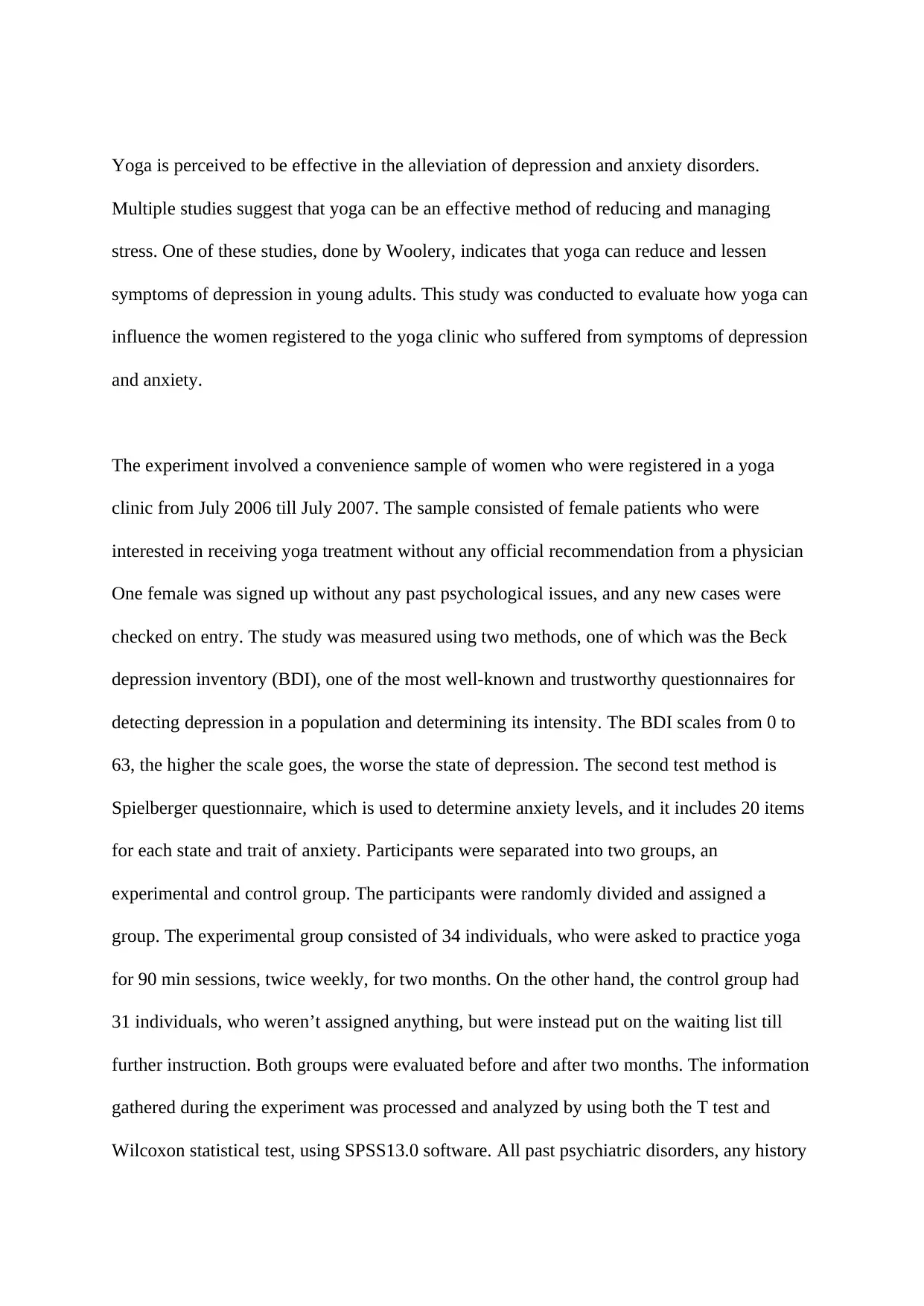
Yoga is perceived to be effective in the alleviation of depression and anxiety disorders.
Multiple studies suggest that yoga can be an effective method of reducing and managing
stress. One of these studies, done by Woolery, indicates that yoga can reduce and lessen
symptoms of depression in young adults. This study was conducted to evaluate how yoga can
influence the women registered to the yoga clinic who suffered from symptoms of depression
and anxiety.
The experiment involved a convenience sample of women who were registered in a yoga
clinic from July 2006 till July 2007. The sample consisted of female patients who were
interested in receiving yoga treatment without any official recommendation from a physician
One female was signed up without any past psychological issues, and any new cases were
checked on entry. The study was measured using two methods, one of which was the Beck
depression inventory (BDI), one of the most well-known and trustworthy questionnaires for
detecting depression in a population and determining its intensity. The BDI scales from 0 to
63, the higher the scale goes, the worse the state of depression. The second test method is
Spielberger questionnaire, which is used to determine anxiety levels, and it includes 20 items
for each state and trait of anxiety. Participants were separated into two groups, an
experimental and control group. The participants were randomly divided and assigned a
group. The experimental group consisted of 34 individuals, who were asked to practice yoga
for 90 min sessions, twice weekly, for two months. On the other hand, the control group had
31 individuals, who weren’t assigned anything, but were instead put on the waiting list till
further instruction. Both groups were evaluated before and after two months. The information
gathered during the experiment was processed and analyzed by using both the T test and
Wilcoxon statistical test, using SPSS13.0 software. All past psychiatric disorders, any history
tabler-icon-diamond-filled.svg

Paraphrase This Document

Need a fresh take? Get an instant paraphrase of this document with our AI Paraphraser
Document Page
with drug abuse and any past experience with yoga were excluded according to the personal
information questionnaire. A comparison of the data collected before and after the two
months using the BDI and Spielberger questionnaire were examined for any change in the
symptoms, anxiety and depression for both groups. The average levels of depression and the
anxiety in comparison that were collected pre and post experiment from the control and
experimental group were examined. However, with regards to stress levels, there was a
decrease. In the control groups, there were no significant difference.
What was found out from this study was that yoga can indeed lessen and treat anxiety,
however does not help as much with women dealing with depression. Furthermore, the
experiment strengthened the possibility of yoga being a potential treatment for other serious
mental disorders, such as obsessive-compulsive disorder (OCD). The average depressive
score in the experimental group was 12.82 and 10.79 before and after intervention
respectively. Cases of depression in pre- and post-treatment were 44.1% and 32.3%
respectively. Average state anxiety before and after intervention was 2.29 and 1.85
respectively. There were 65.3% cases of trait anxiety and 20.6% in pre and post treatment
respectively. In conclusion, yoga should be considered for reducing stress, however as for
depression, it may require a longer therapeutic time period to see any improvements.
chevron_up_icon
1 out of 2
circle_padding
hide_on_mobile
zoom_out_icon
[object Object]