YS1 Case Study: Resilience, Risk, and Youth Participation

Verified

Added on  2022/11/13

|8
|1565
|406
Case Study
AI Summary
This case study examines the life of Faheem, a young man who immigrated to Australia from Sudan, and explores the themes of resilience, risk, and youth participation within the context of his experiences. The study delves into how Faheem navigated challenges related to cultural integration, educational struggles, and social acceptance, highlighting the importance of resilience in overcoming adversity. It further analyzes the risks associated with stigmatization and surveillance faced by young people, particularly within minority communities, and how these factors can impact mental health and identity formation. Finally, the case study investigates the dynamics of youth participation, examining how social and economic pressures influence young people's engagement in social movements and political processes, and the importance of political participation in advocating for social justice and democratic principles. The study uses the case of Faheem to demonstrate how economic and social factors contribute to resilience functions, and how the environment of primal living plays a role in bringing about strategies for survival.
Document Page
YOUTH STUDIES
tabler-icon-diamond-filled.svg

Paraphrase This Document

Need a fresh take? Get an instant paraphrase of this document with our AI Paraphraser
Document Page
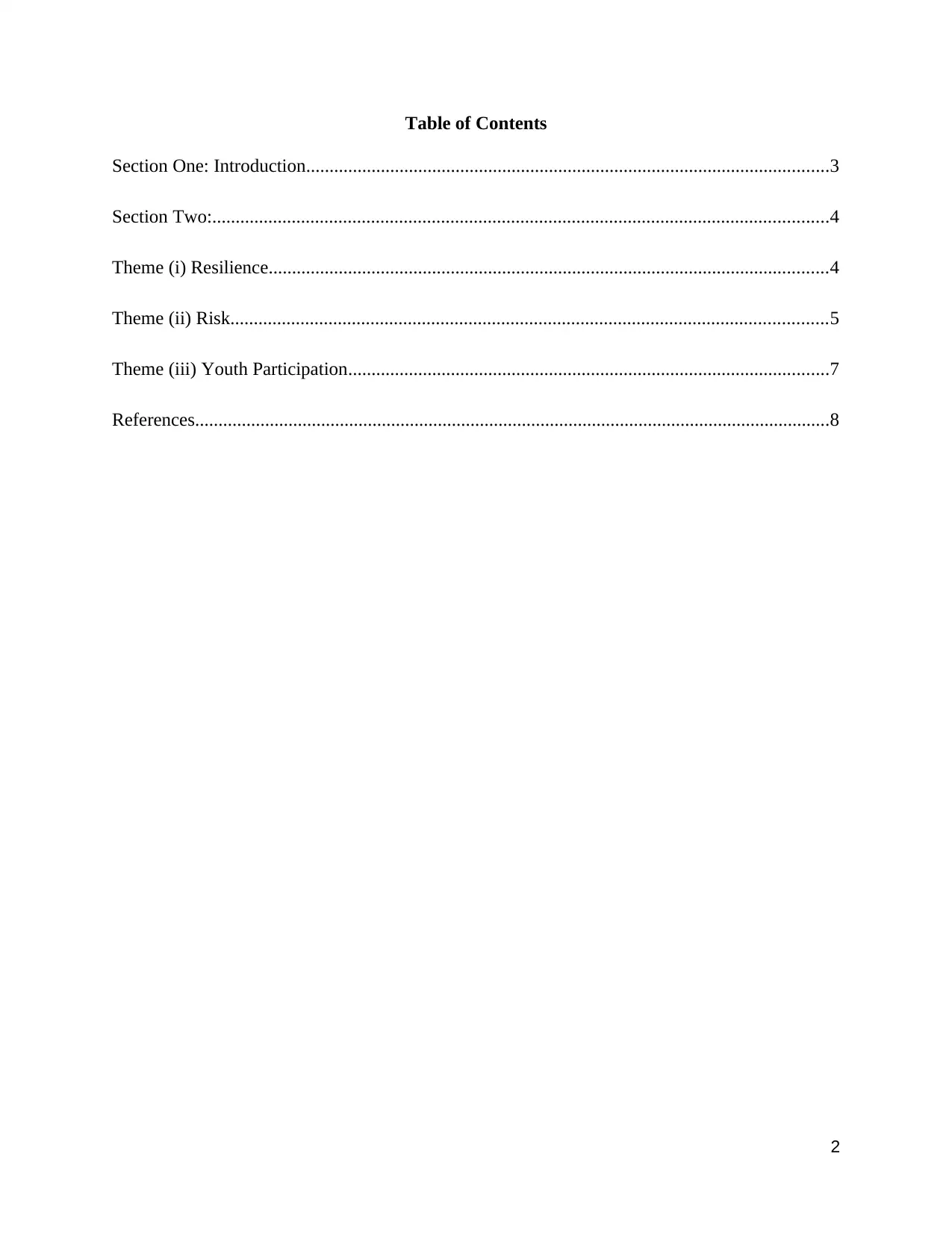
Table of Contents
Section One: Introduction................................................................................................................3
Section Two:....................................................................................................................................4
Theme (i) Resilience........................................................................................................................4
Theme (ii) Risk................................................................................................................................5
Theme (iii) Youth Participation.......................................................................................................7
References........................................................................................................................................8
2
Document Page
Section One: Introduction
It is important to understand the period of development related to young a person that falls
between the transitions from adolescent to an adult. The display of different characteristics of
behaviour and experience related to it is crucial in understanding the emerging society. The
study aims to discuss the perceptions of Faheem who came to Australia as part of Humanitarian
Immigrant Program from Sudan in 2006 when was 10 years old. He and family was welcomed
by the Sudanese community in Australia, however he struggled in school and felt behind other
student. Faheem became a part of community led program under the supervision of male mentor
after he fall into bad company and was also provided extra support for improving his language
skills. He was facing acceptance problem and was not very sure if he will find work or be
accepted as Australian. This focuses on the considerations related to resilience for supporting
people to best overcome adversity. The study will also focus on the concept of risk related to
stigmatisation and increasing surveillance on young people. The study will also focus on youth
participation specifically in cases which deems to be unjustified to them.
Section Two:
Theme (i) Resilience
The term resilience is essentially related to interventions considered for child populations
undergoing stress. The children may face stress because of number of reasons which includes
divorce of parents, homeless youth, children exposed to war, immigrants coping with
displacement. Studies related to resilience leads to producing insights related to ontogeny or
progressions to bring about positive development among population at risk (Ungar, 2008).
Resilience as theory for inform action
3
Document Page
Resilience includes capacity of individuals for navigating their ways for sustain well. It also
includes physical and social explodes providing for these resources. The resilience helps in
negotiating culturally in ways that are meaningful for sharing of resources. Resilience exists to
the extent that is within the reach of child's physical and social ecology (Ungar, 2018).
The study of Resilience prods the knowledge account punting for positive adaptation for
adversity and disadvantage. This can be radially applied in the case of Faheem for developing
resilience dependent on the environment in which he is growing up. This focuses on specific
processes related to each community positive contribution.
Understanding risk in resilience
The social resilience is intertwined with risk focusing on individual factors leading to predicting
risk. The risk needs consideration in all aspects related to discrimination and racism which leads
to profound inequality. The notion of risk helps in justification of application of interventions
The whole social resilience focus on social factors and concurrent needs the theory of resilience
reacted to quality of needs (Gale and Bolzan, 2013). The exploration of social resilience helps.
In recognition of imperative to needs ten resilience functions are focused on the social ecologies.
The case Faheem helps to understand the fact that social and economic factors are real
contributors of resilience functions and see dependent on support like school, society, medical
care and so in. The economic and social ecologist helps in realizing resilience and emphasizes
the environment of primal living. This will help Faheem to bring about changes in the
environment and bring about strategies changes for survival.
Theme (ii) Risk
The significant life experiences faced by the youths have undergone significant changes. The
risk attached to living in a society can lead stigmatization and surveillance by parents. The
4
tabler-icon-diamond-filled.svg

Paraphrase This Document

Need a fresh take? Get an instant paraphrase of this document with our AI Paraphraser
Document Page
empirical evidences focuses on high modernity of lid that has influenced outs outlook towards
society and breakdown related to ontological society.
Changes in the perspective of society
The modern era has ushered conducive environment for classlessness and limited effect on life of
youth because of structural location. This has resulted in widespread spread of unequal
distribution and has inequalities characteristics (Furlong and Cartmel, 2006). The subjective
dimensions of class has undergone changes that has led to individualisation in education and
labour market and social inequalities have hold over people slices The perspective of
postmodernism thinkers interpreted high modernity in social process.
The risk impacts on stigmatisation
The misappropriate impact of power distribution has immense impact on the ethnic minorities
making them vulnerable to political and social influences. The persuasive scrutiny leads to
creation of climate of suspicion and Paranoia those impacts upon the range of Mental Health
issues related to young people and management expression and concealment of their risky
identities (Coppock and McGovern, 2014).
As seen in the case of Faheem who is under immense pressure of being stigmatized of being
outsider and has doubts about his acceptance as Australian. He is also frustrated on the fact that
violent activities are easily passed off crimes that are seen in society around him to be committed
by Black people which is not always the case.
It has been stated that theories related radicalism is imbibed with the feelings and desires related
to fundamental and socio-political changes and pursue changes for supporting far reaching
changes occurring in society. In case of Faheem, the acceptance of Darren and his family in
5
Document Page
Australia and providing of equal opportunity of education consist of ideologies related to process
of radicalisation.
While it is also to be understood that structures of inequality has its roots deeply entrenched and
is epistemological fallacy is significant feature of modernity. There is an ever increase
disjuncture in subjective and objective dimensions related to the life of people. The hai
modernity is characterized by culture of risk as people are subjected to uncertainties which do
not form the part of the day to day life as compared to previous generations.
The uncertain events in Faheem life including his arrest and violence incidence has forced him to
experience diversity it has led to establishing of calculating attitude regarding open possibilities
related to positive and negative actions confronted the continuous way existing in the
contemporary social setup.
Theme (iii) Youth Participation
The issues of youth participation focuses on the fact that protests movements are general
outcome of the economic and social pressure endured by youths. The dynamic transitions effects
the systematic changes and impacts on the participation against resentment of issues that may
lead to political repression, loss of dignity or social injustice (Honwana, 2019). The participation
of youths is brimming topic focuses on the fatal t that young adults are more self-focused on
identity exploration and instable. The problem of lack of participation by youth is is focused on
the declining effectiveness related to social economic and cultural process in western societies.
The social changes and movements related to youth
It has been essentially highlighted that youth of today's generation our conscious of their position
in building structurlisation and willing to find solutions to the problems. There is a development
of sense of common identity in the case of shared marginalisation and Critical consciousness that
6
Document Page
is leading them to challenge established order. As has been observed in the case of Faheem, in
spite of knowing the fact that he and his friends are not responsible for the violence, the
participation level to resentment is very low (Edwards, 2007).
Political participation
The political participation is critical to political disengagement and considers the issues related to
disenfranchised to the commitment of democracy. The political participation will bring
awareness among youth for raising their voices against unjustified acts and issues that enhances
the commitment towards principles related to democracy.
7
tabler-icon-diamond-filled.svg

Paraphrase This Document

Need a fresh take? Get an instant paraphrase of this document with our AI Paraphraser
Document Page
References
Coppock, V. and McGovern, M., 2014. ‘Dangerous Minds’? Deconstructing CounterTerrorism
Discourse, Radicalisation and the ‘Psychological Vulnerability’of Muslim Children and Young
People in Britain. Children & Society, 28(3), pp.242-256.
Edwards, K., 2007. From deficit to disenfranchisement: reframing youth electoral
participation. Journal of youth studies, 10(5), pp.539-555.
Furlong, A. and Cartmel, F., 2006. Young people and social change. McGraw-Hill Education
(UK).
Gale, F. and Bolzan, N., 2013. Social resilience: challenging neo-colonial thinking and practices
around ‘risk’. Journal of youth studies, 16(2), pp.257-271.
Honwana, A.M., 2019. Youth Struggles: From the Arab Spring to Black Lives Matter &
Beyond. African Studies Review, 62(1), pp.8-21.
Ungar, M., 2008. Putting resilience theory into action: Five principles for
intervention. Resilience in action, 17, p.38.
Ungar, M., 2018. The differential impact of social services on young people’s resilience. Child
abuse & neglect, 78, pp.4-12
8
chevron_up_icon
1 out of 8
circle_padding
hide_on_mobile
zoom_out_icon
[object Object]